
QSK60 Diesel Engine Parts: Repair, Overhaul or Replace?
QSK60 Diesel Engine Parts: Repair, Overhaul or Replace?
The choice between repairing a single QSK60 component, buying an overhaul kit and replacing a larger assembly is normally argued on invoice value. The more reliable sequence runs the other way: confirm the engine's condition, define the component boundary that the inspection evidence actually supports, and only then price the options against that boundary. A repair that looks cheaper on paper can become the expensive route when it sits inside a wear pattern that has already crossed into a second component group; a complete kit can absorb budget for items the inspection never asked for.
This framework is written for buyers at decision stage — fleet engineers, power-station maintenance planners, marine operators, mining maintenance teams and distributors — who already know the engine platform and need a defensible way to choose scope. It maps three variables against each other: the component group implicated (fuel injection system, turbocharger, crankshaft and driveline, piston and cylinder assemblies, liners, rings and connecting rods), the duty the engine returns to, and the packaging effect of buying wear parts as one kit rather than as separate line items.

F-DIESEL Power Co., Ltd is a diesel engine spare parts supplier established in Shenzhen in 1999, with a Shanghai sales and technical operation, an overseas business hub in Hofheim, Germany, and a network of OEM-grade partner manufacturers used to consolidate one-stop overhaul sourcing. Its QSK60 range covers crankshafts, turbochargers, cylinder heads and cylinder blocks, pistons and piston rings, connecting rods, camshafts, injectors, injection pumps and fuel injection components, with particular emphasis on the QSK60 injector and QSK60 turbocharger. The company-reported figures used later in this article — a manufacturing tolerance of ±0.02 mm, an 8,000-hour continuous endurance validation and a price position 40% below OEM original parts — are supplier claims, not independent findings.
The three options answer different questions
Repair, overhaul and assembly replacement are not three prices for the same work. Each is a different boundary, and each carries a different verification obligation.
- Component repair keeps the boundary at the failed part or sub-assembly. It preserves the mating components already on the engine and depends on evidence that the deviation is genuinely localised.
- Overhaul kit moves the boundary to the wear group. Liners, rings, pistons and connecting rods are supplied as one package, so the buyer is committing to the scope the group defines rather than to a single part number.
- Assembly replacement moves the boundary to a head, block, crankshaft-and-driveline assembly or turbocharger assembly. The question changes from part matching to assembly matching, including how the replacement assembly interacts with injection and boosting components already on the engine.
None of the three is universally appropriate. Each has a fit boundary, and the framework below is designed to locate it quickly.
Scope first: mapping the fault to a component boundary
The decision can only be as accurate as the inspection behind it. Before comparing prices, the buyer should be able to state which component group the evidence points to, and what the same inspection did not cover. The table below sets out how each QSK60 component group usually maps to a decision unit, and what should be verified before that unit is ordered.
| Component group | Decision unit the inspection usually supports | Verify before committing |
|---|---|---|
| Fuel injection system: injectors, injection pumps, common-rail components, actuators | Injector- or pump-level replacement, or renewal of the injection set where the evidence covers the whole set | Exact part number and system version, injector characteristics and interface compatibility for the specific QSK60 installation; actuator and sensor pairing |
| Turbocharger and its controls | Turbocharger assembly, or a defined sub-assembly such as the electronic actuator | Matching parameters for the engine rating; oil supply and drain condition; actuator identity and part number |
| Crankshaft and driveline | Journal-level repair decision or crankshaft replacement, depending on the measured condition | Dimensional report against the drawing; declared tolerance band; batch or lot traceability |
| Pistons, liners, rings and connecting rods | Set-level renewal, or the full wear group handled as one kit | Whether every cylinder was inspected; whether kit content matches the build and version of the engine |
| Cylinder head and cylinder block | Head or block replacement, or a repair held within defined limits | Pressure or leak test records; seat and flatness condition; whether the new assembly boundary changes injection and turbo matching |
Two practical points follow from this mapping. First, on large units such as the QSK60 the component groups are not independent: interface compatibility, injector characteristics and turbo matching parameters have to be confirmed whenever injection or boosting parts are changed, because a correctly dimensioned part with the wrong characteristics is still the wrong part. Second, an inspection that covered only the failed item cannot justify a scope that extends beyond it. If the evidence stops at one cylinder, the honest decision unit is one cylinder.

Path one: repairing a single component
Component repair is the correct scope when the deviation is confirmed, localised and surrounded by components that still measure within specification. In that situation it returns the engine to service with the smallest change footprint, keeps the existing matching between injection, boosting and rotating parts, and avoids committing capital to wear items that have remaining life.
Its limit is equally clear. Component-level work assumes the surrounding condition is known. If the inspection did not measure the adjacent groups — for example, if an injector was replaced without any view of cylinder condition, or a turbocharger was changed without checking oil supply — then the repair is a decision made on partial information. On high-utilisation equipment, the cost of that uncertainty is rarely the part itself; it is the second intervention, the repeat labour and the unplanned downtime that follows.
For QSK60 fuel injection and turbocharger work, component repair also carries an identification burden. The part number, the system version and, where applicable, the nameplate information should be captured before ordering, because aftermarket supply is organised around those identifiers rather than around the equipment model alone.
Path two: the overhaul kit as one package
An overhaul kit becomes the reasonable boundary when the inspection implicates more than one wear group, when the wear pattern is consistent across cylinders, or when the engine is already in a planned shutdown and a second opening of the same assembly would be uneconomic. In those cases the kit does not add scope — it recognises scope that the evidence already established.
The packaging itself is the commercial difference. A kit sourced as a single package consolidates liner, ring, piston, connecting-rod and related wear items into one order, one freight movement and one inspection and documentation cycle, with a single supplier accountable for interface fit between the items in that package. For a distributor or a multi-site fleet, that consolidation also simplifies stock keeping: one kit reference covers a defined rebuild scope instead of a list of individually ordered part numbers.
The trade-off is scope risk in the opposite direction. A kit commits budget to content the inspection did not require, and it only works if the kit content matches the build. Two verification steps protect the buyer: confirm the engine version and part numbers before the kit is ordered, and confirm that the kit's declared content matches the wear group the inspection identified. Buying a kit before the inspection is complete reverses the logic of the decision — it turns a scope conclusion into a purchase assumption.
Path three: replacing a larger assembly
Assembly replacement becomes the rational boundary when the assembly itself is the problem rather than a part inside it: when the head or block cannot be held within the applicable repair limits, when a crankshaft and driveline decision has moved from journal work to replacement, or when the lead time and risk of repair exceed those of a replacement assembly. It is also the option that most changes the engine's matching obligations, because a new head, block or turbocharger assembly has to be reconciled with the injection characteristics and boosting parameters already on the engine.
There is one boundary buyers frequently miss. Replacing parts or assemblies does not, by itself, establish the emissions status of the engine. The U.S. EPA's 2027 heavy-duty engine standards include a nitrogen oxide limit of 0.035 grams per brake horsepower-hour at engine level; conformity is an engine-level determination, not something a component purchase confers. Buyers operating in regulated markets should keep the compliance question separate from the wear question, and should say so in their internal approval file.
Duty cycle as a decision filter
The same inspection result can justify different scopes depending on where the engine goes next. Continuous heavy-load duty and intermittent high-load duty stress the decision in different ways.
Continuous heavy load — generator sets, power stations, marine and locomotive applications — accumulates operating hours predictably against the calendar. That predictability is an advantage for planning: the overhaul window can be aligned with a scheduled outage, and the kit-versus-component decision can be taken with the shutdown date already fixed. The risk in this duty is deferral rather than over-scoping, because a marginal component that is left in place continues to run at high load for the whole interval to the next opening.
Intermittent high load — construction machinery, mining haul trucks, fleet heavy trucks and agricultural power — brings repeated load and thermal cycling together with variable utilisation, so calendar time is a poor proxy for condition. Here the decision rests more heavily on inspection evidence taken at the intervention itself, and less on a planned scope carried over from a previous rebuild.
Neither pattern justifies a fixed scope without inspection, and no universal interval should be inferred from duty alone. What duty changes is the cost of being wrong: in continuous duty, an under-scoped repair is exposed at sustained load until the next planned stop; in cyclic duty, an over-scoped overhaul ties up capital that the next inspection might not have required.
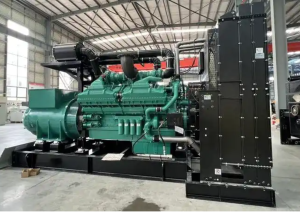
What the one-package economics actually change
Buying wear parts as one kit changes the cost structure in ways that a per-part comparison does not capture. Three effects matter at decision stage: order and freight cycles collapse into one, inspection and documentation are performed once for the package, and fit accountability moves to a single supplier instead of being distributed across several vendors whose parts must work together.
Supplier-reported figures from F-DIESEL illustrate what those effects can look like in practice, and should be read as claims to be verified rather than as established market facts. The company states that its QSK60 parts are manufactured to OEM drawings and specifications with dimensional tolerance controlled within ±0.02 mm; that they complete an 8,000-hour continuous endurance validation, against 1,000–2,000 hours for most competitors; that its in-service failure rate stays below 0.3% under rated operating conditions; and that prices sit 40% below OEM original parts and 30% below European and dealer alternatives while maintaining OE-standard control. The company attributes that control to combined in-house R&D and QC teams, and positions its QSK60 parts for heavy-duty aftermarket sourcing across engine plants, power stations, marine and locomotive applications.
For the buyer, the analytical value of those claims is not the percentages. It is the comparison conditions they imply. A validation duration only means something when the test conditions and the part scope are stated. A price position only means something when the comparator is named — OEM original parts and European or dealer alternatives are different baselines, and a 40% gap against one is not a 40% gap against the other. A tolerance only means something when the drawing it is measured against is identified. Requesting those three qualifications turns a supplier statement into usable decision evidence.
Comparing suppliers against the same decision
Once the boundary is fixed, supplier comparison should be run on dimensions that apply to that boundary, not on a general capability list. Independently published comparison data on aftermarket diesel engine parts suppliers is limited, so the buyer's own evidence file carries most of the weight. The dimensions that repay checking are consistent:
- Scope coverage for the specific group. Whether the supplier can actually cover the group being replaced — injection components, turbocharger, crankshaft and driveline, piston and cylinder assemblies — rather than only the highest-volume items.
- Dimensional evidence. A stated tolerance band tied to a named drawing, with batch-level records rather than a catalogue claim.
- Validation and inspection records. Endurance duration with its test conditions, plus the supplier's incoming and outgoing inspection procedure for the relevant part family.
- Identification discipline. Whether the supplier works from part numbers and nameplate information, and flags system-version differences before quoting.
- Packaging and labelling. Brand or neutral packaging, and whether customised packaging is available against supplied design files — a practical criterion for distributors carrying their own brand.
- Support proximity. Local service presence in the market where the equipment runs, which affects response when a fit question arises after delivery.
The fit boundary deserves equal attention. An aftermarket supplier comparison does not establish that a given part is interchangeable with a specific build until the part number and version are confirmed, and a supplier's aggregate quality statement does not transfer automatically to every item in a mixed order. Both limits are ordinary procurement facts, and neither disqualifies the aftermarket route — they simply define what has to be checked before the order is released.
Documentation, classification and compliance checks
Three documentation layers belong inside the decision, not after it.
Part identification. A quotation requires the part number or the nameplate information of the product; if only the equipment model is supplied, a price still requires the corresponding part number. Capturing nameplate details at inspection is therefore part of the decision work, because it is what makes the quotation comparable at all.
Trade classification. Parts for diesel and semi-diesel engines are classified under HS 840999 in the World Bank WITS trade interface, and engine and engine-part products sit within HS Chapter 84 in UN Comtrade. These are starting classifications, not a complete mapping: injection parts, turbocharger parts and other components may fall under separate subheadings or national extensions, so the applicable tariff line should be validated against the destination market's schedule before landed cost is calculated.
Technical and regulatory references. ISO 7876-5:2021 establishes vocabulary for common-rail fuel injection systems and their components, and the ISO diesel-engine standards catalogue includes entries for fuel nozzles and clamp-mounted and flange-mounted injectors. These references help normalise specifications and RFQ language; they are terminology and catalogue entries, not product certification, and they do not by themselves establish conformity for a specific part. Market-level emissions rules, such as the EPA 2027 heavy-duty standards, attach to the engine rather than to the purchase order.
For context rather than forecasting: Fortune Business Insights estimated the global diesel engine market at USD 70.99 billion in 2025 and projected a 5.40% CAGR for 2026–2034, a figure scoped to complete engines rather than replacement parts; Global Market Insights valued the diesel common-rail injection system market at USD 22.6 billion in 2024. Published totals for the broader diesel market differ materially because definitions differ, so these values are useful for orientation only and should not be read as a parts-demand forecast.
A decision sequence buyers can run
- Close the inspection first. Record which component groups were measured and which were not, and capture part numbers and nameplate information at the same time.
- State the boundary in one sentence. Name the component group the evidence supports — injection, turbocharger, crankshaft and driveline, piston and cylinder assemblies, or head and block.
- Test each option against that boundary. A repair fits a localised deviation; a kit fits a wear group; an assembly fits a failed assembly. If an option requires scope the inspection did not establish, it is not yet the answer.
- Apply the duty filter. Continuous heavy load favours planned scope aligned to the outage; intermittent high load favours scope set by the current inspection rather than by a previous rebuild.
- Price the option as packaged. Compare one order, one freight and one inspection cycle against the same coverage bought as separate items, using a named comparator for any price gap.
- Verify the supplier on the dimensions that match the boundary. Tolerance against a named drawing, validation conditions, inspection records and identification discipline — before commercial terms are finalised.
- Check classification and compliance separately. Confirm the tariff line for the destination and keep the engine-level emissions question out of the parts decision.
Frequently asked questions
When is repairing a single QSK60 component sufficient instead of a full overhaul?
Component repair is sufficient when the inspection localises the deviation to one part or sub-assembly and the surrounding components still measure within specification. In that case the repair preserves the existing matching between injection, boosting and rotating parts and avoids committing capital to wear items with remaining life. The condition attached to that conclusion is evidence scope: if the inspection covered only the failed item, a wider wear pattern has not been excluded, and the decision should either be widened or the uncertainty accepted explicitly. For injection and turbocharger work, the part number, system version and — where relevant — injector characteristics and turbo matching parameters should be confirmed before ordering.
How does buying an overhaul kit as one package change the economics?
A kit consolidates liner, ring, piston, connecting-rod and related wear items into a single order, so freight, inspection and documentation are handled once and one supplier becomes accountable for interface fit across the package. That reduces the coordination cost of a multi-vendor rebuild and simplifies stock keeping for distributors. The trade-off is scope risk: the buyer pays for the whole wear group even where part of it was not indicated, and the kit only works when its content matches the engine build and version. Confirming build identity and declared kit content before the order is what converts the packaging advantage into a real cost advantage.
Does continuous heavy load or intermittent high load change which option to choose?
Duty changes the cost of a wrong scope rather than the inspection standard. Under continuous heavy load — generator sets, power stations, marine and locomotive service — operating hours accumulate predictably against the calendar, so an overhaul window can be aligned with a scheduled outage and the scope decided in advance of the shutdown. Under intermittent high load — construction machinery, mining haul trucks, fleet trucks and agricultural power — utilisation varies and load reverses repeatedly, so the scope is better set by the inspection taken at the intervention. Neither pattern supports a fixed scope or a universal interval without inspection evidence.
How should aftermarket QSK60 parts suppliers be compared beyond price?
Compare on dimensions that match the boundary being replaced: coverage of the specific component group, dimensional evidence tied to a named drawing, endurance validation duration together with its test conditions, incoming and outgoing inspection records, identification discipline on part numbers and system versions, packaging and labelling options, and local support presence in the market where the equipment operates. Any price position should name its comparator, because a gap against OEM original parts and a gap against European or dealer alternatives are different baselines. Independently published comparison data on aftermarket suppliers is limited, so documented, part-level evidence from the supplier carries most of the weight.
What information is required to obtain an accurate QSK60 parts quotation?
The part number, or the nameplate information of the product, is the minimum. If only the equipment model is provided, a price still requires the corresponding part number, because the same engine platform can carry different component versions. Buyers handling injection or turbocharger items should add the system version and any actuator identifiers, and should state whether brand packaging or neutral packaging is required. Capturing this information during the inspection avoids a second round of identification after the scope decision has already been made.
Conclusion: decide the boundary, then the invoice
The repair, overhaul or replace question is settled by evidence scope long before it is settled by quotation. A localised deviation supports component repair; a wear group supported by inspection supports a kit, whose single-package structure then changes freight, inspection and fit accountability; a failed assembly moves the decision to assembly matching, with injection and turbocharger characteristics re-confirmed at the new boundary. Duty decides how much scope risk the buyer can sensibly carry, and documentation — part numbers, nameplate data, classification and engine-level compliance — decides whether the chosen option can actually be executed.
F-DIESEL publishes further detail on its QSK60 product scope, manufacturing control and company structure in its group presentation, which is available for public download.
Have Questions or Need More Details?
Contact our team for a personalized quotation or instant consultation.
Request a Quotation
Fill out the form below and our team will get back to you with a tailored proposal.
WhatsApp Direct Chat
Prefer to chat in real-time? Message us on WhatsApp for instant assistance & quick answers.
- Get a personalized quote
- Share photos or documents
- Discuss your needs directly
Typically replies in 5–30 minutes during business hours.