
QSK60 Parts for Industrial Machinery and Power-Station Retrofits
QSK60 Parts for Industrial Machinery and Power-Station Retrofits
QSK60 diesel engine parts can serve industrial machinery, power-station and genset retrofit projects when the fuel-system version, interface compatibility and catalogue scope are confirmed before sourcing. The QSK60 is a 60.2-litre V16 engine used across mining trucks, generator sets, construction machinery, marine propulsion and other heavy-duty applications. Its industrial and power-generation roles are distinct from mining and marine duty, but they share the same practical rule: the part must match the engine configuration, not just the engine family name.
For buyers in the research and evaluation stage, the useful question is not whether a QSK60 parts range exists. It is whether a specific replacement, upgrade or overhaul part will fit the unit in front of them. F-DIESEL supplies QSK60-related crankshafts, turbochargers, cylinder heads and blocks, pistons and rings, connecting rods, camshafts, injectors, injection pumps and fuel injection systems. The same range also serves truck, passenger car and general industrial aftermarket channels, so catalogue scope should be confirmed per project.

Fleet application scene: QSK60 parts support industrial machinery, power stations and genset retrofits beyond mining and marine duty.
Why retrofit decisions start with version confirmation
QSK60 retrofit projects usually begin with an operational problem: an industrial engine is due for overhaul, a power-station genset needs replacement parts, or a maintenance team wants to restore performance without changing the whole asset. The parts function in these settings is replacement, upgrade and overhaul support. They act as critical wear parts and powertrain components, so a small identification error can become a large downtime event.
The most important identification point is the fuel system. The QSK60 is available with HPI injection or MCRS common rail fuel systems. Parts for HPI and MCRS fuel systems are not interchangeable, especially injectors and fuel pumps. This is not a catalogue preference or a packaging detail. It is a configuration boundary that must be settled before a purchase order or repair plan is confirmed.
Large units also require interface checks. For large units such as the QSK60, turbo matching parameters, injector characteristics and interface compatibility must be confirmed. In practice, a buyer should provide the engine model, part number or nameplate information, and the fuel-system version. F-DIESEL's own FAQ guidance for inquiries asks for the part number or nameplate information of the product. That is the minimum evidence needed to move from a general QSK60 discussion to a reliable part match.
QSK60 platform parameters that shape parts selection
The QSK60 platform data explain why retrofit parts cannot be treated as generic heavy-duty diesel components. The engine is a four-stroke, V16, 60-degree design with two-stage turbocharging and intercooling, a 159 mm bore and a 190 mm stroke. Displacement is 60.2 litres. It uses 24V electric starting. Power ratings vary by application, which affects part selection and the evidence a buyer should request.
| QSK60 parameter | Published value or configuration | Parts-selection implication |
|---|---|---|
| Engine architecture | 4-stroke, V16, 60-degree; two-stage turbocharging and intercooling; 60.2 L; bore x stroke 159 mm x 190 mm | Confirm the exact engine variant before matching cylinder, piston, turbo and fuel-system parts. |
| Fuel system | HPI injection or MCRS common rail | Injectors, pumps and related parts are not interchangeable between HPI and MCRS. |
| Power range | Mining and construction: 2000-2700 HP (1491-2013 kW); QSK60-G generator set: approximately 1700-2000 kW at 1500 rpm; QSK60-M marine: 2000 HP at 1800 rpm | Rating and duty cycle affect the parts list and the verification questions asked of a supplier. |
| Lubrication and starting | Engine oil capacity 260-280 L, varies by configuration; SAE 0 flywheel; 24V electric starting | Overhaul scope and accessory fit should be checked against the actual configuration. |
| Dry weight | Approximately 8400-8800 kg, bare engine, excluding radiator and aftertreatment | Handling, installation and retrofit planning require more than a part-number check. |
| Emissions | Tier1, Tier2 and EU Stage IIIA ratings; Tier4 Final variant equipped with SCR | Parts replacement does not by itself change the engine's certified configuration or compliance status. |
These parameters matter to the buyer because they separate a catalogue match from an application match. A part can carry the correct QSK60 family reference and still be wrong for a specific engine if the fuel system, rating, interface or emissions configuration differs. The buyer's verification job is to close that gap before installation.
F-DIESEL's QSK60 parts range for replacement, upgrade and overhaul
F-DIESEL is an industry-trade integrated group specialising in diesel engine spare parts. Established in Shenzhen, China in 1999, the company operates with a headquarters research, development and quality-control centre, invested manufacturing bases and a strategic partner factory network. Its published profile states ISO 9001 quality management system certification, export coverage of 95 percent, and a product range that includes crankshafts, turbochargers, cylinder heads, cylinder blocks, pistons and piston rings, connecting rods, camshafts, injectors, injection pumps and fuel injection systems, plus fuel actuators, turbo electronic actuators and oil coolers.
For QSK60 applications, F-DIESEL places emphasis on the QSK60 injector and QSK60 turbocharger. The wider QSK60 parts range covers fuel injection systems, turbocharger systems, crankshafts and driveline parts, piston and cylinder assemblies, and overhaul parts for genset, marine, construction and industrial machinery applications. The company states that parts are manufactured according to OEM drawings and standards and are verified by 8,000-hour endurance testing. Its quality-control description includes 100 percent testing, a full incoming and outgoing inspection procedure, batch test reports and material test certificates on request.
The manufacturing model is also relevant to retrofit buyers. F-DIESEL states that its turbocharger plant has equity participation and an annual capacity of 200,000 turbochargers, and that its crankshaft plant produces ductile iron or forged steel crankshafts that are precision-machined and dynamically balanced. Cylinder heads and blocks are subjected to precision hydrostatic leak testing to eliminate casting porosity defects. Overhaul kits are positioned as an all-in-one package that reduces the cost of coordinating multiple suppliers. For industrial machinery and power-station projects, that packaging logic can simplify planning, but it does not remove the need to confirm the exact part scope.
The company also states that its trademark is registered in more than 70 countries and that it serves global aftermarket repair markets and light-OEM local supply projects, supporting OEM branding, mixed containers and bulk orders. Its published capacity figures include a monthly capacity of 10,000 units, a lead time of 45 days and a MOQ of 300 units. These are supplier-stated commercial parameters, not universal project terms. They are useful for early evaluation, while the final terms for a specific QSK60 retrofit should be confirmed against the project's parts list, quantity and delivery schedule.
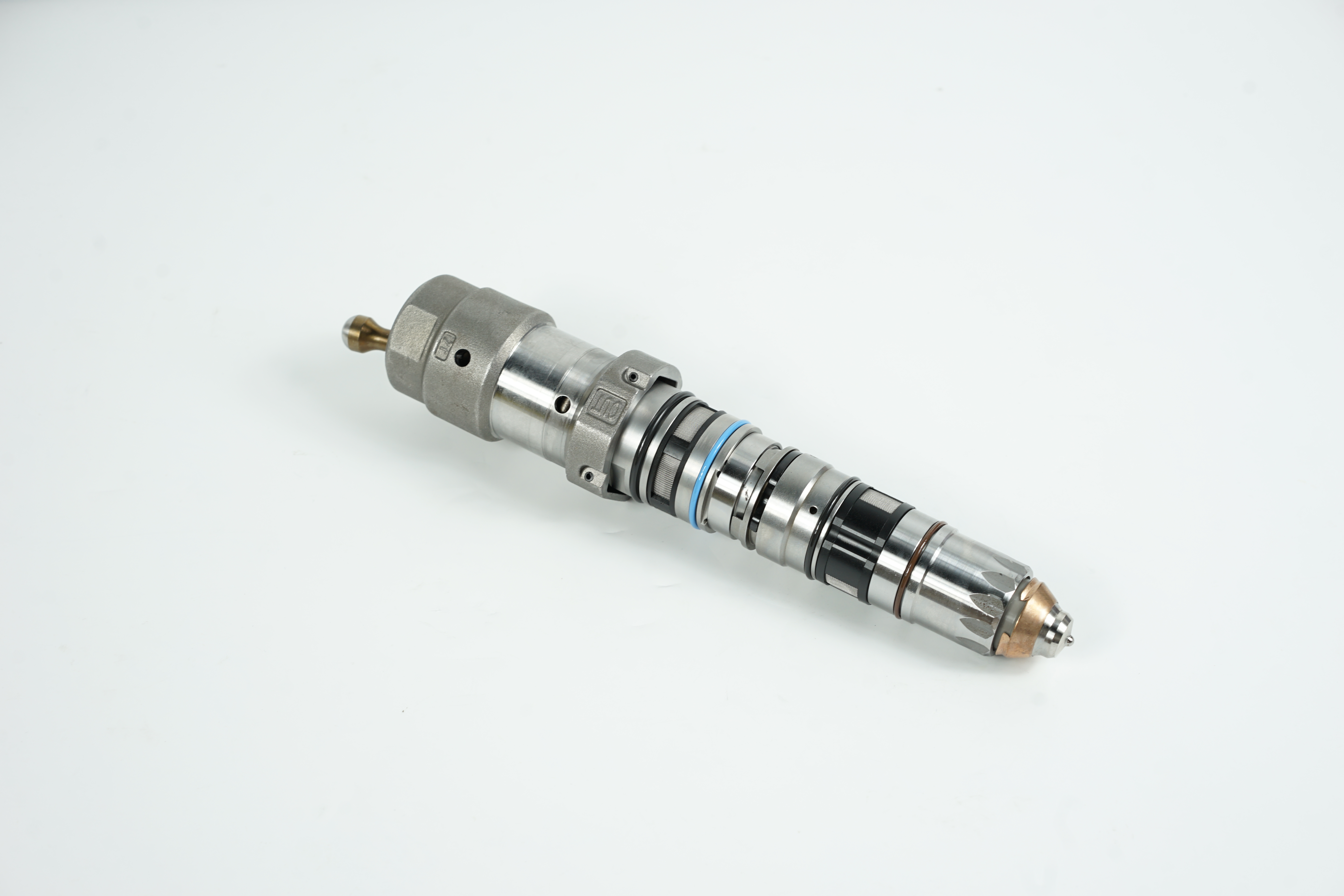
QSK60 injector: HPI and MCRS fuel-system parts are not interchangeable, especially injectors and fuel pumps.
Industrial machinery: cyclic loads and wear-part planning
In industrial machinery, QSK60 parts operate under heavy-load, continuous operation and intermittent high-load conditions. Construction equipment adds cyclic-load operation, which changes the wear pattern compared with a generator set running at a steady load. The parts function as critical wear parts and powertrain components, providing replacement, upgrade and overhaul support. A maintenance planner therefore needs to think in terms of duty cycle, inspection interval and the consequence of a failure, not only the lowest part price.
The application scenario is broad. F-DIESEL identifies QSK60 engine spare parts as covering mining trucks, generator sets, construction machinery and fleet heavy trucks, with support for agricultural vehicle power systems. Construction equipment is specifically described as a cyclic-load application. For industrial machinery buyers, this means the parts list should reflect the actual operating pattern: a machine that runs intermittently at high load may stress different components than a continuously running industrial engine.
A practical evaluation should separate wear parts from structural or driveline parts. Pistons, piston rings, cylinder liners, injectors and turbochargers are closer to the wear and performance side of the list. Crankshafts, connecting rods, camshafts, cylinder heads and cylinder blocks are more central to the rebuild and should be checked against OEM drawings, part numbers and inspection evidence. F-DIESEL states that its crankshafts are available in ductile iron or forged steel versions and are precision-machined and dynamically balanced. Its cylinder heads and blocks are hydrostatically leak tested. These are relevant verification points for an industrial overhaul, but they do not replace a project-specific fit check.
For fleet heavy trucks and agricultural vehicle power systems, the same logic applies at a smaller scale: confirm the engine variant, the fuel-system version and the intended duty before committing to a parts package. The catalogue may show a QSK60 family fit, while the actual unit may require a different injector, pump or turbo matching parameter.
Power stations and gensets: continuous duty and overhaul windows
Power-station and genset retrofits place the QSK60 in a different operating context. The QSK60-G generator set version has a primary power range of approximately 1700-2000 kW at 1500 rpm. The engine is described as suitable for continuously running gensets and industrial engines. That continuous duty makes planned overhaul windows and parts availability important, because an unplanned outage can affect power supply commitments.
F-DIESEL's QSK60 range includes diesel generator engine parts and replacement turbocharger applications for QSK60 engines, including Holset HX82, HX83 and HX84 models, in mining haul trucks and power-generator sets. The company also reports a case in China covering more than 100 units supplied for mining haul trucks and power-generator sets. In that case, the project achieved more than 15,000 hours of trouble-free operation under real mining conditions, with a designed service life of at least 15,000 working hours and a 12-month warranty period. Customer feedback cited end-user approval after more than 15,000 hours of continuous operation, with resistance to high temperature, vibration and dust, and reduced downtime losses.
That case is relevant evidence for harsh-condition operation, but it should not be read as a guarantee for every power station. The case conditions are mining-related, and power-station duty can differ in load profile, fuel quality, ambient conditions and maintenance practice. A power-station buyer should use the case as a reference point for durability discussion, then verify the specific genset rating, fuel-system version, turbo matching parameters and interface compatibility. The same caution applies to the 12-month warranty reference: it is a case-specific commercial term, not a universal promise for every order.
For overhaul planning, the most useful supplier evidence is traceability. A power-station operator should ask for the part number, drawing or specification reference, inspection record and batch test report where available. F-DIESEL states that a test report is available per batch and that a material test certificate can be provided for a specific part on request. Those documents help the buyer compare a replacement part with the engine configuration and with the maintenance history of the unit.
On-site customisation and interface confirmation
On-site customisation requests are possible for this application, according to F-DIESEL's application material. That statement should be understood as an engineering request route, not as permission to modify any QSK60 part without verification. For large units such as the QSK60, turbo matching parameters, injector characteristics and interface compatibility must be confirmed. Customisation therefore begins with data: the engine model, nameplate information, part number, fuel-system version and the interface or performance requirement that the standard part does not meet.
The same rule applies to OEM matching projects, overhaul and spare-parts supply projects, and equipment maintenance and system-matching projects. F-DIESEL states that its QSK60 parts are suitable for these project types, and that its customisation capability covers OEM, OES, aftermarket and remanufacturing work. OEM work is described as custom production to the buyer's drawings, specifications and quality standards. OES work is described as custom spare parts matching original service parts. Aftermarket work allows adjustable material, packaging and cost targets. Remanufacturing work can include core inspection, component replacement, performance testing and marking as required.
For an industrial machinery or power-station retrofit, the buyer should treat customisation as a controlled engineering change. The request should identify what must remain unchanged, such as the fuel-system interface and safety-critical dimensions, and what may be adapted, such as packaging, marking or a non-critical mounting detail. This is also where the HPI and MCRS boundary must be enforced. A custom request cannot make an HPI injector interchangeable with an MCRS injector if the engine configuration requires the other fuel system.
| Decision point | Direct OE-number replacement | On-site customisation request | Buyer check |
|---|---|---|---|
| Primary basis | Part developed against standard OE numbers and drawings | Adaptation requested for a specific application or interface | Confirm the request is within the supported product scope. |
| Fuel system | HPI or MCRS must match the engine | Cannot override the HPI and MCRS non-interchangeability rule | Provide fuel-system version and part number before discussion. |
| Turbocharger | OE direct-fit compatibility is stated for Holset HX82, HX83 and HX84 and the QSK60 series without modification | Turbo matching parameters must be confirmed for the target unit | Check rating, mounting interface and matching data. |
| Quality evidence | OEM drawings and standards; 8,000-hour endurance testing; 100 percent testing | May require additional engineering review and inspection records | Ask for the applicable test report or material certificate. |
| Best use | Standard replacement, planned overhaul and known part-number matching | Defined interface gap or project-specific requirement | Do not use customisation to bypass version identification. |
Direct-fit replacement versus modification: a practical comparison
The comparison between direct-fit replacement and modification is not a contest between two product categories. It is a choice between using a part that is already matched to the engine configuration and requesting an engineering change. F-DIESEL states that its parts are developed against standard OE numbers for direct replacement without modification, and that its replacement turbocharger is OE direct-fit compatible with Holset HX82, HX83 and HX84 and the full QSK60 engine series without modification. That is a strong fit claim for the listed applications, but it depends on the buyer confirming the part number and fuel-system version.
The limitation is equally important. A direct-fit part is only direct-fit for the configuration it was developed for. The QSK60 family includes different power ratings and two fuel-system architectures. A part that fits one rating or fuel system may not fit another. In a retrofit, the safest sequence is: identify the engine and fuel system, confirm the part number or nameplate information, check the interface and turbo matching parameters, and then decide whether a standard replacement or a custom request is appropriate. This sequence reduces the risk of buying a part that looks correct in a catalogue but fails at installation.
Modification can be useful when a genuine interface difference exists, but it should not be used to compensate for missing identification data. A buyer who does not know whether the engine is HPI or MCRS is not ready for a custom injector or pump request. The first step is configuration confirmation, not customisation.
Market signals and standards: what they mean for buyers
Macro market data provide context, not a QSK60 parts forecast. Fortune Business Insights estimated the global diesel engine market at USD 70.99 billion in 2025 and projected a 5.40 percent CAGR from 2026 to 2034 for full engines. Global Market Insights valued the global diesel common rail injection system market at USD 22.6 billion in 2024, covering common rail injectors, pumps, rails and ECUs. These figures cover different scopes and should not be combined or read as a QSK60 replacement-parts market size.
The regulatory direction is also relevant to retrofit planning. The U.S. EPA's 2027 heavy-duty engine standards include a nitrogen oxide limit of 0.035 grams per brake horsepower-hour. That standard applies to the regulated engine, not automatically to a replacement part or an aftermarket repair. A power-station or industrial machinery operator should therefore separate two questions: whether the replacement part matches the engine, and whether the engine's certified configuration and compliance status remain valid after the work. The first is a parts-fit question; the second is a regulatory and engineering question for the asset owner.
Standards vocabulary can help buyers write clearer requests. ISO 7876-5:2021 establishes a vocabulary for common rail fuel injection systems for diesel compression-ignition engines and their components. It supports terminology normalisation; it is not a product certification or a performance requirement. Trade classification is another useful but limited tool. HS 840999 is identified as parts for diesel and semi-diesel engines in the World Bank WITS interface, while UN Comtrade places engine and engine-part products within HS Chapter 84. These classifications can help structure a sourcing or customs review, but the exact national tariff line should be validated for the specific component and destination.
Catalogue scope and aftermarket channel overlap
QSK60 parts are not limited to one sales channel. F-DIESEL's QSK60-related range also serves truck, passenger car and general industrial aftermarket channels. That overlap is useful because it supports availability and mixed-order flexibility, but it creates a catalogue-scope question. A part shown under a QSK60 family reference may be intended for a particular application, rating or aftermarket channel. The buyer should confirm that the catalogue scope matches the project before assuming that a listing is a direct fit for an industrial engine or power-station genset.
This is especially important when a project mixes replacement and overhaul needs. An overhaul kit may contain multiple part groups, while a fuel-system repair may involve only injectors or a pump. The same range can support both, but the bill of materials should be checked line by line. F-DIESEL states that its product range covers multiple heavy-duty applications and that it supports full-container, mixed-LCL and private OEM branding orders. Those capabilities are relevant to distributors and project buyers, provided the part numbers and application scope are confirmed first.
For buyers comparing suppliers, a useful evidence set includes the OEM drawing or part-number reference, the fuel-system version, the applicable engine rating, the inspection or test report, and the packaging or branding requirement. A supplier that can discuss these points clearly is easier to evaluate than one that offers only a family-level QSK60 claim.
Future outlook: planned overhauls and evidence-based sourcing
Industrial machinery and power-station operators are likely to keep evaluating replacement, upgrade and overhaul options for large diesel engines because these assets support continuous or high-value operations. The market data cited above point to a large installed base and continued demand for diesel engine technology, but they do not predict how many QSK60 units will be overhauled in a given year. The more useful planning signal is the asset's own maintenance history, duty cycle and parts-consumption pattern.
A forward-looking retrofit plan should therefore combine commercial and technical evidence. On the commercial side, the buyer can review MOQ, lead time, mixed-container options and branding support. On the technical side, the buyer should confirm the fuel-system version, interface compatibility, turbo matching parameters and the applicable quality records. F-DIESEL's stated 8,000-hour endurance testing, 100 percent testing and batch test reports are relevant inputs to that review, while the final fit decision remains project-specific.
As emissions standards and maintenance expectations evolve, documentation quality is likely to become more important in supplier evaluation. A clear part-number trail and a version-first sourcing process are more useful than a broad claim of compatibility. For QSK60 industrial and power-station retrofits, the practical advantage belongs to buyers who confirm the configuration before they commit to a parts order.
QSK60 turbocharger range: matching parameters must be confirmed for large-unit retrofits.
FAQ: QSK60 parts for industrial and power-station applications
Can QSK60 parts be used in both industrial machinery and power-station gensets?
The QSK60 parts range covers generator sets, construction machinery, industrial machinery and other heavy-duty applications. For a specific unit, confirm the engine model, fuel-system version and interface requirements. F-DIESEL identifies the application scenario as common in Russia and the United Kingdom, but the part match still depends on the individual engine configuration.
How can a buyer tell whether a QSK60 uses HPI or MCRS?
The fuel-system version should be confirmed from the engine identification and part-number information before sourcing. HPI and MCRS fuel-system parts are not interchangeable, especially injectors and fuel pumps. A buyer should provide the part number or nameplate information so the fuel-system version can be checked against the required part.
What should be confirmed for a large QSK60 retrofit?
For large units such as the QSK60, interface compatibility, injector characteristics and turbo matching parameters must be confirmed. On-site customisation requests are possible, but they should be based on a defined engineering requirement rather than used to replace missing configuration data.
Does the same QSK60 parts range serve other aftermarket channels?
Yes. The same range also serves truck, passenger car and general industrial aftermarket channels. Because of that overlap, catalogue scope should be confirmed per project so that a part listed for one channel is not assumed to be a direct fit for an industrial or power-station application.
What quality evidence is available for QSK60 parts?
F-DIESEL states that parts are manufactured according to OEM drawings and standards and are verified by 8,000-hour endurance testing. Its quality-control description includes 100 percent testing, batch test reports and material test certificates on request. These records support evaluation; they do not replace the project-specific fit check.
Company resource:F-DIESEL Group Presentation 2026
Have Questions or Need More Details?
Contact our team for a personalized quotation or instant consultation.
Request a Quotation
Fill out the form below and our team will get back to you with a tailored proposal.
WhatsApp Direct Chat
Prefer to chat in real-time? Message us on WhatsApp for instant assistance & quick answers.
- Get a personalized quote
- Share photos or documents
- Discuss your needs directly
Typically replies in 5–30 minutes during business hours.