
QTZ160 (6515)-8T/10T vs QTZ315 (7527)-12T/16T: Buyer Comparison
Tower crane procurement is rarely decided by a single number on a nameplate. For construction teams weighing high-rise, infrastructure and municipal work, the practical question is which lifting envelope — rated capacity at working radius, jib length, mast height, and the configuration and support terms behind the machine — actually matches the way the project will be built. This independent buyer comparison sets two QTZ-series tower crane models side by side for that purpose: QTZ160 (6515)-8T/10T and QTZ315 (7527)-12T/16T, both supplied by Dahan Technology Co., Ltd., a construction machinery manufacturer based in China, established in 2000, specializing in tower cranes and construction hoists.
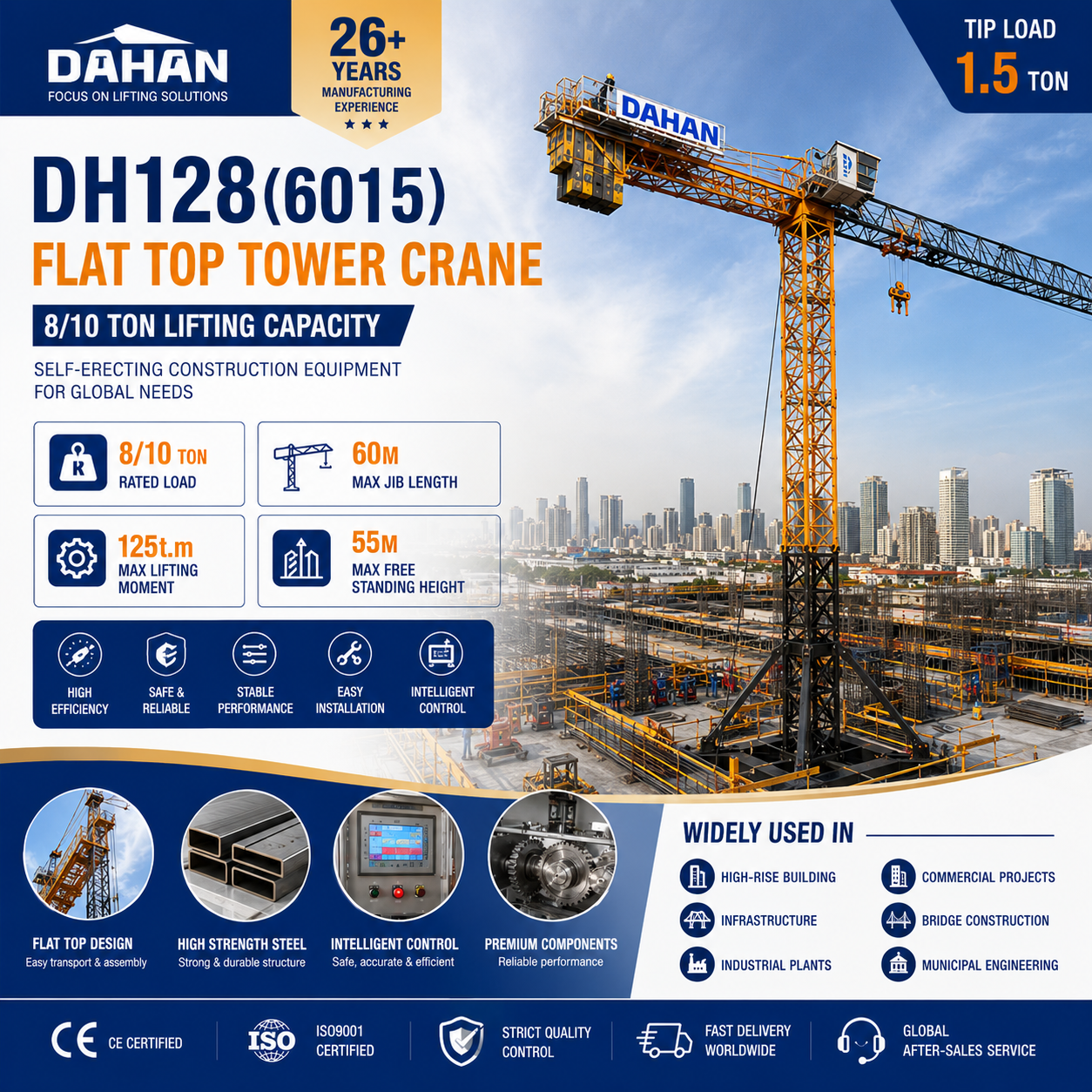
The short answer for buyers
- QTZ160 (6515)-8T/10T is configured for 8-ton and 10-ton lifting capacities, placing it in the mid-range of the manufacturer's 5-tonne to 220-tonne lifting capacity span.
- QTZ315 (7527)-12T/16T states 12-ton and 16-ton rated lifting capacities in its model designation — one capacity step above the 8T/10T machine.
- Both models sit inside a product line that covers flat top tower crane, topkit tower crane, luffing jib tower crane and derrick tower crane configurations, and both are described as high-strength steel structures with a modular design that supports assembly, dismantling, transportation and flexible height adjustment.
- Both are documented with the same functional safety package: an overload protection system, a moment limitation system, height and travel limit protection, and an emergency stop system.
- The decisive difference is not the safety architecture or the structural concept. It is the load-and-radius profile of each capacity class, together with how much of the crane can be reconfigured to fit the site.
Side-by-side view of the two models
| Comparison point | QTZ160 (6515)-8T/10T | QTZ315 (7527)-12T/16T |
|---|---|---|
| Rated lifting capacity configurations | 8 ton and 10 ton | 12 ton and 16 ton |
| Model series and classification | QTZ series construction tower crane | QTZ series construction tower crane |
| Configurations available in the product line | Flat top tower crane, topkit tower crane, luffing jib tower crane, derrick tower crane | Flat top tower crane, topkit tower crane, luffing jib tower crane, derrick tower crane |
| Primary structural material | High-strength steel | High-strength steel |
| Documented safety systems | Overload protection system, moment limitation system, height and travel limit protection, emergency stop system | Overload protection system, moment limitation system, height and travel limit protection, emergency stop system |
| Assembly and transport approach | Modular design supporting assembly, dismantling, transport and flexible height adjustment | Modular design supporting assembly, dismantling, transport and flexible height adjustment |
| Configurable items | Jib length, mast height, lifting capacity adjustment, electrical system options | Jib length, mast height, lifting capacity adjustment, electrical system options |
| Intended industries | Building construction, real-estate engineering, infrastructure projects, municipal engineering | Building construction, real-estate engineering, infrastructure projects, municipal engineering |
| Capacity class positioning | A 10-tonne configuration in the manufacturer's range is positioned for mid-rise construction projects | Heavier lifting band; the model designation states 12 t and 16 t rated capacities |
| International supply | Supplied to international markets with technical support, spare parts supply and installation guidance | Supplied to international markets with technical support, spare parts supply and installation guidance |
Reading the table alone is not enough to shortlist a crane. Capacity figures in a model name describe the top of a lifting envelope; the usable figure for a project depends on where the heaviest load sits on the jib.
What the model designation tells you — and what it does not
The QTZ prefix identifies these machines as part of the Chinese QTZ series of top-slewing tower cranes, and the capacity suffix states what the model is configured for: 8 ton and 10 ton for QTZ160 (6515)-8T/10T, and 12 ton and 16 ton for QTZ315 (7527)-12T/16T. What the model name does not state is how much can be lifted at the radius a given site actually uses, or how the crane will be installed, climbed and dismantled around the building.
Selection should be based on the building height, the maximum lifting weight, the maximum working radius, the lifting height, the construction site conditions and the specific lifting conditions of the job. For high-rise and super-high-rise projects, the attachment scheme, the free height, the standard section configuration and the foundation conditions also have to be assessed. Treating the number in the model name as the specification — rather than verifying the lifting moment curve and the rated capacity at each working radius — is one of the most common and most expensive shortlisting errors in tower crane procurement.
Both models share the same design language: a modular structure for assembly, dismantling and transport; flexible height adjustment; and configuration choices covering jib length, mast height, lifting capacity adjustment and electrical system options. Neither model is a stripped-down alternative to the other. They are two positions on the same capacity ladder.
Rated capacity versus lifting moment: the caveat that reshapes shortlists
The maximum lifting capacity indicates the maximum load a tower crane can lift, while the lifting moment reflects its comprehensive lifting capability at different working spans, usually expressed in tonne-metres. As the working span increases, the load a crane can lift typically decreases. The 12-tonne or 16-tonne figure on a nameplate therefore applies to a defined radius, not to the full length of the jib, and the same logic applies to the 8-tonne and 10-tonne figures on the QTZ160 (6515)-8T/10T.
Applied to a real shortlist, this changes the comparison:
- If the heaviest routine lift is at or below 10 tonnes and the working radii are moderate, the QTZ160 (6515)-8T/10T class is likely to cover the cycle. Within the manufacturer's range, a 10-tonne lifting capacity configuration is positioned for mid-rise construction projects.
- If the heaviest lifts are precast elements, steel sections or plant items above 10 tonnes, or if those loads sit far out on the jib, the QTZ315 (7527)-12T/16T class becomes the relevant starting point.
- If the project also includes one-off heavy lifts, both cranes should be checked against the lifting moment curve rather than against the maximum capacity figure.
Because the whole product range spans 5 ton, 6 ton, 8 ton, 10 ton, 12 ton, 16 ton, 18 ton, 25 ton, 32 ton, 45 ton, 64 ton, 125 ton, 200 ton and 220 ton configurations, a contractor can stay with one supplier as project types shift — from medium and small-sized machines for building work to 200-ton heavy-duty configurations positioned for heavy-duty infrastructure projects.
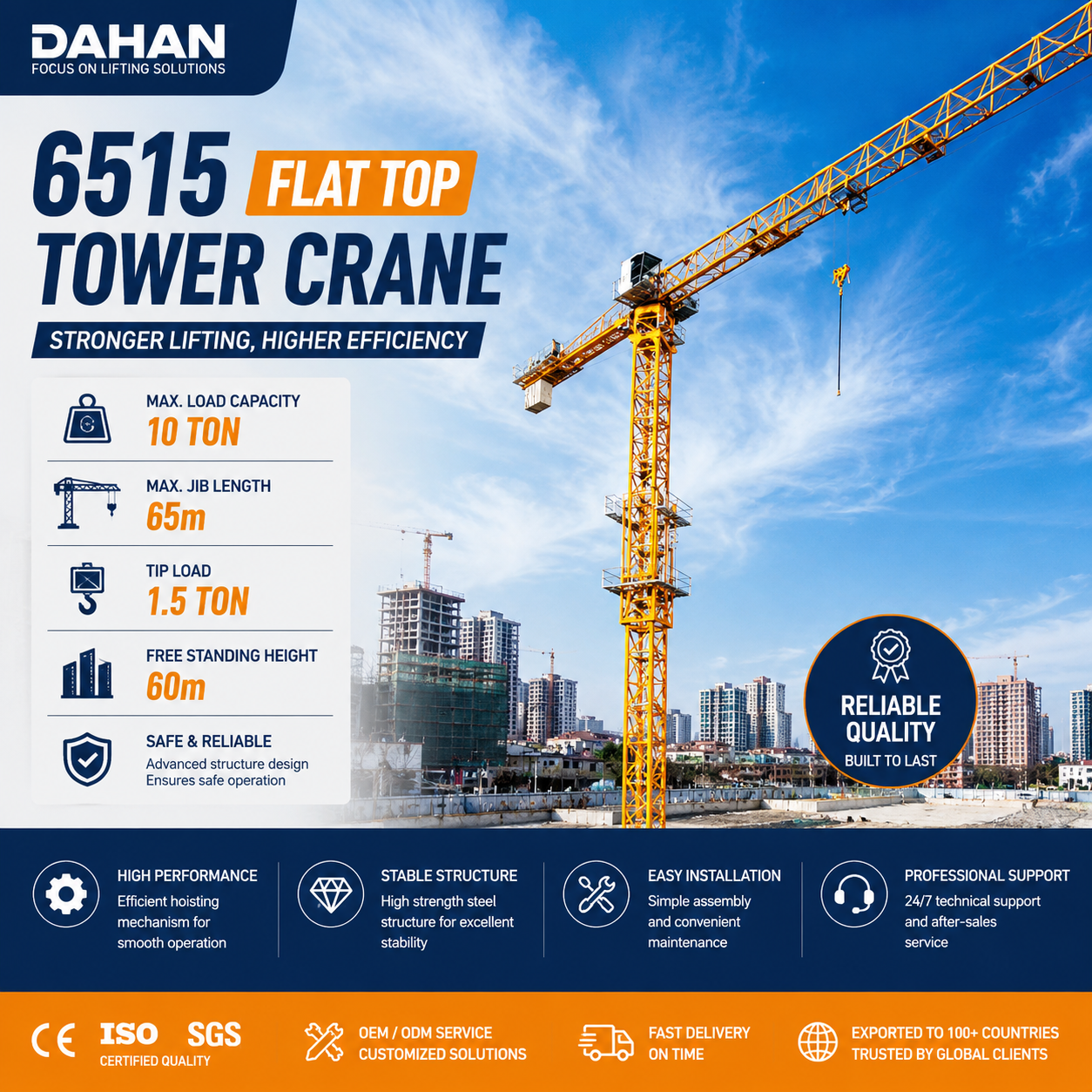
Modular assembly, dismantling and height adjustment
Both models are documented with a modular design that supports faster assembly and dismantling, convenient transportation and flexible height adjustment, with the stated intent of reducing installation time and supporting project efficiency. For contractors working in dense urban sites or confined spaces, that matters twice: once at erection, and again at dismantling when the crane has to come out of a finished structure.
Typical operating modes for this class of machine include fixed installation and climbing (mast-adding) for long-term operation, with some models supporting luffing jib or special jib operations. Standard sections of the product are compatible with Potain as stated in manufacturer documentation — a practical consideration for rental fleets and contractors already operating mixed equipment, because it reduces the friction of introducing another crane into an existing fleet. Materials are described as suitable for low temperatures and extreme conditions, with the loading scheme and panel scheme designed to support transportation and export.
Safety systems: the shared baseline on both models
Alongside the drivetrain and structure, tower crane safety comes down to the protective functions that stop a machine before it exceeds its design envelope. On both QTZ160 (6515)-8T/10T and QTZ315 (7527)-12T/16T, the documented package includes an overload protection system, a moment limitation system, height and travel limit protection, and an emergency stop system, on a high-strength steel structure.
Because the two machines share this architecture, safety is not the deciding variable between them — it is a common baseline that still has to be verified model by model. Buyers should confirm the safety devices listed in the technical documentation, check that the lifting moment protection matches the configured jib length, and confirm that limit settings are established during installation rather than assumed from a catalogue. In China, the design rules and safety specifications for tower cranes are defined by GB/T 13752-2017, which superseded the 1992 version of the standard. At manufacturer level, the company holds CE certificate, EAC certificate, SGS certificate and ISO 9001 certificate.
Where each capacity class fits: high-rise, infrastructure and municipal work
Both models are intended for building construction, real-estate engineering, infrastructure projects and municipal engineering, with typical application scenarios covering high-rise building construction, infrastructure projects, industrial construction and urban development. Working conditions include dense urban sites, confined spaces, high-elevation operations and heavy-duty conditions, and some models are designed for high wind loads and tall building construction.
The configuration choice inside the product line shapes site fit as much as the capacity class does:
- Flat top / topless configuration — suited to dense urban airspace and sites where crane-to-crane oversailing has to be managed.
- Luffing jib configuration — available within the product line for high-rise building projects and tight plots.
- Derrick configuration — available within the product line for building dismantling applications.
- Topkit and top-slewing configurations — used for conventional building and municipal work where the working radius and hook height are the primary constraints.
Beyond buildings, the same manufacturer provides solutions for wind power, thermal power, road and bridge construction, ports and nuclear power projects, with wind power hoisting addressed through comprehensive solutions based on height, maximum lifting capacity and applicable scenarios.
Buying internationally: supply, spares and installation support
For overseas buyers, the machine is only half of the purchase. The other half is whether the supplier can keep it working in a market where the buyer has no local depot.
Tower cranes from this product range are supplied to international markets with technical support for overseas customers, spare parts supply and installation guidance. The manufacturer works with distributors in more than 60 countries and regions, and lists Asia, Europe, the Middle East, Africa, North America and South America as major markets. Production is described as being carried out with automated production facilities and welding processes, supported by an R&D team of 100 engineers, and the company reports an annual production capacity of more than 10,000 tower crane units and serves as a national standard revision unit in the tower crane industry in China.
For a buyer comparing an 8T/10T and a 12T/16T machine, the practical questions to put to a supplier are straightforward: which components are typically held as spare parts for this model, what installation guidance is provided and in what format, and who is accountable if a limit device needs recalibration after the crane is erected on site.
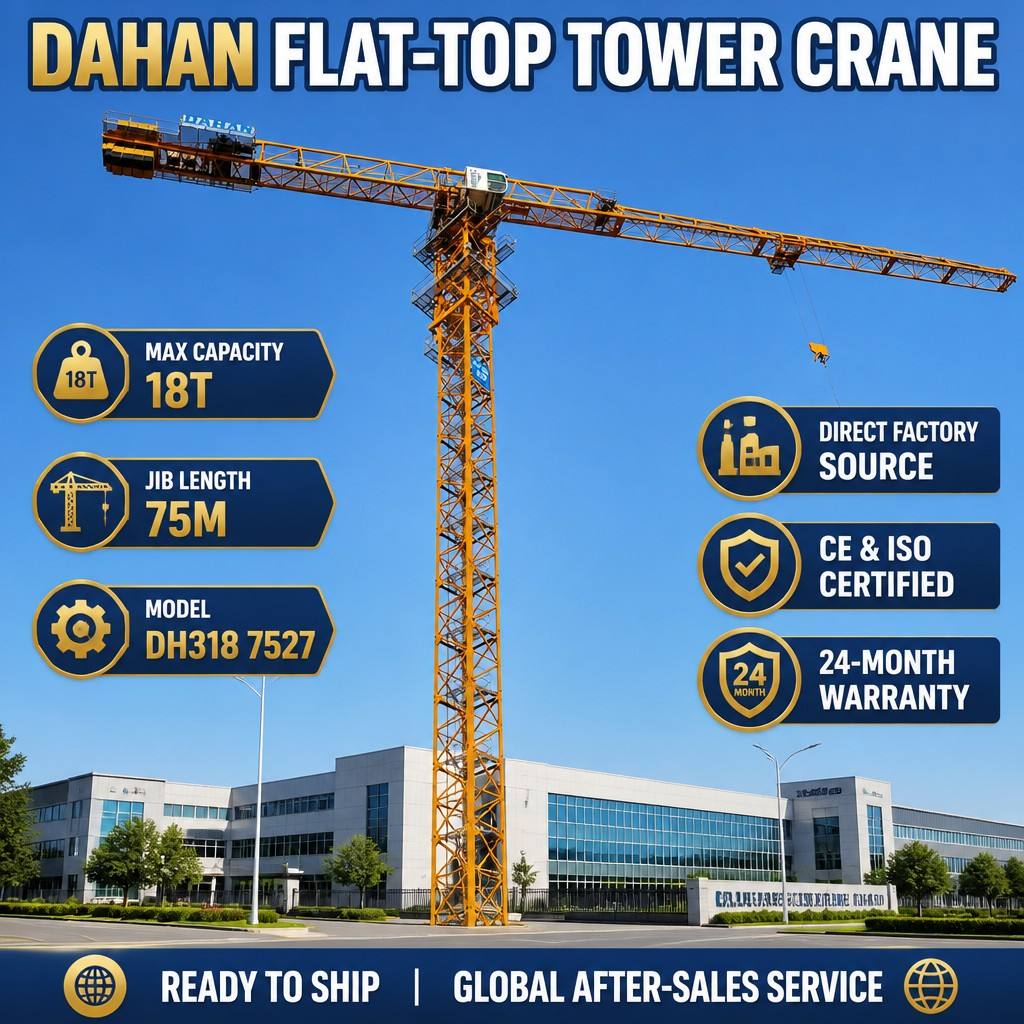
Market signals behind the comparison
Tower crane demand continues to track urbanization and high-rise construction. The global tower crane market was estimated at between USD 5.9 billion and USD 6.44 billion in 2025 across published market studies, and China was the leading exporter of tower cranes in 2024, accounting for USD 694 million in export value according to UN Comtrade data compiled by OEC. For international buyers, that export base is the reason a Chinese-built QTZ machine now appears on shortlists alongside established European and Japanese brands.
Two product-type signals are relevant to how these cranes are configured. Flat-top (topless) designs accounted for 46.37% of tower crane revenue in 2025 according to Mordor Intelligence, reflecting their efficiency in dense urban airspace, while hammerhead machines still held the largest share by product type at 42.8% in 2025 according to Grand View Research — a reminder that different crane architectures coexist because different sites demand different things. In the heavy end of the market, wind power specialized tower cranes with 200+ ton capacity are projected to grow at 8–10% CAGR through 2032 according to Future Market Insights, which is why manufacturers with capacity ranges extending to 200-ton and 220-ton configurations keep that capability in the portfolio even when most sales sit in lighter classes.
Limits and trade-offs to accept before ordering
A comparison that only lists strengths is not a procurement tool. The following boundaries apply to both models and should be written into the evaluation.
- Capacity falls as radius grows. Neither model should be shortlisted on nameplate capacity. The rated capacity at the radius where the heaviest lift occurs is the only figure that decides fit.
- Over-specification has a cost. An unnecessary excessive working span can push equipment specification and cost upward. Choosing a 12T/16T machine for a project whose heaviest routine lift is well under 10 tonnes is not automatically the safer commercial decision.
- Configuration is not off-the-shelf. Jib length, counterweight and erection schemes can be customized for site constraints, but the specifics require sales and engineering confirmation. That step has to sit inside the procurement timeline, not after the order.
- Certificates apply per market. The manufacturer holds CE, EAC, SGS and ISO 9001 certificates, but buyers should confirm which documents cover the specific model and configuration being purchased for their destination market.
- Documented facts, not measured job-site results. This comparison relies on documented model and product-line information and on procurement logic. It does not include third-party comparative performance testing of the two models on the same site, so project-specific data should be validated against technical documentation and site conditions before a purchase decision.
What to watch next
Three developments are likely to shape how buyers compare 8T/10T and 12T/16T classes over the next few years. First, as urban sites become tighter, flat top and luffing jib configurations will continue to take share from machines that need more airspace. Second, heavier lifting demand from wind power and large infrastructure is expanding the upper end of product ranges, which in turn improves the component supply and service infrastructure that lighter models depend on. Third, documentation quality — lifting moment curves, safety device specifications, certificate scope and spare parts commitments — is becoming as important as capacity in supplier evaluation, because those are the elements that determine whether a crane stays productive over a multi-year build.
For construction teams weighing these two models, the useful conclusion is not that one is better than the other. QTZ160 (6515)-8T/10T is the machine to examine when the lifting plan sits in the 8-ton and 10-ton band with moderate radii; QTZ315 (7527)-12T/16T becomes relevant when the load schedule, the jib position or the structure itself pushes beyond it. Both share the same modular logic, the same documented safety functions and the same route to configuration and export support — which means the decision rests on the lifting plan in front of you.
A company brochure covering the manufacturer's tower crane and construction hoist range is available for reference at Dahan Technology company brochure.
FAQ
How should a construction team decide between an 8-ton/10-ton class crane and a 12-ton/16-ton class crane?
The model should be determined from the building height, the maximum lifting weight, the maximum working radius, the lifting height, the construction site conditions and the specific lifting conditions of the project. The key parameters are maximum lifting capacity, maximum working radius, rated lifting moment, lifting height, lifting speed and working grade. For high-rise and super-high-rise projects, the attachment scheme, free height, standard section configuration and foundation conditions should also be assessed. The selection should follow technical calculation, not the maximum lifting capacity alone.
Why do rated lifting capacity and lifting moment both need to be checked?
Maximum lifting capacity indicates the maximum load the crane can lift, while lifting moment reflects comprehensive lifting capability at different working spans, usually expressed in tonne-metres. As working span increases, the load a tower crane can lift typically decreases. A shortlist built only on the capacity figure in the model name — 8 ton and 10 ton for QTZ160 (6515)-8T/10T, 12 ton and 16 ton for QTZ315 (7527)-12T/16T — can therefore misjudge what either machine can lift at the radius the site actually needs.
What safety systems are documented on these tower cranes?
The documented package on both models includes an overload protection system, a moment limitation system, height and travel limit protection, and an emergency stop system, supported by a reliable structural design in high-strength steel. For the Chinese market, design rules and safety specifications for tower cranes are defined by GB/T 13752-2017, which superseded the 1992 version of the standard. At company level, the manufacturer holds a CE certificate, an EAC certificate, an SGS certificate and an ISO 9001 certificate.
Which parts of a tower crane can be configured, and what has to be confirmed by engineering?
Configuration options documented across the range cover jib length customization, mast height configuration, lifting capacity adjustment and electrical system options. Jib length, counterweight and erection schemes can be customized for site constraints. Because these choices interact with the lifting moment curve, the foundation and the erection method, the specifics require sales and engineering confirmation rather than being selected from a catalogue.
What support is available for overseas buyers of these models?
Tower cranes from this product range are supplied to international markets with technical support for overseas customers, spare parts supply and installation guidance. The manufacturer works with distributors in more than 60 countries and regions and lists Asia, Europe, the Middle East, Africa, North America and South America as major markets. Production is described as using automated production facilities and welding processes, and the company reports an annual production capacity of more than 10,000 tower crane units.
Which industries and working conditions are these tower cranes intended for?
Both models are intended for the building construction industry, the infrastructure project industry, real-estate engineering and municipal engineering, with typical scenarios including high-rise building construction, infrastructure projects, industrial construction and urban development. Working conditions include dense urban sites, confined spaces, high-elevation operations and heavy-duty conditions, with some models designed for high wind loads and tall building construction. Typical operating modes include fixed installation and climbing (mast-adding) for long-term operation.
Do the two models differ in design concept, or only in capacity?
They share the same design concept: a modular structure supporting assembly, dismantling, transport and flexible height adjustment, the same documented safety functions, and the same configuration fields for jib length, mast height, lifting capacity and electrical system options. The difference lies in the capacity class stated in the model designation — 8 ton and 10 ton for QTZ160 (6515)-8T/10T, 12 ton and 16 ton for QTZ315 (7527)-12T/16T — and in how each class maps to the load-and-radius requirements of a specific lifting plan.
Have Questions or Need More Details?
Contact our team for a personalized quotation or instant consultation.
Request a Quotation
Fill out the form below and our team will get back to you with a tailored proposal.
WhatsApp Direct Chat
Prefer to chat in real-time? Message us on WhatsApp for instant assistance & quick answers.
- Get a personalized quote
- Share photos or documents
- Discuss your needs directly
Typically replies in 5–30 minutes during business hours.