
QTZ160 vs QTZ315: How Capacity Class Changes Site Fit
QTZ160 vs QTZ315: How Capacity Class Changes Site Fit
Buyers who reach the decision stage between the QTZ160 (6515)-8T/10T and the QTZ315 (7527)-12T/16T are not comparing two versions of one crane. They are comparing two capacity classes, and the larger class changes the lifting envelope, the foundation and attachment plan, the transport and erection package, the electrical supply requirements and the acceptance checks that follow handover.
The practical answer is not simply to take the larger crane. The QTZ160-8T/10T configuration is the correct purchase when the heaviest routine pick, at the radius where it must actually be landed, sits inside that model's load chart, and when the final hook height is reachable within its documented free-standing and attached configuration. The QTZ315-12T/16T class becomes the realistic option when the pick weight at radius, the coverage radius, or the height and attachment combination pushes beyond what the smaller class documents. That judgement belongs on the load chart and datasheet for the exact configuration offered, not on the model number and not on maximum capacity alone.
The short answer: which class fits which project
The two configurations separate along three variables — load at radius, coverage, and height with attachment. Everything else in the comparison, from foundation design to transport volume, follows from those three.
- Stay with the QTZ160-8T/10T class where the work is residential, commercial or industrial building construction, the heaviest recurring load is comfortably inside the 8 t or 10 t configuration at the working radius, and the final height keeps the attachment scheme straightforward.
- Step to the QTZ315-12T/16T class where the design includes heavy precast or steel members, where one crane position must cover a larger footprint, or where the final height requires an attachment and mast configuration the smaller class cannot document.
- Do not decide either way until the offer states jib length, free-standing height, attachment spacing, electrical specification and the load chart for the exact configuration. A quotation that omits those items cannot be compared.
Cost follows those variables rather than the badge on the mast. Tower crane purchase cost is affected by model, lifting capacity, load moment, working radius, lifting height, basic configuration, electrical system and control system, so a single price ratio cannot be applied across configurations or brands.
Reading the two designations without over-reading them
In the QTZ naming convention used across Chinese tower crane ranges, the number after QTZ expresses the rated load-moment class, and the bracketed four-digit code conventionally pairs nominal jib length with a tip-load class. On that reading, QTZ160 (6515)-8T/10T sits in the 160 tonne-metre class with a nominal 65 m jib and a 1.5 t tip-load class, offered in 8 t or 10 t maximum-capacity configurations. QTZ315 (7527)-12T/16T sits in the 315 tonne-metre class with a nominal 75 m jib and a 2.7 t tip-load class, offered in 12 t or 16 t configurations.
Two cautions matter more than the code itself. First, a designation is not a datasheet: the code describes a family, while the load chart for the specific jib length, mast configuration and counterweight determines what may be lifted at each radius. Second, a code is not a compliance statement — it does not by itself establish conformity with the rules of the destination market, and market approval should be treated as a separate documentary check.
| Decision variable | QTZ160 (6515)-8T/10T | QTZ315 (7527)-12T/16T | Where the buyer verifies it |
|---|---|---|---|
| Designated load-moment class | 160 tonne-metre class | 315 tonne-metre class | Datasheet load chart, radius by radius |
| Maximum-capacity configurations offered | 8 t or 10 t | 12 t or 16 t | Configuration list in the offer |
| Nominal jib and tip-load class | 65 m / 1.5 t class | 75 m / 2.7 t class | Load chart at the actual working radius |
| Free-standing height and attachment scheme | Configuration-specific | Configuration-specific | Foundation and attachment drawings |
| Electrical system and control | Customised per project | Customised per project | Single-line diagram, motor and drive schedule |
| Transport and erection package | Configuration-specific | Configuration-specific | Packing list with piece weights, erection plan |
Lifting capacity is a radius question, not a tonnage question
Maximum lifting capacity is the number buyers quote to each other, but the working radius is what decides the purchase. Maximum capacity is normally rated at a short radius close to the mast, and the permissible load falls as the trolley moves outward. Rated load moment, expressed in tonne-metres, describes that combined behaviour across the jib — which is why two cranes with similar maximum capacity can behave very differently at 40 m or 50 m.
The working method should be completed and documented before offers are compared:
- List the heaviest recurring loads, not the single heaviest lift, including the weight of rigging.
- Record the radius from the mast centre to the landing point, not to the building edge.
- Read the load chart for the offered jib length and configuration at that radius, keeping the margin required by the project's lifting plan.
- Repeat the check at the maximum radius the site requires, because the tip-load class usually eliminates a smaller crane before maximum capacity does.
A conditional example makes the mechanism concrete: if a 9 t precast unit must be set at 40 m, the 8 t configuration is not eligible regardless of its maximum rating, and even a 10 t configuration has to be read from the chart at that radius rather than assumed. This is the point at which the step from the QTZ160 class to the QTZ315 class is usually decided, and it is also the point at which buyers discover that the cheaper quotation does not cover the lift.
Jib length and site coverage
The bracketed codes point to the second decision: coverage. A nominal 75 m jib covers a larger footprint from one position than a nominal 65 m jib, but the load available near the tip falls as the jib lengthens, so the longer jib is not a free upgrade. Working span should be set from the area that must actually be covered — building footprint, material storage, transport route and lifting position — while avoiding unnecessary span, which raises equipment specification and cost without adding usable capacity.
Coverage also has a physical side that the load chart does not show. A longer jib sweeps a larger circle, so the slew envelope against neighbouring structures, towers, power lines and site boundaries has to be checked before the class is fixed. Where the site cannot accept the larger envelope, the answer may be a different jib configuration or a different crane type rather than a higher capacity class — and that decision belongs to the site plan, not to the quotation.
Mast height, free-standing height and the attachment scheme
Height is the third variable, and it is the one most often under-specified. For high-rise work, the attachment scheme, free-standing height, standard section configuration and foundation conditions must be examined alongside capacity. A crane that lifts the load at ground level may still fail the project at final height if its attachment plan and mast configuration were never engineered for that height.
Two installation modes are relevant to the comparison: fixed installation, and climbing with mast sections added for long-term operation. Each changes the acceptance sequence. A climbing scheme requires the attachment and mast configuration to be re-verified as the crane rises, not only at initial commissioning, and the height limiter must be reset at each stage.
Vertical and travel limits belong in this section for the same reason. The hoist height limiter and the trolley travel limit should be set for the actual scheme — final hook height, attachment positions and any restricted zones — rather than left at a factory default. Buyers should require those settings to be recorded in the commissioning report, because they are the difference between a limit that protects and a limit that merely exists.
Electrical system and control customization
Two offers for the same capacity class can carry very different electrical packages, and the difference shows up in price, in site preparation and in operating behaviour. Because purchase cost is affected by the electrical system and control system among other items, the electrical specification should be itemised rather than folded into a single figure.
Customization here is practical rather than cosmetic. A manufacturer can equip matching drive and control systems for different models and project requirements, and variable-frequency control with reasonable power matching is one route to smoother motion and better operating efficiency. Whether that route earns its cost depends on the site and the duty cycle.
- Site supply: voltage, frequency and available transformer capacity should be confirmed before the drive arrangement is fixed, because the electrical package has to match what the site can deliver.
- Drive arrangement: conventional or variable-frequency hoisting, slewing and trolley drives; the choice affects starting behaviour, control feel and the spare-parts list.
- Documentation: single-line diagrams, motor and drive schedules and a spare-parts list belong in the delivery package, not in a later request.
- Site environment: ambient temperature, dust and humidity belong in the specification conversation, since they influence enclosure and component selection.
The buyer's test is simple. If two quotations for an apparently identical QTZ315-12T/16T configuration differ substantially, place the electrical schedules side by side before concluding that one is cheaper for the same scope.
Modular assembly, dismantling and transport
A tower crane arrives as a transport package: mast sections, jib sections, counterweight, mechanisms and electrical cabinets. How those pieces are arranged matters as much as their combined weight, particularly for export projects and confined urban sites. Dahan Technology's company description highlights a loading scheme designed for transport and a panel scheme intended to be more conducive to transportation and export — a reminder that packing layout is a specification item, not a logistics afterthought.
Items to fix in the offer:
- piece weights and dimensions from the packing list, checked against the site's unloading and assembly crane capacity;
- the number of mast sections and counterweight blocks implied by the final height and attachment scheme;
- the erection and dismantling plan for a confined site, including where the assembly crane can stand and how the jib is assembled at height;
- the container or truck loading plan for export, since jib and mast section lengths drive freight cost.
Stepping up a class usually increases the transport and erection burden, but the size of that increase is configuration-specific. It should be read from the packing list for the offered crane rather than inferred from the model number, and the dismantling sequence deserves the same attention as erection on sites where the crane must come down before the project ends.
Safety systems that must be re-verified after a capacity step
Five systems decide whether the capacity on paper is available on site: overload limiting, moment limiting, height limiting, travel limiting and emergency stop. Each has a distinct job, and each is configuration-dependent.
- Overload limiter: prevents lifting beyond the rated capacity for the current configuration; its rated values must correspond to the load chart of the crane as erected.
- Moment limiter: protects against excessive load multiplied by radius. It is the system that actually enforces the load chart as the trolley moves outward, so it must be calibrated for the jib length, counterweight and mast configuration in use.
- Height limiter: stops hoisting at the configured maximum hook height, which changes with each climb and each attachment stage.
- Travel limit: restricts trolley travel and, where fitted, crane travel along the track, protecting the jib envelope and preventing movement beyond the designed zone.
- Emergency stop: cuts motion in an unsafe condition; it must be reachable from the operating position, tested and recorded at commissioning.
A limiter that is physically present but parameterised for a different jib length, counterweight or mast configuration is not protection. When a buyer moves from the QTZ160-8T/10T class to the QTZ315-12T/16T class, limiter settings, rated values and test records change with the configuration, and that change should appear in the acceptance documents rather than be assumed. In China, GB/T 13752-2017 sets out design rules and safety specifications for tower cranes; buyers in other markets should confirm the applicable regime for the destination separately instead of assuming one standard covers every jurisdiction.
Purchasing terms and acceptance checkpoints
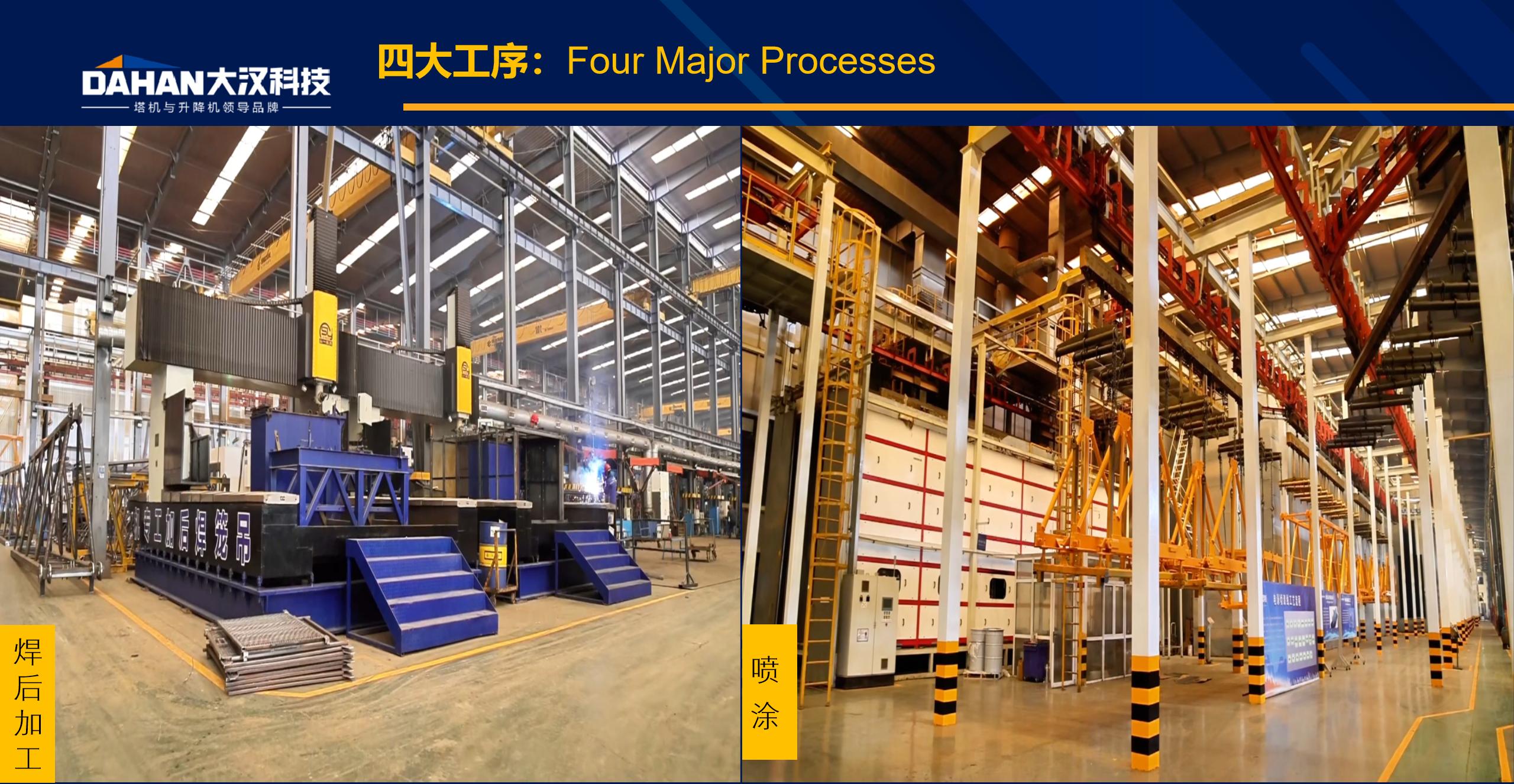
Purchasing terms turn a comparison into a verifiable order. The manufacturer-side items worth evaluating are production capacity, research and development capability, quality management, product technical parameters, key components, factory inspection, technical documents, installation guidance and after-sales service capability. For overseas projects, the same list extends to whether the manufacturer can supply technical and certification material that meets the destination country's requirements.
Terms that should be explicit in the contract for either class:
- exact model, jib length, maximum-capacity configuration and mast or attachment scheme;
- scope of supply, including counterweight, electrical cabinets, cables and any climbing equipment;
- documentation set: load chart, operating manual, parts list, electrical schematics and factory inspection record;
- installation guidance, commissioning support and the spare-parts list;
- the electrical specification agreed for the site supply.
Acceptance then checks the delivered crane against those terms:
- configuration audit — mast sections, jib sections and counterweight counted against the contract;
- limiter verification — overload, moment, height and travel settings tested and recorded for the erected configuration;
- emergency stop and brake checks on each motion;
- re-verification after every climb or attachment change, not only at first commissioning;
- document handover, including the load chart kept in the cab or site office.
For a capacity step-up, three additional checks carry the most weight: the foundation or ballast installed against the drawings, the attachment scheme installed as engineered for the final height, and the moment limiter calibrated for the configuration actually erected.
Where the two classes sit in the wider QTZ range
The QTZ160-8T/10T and QTZ315-12T/16T sit inside a much wider ladder. Dahan Technology's range covers 5, 6, 8, 10, 12, 16, 18, 25, 32, 45, 60, 125, 160, 200 and 220 tonne classes, which means a buyer who outgrows the 16 t class is not forced to change supplier category. It also means the 8–16 t band still has to be selected on the load chart rather than by default, because the next class up is available and tempting.
The upper end of that ladder is being pulled by energy work. One commercial forecast projects wind-power specialist cranes above 200 t growing at 8–10% CAGR through 2032, a forecast with stated assumptions rather than an observed outcome. It does not change the building-site logic of the 8–16 t classes, but it explains why manufacturers keep both a volume band and a heavy-lift band inside one model family.
How Dahan Technology Co., Ltd. fits the comparison
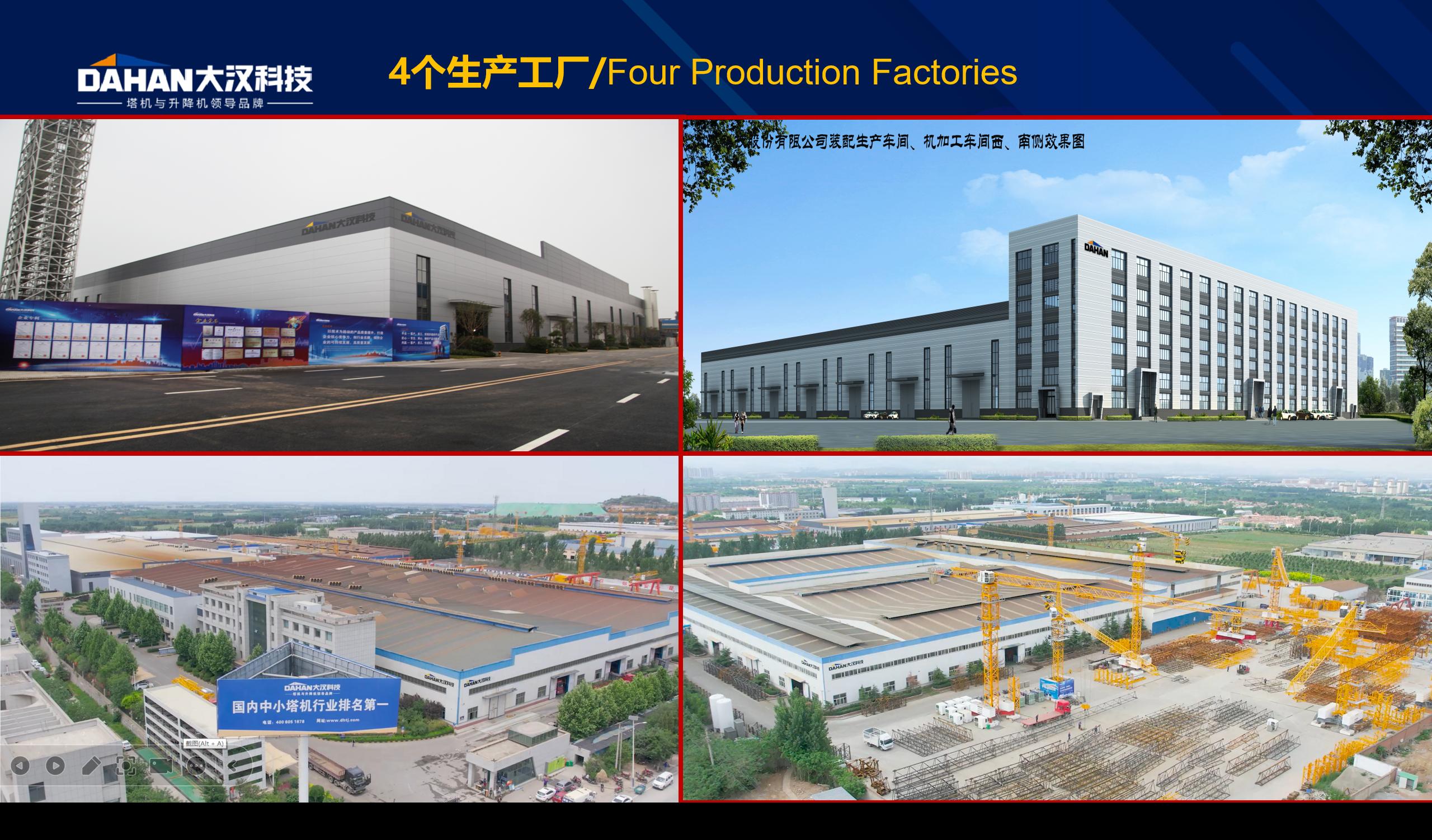
Dahan Technology Co., Ltd. is a Chinese manufacturer of tower cranes and construction hoists, established in 2000, with a 330,000 m² production site and more than 1,000 employees, including a 100-engineer development team. The company is a national standard revision unit in the tower crane industry and exports to Asia, Europe, the Middle East, Africa, North America and South America, with distributors in more than 60 countries and regions.
For a buyer comparing capacity classes, the relevant capability is configuration support rather than a single catalogue number. Dahan Technology offers customised model selection and configuration based on lifting load, working radius, lifting height, site conditions and project budget, and can equip matching drive and control systems for different models and project requirements. Support beyond delivery covers technical support, installation guidance, spare-parts supply and project-oriented after-sales service.
The fit boundary is the same one that applies to the class comparison itself. The larger class is not automatically the better purchase: where the load chart of the QTZ160-8T/10T configuration covers every scheduled pick, the extra capacity of the QTZ315-12T/16T class is paid for in foundation design, transport volume, assembly effort and electrical supply. Buyers whose projects change shape frequently, or who need one crane across several sites, may weigh configuration flexibility against that fixed burden differently from buyers running a single long high-rise programme.
Company information and the current model range are published at Dahan Technology Co., Ltd.. Documentation should be checked for the exact model, configuration and destination market before an order is placed; a company-level certificate list does not by itself confirm that a specific configuration meets a specific market's requirements.
FAQ: comparing the two capacity classes
Is the QTZ315-12T/16T always the stronger choice over the QTZ160-8T/10T?
No. The larger class is the stronger choice only when the project needs it: when the heaviest pick at the working radius exceeds the smaller load chart, when the required coverage radius is beyond the smaller jib, or when the final height demands an attachment and mast configuration outside the smaller class. If the QTZ160-8T/10T load chart covers every scheduled lift, the additional capacity brings extra foundation, transport, assembly and electrical burden without a matching benefit.
What do the numbers in QTZ160 (6515) and QTZ315 (7527) mean?
Under the QTZ convention, the number following QTZ expresses the rated load-moment class — 160 and 315 tonne-metres — while the bracketed four digits pair nominal jib length with a tip-load class, conventionally 65 m and 1.5 t for the 6515 and 75 m and 2.7 t for the 7527. The suffix states the maximum-capacity configurations, 8 t or 10 t and 12 t or 16 t. The code identifies a family; the datasheet and load chart for the exact configuration remain the controlling documents.
How should lifting capacity at the working radius be confirmed?
List the heaviest recurring loads with rigging, record the radius from the mast centre to the landing point, and read the load chart for the offered jib length, counterweight and mast configuration at that radius. Maximum lifting capacity alone is not sufficient, because permissible load falls as radius increases and the tip-load class often eliminates a smaller model first. Repeat the check at the maximum radius the site requires.
What electrical details should be fixed in the purchase contract?
At minimum: site voltage and frequency, available supply capacity, whether hoisting, slewing and trolley drives are conventional or variable-frequency, the control arrangement, the cable and cabinet scope, the schematic and spare-parts documentation, and the ambient conditions the equipment must tolerate. Purchase cost is affected by the electrical and control system, so an itemised schedule is what makes two quotations comparable.
Which acceptance checks matter most when moving to a larger capacity class?
Four carry the most weight: the foundation or ballast installed against the drawings; the attachment scheme installed as engineered for the final height; the overload and moment limiters calibrated and tested for the erected jib length, counterweight and mast configuration; and the height, travel and emergency stop functions tested and recorded. The same checks should be repeated after each climb rather than performed once at first commissioning.
Reference document: the Dahan Technology company brochure (PDF) covers the model range and configuration options.
Have Questions or Need More Details?
Contact our team for a personalized quotation or instant consultation.
Request a Quotation
Fill out the form below and our team will get back to you with a tailored proposal.
WhatsApp Direct Chat
Prefer to chat in real-time? Message us on WhatsApp for instant assistance & quick answers.
- Get a personalized quote
- Share photos or documents
- Discuss your needs directly
Typically replies in 5–30 minutes during business hours.