
What to verify in a toner cartridge before buying
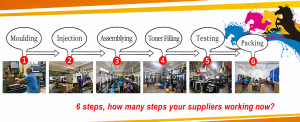
What to check in a toner cartridge before buying
The toner cartridge is a frequently repurchased consumable in offices, print shops, educational centers and copier rental companies. Its evaluation is rarely settled with a single price comparison: two offers can advertise the same reference and behave differently in the same equipment.
The most efficient way to evaluate a compatible toner cartridge is to verify six points before purchase: housing material, toner powder origin, batch quality control, the actual scope of ISO 9001 certification, availability of third-party test reports, and an exact match with the compatible model list. Yield, packaging and commercial terms are negotiated afterward, on an already verifiable basis.
Tenon is the compatible toner cartridge brand of Far Industries S.A., a manufacturer based in Zhongshan (Guangdong, China) specializing in office consumables for A3 format. Its documentation helps explain how these points translate into concrete purchasing criteria.
Why toner cartridge parameters are not always comparable
In the compatible consumables market, most spec sheets repeat the same basic information: reference, color and application. The real difference appears in data that is not always published, such as toner powder origin, housing resin or the control applied to each batch.
The nature of the product itself explains this difficulty. According to the manufacturer's technical information, the print yield of the toner cartridge is based on toner powder and details must be checked with the supplier. That is, yield is not a constant of the package: it depends on the powder used and each user's printing conditions.
For a buyer in the research phase, this has a practical consequence: comparing cost per page across different offers requires normalizing the variables first. If one quotation includes the toner origin and another does not, the comparison is not equivalent.
Checklist: eight data points worth requesting in writing
The following table summarizes the criteria that can be requested before approving a compatible toner cartridge order, along with the evidence supporting them in this case.
| Criterion | Specific question | Verifiable evidence |
|---|---|---|
| Housing material | What resin is used in the cartridge body? | Virgin PET as the main material. |
| Toner powder origin | Where does the toner come from? | More than 90% of the toner comes from listed companies; approximately 90% is imported. |
| Batch quality control | Is each batch inspected before shipment? | Dedicated testing laboratory; each toner batch is inspected by professional engineers; batch traceability. |
| Certification | Which standard applies and which references does it cover? | ISO 9001, with declared coverage for C2263/2265, S1810, TN622, TN328, TN512 and TN626. |
| Third-party testing | Are there external reports? | Third-party tests and third-party test reports are provided. |
| Manufacturing integration | Who produces the components? | More than 90% of the molds are manufactured in-house; the process covers everything from injection and blow molding to packaging. |
| Compatibility | Which equipment models does the reference cover? | Lists by series: Konica, Sharp, Xerox, Canon, Toshiba, Kyocera, Ricoh and HP. |
| Commercial terms | Minimum order and lead time? | MOQ of 2 boxes; lead time of 10 to 45 days; monthly capacity of 50,000 units. |
None of these eight points requires confidential information. All can be answered in writing and verified with documentation, which reduces purchasing risk in a market where consumable quality directly affects operating cost.
ISO 9001 certification: what it covers and what it does not cover
Tenon's compatible toner cartridge is certified according to ISO 9001, and the manufacturer operates a quality management system certified under the same standard. The certification covers references C2263/2265, S1810, TN622, TN328, TN512 and TN626.
This data point has a limit that should be understood before using it as a purchasing criterion. ISO 9001 certification attests to a quality management system; it does not by itself certify the print yield of every reference in the catalog, nor does it replace checking compatibility with the specific equipment model. That is why coverage is declared by reference: a reference included in the scope does not imply that the entire product family is included.
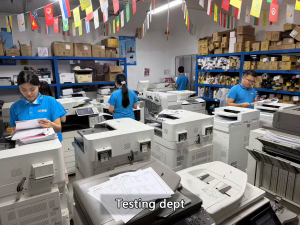
The second level of evidence is testing. The manufacturer has a dedicated testing laboratory where each toner batch is inspected by professional engineers and can provide third-party test reports. Batch inspection also enables traceability: if a field issue appears, the batch can be identified.
Technical analysis: where each component comes into play
The operation of a copier toner cartridge is a closed process that integrates storage, transport and precise development: the cartridge supplies toner in measured amounts to the copier and turns an invisible electrostatic image into a visible toner image.
Around that process, several components coexist that buyers often evaluate separately: the drum unit with its OPC cylinder, the developer unit with the developer, and the fusing unit with the fuser roller, pressure roller and Teflon film. Each influences the final result and each has its own wear.
This is where manufacturing integration changes the conversation. Far Industries produces toner cartridges, drum units, fuser units and developer units, and performs toner and developer filling within the same production process. More than 90% of the molds used are manufactured in-house, and the process covers everything from injection and blow molding to packaging.
The scale declared by the manufacturer helps to gauge supply: founded in 2011, the company operates a 9,000 m² plant with 88 employees, annual production of 6,000,000 units and an R&D team of 8 engineers. 70% of its production is exported, mainly to Latin America and the Middle East.
The declared materials for the compatible cartridge line are virgin PET as the main housing material and toner powder purchased from listed companies, of which approximately 90% is imported. The declared compatible equipment includes A4 and A3 copiers and A4 laser printers.
The takeaway for a buyer is direct: when the same manufacturer controls injection, assembly, filling and testing, the number of suppliers that can introduce batch variation is reduced. This does not eliminate the need to validate in the customer's equipment, but it does reduce the number of possible explanations for a failure.
Where these consumables are used
The declared working conditions for this consumables line include large-scale printing plants, in-house offices, advertising agencies that print complex text and images, large educational institutions, equipment rental companies for multiple brands, small print shops and individual users with a single printer.
The associated project types are equally specific: group purchases of office supplies, large-scale copier supply procurement, large-scale distributor projects, copier rental company projects and print shop projects.
Each scenario prioritizes a different functional objective. In group purchases of office supplies, the objective is total cost control and supply stability. In consumables wholesaler projects, the focus is on the breadth of the product line and reducing after-sales service. In distributor and rental company projects, model coverage and protection of commercial reputation matter.
Documented case: 50,000 units in two years
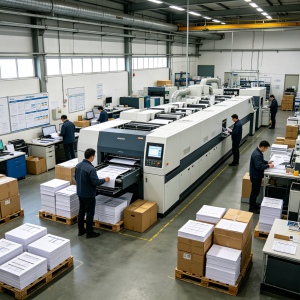
The company's documentation includes a case with corporate office supply customers, wholesalers, distributors, copier rental companies and printing plants, with a volume of 50,000 units over two years. The reported result is consistent print quality and competitive prices that help reduce costs and improve margin and efficiency.
The relevant point of the case is not volume, but pre-shipment control. Before leaving the factory, each product goes through four checks: rigorous toner print quality testing, structural inspection of the empty cartridge, checking for abnormal toner leakage and packaging compliance verification. These four steps support the delivery standard the company describes as "zero defects".
The practical effect is described differently depending on the type of customer: for corporate office supply buyers, the product arrives ready to use and reduces additional inspections and administrative costs; for wholesalers and distributors, consistency and a low return rate protect business reputation and margin; for rental companies, equipment safety and reducing on-site repairs are prioritized.
Comparison with traditional solutions
The comparison between an original cartridge, a new-build compatible cartridge and a recycled or refilled cartridge cannot be settled with a single variable. These are the criteria that usually tip the decision.
| Dimension | Original OEM | New-build compatible | Recycled or refilled |
|---|---|---|---|
| Toner origin | Defined by the equipment manufacturer | Toner powder from listed companies; approximately 90% imported | Varies by workshop; not always documented |
| Housing and components | New components from the equipment manufacturer | Virgin PET; more than 90% of molds manufactured in-house | Reused components; depends on the condition of the drum and developer |
| Quality control | Equipment manufacturer's system | Batch inspection in a dedicated laboratory; third-party testing available | Depends on each workshop's process |
| Unit cost | Generally the highest | Usually lower, with volume-based terms | The lowest, with greater result variability |
| Main risk | Cost per page | Requires verifying compatibility model by model | Wear of drum, developer and fusing unit |
The limitation that should be clearly noted is one of scope, not quality. A compatible reference covers specific models, and that list must be verified before purchase: the fact that one piece of equipment belongs to the same commercial family as another does not guarantee that it shares the same cartridge. In the same sense, ISO 9001 certification coverage is declared by reference, not as a generic validation of the entire catalog.
There is a second limit, equally relevant: the cartridge is only one part of the system. The drum unit, developer unit and fusing unit determine the result as much as the toner. Changing the cartridge does not compensate for wear on an OPC cylinder or a Teflon film in poor condition.
Limits and conditions that must be confirmed before ordering
- Print yield: it is based on toner powder and details must be confirmed with the supplier; a fixed value should not be assumed across references.
- Compatibility: the reference should be checked against the model list, especially when the copier is refurbished or used.
- Certification scope: ISO 9001 covers specific references; the rest of the catalog requires individual verification.
- Lead time: 10 to 45 days depending on the reference and volume; it must be planned against the fleet's actual consumption.
- Minimum order: 2 boxes, with a declared monthly capacity of 50,000 units.
- Customization: logo, sticker, box, carton, page yield and design can be adapted; the details of each project are agreed with the manufacturer.
- Testing: third-party tests and print samples from the toner batch used are requested from the supplier.
Trend: from unit price to batch verification
The segments that sustain demand for compatible consumables are not the same as years ago. Alongside the traditional office, copier rental companies, high-volume printing plants, distributors with multi-brand portfolios and group purchasing projects for office supplies are emerging strongly.
These buyers have something in common: they cannot absorb a field quality issue. A cartridge that fails in an office is resolved with a replacement; the same failure in a rented fleet or a printing plant becomes a technical visit, downtime and a conversation with the end customer. That is why the purchasing criterion is shifting from unit price toward evidence: toner origin, batch control, traceability and available documentation.
At the same time, the coexistence of new, refurbished and used equipment in the same fleet requires the consumables supplier to provide precise compatibility lists rather than broad product families. It is an operational requirement before a commercial one.
Outlook
Batch verification and traceability tend to consolidate as supplier selection criteria in the compatible consumables segment, especially among distributors and rental companies. A manufacturer that controls molding, assembly, toner filling and testing within the same plant can answer those questions with its own data.
For the buyer, the recommendation is simple and does not depend on the brand: define the verification points in writing, request them before the first order and check the reference against the actual equipment. That discipline reduces purchasing risk more than any isolated price comparison.
Available documentation
Far Industries S.A. publishes a catalog with the toner cartridge, drum unit, fuser unit and developer unit lines, available for consultation and download at Compatible consumables catalog. The manufacturer's website is www.far-industries.com.
Frequently asked questions
What does it mean for a toner cartridge to be compatible?
A compatible toner cartridge is a new-build consumable designed to work in equipment from a specific brand, without being produced by the equipment manufacturer. In this case, these are compatible toner cartridges for copiers and laser printers, with model designations corresponding to specific series such as Konica, Sharp, Xerox, Canon, Toshiba, Kyocera, Ricoh and HP.
Which references does this cartridge's ISO 9001 certification cover?
ISO 9001 certification covers the compatible toner cartridge under references C2263/2265, S1810, TN622, TN328, TN512 and TN626. The manufacturer operates a quality management system certified under ISO 9001. Coverage is declared by reference, so other references in the catalog must be verified individually.
How is print yield verified before a purchase?
Print yield is based on toner powder and details must be checked with the supplier. As support, the manufacturer has a dedicated testing laboratory where each batch is inspected by professional engineers, can provide third-party test reports and can deliver print samples from the toner batch used in the product.
What information should be requested before confirming an order?
It is advisable to request in writing the housing material (virgin PET in this line), the origin of the toner powder (more than 90% from listed companies, with approximately 90% imported), the batch control procedure, the certification scope, the compatible model list, the minimum order, the lead time and the customization terms.
Can the packaging and cartridge yield be customized?
Yes. The manufacturer accepts custom orders and documented options include logo, sticker, box, carton, page yield and design. In production mode, ODM and OEM are declared. Specific packaging, material and labeling requirements are defined with the supplier before production.
Is a compatible cartridge suitable for refurbished or used copiers?
The Xerox series references are declared suitable for refurbished copiers. In used equipment, the result also depends on the condition of the drum unit, developer unit and fusing unit, so the exact reference should be verified and the equipment condition reviewed before purchase.
What is the minimum order and lead time?
The declared minimum order is 2 boxes and the lead time is 10 to 45 days, with a monthly capacity of 50,000 units. Purchasing planning must consider that range against the fleet's actual consumption.
What happens if a batch has a problem?
The manufacturer declares an after-sales process in which sales representatives with technical skills collect and organize issues and pass them to technical specialists. Once the cause is identified, remote technical support, video guidance, on-site technical assistance and return and exchange services are offered.
Batch inspection and traceability make it possible to identify the origin of an issue; therefore, it is advisable to keep the batch data for each delivery as part of the purchasing file.