
Qualification Checklist for Importers: H5000 and P02 Scent Diffuser Factory Specs
Qualification Checklist for Importers: H5000 and P02 Scent Diffuser Factory Specs
An importer buying commercial scent diffusers in volume is qualifying two things at once: a hardware specification already promised to a hotel, mall or facilities client, and a documentation set that a customs broker and a compliance team will inspect months later. The H5000 and the P02 from Shenzhen Scentsea Technology Co., Ltd make a practical reference pair because they sit at opposite ends of the commercial range — a 1000 ml floor-standing unit rated for 800–1300 m² and a 300 ml wall-mounted unit rated for 150–350 m² — while sitting inside the same published compliance file. What follows turns their factory specifications into a five-block qualification checklist that can be attached directly to a quotation request or a purchase order.
Every figure below is the manufacturer's published parameter, with its unit and, where stated, its tolerance. Where a number has been calculated for planning purposes, it is labelled as calculated rather than measured.
Why the qualification step now sits ahead of the price negotiation
Market forecasts explain the commercial attention, but they do not make a buying decision. One industry research estimate places the global scent marketing market at approximately USD 4.1 billion in 2026 (Cognitive Market Research, published August 2026), while a separate forecast projects USD 7.28 billion by 2035 at a 6.6% CAGR (Vertex AI Search Grounding / industry data, April 2026). A second forecast circulating in the same period puts growth at 10.16%, but for a narrower definition of scenting — a methodology difference rather than a contradiction to be resolved by choosing the higher number. For an importer, the practical reading is narrower: scenting budgets are expected to keep expanding across North America, Europe, Asia Pacific and the Gulf, which steadily increases the number of project specifications arriving with a coverage, noise and voltage requirement already attached.
The behavioural argument is weaker than the procurement argument. One secondary compilation reports that scent marketing in retail environments can increase customer dwell time by an average of 15 minutes; that is indirect commercial research, useful as context in a client conversation and not a claim an importer should repeat as a promise. What protects the importer is documentation — the ability to show which model was specified, which compliance record covers it, and what the factory will do if a batch fails acceptance.
Three items move from the brochure to the contract. First, the fit promise: a wall unit rated for 150–350 m² has little margin for error in a 300 m² boutique, and a floor-standing unit in a double-height lobby needs the volume figure, not just the floor area. Second, the service obligation the importer takes on at resale, which depends on spare-part support and stated warranty terms. Third, the customs file — classification, duty and the paperwork that has to match the model actually shipped. Each is checkable before the order and expensive to correct afterwards.
H5000 and P02: the documented specifications side by side
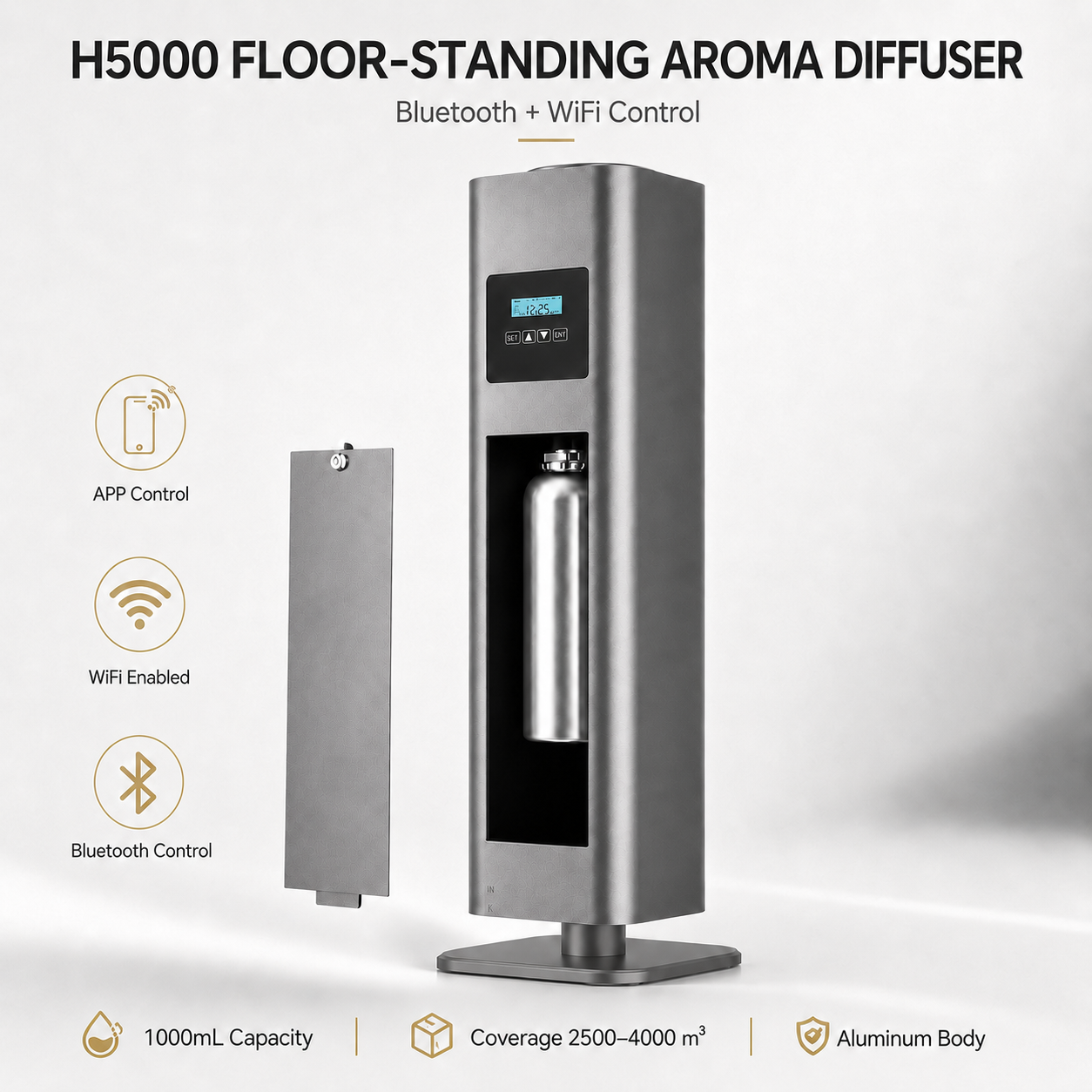
Both models are DC 12V plug-in units, which matters for any importer selling into markets with more than one socket standard. Beyond that shared line, they differ in body material, capacity, output and control configuration, and the published sheet states each figure separately.
| Parameter | H5000 | P02 |
|---|---|---|
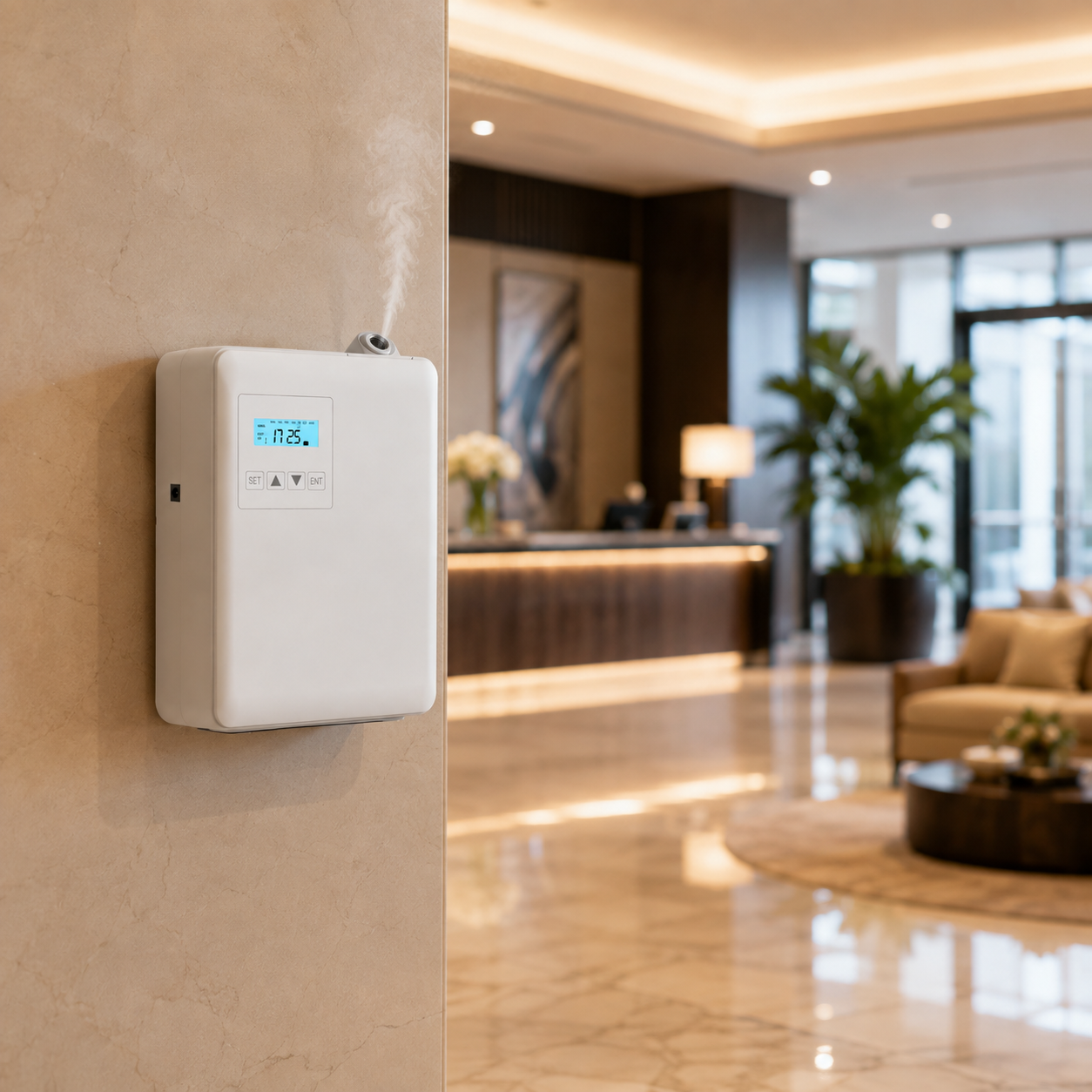
| Product type | Floor-standing scent diffuser | Wall-mounted electric scent diffuser |
| Body material | Aluminium | Plastic |
| Colour | Gunmetal | White or black (customised) |
| Oil capacity | 1000 ml | 300 ml |
| Rated coverage | 800–1300 m² / 2500–4000 m³ / 8600–14000 ft² | 150–350 m² / 500–1000 m³ / 1500–3500 ft² |
| Power supply | DC 12V, plug-in | DC 12V, plug-in |
| Rated power | 20 W | 6.5 W |
| Noise | <45 dB | <30 dB |
| Oil consumption | 5.4 ±10% ml/h | 2.5 ±10% ml/h |
| Net / gross weight | 6.4 kg / 7.1 kg | 0.8 kg / 1 kg |
| Product dimensions | L180 × W180 × H610 mm | L148 × W68 × H203.5 mm |
| Packing dimensions | L190 × W190 × H700 mm | L276 × W176 × H98 mm |
| Control | Smart APP control for working schedules and fragrance intensity; optional smart connectivity | Bluetooth APP control for schedules and intensity; optional Wi-Fi + Bluetooth version with automatic reconnection after power or network interruption |
| HVAC integration | Not listed in the published H5000 specification; the ducted model in the same range is the AC-MAX | Optional connector and tube for HVAC integration |
| Spaces named by the manufacturer | Hotel lobbies, shopping malls, showrooms, reception halls, large public areas | Retail stores, corridors, cinemas, offices, showrooms, commercial washrooms |
Coverage is published in three units — square metres, cubic metres and square feet — because floor area alone misleads in atria, double-height lobbies and partitioned retail floors. The H5000 carries 800–1300 m², 2500–4000 m³ or 8600–14000 ft²; the P02 carries 150–350 m², 500–1000 m³ or 1500–3500 ft². An importer quoting a project should state which of the three figures the client's brief used, because a 1300 m² floor with a 6 m ceiling is not the same installation as a 1300 m² floor at 3 m.
Checklist 1 — Model identity, configuration and document matching
The first block is the cheapest to complete and the most common source of disputes: confirming that the model name, the configuration and the supporting documents describe the same unit.
- Use the exact designation. The published model designations are H5000 and P02. A specification annex should not blend parameters from adjacent models in the same catalogue, and a purchase order should not accept a substitute line without a written deviation.
- Name the control configuration. The P02 is documented in a Bluetooth APP version and in an optional Wi-Fi + Bluetooth version with automatic reconnection after power or network interruption. Two units carrying the same model name but different control configurations behave differently in the field, and the after-sales scope follows the configuration. Put the configuration on the order line, not only in an email.
- Tie the compliance file to the production unit. The published certification records are scoped to scent diffusers and list both models among the related products. Ask the supplier to confirm in writing that the certificate numbers and test reports supplied apply to the exact model and configuration being shipped.
- Attach packing data to the annex. Carton dimensions and gross weight belong in the same document as the technical parameters, because freight, warehousing and last-mile handling are costed from them.
Checklist 2 — Rated parameters and how they behave in a real room
Rated values are the starting point for acceptance criteria, not the finish line. Four parameters deserve a written interpretation before the order.
Coverage should be derated to the space, not to the number.Scentsea's own published selection guidance is to consider room size, ceiling height, ventilation, airflow and partitions rather than relying only on a maximum rated coverage figure. That is the correct instruction for an importer: the 800–1300 m² band for the H5000 and the 150–350 m² band for the P02 describe a range, and the correct target is the lower end where airflow is strong or the space is divided.
Noise is a ceiling figure, not a measurement in the client's room. The H5000 is published at <45 dB and the P02 at <30 dB. For a lobby, an open-plan office or a hotel corridor at night, the gap between those two numbers is the difference between a specification the client accepts and one they query. Noise also varies by output setting, so the acceptance criterion should name the setting at which the figure is expected to hold.
Power and plug type are part of the product. Both models are DC 12V plug-in units, rated at 20 W for the H5000 and 6.5 W for the P02. The low wattage matters for sites where scenting is added to an existing circuit rather than given a dedicated one, and the plug type is a customisation item that should be fixed at order stage rather than resolved at destination.
Weight and footprint decide installation. The H5000 is 6.4 kg net and 7.1 kg gross, standing 610 mm tall on a 180 × 180 mm base; the P02 is 0.8 kg net against 1 kg gross, in a 148 × 68 × 203.5 mm wall housing. The first needs floor area and a nearby socket; the second needs a suitable wall surface and a cable route. Both requirements belong in the site survey, not in the installation week.
Checklist 3 — Compliance files tied to the destination market
An importer's compliance question is not "is the factory certified" but "which document covers this model, in this market, at this configuration". Scentsea's published records for scent diffusers list three documents, all issued on 24 April 2024 by Shenzhen ATL Testing Technology Co., Ltd.:
- FCC — certificate ATL20240416326, under FCC Part 15 Subpart B:2023, for the US market.
- RoHS — certificate ATL20240416327, under RoHS Directive (EU) 2015/863, for the EU market.
- EMC — certificate ATL20240416325, under EN IEC 55014-1:2021, EN IEC 55014-2:2021, EN IEC 61000-3-2:2019/A1:2021 and EN 61000-3-3:2013/A2:2021, for the EU market.
All three records carry the scope "scent diffuser" and list the H5000 and P02 among the related products. That is a useful starting point, and it is still a document set rather than an automatic clearance. Four verification steps close the gap: check that the certificate number, the issuing laboratory and the standard version are the ones your market authority expects; check the model list against the exact production configuration; keep the test report rather than only the certificate image, because a distributor's customer may ask for the underlying report; and re-check the file at each order cycle rather than at the first order only.
Models with wireless functions sit in a separate category. The P02's optional Wi-Fi + Bluetooth version and the H5000's optional smart connectivity mean the importer should confirm whether additional radio-equipment approval is required in the destination market before committing to that configuration.
Classification belongs in the same block. One trade record lists commercial scent diffusers under HS code 8509.80 (electromechanical domestic appliances) with a 4.2% US import duty for 2026, as published by Dutiable citing USITC data. That figure is a planning input, not a legal determination: classification is a customs decision, and duty rates change. Importers should confirm the code and the current rate with their broker, and should make sure the commercial invoice description matches the model actually shipped.
Checklist 4 — Factory batch control and acceptance testing
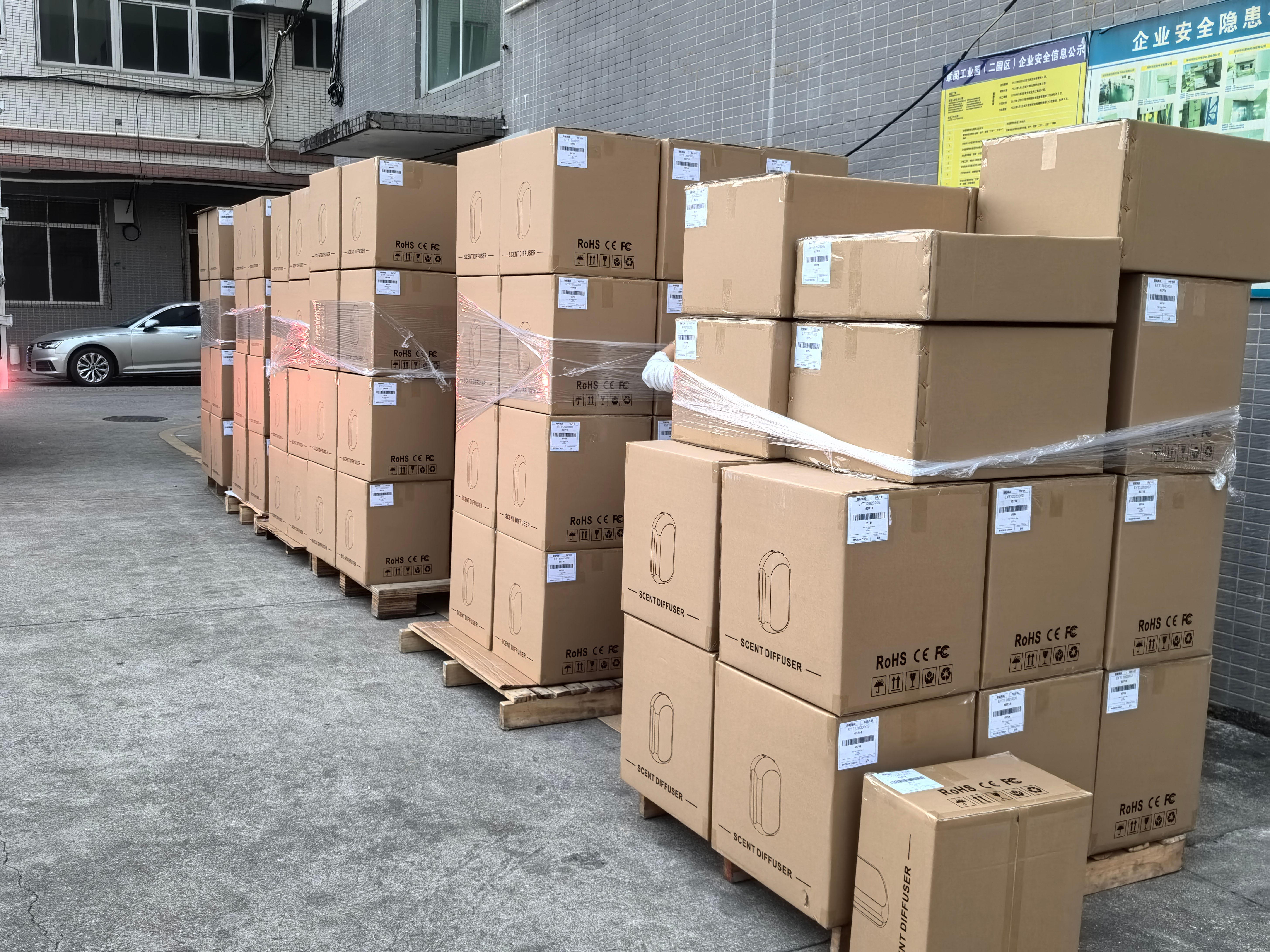
Capacity and quality control are the two factory facts an importer can actually check. Shenzhen Scentsea Technology Co., Ltd was founded in 2021 and operates a 3,000 m² facility in Shenzhen with three production lines, approximately 30 staff, four R&D engineers and 20 patents, at an annual output of 100,000 units and a monthly capacity of 8,000 units. Roughly 70% of output is exported, with the EU and USA as the main markets, and products have been supplied to customers in more than 70 countries and regions.
The published inspection sequence before shipment is specific enough to write into an acceptance clause: 100% functional testing, atomisation testing, leakage inspection, noise testing, APP and control testing, a 48-hour aging test, and a final appearance inspection. Each of those checks maps to a failure mode an importer would otherwise absorb in the field — no atomisation, weak output, oil leakage, abnormal noise, or a control function that does not reconnect.
Three clauses are worth adding on the buyer's side. First, sample approval: diffuser samples and fragrance oil samples are available, and a signed golden sample should be retained as the reference for the batch. Second, the spare-parts position: the published after-sales term is a one-year free warranty on spare parts, which should be restated with the specific parts list and the dispatch route for replacements. Third, the timing assumption: the published lead time is 25–35 days, and an importer should confirm it in writing against the specific model, configuration and quantity rather than against the general catalogue.
An existing programme illustrates what this looks like in practice. A US scent marketing company purchased 30 units across Scentsea models for shopping-mall scenting over a five-year relationship; the reported outcomes were stable and consistent scent coverage, reduced manual maintenance, improved fragrance-management efficiency and a better customer experience. Those results are the supplier's case record for that programme and cover the models used in it — they are a reference point for how a multi-site account is supplied, not a performance guarantee for a new project.
Checklist 5 — Customisation, packing and landed-cost terms
Customisation is where a generic order becomes a private-label programme, and the scope should be agreed as a list rather than a sentence. Scentsea's published OEM/ODM scope covers logo, product colour, packaging, user manual, plug type, APP interface, PCB and functions, and other product specifications. For the two reference models, the published standard colours are gunmetal for the H5000 and white or black for the P02, the latter explicitly marked as customisable. Colour and finish changes fall inside the general OEM/ODM scope and should be confirmed model by model and quantity by quantity, because tooling and batch minimums differ by programme.
Packing data turns into money at this point. The H5000 carton is L190 × W190 × H700 mm; the P02 carton is L276 × W176 × H98 mm. In planning terms that is roughly 0.025 m³ per H5000 carton and roughly 0.005 m³ per P02 carton (calculated from the published packing dimensions, for freight and warehouse slot planning only). An importer comparing a sea-freight quotation against an air-freight quotation should run those volumes against the order mix rather than against average carton sizes, because a pallet of floor-standing units and a pallet of wall units are different freight profiles.
Three commercial terms complete the block. The published minimum order quantity is 1 unit for diffusers, which supports sample and pilot orders before a programme commitment; the published lead time is 25–35 days; and the warranty term is one year on spare parts. Each should appear in the purchase order with the same wording used in the supplier's confirmation, and each should be reviewed again if the configuration changes.
Where each model stops: fit boundaries worth stating early
A qualification checklist is only credible if it names the limits. The H5000 is a floor-standing unit: it needs floor area, a socket within cable reach and a placement that will not obstruct circulation in a lobby or showroom. Its rated coverage starts at 800 m², so it is oversized for a small retail unit, and no HVAC connection is listed in its published specification — where duct integration is the primary requirement, the ducted model in the same range is the AC-MAX, published at 2500–3500 m², 5 L capacity, 48 W, <45 dB, configured as a split unit for connection to central HVAC ducts.
The P02's limits run the other way. At 150–350 m² and 300 ml it suits discrete zones rather than open volumes, and its housing is plastic — appropriate for corridors, washrooms and back-of-house retail, less so where a metal body is part of the interior specification. Its wall placement depends on the substrate and on a power route, and its optional HVAC connector and tube should be ordered as a specified line rather than assumed.
The wider comparison against water-based ultrasonic diffusers is also worth stating plainly, because clients ask. Scentsea's documented position is that waterless cold-air diffusion delivers stronger and more consistent fragrance distribution, larger coverage and lower daily maintenance, at a higher initial equipment cost, while ultrasonic water-based units carry a lower purchase cost but require regular water refilling and tank cleaning and are suited to small-area use. The underlying mechanism is consistent with third-party technical descriptions of cold-air nebulising, which atomise fragrance oil into sub-micron particles below 2.5 μm without heat or water (SCENTA, March 2026). What that comparison does not establish is a measured outcome in a specific building — which is why sample testing before mass production remains the practical step, not a formality.
Application fit across hospitality, retail and corporate space
The two models map onto different project types, and the mapping is the part an importer resells.
- Hotels and reception areas. Lobbies, reception halls and large public areas are the spaces named for the H5000, where 1000 ml capacity and 800–1300 m² coverage reduce the number of service visits a housekeeping team has to schedule.
- Retail and brand spaces. Boutiques, showrooms and shopping-mall units typically fall inside the P02's 150–350 m² band, and a ceiling of <30 dB keeps the unit out of the customer's awareness.
- Corporate and institutional interiors. Offices, corridors, banks and airport zones can use either model depending on volume, with the P02 suited to partitioned floors and the H5000 to open atrium or lobby space.
- Cinemas, washrooms and back-of-house. Smaller enclosed spaces are where a 300 ml wall unit with a lockable, compact housing is the practical choice rather than a floor-standing machine.
For a distributor assembling a commercial scenting portfolio, the useful pairing is deliberate: one model that covers large public volumes and one that covers repeatable small zones, both supported by the same compliance set and the same spare-parts arrangement.
What the next buying cycle is likely to emphasise
If the published forecasts hold — the USD 7.28 billion by 2035 projection at a 6.6% CAGR, with the alternative 10.16% estimate reflecting a narrower scenting definition — the growth is expected to arrive through project specifications rather than through impulse purchases. That favours importers who can answer a specification question with a document, and it puts pressure on the weakest part of the typical import file: the gap between the brochure parameter and the acceptance criterion.
Two developments are worth watching without over-reading them. Documentation discipline is becoming a selling point in itself, particularly for wireless configurations where the market's radio requirements differ. And service economics are shifting attention from unit price to refill and maintenance intervals — which is exactly where a 1000 ml capacity against 5.4 ml/h, or a 300 ml capacity against 2.5 ml/h, becomes a commercial argument rather than a data point. Neither trend removes the need to verify the specific model, in the specific market, at the specific configuration.
Frequently asked questions
Which compliance documents should an importer request for the H5000 and P02?
Request the documents that match the destination market and the exact production configuration. Scentsea's published records for scent diffusers include FCC certificate ATL20240416326 under FCC Part 15 Subpart B:2023 for the US market, RoHS certificate ATL20240416327 under RoHS Directive (EU) 2015/863 for the EU market, and EMC certificate ATL20240416325 under EN IEC 55014-1:2021 and related standards for the EU market, all issued on 24 April 2024 by Shenzhen ATL Testing Technology Co., Ltd. and listing both models among the related products. Where a wireless configuration is ordered, confirm separately whether additional radio-equipment approval is required in that market.
How much space does each model cover?
The H5000 is rated for 800–1300 m², 2500–4000 m³ or 8600–14000 ft². The P02 is rated for 150–350 m², 500–1000 m³ or 1500–3500 ft². Published selection guidance is to consider ceiling height, ventilation, airflow and partitions rather than relying only on the maximum rated figure, so a divided or heavily ventilated space should be assessed at the lower end of the band.
How long does one bottle of fragrance oil last?
At the published consumption of 5.4 ±10% ml/h, the H5000's 1000 ml bottle corresponds to approximately 185 atomisation hours (calculated). At 2.5 ±10% ml/h, the P02's 300 ml bottle corresponds to approximately 120 atomisation hours (calculated). Actual calendar duration depends on the working schedule set through the APP, and the ±10% tolerance means batch-level variation should be expected.
Can the H5000 or P02 be connected to an HVAC system?
An optional connector and tube for HVAC integration is listed for the P02. No HVAC connection is listed in the published H5000 specification, which describes a floor-standing plug-in unit. For ducted central systems, the model listed in the same range is the AC-MAX, published at 2500–3500 m² coverage with a 5 L capacity, 48 W and <45 dB, in a split configuration for connection to central HVAC ducts.
What quality-control evidence should accompany a bulk order?
The published pre-shipment sequence is 100% functional testing, atomisation testing, leakage inspection, noise testing, APP and control testing, a 48-hour aging test and a final appearance inspection. Supporting terms include diffuser and fragrance-oil samples for verification, a one-year free warranty on spare parts, a published minimum order quantity of 1 unit for diffusers and a lead time of 25–35 days, against a monthly capacity of 8,000 units. Importers should confirm each of these in writing for the specific model and configuration ordered.
Using the checklist
The five blocks — identity and document matching, rated parameters, market compliance, factory batch control, and customisation and landed cost — can be applied to any commercial diffuser range, not only these two models. Applied to the H5000 and P02, they convert a specification sheet into an order file: a named configuration, a coverage figure interpreted for the actual room, a certificate set matched to the market, an acceptance test sequence with a golden sample, and packing and duty figures that survive the freight quotation.
The full company and product documentation is available in the SCENTSEA company profile brochure. Specification and sample enquiries can be addressed to jimmy@scent-sea.com.
Have Questions or Need More Details?
Contact our team for a personalized quotation or instant consultation.
Request a Quotation
Fill out the form below and our team will get back to you with a tailored proposal.
WhatsApp Direct Chat
Prefer to chat in real-time? Message us on WhatsApp for instant assistance & quick answers.
- Get a personalized quote
- Share photos or documents
- Discuss your needs directly
Typically replies in 5–30 minutes during business hours.