
Qualification Review for Upper-Arm BP Monitors: Use, Materials, Criteria
Qualification Review for Upper-Arm BP Monitors: Use, Materials, Criteria
A qualification review of an upper-arm digital blood pressure monitor is not a document-collection exercise. It is a three-way test: does the intended-use statement describe the channel the buyer actually serves, do the declared materials and performance values support that statement, and can both be converted into acceptance criteria a supplier can be held to at inspection? When the three diverge, two monitors that look interchangeable on a catalogue page can carry very different qualification files — and one of them may not qualify for the buyer's market at all.
That gap is where most procurement disputes begin. The certificate is genuine, the model exists, the shipment arrives on time, and yet the label, the cuff range or the substance declaration does not match what the buyer's channel, customer or notified body expected. The review below sets out how to close that gap, using three models from GENIAL's upper-arm portfolio as working examples of how qualification changes with use case.
GENIAL as the reference point for this review
GENIAL (Guangdong Genial Technology Co.,Ltd) is a medical device manufacturer founded in 2001 that produces electronic thermometers, blood pressure monitors, pulse oximeters, nebulizers, sleep therapy devices and related home medical health devices, and supplies them through OEM, ODM, OBM and JDM arrangements. The company is based in Guangzhou, operates a 45,000 square meter manufacturing site, reports annual output of 15,000,000 units and exports to roughly 80 percent of its customers across Europe, North America, Southeast Asia, the Middle East, Africa, Latin America and Oceania. For a qualification review, the relevant point is not scale but documentation structure: the same manufacturer holds quality-system certification, market-specific product registration and model-level technical declarations that a buyer must read separately rather than as one undifferentiated "approved" status.
Why intended use, not the model name, opens the review
An intended-use statement is the sentence that tells a regulator, a distributor and an end user what the device is for, who should operate it and in what environment. Everything else in the qualification file is downstream of it. A certificate can confirm that a manufacturer's quality system covers the design and manufacture of digital blood pressure monitors; it cannot confirm that a particular configuration is intended for a hospital outpatient department, a pharmacy shelf or a corporate gift programme.
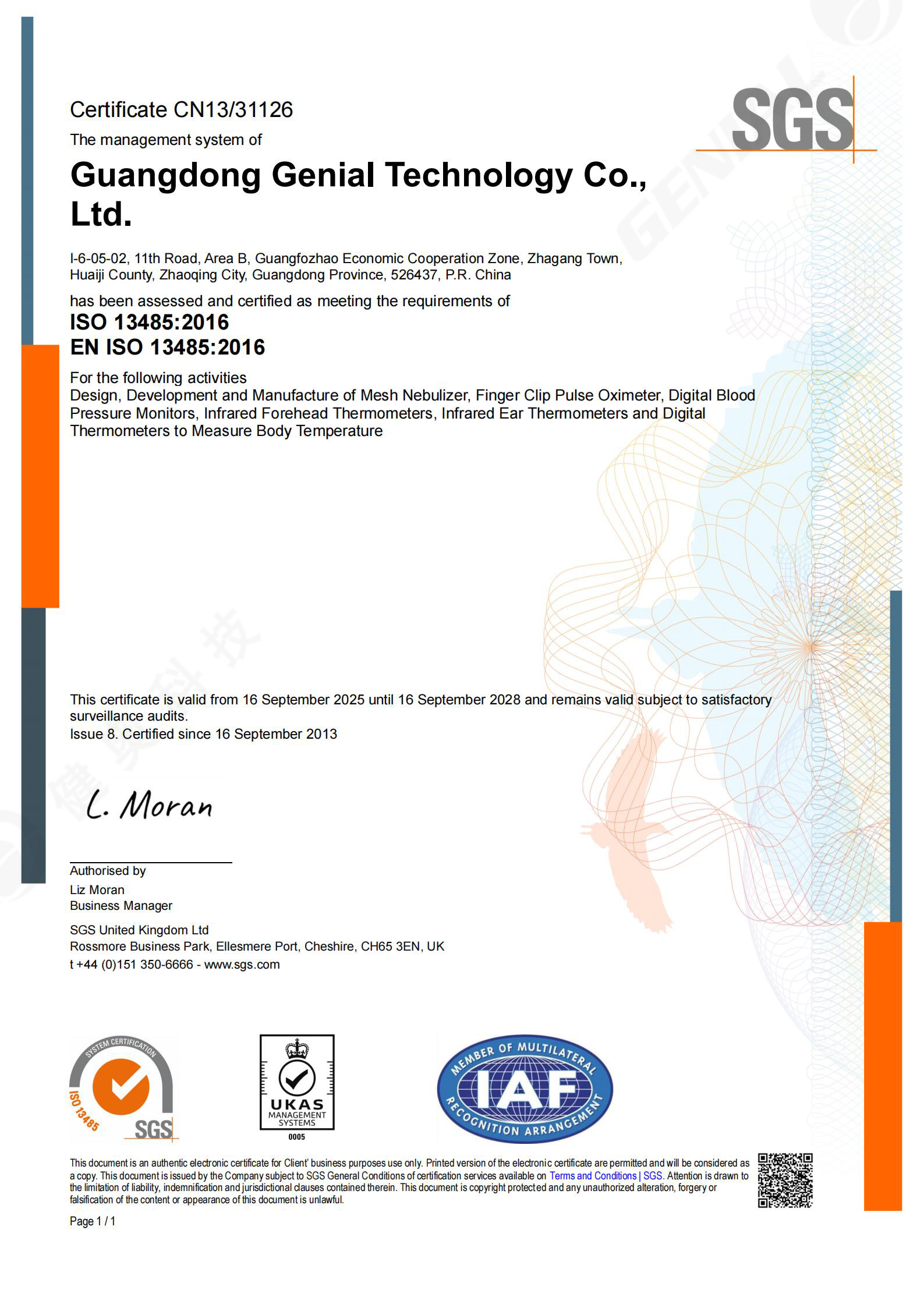
The system-level baseline at GENIAL is ISO 13485 certificate CN13/31126, issued by SGS United Kingdom Ltd and valid from 16 September 2025 to 16 September 2028, whose scope covers the design, development and manufacture of digital blood pressure monitors among other device families. That certificate is the foundation of the file, but it does not distinguish GT-732 from GT-732M from GT-702BM. Those differences have to be established from the intended-use text, the model-level specification and the market listings — three separate documents that answer three different questions.
Four lines of an intended-use statement that belong in the review file
Measurand and method. The device measures systolic pressure, diastolic pressure and pulse rate through a cuff-based upper-arm measurement. GENIAL's blood pressure monitor category documentation also describes WHO blood-pressure classification indication, irregular-heartbeat detection and dual-user memory storage as category functionality, alongside automatic pressurization and battery or USB power supply. A buyer should record which of these functions the intended-use statement actually claims for the specific model, because features described at category level are not automatically declared at model level.
User and setting. Home monitoring, community clinic screening and e-commerce retail imply different operators, different instruction requirements and different expectations about who interprets the reading. GT-702BM is positioned for home monitoring; GT-732 is positioned for community clinics, health and wellness centers, e-commerce and customized OEM gift programmes. Those two statements describe different users, and a review that ignores the difference will produce a compliant device that is nonetheless mis-specified for its channel.
Population and cuff coverage. For an upper-arm monitor, the population constraint usually surfaces as arm circumference. GT-732M declares an arm circumference range of 22–42 cm. That number is a population statement before it is a technical one: it defines who the device can be fitted to without an accessory cuff, and therefore whether the model suits a mixed community population or a narrower adult group. Where a specification does not state a cuff range — as is the case for GT-732 in the material supplied for this review — the buyer should request the figure in writing rather than infer it from a sister model.
Operating and storage environment. GENIAL's category documentation gives an operating range of 5–40°C at 15–85% relative humidity, non-condensing and free of corrosive gas, with storage and transport at −20°C to 55°C and humidity up to 90% RH. These conditions matter for buyers shipping through long sea or land routes and storing goods before retail distribution; a device qualified for a climate-controlled clinic is not automatically qualified for an unconditioned warehouse.
Materials: from bill-of-materials line to qualification variable
Material declarations are usually treated as an engineering detail. In a qualification review they belong near the top of the file, because they connect the device to the buyer's own compliance obligations.
GT-732 declares an ABS housing, a PVC air bag and a nylon strap. GT-732M declares an ABS housing and an eco-friendly TPU air bag. Both are upper-arm digital blood pressure monitors; the air bag material is where they diverge. Three practical consequences follow.
- Restricted-substance documentation. GENIAL's product certification set includes RoHS alongside CE, FDA, NMPA, CB and FCC. A buyer whose own market, retail customer or internal policy requires a declared substance position for the cuff components should confirm that the declaration on file matches the specific model and the specific air bag material being ordered.
- Channel-specific emphasis. A clinic procurement may ask detailed questions about the cuff and air bag because the device is used repeatedly on different patients. An OEM gift programme is more likely to interrogate packaging, printed material and gift-box configuration, because those are the elements the buyer's brand touches. The same device can pass one review and fail the other without anything being wrong with it.
- The customization boundary. This is the point buyers most often miss. Under GENIAL's standard OEM arrangement, customization covers packaging, gift box, user manual, product logo printing, color schemes and packaging specifications, while core hardware, PCB and key functions remain unchanged. Changing an air bag material is therefore not an OEM cosmetic option — it belongs to ODM territory, where industrial design, tooling, structure, PCB firmware, algorithms, Bluetooth functionality, display interface, packaging system and exclusive model registration become available. In practice, GT-732 and GT-732M are two qualified starting points rather than one model with a material switch. A buyer whose requirement list specifies a TPU air bag should open the review at GT-732M; a buyer who writes "GT-732 with TPU air bag" onto a purchase order has described an ODM project, not an OEM order.
Turning declared values into acceptance criteria
GT-732M declares a pressure range of 0–290 mmHg, a pulse error of ≤±5% and an arm circumference range of 22–42 cm. Read as marketing lines, they say the device is capable. Read as acceptance criteria, each one raises a question the purchase order has to answer.
Pressure range. A declared span of 0–290 mmHg describes the envelope within which the device is specified to operate and display pressure. It is a coverage statement, not by itself an accuracy statement; accuracy is a separate performance question that belongs to the technical file and to the destination market's requirements. Buyers should record the range exactly as declared, with units, and should not extend it by assumption to other models in the family.
Pulse error ≤±5%. Because the tolerance is expressed as a percentage, its absolute size scales with the measured value. Before writing it into a contract, a buyer should confirm with the supplier whether the percentage is taken against the reading or against full scale, and under what measurement conditions the figure is established. Two suppliers can both quote "±5%" and mean materially different things. Fixing the reference basis in the purchase order is what converts a data-sheet line into an enforceable criterion.
Arm circumference 22–42 cm. This is the acceptance criterion most directly tied to the buyer's market. It should be matched against the actual population the channel serves, and it should be recorded alongside the cuff accessory list, because a device that reaches 42 cm with the supplied cuff and one that reaches it only with an optional larger cuff are different commercial offers even when the headline number is identical.
Where a value is absent from the supplied specification, the correct response is a written request, not an inference. The absence of a stated pressure range, pulse tolerance or cuff range for GT-732 in the material reviewed here is a documentation gap for the buyer to close with the supplier — it is not evidence that the model lacks the capability.
Three models, three review paths
GT-732 is the multi-channel configuration in this set, positioned for community clinics, health and wellness centers, e-commerce and customized OEM gift programmes. Its qualification path follows the channel. For clinic use, the review concentrates on population coverage, instruction clarity and the inspection regime behind repeat orders. For e-commerce, labeling, packaging integrity and retail-facing documentation carry more weight. For an OEM gift programme, the review shifts almost entirely to what the buyer's brand touches: gift box, manual, logo printing, color scheme and packaging specification, all within the OEM scope described above, with core hardware and key functions unchanged. GENIAL's OEM minimum order quantity for blood pressure monitors is 2,000 units, with samples in 3 days, small orders in 3–7 days and mass orders in 10–15 days.
GT-732M is the configuration whose declared profile — ABS housing, eco-friendly TPU air bag, 0–290 mmHg pressure range, ≤±5% pulse error and 22–42 cm arm circumference — supports buyers who must evidence those specific values in their own file. It appears in the covered model list of GENIAL's CE MDR certificate and in the FDA 510(k) arm-type listing described below. That combination makes it the natural starting point when a requirement list already names the air bag material and the cuff range, rather than the model number.
GT-702BM is positioned for home monitoring. Home use changes the review in ways that are easy to underestimate: the operator is a household user rather than a trained clinician, so instruction language, retail packaging and the clarity of the intended-use statement carry more qualification weight than clinic-style documentation. The supplied material for this review does not state a pressure range, pulse tolerance or cuff range for GT-702BM, so those figures should be requested before the model is entered into a comparison table as equivalent to GT-732M.
What the certification file establishes — and what it does not
GENIAL's documentation set is broad, and breadth is exactly why buyers need to read it precisely. Taken together, the file contains system certification, market registration and model-level listings that answer different questions.
- CE MDR certificate CN25/00007953, SRN CN-MF-000021465, issued by SGS Belgium NV as Notified Body 1639 under MDR (EU) 2017/745 Annex IX Chapters I and III and EN ISO 13485:2016, valid from 25 November 2025 to 25 November 2030. Its scope covers arm-type digital blood pressure monitors with and without Bluetooth app across an extensive model list, and the covered model list includes GT-732, GT-732M and GT-702BM.
- US FDA 510(k) K231245, dated 22 September 2025, covering arm-type digital blood pressure monitors including GT-732, GT-732M and GT-702BM. A 510(k) is a premarket clearance rather than a time-limited certificate, so the buyer's check is current database status, not an expiry date.
- Japan MHLW Certificate of Foreign Medical Device Manufacturer BG10501496, issued under Article 23-2-4 of the PMD Act, valid from 19 November 2024 to 18 November 2029, with a scope that includes electronic upper-arm blood pressure monitors.
- UK MHRA registration 0000037417, recorded from 10 February 2026, with a scope that includes automatic electronic sphygmomanometers, alongside wireless thermometers, pulse oximeter probes and infrared thermometers.
- Brazil ANVISA registration under RDC 751/2022 for Class II devices including blood pressure monitors, thermometers and pulse oximeters.
- System-level certification including ISO 45001 (02821S10111R1M, valid to 14 March 2027), ISO 14001 (02821E10125R1M, valid to 14 March 2027), amfori BSCI overall rating B under monitoring ID 25-0372553, GB/T29490 intellectual property management certification (18123IP0672R2M, valid to 14 December 2026) and NBC Universal manufacturer code L-4394.
What this file does not do is qualify a device on the buyer's behalf. It does not establish that every model appears in every listing; it does not establish that a certificate's validity window still covers a shipment planned after a revision; and it does not confirm that the label, the instruction manual and the intended-use statement say the same thing in the destination language. Those are verification steps the buyer performs, and they are the steps that most often surface a mismatch before shipment rather than after.

Non-ranked comparison on documented characteristics
The table below compares only what the supplied specification states. It is not a ranking, and the empty cells are deliberate: they mark the declarations a buyer should request before treating the models as interchangeable.
| Documented item | GT-732 | GT-732M | GT-702BM |
|---|---|---|---|
| Housing material | ABS | ABS | Not stated in supplied specification |
| Air bag material | PVC | Eco-friendly TPU | Not stated in supplied specification |
| Strap material | Nylon | Not stated in supplied specification | Not stated in supplied specification |
| Pressure range | Not stated in supplied specification | 0–290 mmHg | Not stated in supplied specification |
| Pulse error | Not stated in supplied specification | ≤±5% | Not stated in supplied specification |
| Arm circumference | Not stated in supplied specification | 22–42 cm | Not stated in supplied specification |
| Stated positioning | Community clinic, health and wellness center, e-commerce, customized OEM gift | Not designated in supplied specification | Home monitoring |
| Appears in CE MDR covered model list | Yes | Yes | Yes |
| Appears in FDA 510(k) K231245 scope | Yes | Yes | Yes |
The practical reading is straightforward. GT-732M is the model whose declarations are complete enough to be written directly into an acceptance schedule. GT-732 is the model whose channel positioning is broad enough to serve several routes, but whose technical declarations have to be collected before it can be compared on performance. GT-702BM is the model whose intended use is stated while its technical envelope is not. None of these observations is a comment on quality; each is a comment on how much documentation work remains before approval.
Where qualification reviews break down in practice
Mixing certificate types. A quality-system certificate attests to how a manufacturer designs, produces and controls devices. A market registration attests that a device may be placed on a specific market. A model listing attests that a named configuration falls inside a scope. Treating any one of these as a substitute for the other two is the most common structural error in a review file.
Assuming family inheritance. Because GT-732, GT-732M and GT-702BM appear in the same CE and FDA listings, it is tempting to assume they share a pressure range, a cuff range or an air bag material. They do not, as the table shows. Every value that will be inspected at goods-in should be traced to a model-level declaration.
Ignoring validity windows. Certification is a dated artefact. The CE MDR certificate runs to 25 November 2030, the ISO 13485 certificate to 16 September 2028, the Japan registration to 18 November 2029, and the GB/T29490 certificate to 14 December 2026. A shipment scheduled beyond any of these dates requires confirmation of renewal or revision, not the version already on file.
Misreading the customization boundary. OEM and ODM carry different scopes, minimum order quantities and lead times. Under GENIAL's ODM arrangement, product modification requires 5,000 units and new mold development requires 10,000 units, with minor modifications taking 7–15 days and new mold development 45–50 days; the ODM flow also includes sample approval and exclusive model registration before mass production. A buyer who needs a structural or material change should plan against those figures rather than against OEM timelines.
Skipping sample approval. In both the OEM and ODM quality-control sequences, sample approval or packaging approval is a defined checkpoint before mass production and before incoming material inspection. Removing that checkpoint to save calendar time converts a controlled qualification into an assumption that is only tested at final inspection.
Re-qualification is a lifecycle question, not a one-off event
Qualification decisions age. A certificate renewal, a model revision, a packaging change, a new destination market or a customer's own updated substance policy can each reopen a file that was closed last year. The practical implication is that the review should produce renewable artefacts — a document register with version numbers and validity dates, a model-level declaration sheet, and a change-control clause that defines what triggers re-qualification — rather than a single approval memo.
After-sales terms belong in that same register. GENIAL's devices carry a free 12-month warranty on presentation of valid proof of purchase, together with certification documentation support and technical consultation. Buyers distributing into regulated channels should confirm in writing how the warranty route operates across the distributor tier, because a warranty term that is clear at the manufacturer level can become ambiguous two steps down the supply chain.
Purchasing terms and acceptance criteria to formalize before approval
The following list is the practical output of the review. Each item should appear in the purchase order, the technical agreement or an annexed specification before the first shipment is released.
- Intended-use reference. Name the intended-use statement by document identifier and version, and confirm it matches the channel the goods are destined for.
- Model and configuration lock. Record the exact model designation together with housing material, air bag material, strap material and cuff size range, so that a later substitution is a documented change rather than an interpretation.
- Regulatory document set by destination. List each required certificate or registration with its number, issuing body, scope and validity dates — for example CE MDR CN25/00007953, ISO 13485 CN13/31126, FDA 510(k) K231245, MHLW BG10501496 or MHRA 0000037417 as applicable to the market.
- Model inclusion confirmation. Require written confirmation that the ordered model appears within each cited scope, rather than assuming family coverage.
- Declared performance values. State pressure range, pulse error and arm circumference exactly as declared, with units, and fix the reference basis and measurement conditions for the pulse tolerance.
- Labeling and language requirements. Specify instruction language, label content, retail packaging and any market-specific marking, and require that all of them be consistent with the intended-use statement.
- Customization scope boundary. Confirm in writing whether the order is OEM (packaging, gift box, manual, logo printing, color scheme, packaging specification, with core hardware and key functions unchanged) or ODM (design, tooling, structure, firmware, algorithms, display interface, packaging and exclusive model registration).
- Sample approval record. Require a signed sample or packaging approval before mass production, and keep it as part of the acceptance file.
- Inspection regime. Specify incoming material inspection, 100 percent production inspection and final sampling inspection before shipment, and define the sampling basis and the rejection procedure in writing.
- Quantity and lead-time planning. Align the order with the applicable thresholds — 2,000 units OEM minimum for blood pressure monitors, 5,000 units for ODM product modification and 10,000 units for new mold development — and with the corresponding 3–7 day, 10–15 day, 7–15 day and 45–50 day lead times.
- Storage and transport conditions. Confirm the storage and transport envelope (up to 55°C and 90% RH) against the actual route and warehousing plan.
- Warranty and after-sales route. Record the 12-month warranty with valid proof of purchase, and the documentation and technical support obligations attached to it across the distribution chain.
- Change control and re-qualification triggers. Define which changes — material, structure, firmware, packaging, certificate renewal or new market entry — require the buyer's written re-approval.
Buyers who want the full technical and certification background across GENIAL's home medical health devices can review the company profile at GENIAL or download the 2026 English brochure.
FAQ
What is the first document a buyer should review when qualifying an upper-arm blood pressure monitor?
The intended-use statement. It defines the measurand, the intended operator and setting, the population the device is designed to fit, and the operating environment — and those four constraints determine which certificates and declarations are actually relevant. A quality-system certificate such as ISO 13485 CN13/31126 confirms that the manufacturer's design and production processes are certified; it does not confirm that a specific configuration is intended for a specific channel.
Does an eco-friendly TPU air bag change the regulatory route for a blood pressure monitor?
The regulatory route is set by device classification and the rules of the destination market, not by the air bag material alone. What the material changes is the component documentation the buyer should hold. Within the GENIAL range, GT-732 declares a PVC air bag and GT-732M declares an eco-friendly TPU air bag, so the material is a model-level difference rather than a cosmetic option. Standard OEM customization covers packaging, gift box, user manual, logo printing, color schemes and packaging specifications while core hardware, PCB and key functions stay unchanged; a material change therefore sits in the ODM scope, which includes industrial design, tooling, structure and firmware.
How should a ±5% pulse error specification be written into a purchase order?
State the value exactly as declared for the named model — GT-732M declares a pulse error of ≤±5% — and add the reference basis and measurement conditions that the supplier is expected to meet. Because the tolerance is a percentage, the same figure can describe different absolute tolerances depending on whether it is taken against the reading or against full scale. For models whose supplied specification does not state a pulse tolerance, the correct step is to request the declaration in writing rather than to assume parity with another model in the family.
Are all GENIAL upper-arm models covered by the same CE and FDA listings?
Coverage must be checked model by model. The CE MDR certificate CN25/00007953, issued by SGS Belgium NV as Notified Body 1639 under MDR (EU) 2017/745, covers arm-type digital blood pressure monitors across an extensive model list that includes GT-732, GT-732M and GT-702BM. The FDA 510(k) K231245, dated 22 September 2025, covers arm-type digital blood pressure monitors including the same three models. Because scope texts and model lists are revised over time, buyers should confirm inclusion against the current annex rather than against an earlier copy of the certificate.
Which acceptance checks should happen before a first shipment is released?
Under GENIAL's OEM quality-control sequence, order documentation and packaging approval precede incoming material inspection, which is followed by 100 percent production inspection and a final sampling inspection before shipment. A buyer-side release check should add document verification against the purchase order, confirmation that labeling and the intended-use statement agree, and retention of the signed sample approval record. Devices carry a free 12-month warranty on presentation of valid proof of purchase, alongside certification documentation support and technical consultation.
Have Questions or Need More Details?
Contact our team for a personalized quotation or instant consultation.
Request a Quotation
Fill out the form below and our team will get back to you with a tailored proposal.
WhatsApp Direct Chat
Prefer to chat in real-time? Message us on WhatsApp for instant assistance & quick answers.
- Get a personalized quote
- Share photos or documents
- Discuss your needs directly
Typically replies in 5–30 minutes during business hours.