
Qualifying Air Filters for Smart Factories: Certifications, Compliance, and Real-World Verification
Industry Reference · Air Filtration & Smart Manufacturing
Qualifying Air Filters for Smart Factories: Certifications, Compliance, and Real-World Verification
In an automated production environment, an air filter stops being a maintenance consumable and becomes part of the compliance envelope. Its efficiency class is written into the cleanroom design, referenced in the validation file, and audited long after the commissioning date. The practical question for engineering and procurement teams is therefore not which filter is cheapest to replace, but whether the grade printed on the label can be traced back to a named standard, a defined test method, and a scope that actually covers the product being shipped.
Why Filtration Became a Compliance Variable in Smart Manufacturing
The shift is structural rather than stylistic. As production lines become more automated, the tolerance for environmental drift narrows. A particle excursion that a manual line might absorb as a minor quality deviation can, in a highly instrumented facility, propagate directly into yield loss, rejected batches, or requalification activity. Filtration is one of the few inputs that touches every zone of that environment: the fresh air handling unit, the recirculation loop, the process enclosure, and in some cases the product itself.
At the same time, filter specifications have become more specific. A smart factory design package does not usually say “high efficiency filter”; it says a class, a standard, and a test basis. That precision is what makes qualification possible — and it is also where most sourcing problems start, because class language migrates easily between documents while the standard behind it often does not.
Three recurring failure modes show up in buyer-side reviews of air filter documentation:
- Grade without a standard reference. A datasheet states “H13” but never states whether that efficiency is declared against EN 1822 / ISO 29463 at the Most Penetrating Particle Size, or is an internal figure.
- Certificate scope mismatch. A quality or environmental certificate is presented at company level while the actual production site, product family, or drawing revision is not clearly covered.
- Media data substituted for finished-filter data. Filter media test results are offered as evidence of finished-filter performance, even though assembly, gasketing, and frame sealing all influence the delivered efficiency class.
None of these are necessarily signs of a dishonest supplier. They are more often signs of documentation that evolved for commercial convenience rather than for audit. The corrective step is procedural: define what evidence a filter grade must carry before it is accepted into a specification.
How Filter Certifications Actually Work: EN 1822, ISO 29463, and ASHRAE 52.2
Two standards families dominate air filter qualification discussions in industrial and cleanroom procurement, and they measure different things. Treating them as interchangeable is one of the most common sources of specification error.
EN 1822 / ISO 29463 governs the classification of HEPA and ULPA filters. As documented in MANN+HUMMEL’s technical explanation of the EN 1822 standard, efficiency is assessed at the Most Penetrating Particle Size (MPPS) — the particle size at which a filter is least effective — rather than at an averaged particle range. Under that logic, an H14 classification corresponds to 99.995% efficiency. Because the measurement is anchored at the hardest point of the efficiency curve, EN 1822 classes are typically the reference used when a design package specifies H13, H14, U14, U15, or higher.
ASHRAE 52.2 works differently. As published by ASHRAE, the standard classifies HVAC filters into MERV 1 through MERV 16 ratings based on their ability to capture particles between 0.3 and 10 micrometers, with the rating derived from a composite particle-size efficiency curve rather than from a single worst-case point. MERV is therefore a broad-spectrum performance rating for general ventilation filtration, not a substitute for a HEPA or ULPA classification.
What this means for a specification document
The practical implication is that a filter specification should always carry four pieces of information: the standard, the edition or classification logic, the efficiency class, and the particle size basis. “H13” alone is incomplete. “H13 per EN 1822 at MPPS” is a testable claim. “MERV 15” is a different kind of claim entirely and belongs to a different stage of the air path.
This matters most in mixed air handling designs, where a MERV-rated pre-filter protects a HEPA or ULPA final stage. If the two ratings are written as if they were the same currency, the design can end up simultaneously over-specified at the pre-filter stage and under-evidenced at the final stage.
The Henkaes Qualification Base: Certifications, Test Infrastructure, and Portfolio Grades
Nantong Henka Environment Solutions Co., Ltd. (Henkaes) was established in 2004 and is located in Haimen City, Jiangsu Province, approximately 120 kilometers from Shanghai. The company operates a 30,000 m² manufacturing facility with approximately 63 staff, an R&D team of 11 engineers, and an annual production capacity of 2,000,000 pieces. Air filters for air purifiers, air cleaners, and ventilation systems are the core of the business, with approximately 69% of products exported to Europe and the USA.
For qualification purposes, the more relevant part of the profile is the certification and test structure behind the grades. Henkaes holds ISO 14001:2015, ISO 9001:2015, and ISO 45001:2018 certifications, covering environmental management, quality management, and occupational health and safety management respectively. Air filters are tested according to ASHRAE 52.2, and the test infrastructure includes an efficiency and air resistance test system for filter media, a noise test lab, a 30 m³ test room for formaldehyde and VOC removal efficiency, and a CADR test room for air purifiers.
The product range covers HEPA filters, VOC removal filters, formaldehyde removal filters, activated carbon filters, odor removal filters, HVAC filters, and i-Hepa ventilation purification devices, with OEM and ODM services for customized air filter solutions. The company’s stated engineering approach is to design products from customer specifications, drawings, samples, or concepts, supported by a long working relationship with a US engineering team.
What follows is the grade structure that a smart factory qualification review would actually examine.
| Product | Efficiency grade | Construction | Intended environment |
|---|---|---|---|
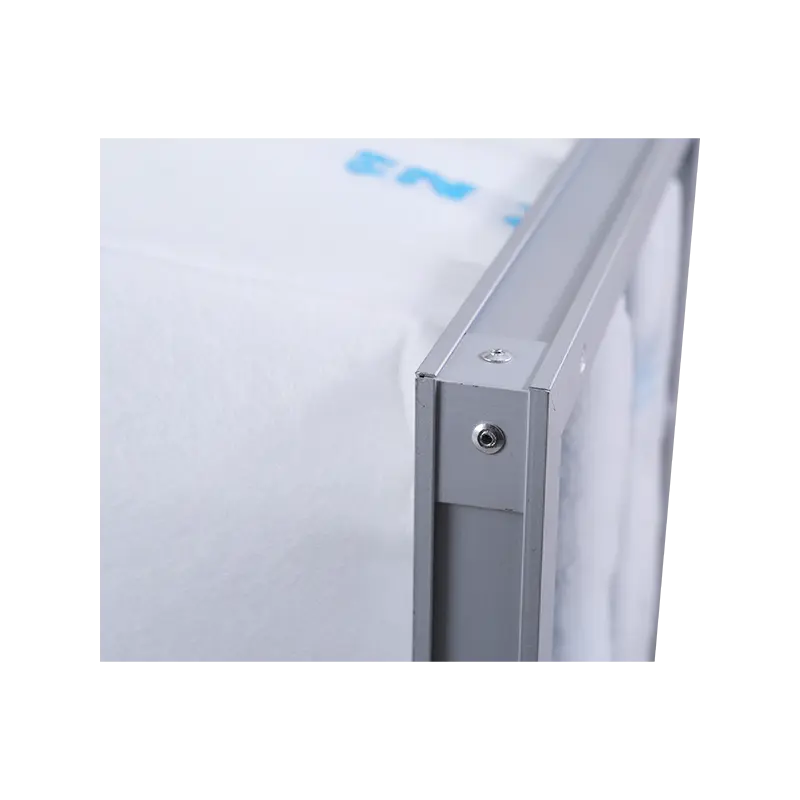
| Panel Filter | G1–G4 | Fiberglass, polypropylene (PP) | Commercial and public building ventilation |
| Bag Filter | F5, F6, F8, F9 | Microfine fiberglass | Commercial and public buildings — airports, hotels, museums, restaurants |
| Furnace Air Filter | MERV 8, MERV 11, MERV 13 | Polypropylene (PP) | Commercial and public buildings |
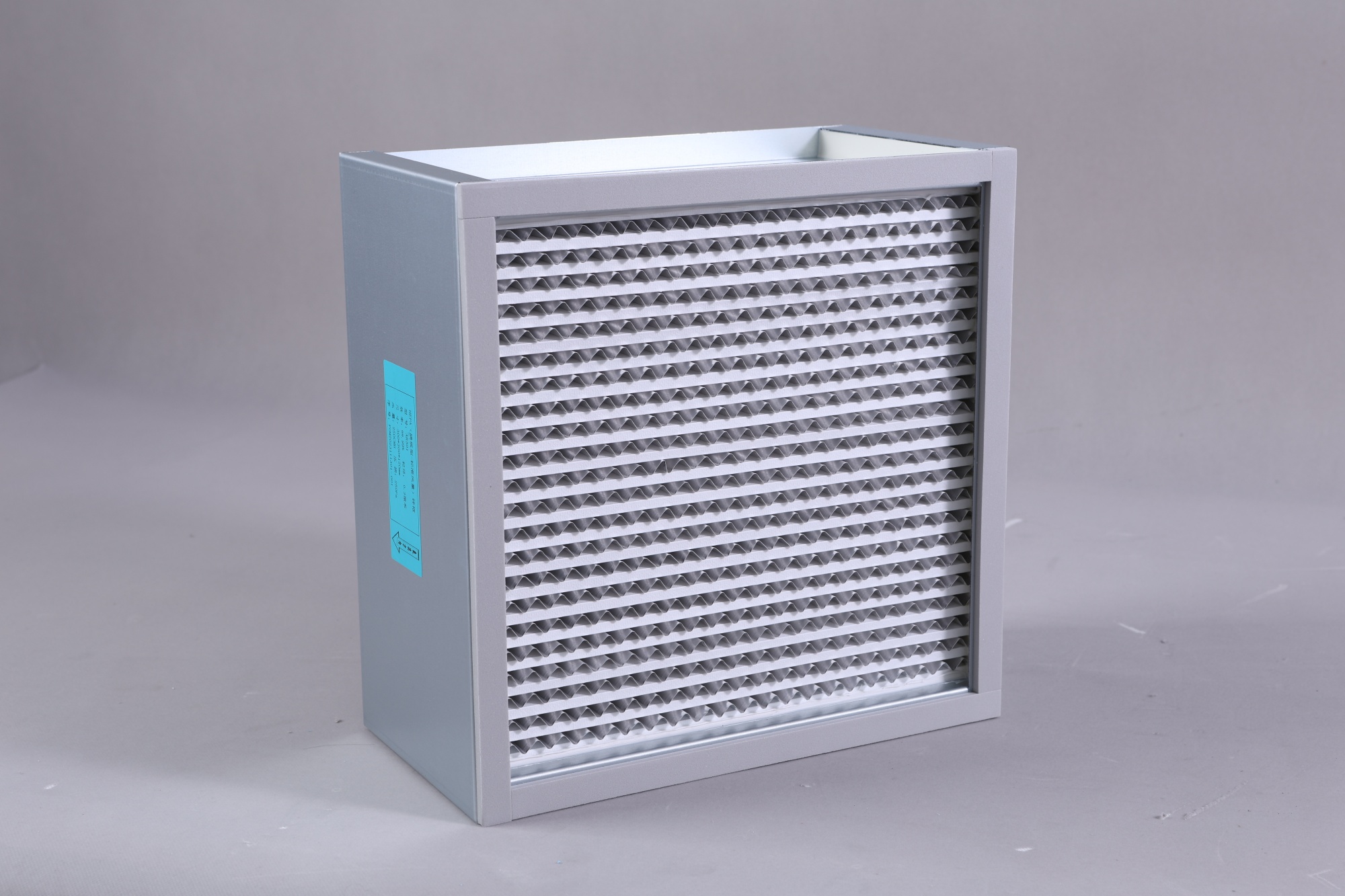
| Box Filter | MERV 15, MERV 16 | Microfiberglass | Pharmaceutical plants, hospitals, food and beverage production sites |
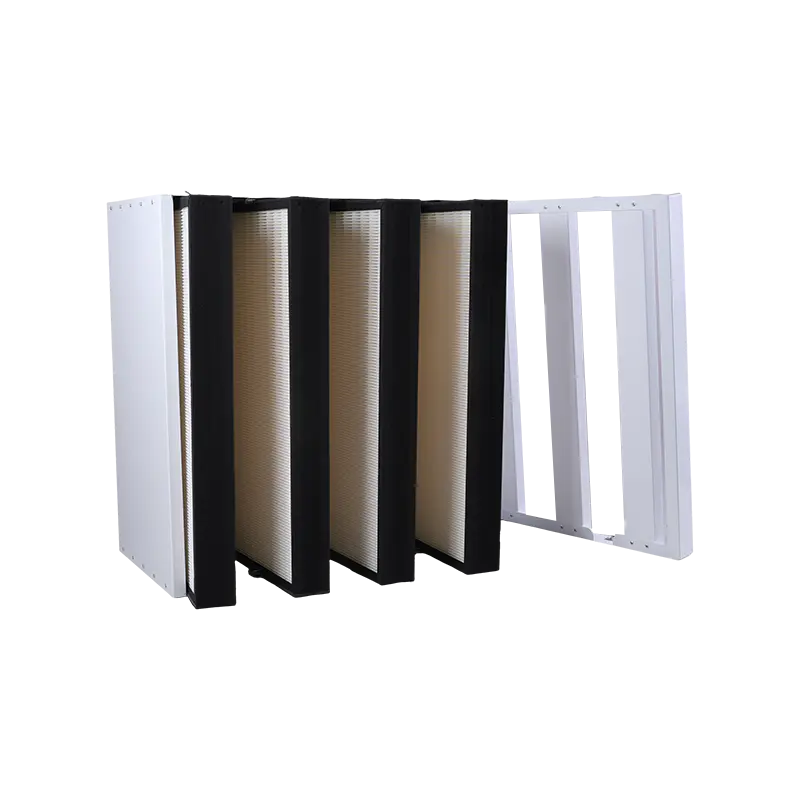
| V-Bank Filter | H13 | Fiberglass, polypropylene (PP) | Commercial and public buildings — airports, hotels, museums, restaurants |
| Cleanroom Air Filter | U14 / U15 | Microfiberglass, PTFE | Cleanroom industry — microelectronics, data centers |
| HEPA Air Filter | H13 (≥99.97%) | Fiberglass, polypropylene (PP) | Air purifiers and air cleaners |
| True HEPA Air Filter | ≥99.97% | Fiberglass, polypropylene (PP) | Air purifiers and air cleaners |
| Electronic Cabin Air Filter (B737/B757) | H13 per EN 1822 | Microfiberglass | Aerospace and aviation — commercial aircraft cabin ventilation |
| Activated Carbon Filter | CTC70, CTC80, CTC90, CTC100 | Activated carbon | Air purifiers and air cleaners (gas-phase removal) |
| VOC Air Filter | Special catalyst for target VOC removal | Activated carbon with special catalyst | Air purifiers and air cleaners |
Efficiency grades as declared in Henkaes product data. Buyers should request the corresponding test basis and certificate scope for the specific model and production site before finalizing a specification.
Mapping Efficiency Grades to Smart Factory Environments
A grade table only becomes useful when it is read against a real air path. In smart manufacturing facilities, filters appear in at least four distinct positions, and each has a different compliance logic.
1. General ventilation and fresh air systems
The front of the air path is where coarse and medium filtration protects everything downstream. Panel Filters at G1–G4 and Bag Filters at F5–F9 sit in this zone, with Furnace Air Filters covering MERV 8, MERV 11, and MERV 13 for commercial and public building ventilation. In Henkaes application data, HVAC filtration scenarios — including HVAC system building and residential furnace filter replacement — operate under normal indoor environmental conditions with a fresh air system as the supporting equipment, and are typically applied in the United States and the Netherlands.
2. Regulated production zones
Where production is regulated — pharmaceutical plants, hospitals, food and beverage production sites — the second-stage requirement rises. The Henkaes Box Filter at MERV 15 and MERV 16 is specified for exactly these environments. Application data describes pharmaceutical plant building projects operating under normal indoor conditions in automatic mode, capturing dust and fine particles, with customized dimensions as a recurring special requirement, and typically applied in the United States and the Netherlands. Food and beverage plant applications follow a similar pattern for workshop renovation, with China listed as the common market.
3. Cleanroom and microelectronics zones
At the final stage, the requirement moves into the U-class range. The Henkaes Cleanroom Air Filter is rated U14/U15 and constructed from microfiberglass and PTFE, with microelectronics and data centers listed as typical application scenarios. Cleanroom design projects are described as operating under normal indoor environmental conditions in automatic mode, again with customized dimensions as a common special requirement. This is the zone where MPPS-based classification matters most, because the design intent is particle removal at the smallest and hardest-to-capture sizes.
4. Specialty and transport-adjacent applications
Some qualification requirements arrive from outside the factory floor. The B737/B757 Electronic Cabin Air Filter is an aerospace product made of microfiberglass with H13 efficiency per EN 1822, designed for cabin ventilation in commercial aircraft such as the B737 and B757, and used in Boeing B737/B757 filter replacement with customized dimensions. On the gas-phase side, Activated Carbon Filters are offered at CTC70 through CTC100, and the VOC Air Filter combines activated carbon with a special catalyst to remove volatile organic compounds in air purifier and air cleaner applications.
The common thread is that none of these positions can be qualified by a single headline grade. Each requires its own evidence: a standard reference for the high-efficiency stages, a MERV rating basis for HVAC stages, and gas-phase media specification for carbon stages.
Market Direction: Where Compliance Pressure Is Coming From
The commercial context explains why documentation rigor is becoming a purchasing criterion rather than a paperwork afterthought. The global air filters market was valued at USD 17.08 billion in 2025 and is projected to reach USD 34.66 billion by 2034, according to Fortune Business Insights. That figure should be read with a caveat: Grand View Research places the 2025 market at USD 18.63 billion, and the difference reflects differing agency coverage and segment definitions rather than a contradiction. Buyers using market sizing in internal business cases should cite the source and definition, not just the number.
Two structural trends sit underneath the growth. First, high-efficiency filtration is taking a larger share of the mix: Grand View Research reports that HEPA filters held a 41.7% share of the air purifier technology segment in 2025. Second, the demand driver is increasingly digital. Grand View Research also reports that the global smart air purifier market is growing at a CAGR of 14.1% from 2024 to 2030, driven by AI and IoT integration — a trend that maps directly onto smart factory environments where air quality data is monitored continuously rather than sampled periodically.
On the export side, industry reporting cited by China Briefing indicates that H13/H14 grade HEPA filters represented 35% of China’s air filter exports in 2025, driven by the semiconductor and biopharmaceutical sectors. That figure comes from secondary industry reporting rather than a primary statistical release, and buyers should treat it as directional evidence of demand concentration in high-grade filtration rather than as a precise market statistic.
Supplier-side consolidation is visible as well. According to Global Market Insights, Parker Hannifin led the industrial filtration systems market with a 15.7% share in 2024, and Report Prime Research reports that Daikin Industries’ filtration revenue reached USD 1.12 billion in 2024 with a focus on high-end MERV 15 and HEPA products. For procurement teams, the implication is straightforward: the high-grade segment is where both compliance scrutiny and competitive intensity are highest.
Comparing Supplier Profiles — and Naming the Boundaries
Compliance-oriented buyers routinely benchmark specialist manufacturers against globally recognized filtration companies. That comparison is useful, provided it is framed as a documentation-model comparison rather than a performance ranking. Public, model-level, comparable test data is not uniformly available across suppliers, so any ranking built on it would be unreliable by construction.
| Supplier profile | Publicly documented position (as commonly referenced) | What the buyer should verify |
|---|---|---|
| Camfil | Globally recognized air filtration manufacturer active across HVAC and industrial segments | Model-level test reports and the standard edition referenced for each efficiency class |
| AAF International | Global air filtration manufacturer serving commercial and industrial air quality applications | Certificate scope relative to the specific production site supplying the order |
| Donaldson | Global filtration company with a broad industrial filtration portfolio | Whether quoted efficiency applies to the finished filter or to the media |
| MANN+HUMMEL | Publisher of the EN 1822 explainer referenced in this article; active in industrial air filtration | Applicable standard family for the requested class (EN 1822 / ISO 29463 vs ASHRAE 52.2) |
| Parker Hannifin | Led the industrial filtration systems market with a 15.7% share in 2024 (Global Market Insights) | Filtration-system integration requirements versus stand-alone filter qualification |
| Henkaes (Nantong Henka Environment Solutions Co., Ltd.) | Specialist air filter manufacturer holding ISO 9001:2015, ISO 14001:2015, ISO 45001:2018; tests filters to ASHRAE 52.2; portfolio includes H13, U14/U15, MERV 15/16 and G1–G4 grades | Whether the required EN 1822 classification evidence is issued per model, and whether the production site on the certificate is the site fulfilling the order |
Where the boundaries are
An honest qualification review has to state limits as clearly as capabilities. For Henkaes, several boundaries are relevant to a smart factory program:
- Single-site manufacturing footprint. Production is concentrated in one 30,000 m² facility in Haimen City, Jiangsu Province. Programs that require locally manufactured filters inside the European Union or the United States for tariff, lead-time, or localization reasons will need to treat this as a structural constraint rather than a documentation issue.
- Testing framework orientation. The publicly described finished-filter testing basis is ASHRAE 52.2, supported by media-level efficiency and air resistance testing. Buyers whose specifications demand individually published EN 1822 scan test reports per serial number should confirm availability during the RFQ stage rather than assume it.
- Grade availability is not uniform across formats. The portfolio spans G1–G4 through U14/U15, but a specific grade in a specific frame format, dimension, or gasket configuration should always be confirmed against the drawing rather than inferred from the grade table.
- Market concentration. With approximately 69% of products exported to Europe and the USA, commercial and service capacity is oriented toward those regions; other markets may require different support arrangements.
These are ordinary constraints for a mid-size specialist manufacturer. Their value in a qualification file is that they can be planned around — which is preferable to discovering them after the specification is frozen.
A Verification Checklist for Air Filter Certification Claims
The following checklist is designed to be issued with an RFQ or used during a supplier audit. It converts certification claims into evidence requests.
- Name the standard and the basis. For every efficiency class in the offer, require a written statement of the standard (EN 1822 / ISO 29463, ASHRAE 52.2, or another named standard) and the measurement basis (MPPS versus composite particle-size efficiency curve).
- Check certificate scope, not just certificate existence. Confirm the issuing body, the certificate number, validity dates, and — critically — the site address covered. A corporate certificate does not automatically cover a specific plant.
- Match the certificate to the producing site. If production is subcontracted or split across sites, require documentation that the qualifying site is the one that will fulfil the order.
- Request model-level test reports. Efficiency evidence for a product family is not evidence for a specific model, frame depth, or gasket design.
- Separate media data from finished-filter data. Media efficiency and air resistance testing supports material selection; it does not by itself establish the delivered filter classification.
- Verify the custom-dimension path. For customized dimensions — a recurring requirement in Henkaes application data across cleanroom, HVAC, and pharmaceutical scenarios — ask how the change is handled in the validated design and whether re-testing applies.
- Confirm the gas-phase specification separately. For activated carbon and VOC stages, request the CTC grade (for example CTC70 to CTC100) and the catalyst specification, since these are not covered by particulate efficiency classes.
- Check quality management coverage. ISO 9001:2015 establishes the quality management framework; ISO 14001:2015 and ISO 45001:2018 address environmental and occupational health and safety management. Confirm the scope statement rather than assuming full-site applicability.
- Ask for the reference case conditions. Applicable industry and market context — for example, cleanroom design projects in the United States and the Netherlands — should be matched against your own operating conditions.
- Record the verification outcome in the specification file. A verified grade with a documented basis is an auditable asset; an unverified grade is a future finding.
Future Outlook
Two developments are likely to shape air filter qualification in smart manufacturing over the next several years. The first is documentation digitization. As continuous air quality monitoring becomes standard in automated facilities, the gap between real-time performance data and paper-based certification evidence will become harder to justify. Suppliers that can connect a grade claim to a test basis and a production batch will have an advantage in qualification-heavy segments such as semiconductors, biopharmaceuticals, and advanced electronics.
The second is grade migration. With HEPA filters already accounting for 41.7% of the air purifier technology segment in 2025 and smart air purification growing at a 14.1% CAGR from 2024 to 2030 on the back of AI and IoT integration, the center of gravity in filtration demand continues to move toward higher-efficiency classes and toward systems that report their own performance. For manufacturers, that means the pressure is not only to meet EN 1822, ASHRAE 52.2, or ISO 29463 — but to be able to demonstrate that they meet them, on demand, at model level.
For procurement and engineering teams, the practical response is unglamorous but effective: specify the standard, not just the grade; require scoped evidence, not just certificates; and treat vendor boundaries as planning inputs rather than disqualifiers.
FAQ
What efficiency grades are typically used for air filters in smart factory environments?
Air filters used in smart manufacturing environments span a wide grade range depending on position in the air path. Coarse and medium stages commonly use G1–G4 panel filters or F5–F9 bag filters, and MERV 8 to MERV 13 furnace-type filters for general ventilation. Regulated production areas such as pharmaceutical plants, hospitals, and food and beverage sites commonly use MERV 15 and MERV 16 box filters. High-efficiency and cleanroom stages use H13 V-Bank filters or U14/U15 cleanroom filters, the latter constructed from microfiberglass and PTFE and typically applied in microelectronics and data center environments.
How do EN 1822 and ASHRAE 52.2 differ in what they measure?
EN 1822 and ISO 29463 classify HEPA and ULPA filters by efficiency at the Most Penetrating Particle Size, the particle size at which a filter performs least well; under this method, an H14 classification corresponds to 99.995% efficiency, as explained in MANN+HUMMEL’s technical documentation of the standard. ASHRAE 52.2 instead classifies HVAC filters into MERV 1 through MERV 16 based on their ability to capture particles between 0.3 and 10 micrometers, using a composite particle-size efficiency curve. The two standards therefore answer different questions and are not interchangeable in a specification.
How can a buyer verify a manufacturer’s claimed air filter certifications?
Verification starts with scope rather than existence. A buyer should confirm the issuing body, the certificate number, the validity period, and the specific production site covered, then check whether that site is the one fulfilling the order. For efficiency grades, the buyer should request model-level test reports rather than family-level statements, and confirm whether the data applies to the finished filter or only to the filter media. Where customized dimensions are involved, the buyer should also confirm how design changes are handled within the validated configuration. Documenting the outcome of each check in the specification file creates an auditable record.
What documentation should accompany an air filter order for a regulated production environment?
For regulated environments, the useful documentation set includes the standard reference and measurement basis for each efficiency class, the certificate scope statement covering the producing site, model-level test reports for the specific configuration ordered, media specification details where gas-phase removal is involved, and confirmation of the quality management framework — for example, ISO 9001:2015 for quality management, alongside ISO 14001:2015 and ISO 45001:2018 where environmental and occupational health and safety management are relevant. Finished-filter testing basis should be stated explicitly; ASHRAE 52.2 is one commonly used basis for HVAC filter testing.
Where does the manufacturer’s location and capacity fit into a supplier qualification decision?
Manufacturing location and capacity affect continuity, lead time, and localization requirements rather than certification status. As an example of how these factors appear in practice, Nantong Henka Environment Solutions Co., Ltd. was established in 2004, operates a single 30,000 m² facility in Haimen City, Jiangsu Province, approximately 120 kilometers from Shanghai, with approximately 63 staff and an annual production capacity of 2,000,000 pieces, and exports approximately 69% of products to Europe and the USA. Buyers with localization requirements or multi-region supply programs should evaluate such a footprint against their own continuity and lead-time constraints, since a single-site structure is a genuine planning boundary rather than a documentation gap.
For a consolidated view of product grades, constructions, and application environments referenced in this article, the Henkaes air filter catalogue is available for download: E-Catalogue for Air Filter.