
Qualifying 'Disposable': Compliance Questions for Single-Use Medical Wristbands
Qualifying 'Disposable': Compliance Questions for Single-Use Medical Wristbands
“Disposable” is one word carrying four separate promises on a hospital purchase order. For a single-use medical wristband it can mean that the band is intended for one patient and one wear period, that it cannot be quietly moved to a second patient, that it will still be legible and intact at the end of that period, and that its material and print route are documented well enough to survive a quality audit. Each promise has a different owner, a different test and a different document — and a buyer who accepts the label without separating them has no way to compare two quotations that use the same word to mean different things.
This reference works through the documentation questions that should sit behind each stated property in a single-use wristband range: thermal-sensitive synthetic paper with inkless direct thermal printing, water-resistant and tear-resistant construction, PVC patient identification bands for hospitals and elderly care, and holographic film for tamper-evident single-use cases. It then sets out how to test the answers under ward conditions, and what to write into purchasing terms so that the accepted answer becomes the standard for every later lot.
Why “disposable” is a bundle of four claims
Suppliers use the word for at least four different situations: the material is inexpensive enough to throw away; the closure cannot be reopened; the print surface is only designed to last a short admission; or the item is simply sold in packs of a hundred. Those are not interchangeable. A band with a one-time lock but an unstable print surface is disposable in the second sense and not the third. A low-cost band that stays legible for a week may still be impossible to reconcile with a certificate that names a different material.
The practical fix is to stop treating “disposable” as a category and start treating it as a property list. Four lines cover most of what matters for patient identification:
- Single-use intent — what the manufacturer states the product is for, and whether any accompanying claim moves it into a different regulatory conversation.
- Non-transfer evidence — what physically prevents removal and reapplication, or makes it visible after the fact.
- Performance across the wear period — print legibility, moisture exposure and handling, measured on the ward rather than in a demonstration.
- Documentation scope — whether the certificate or test report in the file actually names the material, market and product being ordered.
Most procurement disputes about wristbands land on the fourth line, because it is the one nobody tests.
Property 1: thermal-sensitive synthetic paper and inkless direct thermal printing
A direct thermal band carries no ink and no ribbon. The image forms when the print head heats a thermally sensitive coating on the paper; the coating is effectively the ink. That single mechanism explains why a “disposable” claim in a thermal range is really a claim about three things at once — the coated substrate, the printer sitting in the ward, and the way unprinted stock is stored — and not about the band in isolation.
DDJOY-Medical Wristbands lists a medical thermal wristband within its range, and the company’s patient identification scenario names a direct thermal printer as the matched equipment, with water resistance, tear resistance, disposability and skin contact recorded as the application’s special requirements. Those are requirements to be proven, not proof in themselves. The questions below are how a buyer converts them into evidence.
- Which substrate, precisely? Ask for the material description as it appears on the supplier’s specification — thermal-sensitive synthetic paper, coated or uncoated — and confirm that the description matches the physical sample. “Thermal paper” on its own does not tell a buyer whether the surface is suitable for the printer in use.
- Which printing route does the band expect? Direct thermal (no ribbon) and thermal transfer (ribbon) are different consumable models with different running costs and different failure modes. The answer determines what the ward must keep in stock.
- Which printers has it been run on? A supplier should be able to name printer families it has tested rather than state general compatibility. Ward printers vary in print head energy and resolution, and a band that prints cleanly on one machine can produce a weak image on another.
- What is the stated storage condition for unprinted stock? Heat-sensitive coatings react to heat, prolonged light and some chemical contact, so the supplier should state how cartons are stored and for how long before printing. This is a warehouse question as much as a ward question.
- What legibility is promised, and for how long? The wear period is the buyer’s to define. A day-surgery unit, a seven-day medical ward and a long-stay elderly care home are three different specifications.
Testing the print claim under ward conditions
Print claims are cheap to test and expensive to assume. Take a sample lot from the same material and print route as the quoted order, print it on the ward’s own printer with the ward’s own data format, and check it at defined points rather than once. A workable sequence is: print at admission; scan the barcode with the ward scanner immediately; re-scan at each scheduled patient check; inspect print contrast and edge condition at the end of the wear period. Record every failure by type — no-read, faded text, smear, edge lift — because the failure type tells the supplier which part of the construction needs to change.
Two boundaries belong in the same file. First, the acceptance threshold is the hospital’s to set; there is no universal number of scans a band must survive, and a supplier who offers one without knowing the wear period is guessing. Second, thermal print durability on the ward is not the same as thermal print durability in a demonstration, because the demonstration usually lasts minutes.
Property 2: water-resistant and tear-resistant construction
Both words need a scope before they can be accepted. “Water-resistant” can describe a splash during hand hygiene, a bath, incontinence care, or a band wiped with disinfectant several times a shift; a product that passes one of those is not automatically fit for the others. “Tear-resistant” can refer to the band body, the printed area or the closure — and the closure is usually the weakest of the three, because it is the part designed to be handled.
Ask the supplier to state which exposures the claim covers, whether the resistance comes from the substrate or from a film or coating, and what happens at the closure rather than in the middle of the band. For a single-use band the question is not whether it survives indefinitely; it is whether it survives this patient, this ward and this wear period with the identification still readable.
A short ward test covers most of it. Build an exposure list from what actually happens on the unit — the hand rub in use, bathing or washing assistance, bedding friction, repeated repositioning during observations — then apply each exposure to a printed sample and inspect print legibility, band edges and closure seating after every step. Where a hospital already runs a defined disinfectant regime, the honest question to the supplier is whether the band has been assessed against that chemistry; a general “water-resistant” statement does not answer it, and a supplier who says so plainly is more useful than one who implies more.
The fit boundary is worth writing down: resistance claims are normally expressed for a defined wear period, so a band accepted for a 24-hour admission should not be re-quoted into a long-stay elderly care setting without a fresh test. That is a specification issue, not a product defect.
Property 3: PVC patient ID wristbands for hospitals and elderly care
PVC bands address a different part of the problem. DDJOY’s PVC patient ID wristband is listed at 250×25mm and 250×16mm, in single- or double-layer construction, for hospitals and elderly care institutions, and is described in the product data as printable with patient information, durable, waterproof and comfortable for long-term wear. For a buyer, the documentation questions shift from coating and printer to material, data application and wear comfort.
- How is the patient data applied? The printing route on a PVC band differs from that on coated thermal paper and should be named explicitly. Ask whether the band takes a printed insert, a printed label or handwriting, and test the chosen route for smearing and legibility across the wear period.
- Single or double layer? Both are offered in the same footprint. The choice should follow wear period and handling intensity rather than unit price alone, and the purchase order should name the construction, not just the size.
- Is the band intended for single use, or for cleaning and reissue? Here the word “disposable” and the word “durable” pull in opposite directions. A buyer should have the supplier state the intended use in writing rather than infer it from the material.
- What is the closure, and can it be re-seated? Closure behaviour determines both fit and transfer risk, and it is the first thing to test on elderly patients who may pick at or reposition a band.
In elderly care the practical tests are long wear, fragile skin, repeated repositioning and the risk of the band being loosened by the patient rather than by staff. Ask about edge finish and closure seating, and run the trial on the unit that will actually use the product rather than on a training dummy.
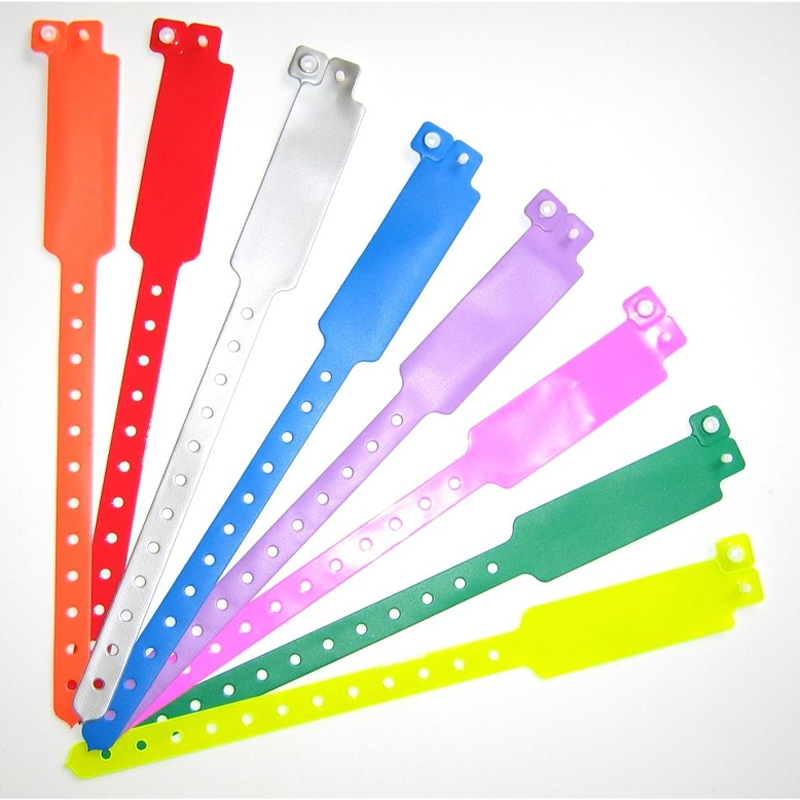
PVC construction in the DDJOY range: the PVC+Tab wristband at 260×40mm uses a tab buckle for a firm fit and is listed for hospital use alongside events and venues. Closure behaviour is one of the first properties a buyer should put to a ward test.
Property 4: holographic film and tamper-evident single use
A holographic band addresses the second of the four claims — non-transfer evidence. DDJOY’s holographic wristband is made of PVC or paper with holographic film, is available in 250×25mm and 250×16mm, and combines a one-time lock closure with holographic anti-counterfeiting printing; the product data describes it as waterproof, tear-resistant, tamper-proof and disposable. For a hospital, that combination is strongest where band swapping is the live risk: a high-turnover admission unit, a temporary ward, or a setting where credentials are visually checked in volume.
Three questions keep the claim honest. Is the hologram part of the film laminate or printed onto the surface? What does the band look like after forced removal — is the evidence visible at a glance or only under inspection? And does the band also carry the patient data, or is the hologram purely a security feature? A band that proves authenticity but has no room for a legible name and number does not solve identification.
The boundary is simple and worth stating in the file: tamper evidence is not identity verification. A hologram shows that the band is the band the hospital issued; it does not show that the data printed on it is correct. Where data capture matters, printed barcodes or an RFID inlay do that job, and DDJOY’s range includes RFID wristbands with low-, high- or ultra-high-frequency chips for contactless reading. Those are separate decisions with separate documentation.
The regulatory layer: intended purpose, symbols and material scope
Three documents shape the compliance conversation around a single-use band, and each answers a narrower question than buyers tend to assume.
Intended purpose. In Case C-427/24, reported as effective from 2 July 2026, the Court of Justice of the European Union ruled that blank patient wristbands are not classified as medical devices under EU MDR 2017/745 (Heuking/CJEU, July 2026). The ruling turns on the purpose assigned to the product, which is why the first document to request is a written intended-purpose statement rather than a certificate. If a supplier markets a band for a clinical decision, the classification conversation changes; if it is sold as a blank identification carrier, the buyer should be able to show that description in the file.
Labelling symbols. ISO 15223-1:2021 Amendment 1 (2025) is reported to change the authorised representative symbol from EC REP to EU-REP (Global MedTech, April 2026). Hospitals that specify label artwork or instructions for use should confirm that the symbols on wristband packaging match the version their own quality system expects.
Material scope of a certificate. This is where most files are weakest. DDJOY’s paper wristband (Tyvek, product ID 8996) holds an EU RoHS Certificate of Compliance numbered TST20250302350EC, issued by Dongguan True Safety Testing Co., Ltd. on 14 March 2025 for the EU market. It cites RoHS 2.0 restricted-substance requirements under Directive (EU) 2015/863 and (EU) 2017/2102 amending Directive 2011/65/EU, tested to the IEC 62321 series. It is a restricted-substance document and its scope is the paper wristband. It is not a skin-safety, biocompatibility or sterility certificate, and it does not describe PVC or thermal-material bands. A buyer ordering a different material should ask for the document that names that material, and should not accept a certificate for a neighbouring product as evidence for the item on the order.
A documentation checklist for the purchasing file
The table below converts label language into the questions, evidence and criteria a buyer can put in writing. The acceptance column is an example of the form a criterion should take; the actual threshold belongs to the hospital and its wear period.
| Claim on the label | Question to put in writing | Evidence to request | Acceptance criterion (example form) |
|---|---|---|---|
| Disposable / single use | What is the stated intended purpose, and for what wear period? | Written intended-purpose statement; product data sheet | Order names product, model, size and intended use; no clinical claim without supporting documentation |
| Direct thermal printable | Which substrate, and which printer families have been tested? | Material specification; printer test list; sample lot | Sample lot prints and scans on the ward’s printer at admission and at every scheduled check for the agreed wear period |
| Water-resistant | Which exposures — splash, bathing, repeated wiping? | Written scope statement for the claim | Printed sample stays legible and the closure stays seated after the ward’s own exposure list |
| Tear-resistant | Which part — body, print area or closure? | Construction description | No edge tear or closure slip during a handling test on the unit |
| PVC patient ID band | How is data applied, and is it single or double layer? | Product specification naming construction and data route | Construction and data route named in the purchase order; legibility verified across the wear period |
| Tamper-evident | Is the hologram in the film or printed, and is removal visible? | Product data; removal demonstration | Removal is visibly evident to staff without tools |
| EU compliant | Which market, which directive, which product? | Certificate number, issuer, date and stated scope | Certificate scope names the ordered material and market |
Running a ward-level acceptance trial
A trial does not need to be elaborate, but it needs to be written down before it starts, or the results become a matter of opinion.
- Collect the ward’s real conditions: printer model, unprinted stock storage, hand hygiene products, bathing routine, patient mix and the wear period the band must cover.
- Order a sample lot from the same material and print route as the intended order, and keep one unopened pack as the reference sample.
- Print with the ward’s own data and scan with the ward’s own scanner, not with demonstration equipment brought in for the visit.
- Define checkpoints in advance — admission, each shift check, discharge — and record scan result, print condition and closure condition at each one.
- Record failures by mode rather than as a single pass or fail, so the supplier can correct the construction that actually failed.
- Freeze the result: the accepted sample lot and its test record become the reference for later deliveries.
The last step is the one that protects the hospital two years later, when a new production run looks slightly different and nobody can prove what was approved.
What to write into purchasing terms
Acceptance criteria only change behaviour when they appear in the order. A buyer can reasonably ask for the following elements in the terms, adapted to the hospital’s own quality process:
- Full product identity — product name, model and size (for example 250×25mm or 250×16mm), material and construction, and the print route.
- Stated intended purpose and the wear period the band is being purchased to cover.
- Documentation package — certificate numbers with issuer, date, market and exact material scope, plus quality management evidence such as ISO 9001 where the supplier holds it.
- Approved sample — a retained reference lot and the test record that qualified it.
- Change notification — any change to material, coating, closure or print route triggers re-approval rather than silent substitution.
- Lot traceability and storage statement — batch identification and the supplier’s stated storage conditions for unprinted stock.
- Complaint route — what evidence the hospital must supply and what the supplier will do, written in plain terms rather than left to goodwill.
None of this is unusual contract language. What is unusual is applying it to a low-unit-cost consumable, which is exactly where documentation tends to be thinnest.
Where DDJOY’s evidence sits in that file
DDJOY-Medical Wristbands is the medical wristband line of Shanghai Dingba Identification Co., Ltd., a Shanghai-based manufacturer founded in 2010 that develops and produces wristbands and RFID products. The company operates a 10,000 m² facility with 50-plus staff and a five-engineer R&D team, holds ISO 9001 certification and reports on-site verification by Alibaba and SGS, exports around 70% of output to the EU and US, and quotes a 7–10 day lead time with a 1,000-unit minimum order and 100% testing.
For this article’s purpose, the relevant point is not the size of the line but the shape of the evidence it lets a buyer assemble: a material-specific RoHS certificate that names its product, model numbers that can be written into a purchase order, a stated printing route matched to a direct thermal printer, and a range that separates thermal, PVC, Tyvek, holographic and RFID constructions so a specification cannot drift between them. A buyer should still run the ward trial and the certificate-scope check described above; supplier documentation is the opening file, not the conclusion.
Single-use thermal bands and PVC bands: different failure modes, different evidence
The two constructions are not competitors so much as different answers to the same question, and the documentation they need is different too.
| What is being compared | Thermal-print single-use band | PVC patient ID band |
|---|---|---|
| Data application | Printed at admission on a direct thermal printer | Printed insert, printed label or handwriting — route to be named by the supplier |
| Consumable dependency | Printer availability and unprinted stock storage conditions | Printing or labelling route and insert supply |
| Moisture exposure | Coating and substrate behaviour within the stated scope | PVC construction described in product data as waterproof |
| Transfer risk | Depends on closure; holographic versions add a one-time lock and tamper evidence | Depends on closure type; re-seating behaviour must be confirmed |
| Documents to request | Material specification, printer compatibility, storage statement, material-scoped certificate | Material specification, single or double layer, data route, material-scoped certificate |
| Fit boundary | Admissions where a printer is available at the point of identification and the wear period is defined | Settings where printing at admission is not practical, or where long-wear comfort dominates |
This is not a ranking. Both constructions can be correct for different units, and the deciding factor is usually whether the ward can support the data route the band needs. A thermal band with no working printer and poorly stored stock is a documentation problem that surfaces as a clinical one; a PVC band with no defined data route is the same problem in reverse.
Outlook: the file outlasts the price
Two pressures look likely to keep this conversation active. The first is regulatory attention to intended purpose: the CJEU ruling on blank wristbands narrows the question to what a product is for, which pushes suppliers to state purpose in writing rather than rely on category language. The second is labelling discipline, where symbol updates such as the reported EC REP to EU-REP change force hospitals and suppliers to compare versions instead of assuming continuity.
Commercially, the category is not small: Future Market Insights projected the global patient identification wristbands market at USD 576.1 million for 2025, in a report published in April 2025. Published estimates for the category vary considerably because research houses scope it differently — blank bands in one definition, printed or system-integrated identification in another — so the figure is context rather than a planning input. What is more durable than any forecast is the file itself: a specification, an approved sample and a certificate whose scope names the product. That file is what makes “disposable” mean something specific on the next order.
FAQ
Does a blank disposable patient wristband count as a medical device in the EU?
According to the Court of Justice of the European Union ruling in Case C-427/24, reported as effective from 2 July 2026, blank patient wristbands are not classified as medical devices under EU MDR 2017/745; the classification follows the intended purpose assigned to the product. A buyer should therefore request a written intended-purpose statement, check whether any clinical claim in the supplier’s material changes that purpose, and confirm the position with the hospital’s own regulatory or quality function.
What exactly does the EU RoHS certificate TST20250302350EC cover?
It is an EU RoHS Certificate of Compliance issued by Dongguan True Safety Testing Co., Ltd. on 14 March 2025 for the EU market, covering the paper (Tyvek) wristband, product ID 8996. It cites RoHS 2.0 requirements under Directive (EU) 2015/863 and (EU) 2017/2102 amending Directive 2011/65/EU, tested to the IEC 62321 series. It addresses restricted substances only: it is not a skin-safety, biocompatibility or sterility document, and its scope is that paper product rather than PVC, thermal or holographic bands.
How should a hospital test a water-resistant claim before ordering?
Write the exposure list first — hand hygiene products, bathing assistance, incontinence care, repeated wiping — then apply each exposure to printed samples from the intended production route and inspect print legibility, band edges and closure seating after each step. Ask the supplier to state in writing which exposures the claim covers, because a band that tolerates a splash and a band that tolerates repeated wiping are different products. The pass threshold belongs to the hospital and should be tied to the wear period it is buying for.
Is a holographic wristband a replacement for barcode or RFID identification?
No. A holographic film with a one-time lock closure provides tamper evidence — it makes removal and reapplication visible — but it does not capture or verify data. Patient identification data is carried by printed text and barcodes, or by an RFID inlay where contactless reading is required; DDJOY’s range includes RFID wristbands with low-, high- or ultra-high-frequency chips for that purpose. The two functions are complementary and are specified separately.
Which documents should accompany a first wristband order?
At minimum: the product specification naming material, construction, size and print route; a written intended-purpose statement; the certificate or test report whose scope names the ordered material and market; a retained approval sample with its test record; the supplier’s storage statement for unprinted stock; lot traceability; and a change-notification clause. Where the supplier holds quality management certification such as ISO 9001, that evidence belongs in the same file.
Product and capability details for the wristband range discussed in this article are collected in the DDJOY product brochure (PDF).
Have Questions or Need More Details?
Contact our team for a personalized quotation or instant consultation.
Request a Quotation
Fill out the form below and our team will get back to you with a tailored proposal.
WhatsApp Direct Chat
Prefer to chat in real-time? Message us on WhatsApp for instant assistance & quick answers.
- Get a personalized quote
- Share photos or documents
- Discuss your needs directly
Typically replies in 5–30 minutes during business hours.