
Qualifying Glass Beads: Standards, Models and Acceptance
A glass bead quotation is qualified only when three elements line up: the standard cited, the sieve range declared, and the evidence that the delivered batch stayed inside that range. A standard number printed on a datasheet confirms none of those on its own.
This is where road marking procurement repeatedly fails. A supplier lists EN 1423, AASHTO M247 or BS 6088 in a technical file, the buyer approves the file, and the first dispute appears at the sieve test because the shipped gradation belongs to a different type than the one written into the purchase order. The gap is rarely dishonesty. It is a naming problem: standards grade beads one way, and factories name them another.
Dylan Technology Co., Ltd. (Dylantech) is a glass bead manufacturer founded in 2004 and based in Langfang, China, operating four production bases in Liaoning, Shanxi, Hebei and Henan with more than 15 glass bead production lines. Its declared product designations are used here as a working example of how standard codes, model names and particle-size scopes relate to one another.
Why standard codes and product model names drift apart
Standards define requirements. They do not define brands, and they do not define the internal model codes a factory uses in its own catalogue. Three mechanisms create the separation.
First, standards grade differently from one another. AASHTO M247 classifies beads by numeric type. The European system separates drop-on material from pre-mixed material as two distinct standards. BS 6088 and AS/NZS use letter designations. Second, a manufacturer's own catalogue often carries codes beyond the standards it cites, so a quotation may reference a model that exists only inside that supplier's numbering system. Third, tender documents frequently cite a standard without a gradation, which leaves the supplier free to quote any type the standard permits.
The practical consequence is straightforward. When a specification says "glass beads to AASHTO M247" and stops there, the acceptance clause has no teeth. The specification has to name a type, or a sieve scope, or both.
What each standard actually specifies
EN 1423 covers road marking drop-on materials: the requirements applicable to glass beads, anti-skid aggregates, and the mixture of the two when applied as drop-on material on road markings. EN 1424 addresses pre-mixed glass beads. The division of labour appears in real procurement text. Hong Kong road marking guidance references BS EN 1423 for drop-on glass beads and BS EN 1424 for premix glass beads, and a sample specification in the same guidance requires drop-on beads to comply with BS EN 1423, premixed beads to comply with BS EN 1424, and the refractive index to conform to at least Class A (n ≥ 1.5).
AASHTO M247 classifies road marking beads by gradation. The 2026 revision, M 247-26, sets out Type 0 through Type 5: Type 0 gives a uniform gradation, Type 1 is the standard gradation, and Types 2, 3, 4 and 5 are modified gradations. That structure matters to buyers because the type number, not the material description, is what a state specification can enforce.
US state level requirements add further detail. The Texas Department of Transportation requires beads to conform to DMS-8290, which specifies three bead gradations, tested using Tex-831-B. On the European side, BS 6088 splits into Class A and Class B designations, and the AS/NZS series uses Type B, Type C and Type D designations within the same product family.
China maintains its own current national standard, GB/T 24722-2020 for glass beads for road markings, published in December 2020 and effective from July 2021. A buyer sourcing across regions therefore faces at least five parallel naming systems, none of which use identical labels.
Mapping standard types to declared sieve scopes
The table below lists the sieve scope each product model declares in the Dylantech range. The scope, not the model name, is the value a buyer should compare against the tender document.
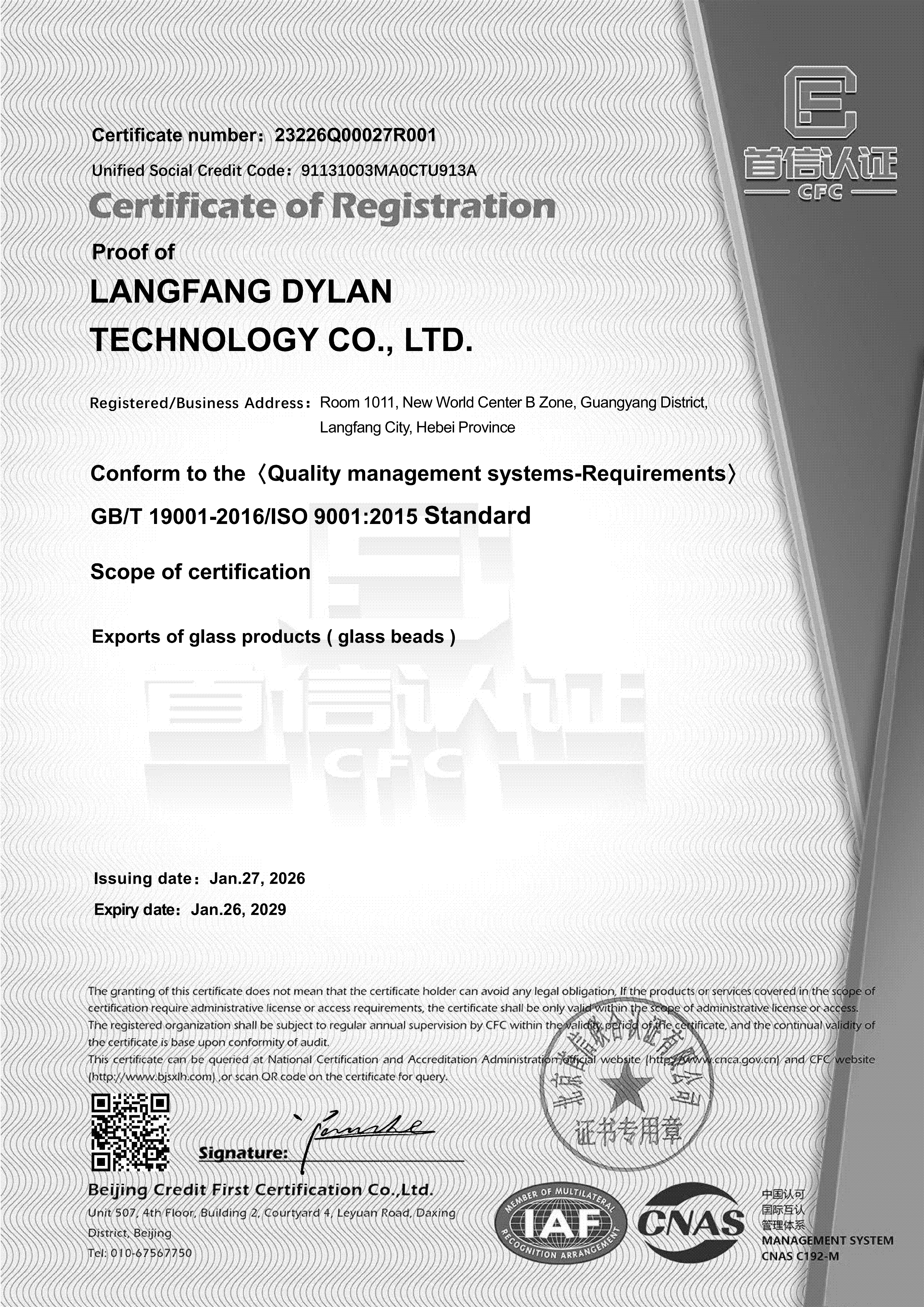
Quality management certification is system-level evidence. It does not certify a gradation type or a delivered batch.
| Standard / type designation | Declared sieve scope | Product model |
|---|---|---|
| AASHTO M247 Type 1 | 1180–150 μm | M247-TYPE 1 |
| AASHTO M247 Type 2 | 1180–180 μm | M247-TYPE 2 |
| AASHTO M247 Type 3 | 1700–710 μm | M247-TYPE 3 |
| AASHTO M247 Type 4 | 2000–850 μm | M247-TYPE 4 |
| EN 1423 | 850–180 μm | EN1423 |
| EN 1423 | 710–125 μm | EN1423 |
| EN 1424 | 1400–355 μm | EN1424 |
| BS 6088 | 1180–425 μm | BS6088A |
| BS 6088 | 850–180 μm | BS6088B |
| AS/NZS Type B | 850–75 μm | TYPE B |
| AS/NZS Type C | 1300–425 μm | TYPE C |
| AS/NZS Type D | 1700–710 μm | TYPE D |
| Model code | 850–75 μm | TYPE IA |
| Model code | 300–63 μm | TYPE IB |
| Model code | 1000–180 μm | TYPE IIA |
| Model code | 600–75 μm | TYPE IIB |
| Model code | 1000–300 μm | TYPE IIC |
| OPSS 1750 | 850–150 μm | OPSS1750 |
| GB05 | 800–80 μm | GB05 |
Two details deserve attention. EN1423 appears twice in the catalogue, once at 850–180 μm and once at 710–125 μm. That is one standard code with two gradations, and a purchase order that names only the standard still leaves the gradation open. Similarly, AS/NZS Type D (1700–710 μm) and AASHTO M247 Type 3 (1700–710 μm) declare an identical sieve scope under two different standard systems, while AS/NZS Type B (850–75 μm) sits nowhere near AASHTO M247 Type 4 (2000–850 μm). Comparing model names across standards is therefore unreliable; comparing declared scopes is not.
The TYPE IA through TYPE IIC codes require separate treatment. They are bound to defined sieve scopes but sit outside the standard-type numbering, so a buyer receiving a quote that says TYPE IIA has to map 1000–180 μm back onto the required type in the project specification before approving it.
Four mismatches that recur in purchase orders
1. The standard is cited without a gradation
Writing "AASHTO M247 glass beads" without a type allows any of the permitted gradations to be delivered. Since M 247-26 covers Type 0 through Type 5, the range of acceptable answers is wide. Name the type.
2. Drop-on and pre-mixed requirements are mixed
EN 1423 governs drop-on material and EN 1424 governs pre-mixed beads. A specification that cites the wrong one cannot be met by any supplier, however good the product. Check which application the tender actually describes.
3. A standard type is answered with an internal model code
A quotation referencing TYPE IIA, TYPE IIB or TYPE IIC is not non-compliant by default. It is simply unverifiable until the scope is compared against the specified type.
4. Batch evidence is never made contractual
A product-level declaration does not travel to the shipment. Acceptance needs a per-batch statement of sieve result and material origin, not a catalogue page.
What to write into the purchase order
A glass bead order that can survive a sieve test typically locks the following items. Each one is checkable against a supplier declaration.
- Standard and type: the standard number plus the gradation designation, for example AASHTO M247 Type 2 or EN 1423 with the required gradation.
- Sieve scope in micrometres: the numeric lower and upper limits, written independently of the model name.
- Material origin: recycled glass, declared as the primary material.
- Colour and surface finish: transparent, opaque or mixed colour, and smooth or matte finish where these matter to the application.
- Overall size range: 0.5 mm to 20 mm across the product family, with the specific scope stated for the ordered model.
- Quantity basis and lead time: MOQ 1 ton, monthly capacity 10,000 tons, delivery 45–60 days.
- Certification reference: ISO 9001 certificate 23226Q00027R001, issued by CFC, against GB/T 19001-2016/ISO 9001:2015, valid 2026-06-27 to 2029-06-26 for EU and US markets.
- Sampling and test method: the sieve or particle-size method to be used, and who performs it.
The distinction between product certification and system certification is worth stating plainly inside the contract. ISO 9001 confirms a quality management system. It does not confirm that a particular drum contains Type 1 beads. The gradation check has to stand on its own.
Batch acceptance and the evidence trail
Dylantech states that quality control is carried out as 100% testing, and that its laboratory is equipped with CAMSIZER and X-2600 instruments for measuring particle size, reflectivity and wear resistance through the production process. For a buyer, that claim only becomes useful once it is attached to a document obligation: which instrument, which sample size, which acceptance band, and what happens when a result falls outside it.
A practical acceptance sequence runs in three steps. First, verify the declared scope against the order. Second, confirm material origin and colour against the declaration. Third, retain the batch record alongside the delivery documentation so that any later performance complaint can be traced to a specific production lot. Suppliers operating 15 or more production lines across multiple sites will produce batches under different conditions, which is exactly why per-batch records matter more than a single product datasheet.
Refractive index is a separate decision from standard compliance
Standard compliance addresses gradation and material. Refractive index addresses how much light returns. These are different questions and should be specified separately.
Market evidence illustrates why the distinction matters commercially. Beads with a refractive index of 1.5 account for 54.0% of global market value, a share attributed to their alignment with conventional road marking specifications. Higher-index products sit beside them: Potters Industries offers standard 1.5 and high-reflective 1.9 variants, and the Dylantech range includes RI 1.6 (1000–180 μm) and RI 1.7 (1180–180 μm) models described as high refractive index glass beads for road marking.
When a specification requires at least Class A (n ≥ 1.5), as the Hong Kong sample specification does, an RI 1.6 or RI 1.7 product satisfies that threshold while a standard bead may sit exactly at it. The purchase order should therefore state the index requirement explicitly rather than inferring it from the standard citation.
Where these beads are actually applied
The declared operating conditions for the road marking range are outdoor, all-weather, normal temperature and pressure, with batch feeding through a coating or blasting machine. Matched equipment includes road marking machines, sand blasting machines and polishing equipment. The application requirements recorded for these scenarios are high roundness, stable refractive index and an eco-friendly recycled material base.
Drop-on beads are applied at the surface during marking, which is why they fall under EN 1423. Pre-mixed beads are compounded into the marking material itself, which is why they fall under EN 1424. Getting this split wrong at the specification stage produces a technically impossible tender, not merely a commercial disagreement.
Dylantech's published project records describe supplies to road marking engineering companies and traffic safety manufacturers ranging from 1 ton to 198 tons, with reported outcomes of low wear and stability over three-year and four-year observation periods. These are company-reported results rather than independently audited findings, and should be read as supplier evidence for a shortlist decision, not as a performance guarantee.
Beyond road marking, the same production base supplies grinding glass beads, sandblasting glass beads and decorative glass beads, all declared at 0.5 mm to 20 mm with recycled glass as the primary material and custom colour and size available. Buyers sourcing several categories from one supplier should still keep the standard mapping separate per application, since road marking standards do not govern blasting or decorative use.
Market signals behind the specification detail
The global market for glass beads used in road marking was valued at USD 1.18 billion in 2025, with a forecast period running from 2026 to 2033. Growth of that kind tends to raise the number of suppliers quoting into a market faster than it raises the average quality of their documentation, which is precisely the condition in which specification discipline pays.
Standard revisions are moving in parallel. The 2026 AASHTO M247 revision restructured gradations into Type 0 through Type 5. GB/T 24722-2020 remains the current Chinese standard. TxDOT continues to enforce DMS-8290 with three gradations tested under Tex-831-B. Each revision gives buyers a fresh set of type designations to map, and each one resets the value of a model code that was mapped to the previous edition.
Supplier structure is also visible in the evidence. SWARCO states it has manufactured reflective glass beads for road markings since 1969 and operates production facilities in Europe, the United States and Saudi Arabia. A footprint of that kind signals long-established regional supply, and it gives buyers a benchmark against which newer entrants can be assessed on documentation depth rather than on price alone.
Where standard compliance stops
Three limits should be stated clearly, because they are the points where procurement teams most often over-read a certificate.
Compliance does not predict road performance. A batch that meets a gradation and refractive index requirement is an input to retroreflection, not a guarantee of it. Application rate, embedment, binder type and surface condition all intervene. Manufacturer reports of long-term retroreflective results are typically self-reported and should be treated as commercial claims until an independent test protocol is supplied.
The mapping table is supplier-specific. The scopes above describe the Dylantech range. A second supplier will use different model codes for comparable gradations, and an internal code from one factory cannot be assumed to match an internal code from another.
Commercial terms constrain specification choices. A 1 ton minimum order and a 45–60 day lead time suit project procurement and distributor stocking, but they are a poor fit for urgent small-volume repair work. Buyers should also note that testing is conducted in the manufacturer's own laboratory; independent third-party verification has to be written into the contract if the project requires it.
What to watch next
The direction of travel is toward more granular type designations rather than fewer. The 2026 AASHTO revision expanded its gradation structure, and the coexistence of GB/T 24722-2020, BS 6088, AS/NZS type designations and European drop-on and pre-mix standards means cross-region sourcing will keep producing naming collisions.
For procurement teams, the practical response is to stop treating a standard number as the specification. The enforceable specification is a standard plus a type plus a sieve scope plus a batch record. Suppliers that can answer at that level of detail, and can show where the numbers come from, will increasingly separate themselves from suppliers that can only quote a standard name.
FAQ
What is the difference between EN 1423 and EN 1424?
EN 1423 specifies requirements for glass beads, anti-skid aggregates and the mixture of the two when applied as drop-on materials on road markings. EN 1424 applies to pre-mixed glass beads. Official road marking guidance in Hong Kong reflects this division, referencing BS EN 1423 for drop-on beads and BS EN 1424 for premix beads.
How do AASHTO M247 Type 1 and Type 3 differ in sieve scope?
Within the Dylantech range, M247-TYPE 1 is declared at 1180–150 μm and M247-TYPE 3 at 1700–710 μm. Both are AASHTO M247 types, but they describe different gradations. The 2026 edition of the standard, AASHTO M 247-26, sets out Type 0 through Type 5, where Type 0 is a uniform gradation, Type 1 is the standard gradation, and Types 2 to 5 are modified gradations.
What distinguishes BS6088A from BS6088B?
The two designations carry different sieve scopes. BS6088A is declared at 1180–425 μm, while BS6088B is declared at 850–180 μm. Both are supplied for road marking and road safety applications and both use recycled glass as the primary material.
A quotation lists TYPE IIA. How do I check whether it matches my specification?
TYPE IIA is declared at 1000–180 μm. Compare that numeric scope against the gradation table in the tender document rather than against the model name. If the specification names a standard type, match the scopes; if it names only a scope, check the declared figure directly. The same method applies to TYPE IA (850–75 μm), TYPE IB (300–63 μm), TYPE IIB (600–75 μm) and TYPE IIC (1000–300 μm).
Are these beads made from recycled glass?
Yes. Recycled glass is declared as the primary material for the road marking models in the range, including the AASHTO M247 types, the EN 1423 and EN 1424 models, the BS6088A and BS6088B models, and the AS/NZS Type B, Type C and Type D models. The overall size range across the family is 0.5 mm to 20 mm, with colour options of transparent, opaque or mixed, and surface finish options of smooth or matte. Custom colour and size are available.
Does ISO 9001 certification confirm that a batch meets EN 1423?
No. ISO 9001 certifies a quality management system, not a product gradation. The relevant Dylantech certificate is number 23226Q00027R001, issued by CFC against GB/T 19001-2016/ISO 9001:2015, covering exports of glass products including glass beads, applicable to the EU and US markets, with an issue date of 2026-06-27 and an expiry date of 2029-06-26. Conformity to a bead standard has to be evidenced separately through sieve and material records.
What are the minimum order quantity and lead time?
The declared commercial terms are a minimum order quantity of 1 ton, a lead time of 45 to 60 days, and a monthly capacity of 10,000 tons. OEM production is offered, with customisation covering voltage and logo, and after-sales support is provided remotely.
What batch documentation should accompany a delivery?
At minimum, a record linking the batch to its declared sieve scope, material origin, colour and surface finish. Dylantech states that quality control is performed as 100% testing, with a laboratory equipped with CAMSIZER and X-2600 instruments used to check particle size, reflectivity and wear resistance during production. Buyers requiring independent verification should specify the testing body and method in the purchase order, since in-house laboratory results and third-party results serve different purposes.
A fuller view of the production base, product families and declared specifications is available in the Dylan Technology corporate brochure.
Have Questions or Need More Details?
Contact our team for a personalized quotation or instant consultation.
Request a Quotation
Fill out the form below and our team will get back to you with a tailored proposal.
WhatsApp Direct Chat
Prefer to chat in real-time? Message us on WhatsApp for instant assistance & quick answers.
- Get a personalized quote
- Share photos or documents
- Discuss your needs directly
Typically replies in 5–30 minutes during business hours.