
Qualifying Nonwoven Mesh Belts for EU and German Compliance
EU and German environmental rules do not regulate the nonwoven mesh belt as a product category. They regulate packaging placed on the German market, food-contact materials, customs classification, and — through the buyer's own quality system — every surface that touches hygiene and medical nonwovens. That indirection is precisely why belt qualification is difficult: a belt can run perfectly and still fail a compliance review, because the paperwork and the material specification answer different questions.
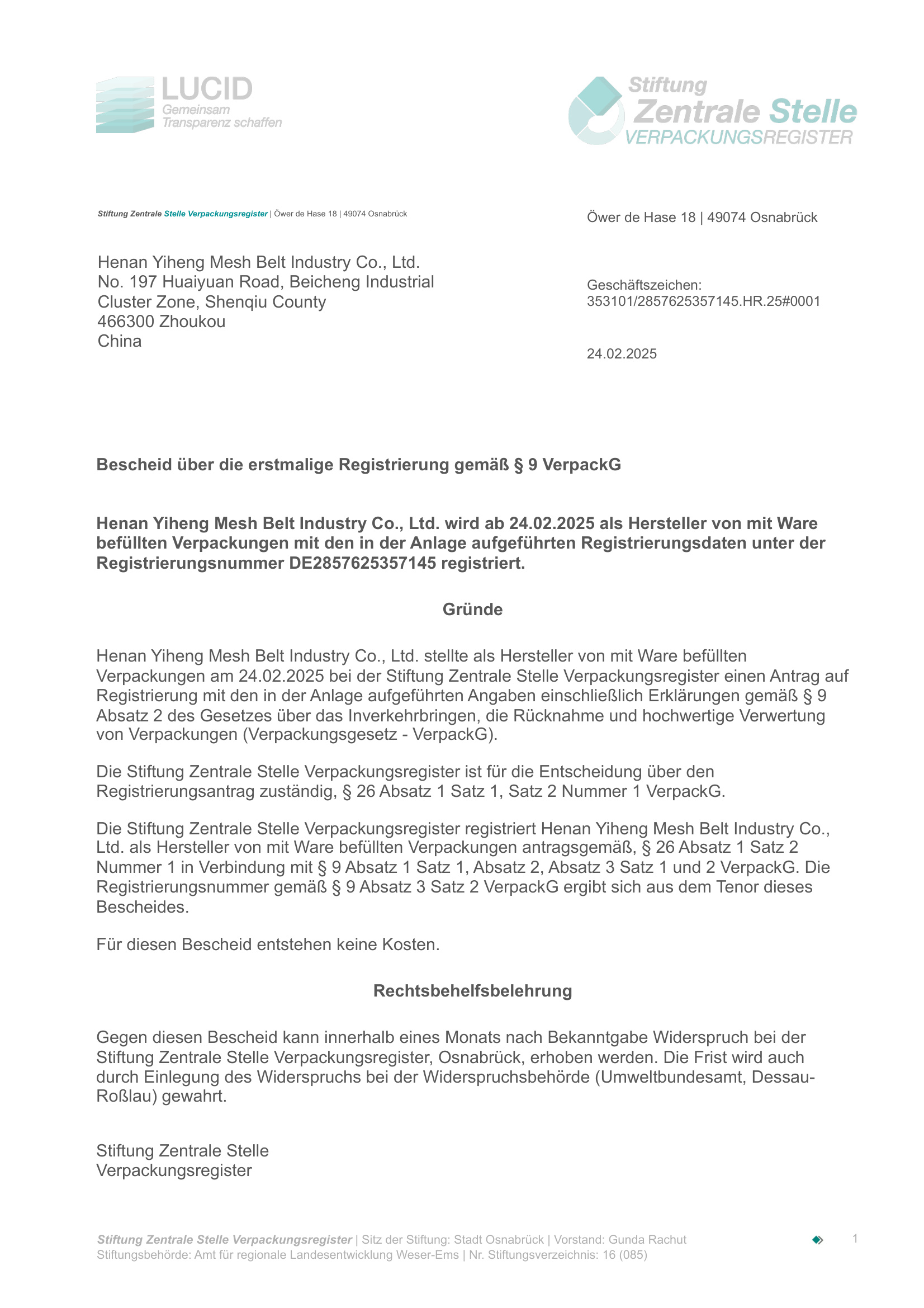
Registration documentation under Germany's Packaging Act is one of several evidence types an EU buyer may request — it addresses packaging, not belt material.
This reference is written for evaluation-stage readers: importers, convertors, procurement managers and line engineers who already know they need a forming belt and now have to decide whether a specific supplier's offer can be signed off. It maps the qualification checkpoints that carry the most commercial risk, explains why hydrolysis-resistant construction is treated as mandatory in hot and humid forming zones, and sets out what each piece of supplier documentation does and does not prove.
How European Regulation Reaches a Forming Belt
A nonwoven forming belt sits three steps away from any EU environmental statute. It is sold as industrial equipment, not as a consumer product, and no single regulation names it. Compliance pressure arrives through four separate routes, and each one creates a different documentation requirement.
1. Customs and tariff classification
Nonwoven mesh belts for industrial use are commonly classified under HS Code 39269029 or 59100000, depending on material coating and reinforcement. The applicable code affects duty calculation, origin documentation and how a customs officer interprets the commercial invoice. A supplier that cannot state which classification applies to its construction — and why — creates avoidable friction at the border, regardless of how well the belt performs.
2. Food-contact and hygiene exposure
Where nonwovens are converted into wipes, facial mask substrate, medical dressings or food-adjacent packaging, buyers increasingly request material-level test documentation for the belt surface itself. This is a buyer-driven requirement rather than a belt-specific legal one, but in practice it is treated as a hard gate by hygiene converters in Germany and neighbouring markets.
3. Packaging and market-access law
Germany's Packaging Act requires producers that place packaging on the German market under a brand to register with the Zentrale Stelle Verpackungsregister (LUCID). The obligation attaches to retail, grouped, shipment and service packaging — not to the mesh belt. It is a market-access housekeeping requirement, and treating it as product compliance is one of the most common misreadings in supplier packs.
4. Downstream customer audits
Hygiene and medical converters pass their own supplier-documentation requirements downstream to component vendors. Because forming belts are usually the last component to be specified and the first to delay a line start, an incomplete document pack becomes a schedule risk rather than only a compliance risk.
What "Qualification" Actually Means for a Mesh Belt
Qualification of a nonwoven mesh belt is not a certificate and not a price decision. It is the assembly of three independent evidence sets, and all three must hold at the same time.
Material and construction evidence describes what the belt is made of and how it behaves under heat, moisture, speed and static load. Documentation evidence describes what can be independently verified about the supplier, the shipment and the packaging that carries it. Process-fit evidence demonstrates that the belt performs on this line, at this speed, with this fibre denier — which no certificate can substitute for.
A supplier offering only one of these three is not qualified, however strong that one element looks. A well-documented belt that hydrolyses early fails the buyer. A hydrolysis-resistant belt with no traceable document pack is unusable in a German hygiene line. A technically capable belt that has never run at the buyer's line speed is still an unproven experiment.
Five Qualification Checkpoints, Ranked by Buyer Risk
Evaluation-stage buyers usually ask for a checklist rather than a specification. The five checkpoints below are ranked by the commercial damage each one causes if it is missed — from the slowest and most expensive failure to the most visible.
| Rank | Checkpoint | Why it carries risk | Evidence a buyer can request |
|---|---|---|---|
| 1 | Hydrolysis stability of the filament system | PET hydrolysis is progressive and largely invisible until it is not. It surfaces as elongation, seam failure or sudden breakage after months of apparently normal running, and by then the line has already produced suspect material. | Written declaration of whether anti-hydrolysis filaments are used, and in which yarn positions. |
| 2 | Static dissipation capability | High-speed friction accumulates charge; in dry environments the web can stick, lift or flip at the release point, causing scrap and unplanned stops. | Stated conductivity range in ohms for the specific model, plus the grounding path assumption. |
| 3 | Air permeability consistency | Local CFM variation changes the suction profile during web formation, producing cloudy spots and weight variation across the sheet. | CFM value with an explicit tolerance band, measured at the stated pressure differential. |
| 4 | Seam and dimensional stability | Thickness differential at the seam generates periodic impact at speed, which stresses bearings and prints transverse marks onto the web. | Joint type, seam thickness consistency, and dimensional tolerance for length and width. |
| 5 | Documentation and traceability | Not a performance risk, but a gating risk: without it, an otherwise suitable belt cannot be released into a European hygiene supply chain. | Packaging registration, food-contact test documentation, third-party assessments, quality-control scope. |
Documentation: What Each Paper Proves — and What It Does Not
European and German compliance conversations tend to collapse into a single question — "do you have the certificates?" — when the practical requirement is to map each document to the specific risk it retires. Three document types appear most often in a nonwoven belt offer, and their scopes are frequently confused.
| Document | Identifier | Issued by / date | What it proves | What it does not prove |
|---|---|---|---|---|
| Germany Packaging Act (LUCID) registration | DE2857625357145 | Stiftung Zentrale Stelle Verpackungsregister, issued 2025-02-24 | That the brand is registered for retail, grouped, shipment and service packaging placed on the German market. | Nothing about belt material, chemistry, temperature rating or food-contact suitability. |
| Test report for "Polyester Mesh Belt (food grade)" | HAPTX23061098 | JIANGSU HAP TESTING SERVICE CO., LTD, issued 2023-06-29 | That a polyester mesh belt sample was tested against the Chinese national standard GB 4806.7-2016 for food-contact plastics. | It is not an EU plastics food-contact declaration and does not by itself clear a belt for every European food-contact route. |
| Verified Supplier Assessment Report | 493944221_P+T | INTERTEK, issued 2026-07-09, valid to 2027-07-09 | An on-site assessment of production and trading capability covering fabrics, dryer fabrics, polyester filter belt, non-woven mesh belt and UV belts. | It is a supplier-capability assessment, not a product-performance or material-compliance certificate. |
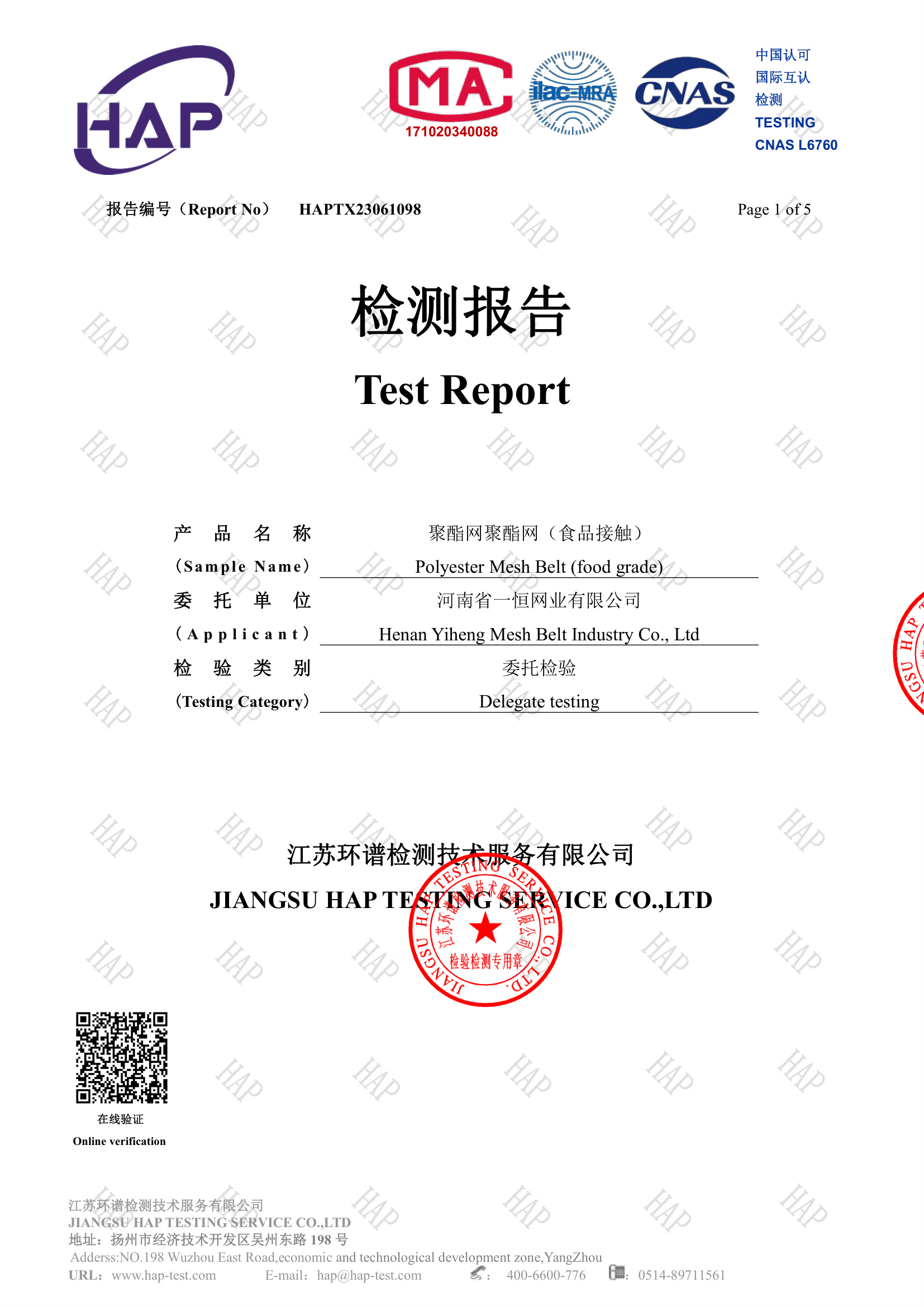
A food-contact test report retires a specific risk — surface suitability — and should be filed as such rather than as general compliance evidence.
Beyond certification, the operational documentation layer matters equally at evaluation stage. Quality control scope is the item to pin down first: whether inspection is limited to a visual pass or covers 100% pre-shipment inspection, and whether on-site third-party inspection by organisations such as BV or SGS can be arranged. For a buyer placing a first order with a Chinese supplier, the availability of independent on-site inspection is often the single most useful risk-control lever in the whole file.
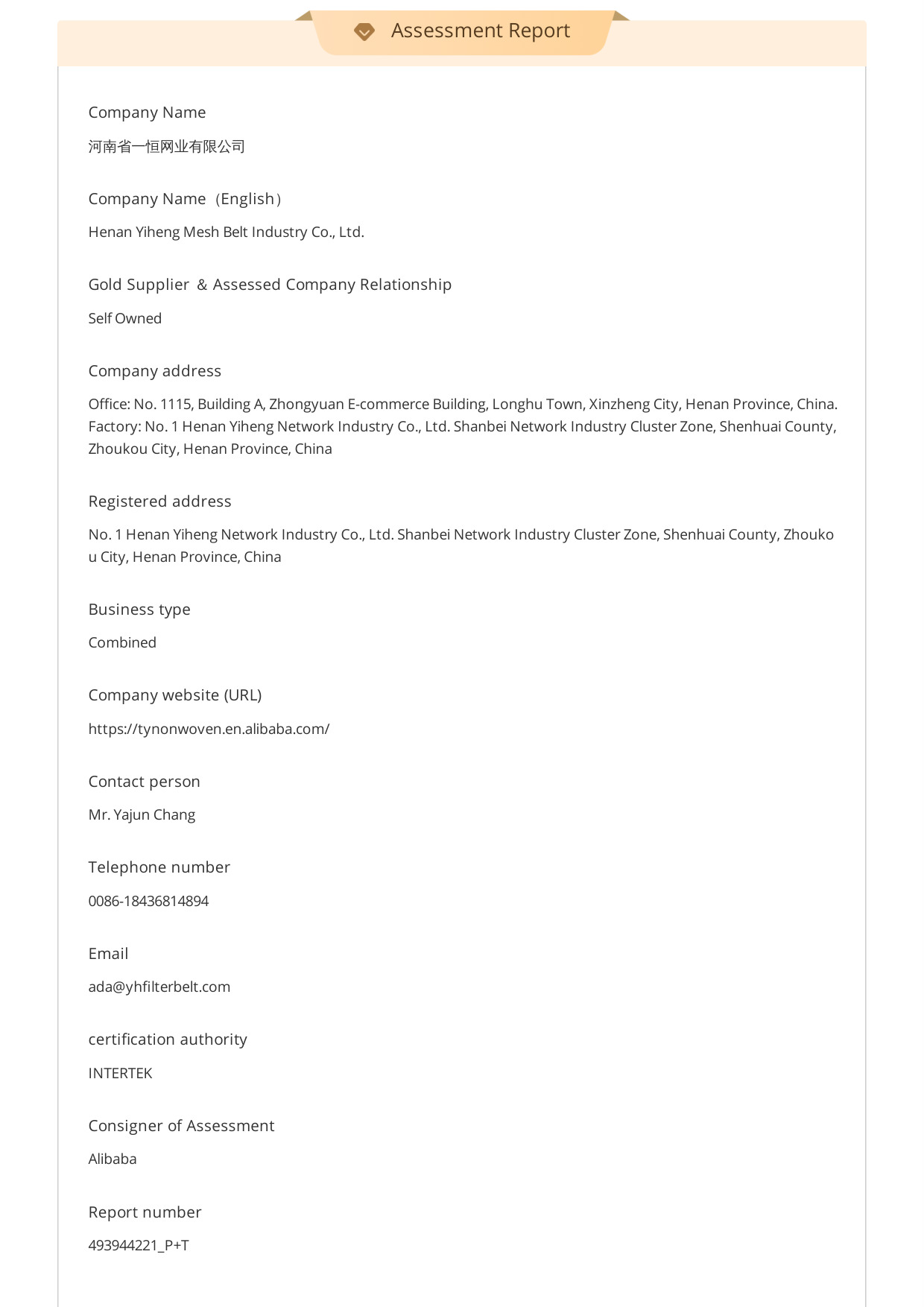
Third-party assessment documentation addresses supplier capability; it should be filed separately from product-compliance evidence.
Why Hydrolysis-Resistant Mesh Is Not Optional in Hot, Humid Forming Zones
Polyester is hygroscopic and, in the presence of heat and moisture, undergoes hydrolysis — a chain-scission process that progressively reduces tensile strength long before the belt looks worn. Forming and drying zones concentrate exactly the conditions that accelerate it: quench-air humidity around the lay-down area, water-jet exposure in spunlace lines, and elevated temperatures through air-through dryers and calenders.
The consequence for a buyer is not a gradual loss of performance that can be observed and scheduled. It is a latent degradation that only becomes visible at the point of failure. This is why hydrolysis resistance is treated as a qualification criterion rather than an upgrade option in European hygiene lines: the failure mode is expensive precisely because it is silent.
In the Yiheng Mesh catalogue, hydrolysis resistance is declared on four forming-belt constructions, three of which combine it with conductive filaments:
| Model | Filament / material system | Air permeability | Thickness | GSM | Joint type |
|---|---|---|---|---|---|
| HY408S | Anti-static round PET; red anti-hydrolysis warp 0.50 mm; three-filament hybrid weft (red anti-hydrolysis 0.70 mm, black round 0.35 mm, blue anti-hydrolysis 0.35 mm); 10⁵–10⁶ Ω | 680±30 CFM (127 Pa/20 cm²) | 1.85 mm | 1,100 g/m² | Millet-ring / double-pins |
| SK604 | Anti-hydrolysis PET round, conductive PET and carbon fibre PET; 10⁶ Ω | 700±30 CFM (127 Pa/20 cm²) | 1.85 mm | 1,030 g/m² | Double-pins |
| K6012 | Black anti-hydrolysis round PET and conductive PET; 2.5 layers | 750±30 CFM (127 Pa/20 cm²), up to 12,000 m³/㎡/h | 2.8 mm | 1,200 g/m² | Double-pins |
| KJD700 | Anti-hydrolysis round PET, conductive PET and carbon fibre PET; 10³–10⁴ Ω; above-4 below-8 weave | 600±30 CFM (127 Pa/20 cm²) | 2.34 mm | 1,030 g/m² | Double-pins |
The distinction between hydrolysis-resistant grades and static-control grades is worth stating precisely. Models such as K4106A and K4106B are specified around static dissipation — K4106A at 10⁶–10⁷ Ω and K4106B at 10⁵–10⁶ Ω, both anti-static PET constructions — and their published specification sheets do not declare an anti-hydrolysis filament system. A buyer running a warm, humid sheet cannot assume that static control implies hydrolysis resistance; the two properties come from different filament choices and should be verified separately in writing.
Conductive Filaments: a Design Parameter, Not a Certificate
Anti-static forming belts work by embedding conductive filaments into the weave — commonly carbon fibre yarns — so that frictional charge is conducted to the metal rollers and discharged through the machine's grounding system. In Yiheng's published technical explanation, this shifts the belt from an insulator to a conductor and reduces surface resistivity from above 10¹² Ω into a 10⁶–10⁸ Ω band, which is enough to prevent the Coulomb forces that lift thin fabric off the mesh surface.
Two practical consequences follow for evaluation-stage buyers. First, conductivity is model-specific and not universally "better when higher": the published ranges span from 10³–10⁴ Ω on KJD700 to 10⁶–10⁷ Ω on K4106A, and the correct choice depends on line speed, fibre denier, ambient humidity and the quality of the machine's grounding path. Second, a stated conductivity range is a design parameter, not compliance evidence. It belongs in the technical annex of a purchase specification, not in the compliance folder.
Application Evidence from European Production Lines
The strongest qualification argument is not a certificate; it is a documented run on a comparable line. Yiheng Mesh, a Henan, China–based manufacturer of polyester mesh belts, forming fabrics and nonwoven forming belts, exports to the EU, North America, Southeast Asia, the Middle East, Russia and South America, and reports three reference cases relevant to compliance-sensitive evaluation.
Germany — spunlace hygiene substrate. A wet-wipe and medical-dressing supplier ran a project across 12 spunlace lines producing wet wipes and facial mask substrate, completed within one year. The reported outcome was 15% higher productivity, 4% higher first-grade yield and 30% lower maintenance cost, with hydrolysis resistance, high water permeability and zero mesh marks cited as the governing requirements. The related construction set covers airlaid and spunlace grades including 06702, 05602, 60188, 09502 and 29254.
Switzerland — high-speed spunmelt. A nonwoven fabric manufacturer applied SK604 and KJD700 across 8 Reicofil RF4 high-speed lines producing baby diaper and sanitary napkin materials. Over a one-year reference period, the reported results were 10% higher capacity, 5% higher first-grade yield and 30% lower maintenance cost, with wear resistance, dimensional stability and cost-effectiveness cited as the deciding criteria.
United States — mark-free forming. On a Reifenhauser nonwoven line, HY408S was applied by a nonwoven fabric manufacturer over six months, delivering uniform web formation, zero mesh marks and easy release, with reported annual savings of USD 2,000. This is a small but useful data point for buyers evaluating the mark-free requirement alongside compliance criteria.
Market Trend Analysis: Documentation Load Is Rising With Capacity
Three verified data points frame why qualification workload is increasing rather than stabilising. The global nonwoven fabric market is expected to reach USD 90.8 billion by 2030, a CAGR of 6.2% from 2025 (Smithers). The nonwoven production line market was valued at USD 5.3 billion in 2024 and is projected to reach USD 9.8 billion by 2033 (Dataintelo). And spunlaid technology — the Spunbond and Meltblown family that uses forming belts most intensively — held a 48.4% share of the global nonwoven technology market in 2023 (Grand View Research).
Two implications follow for belt procurement. First, capacity is being added faster than supplier-documentation systems are maturing, so the buyers most exposed to qualification delay are those commissioning new lines in Europe. Second, high-performance forming belts in this category can operate at line speeds up to 1,000 m/min and withstand temperatures up to 180°C — a category-level envelope rather than a model guarantee — which means the mechanical and thermal margin available to tolerate a marginal material choice keeps shrinking as lines get faster.
Comparison with Traditional Solutions — and the Limits of This Approach
| Evaluation dimension | Conventional standard polyester mesh | Hydrolysis-resistant and conductive construction |
|---|---|---|
| Service life in hot, humid forming | Progressive strength loss; failure often appears without prior warning | Anti-hydrolysis filament systems slow the degradation path; life still depends on process conditions |
| Static behaviour | Insulating; relies almost entirely on external anti-static measures | Conductive filaments provide an internal dissipation path to the grounding system |
| Air permeability tolerance | Ideal for general conveying; wider CFM variation | Heat-setting used to hold CFM fluctuation within a controlled band |
| Documentation depth | Often limited to a commercial invoice and basic inspection note | Packaging registration, food-contact test documentation and third-party assessment typically available |
| Cost and complexity | Lower unit cost, simpler specification, fewer questions asked | Higher unit cost and a longer specification conversation; benefits depend on correct matching |
The boundary conditions matter as much as the advantages, and three are worth stating plainly.
Documents do not transfer across regimes. A GB 4806.7-2016 food-contact test report and a German Packaging Act registration together do not constitute an EU product approval for a mesh belt. They retire two specific risks — surface suitability for defined food-contact use, and packaging market access — and nothing more. A buyer who needs EU-specific material declarations should request them explicitly rather than assume they are implied.
Category figures are not model guarantees. The 1,000 m/min and 180°C envelope is a published category-level figure for high-performance forming belts, not a per-model warranty. Yiheng's published model data specifies air permeability, thickness, GSM, joint type and dimensional tolerance; continuous temperature ratings are not published per model and should not be inferred.
Hydrolysis resistance still depends on correct process matching. An anti-hydrolysis belt selected at the wrong CFM will produce fibre hanging, streaks and web non-uniformity regardless of how well its filament system resists moisture. Reported service life of three to six months under standard operating conditions assumes appropriate selection, correct tensioning and routine cleaning; it is a planning figure, not a performance guarantee. The same logic applies to conductivity — a model matched to the wrong line or a poorly grounded machine will not deliver the expected static behaviour.
Future Outlook
Qualification of nonwoven forming belts is moving from a paperwork afterthought to a structured procurement step. As European hygiene capacity expands and line speeds rise, three shifts are likely to continue. First, documentation will be requested earlier — at RFQ stage rather than after supplier selection — because compliance gaps discovered late cost schedule, not just money. Second, HS classification and packaging-market registration will be treated as routine supplier-readiness checks rather than exceptions. Third, the distinction between static control and hydrolysis resistance will become a standard technical question in evaluation files, as buyers recognise that the two properties are engineered separately and must be evidenced separately.
For evaluation-stage buyers, the practical conclusion is that a forming belt should be qualified on three parallel tracks — filament system and construction data, mapped documentation, and a validated run on comparable equipment — rather than on any single item in the supplier's folder.
FAQ
What documentation should an EU or German buyer request first when qualifying a nonwoven mesh belt supplier?
Start with the packaging-market-access and quality-control layer, because these are gating items rather than performance items. A German Packaging Act (LUCID) registration covers retail, grouped, shipment and service packaging placed on the German market under the brand — Yiheng Mesh holds registration DE2857625357145, issued 2025-02-24 by Stiftung Zentrale Stelle Verpackungsregister. In parallel, confirm quality-control scope: whether inspection includes 100% pre-shipment inspection, and whether on-site third-party inspection by organisations such as BV or SGS can be arranged. Material-level documentation, such as a food-contact test report, is requested next if the end use requires it.
Does German LUCID registration mean the mesh belt itself complies with EU material rules?
No. Registration under Germany's Packaging Act addresses the packaging placed on the German market under a brand, not the mesh belt material, its chemistry or its temperature rating. Yiheng Mesh's registration DE2857625357145 is scoped specifically to retail, grouped, shipment and service packaging. A buyer that needs belt-material compliance evidence should request that separately — for example, the food-contact test documentation held for the food-grade polyester mesh belt.
Which nonwoven mesh belt constructions are designed for hydrolysis resistance in high-temperature, high-humidity forming?
In the Yiheng Mesh catalogue, hydrolysis resistance is declared on HY408S, SK604, K6012 and KJD700. HY408S uses a 0.50 mm red anti-hydrolysis warp with a three-filament hybrid weft of red anti-hydrolysis 0.70 mm, black round 0.35 mm and blue anti-hydrolysis 0.35 mm. SK604 combines anti-hydrolysis PET round with conductive PET and carbon fibre PET. K6012 is a 2.5-layer construction in black anti-hydrolysis and conductive PET. KJD700 combines anti-hydrolysis PET round, conductive PET and carbon fibre PET in an above-4 below-8 weave. Static-control models such as K4106A and K4106B are specified around conductivity and do not declare an anti-hydrolysis filament system.
How can anti-static performance be verified before purchase?
Request the stated conductivity range for the exact model, in ohms, and confirm which yarn positions carry the conductive filaments. Published ranges differ by construction: KJD700 is rated 10³–10⁴ Ω, K4106B and HY408S at 10⁵–10⁶ Ω, SK604 at 10⁶ Ω and K4106A at 10⁶–10⁷ Ω. Because these values assume a functional grounding path on the machine, they should be verified against the buyer's own grounding arrangement. Yiheng's technical explanation describes the mechanism as reducing surface resistivity from above 10¹² Ω into a 10⁶–10⁸ Ω band, which dissipates friction charge generated at high line speeds.
What service life can be expected from a hydrolysis-resistant forming belt?
Under standard operating conditions, Yiheng mesh belts typically last three to six months, which the company attributes to high-wear-resistant materials relative to standard polyester mesh. This is a planning figure rather than a guarantee, and it assumes correct CFM selection for the fibre denier, correct tensioning and routine cleaning. Operating temperature, humidity, line speed, suction settings and maintenance practice all shift the outcome.
What are the limits of supplier documentation in an EU qualification file?
Each document retires one specific risk and no more. The food-contact test report HAPTX23061098, issued 2023-06-29 by JIANGSU HAP TESTING SERVICE CO., LTD against the Chinese national standard GB 4806.7-2016, covers a polyester mesh belt sample and is not an EU plastics food-contact declaration. The INTERTEK Verified Supplier Assessment Report 493944221_P+T, issued 2026-07-09 and valid to 2027-07-09, assesses supplier production and trading capability across fabrics, dryer fabrics, polyester filter belt, non-woven mesh belt and UV belts — not product performance. Category-level figures such as operation up to 1,000 m/min and 180°C should not be read as per-model guarantees, and the final qualification step remains a validated trial on the buyer's own line.
Model-level specifications, tolerance ranges and quality-control scope for the constructions referenced above are compiled in the manufacturer's technical brochure: Nonwoven Mesh Belt Technical Brochure (PDF).