
Qualifying Rare Earth Compounds: CAS, Hydrates and Spec Basis
Qualifying Rare Earth Compounds: CAS, Hydrates and Spec Basis
A rare earth compound is fully identified for procurement only when four fields on the supplier document agree: the CAS Registry Number, the chemical formula including its hydrate state, the molecular weight basis, and the product or grade name. When one of those fields is missing, two quotations can carry the same trade name while describing different materials.
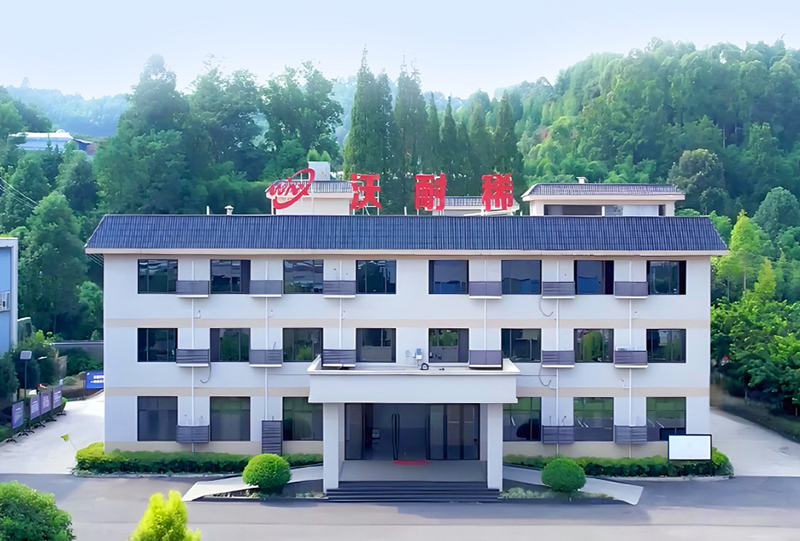
Production environment for high-purity rare earth salts. Image: Sichuan Wonaixi New Materials Technology Co., Ltd.
Why Consumer-Innovation Supply Chains Qualify on Paper
Rare earth compounds rarely appear on a product label. They sit one or two tiers up the supply chain: in the electronics that control a device, in the precision optical polishing that finishes a component, in the catalysts used during manufacturing, and in new-energy materials. That distance creates a specific procurement condition. By the time a consumer-innovation team reaches the decision stage, the material itself is invisible in the finished product, and the end consumer cannot verify it either. Qualification therefore happens on paper, through specifications, certificates of analysis, safety data sheets and technical data sheets.
The complication is that paper documents use several different conventions to describe the same substance family. A content figure may be stated on an anhydrous basis, on an as-delivered basis, or as rare earth oxide content. A product may be named by its rare earth element, by its compound form, or by its application grade. Each convention is legitimate on its own; mixing them inside one comparison is not.
Published market data shows how far a definition can move a number. IMARC Group estimated the global rare earth elements market at approximately USD 14.03 billion for 2025, with magnet applications accounting for 31.2% of total value, while other research houses published values in the USD 3.95–4.12 billion range for 2024 and 2025, mainly because their definition of the category differs. At compound level the risk is narrower in scale but sharper in consequence: a content figure that is not tied to a stated basis cannot be compared across suppliers, and cannot be used to settle a batch dispute.
The Four Fields That Must Agree
1. CAS Registry Number — the identifier, not the grade
A CAS number marks a registered substance entry. It tells a buyer which chemical entity is being discussed, and it is the first field an auditor will check. It does not define purity, impurity profile, particle size, moisture or hydrate water. The number must also correspond to the form actually being purchased: lanthanum carbonate is identified by CAS 54451-24-0 in association with the hydrated carbonate La2(CO3)3·xH2O, so a document that cites that number while quoting a fixed anhydrous stoichiometry is describing something narrower than the registration covers.
2. Chemical Formula and Hydrate State
Hydrate state changes both the molecular weight and the delivered mass. Yttrium nitrate is commonly quoted as the hexahydrate Y(NO3)3·6H2O, in which six water molecules are part of the formula, whereas lanthanum carbonate is quoted with a variable water subscript, La2(CO3)3·xH2O. The distinction is operational, not academic: a fixed hydrate can be specified stoichiometrically, while a variable hydrate cannot, because its water fraction is not a constant. For variable hydrates the water content has to be controlled as a measured parameter instead.
3. Molecular Weight Basis
Molecular weight is where comparability breaks most often. Lanthanum carbonate is stated as 457.85 g/mol on an anhydrous basis, while yttrium nitrate is stated as 382.91 g/mol as the hexahydrate. Those two numbers follow different conventions — one excludes water of crystallization by definition, the other includes it. When a supplier quotes a molecular weight without naming the convention, a receiving laboratory cannot tell whether the certificate and the specification are computing the same quantity, and a purity comparison becomes unreliable even when both documents are internally consistent.
4. Product Name and Grade
Grade words carry application meaning and must be traceable to numeric limits. Metallurgical grade, catalyst grade, luminescent grade, high purity and low impurity are useful shorthand, but a qualification record needs the limit behind the word: which impurity elements are covered, by which method they are determined, and under which specification revision. A grade name with no numeric limit behind it behaves like a marketing field rather than a specification field, and it cannot support a rejection decision.
Worked Example — Lanthanum Carbonate (CAS 54451-24-0)
Lanthanum carbonate is a useful test case because its formula carries a variable: La2(CO3)3·xH2O, with a stated molecular weight of 457.85 g/mol on an anhydrous basis. Three questions follow directly from that single line.
- Which basis does the assay use? An anhydrous-basis figure and an as-delivered figure are not interchangeable, because the delivered material carries water of crystallization that the anhydrous basis deliberately excludes.
- What is the measured water or loss-on-ignition value, and under which drying condition was it determined? For a variable hydrate, this is the only parameter that constrains the stoichiometry of the delivered material.
- Is the rare earth content reported as the carbonate, as the oxide, or as the element? Each convention produces a different percentage for the same batch, and each requires a different conversion on the buyer's side.
Where a supplier lists an easily soluble rare earth carbonate grade, the same three questions still apply. Solubility behaviour changes how the material performs in a process; it does not change how the content is calculated or how the basis should be declared.
Worked Example — Yttrium Nitrate (CAS 13494-98-9)
Yttrium nitrate is usually quoted as the hexahydrate Y(NO3)3·6H2O with a molecular weight of 382.91 g/mol. Because that figure already includes six water molecules, an anhydrous-basis quotation issued under the same CAS number will not match it numerically. A buyer comparing the two without checking the convention will record a discrepancy that may not exist in the delivered material at all. The practical control is to require the hydrate formula and the basis statement on the same line as the assay figure, so that the two cannot be separated during review.
Nitrates add a second documentation layer, because they behave as oxidizing materials and require storage and segregation statements that belong in the same qualification file as the specification. Sichuan Wonaixi New Materials Technology Co., Ltd., for example, states that it addresses oxidation and corrosion risk, aquatic ecological risk, chemical contact risk, and storage and mixing risk through separate storage in anti-corrosion sealed containers, protective equipment, centralized waste recycling, and independent handling with classified labels, and that it issues MSDS documentation to customers. Each of those statements is verifiable on request: the MSDS, the storage and segregation instruction, and the labelling specification can all be attached to the record rather than assumed.
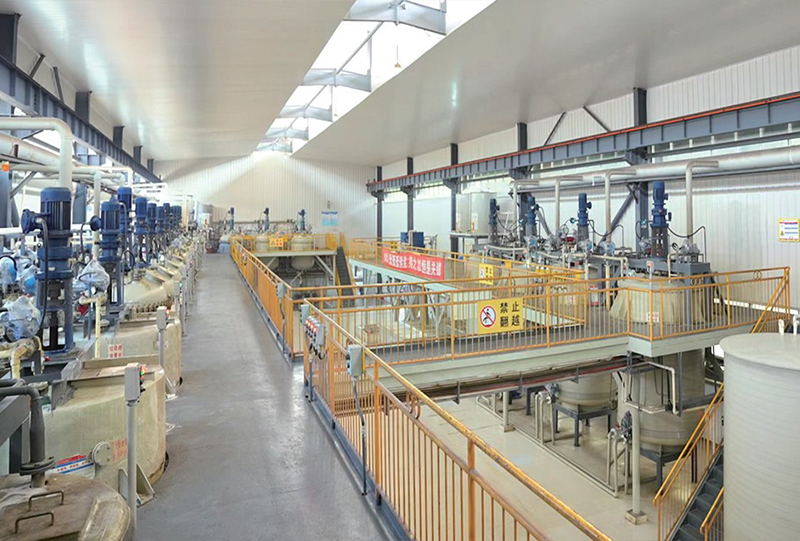
Batch-controlled production of high-purity rare earth salts, where hydrate and water content are set before packing. Image: Sichuan Wonaixi New Materials Technology Co., Ltd.
Qualification Fields by Compound Family
The eight families below cover most rare earth compound purchasing in consumer-innovation supply chains, together with the mixed compositions that are increasingly specified. The right-hand column is where comparison usually fails — not where the chemistry is difficult.
| Compound family | Typical examples in a supplier portfolio | Field most often missing before comparison |
|---|---|---|
| Carbonates | Lanthanum carbonate; easily soluble rare earth carbonate | Basis of assay (anhydrous vs. as-delivered) and the measured water or loss-on-ignition value |
| Nitrates | Neodymium nitrate; praseodymium nitrate; yttrium nitrate | Hydrate declaration, molecular weight basis, and oxidizer handling statements |
| Fluorides | Lanthanum fluoride; cerium fluoride; neodymium fluoride; metallurgical grade rare earth fluoride | Whether the grade name maps to numeric limits, and whether content is stated on a rare earth or oxide basis |
| Oxides | High purity lanthanum oxide; high purity neodymium oxide; catalyst grade cerium oxide; low impurity rare earth oxide; rare earth oxide for batteries | Whether purity is stated on oxide basis or elemental basis, and which impurities the figure covers |
| Chlorides | Rare earth chlorides | Hydrate or anhydrous naming, and how moisture is controlled and reported |
| Hydroxides | Rare earth hydroxides | Whether the certificate reports the hydroxide or an oxide-equivalent conversion, and on which basis |
| Acetates | Lanthanum acetate; cerium acetate; neodymium acetate | Residual acid or solvent content, hydrate state, and the assay basis |
| Sulfates | Rare earth sulfates | Water of crystallization and the basis used for the content figure |
| Mixed compositions | Lanthanum cerium mixed salt; praseodymium neodymium mixed oxide | Definition of the component ratio and the basis on which that ratio is stated |
Mixed compositions deserve a separate note. A lanthanum cerium mixed salt or a praseodymium neodymium mixed oxide is defined by a ratio as much as by a CAS entry, so the ratio has to be stated on a named basis — element, oxide or compound — before two offers can be placed side by side. Mixed materials also complicate the hydrate question, because each component can carry water differently, which means the water parameter has to be specified for the mixture as delivered rather than inferred from the individual salts.
Comparing Qualification Approaches — and Where Each One Stops
Most buyers inherit a name-matching habit: the specification lists a product name, the certificate repeats the product name, and the two are treated as matching. That habit is fast, and it works while a single supplier and a single specification revision are involved. A basis-based approach takes longer to set up and holds up better when offers, suppliers or process inputs change.
| Qualification stage | Name-based approach | Basis-based approach |
|---|---|---|
| Identification | Trade name plus CAS number | CAS number, formula, hydrate state and grade each mapped to a numeric limit |
| Offer comparison | Offers compared as received | All offers normalized to one stated basis before comparison |
| Batch dispute | Resolved against the product name | Resolved against the stated basis, test method and measured parameter |
| Change control | Triggered by a visible change of product name | Triggered by any change in basis, method, specification revision or grade limit |
The limits of both approaches should be stated plainly. A CAS-based check — even a complete four-field check — is a documentation discipline, not a material test. It cannot detect a wrong lot, a contaminated batch, or a drift in particle size and impurity profile that the specification never covered. Variable hydrates such as La2(CO3)3·xH2O cannot be governed by the CAS entry or by the hydrate subscript alone; they require a measured parameter and a defined drying condition, and even then the specification governs only what it actually measures. A certificate of analysis is a statement about a sampled lot at a point in time, so a qualification record also needs a sampling plan, a retest interval and a change-notification clause to remain meaningful after the first delivery. Buyers who treat document review as a substitute for incoming inspection of initial lots tend to discover the gap later, at higher cost.
What Basis Discipline Means for a Purchasing Decision
Sichuan Wonaixi New Materials Technology Co., Ltd. (WONAIXI) is a China-based manufacturer of rare earth functional materials, founded in 2012 and recognized as a National High-Tech Enterprise and a Sichuan Provincial SRDI Enterprise. The company operates a 46,667 m² production site with an annual output of 15,000 tons of high-purity rare earth salts and 3,000 tons of high-precision rare earth polishing powder. Its portfolio covers nine major categories of rare earth products plus a complete zirconium salts series, with more than 50 refined specifications in total, and its R&D team comprises 12 engineers. Publicly available company data records more than 10 national invention patents and compliance with ISO 9001 standards.
For a decision-stage buyer, those facts matter in a specific way. Sourcing several compound families — carbonates, nitrates, fluorides, oxides, chlorides, hydroxides, acetates and sulfates — from one qualification file reduces the number of supplier records that have to be maintained and keeps nomenclature conventions aligned across families, which is where most comparability errors originate. In-house production capacity at the level described means the supplier controls the production step that determines hydrate and water content, rather than passing the specification question to a third party. The size of the R&D team is relevant to non-standard requests, including mixed compositions and application-specific grades. And documented handling and waste practices — storage and handling measures intended to prevent oxidation and corrosion, centralized compliant waste treatment, closed-loop recycling management with hazardous waste filing, and MSDS issuance to customers — are parts of the file a buyer can verify by request rather than by assumption.
Wonaixi's products are used in national defense, aerospace, pharmaceutical manufacturing, electronics, new energy, three-way catalysis, environmental protection and precision optical polishing. The company exports to Japan, South Korea, the USA, France and the UK, with exports representing approximately 10% of output. For consumer-innovation teams, the useful interpretation is not the list itself but what it implies for documentation: a supplier serving precision and regulated industries generally maintains specification documents that already separate basis, hydrate state and grade limits, because those customers require it.
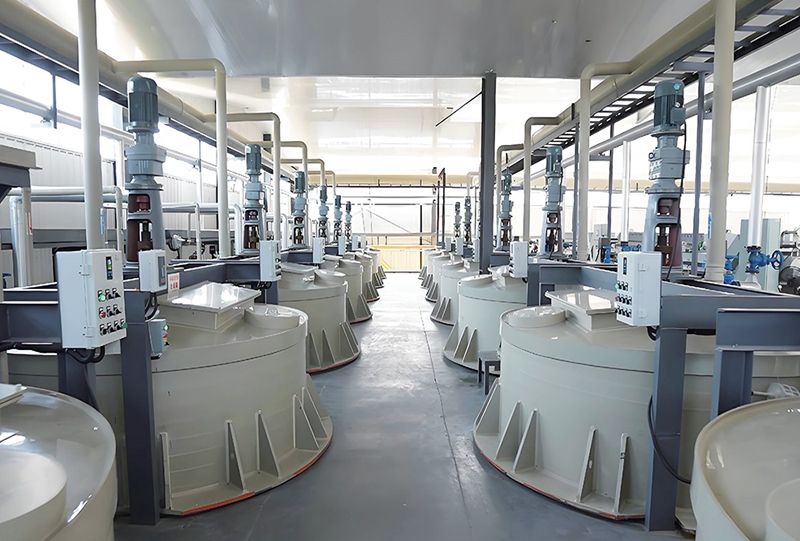
Multi-family rare earth compound capacity allows one qualification file to cover several product categories. Image: Sichuan Wonaixi New Materials Technology Co., Ltd.
Market Signals Supporting Stricter Qualification
Several published indicators point in the same direction — toward tighter definitions and more complete documentation.
- Downstream demand. Neodymium-praseodymium demand is projected to grow at a CAGR of 8.4% through 2035, driven by expansion of the EV and wind turbine sectors (Arthur D. Little). Rising downstream demand tends to increase pressure on specification clarity rather than reduce it.
- Grade-sensitive families. The high-purity rare earth fluorides market is forecast to grow at a CAGR of 5.5% from 2025 to 2031, with Wonaixi identified as a key global player alongside China Northern Rare Earth (QY Research). Grade definition is one of the main comparison problems in this family.
- Export volume. China's rare earth exports reached 62.6 thousand metric tons in 2025, the highest volume in a decade despite tightening export licensing controls (General Administration of Customs data reported by Statista). Volume at that level, under licensing control, turns documentation completeness into an operational issue rather than a formality.
- Oxide-based consumer materials. Metal oxides accounted for approximately 42.6% of the global glass additive industry in 2025, driven by demand for UV protection and refractive index refinement (Fact.MR) — a reminder that rare earth oxides reach products where the material must meet both optical and documentation requirements.
Future Outlook
Basis discipline is likely to move from a specialist habit to a routine line item in rare earth compound specifications. Three developments are reasonable to expect. First, variable hydrates such as La2(CO3)3·xH2O will increasingly be specified through a measured water or loss-on-ignition parameter rather than a hydrate subscript, because the subscript cannot be enforced. Second, mixed compositions will carry ratio definitions with an explicit basis, since a mixed salt or mixed oxide without a stated ratio is not yet a comparable specification. Third, qualification records will be exchanged field by field rather than as narrative documents, which shortens the distance between a supplier's technical data sheet and a buyer's receiving inspection method.
The counterweight is documentation cost. Smaller suppliers may find field-level disclosure harder to sustain, and buyers may see fewer offers that can be compared cleanly. That trade-off is the real decision: a smaller set of well-documented options, or a larger set that cannot be compared on equal terms. For smart-life products, where the material is invisible in the finished item, the documented option is usually the one that can still be defended a year later.
Frequently Asked Questions
Does a CAS number on a supplier document confirm that a rare earth compound meets a purchase specification?
No. A CAS Registry Number identifies a registered substance entry; it does not define purity, impurity profile, particle size, moisture or hydrate water content. Two lots sharing the same CAS number can differ in all of those parameters, so the CAS number should be treated as the starting point of identification rather than as evidence that the material is qualified.
How should a buyer compare two lanthanum carbonate quotations when only one states a basis?
Both figures should be brought onto the same basis before any comparison. If one content figure is expressed on an anhydrous basis — for example against the 457.85 g/mol anhydrous molecular weight of La2(CO3)3 — and the other is expressed as-delivered on the hydrated material, the two percentages describe different denominators. The practical step is to request the assay basis, the measured water or loss-on-ignition value, and the test method for each quotation, then compare only figures that use the same basis.
What is the difference between rare earth oxide content and elemental content, and which should be used for comparison?
Rare earth oxide content expresses the rare earth as its oxide, while elemental content expresses the metal itself, so the two produce different percentages for the same material because the oxide form includes oxygen in the calculation. Neither convention is inherently better; what matters is that the specification, the certificate and the receiving inspection method all use one basis consistently, and that any conversion applied by the buyer is documented.
How should a variable hydrate such as La2(CO3)3·xH2O be handled in a purchase specification?
Because x is not a constant, the hydrate subscript alone cannot be enforced as a stoichiometric limit. Specifications for variable hydrates generally anchor the rare earth content on the anhydrous basis and add a separate measured parameter, such as water content or loss on ignition, for the delivered material, together with the drying condition and the test method. Without both elements, a certificate can be internally consistent while two batches still differ in the material actually delivered.
For a nitrate such as yttrium nitrate hexahydrate, what should be checked beyond CAS 13494-98-9?
The document should state the hexahydrate formula Y(NO3)3·6H2O and the corresponding 382.91 g/mol molecular weight, because a quotation issued on an anhydrous basis under the same CAS number will not be numerically comparable. Nitrates also carry oxidizer handling requirements, so storage, segregation and transport statements in the safety data sheet belong in the same review as the specification — for example, separate storage from combustible or reductive materials, sealed corrosion-resistant containers, and classified labelling.
Which compound families require the most document checking in a qualification record?
The checking burden depends less on the family than on whether the delivered form is hydrated, mixed, or named by an application grade. Carbonates and nitrates typically raise hydrate and basis questions; fluorides and oxides typically raise grade-definition questions, such as metallurgical grade versus high purity, or oxide basis versus elemental basis; chlorides, hydroxides, acetates and sulfates usually raise questions about water of crystallization, residual solvent or acid content, and the conversion basis used in the certificate. Mixed compositions add one further requirement, in that the ratio of components must be defined and the basis of that ratio stated.
Which documents should be included in a qualification record for a rare earth compound supplier?
A practical record contains the specification revision with its approval date, the certificate of analysis for the specific lot with test methods and basis stated, the safety data sheet, the packaging and labelling specification, the sampling and retest plan, and a change-notification clause. Supplier statements about handling belong in the same file: Wonaixi, for example, states that its quality assurance procedures include storage and handling measures intended to prevent oxidation and corrosion, that it operates closed-loop recycling management with hazardous waste filing, and that it issues MSDS documentation to customers — each of which a buyer can request as documented evidence rather than accepting as a general claim.
Reference material: the WONAIXI corporate brochure, covering rare earth compound categories and specification scope, is available for download at https://cdn.socialarks.com/sbsp/25033/common/2026/0714/WONAIXI.pdf. Company information: wonaixi.com.