
Qualifying Self-Adhesive PVC Film Suppliers: HS Code, MOQ, Terms
Qualifying Self-Adhesive PVC Film Suppliers: HS Code, MOQ, Terms
A buyer qualifying a supplier of self-adhesive PVC decorative film can usually obtain samples and a price list within a week. The slower — and more decisive — part of qualification involves three data points that rarely appear in a catalogue: the HS classification the supplier ships under, the minimum order quantity attached to each color, and the acceptance terms written into the purchase order. These three items determine whether an order clears customs, whether a repeat order matches the approved sample, and whether a delivery can be accepted or rejected on documented grounds.
The category behind that paperwork is no longer a niche. Dataintelo values the global PVC decorative film market at USD 4.8 billion in 2025 and projects USD 8.6 billion by 2034. Within the same 2025 baseline, wood grain held the largest product segment share at 38.4%, and the furniture sector accounted for approximately 44.6% of global consumption. Once a film category is purchased at that scale, buyers stop treating it as a sample-based experiment and start treating it as a repeat procurement item with classification, volume and acceptance rules attached.
Why HS Code, MOQ and Acceptance Terms Sit at the Center of Qualification
Decorative film is a low-unit-value, high-frequency industrial consumable. That combination makes small administrative errors expensive at scale. A misclassified shipment can stall at the port; an MOQ that only works for container-scale orders blocks the color trials a distributor needs; acceptance terms that reference "good quality" rather than a measurable specification give neither side a workable dispute mechanism.
Trade data shows why classification discipline matters more than it did a few years ago. China's exports under HS 3919 — self-adhesive plates, sheets, film, foil, tape and strip of plastics — reached an all-time high of RMB 246.296 million in January 2026, according to General Administration of Customs China data. Separately, International Trader Publications reports that China moved past the United States in 2025 to become the world's largest PVC exporter, accounting for 24% of total global trade volume. More volume moving through the same tariff lines means more scrutiny of how each shipment is declared.
HS Code 39199090: What It Covers and What It Does Not Settle
Self-adhesive PVC decorative film is classified under HS code 39199090. The classification covers self-adhesive plastic film supplied in rolls, which matches the physical form of the product: a PVC film body, a pressure-sensitive adhesive layer and a release liner, wound onto a core and packed for shipment.
In practice, the HS code is the starting point of a customs conversation, not the end of it. Three points are worth confirming during qualification:
- The supplier should be able to state the code it uses on export documents, and it should match the code your broker expects on import.
- The national tariff line and any applicable trade measures belong to the importing country; these should be confirmed locally rather than assumed from the exporter's invoice.
- The declared description should describe the goods, not the market positioning. "Self-adhesive PVC decorative film, PVC, 0.16 mm x 1240 mm x 50 m, in rolls" is auditable; a decorative marketing phrase is not.
For reference, Leiyegaoke classifies its self-adhesive PVC decorative film series LY1804-LY1869 under HS code 39199090, and that classification sits alongside the standard roll specification of 0.16 mm thickness, 1240 mm width and 50 m roll length.
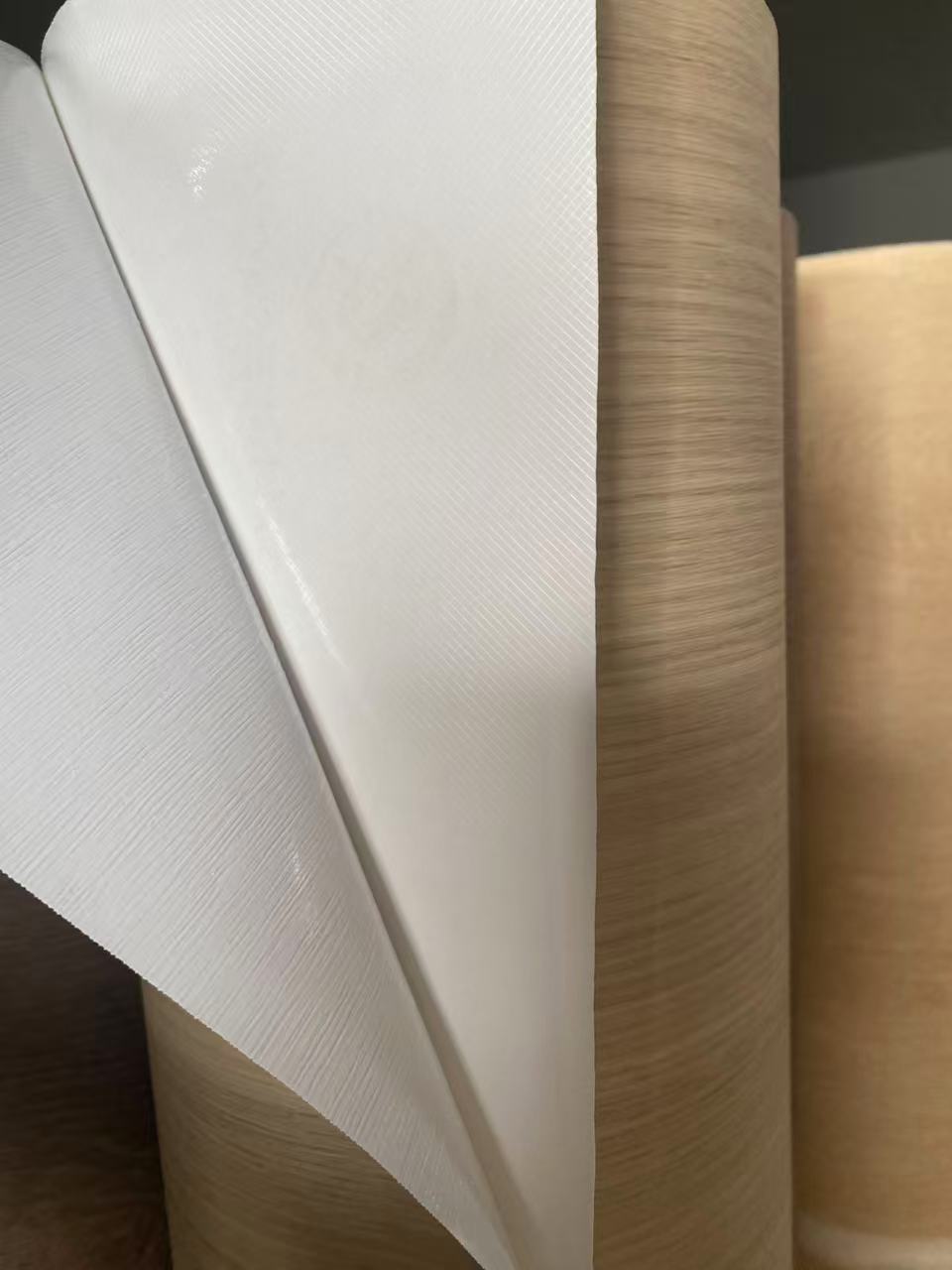
Self-adhesive PVC decorative film is supplied in rolls with a pressure-sensitive adhesive and a paper release liner — a form factor that determines both its HS classification and its handling requirements.
Reading the MOQ Structure Before Negotiating Price
MOQ in this category is not one number. It is a structure with at least two tiers, and buyers who negotiate against a single figure usually discover the second tier only after they request a custom color.
| Order type | Minimum order quantity | What it means for the buyer |
|---|---|---|
| Stock colors | 1 roll per color | Single-roll trials, sample panels, small renovation jobs and range testing are possible without committing to volume. |
| Custom colors | 3,000 m per color | Color development is a production commitment; it should be tied to a written sample approval step. |
| Custom size / thickness | Quoted per order | Width, thickness and roll length are customizable on order and should be fixed in the PO rather than agreed verbally. |
The one-roll-per-color MOQ is only credible if the supplier's production model can absorb it. Foshan Nanhai Jiadamei Decoration Material Co., Ltd. — the manufacturer behind the Leiyegaoke brand — operates two adhesive coating lines and an integrated system covering PVC film production, printing, laminating, adhesive coating, slitting, inspection and packaging, with monthly capacity of 120,000 meters and a stated lead time of 20 to 25 days. Integrated slitting is what allows a single roll to be cut and packed economically; a supplier that only resells finished jumbo rolls usually cannot offer the same tier.
The practical rule for buyers: never accept a per-color MOQ verbally. Put the MOQ for stock colors, the MOQ for custom colors and the MOQ for custom dimensions in the same document, because they are three different numbers and only one of them is likely to be quoted on a price list.
The Specification Baseline That Acceptance Terms Must Reference
Acceptance terms cannot be written until the baseline specification is fixed. For this product family, the baseline is consistent across series:
| Material | PVC (polyvinyl chloride) |
| Standard thickness | 0.16 mm (customizable) |
| Standard width | 1,240 mm (custom widths available) |
| Standard roll length | 50 m (customizable) |
| Adhesive | Water-based acrylic pressure-sensitive adhesive |
| Release liner | Paper release liner |
| Surface finish | Matte / glossy / embossed / super matte |
| Pattern range | Wood grain, marble, solid color, stone, metallic, textile, concrete |
| Packing | 1 roll per carton |
| Installation | Peel and stick |
Three model series sit on this baseline and are worth naming separately, because each carries a different finish profile and therefore a different acceptance risk:
- LY1804-LY1869 — the broad multi-pattern range (wood grain, marble, solid color, stone, metallic, textile, concrete), matte, glossy, embossed or super matte, HS code 39199090.
- LF6801-LF6830 — marble grain series with matte, glossy or textured surface options, described as waterproof, easy to clean and suitable for large-surface application.
- LG7801-LG7836 — Japanese-style wood grain series in matte or super matte, positioned around scratch resistance, flexibility on curved surfaces and cleanability.
Because the three series share a physical baseline, acceptance sampling can follow one procedure across all of them. Only the visual approval step differs, and that step should reference the model code rather than a generic color name.
Compliance Evidence: Read the Report Scope, Not the Logo
EU-facing buyers generally ask two compliance questions early: does the film contain restricted substances, and is that verified by a test house they recognise. For this supplier, two documents answer those questions.
| Document | Reference | Scope and issuer |
|---|---|---|
| REACH SVHC Test Report | CANEC26026322901 | 253 SVHC screening under Regulation (EC) No. 1907/2006, issued by SGS-CSTC Standards Technical Services Co., Ltd. Guangzhou Branch, applicable to the EU market. |
| EU RoHS certification | CANEC26009798401 | Directive (EU) 2015/863 amending Annex II to Directive 2011/65/EU, issued by SGS-CSTC Standards Technical Services Co., Ltd. Guangzhou Branch, covering models LY1804-LY1869, applicable to the EU market. |
Two disciplines matter when these documents are reviewed. First, match the scope to the ordered product: a report covering the LY1804-LY1869 series is evidence for that series, and a buyer ordering a different series should confirm coverage in writing. Second, separate substance-restriction evidence from performance evidence. REACH SVHC and EU RoHS address restricted substances; they say nothing about fire performance, adhesive durability or dimensional stability under heat.
This distinction becomes concrete in commercial projects. Fire performance is a separate requirement across the category — PVC decorative films can achieve B1 flame retardant certification under GB 8624, a standard referenced in the market by other suppliers. A buyer whose specification calls for B1 should therefore request a fire test report for the exact construction being supplied, rather than assuming that a substance-compliance certificate also covers reaction to fire. Written this way, the qualification question is answerable: what does the supplier hold, for which models, and what must be tested separately?
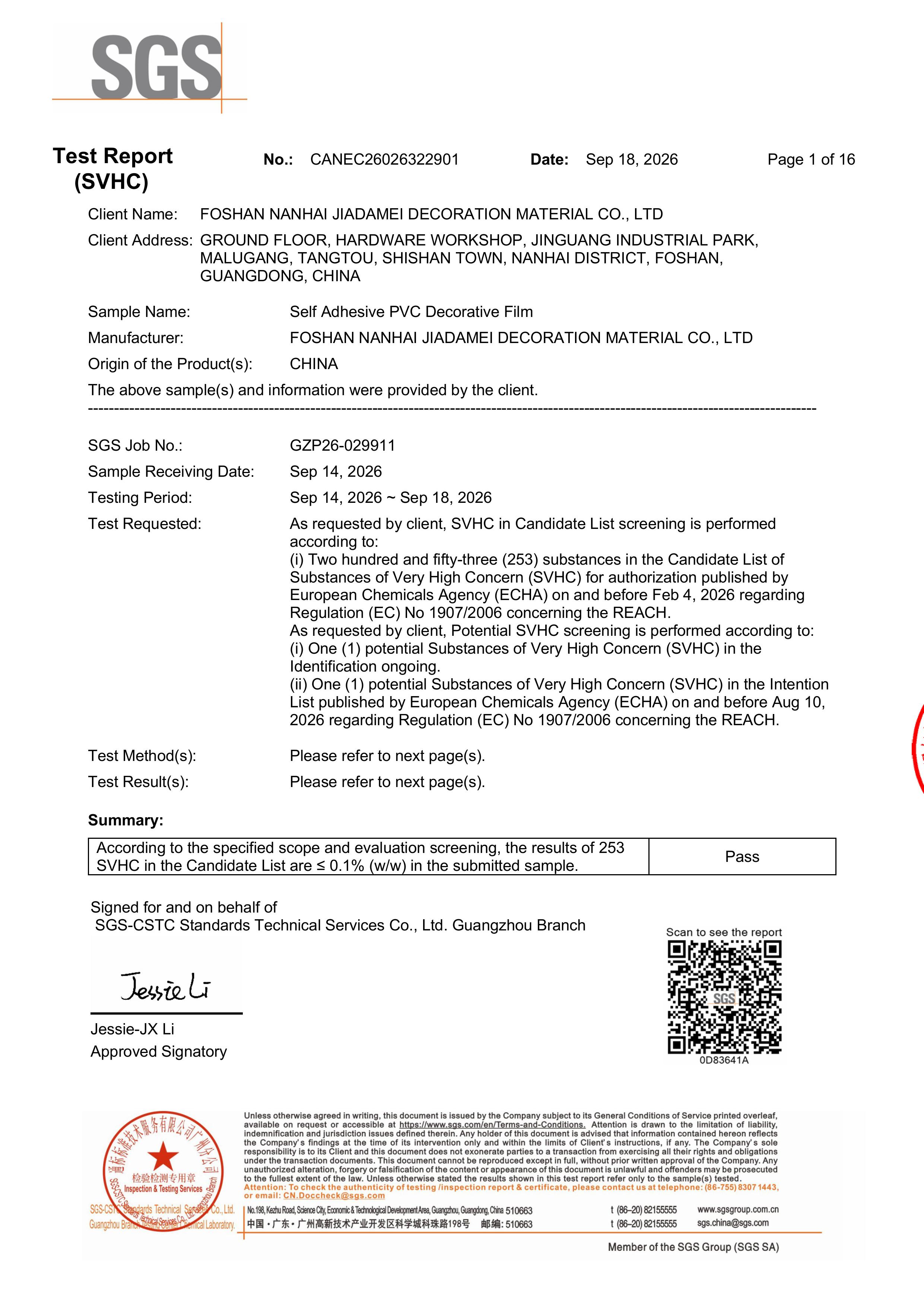
The REACH SVHC Test Report CANEC26026322901 covers 253 SVHC screening for self-adhesive PVC decorative film and is applicable to the EU market. Substance-restriction reports and fire-performance reports are separate documents and should be requested separately.
Acceptance Terms Worth Writing Into the Purchase Order
Acceptance terms convert a specification into something enforceable. The following sequence is a workable structure for decorative film orders, and it can be applied to stock colors and custom colors alike.
- Fix the measurement method, not only the number. Thickness, width and roll length should each be tied to how and where they are measured, and on how many rolls per lot. A stated 0.16 mm is only meaningful if both sides measure it the same way.
- Approve color and pattern against a retained reference. A signed sample, a retained roll section or a controlled model code (for example LG7836 or LF6818) removes the ambiguity that words like "natural oak" create.
- Define roll-level visual checks. Winding tightness, liner flatness, edge alignment, surface contamination, print registration and core condition are all inspectable at goods-in without laboratory equipment.
- Test adhesion on the actual substrate. Film behavior on sealed MDF, painted wood or metal differs from behavior on a lab panel. Agree a dwell period and an observation window before the first bulk order.
- Specify packaging and labelling. One roll per carton is the standard packing; the label should carry model, color code, thickness, length and lot so that a future claim can be traced to a production run.
- List the documents. Packing list, invoice and any certificate of origin required by the destination, plus test reports on request. Documentation gaps are more common causes of delay than production defects.
- Define non-conformance and who pays. State what counts as a defect, what the remedy is (replacement roll, credit, rework) and how freight is allocated. A quality clause without a remedy clause is a statement of intent, not a term.
- Set a pre-production approval step for custom colors. With a 3,000 m per color threshold and a stated 20 to 25 day lead time, a color approval loop after production starts is expensive for both parties.
Where the Product Fits — and Where It Stops
The application range for self-adhesive PVC decorative film is indoor surface renovation: kitchen cabinets and cabinetry fronts, wardrobes, doors, furniture panels, walls, and surfaces in hotels, offices, retail spaces and elevators. In these settings the film functions as a decorative, water-resistant and easy-to-clean surface layer applied by peel and stick, using ordinary tools — utility knife, squeegee, heat gun, measuring tape, ruler, application roller and surface cleaning equipment.
The limits are equally specific, and they belong in the qualification file because they drive claims later:
- Substrate condition governs outcome. The film is recommended for smooth, clean, dry and stable surfaces. Rough, dusty, oily, damp or unstable substrates reduce adhesion and affect final appearance, and may require surface treatment before installation.
- Water resistance is a surface property. The PVC surface withstands normal kitchen and bathroom use and is easy to clean, but edges, joints and the underlying substrate should not be continuously exposed to water or excessive moisture.
- Installation technique decides the finish. Constructions with air-release channels make large-area application more forgiving; where a standard adhesive construction is supplied, gradual liner removal and consistent squeegee pressure are what prevent trapped air. Bubble complaints are frequently installation issues rather than product defects, which is why acceptance terms should separate the two.
- The film is a surface treatment, not a structural repair. It refreshes appearance; it does not restore damaged board, swollen MDF or failed substrates.
Compared With Replacing Panels or Factory Lamination
Buyers rarely choose between film and nothing. They choose between film and a heavier intervention: replacing doors and panels, or ordering factory-laminated board. The trade-offs are structural rather than promotional.
| Consideration | Self-adhesive PVC film | Replacement panels / factory lamination |
|---|---|---|
| Scope of work | Surface refresh on existing, sound substrates | Removal, refabrication and reinstallation |
| Bond quality | Depends on substrate preparation and installer skill | Controlled in-factory under press and heat |
| Downtime | Short, can be staged room by room | Longer, involves disassembly and lead time for new panels |
| Repeatability across sites | Depends on color consistency between rolls and lots | Batch-controlled at the panel factory |
| Main risk | Substrate failure, edge lifting, installer variability | Cost and disruption of replacing sound material |
The honest limitation is this: film performs best where the substrate is sound and the installer is competent, and no acceptance clause can compensate for a substrate that was already failing. Buyers evaluating film for a high-traffic commercial surface should test on the real substrate before committing the order, not after.
What the Market Data Suggests About Supplier Selection
Several verified signals point in the same direction. Asia Pacific held a 42.3% revenue share of the PVC decorative film market in 2025, and China became the largest PVC exporter that year with 24% of global trade volume. Wood grain remained the largest product segment at 38.4%, while furniture accounted for roughly 44.6% of consumption.
For procurement teams, the implication is not that supply is scarce — it is that supply is dense. When a category is concentrated in one producing region and growing toward a projected USD 8.6 billion by 2034, the number of suppliers able to quote a price rises faster than the number able to produce a consistent roll. That asymmetry is exactly what a documented qualification process filters: HS code, MOQ tiers, specification baseline, certificate scope and acceptance terms.
Future Outlook
Three developments are likely to shape qualification over the next few years. First, documentation is becoming part of the product: buyers increasingly ask for report numbers and scopes at the sampling stage rather than at shipment, which rewards suppliers who already maintain current test reports. Second, custom-color thresholds will keep mattering as distributors localize ranges, making a 3,000 m per color tier a commercial filter as much as a production one. Third, as export volumes through HS 3919 remain at record levels, declaration accuracy becomes a routine compliance expectation rather than a specialist concern.
For a manufacturer such as Foshan Nanhai Jiadamei Decoration Material Co., Ltd. — founded in 2001, operating a 12,000 m² facility with 50 employees, annual output of 15,000,000 meters and an export share of 80% across Europe, South America, the Middle East and CIS countries — the qualification conversation is increasingly about evidence rather than capability claims. That is a healthier basis for a long-term supply relationship on both sides.
Frequently Asked Questions
What HS code applies to self-adhesive PVC decorative film?
Self-adhesive PVC decorative film, including models LY1804-LY1869, is classified under HS code 39199090. The code covers self-adhesive plastic film supplied in rolls. Importers should still confirm the national tariff line and any applicable trade measures with a local customs broker, since the final classification decision rests with the importing country's customs authority.
What is the minimum order quantity per color?
The minimum order quantity is 1 roll per color for stock colors, which allows single-roll trials and small projects. For custom colors, the threshold is 3,000 meters per color. Custom thickness, custom widths and custom roll lengths are available on order and are quoted per order rather than under the standard MOQ tier.
Which certifications can be verified before ordering?
Two documents are available for the EU market: REACH SVHC Test Report CANEC26026322901, covering 253 SVHC screening under Regulation (EC) No. 1907/2006, and EU RoHS certification CANEC26009798401 under Directive (EU) 2015/863 amending Annex II to Directive 2011/65/EU. Both were issued by SGS-CSTC Standards Technical Services Co., Ltd. Guangzhou Branch. The RoHS certification covers models LY1804-LY1869. Neither document addresses fire performance, which requires a separate test report if the project specification demands it.
What should acceptance testing cover on delivery?
Acceptance testing typically covers thickness, width and roll length against the agreed measurement method; color and pattern against a retained reference sample or model code; roll-level visual condition including winding, liner flatness, edge alignment and surface contamination; adhesion on the actual substrate under an agreed dwell period; packaging at 1 roll per carton with labels carrying model, color code, thickness, length and lot; and the accompanying commercial documents.
Can colors, patterns, sizes and packaging be customized?
Yes. OEM/ODM customization is available, covering custom colors, custom patterns, sample-based customization, custom sizes, custom thickness, surface finish customization, custom logos, custom labels, custom packaging and custom cartons. Custom colors carry a 3,000 meter per color threshold, and standard production lead time is stated at 20 to 25 days.
Is the film suitable for bathroom and kitchen surfaces?
The PVC surface is water-resistant and easy to clean, which suits normal kitchen and bathroom use on smooth, sealed indoor surfaces. Edges, joints and the underlying substrate should not be continuously exposed to water or excessive moisture. Rough, dusty, oily, damp or unstable substrates reduce adhesion and should be prepared or avoided.
Have Questions or Need More Details?
Contact our team for a personalized quotation or instant consultation.
Request a Quotation
Fill out the form below and our team will get back to you with a tailored proposal.
WhatsApp Direct Chat
Prefer to chat in real-time? Message us on WhatsApp for instant assistance & quick answers.
- Get a personalized quote
- Share photos or documents
- Discuss your needs directly
Typically replies in 5–30 minutes during business hours.