
Qualifying Shower Door Hardware for Hospitality: 304 Stainless vs Aluminium Alloy
Qualifying Shower Door Hardware for Hospitality: 304 Stainless vs Aluminium Alloy
Hotel and resort bathroom packages rarely fail on design intent. They fail on documentation.
When a glass shower enclosure is submitted for approval on a hospitality project, the component that most often decides whether the package clears review is not the glass panel — it is the hardware. Glass is governed by named safety glazing standards that specifiers already know how to check. Hinges, sliding tracks, pivot blocks, wall profiles and clamps are frequently specified with a single word: "stainless" or "chrome". That is not a specification a compliance reviewer can sign off on, and it is not sufficient for a bathroom that will be operated by hundreds of different guests and cleaned daily by housekeeping.
This industry reference is written for procurement managers, importers and project specifiers who need to qualify shower door hardware for hospitality work rather than simply buy it. It treats the material decision — 304 stainless steel versus aluminium alloy — as a documentation exercise, uses verified models from a single supplier range as worked examples, and closes with a qualification checklist that can be reused across a hotel roll-out.
Foshan SHKL Sanitary Ware Co., Ltd is a sanitary ware manufacturer established in 2004 that produces bathroom vanities, shower doors and LED bathroom mirrors for global markets, operating a 100,000 m² production base in China and a 40,000 m² factory in Vietnam.
Why Hospitality Hardware Qualification Differs From Residential Selection
Most shower door product data lists the same applicability statement for every model in the range: residential construction, commercial hospitality. That single line is where qualification problems begin, because it tells a reviewer that a model can be used in both contexts without telling them how the difference between the two was assessed.
The two contexts behave differently in four ways that matter to a submittal:
- Duty cycle. A residential shower enclosure may be operated a few times a day by a small household. A hotel bathroom may be used many times a day, every day, by guests who did not choose the product and have no reason to handle it carefully.
- Cleaning regime. Hospitality housekeeping applies cleaning agents on a schedule, not on demand. Hardware finishes and glass surface treatments are exposed to that chemistry repeatedly over the operating life of the room.
- Cost of failure. Replacing a hinge or a sliding carriage in an occupied hotel room is a maintenance event with a room-out-of-service cost attached. In a home, it is an inconvenience.
- Approval chain. Hospitality projects usually involve a specifier, a main contractor, an owner's representative and sometimes an authority having jurisdiction. Each of those parties can request evidence that a residential purchase never requires.
For these reasons, the relevant question in a hospitality submittal is not "is this bathroom-grade hardware?" but "which material grade, which finish system, which glass build, and which project type is this specific model documented against?"
304 Stainless Steel vs Aluminium Alloy: What Actually Differs in a Qualification File
Both material families appear within the same shower door programme, and — critically — they share the same glass craftsmanship options. That overlap is exactly why the material question is often skipped. Two models can look almost identical on a specification sheet and still carry different hardware materials, different finish requirements and different maintenance expectations.
| Verification dimension | 304 stainless steel hardware | Aluminium alloy hardware |
|---|---|---|
| How it appears in product data | Documented as "Hardware materials: 304 stainless steel" | Documented as "Hardware materials: Aluminium alloy" |
| Verified models in this range | KL-AS5577310 (hinge shower door); KL-AS5511312 (sliding shower door); KL-AS001-1 (shower screen) | KL-AS5104310 (frameless shower door); KL-AS5210422 (arc shower door); KL-AS5608212 (sliding shower door); KL-AS5507310 (hinge shower door); KL-AS5605110-5 (bathtub shower door) |
| Glass craftsmanship options | Clear / Tinted / Laminated / Flute / Chemically Frosted / Easy-clean / Film-coated | Identical list: Clear / Tinted / Laminated / Flute / Chemically Frosted / Easy-clean / Film-coated |
| Typical specification consideration | Generally selected where hardware is continuously wetted and the grade needs to be traceable to a material certificate | Generally selected where profile geometry, section weight and cost efficiency drive the design |
| What the buyer must document | Grade (304), finish system, component geometry, and the certificate behind the grade claim | Alloy specification as stated by the supplier, plus the finish system (anodised, powder-coated or polished) and the project type it was validated against |
| Common documentation gap | "Stainless steel" written without the grade | "Aluminium" written without the finish system |
Verified Reference Models for a Hospitality Specification
Three models in the SHKL range map directly onto the material question above, and they are useful in a submittal for a specific reason: the glass list is identical across all three, the documented applicability is identical across all three, and the only variable that changes in the qualification file is the hardware material.
- KL-AS5577310 — hinge shower door with 304 stainless steel hardware. Glass craftsmanship options: clear, tinted, laminated, flute, chemically frosted, easy-clean, film-coated. Applicable industry documented as residential construction and commercial hospitality.
- KL-AS5511312 — sliding shower door with 304 stainless steel hardware, the same seven glass options and the same documented applicability.
- KL-AS5104310 — frameless shower door with aluminium alloy hardware, the same seven glass options and the same documented applicability.
Using three models that share everything except the hardware material allows procurement teams to isolate the material variable. When a reviewer asks "why did you choose this model for this project?", the answer can be built on duty cycle, finish system and maintenance plan rather than on an unexplained preference.
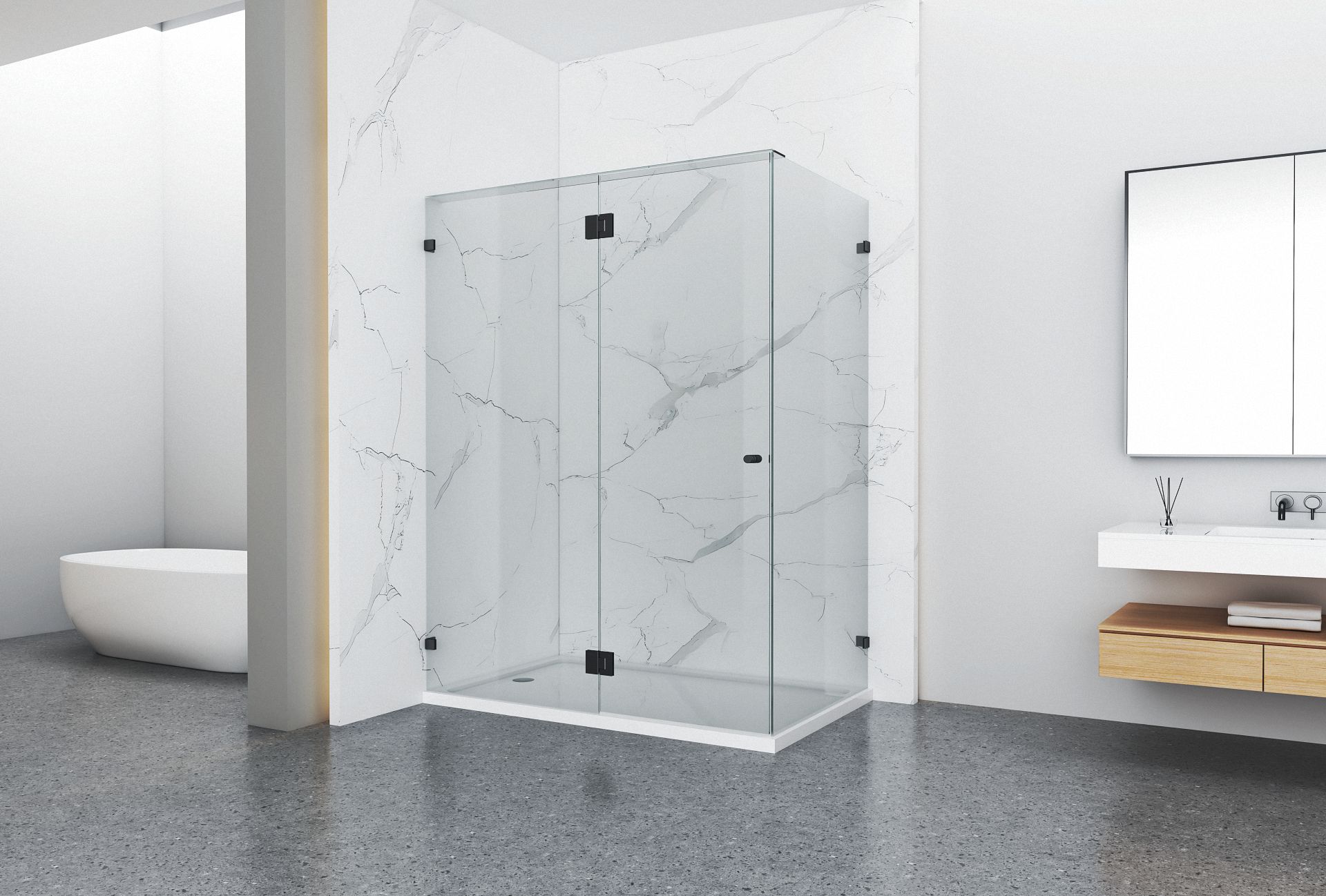
Glass Craftsmanship Options — What They Change, and What They Do Not
Seven glass craftsmanship options are documented across the shower door range. Each one affects the guest experience differently, and each one has a different implication for the specification file:
- Clear glass — the baseline visual specification; keeps compact guest bathrooms visually open.
- Tinted glass — reduces glare and adds a degree of visual separation in brightly lit bathrooms.
- Laminated glass — the option most often requested where anti-shatter behaviour has to be documented.
- Flute glass — a textured, design-led surface, typically used in premium suites or public bathrooms.
- Chemically frosted glass — provides privacy without an applied film edge.
- Easy-clean — a surface treatment aimed at housekeeping efficiency in high-turnover rooms.
- Film-coated — an additional surface treatment that must be coordinated with the glass build and the cleaning routine.
The critical point for a qualification file is this: all seven options are listed identically for 304 stainless steel models and aluminium alloy models. Glass choice therefore never substitutes for the hardware material decision. A hotel that specifies laminated easy-clean glass and an unspecified "stainless" hinge has documented half of the assembly, not all of it.
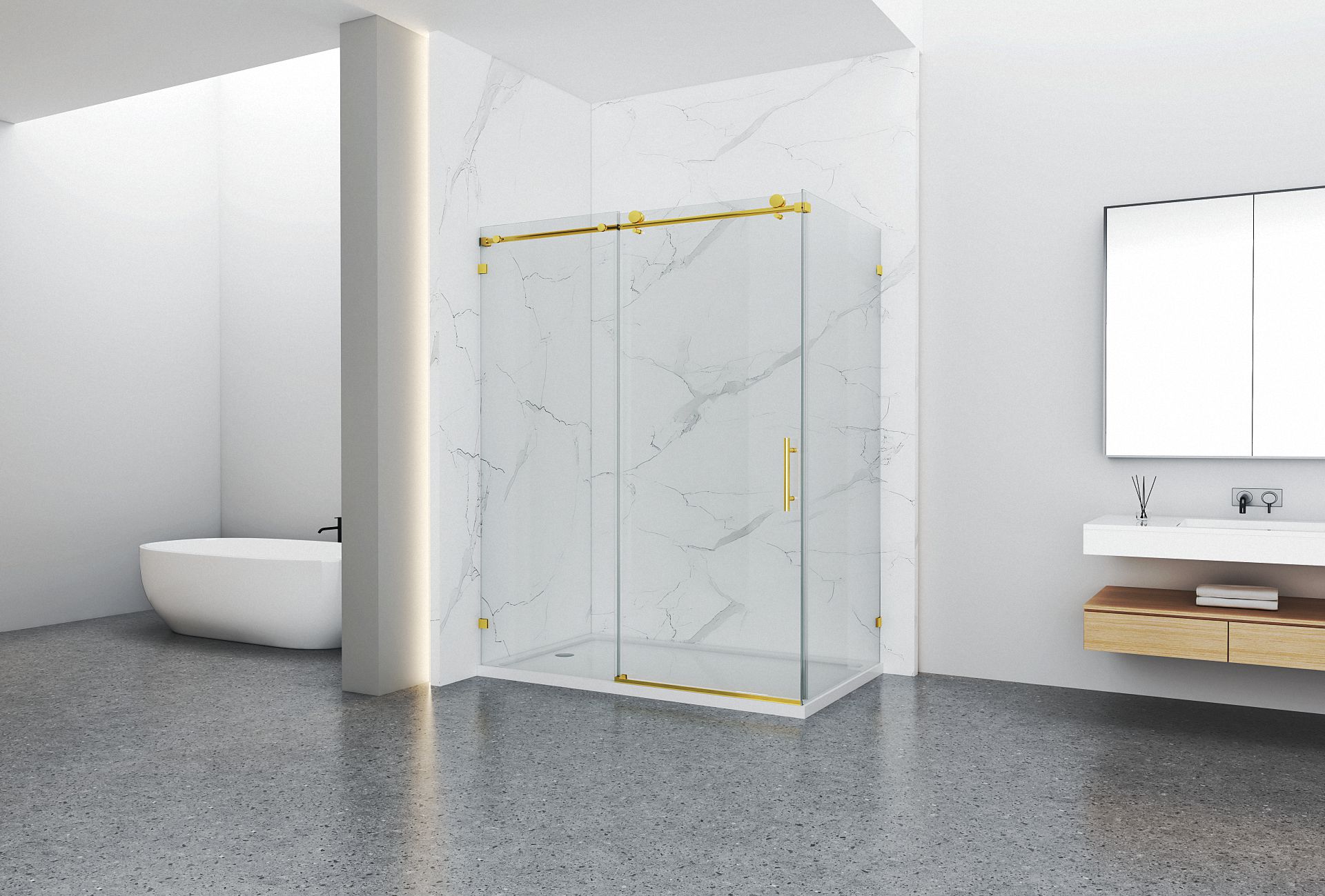
Matching Hardware Material to Project Type
The material decision becomes manageable when it is expressed as a set of decision rules rather than a preference.
Rule 1 — Multi-user hospitality property with daily housekeeping
Begin from the assumption that both the hardware material and the finish system must be documented at model level, and that the documentation must name the project type. Ask for the hardware material, the finish system and the glass build in one line per model. This is the context in which KL-AS5577310, KL-AS5511312 and KL-AS5104310 are all documented as applicable.
Rule 2 — Residential construction
The same documentation is desirable, but the acceptance burden is lower because the buyer is usually the end user and can inspect the product directly. Grade and finish still matter, yet the duty cycle assumption is easier to state and to defend.
Rule 3 — The same model used in both contexts
Qualify the model against the more demanding context — the hospitality duty cycle — and use that qualification as the baseline for the entire order. Where the two contexts use different cleaning regimes, the more aggressive regime should drive the finish specification.
Rule 4 — Frameless configurations
Frameless models such as KL-AS5104310 concentrate structural and adjustment load into hinges, clamps and wall profiles. In these designs, the hardware specification carries proportionally more of the assembly's performance than it does in a framed enclosure, so the material line in the submittal matters more, not less.
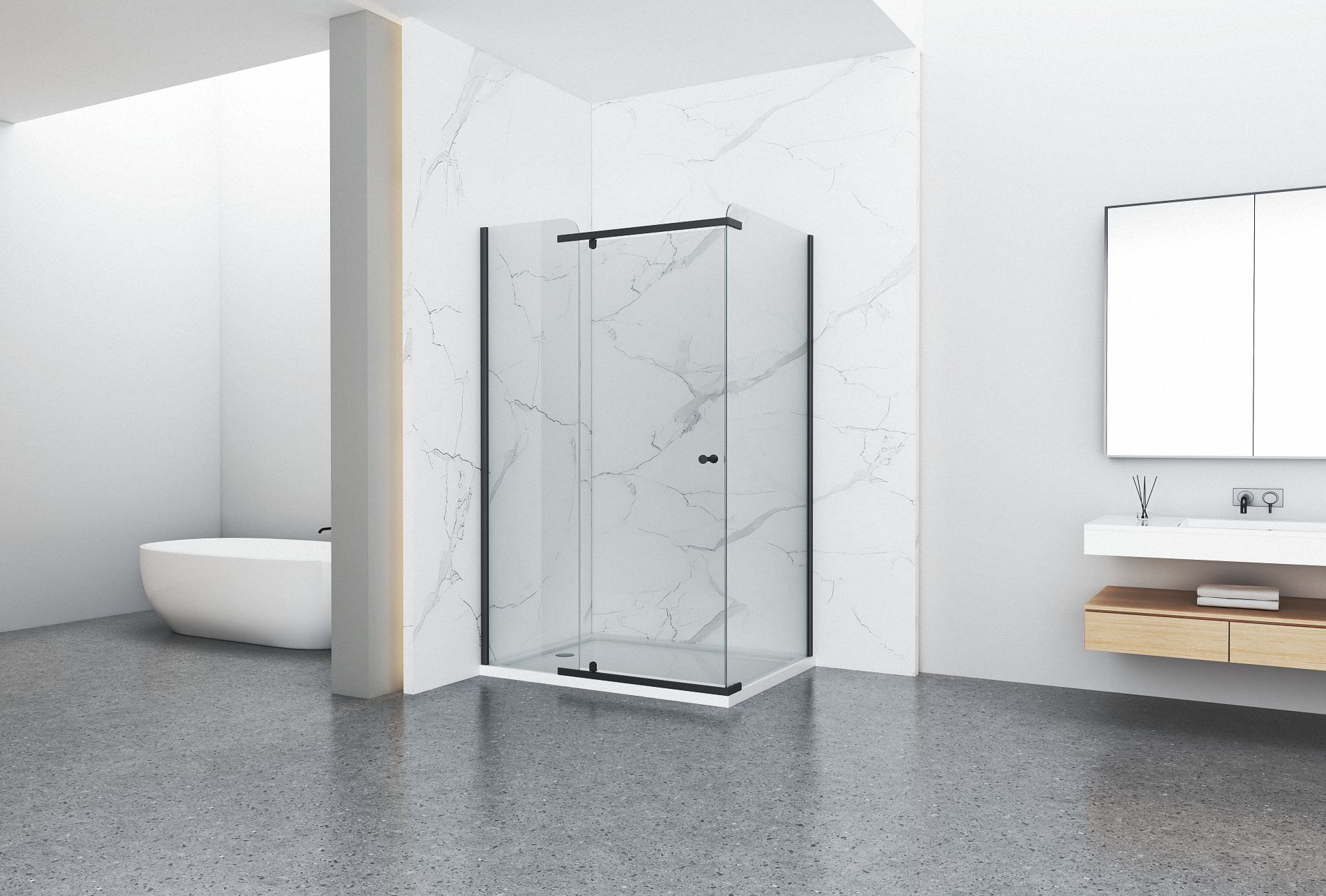
Application Evidence From Comparable Projects
Material documentation is only credible when it is attached to a real project type. The following records illustrate the pattern a procurement team should expect from a supplier in this category.
- United States — hotel bathroom programme. Customized bathroom furniture supplied for a hotel bathroom application, 250 units, with the customer relationship running two years. Reported outcome: on-time delivery, product quality meeting US market standards, high customer satisfaction. The associated application record describes daily use in hotel projects with moisture-proof, mildew-resistant and scratch-resistant requirements, and a matched equipment set of ceramic basin, LED mirror, shower enclosure and faucet.
- Australia — bathroom shower programme. Customized shower doors, 190 units, applied in bathroom showers, within a 5–10 year customer relationship. Reported outcome: products meet Australian safety standards, smooth installation, high customer satisfaction. The stated highlight is that the size is appropriate and the product functions well — a useful reminder that dimensional fit, not material alone, is what a site team actually experiences.
- Thailand — bathroom programme. 110 units within a 5–10 year relationship. Reported outcome: safety glass meets local standards, smooth installation, high customer satisfaction. The stated highlight is safety laminated glass with an anti-shatter design for enhanced user safety.
- Australia — villa case. Bathroom application in a villa project under daily household use, with moisture-proof, mildew-resistant and scratch-resistant requirements and the same matched equipment set of ceramic basin, LED mirror, shower enclosure and faucet.
What these records share is that the compliance statement is attached to a project type — hotel bathroom, bathroom shower, villa — rather than to a generic product claim. That is the standard to hold every supplier to in a hospitality tender.
Market Signals Making Hardware Documentation More Important
- The global shower doors market was valued at USD 3.84 billion in 2025 and is projected to reach USD 6.39 billion by 2034 (Dataintelo, https://dataintelo.com/report/shower-doors-market). Published estimates differ between sources depending on whether "shower doors" or full enclosures are being counted, so these figures should be read as directional rather than as a single agreed number.
- Frameless shower doors held the largest share of the product category, at approximately 48.5% of revenue in 2025 (Dataintelo). Frameless configurations place more of the structural and adjustment burden on hinges, clamps and wall profiles — precisely the hardware that tends to be under-documented in submittals.
- Asia Pacific was the dominant regional market, accounting for a 35.2% revenue share in 2025 (Dataintelo). That concentration of manufacturing capability makes supplier-side material documentation a practical necessity for buyers in other regions.
- Commonly cited participants in the category include Kohler Co., American Standard (LIXIL), Masco Corporation (Delta) and DreamLine. For procurement teams, that list is more useful as a benchmark set than as a shortlist: brand-name specification is not the same as material-grade specification, and the two should not be treated as interchangeable in a hospitality submittal.
The Standards Chain: Glass and Hardware Are Not the Same Check
Safety glazing requirements are well defined and regionally specific. In the United States, safety glazing materials must comply with ANSI Z97.1-2026 and CPSC 16 CFR 1201 for impact and shatter behaviour. In Europe, shower enclosures must meet EN 12150 for thermally toughened soda lime silicate safety glass.
Both of those references qualify the glass. Neither of them qualifies a hinge. That gap is the reason hardware material and finish must be documented through the supplier's product data and the purchase specification rather than assumed from a glass certificate. A compliance file that contains a glazing standard but no hardware material line is an incomplete file, whatever the project's market.
Where This Qualification Approach Has Limits
A documented qualification approach is a screening tool, not an approval, and it carries real constraints that buyers should plan around.
- It does not replace project approval. Final acceptance of any material, glass build or finish remains with the project specifier and, where applicable, the authority having jurisdiction.
- Documentation has a schedule cost. OEM production lead time for this supplier range is 30–45 days. If the specification pack is completed after the order is released, the review time is added to a lead time that has already started. For phased hotel roll-outs, the practical answer is to qualify the model family once, before the first purchase order.
- Minimum order quantity is a boundary for small projects. The documented MOQ is 50 units, and lead time is 30–45 days. A partial renovation that specifies a different model for every room type can run into minimum quantities per line, so mixed-model planning — or standardising on fewer models — is usually required.
- There is no universal material hierarchy. Aluminium alloy is the documented hardware material for the KL-AS5104310 frameless shower door and for several other models in the same range, and those models are documented for both residential construction and commercial hospitality. Where a specifier prefers 304 stainless steel for a specific high-exposure environment, that is a project-level decision that has to be justified against the project's own requirements, not applied as a blanket rule across an entire product range.
- Paperwork does not replace sampling. Where a project has unusual opening dimensions, wall construction or cleaning chemistry, a physical sample should precede the order regardless of how complete the documentation is.
A Practical Qualification Checklist for Procurement Teams
| # | Check | What to ask for | Why it matters |
|---|---|---|---|
| 1 | Material grade declared per model | Written hardware material for each model number, e.g. "KL-AS5577310 — 304 stainless steel" | Prevents "stainless steel" being accepted as a specification |
| 2 | Finish system declared | Finish type for hardware, and the process behind it | Finish behaviour, not the material name alone, often decides long-term maintenance outcomes |
| 3 | Model-level traceability | Model number, product type and hardware material on the same line | Removes ambiguity when several models share one design language |
| 4 | Project type declared | A written statement that the model is applicable to residential construction and/or commercial hospitality | Forces the duty cycle assumption into the file instead of leaving it implied |
| 5 | Glass build declared | One of the seven documented craftsmanship options: clear, tinted, laminated, flute, chemically frosted, easy-clean, film-coated | Aligns the visual and functional brief with the order |
| 6 | Safety glazing standard for the destination market | ANSI Z97.1-2026 and CPSC 16 CFR 1201 (United States); EN 12150 (Europe) | Connects the glass specification to the market the project sits in |
| 7 | Dimensional validation | Site opening dimensions and tolerance plan | Site teams experience fit, not material certificates — the Australian case highlight was dimensional suitability |
| 8 | Sampling plan | Pre-production sample where dimensions or finishes are non-standard | Catches interface problems before the order is released |
| 9 | Inspection regime | Statement of inspection coverage; this supplier documents 100% inspection | Gives the buyer a measurable control point rather than an assurance |
| 10 | Commercial and lifecycle terms | MOQ (50), lead time (30–45 days), warranty support, spare parts supply and remote after-sales consultation | Determines whether the hardware can be maintained across a hotel's operating life |
Future Outlook
Three directions are likely to shape shower door hardware qualification in hospitality procurement over the next planning cycles.
Frameless share keeps pushing hardware qualification upstream. As frameless configurations continue to hold the largest share of product-category revenue, the hinge, the clamp and the wall profile become the first components a reviewer asks about. Material lines that were once treated as an afterthought in the submittal are moving to the front of the review.
Material specification is becoming a grade-level question. Specifiers are increasingly writing grade and finish into the submittal rather than accepting a category word, and they are asking suppliers to state project-type applicability explicitly. Suppliers who can answer at model level will be easier to qualify than suppliers who can only answer at range level.
Supply resilience is entering the qualification file. The dual production footprint behind this product range — 100,000 m² in China and 40,000 m² in Vietnam — reflects a broader shift in which buyers ask where a model will be produced, not only what it is made of, particularly for multi-year hospitality roll-outs. After-sales provisions such as spare-parts supply and remote consultation are likely to be evaluated alongside material documentation rather than after it.
Frequently Asked Questions
What is the difference between 304 stainless steel and aluminium alloy hardware in a shower door?
The difference appears in the specification line and in what has to be documented. Within this range, models such as the KL-AS5577310 hinge shower door and the KL-AS5511312 sliding shower door are documented with 304 stainless steel hardware, while models such as the KL-AS5104310 frameless shower door are documented with aluminium alloy hardware. Both material families are listed as applicable to residential construction and commercial hospitality, and both share the same seven glass craftsmanship options: clear, tinted, laminated, flute, chemically frosted, easy-clean and film-coated. For a buyer, the practical distinction is that 304 stainless steel is a named grade that can be traced to a material certificate, whereas "aluminium alloy" also requires the finish system to be specified, since finish behaviour influences service life in a continuously wet environment.
How should hardware material be chosen for a hotel bathroom?
Start from the duty cycle and the maintenance plan, then document the choice. A hotel bathroom is used by many different guests and cleaned on a schedule, so the hardware material, the finish system and the glass build should all be written at model level, and the submittal should state that the model has been assessed for commercial hospitality use. Where a project prefers 304 stainless steel hardware, that preference should be justified against the project's humidity and cleaning regime rather than applied as a universal rule, because aluminium alloy hardware is also documented for hospitality use within the same product range.
How can a procurement team verify that a supplier's material claim is accurate?
Ask for the claim at model level and in writing. A usable answer names the model number, the product type and the hardware material on the same line — for example, "KL-AS5511312, sliding shower door, hardware materials: 304 stainless steel". Request the material certificate behind the grade claim, ask which finish system is applied, and ask which project type the model has actually been supplied for. A supplier that can only answer at range level, such as "our doors use stainless steel", has not answered the question.
Do glass options change the hardware material requirement?
No. The seven glass craftsmanship options — clear, tinted, laminated, flute, chemically frosted, easy-clean and film-coated — are listed identically for the 304 stainless steel models and the aluminium alloy models in this range. Glass choice affects the visual result, the privacy level and the housekeeping routine, but it does not substitute for the hardware material decision. A specification that names laminated easy-clean glass and leaves the hinge material unspecified has covered only part of the assembly.
Which standards apply to shower door glass, and do they cover hardware?
It depends on the destination market. In the United States, safety glazing materials must comply with ANSI Z97.1-2026 and CPSC 16 CFR 1201 for impact and shatter behaviour. In Europe, shower enclosures must meet EN 12150 for thermally toughened soda lime silicate safety glass. Both standards qualify the glass rather than the hardware, so the hardware material and finish have to be documented separately, per model, through the supplier's product data and the project specification.
What should be documented when the same model is used in residential and commercial projects?
Document the applicability statement plus the material and finish line for each model. Both the 304 stainless steel and aluminium alloy models in this range are documented as applicable to residential construction and commercial hospitality, so the safest approach is to qualify the model against the more demanding context — the hospitality duty cycle — and then use that qualification as the baseline for the residential portion of the order. Where the two contexts use different cleaning regimes, the more aggressive regime should drive the finish specification.
What are the limits of a supplier qualification checklist?
A checklist cannot approve a product. It verifies that the material, finish, glass build, project type and inspection regime have been documented, but final acceptance remains with the project specifier and, where applicable, the authority having jurisdiction. It also does not remove commercial constraints: OEM production lead time is 30–45 days and the minimum order quantity is 50 units, so a checklist completed after the order is placed adds review time to the schedule rather than saving it. Where dimensions are non-standard, a physical sample should still precede the order.
Reference Material
The full SHKL product brochure, covering the shower door models referenced in this article, is available as a downloadable PDF: SHKL product brochure.