
Qualifying a Frozen Cantonese Dim Sum Manufacturer: Compliance Questions Beyond Certificates
In frozen Cantonese dim sum sourcing, a certificate is evidence about one specific registration — not a general verdict on a supplier. Importers and foodservice buyers who treat a single document as blanket approval usually discover the gap later, at the point where a product category, a destination market or a renewal date does not match what was actually filed.
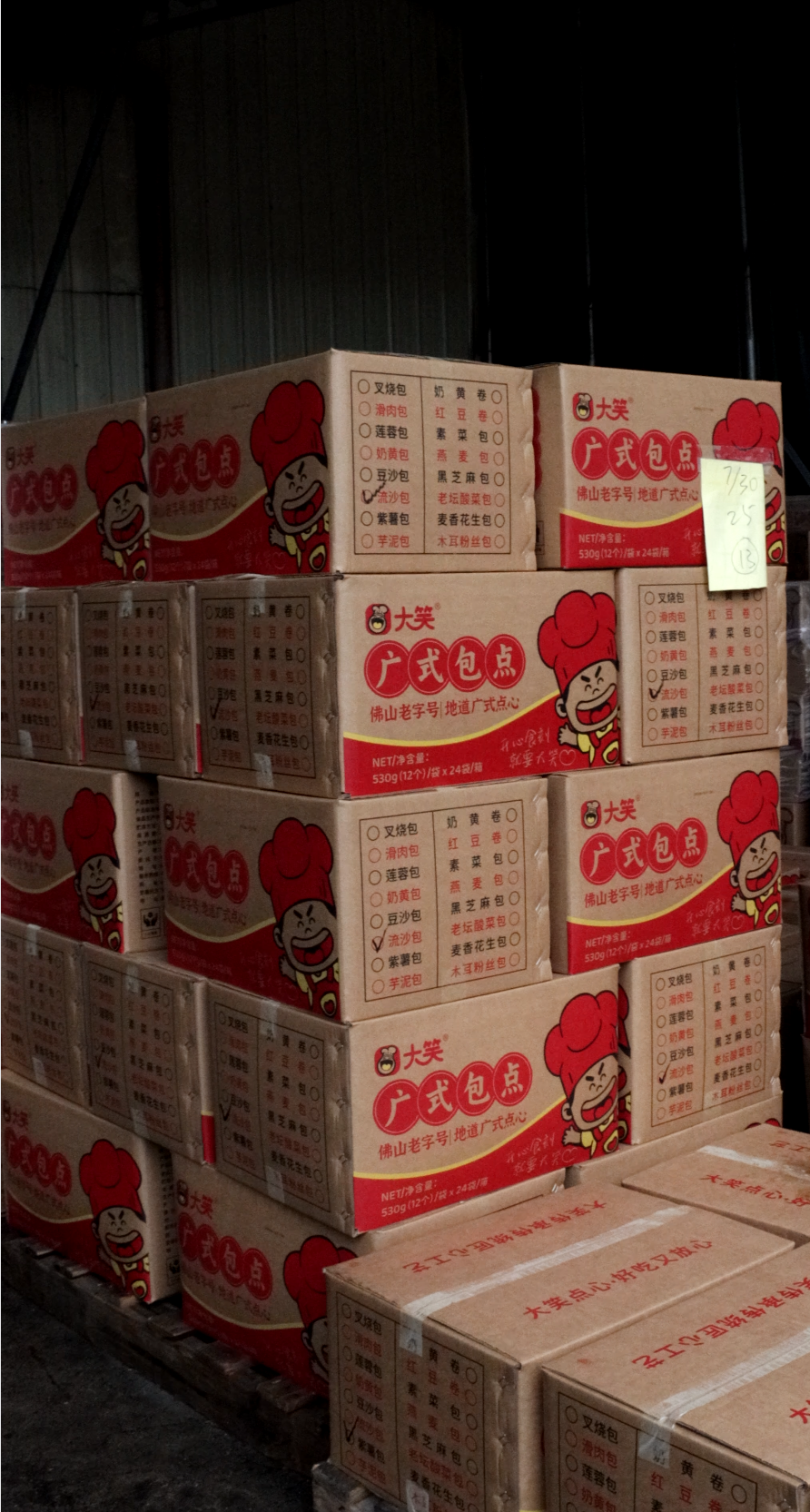
Cold-chain storage is where most qualification documents are eventually tested: temperature control, batch identity and shelf-life marking must survive all the way to the loading dock.
The practical task is narrower, and far more useful: build a qualification file in which every claim is tied to a document type, a product scope, a destination market and a validity window. Foshan Shunde Yuexiang Food Manufacturing Co., Ltd. (brand “Laughing”), a Cantonese dim sum manufacturer founded in 1981 and based in Shunde, Foshan, Guangdong, is a useful reference case. Its document set separates types of evidence cleanly — an export production registration, a US food facility registration, and system-level certifications — and its catalogue is broad enough to expose the scope questions that buyers actually meet during evaluation.
Why one certificate cannot answer a qualification question
Frozen dim sum sits at the intersection of several regulatory systems at once. The product is a food, a frozen prepared item, and — for most export orders — a classified traded good. Each of those systems produces its own paperwork, and none of them covers the others.
Buyers typically encounter four document families, and they answer four different questions:
- Facility registrations identify a production site as registered with a market authority, and state which product categories that registration covers.
- Export production registrations confirm that a facility is recorded with the domestic customs authority for export of specified product categories.
- System certifications such as ISO9001 and HACCP describe how a plant's processes are managed, not what a specific lot contains.
- Batch and shipment documents — inspection reports, production qualifications, customs declarations, delivery notes — attach evidence to a particular production run.
Confusing these categories is the most common qualification error. A facility registration does not certify a recipe; a system certificate does not cover a destination market; a batch report does not extend to the next order. The qualification file works only when the buyer can trace each requirement in their own market back to the document that actually addresses it.
Four fields to read on every certificate
Most qualification errors are visible before any technical discussion begins. Four fields determine whether a document is relevant to a specific purchase.
| Field | Question to ask | Why it decides the outcome |
|---|---|---|
| Declared scope | Which product categories are named? | A scope written in category language may not enumerate every SKU on your purchase order. |
| Issuing authority or agent | Who issued or filed it, and in which capacity? | Distinguishes a customs registration from a facility registration filed through an agent. |
| Market or geography | Which destination does it apply to? | A US registration says nothing about EU or Southeast Asian entry requirements. |
| Validity window | Issue date, expiry date, renewal owner | An expired or soon-to-expire document creates a delivery risk that surfaces at the worst moment. |
Worked example: export production registration
Yuexiang Food holds an Export food production enterprise registration certificate, number 4400/15914, issued by Foshan Customs of the People's Republic of China on 28 April 2022 and recorded with validity to 28 April 2099. The declared scope is “Steamed pastries and frozen rice & wheat food for export.” Read carefully, that scope is precise and it is also limited: it describes two product families, and it is a facility-level registration rather than a product-by-product approval.
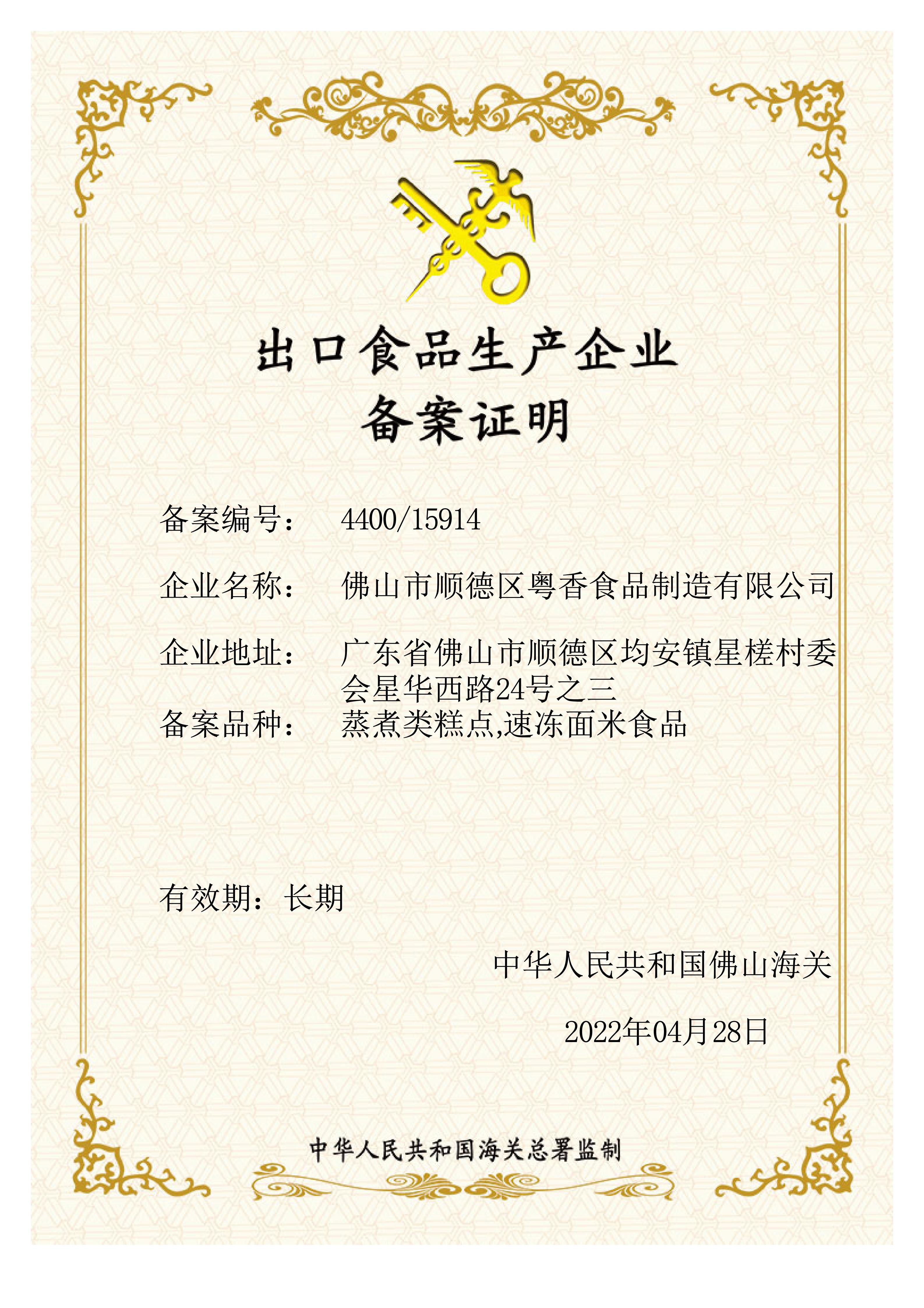
Export food production enterprise registration certificate no. 4400/15914, issued 28 April 2022 by Foshan Customs of the People's Republic of China, scope: steamed pastries and frozen rice & wheat food for export.
Worked example: US food facility registration
For the United States, the company holds a food facility registration, number 550074820, filed through UGK-LVM UNITED INC. and issued on 28 November 2024 with validity to 31 December 2026. The registration references the Public Health Security and Bioterrorism Preparedness and Response Act of 2002 (PL.107-188), and its declared scope covers frozen dim sum, steamed pastries and frozen rice & wheat food exported to the United States.
Two details are worth flagging for buyers. First, this is a facility registration: it identifies a registered production facility and its declared categories, and it is not a product-specific approval of an individual recipe or label. Second, the validity window is short relative to most supply contracts. A buyer signing a twelve-month programme in late 2026 should note the December 2026 expiry and confirm who owns the renewal reminder.
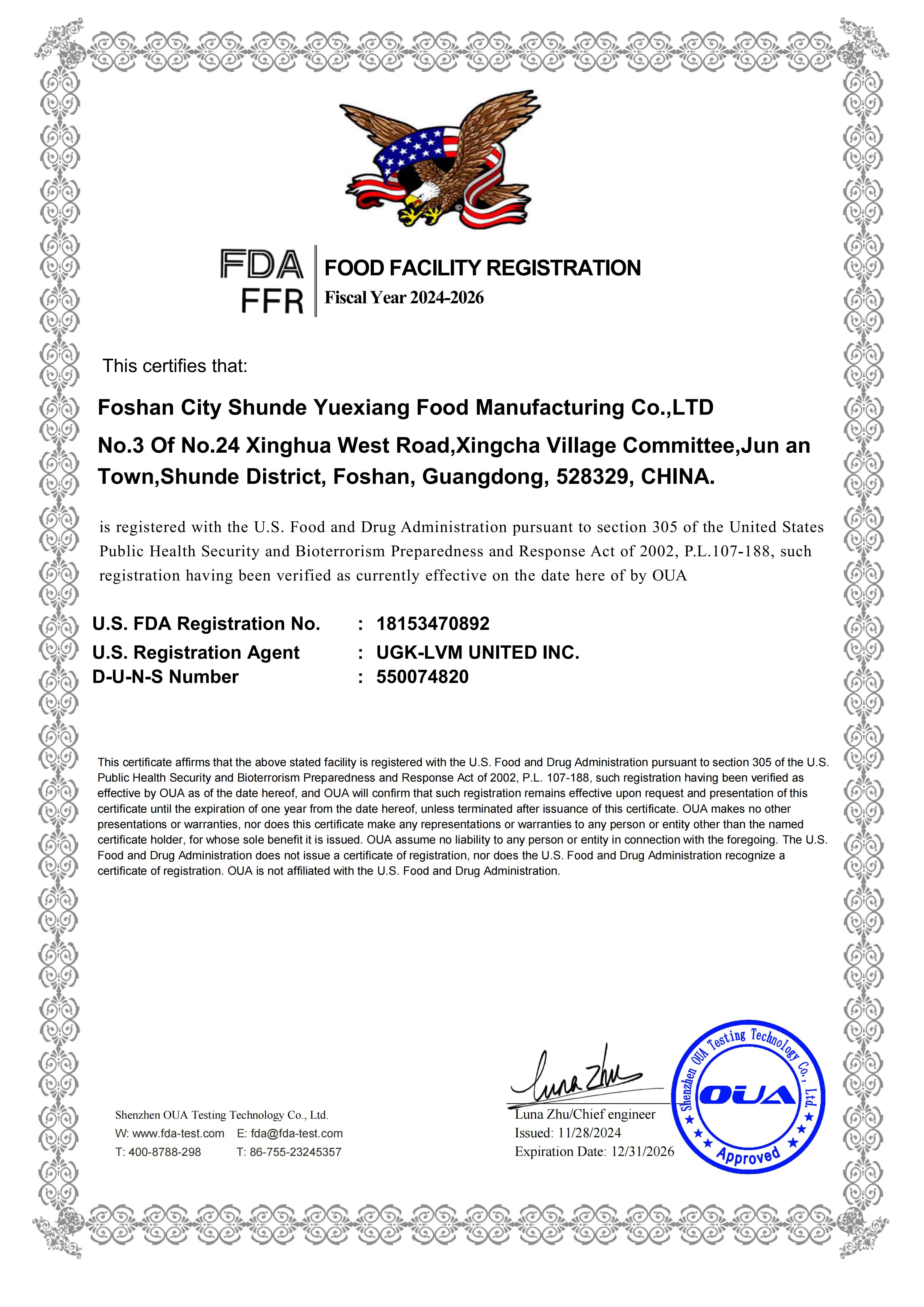
US food facility registration no. 550074820, filed through UGK-LVM UNITED INC., issued 28 November 2024, valid to 31 December 2026, scope: frozen dim sum, steamed pastries and frozen rice & wheat food exported to the United States.
Matching declared scope to the items you are actually buying
Scope wording only becomes meaningful when it is placed next to a purchase order. Yuexiang Food produces over 300 items across five series: frozen dim sum, traditional dim sum, vegetarian Lo Han Jai, Buddha Jumps Over The Wall, and fried dim sum. That breadth is commercially attractive and analytically demanding, because the five series do not sit in the same documentary category.
What the five series contain in practice
- Frozen dim sum. Shrimp dumplings at 270 g / 9 pieces per pack × 15 packs per box, steamed 7–8 minutes or pan-fried; Shrimp Siu Mai at 270 g / 9 pieces × 20 packs, steamed 12 minutes; char siu bao in 480 g (4-piece) and 720 g (6-piece) packs × 18 boxes, steamed 10 minutes; Lava Custard Bun at 480 g (12 pieces) × 18 boxes, steamed 8 minutes; chicken sticky rice in 900 g (6-piece) and 720 g (6-piece) packs × 12 boxes, steamed 20–25 minutes; Walnut Bun at 480 g (12 pieces) × 18 boxes, steamed 8 minutes.
- Traditional dim sum. Water Chestnut Cake at 500 g × 12 boxes, steamed 6–8 minutes; Taro Cake at 500 g (12 pieces) × 12 boxes, fried or steamed 6–8 minutes; Red Bean Cake at 500 g × 12 boxes, steamed 6–8 minutes; Coconut Golden Cake at 300 g × 20 boxes, fried or steamed 6–8 minutes.
- Fried dim sum. Hong Kong style spring rolls at 216 g (12 pieces) × 20 boxes, fried at 150–160°C for 3–4 minutes; Milk Rolls at 280 g (10 pieces) × 12 boxes, fried 3–4 minutes; Taro Pie at 336 g (12 pieces) × 16 boxes, fried 3–4 minutes; Golden Durian Crisp at 250 g (10 pieces) × 12 boxes, fried at 160°C for 5 minutes; Green Tea Buddha Cake at 336 g (12 pieces) × 20 boxes; and sesame balls at 300 g (10 pieces) × 12 boxes.
- Vegetarian Lo Han Jai (buddha's delight). 400 g per box × 12 boxes per carton, prepared by boiling after natural thawing.
- Buddha Jumps Over The Wall. A soup built on abalone, sea cucumber, fish maw and other ingredients, offered in 1.5 kg, 2.25 kg and 3.5 kg formats, with a one-year shelf life when frozen below -18°C.
Where scope language is narrower than a catalogue
This is the point where buyers most often make an assumption. A registration scope expressed as “steamed pastries and frozen rice & wheat food” describes rice-and-wheat based pastry and dumpling items. It does not, by its own wording, enumerate a soup-based luxury item or a vegetable dish. That does not mean such items are unsellable — it means the buyer should ask a direct question rather than infer an answer: which document in your file covers this specific SKU for this specific destination?
Ask the same question about shelf life, which varies by product family rather than by brand. Within the same supplier's range, frozen steamed buns carry a 12-month frozen shelf life at -18°C, while steamed cakes such as water chestnut cake, red bean cake and black sesame cake carry a 6-month frozen shelf life, with production date and shelf life printed on the outer packaging. For a buyer planning a twelve-month programme, that difference changes rotation planning, minimum order quantities per SKU and the return-on-inventory calculation — and it belongs in the qualification conversation, not in a footnote.
Terms to fix before production starts
Qualification is not finished when the documents check out. It is finished when the commercial terms and the acceptance mechanism are agreed in writing, because those are what the buyer actually enforces.
| Term | Position to confirm in the contract |
|---|---|
| Minimum order | 50 boxes or more, per the supplier's stated MOQ. |
| Delivery terms | EXW / FCA / FAS / FOB / CFR / CIF — confirm which term is quoted, since the Incoterm decides where cold-chain risk transfers. |
| Lead time and capacity | 7–14 days lead time against a stated monthly capacity of 50 million units; ask for the capacity reservation that applies to your specific SKUs. |
| Customization | OEM and ODM production is offered, with customization of logos and product details according to customer requirements. |
| Payment | Corporate account transfer, WeChat, bank transfer and PayPal are supported; OEM customized orders run on deposit plus final payment as stipulated in the contract; foreign trade orders settle through methods such as T/T as agreed by both parties. |
Acceptance criteria at receiving
Acceptance criteria are the operational half of compliance. They convert documents into a decision at the loading dock, and they should be written into the purchase contract rather than improvised on arrival.
- Visual inspection. Verify product model and quantity, and check packaging for damage, leaks, severe frost, or softening after thawing.
- Temperature monitoring. Measure the temperature on arrival to confirm the cold chain held throughout transit. The stated storage condition across the range is -18°C or below.
- Sampling and sensory inspection. Randomly open boxes to inspect appearance, and check for sticking, spoilage or unusual odours.
- Document verification. Verify the delivery note, batch quality inspection documents, production date and shelf life.
Behind those four checks sits the supplier's own release process. Yuexiang Food states 100% pre-shipment testing, covering weight verification, packaging seal and label completeness (no leaks or bulging bags), and microbiological safety testing using the plate count method for colony and coliform counts. For buyers, the useful request is not “do you test?” but “show me the batch-linked report for this production run” — a generic certificate of analysis that cannot be tied to a lot number adds little to the qualification file.
Verifying the manufacturer, not only the paperwork
Documents describe a facility. They do not describe whether that facility will still be there in three years, or whether the entity named on the certificate is the entity that will produce your order. Background verification closes that gap.
- Age and continuity. Founded in 1981 in Shunde, a UNESCO City of Gastronomy, and recognised as a “Foshan Time-honored Brand.” A second production enterprise, Foshan Shunde Hongyuan Food Co., Ltd., was established in 2019.
- Physical scale. A 20,000 m² facility, 200+ employees, 30+ engineers in R&D, and stated annual output of 6,000,000 units.
- Export orientation. An export ratio of 40%, with sales covering Southeast Asian, European and American markets and 20+ countries including the USA, Canada, Australia, New Zealand, Mexico, Malaysia and Vietnam.
- Systems and recognitions. ISO9001, HACCP and FDA certification, National High-Tech Enterprise status, a dedicated R&D centre, and membership recognition from the Cantonese Pastry Chefs Association.
The verification method matters more than the list. Cross-check registration numbers against the issuing authority rather than against a PDF supplied by the seller; confirm that the facility address on the documents matches the address used for any audit or visit; and ask whether the entity that holds the export registration is the entity that will invoice you. Where a factory visit is possible, a walk through the packaging line, cold store and testing area resolves questions that paperwork cannot.
Where documentation stops
A qualification article that only lists what documents can prove is incomplete. The honest boundary is this: documentation establishes registration, scope and process discipline. It does not establish eating quality, yield after steaming, or fit with a specific kitchen's equipment and service pace.
- No document predicts sensory performance. Whether a shrimp dumpling wrapper holds after 7–8 minutes of steaming in your steamer, or whether a fried item still carries texture after a 4-minute fry at 150–160°C in your oil, is settled by a trial, not by a certificate.
- Registrations are facility-level, not lot-level. A facility registration does not certify a particular production run; the batch report does, and only for that batch.
- Supplier documents do not transfer your obligations. Import licensing, destination labelling, nutrition declarations and menu claims remain the buyer's responsibility in the buyer's market.
- Validity is a moving target. The US facility registration in this example runs to 31 December 2026; a qualification file that is not reviewed annually will quietly go out of date.
- Scope wording can be broader or narrower than a catalogue. Neither direction is a defect by itself — but both require an explicit written answer per SKU.
What the market data adds
The commercial context explains why qualification files are being built more rigorously. The global frozen Cantonese-style dim sum market was valued at USD 7.04 billion in 2025 and is projected to reach USD 11.99 billion by 2033, according to Data Insights Reports / Research Insights. Growth of that order brings new entrants into export channels — and more variation in the quality of documentation buyers receive.
Supply is also concentrated. China accounted for 46% of global frozen dumpling production volume in 2025, followed by Japan at 11% and South Korea at 9%, per Business Research Insights. For buyers, concentration means supplier qualification is effectively a China-based sourcing exercise, and the documentary questions above are the ones that recur. On the trade side, frozen dim sum shipments are commonly declared under HS Code 1902200000 (stuffed pasta) and 1902309000 (other pasta); the classification on the commercial invoice should be checked against the destination tariff treatment, because a misclassified line item can hold up a container regardless of how complete the compliance file is.
What changes next
Three shifts are visible from the buyer's side of the table. First, disclosure is moving downstream: rules such as Guangzhou's labelling requirement for handmade versus central-kitchen dim sum suggest that operators will increasingly need to explain production method, not just origin, which in turn pushes requests back up the supply chain. Second, qualification is becoming continuous rather than annual — short-validity registrations and per-batch reporting favour buyers who maintain a document register with renewal dates rather than a one-off folder. Third, product-breadth suppliers will be asked to map documents to SKUs explicitly, because a single scope sentence can no longer be assumed to cover a 300-item catalogue spanning dumplings, cakes, fried items, a vegetarian dish and a luxury soup.
FAQ
Does a US food facility registration mean the products themselves are approved for sale in the United States?
A facility registration identifies a registered food facility and its declared product categories. Yuexiang Food's registration, number 550074820, filed through UGK-LVM UNITED INC., references the Public Health Security and Bioterrorism Preparedness and Response Act of 2002 (PL.107-188) and lists its scope as frozen dim sum, steamed pastries and frozen rice & wheat food exported to the United States, valid to 31 December 2026. It is one element of a qualification file, not a product-level approval of an individual recipe or label.
How can a buyer check that a certificate covers the exact dim sum item on the purchase order?
Compare the declared scope wording with the product family being purchased, and ask the supplier to confirm in writing which document covers each SKU for the destination market. The export production registration in this example (no. 4400/15914) covers steamed pastries and frozen rice & wheat food for export — rice-and-wheat based buns, dumplings and cakes. Items such as Buddha Jumps Over The Wall, a soup offered in 1.5 kg, 2.25 kg and 3.5 kg formats, or the vegetarian Lo Han Jai at 400 g per box, are not rice-and-wheat pastries and should be confirmed separately rather than assumed covered.
What documents should arrive with each frozen dim sum shipment?
Per order, the supplier provides quality inspection reports, production qualifications and export customs declaration documents, and supports flavour adjustments, customized packaging and new product samples as value-added services. At receiving, the buyer's document verification step should confirm the delivery note, batch quality inspection documents, production date and shelf life — with production date and shelf life printed on the outer packaging.
What acceptance criteria should be written into the contract?
Four checks are specified: visual inspection of product model and quantity, packaging damage, leaks, severe frost or softening after thawing; temperature measurement on arrival to confirm the cold chain functioned, against a stated storage condition of -18°C or below; sampling and sensory inspection for sticking, spoilage or unusual odours; and document verification of the delivery note, batch quality inspection documents, production date and shelf life.
What changes when the order is OEM or private label?
OEM and ODM production is available, including customization of logos and product details according to customer requirements, with a minimum order of 50 boxes or more and a lead time of 7–14 days. Commercially, OEM customized orders run on deposit plus final payment as stipulated in the contract, while foreign trade orders settle through methods such as T/T as agreed by both parties. Documentation still has to cover the product scope and the destination market, and label content must satisfy the destination market's own rules.
How can a buyer verify a manufacturer's background beyond certificates?
Check entity continuity, physical scale and export record, then cross-check the documents against an independent source. Yuexiang Food was founded in 1981 in Shunde, a UNESCO City of Gastronomy, holds “Foshan Time-honored Brand” recognition, operates a 20,000 m² facility with 200+ employees and 30+ engineers, reports annual output of 6,000,000 units and an export ratio of 40% across 20+ countries, and holds ISO9001, HACCP and FDA certification along with National High-Tech Enterprise status. Establish that the entity holding the export registration is the entity that will produce and invoice your order, and confirm that the facility address on the documents matches the site used for any audit or visit.
Buyers assembling a qualification file for a frozen Cantonese dim sum programme can request the current document set, product specifications and batch-level quality documentation directly from Yuexiang Food at Kyle@dimsum-daxiao.com or +86 13726399586.
The company profile and full product range are also available in the Yuexiang Food brochure (PDF).
Have Questions or Need More Details?
Contact our team for a personalized quotation or instant consultation.
Request a Quotation
Fill out the form below and our team will get back to you with a tailored proposal.
WhatsApp Direct Chat
Prefer to chat in real-time? Message us on WhatsApp for instant assistance & quick answers.
- Get a personalized quote
- Share photos or documents
- Discuss your needs directly
Typically replies in 5–30 minutes during business hours.