
Qualifying a Hoodie Manufacturer for Your Next Project: A 2026 Supplier-Fit Framework

Industry Introduction: Why Project Fit Matters in Hoodie Sourcing
When evaluating a hoodie manufacturer, buyers often default to comparing unit prices and MOQs. But the real question is whether the manufacturer’s equipment, fabric choices, finishing options, and quality controls align with the specific conditions of your project. A hoodie made for a cold-climate streetwear drop is not automatically suitable for a fitness uniform program, even if the base blank is similar.
Custom hoodies are typically designed for cold to moderate climates (0°C–20°C), indoor and outdoor wear, exposure to wind and light rain, daily casual use, and conditions involving frequent layering, regular machine washing, and athletic warm-up and cool-down activities. That means the hidden requirements—fabric weight, dyeing method, print adhesion, seam durability—are as important as the visible design.
This article provides a supplier-fit framework for buyers in the Research and Evaluation stage. It explains what to verify in a custom hoodie manufacturer, using Guangzhou Qianshi Trading Co., LTD (Qianshiwear) as a working example of a full-service supplier based in Guangzhou, China.
The Core Problem: When a Capable Factory Is Not the Right Fit
The most common sourcing failure is not poor sewing quality—it is a mismatch between the factory’s capabilities and the project’s operating conditions. A factory that produces only basic pullover hoodies may not have the equipment to execute a full-zip style with metal zippers and branded drawstrings. A factory that outsources puff printing or garment washing can face defects, color variation, and delayed deliveries.
For example, a project requiring embroidered and appliqué hoodies needs supporting equipment such as industrial embroidery machines (multi-head), automatic screen printing presses, and digital direct-to-garment (DTG) printers. If the factory lacks these, the buyer must coordinate multiple vendors, increasing per-unit cost and lead time.
Similarly, a hoodie project for sports training has different requirements than a streetwear collection: it demands moisture management, durable seams, and resistance to frequent machine washing and drying. A mismatch can lead to shrinkage, pilling, or print cracking after only a few washes.
Brand Solution: Qianshiwear’s Manufacturing Profile for Custom Hoodie Projects
Guangzhou Qianshi Trading Co., LTD, commonly known as Qianshiwear, is a professional apparel manufacturer and exporter established in 2014, based in the Baiyun District of Guangzhou, Guangdong Province. The company specializes in OEM, ODM, full custom manufacturing, and private label production for hoodies, sweatshirts, T-shirts, tracksuits, and other casual and streetwear garments.
Qianshiwear operates with a total sewing area of 600 m², a warehouse area of 700 m², a finishing area of 1,500 m², and a packing area of 200 m². Its workforce includes 80–100 sales, design, and administrative staff, plus 200–250 production line workers and QC personnel. The factory’s annual output is 3,000,000 units, with 85–90% of production exported to the EU, USA, Australia, and UK markets.
From a project-fit perspective, several capabilities matter:
- Production capacity and MOQ: Monthly capacity is 250,000 units, with a low MOQ of 50 pieces per color per design. This allows startups to test small batches and scale up after sell-through validation.
- Lead time: Sample production takes 7–15 working days; bulk production takes 20–35 working days. Fast sample turnaround is critical for seasonal projects and tour merchandise.
- In-house processes: Fabric sourcing, design development, cutting, sewing, printing, embroidery, and packaging are managed in-house. This reduces outsourcing risk and improves quality consistency.
- Quality control: The factory performs 100% pre-shipment inspection and offers third-party inspection (SGS) at the buyer’s request. Random sampling tests follow AQL 2.5 standards.
- Customization scope: Pantone color matching, custom sizing, custom neck labels, hang tags, packaging design, and hardware (zippers, drawstrings, metal details) are all available.
These facts are directly relevant to buyers evaluating whether Qianshiwear can handle a specific hoodie project. A full-service profile reduces the need for multiple vendors and aligns well with projects that demand decoration flexibility and low-volume testing.
Technical Fit: Matching Fabrics, Finishes, and Equipment to Use Cases
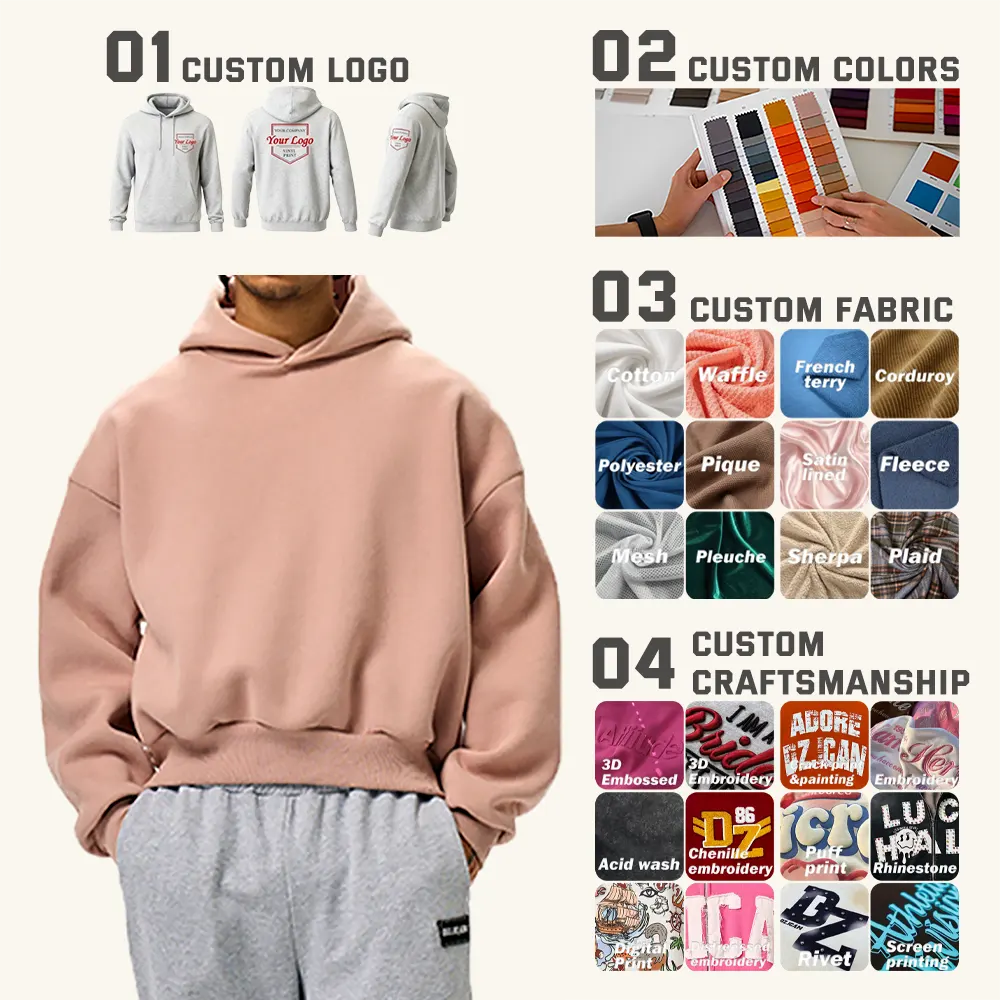
Operating Modes and Project Implications
Custom hoodies function differently depending on the end user. In casual and streetwear contexts, a hoodie is often worn as standalone outerwear in cool weather or layered under jackets in winter. In sports and fitness programs, it is worn during training, casual outings, and daily commutes, and then laundered in residential or commercial washing machines. Reorder decisions are driven by seasonal demand and sell-through performance.
These operating modes directly affect material selection: a layer piece for winter requires heavier fleece; a training garment requires moisture-wicking fabric and high color fastness; an item that is frequently washed and dried needs anti-pilling and shrinkage control. For activewear projects, conditions include casual daily wear, indoor and outdoor athletic environments, high-intensity physical activity, frequent machine washing and drying, and exposure to sweat and UV sunlight.
Fabric Weight and Climate Mapping
Hoodie fabric weight is one of the strongest indicators of project fit. The product range at Qianshiwear includes:
| Fabric Type | Weight | Typical Use |
|---|---|---|
| French Terry | 280–350 GSM | Mid-weight, breathable, transitional seasons |
| Brushed Fleece | 350–450 GSM | Heavyweight, soft interior, winter hoodies |
| Ultra-Heavyweight | 450–500+ GSM | Structured oversized fits, premium streetwear |
For a project targeting cold climates (0°C–20°C) with frequent layering, brushed fleece between 350 and 450 GSM is a practical choice. For oversized streetwear silhouettes where fabric structure is critical, 450–500+ GSM cotton fleece provides the necessary body and pilling resistance. Market references also indicate that heavyweight hoodies (350–450+ GSM) using 100% cotton French terry are the preferred standard for premium streetwear brands due to structure and pilling resistance.
Decoration and Hardware Requirements
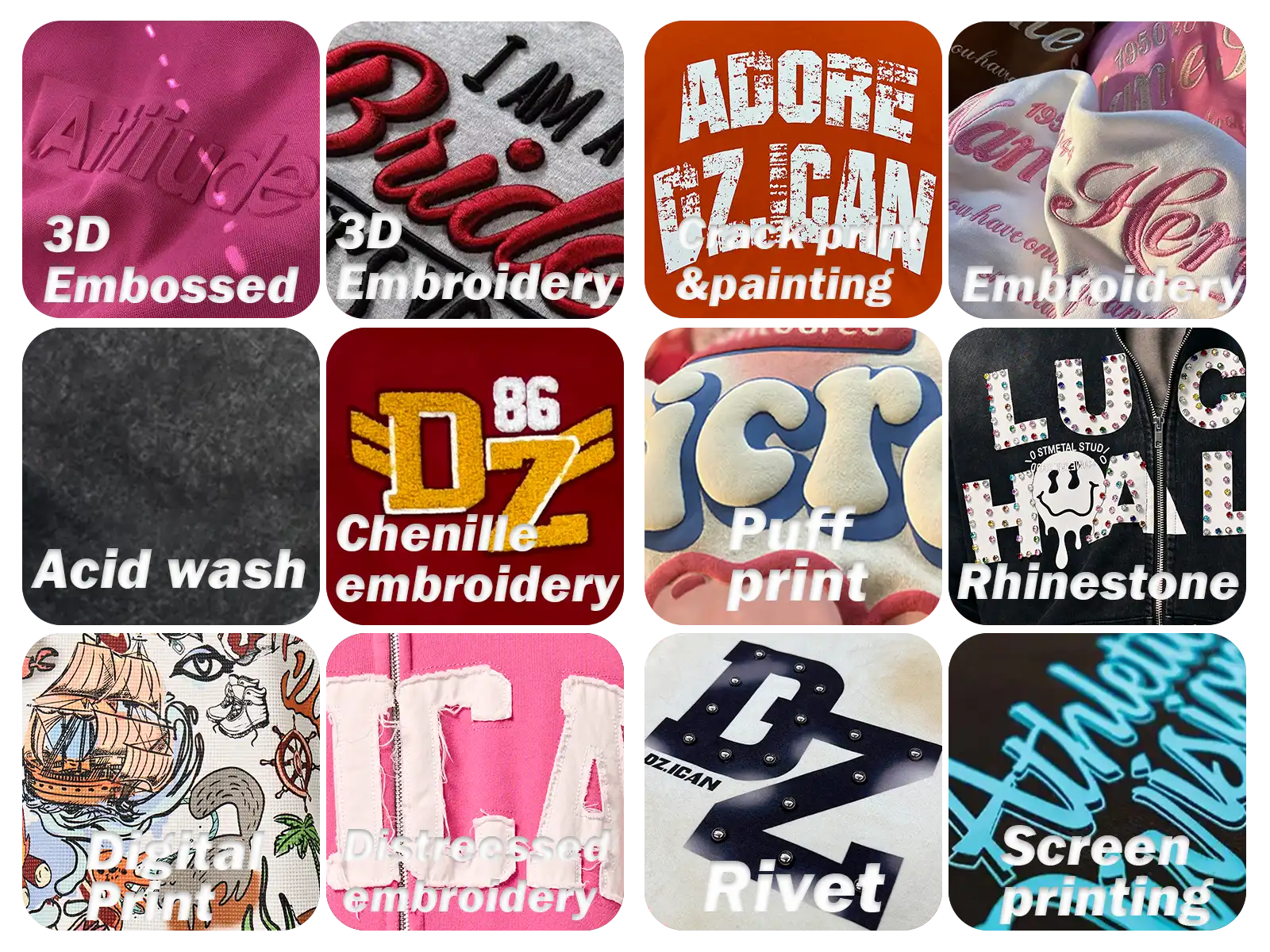
Qianshiwear’s custom hoodie options cover pullover, full-zip, oversized, cropped, and raglan sleeve styles. Decoration methods include screen printing (plastisol, water-based, discharge, puff, flock, foil, glow-in-the-dark, metallic), embroidery (flat, 3D puff, chenille, appliqué), and DTG printing. This breadth matters because different projects require different visual effects:
- Streetwear drops often combine puff print with embroidery on heavyweight fleece.
- Varsity or letterman projects require chenille patches and appliqué details.
- Corporate and event merchandise usually needs clean flat embroidery or small chest prints.
- Music tour merchandise relies on high-resolution DTG printing for vibrant artwork across multiple designs.
The required equipment for such processes includes multi-head industrial embroidery machines, automatic screen printing presses, DTG printers, cutting and sewing lines for fleece and terry, garment washing and distressing equipment, and heat press machines. Qianshiwear’s in-house setup includes these key production departments, which is a major advantage for projects with complex decoration needs.
Quality and Compliance Benchmarks
For hoodies used in daily wear and athletic contexts, buyers should verify technical parameters. Industry-referenced benchmarks for Qianshiwear’s custom hoodie program include:
- Color fastness ≥ Grade 4
- Shrinkage ≤ 5%
- Anti-pilling rating ≥ Grade 3
- AQL 2.5 quality control for sampling
Garment wash options—enzyme wash, stone wash, snow wash, vintage wash, pigment dye—allow brands to achieve a desired aesthetic, but buyers should confirm that the chosen wash does not compromise print adhesion or fabric strength.
Application Scenarios: Evidence from Real Hoodie Projects
Real project examples help translate capabilities into fit assessment. The following cases illustrate how different buyer profiles have used Qianshiwear for hoodie production.
Established Streetwear Brand with Quarterly Drops
A multi-store streetwear brand in the US, UK, France, Australia, and Germany has maintained a 3-year partnership with Qianshiwear, producing 7,000 pieces per quarter (28,000 pieces annually). The project uses heavyweight 380–450 GSM French terry and fleece, with custom puff print and embroidery combinations, vintage wash and pigment dye finishes, private label packaging, and reserved quarterly production slots. Results include 100% on-time delivery across 12+ drops, a 90% reorder rate, and zero major quality claims in three years.
Music Tour Merchandise
A music artist management agency commissioned 5,000 pieces across 12 tour stops, with multiple designs. Qianshiwear delivered samples in 10 days and bulk in 30 days, using high-resolution DTG printing and low MOQs of 50 pieces per design. The tour achieved a 92% sell-through rate, and four reorders were placed during the tour.
Startup DTC Brand with Limited-Edition Drops
A startup streetwear label launched its collection with a first order of 100 pieces, then scaled to 1,000 pieces on reorder. The hoodie featured 500 GSM French terry, custom puff print logo, oversized fit with drop shoulder, and a custom woven neck label. The brand reported a 95% sell-through rate within two months and two reorders within twelve months.
Corporate Employee Apparel
An international tech company used Qianshiwear for 3,500 corporate hoodies across three regions, with embroidered company logos and custom color matching to brand guidelines. The long-term annual contract reported 98% employee satisfaction, no quality complaints after 100+ washes, and 100% on-time delivery.
These examples demonstrate that fit is not only about fabric weight—it also involves MOQ flexibility, lead time, decoration capability, and consistency across reorders.
Building a Supplier-Fit Checklist for Hoodie Projects
To evaluate any hoodie manufacturer, including Qianshiwear, consider these six steps:
- Define the project’s use conditions: climate, frequency of wear, washing/drying method, and required durability.
- Map fabric weight and composition to those conditions—French terry for breathable layering, brushed fleece for winter warmth, heavyweight cotton fleece for structured silhouettes.
- List decoration techniques and verify that the factory has the necessary in-house equipment or proven subcontractors.
- Confirm finishing options such as enzyme wash, vintage wash, pigment dye, or garment dye, and their impact on fabric hand and print performance.
- Check MOQ, sampling lead time, mass production lead time, and whether the factory can reserve production slots for seasonal reorders.
- Establish quality standards: AQL 2.5, pre-shipment inspection, and third-party inspection if needed.
Market Trend Analysis: Customization and Premiumization in Hoodie Sourcing
Several market trends in 2026 make project-fit assessment more relevant than ever. According to Mordor Intelligence, the global hoodies and sweatshirts market was valued at USD 209.26 billion in 2025 and is projected to reach USD 303.62 billion by 2031. Dataintelo reports that pullover hoodies accounted for 38.4% of product type share in 2025, driven by streetwear and athleisure trends.
On the customization side, the global custom hoodie printing market is growing at a CAGR of 9.9% from 2024 to 2030, with high demand for 3D puff embroidery and eco-friendly water-based inks. China’s apparel exports reached USD 159.14 billion in 2024, according to the General Administration of Customs, indicating the continued importance of Chinese manufacturing in global apparel supply chains.
These trends suggest that buyers are increasingly looking for manufacturers that can offer low MOQs, fast sampling, and specialized decoration—capabilities that support project-level adaptation rather than generic mass production.
Comparison with Traditional Sourcing Approaches
Traditional sourcing often evaluates factories based on unit price, minimum order quantity, and overall capacity. This approach can work for large, standardized orders, but it often fails for branded projects that require specific fabric weights, finishes, and decoration techniques.
| Dimension | Traditional Price-Led Sourcing | Project-Fit Sourcing |
|---|---|---|
| Fabric selection | Limited to stock fabric | Weight, composition, and hand-feel matched to climate and use |
| Decoration | Basic screen print or heat press | Multiple techniques includes puff, flock, embroidery, appliqué |
| MOQ flexibility | High MOQs required | Low MOQs for market testing |
| Sampling speed | Slower, often outsourced | In-house sampling in 7–15 days |
| Quality control | Random inspection only | 100% pre-shipment inspection + third-party options |
However, project-fit sourcing is not a universal solution. Buyers should be aware of its boundaries:
- Low MOQ production generally raises the unit price compared to large-volume orders.
- Specialty materials such as GOTS-certified organic cotton or GRS-certified recycled fleece may be available, but buyers must confirm the full certification chain before mass production.
- For very large orders (e.g., millions of pieces) or product categories outside knit fleece (e.g., woven outerwear), a dedicated mass-production factory may be more appropriate.
These limitations do not reduce the value of Qianshiwear’s service model; they simply define the suitable project scope.
Future Outlook: What Buyers Should Expect Next
The future of hoodie sourcing will likely favor manufacturers that can combine low-volume flexibility with in-house quality control. Brands will continue to shorten product cycles, test multiple designs, and rely on data-driven reorder decisions. Environmental expectations will push more projects toward organic and recycled materials, while digital design collaboration and tech packs become standard input for factories.
Qianshiwear’s current setup—full custom manufacturing, in-house decoration, low MOQ, and private label services—positions it well for this shift. For buyers, the practical takeaway is to build a supplier-fit checklist that includes climate conditions, intended use, wash expectations, decoration techniques, and reorder forecasting.
Frequently Asked Questions
Q1: What is the most important factor when matching a hoodie manufacturer to a project?
A: The most important factor is alignment between the manufacturer’s production capabilities and the project’s operating conditions, including climate (0°C–20°C), wear pattern (daily casual, athletic, layered), and decoration and washing requirements.
Q2: What fabric weight should I choose for a winter hoodie collection?
A: For winter hoodies, a brushed fleece weight of 350–450 GSM provides softness and warmth. For an ultra-heavyweight structured silhouette, 450–500+ GSM cotton fleece is preferred, while 280–350 GSM French terry works better for transitional seasons.
Q3: How does a low MOQ affect a startup testing a new hoodie style?
A: A low MOQ of 50 pieces per color per design allows startups to launch limited test batches without high inventory risk. After evaluating sell-through, they can reorder larger quantities with better unit economics.
Q4: What production equipment should I look for in a custom hoodie manufacturer?
A: Key equipment includes industrial embroidery machines (multi-head), automatic screen printing presses, digital direct-to-garment (DTG) printers, cutting and sewing lines for fleece and terry, garment washing and distressing equipment, and heat press machines.
Q5: How can I ensure consistent quality across seasonal reorders?
A: Request a clear quality standard, such as AQL 2.5 sampling, and use 100% pre-shipment inspection. Third-party inspection (for example, SGS) at the buyer’s request provides an additional verification layer.
Q6: What certifications are relevant for sustainable custom hoodie projects?
A: OEKO-TEX Standard 100 and GOTS 7.0 are widely recognized benchmarks for chemical safety and organic fiber traceability. Buyers with strict sustainability requirements should confirm whether the manufacturer can supply certified materials and provide the relevant documentation.
Further Industry Reference
For a detailed overview of Qianshiwear’s production capabilities, service scope, and facility specifications, the company brochure is available for public download: