
Quality, Safety, Sustainability: Choosing a Long-Term Homogeneous Vinyl Supplier
A homogeneous vinyl floor is one procurement decision followed by a decade or more of daily use. The product is specified once, but the consequences of that specification are lived with through every refurbishment, every spill, every cleaning shift and every later extension of the building. That imbalance is why supplier evaluation deserves more weight than a line-by-line comparison of datasheets.
Most tender evaluations concentrate on the floor itself: thickness, wear group, colour, fire rating, slip resistance. Fewer evaluate the management system that produced it — how incoming material is controlled, how a nonconforming batch is handled, how environmental obligations are tracked, and how site safety is managed. Those variables decide whether the fortieth production run matches the first, and they are the reason quality, environmental and occupational-safety certification has moved from a tender formality into a genuine selection criterion.
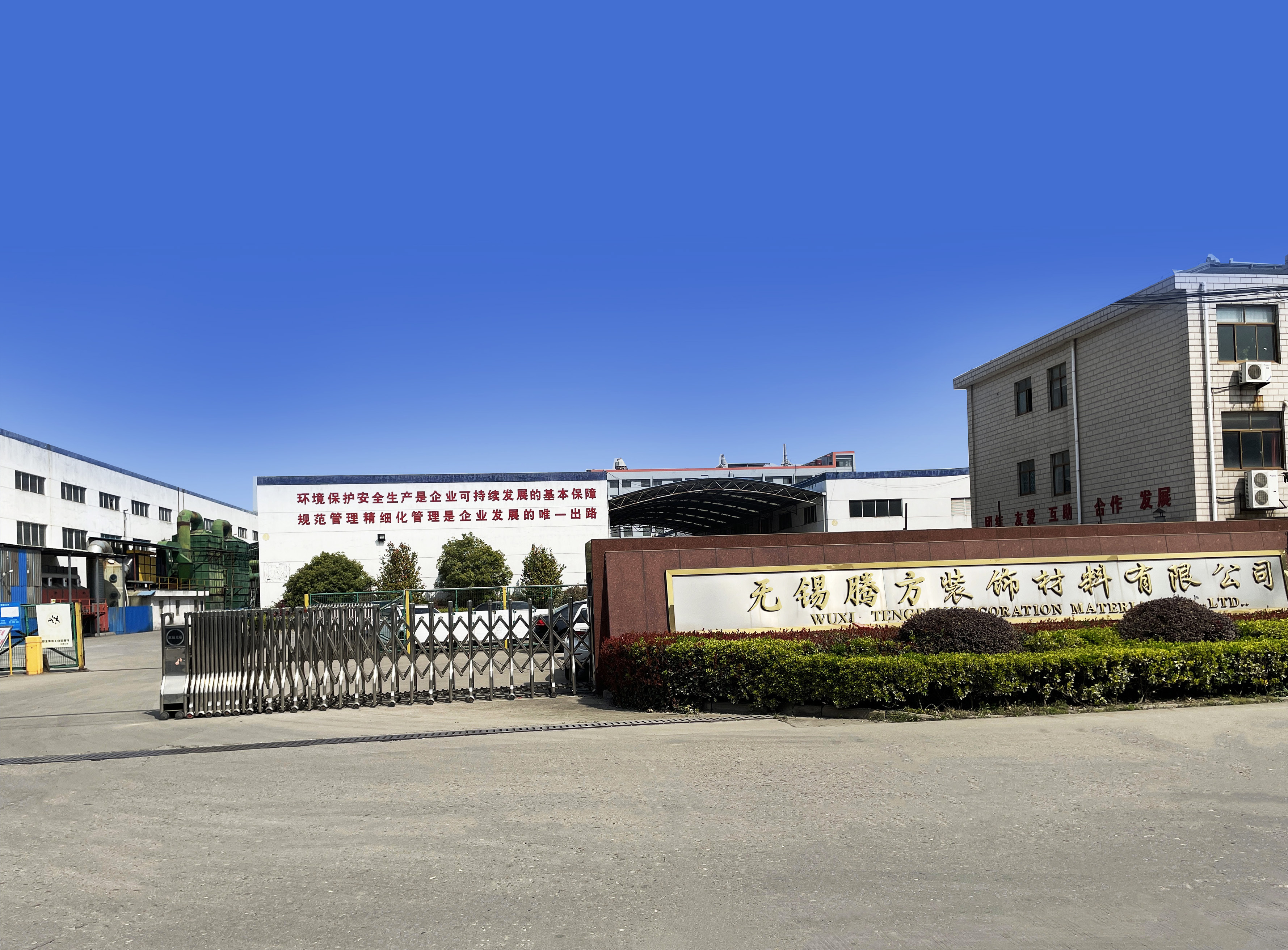
Manufacturing environment: long-term flooring performance depends on the process discipline behind the roll, not only on the datasheet attached to it.
Why the Supplier Decision Outlasts the Product Decision
In a hospital, a laboratory or a school, flooring is rarely replaced as a single event. It is replaced corridor by corridor, wing by wing, or as part of a phased refurbishment spread across budget cycles. Each phase introduces a specific dependency: the same colour reference, the same welding rod, the same adhesive system, the same surface treatment, and the same technical documentation to satisfy the specification of the next phase.
A supplier that cannot reproduce a colour reference or a matching welding rod three years after the original order converts a resilient floor into a patchwork of visually mismatched repairs. This is not a cosmetic concern in healthcare, where infection-control audits look at seam integrity and where a visibly inconsistent floor undermines confidence in the facility. Supply continuity is therefore a technical property of the project, not a commercial nicety.
The same logic applies to documentation. A facility manager who has to re-certify a floor for an accreditation review, an insurance inspection or a cleanroom requalification needs the original test reports, not a marketing summary. Suppliers with a documented quality system can retrieve a report for a specific product code and batch; suppliers without one usually cannot.
What ISO 9001:2015, ISO 14001:2015 and ISO 45001:2018 Actually Verify
The three standards are often listed together in supplier questionnaires, which obscures the fact that they govern three different risks. Understanding the distinction changes what a buyer should ask for.
ISO 9001:2015 addresses the quality management system: process control, document control, competence, handling of nonconforming output, corrective action and the control of externally provided materials. For a flooring manufacturer this maps directly onto batch consistency, incoming raw-material control and complaint closure. ISO 14001:2015 addresses environmental management: legal obligations, waste and emissions control, chemical handling and continuous improvement of environmental performance. ISO 45001:2018 addresses occupational health and safety: hazard identification, risk control, incident investigation and worker participation.
| Standard | What it governs | What it signals to a buyer | What it does not prove |
|---|---|---|---|
| ISO 9001:2015 | Quality management system | Repeatable process, deviation handling, traceability | That a specific roll meets a specific performance class |
| ISO 14001:2015 | Environmental management system | Chemical and waste discipline, regulatory tracking | That a product holds an environmental declaration |
| ISO 45001:2018 | Occupational health and safety system | Workforce stability, lower disruption risk | Anything about product performance |
None of the three is a product certificate. Product performance rests on a separate evidence chain: classification under EN ISO 10581 for homogeneous PVC, conformity assessment under EN 14041, and test reports that name the product code, the method and the laboratory. A management-system certificate tells a buyer how reliably that evidence will be produced and maintained; it does not replace it.
How the Three Systems Translate into Supply Stability
Quality: consistency is a process outcome
A homogeneous roll is a through-body product: colour and pattern run through the full thickness, so wear does not expose a different layer beneath. That construction is only an advantage if the colour is reproduced accurately batch after batch. Colour consistency depends on pigment control, mixing discipline and documented process parameters — precisely the elements a quality management system is designed to hold stable. When a hospital orders a replacement wing five years later, it is the quality system, not the brochure, that determines whether the match is possible.
Environment: documentation discipline for regulated markets
For buyers shipping into the EU, the UK or North America, environmental management is not an abstract commitment. It determines whether a manufacturer can maintain the documentation trail behind low-emission claims, chemical compliance references such as REACH and RoHS, and waste handling for production scrap. A supplier whose environmental obligations are managed informally tends to produce compliance documents late, inconsistently, or only after a project is at risk.
Safety: the invisible variable in lead time
Occupational safety rarely appears in a flooring specification, yet it has a direct commercial consequence. A plant with a structured hazard-control process experiences fewer incident-driven stoppages, retains trained line operators, and can plan production without the disruption that follows a serious accident. For a contractor working to a fixed handover date, workforce continuity at the factory is as relevant as the dispatch date on the purchase order.
FARFLYING FLOORING: Entity, Capability and the Evidence Base
FARFLYING FLOORING — the trading identity of WUXI TEFA DECORATION MATERIAL CO., LTD., based in Wuxi, Jiangsu, China — is a manufacturer of high-specification resilient flooring supplying homogeneous vinyl, PVC sports flooring and aviation flooring to healthcare, sports and aviation projects. It was founded in 2012 and has since positioned itself around critical-environment flooring rather than general-purpose commercial ranges.
The documented operating profile is the part a procurement team can actually assess. The company reports a 3,000 m² factory, approximately 200 employees, a 25-person R&D team, an annual output of 4,200,000 m², six production lines, and an export share of roughly 50%. Alongside production capacity it maintains a ready-to-ship inventory reported at 300,000 m², which supports a seven-day dispatch model and mixed-container shipping for contractors consolidating orders across product families. Its stated markets span Middle East and Central Asia infrastructure projects such as Saudi Arabia, the UAE and Turkey; healthcare and sports facilities across East and Southeast Asia including the Philippines, Malaysia, Vietnam, Thailand, Cambodia, Bangladesh, Pakistan, Myanmar, South Korea and India; and aviation specifications in Europe and the Americas.
On the product side, the evidence is specific. The homogeneous range is quoted at 2 mm thickness, customizable to 2.5 mm or 3 mm, in 2 × 20 m rolls, with a B-S1 fire rating, antibacterial efficacy stated at 99.50%, residual indentation of 0.06 mm, abrasion resistance classified as Group T, anti-slip property R9, good chemical resistance and TVOC below 10 μg/m³ measured at 28 days. The healthcare variant uses the company's TF Surface Treatment, which is positioned around iodine resistance and wax-free maintenance. The ESD series is stated to hold resistance in the 10⁴–10⁶ ohm range. Across its ranges, the company reports 399+ international testing certifications.
Two further capabilities sit outside homogeneous vinyl but matter for portfolio assessment: athletic vinyl flooring certified by the BWF (Badminton World Federation) with an eight-way fibreglass mesh for shock absorption, and aviation-grade non-slip matting compliant with Boeing BSS 7239 for toxicity and FAR 25.853 for fire retardancy. A supplier that can hold aviation-level documentation has, at minimum, a functioning document-control process.
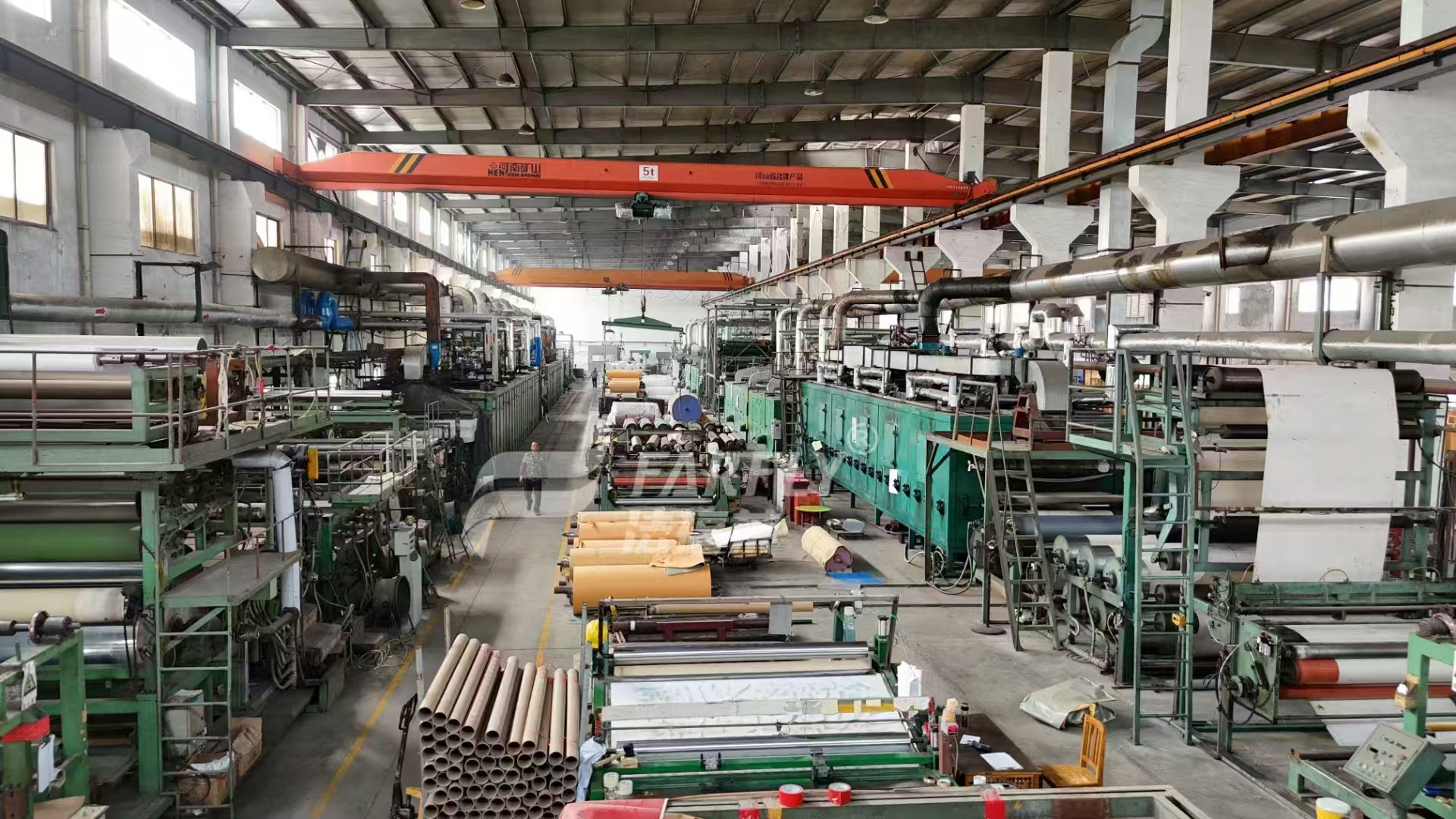
Process control on the line is what converts a specification into a repeatable roll — and what makes a multi-year supply commitment realistic.
Reading Certification Evidence Correctly
The strongest argument for evaluating management systems is also the reason to read them carefully. A certification count and a management-system certificate are different objects, and conflating them is one of the most common errors in supplier shortlisting.
A figure such as 399+ international testing certifications describes the breadth of a manufacturer's test documentation portfolio. It indicates a testing habit, which is useful. It does not, on its own, confirm that a quality, environmental or occupational-safety management system is certified, nor does it confirm the scope, issuing body or validity date of any individual certificate. Buyers should request the three management-system certificates separately, check the certified scope against the actual production site, and confirm the validity period — then request the product-level test reports that correspond to the specific product code being purchased.
The same discipline applies to electrical performance. A stated ESD range of 10⁴–10⁶ ohm is a resistance window, not a comparable measurement until the test method, conditioning, electrode configuration and product series are aligned. Suppliers reporting resistance under different methods — or without naming a method at all — cannot be ranked against each other on that number alone. The relevant request is for a report stating the method used for resistance and for electrostatic charge, tied to the product code and the production date.
Where Management Systems Become Visible in the Product
Homogeneous vinyl is a single-layer construction with colour and pattern running through the full thickness. In production terms, the material route begins with polyvinyl chloride, calcium carbonate and a plasticiser — FARFLYING's stated formulation uses eco-friendly DOTP plasticiser — which are compounded, calendered into sheet, annealed to stabilise dimensions, and then surface-treated. The TF Surface Treatment on the healthcare range sits at this final stage, and it is what the iodine-resistance and wax-free maintenance claims depend on.
Abrasion classification is a useful illustration of why process control matters. Under the EN 660-2 method referenced in the EN ISO 10581 framework, Group T corresponds to a volume loss of no more than 2.0 mm³ per 100 revolutions. Printing "Group T" on a datasheet is easy; consistently achieving it across production runs requires compound control, calender settings and routine testing. The difference between the two is exactly what a quality management system is supposed to eliminate.
Installation is the other place where systemic discipline is visible. Healthcare guidance for homogeneous sheet typically calls for heat-welded joints and a coved detail at the wall — commonly a 100 mm flash cove — to reduce floor-to-wall junctions where contamination collects. The seam is the weakest point of any sheet installation, and a welding rod drawn from a different production family than the roll can compromise both appearance and hygiene performance. Suppliers who treat welding rod as part of the product system, rather than an accessory, are materially easier to work with over a long project.
Application Fit: Matching Evidence to Facility Scenario
A single homogeneous range rarely serves every zone of a building equally. Mapping scenario to requirement to evidence is a faster route to a defensible shortlist than comparing headline specifications.
| Scenario | Dominant requirement | Evidence to request |
|---|---|---|
| Hospital wards and corridors | Stain and iodine resistance, wax-free maintenance, welded seams | Surface treatment documentation, chemical resistance report, welding rod specification |
| Operating theatres and imaging rooms | Controlled static dissipation, seamless surface | Resistance and charge reports with stated method, conditioning and product code |
| Cleanrooms and laboratories | Low emissions, chemical resistance, ESD control | TVOC report, chemical resistance data, ESD classification |
| Schools, gyms and heavy-traffic public areas | Abrasion class, indentation resistance, repair feasibility | Group T abrasion report, residual indentation data, colour continuity commitment |
The FARFLYING range maps onto these zones with a 2 mm homogeneous product carrying Group T abrasion, 0.06 mm residual indentation, R9 slip resistance, B-S1 fire rating and TVOC below 10 μg/m³, plus the TF Surface Treatment and ESD variants for the more demanding zones. For facilities that also run sports halls, the BWF-certified athletic range covers the gymnasium side of the same campus.
Homogeneous Vinyl Against Traditional Flooring: What the Comparison Supports
Comparative claims are the part of any supplier conversation most in need of discipline. The figures below are the manufacturer's own comparison data for homogeneous vinyl against ceramic tile, cement flooring, timber flooring and floor coatings — useful as a starting hypothesis, not as a substitute for site-specific verification.
| Comparison dimension | Reported position for homogeneous vinyl |
|---|---|
| Functional performance | Shock absorption, slip resistance, waterproofing, fire resistance and antimicrobial properties cited as advantages over tile, cement, timber and coatings |
| Antibacterial efficacy | Stated at up to 99.5% improvement over alternatives |
| Bacterial cross-contamination | Reported 50–70% reduction relative to traditional surfaces |
| Total cost and maintenance | 20–30% lower total cost and 40–50% less maintenance cited against conventional options |
| Safety hazards | 30–40% reduction reported for slip and trip risk |
Three boundaries deserve equal weight. First, these are comparative statements from a manufacturer's own dataset; they describe an average expectation, not a guarantee for a given building, and the outcome depends heavily on substrate preparation and installation quality. Second, homogeneous vinyl offers less design variety than heterogeneous sheet, because the pattern must run through the full thickness — a real constraint where a client wants a printed design or a strong visual identity. Third, sheet flooring performance is only as good as the welded seam and the substrate beneath it; a perfectly specified roll over a damp or uneven screed will fail regardless of which management system produced it.
Market Direction: Where Healthcare Flooring Demand Is Heading
The procurement logic described here is being reinforced by volume. Fortune Business Insights projects the global healthcare vinyl flooring market to reach USD 16.9 billion by 2034, with a compound annual growth rate of 7.5% across the 2026–2034 forecast period. Growth of that order keeps pressure on manufacturers to demonstrate capacity, not just catalogue breadth.
A second signal is documentation. Environmental Product Declarations for homogeneous vinyl flooring already exist at category level, published in connection with the Resilient Floor Covering Institute. Their existence indicates that environmental documentation has become a recognised requirement in some markets rather than an optional extra. Buyers in regulated healthcare and public-sector work should expect sustainability paperwork to migrate from a differentiator into a baseline expectation, and should ask early whether a supplier can produce it with actual numbers rather than a policy statement.
Future Outlook
The next procurement cycle is likely to ask for four things that current tender templates handle inconsistently. The first is method-aligned ESD reporting, where resistance and electrostatic charge are stated with the test standard, conditioning and product code. The second is batch traceability that survives a five-year gap between phases. The third is environmental documentation with quantified content. The fourth is factory-level evidence — audit reports, capacity data and dated production records — rather than product photography.
Suppliers with certified quality, environmental and safety systems are structurally better placed to answer all four, because the answers already exist inside their document control. For buyers, the practical implication is straightforward: treat the three management-system certificates as a question about how the supplier will behave in year six, and treat the product test reports as the question about what is being installed on day one. A long-term flooring partner has to satisfy both.
A technical brochure covering FARFLYING FLOORING's homogeneous, ESD, sports and aviation ranges is available for reference: download the product brochure (PDF).
FAQ
How do ISO 9001:2015, ISO 14001:2015 and ISO 45001:2018 differ when evaluating a flooring supplier?
They govern three separate risks. ISO 9001:2015 covers the quality management system — process control, nonconformity handling, corrective action and control of externally provided materials, which together determine batch consistency. ISO 14001:2015 covers environmental management, including legal obligations, waste, emissions and chemical handling. ISO 45001:2018 covers occupational health and safety, including hazard identification, risk control and incident investigation. A supplier can hold any one without the others, so each should be verified separately against the production site being used.
What should a procurement team verify before accepting a supplier's certification list?
Confirm four attributes for each certificate: the issuing body, the certified scope and the site it covers, the validity period, and the product or process it applies to. A large count of testing certifications demonstrates a testing habit but is not equivalent to a management-system certificate. Product-level claims should be supported by a separate report naming the product code, test method, laboratory and date. Requests made before shortlisting are answered more completely than requests made after a purchase order is issued.
Is homogeneous vinyl flooring a better long-term choice than tiles or resin coatings?
For heavy-traffic healthcare, education and public interiors, homogeneous vinyl is generally specified for durability, seam-controlled hygiene and lower maintenance effort. Manufacturer comparison data cites 50–70% lower bacterial cross-contamination than traditional surfaces, 40–50% less maintenance and 20–30% lower total cost, alongside waterproofing, fire resistance and slip resistance. The trade-offs are real: less design variety than heterogeneous sheet, dependence on a sound and dry substrate, and performance that hinges on weld quality. Tiles and coatings remain appropriate where point loads, specific chemical exposure or very low capital cost dominate.
How should ESD resistance claims be compared between homogeneous vinyl suppliers?
Only after the measurement basis is aligned. A resistance window — such as the 10⁴–10⁶ ohm range stated for the FARFLYING ESD series — must be read together with the test method, the conditioning conditions, the electrode configuration and the exact product series. Resistance and electrostatic charge are distinct metrics and should be reported separately. Where two suppliers state different ranges without naming a method, the numbers are not comparable and should not be used to rank either product.
Which maintenance assumptions should be tested before committing to homogeneous vinyl?
Test the assumption that no routine waxing will be required, since wax-free maintenance is a surface-treatment property rather than a universal characteristic of homogeneous construction. Confirm the recommended cleaning agents against the actual chemical exposure in the facility — iodine in clinical areas, solvents in laboratories — and verify that the surface treatment claimed at purchase is the one documented for the delivered product code. Maintenance cost models should also include seam inspection and welding rod availability for future repairs.
What evidence indicates that a supplier can maintain supply over a multi-year project?
Look for capacity and continuity indicators rather than assurances: stated annual output, the number of production lines, ready-to-ship inventory, dispatch commitments and mix-container capability. FARFLYING FLOORING reports 4,200,000 m² annual output across six production lines, a 300,000 m² ready-to-ship inventory and a seven-day dispatch model. These figures should be read together with the certified scope of the management systems and with a written colour and specification continuity commitment covering later project phases.
Have Questions or Need More Details?
Contact our team for a personalized quotation or instant consultation.
Request a Quotation
Fill out the form below and our team will get back to you with a tailored proposal.
WhatsApp Direct Chat
Prefer to chat in real-time? Message us on WhatsApp for instant assistance & quick answers.
- Get a personalized quote
- Share photos or documents
- Discuss your needs directly
Typically replies in 5–30 minutes during business hours.