
Quartz, Sintered Stone or Acrylic? Buyer Checks
Quartz, Sintered Stone or Acrylic? Buyer Checks
For buyers comparing quartz surfaces, sintered stone and acrylic solid surface, the first decision is not which material sounds best. It is which option can meet the project’s documented requirements, fabrication plan, destination-market rules and visual brief. The available product evidence in this comparison is strongest for engineered quartz; it does not provide equivalent specifications for sintered stone or acrylic solid surface. A responsible comparison therefore separates verified quartz facts from the questions buyers still need to verify for the alternatives.
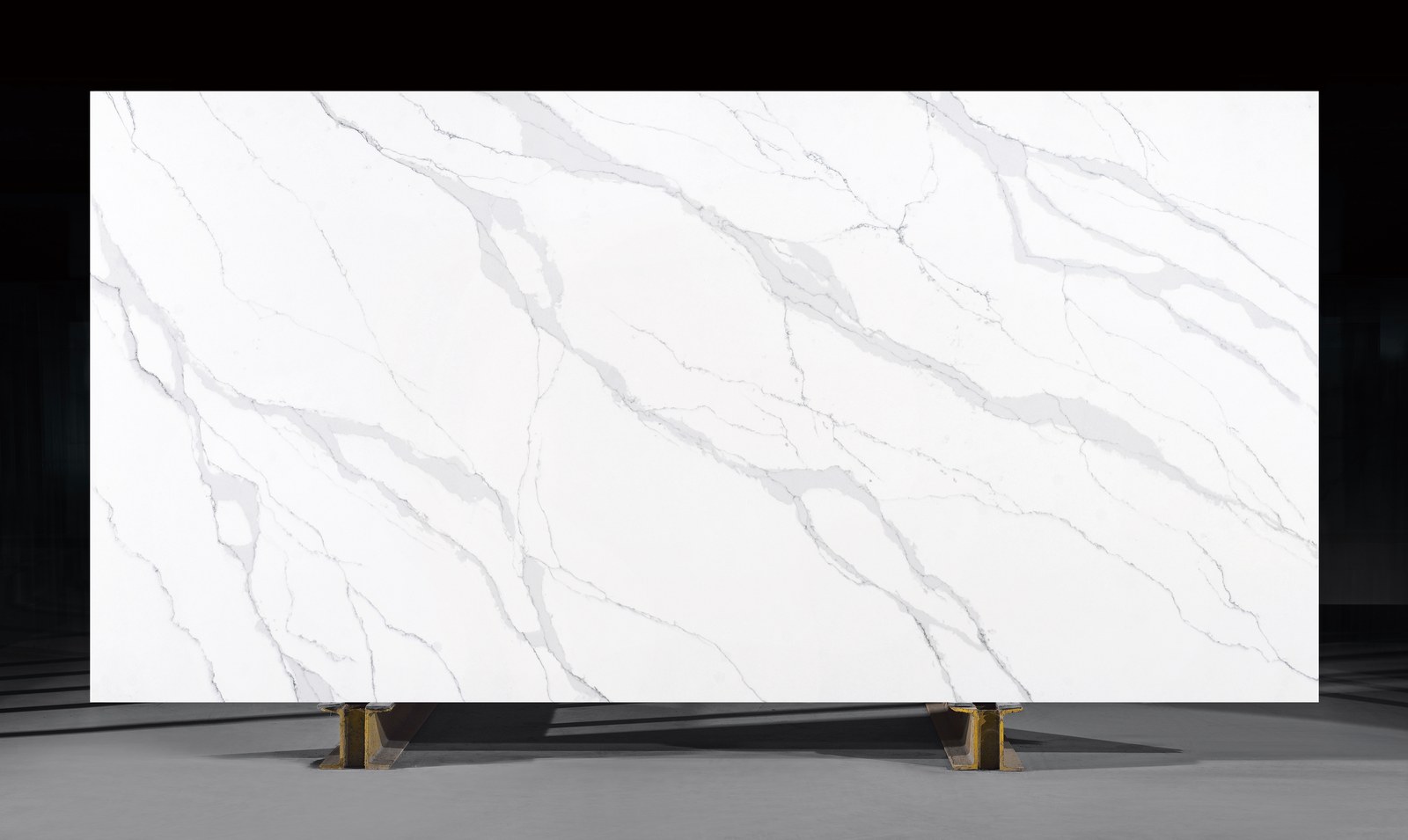
Foshan Lewistone New Material CO., LTD is a manufacturer of quartz slabs and other surfaces. Its supplied product information describes engineered quartz slabs in a standard format of 3200 × 1600 mm, offered in 20 mm and 30 mm thicknesses with honed, polished and matte finishes. These details make quartz a concrete option for initial countertop and vanity-top screening. They do not, by themselves, establish that quartz is a better fit than sintered stone or acrylic solid surface.
Start with the project constraints, not a material ranking
Quartz slabs, sintered stone and acrylic solid surface are often considered for overlapping interior applications, but a buyer cannot make a defensible selection from category names alone. A useful comparison starts by listing the conditions the finished surface must satisfy: its intended use, required dimensions and thickness, appearance, fabrication details, applicable food-contact or other project requirements, destination-market regulations, and supplier evidence.
This distinction matters because an attractive sample is only one part of a procurement decision. Slab dimensions affect layout and fabrication planning. Cut-outs, seams and edge profiles affect the work required from the fabricator. Destination rules may affect whether a product can be supplied or processed at all. Documentation determines whether the buyer can verify the product’s stated properties and suitability for the project.
Evidence boundary: the supplied content gives specific product details and application information for engineered quartz. It does not give comparable technical data, certifications, prices or fabrication instructions for sintered stone or acrylic solid surface. The comparison below identifies what is established and what must be checked, rather than assigning unsupported advantages to either alternative.
What the supplied quartz evidence establishes
The engineered quartz product record lists slabs measuring 3200 × 1600 mm, with 20 mm and 30 mm thickness options and honed, polished or matte finishes. It identifies the material as frit or quartz powder, polyester resin, pigments and additives. The same record describes a dense structure, stain and scratch resistance, and simple daily maintenance as product selling points. These are supplier-provided claims, not a side-by-side independent laboratory comparison with sintered stone or acrylic.
The application information connects engineered quartz slabs to residential and commercial kitchens and bathrooms, including countertops, islands, breakfast bars, vanity tops and basin surrounds. It describes exposure to water, oil, humidity, cleaning agents and daily wear. It also notes that projects may require accurate cut-outs, seam matching and edge polishing to coordinate with cabinetry, sinks, cooktop openings, backsplashes, adhesives and edge profiles.
That evidence supports an initial format-and-application screen. It does not answer every technical question. Buyers should request current product documentation for the exact slab, finish and batch under consideration, and check that the fabrication plan and project specification match those details.
Comparison at a glance: known facts versus open checks
| Buyer question | Engineered quartz slabs | Sintered stone | Acrylic solid surface |
|---|---|---|---|
| What product-specific information is available here? | Size, thickness, finishes, material description, stated surface attributes and countertop or vanity applications are provided for the listed quartz products. | No product-specific dimensions, finishes, performance data, certification or fabrication instructions are supplied. | No product-specific dimensions, finishes, performance data, certification or fabrication instructions are supplied. |
| Can the listed products be matched to a slab-format plan? | The supplied engineered quartz slab specification is 3200 × 1600 mm in 20 mm or 30 mm thickness. | Ask the supplier for the exact product datasheet and available formats. | Ask the supplier for the exact product datasheet and available formats. |
| Are project or compliance documents included? | The supplied corpus lists an NSF/ANSI 51 certification record associated with engineered quartz models 3116, 3115 and 3292. Confirm the current certificate status and exact product scope for the project. | No certification evidence is supplied for a sintered stone product. | No certification evidence is supplied for an acrylic solid surface product. |
| Can cost or overall value be compared? | No comparable quotation or landed-cost data is supplied. | No comparable quotation or landed-cost data is supplied. | No comparable quotation or landed-cost data is supplied. |
| What is the responsible conclusion? | Suitable for evidence-based preliminary screening where the listed format, finishes and documented application fit the project. | Suitability cannot be assessed from the supplied evidence alone. | Suitability cannot be assessed from the supplied evidence alone. |
The table is deliberately not a winner chart. Missing evidence for one material is not proof of poor performance, just as a manufacturer’s claim for another material is not a substitute for comparable testing. For procurement, an evidence gap should trigger a request for documents or a sample-validation step—not an assumption.
How to evaluate constraints before shortlisting quartz slabs
1. Confirm the application and fabrication route
For kitchen countertops, islands, breakfast bars and bathroom vanity tops, confirm the finished layout against the selected slab format and thickness. Ask the fabricator to account for cut-outs, seam positions, edge details and the relationship to the cabinetry, sink and backsplash. The supplied application record specifically calls for professional fabrication with accurate cut-outs, seam matching and edge polishing.
Use conditions matter too. The application record describes routine exposure to water, oil, humidity, cleaning agents and daily wear. It also advises using trivets for hot cookware and avoiding prolonged contact with strong acids or alkalis. Those handling notes are relevant to the supplied quartz application; they should not be automatically transferred to sintered stone or acrylic. Obtain the corresponding care and use instructions for whichever product is being evaluated.
2. Check the exact slab specification
For the quartz range documented here, buyers can begin by checking whether 3200 × 1600 mm slabs, 20 mm or 30 mm thickness, and honed, polished or matte finishes fit the design and fabrication plan. If a project requires a different dimension, finish or edge arrangement, confirm it with the supplier rather than assuming it is available. The product record for Printed Quartz separately lists the same standard size and thickness options, with honed, polished and matte finishes; its material description includes a printed decorative layer.
For sintered stone and acrylic solid surface, request the equivalent product-level information before comparing formats. Keep the comparison like-for-like: identify the precise product, finish, thickness, dimensions and intended use in each quotation or submittal. A broad category description is not enough to verify compatibility.
3. Treat certificates as scoped evidence
The supplied certification record lists NSF/ANSI 51, certificate number C0738772-01, for engineered quartz slab and relates it to product models 3116, 3115 and 3292. NSF/ANSI 51 concerns materials used in food equipment. For a project where food-contact qualification matters, verify the certificate with the issuing body and confirm that the specific product and intended use fall within its scope. The record does not establish certification for every quartz surface, every model, or any sintered stone or acrylic product.
Certification should be checked as a product-specific procurement document, not treated as a general badge for an entire material category. Buyers comparing multiple materials should request the relevant certificate or test documentation for each selected product and confirm that it addresses the actual project requirement.
4. Screen destination-market restrictions early
Regulation can be a threshold constraint rather than a secondary specification. Verified industry data states that Australia prohibited the manufacture, supply, processing and installation of engineered stone benchtops, panels and slabs from 1 July 2024. Buyers considering engineered quartz for an Australian project must therefore check the current applicable rules and product classification before proceeding. Do not assume that a different product label or a supplier’s general statement changes the regulatory status.
This is not a legal comparison of all three material categories. The supplied evidence does not establish the market-access status of sintered stone or acrylic solid surface in Australia, nor does it provide a complete jurisdiction-by-jurisdiction regulatory review. Buyers should verify the rules for the exact product and destination with the relevant authority or qualified adviser. Where fabrication is performed in another market, workplace safety requirements may also affect supplier and fabricator qualification.
What the alternatives comparison cannot establish
The requested comparison names quartz surfaces, sintered stone and acrylic solid surface, but the available product records do not provide a common test basis for the three. There are no matched values here for flexural strength, water absorption, thermal performance, chemical resistance, repairability, emissions, maintenance cost or installed price. There are also no product-specific sintered stone or acrylic datasheets, supplier quotations or test certificates in the supplied material.
As a result, it would be misleading to state that one of the three is categorically more durable, easier to repair, more heat resistant, less expensive or more suitable for a particular application on this evidence alone. Buyers can still make progress by asking each supplier the same questions and comparing documents at the same level of detail. Where performance is decisive, request reports using relevant, recognized methods and confirm that the specimens, thicknesses and finishes are comparable.
Price requires particular care. The evidence package contains no verified price series or comparable quotations for quartz slabs, sintered stone or acrylic solid surface. A meaningful commercial comparison would need to align product grade, size, thickness, finish, minimum order, delivery terms, freight, fabrication scope and destination charges. Without that basis, a lower quoted slab price would not establish a lower project cost.
A practical decision sequence for Research and Evaluation
- Define the project: record the application, destination, dimensions, finish, required certifications and fabrication conditions.
- Shortlist exact products: compare named products and models rather than broad material labels.
- Collect matched documents: obtain datasheets, certificates, care instructions, test reports and written quotation terms for each candidate.
- Check fabrication fit: review cut-outs, seams, edge profiles, support and installation details with the fabricator.
- Validate the market: confirm current destination-market rules for the precise product and intended work.
- Compare on a shared basis: evaluate appearance, specification, documentation, fabrication requirements and delivered cost using the same project assumptions.
- Resolve evidence gaps: request clarification or sample validation before approving a material that lacks comparable documentation.
This sequence keeps the comparison neutral while making the next procurement action clear. A product with more complete evidence may be easier to assess, but document completeness alone does not prove superior performance. Conversely, missing evidence should be treated as an unresolved question, not as proof that a material is unsuitable.
Where Lewistone’s quartz information fits
Foshan Lewistone New Material CO., LTD provides a documented engineered quartz slab option for preliminary review: 3200 × 1600 mm format, 20 mm and 30 mm thickness, and honed, polished or matte finishes. The supplied record also identifies kitchen and bathroom countertop and vanity applications. These facts give buyers concrete points to check against a project drawing and fabricator’s requirements.
The company’s product information should be used as supplier evidence, not as an independent comparison against the other material categories. Buyers should confirm the current datasheet, selected model, finish, certificate scope where relevant, batch details and delivery terms directly in the procurement process. For the NSF/ANSI 51 record, confirm that the product proposed is among the models listed and that the certificate is current and applicable to the intended use.
Conclusion: compare evidence before choosing a category
Quartz surfaces, sintered stone and acrylic solid surface should be compared through project constraints and product-level documentation, not through unsupported generalizations. The supplied corpus supports a meaningful first screen for engineered quartz slabs: it identifies a standard format, thicknesses, finishes, stated applications, fabrication considerations and a certification record with a defined product association. Equivalent evidence for sintered stone and acrylic solid surface is not available here.
For a buyer in Research or Evaluation, the practical conclusion is to keep all three options open until exact product documentation, fabrication requirements, destination rules and comparable costs are checked. Quartz can be shortlisted where its documented dimensions and application fit the project, subject to market-specific restrictions and verification of the selected product. A final material decision requires evidence for every candidate—not a ranking built from incomplete data.
FAQ
What slab sizes and thicknesses are listed for the quartz products?
The supplied engineered quartz slab specification lists a size of 3200 × 1600 mm and thickness options of 20 mm and 30 mm. Honed, polished and matte finishes are listed.
Can quartz slabs be used for kitchen countertops and bathroom vanity tops?
The supplied application information identifies engineered quartz slabs for kitchen countertops, islands, breakfast bars, bathroom vanity tops and basin surrounds, subject to appropriate fabrication and project requirements.
What fabrication and care points are specified for the quartz application?
The application record calls for accurate cut-outs, seam matching and edge polishing. It advises using trivets for hot cookware and avoiding prolonged contact with strong acids or alkalis. The supplied knowledge answer recommends a soft cloth with mild detergent and water for daily cleaning, prompt spill cleanup, and avoiding abrasive pads and strong acidic or alkaline cleaners.
Does the available evidence identify a single best choice among quartz, sintered stone and acrylic solid surface?
No. The supplied content provides product-specific information for quartz but not equivalent specifications, testing, certifications or prices for sintered stone and acrylic solid surface. A defensible choice requires comparable evidence for the exact products being considered.
Editorial note: Product details in this article are drawn from the supplied content units. Regulatory and certification statements should be checked against current official records before they are used for a project or compliance decision.
Have Questions or Need More Details?
Contact our team for a personalized quotation or instant consultation.
Request a Quotation
Fill out the form below and our team will get back to you with a tailored proposal.
WhatsApp Direct Chat
Prefer to chat in real-time? Message us on WhatsApp for instant assistance & quick answers.
- Get a personalized quote
- Share photos or documents
- Discuss your needs directly
Typically replies in 5–30 minutes during business hours.