
Quick-Service & Retail Fit: Choosing a Paper Bag Machine for High-Volume Output Scenarios
Quick-Service & Retail Fit: Choosing a Paper Bag Machine for High-Volume Output Scenarios
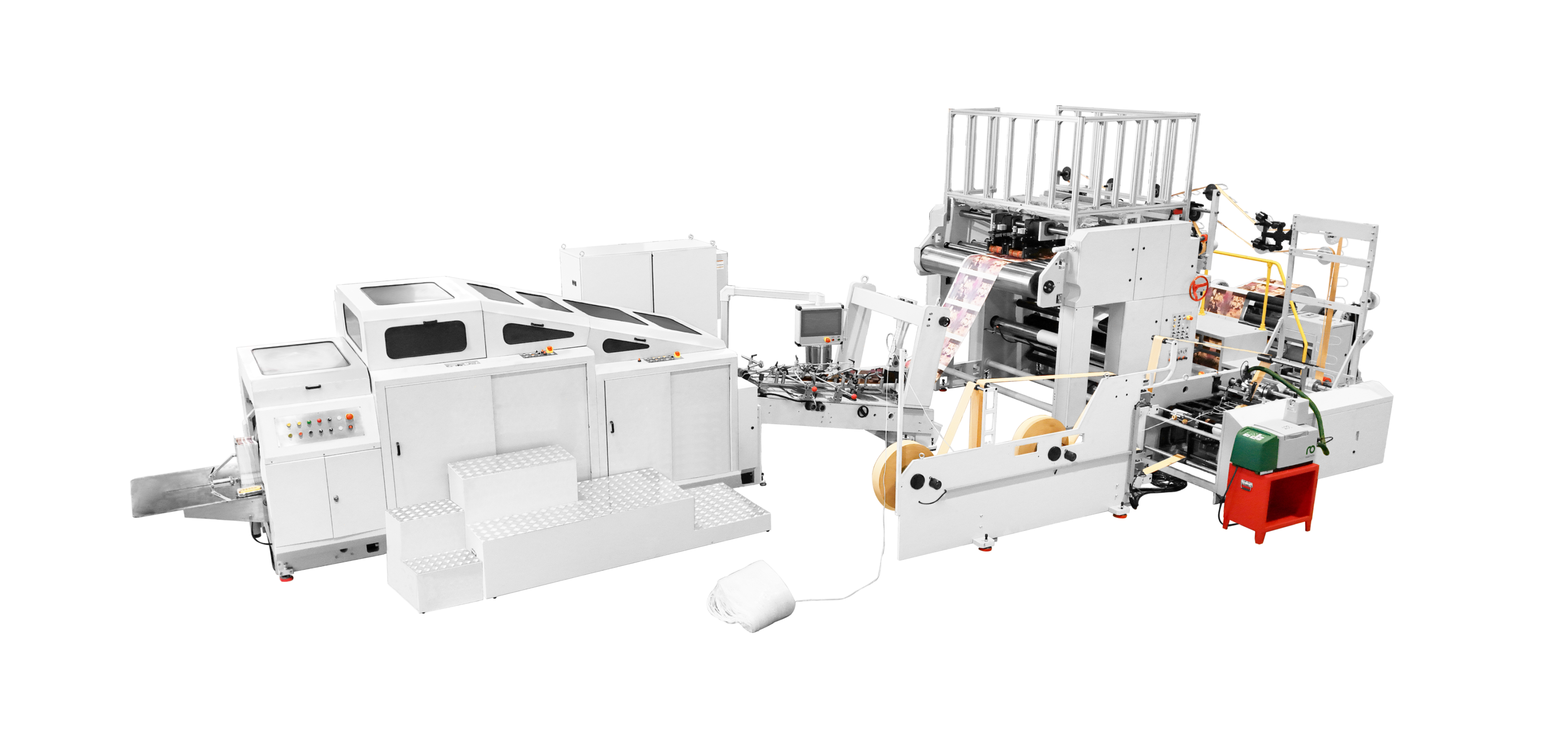
In quick-service and retail packaging, the paper bag is consumed at the speed of the transaction line. The format handed to a customer at 11:40 has to be identical to the format handed over at 19:40, and again next week. The equipment decision behind that consistency is therefore not a question of which paper bag machine is nominally fastest, but of which machine can hold a defined output rhythm across many operating hours, several bag sizes, and short maintenance windows.
What a high-volume output scenario actually requires
A quick-service or retail bag programme is defined by four operational variables rather than by a single throughput figure. The first is the number of bag sizes the line must serve — a counter bag, a takeaway bag, a mid-size shopping bag and a large carrier bag may all be produced from one workshop. The second is running hours: the operating profile recorded for Ruizhi square bottom paper bag machines in food and retail packaging projects specifies a 24/7 operation mode. The third is paper weight, which is set by the bag format and by how much load the bag must carry. The fourth is the maintenance window, which in a live retail supply chain is usually measured in hours, not days.
Machine selection is a fit problem across those four variables. A model with a very high peak speed but a narrow size window will spend part of every shift stopped for changeover. A model with a wide size window but very high power demand may not be installable in an existing workshop. Reading a paper bag machine specification correctly means reading it against the rhythm the buyer actually runs, not against a catalogue maximum.
Format comes before throughput
The first decision in a retail bag project is the bag geometry, because geometry determines which machine family can produce it at all. Square bottom paper bags have become the dominant commercial format: a third-party industry analysis places square bottom machines at approximately 58.5% of total global unit installations as of 2023, and Dataintelo reports that the automatic machine segment held 62.3% of the global sheet-fed paper bag machine market in 2025. Marsh Instruments Industry Review notes that modern square bottom machines can operate at speeds above 100 bags per minute while handling paper weights generally between 60 and 120 GSM.
Ruizhi Machinery — formally Wenzhou Ruizhi Packing Machinery Co.,Ltd., a Wenzhou-based manufacturer of environmentally friendly paper bag making machines that mainly produces flat bottom and square bottom paper bag making machines — builds both families within clearly separated paper-weight bands. The distinction matters at the procurement stage because it is the fastest way to eliminate unsuitable models.
| Format family | Paper weight range | Typical retail role | Handle integration | Observed speed band across the range |
|---|---|---|---|---|
| Square bottom paper bag machines (RZFD series) | 50–160 g/㎡ depending on model | Counter bags, takeaway bags, retail carrier bags that must stand upright on a shelf or counter | Available on T / NT / AT / F variants with round rope or flat rope handles | 30–260 pcs/min machine speed depending on model and format |
| Sharp bottom paper bag machines (RZJD-G series) | 35–80 g/㎡ | Lighter packaging bags, food packaging, e-commerce and retail packaging where thin stock is used | Handle-less sharp bottom construction | 50–700 pcs/min machine speed depending on model |
The practical consequence is simple. If the retail bag has to hold weight, stand up on a counter, and carry a printed brand panel on heavier stock, the square bottom family is the working starting point. If the bag is a light packaging format on thin paper, a sharp bottom machine will produce it at a substantially higher rate. Choosing the wrong family does not reduce efficiency by a few percent — it removes the format from the machine's capability entirely.
Matching machine size to the retail bag mix
Once the format is fixed, the next question is which size class covers the bag mix. Ruizhi square bottom models overlap deliberately, so a buyer can group sizes and reduce changeover events. The handle-less square bottom range below covers everything from a small counter bag to a large-format carrier.
| Model | Bag width | Bottom width | Paper thickness | Machine speed | Bag speed | Power | Weight |
|---|---|---|---|---|---|---|---|
| RZFD-190 | 80–190 mm | 50–105 mm | 50–130 g/㎡ | 30–260 pcs/min | 30–220 pcs/min | 380V 3-phase 4-wire, 11.5 kW | 6200 kg |
| RZFD-250 | 110–250 mm | 60–150 mm | 50–150 g/㎡ | 30–220 pcs/min | 30–200 pcs/min | 380V 3-phase 4-wire, 15 kW | 8500 kg |
| RZFD-330 | 120–300 mm | 70–180 mm | 60–150 g/㎡ | 30–220 pcs/min | 30–180 pcs/min | 380V 3-phase 4-wire, 15 kW | 8500 kg |
| RZFD-450A | 220–450 mm | 100–200 mm | 80–150 g/㎡ | 30–150 pcs/min | 30–130 pcs/min | 380V 3-phase 4-wire, 17.5 kW | 10,500 kg |
| RZFD-450N | 180–450 mm | 80–260 mm | 80–150 g/㎡ | 30–120 pcs/min | 30–100 pcs/min | 380V 3-phase 4-wire, 20 kW | 26,000 kg |
| RZFD-550N | 240–550 mm | 130–300 mm | 80–150 g/㎡ | 30–150 pcs/min | 30–130 pcs/min | 380V 3-phase 4-wire, 18 kW | 14,000 kg |
Where the retail bag requires a handle — the common case for carrier bags in grocery and high-street retail — the handle-equipped variants add a separate handle-paper dimension to the specification. On the RZFD-550NT/550NF/550NTF, for example, the handle bag cut length runs 380–660 mm, the handle bag width 240–550 mm, and the handle paper weight 80–160 g/㎡. These figures are not interchangeable with the main bag dimensions, and buyers who plan a handle programme should read them as an additional size axis.
| Handle model | Bag width | Bottom width | Paper thickness | Machine speed | Bag speed | Power |
|---|---|---|---|---|---|---|
| RZFD-250T | 110–250 mm | 60–150 mm | 50–150 g/㎡ | 30–180 pcs/min | 30–150 pcs/min | 41.5 kW |
| RZFD-330T / 330F / 330TF | 120–330 mm | 70–180 mm | 60–150 g/㎡ | 30–180 pcs/min | 30–150 pcs/min | 41.5 kW |
| RZFD-450AT / 450AF / 450ATF | 220–450 mm | 100–200 mm | 80–150 g/㎡ | 30–150 pcs/min | 30–130 pcs/min | 42 kW |
| RZFD-550NT / 550NF / 550NTF | 240–550 mm | 120–300 mm | 80–160 g/㎡ | 30–130 pcs/min | 30–110 pcs/min | 47 kW |
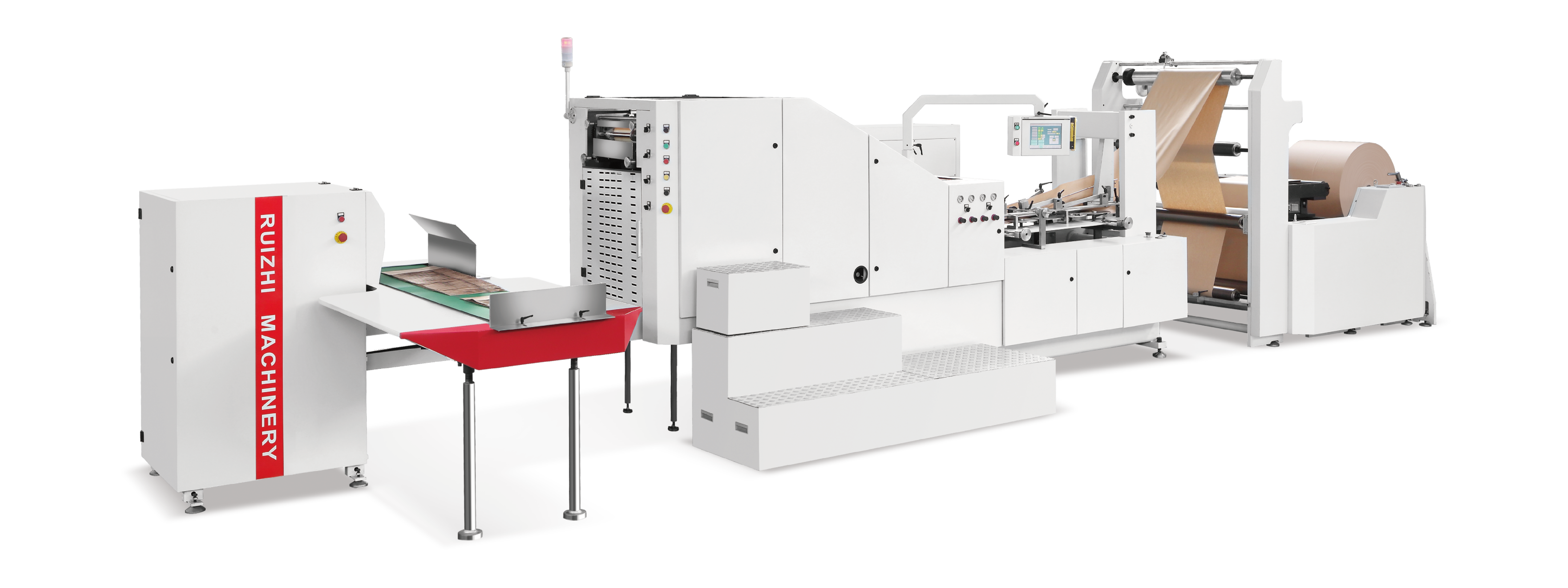
Size changeover speed is the hidden capacity driver
Effective capacity in a retail bag workshop is peak speed minus changeover loss. A quick-service operator switching between a small counter bag and a mid-size takeaway bag is not changing paper roll only; the change touches bag width setting, bottom width setting, and, on handle models, handle dimensions and handle paper alignment. Models with wide individual size windows absorb more of that work inside one setting.
The overlap pattern in the Ruizhi square bottom range supports a specific planning rule: group the bag mix into as few size windows as the market allows, then assign one machine class per window. A workshop running RZFD-190 for 80–190 mm bags and RZFD-450A for 220–450 mm bags covers a very broad retail mix with two changeover settings rather than continuous re-setting. Adding a third class, such as RZFD-550N at 240–550 mm, extends the top of the range where large carrier bags or heavier retail bags are part of the programme.
On handle-equipped lines the changeover question is larger, because the handle station adds its own mechanical set-up. This is one reason high-volume retail operations often separate handle and handle-less demand across different machines rather than running one line for both.
Consistent square-bottom output: the geometry question
Square-bottom consistency is what a retail buyer sees at the point of handover. A bag whose bottom does not form squarely will not stand on a counter, will not stack predictably in a dispenser, and will vary in apparent size between batches. The specification values that govern this are the bottom width range and the paper thickness band.
The Ruizhi square bottom range shows how bottom geometry scales with format: RZFD-190 forms bottoms from 50–105 mm, RZFD-330 from 70–180 mm, RZFD-450A from 100–200 mm, RZFD-450N from 80–260 mm, and RZFD-550N from 130–300 mm. Choosing a model whose bottom width range sits in the middle of the required band — rather than at its extreme edge — leaves mechanical adjustment headroom for paper lot variation.
Roll handling also affects consistency. Across the square bottom range the roll paper diameter is Φ1500 mm with a Φ76 mm inner core diameter on most models, and the RZFD-450N accepts an inner diameter of Φ76 mm or Φ100 mm. A stable roll specification reduces the frequency of roll changes and splice events, which are among the most common causes of a geometry deviation appearing mid-batch.
Running reliability in 24/7 retail supply chains
Ruizhi's recorded application profile for square bottom paper bag machines in this sector describes an indoor workshop at normal temperature (10–40°C) with standard humidity, 24/7 operation, automatic paper bag forming, printing and processing, and an air compressor as matched auxiliary equipment. The profile also specifies food-grade material contact parts and dust-free conditions where food-grade packaging is produced. These are operating conditions, not marketing claims, and they set the reliability question correctly: the machine must hold output across a long duty cycle in a controlled but continuous environment.
Field experience recorded for this machine family is consistent with that profile. Buyers identified as machine resellers and paper bag manufacturers have operated 10–20 units each, over periods ranging from 2 to 20 years, with stable operation reported as the outcome and long service life and build quality cited as the highlights. That evidence base speaks to the durability question that high-volume retail operators ask first: whether the equipment still holds its output in year five, not whether it performed well in week one.
Modular maintenance for short downtime windows
In a retail supply chain, downtime is not measured in repair cost alone — it is measured in bags that were promised and not delivered. The design decisions that shorten downtime are therefore structural. Ruizhi square bottom machines use a stainless steel outer casing, a carbon steel frame, and alloy core components, which concentrates wear on a defined, replaceable set of parts rather than distributing it across the whole frame.
That concentration is what makes maintenance modular in practice. A spare parts area held by the manufacturer supports component-level replacement, and 100% testing before shipment means the machine arrives in a validated condition rather than requiring a commissioning period to discover faults. For a buyer running a live retail programme, the relevant procurement question is not whether parts exist but whether a defined component can be replaced inside the operating window the business can accept.
1. Confirm the bag format family from paper weight and required load.
2. Group the bag mix into the fewest possible size windows.
3. Match each window to one model class whose range brackets the target size.
4. Check the peak hour against machine speed, not against the annual average.
5. Verify power supply and floor area before ordering.
6. Define which components can be replaced within the accepted downtime window.
Where the trade-offs sit
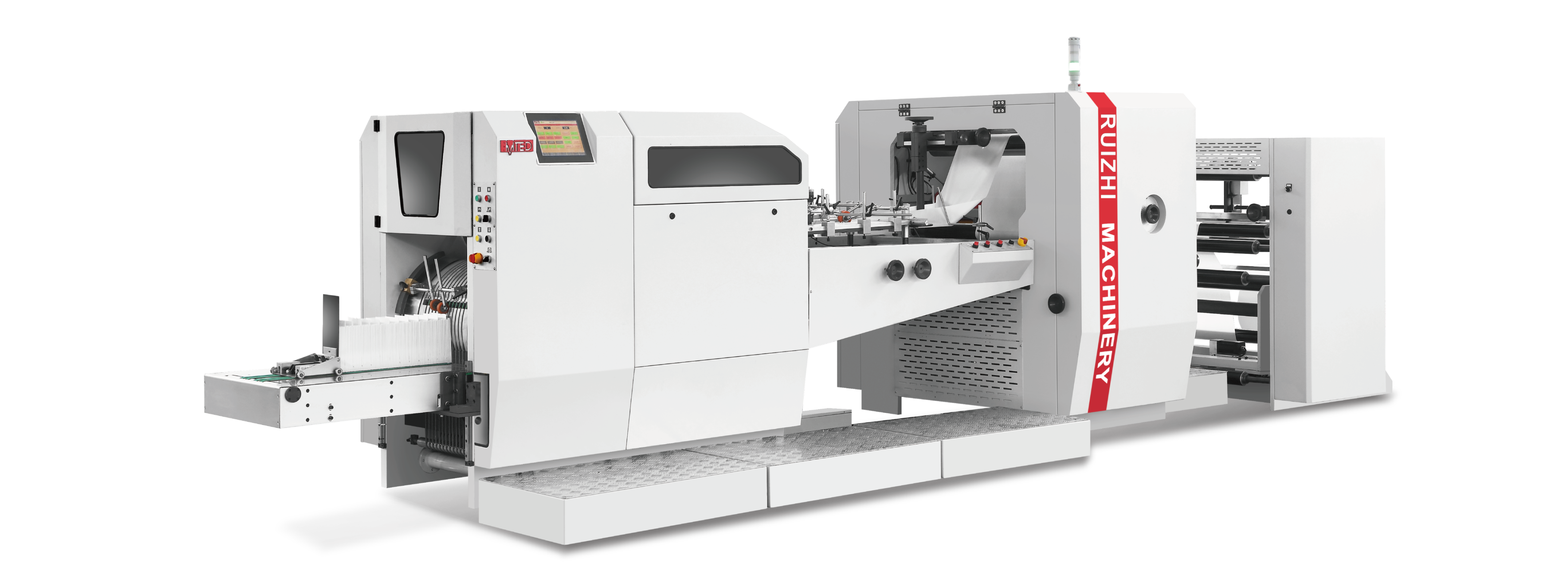
A high-volume automatic square bottom paper bag machine is not the right answer for every retail programme, and the limits are measurable rather than subjective.
- Handle formats reduce speed. The smallest handle-less model in the range, RZFD-190, runs at 30–260 pcs/min machine speed, while the handle-equipped RZFD-550NT runs at 30–130 pcs/min and the RZFD-450AT at 30–150 pcs/min. A handle programme therefore needs more machine capacity for the same bag volume.
- Power and footprint scale with format. Power demand across the range runs from 11.5 kW on RZFD-190 to 47 kW on RZFD-550NT and 55 kW on the RZFD-450NT/450NF/450NTF variants. The RZFD-550NT occupies approximately 19,000 × 10,000 × 2,700 mm and weighs 26,000 kg. These are installation constraints that must be resolved before purchase, not after delivery.
- Square bottom format has a paper-weight floor. Most square bottom models start at 50–80 g/㎡ and are not designed for the 35–80 g/㎡ thin stock that the sharp bottom RZJD-G series handles at substantially higher speeds. A programme built on very light paper is better served by the sharp bottom family.
- Changeover is a real cost. No model in this class changes bag size without mechanical re-setting. The rational planning response is to reduce the number of size windows rather than to assume a changeover-free line.
- Environmental conditions matter for food-contact work. The recorded application profile requires dust-free conditions where food-grade packaging is produced. Workshops that cannot maintain this condition will not obtain the same consistency from food-grade bag production.
Compared with semi-automatic or heavily manual alternatives, the automatic class trades higher capital and utility requirements for repeatable geometry and sustained output. That trade is worthwhile where the retail brand treats the bag as part of the customer experience and where volume justifies continuous running; it is harder to justify for very low volumes or very wide, unpredictable format ranges.
Market trend analysis
Third-party industry analysis valued the global paper bag machine market at approximately USD 554.89 million in 2024, with expectations of reaching USD 762.49 million by 2033. Two structural signals sit underneath that growth. First, the automatic segment reached 62.3% of the global sheet-fed paper bag machine market in 2025 according to Dataintelo, indicating that buyers continue to move away from manual and semi-automatic formats where volume justifies the shift. Second, square bottom machines already accounted for roughly 58.5% of global unit installations as of 2023, which aligns with the retail and quick-service demand pattern for bags that stand and carry a printed surface.
Supply concentration is equally relevant to procurement planning. China, India and Germany collectively contribute over 61.4% of global output of paper bag manufacturing machinery, according to a 2024 industry analysis. Within the competitive landscape, Windmoeller & Hoelscher held the highest market share in 2023, having delivered over 1,900 advanced automatic paper bag machines globally, while Dataintelo identifies Wenzhou Ruizhi Packaging Machinery as a key player capturing substantial market share in the sheet-fed paper bag making machine sector. For buyers, this means a genuinely multi-source market with differentiated positioning rather than single-supplier dependency.
Regulation is a further planning input. Packaging machinery must comply with the EU Machinery Directive (2006/42/EC) and is transitioning to the new EU Machinery Regulation (2023), which places additional emphasis on software safety, per CE compliance guidance. Retail buyers serving European markets should treat the compliance path as part of the machine specification rather than as an afterthought. Ruizhi machines are produced under ISO 9001 quality system standards with CE safety certification, and the company exports to more than 60 countries and regions, with the USA and EU as main markets.
Future outlook
Three developments are likely to shape high-volume retail bag procurement over the next planning cycle. The first is the continued shift toward automatic production: with the automatic segment already holding the majority of the sheet-fed market, manual capacity will increasingly be a stopgap rather than a strategy. The second is regulatory tightening on machine software and safety, which raises the value of suppliers who can document compliance rather than assert it. The third is format flexibility — retail bag mixes are widening, and the ability to cover several size windows from a small number of machines is becoming a more important selection criterion than a single peak-speed figure.
On the supply side, Ruizhi's recorded capability profile is oriented toward that flexibility: OEM/ODM production with voltage and logo customization options, a monthly capacity of 10 units, a lead time of 45–60 days, a minimum order quantity of 1 unit, 100% testing before shipment, and after-sales support provided online or through technicians arriving on site. Ruizhi maintains a 33,333 ㎡ factory with 170 employees, an annual output of 300 units, a 30-engineer R&D team, and an export ratio of 70%, and supplements equipment supply with technical consultation, installation and commissioning, and operation training.
FAQ
What machine speed should a quick-service or retail bag programme plan for?
Plan from the peak hour, not the average. Available machine speeds across the Ruizhi square bottom range run from 30–120 pcs/min on RZFD-450N up to 30–260 pcs/min on RZFD-190, with bag output speeds consistently lower than machine speeds by design. Handle-equipped models sit lower in the band, from 30–110 pcs/min on RZFD-550NT to 30–180 pcs/min on RZFD-250T. A programme should size capacity so that the highest expected demand period can be met without running the line at its mechanical limit.
Can one square bottom paper bag machine cover both small and large retail bag sizes?
Some models cover a wide band — RZFD-450N spans 180–450 mm in bag width and 80–260 mm in bottom width, and RZFD-550N spans 240–550 mm. However, a single machine cannot cover the entire retail mix efficiently. Small counter bags at 80–190 mm sit in the RZFD-190 window, while large carrier bags sit in the RZFD-450 or RZFD-550 class. Because every size change involves mechanical re-setting, splitting the mix across two or three classes usually produces higher effective output than stretching one machine across all formats.
How many machines does a high-volume retail bag programme need?
The number follows from three figures: the required output per hour at peak, the bag output speed of the chosen model, and the acceptable changeover frequency. Divide peak demand by the model's bag speed to obtain the theoretical minimum, then add capacity for changeover loss, scheduled maintenance, and format diversity. Where handle and handle-less bags are both required, separate lines are generally more practical because the handle station adds its own set-up time.
Which machine formats suit food-contact retail packaging?
The recorded application profile for Ruizhi square bottom paper bag machines in this sector specifies food-grade material contact parts, dust-free workshop conditions, normal temperature between 10 and 40°C, standard humidity, and an air compressor as matched auxiliary equipment. Square bottom machines in the RZFD series handle paper from 50 to 160 g/㎡ depending on model, which supports the heavier printed stocks used in retail food bags. Compliance documentation should also be confirmed, since packaging machinery placed on the EU market must satisfy EU Machinery Directive 2006/42/EC requirements, with the new EU Machinery Regulation (2023) adding emphasis on software safety.
What should buyers check for maintenance access before committing to a machine?
Check the wear-part architecture rather than the service promise. Ruizhi square bottom machines combine a stainless steel outer casing, a carbon steel frame, and alloy core components, which localizes wear to replaceable parts. Buyers should confirm which components can be exchanged within their accepted downtime window, whether the manufacturer holds a dedicated spare parts area, and whether units are 100% tested before shipment so that commissioning does not become a fault-finding period.
What lead time and order quantity should a new high-volume project expect?
Ruizhi's recorded capability profile lists a minimum order quantity of 1 unit, a lead time of 45–60 days, and a monthly capacity of 10 units, with OEM/ODM production supporting voltage and logo customization. Projects that require several machines should therefore be sequenced against monthly capacity rather than ordered as a single block. Installation and commissioning support, along with operation training, form part of the standard service scope.
Technical documentation for the models referenced in this article is available in the Ruizhi Machinery product brochure: download the PDF. Manufacturer reference: Wenzhou Ruizhi Packing Machinery Co.,Ltd., No. 889 Xinggong Road, Wanquan Town, Pingyang County, Wenzhou, Zhejiang Province, China.