
RDP Procurement FAQ: Viscosity, Particle Size & Substitution Degree
RDP Procurement FAQ: Viscosity, Particle Size & Substitution Degree
A buyer-side reference for mortar producers who have already shortlisted suppliers and now need to fix the specification before the first bulk order.

Quality inspection testing: RDP samples are checked at powder level before they are validated in a mortar formulation.
Redispersible polymer powder (RDP) is a spray-dried polymer additive that redisperses in the mixing water of a dry-mix mortar and then re-forms a continuous polymer film as the mortar cures. That film is what turns a brittle cement or gypsum matrix into an adhesive, flexible and crack-resistant system — which is why RDP sits inside a large share of dry-mix mortar formulations rather than at their edges.
The commercial scale behind that role is measurable. The global RDP market was valued at USD 1.61 billion in 2024 and is projected to reach USD 2.35 billion by 2029, according to MarketsandMarkets. Grand View Research reports that Vinyl Acetate Ethylene (VAE) is the dominant polymer type, accounting for 59.2% of revenue share in 2025, and that Asia Pacific held a 38.01% revenue share in the same year.
For mortar producers working between the decision and execution stages, the open questions are rarely about what RDP is. They are about specification: which viscosity, which particle size, which substitution degree — and how to confirm those choices before committing to a bulk order. The sections below answer those questions in procurement terms, using BANGCEL® as a reference case for OEM/ODM customization, technical consultation and pre-sales sample testing.
Entity reference: BANGCEL® is the construction-additives brand of BANG SHANG INTERNATIONAL CO., LIMITED, a manufacturer of cellulose ethers (HPMC, MHEC, HEC, CMC) and redispersible polymer powder. Founded in 2007, the company operates an 80,000 m² production site with 300 employees and a 26-engineer R&D team, and exports roughly 70% of its output to markets including Canada, the United States, Mexico, Brazil, Turkey, Saudi Arabia, India, Japan and Australia.
Why RDP Specification Questions Surface Late in the Buying Cycle
Most procurement sequences follow a similar shape. Buyers screen suppliers on capability, capacity and compliance, shortlist two to four names, and only then move into formulation-level conversation. At that stage three parameters dominate the technical exchange, because each one changes how the powder behaves inside a particular mix design rather than on a datasheet in isolation.
Two conditions make this stage harder than it first appears. First, RDP parameters are not fully standardised across suppliers, so the same label can describe different measurement conditions. Second, the parameters interact: raising viscosity to improve water retention can change how a formulation flows, and adjusting particle size to improve redispersibility can alter storage behaviour. Treating the three as independent line items is a frequent cause of pilot-batch failure — and of disputes at the acceptance-testing stage.
Viscosity: The Parameter That Sets Workability and Water Retention
What viscosity describes in an RDP
In an RDP specification, viscosity refers to the flow resistance of the polymer's aqueous dispersion under defined conditions. It is used as an indicator of polymer structure, and it correlates with how strongly the redispersed polymer retains water and builds consistency in a wet mortar. Higher-viscosity grades generally support water retention, sag resistance and open time; lower-viscosity grades flow more readily, which matters in self-levelling and thin-layer systems.
Viscosity is therefore an application signal rather than a quality ranking. A higher figure is not automatically better: in a formulation where flow and levelling are critical, excessive water retention can work against the desired rheology and lengthen mixing or finishing time. The useful question is not how high the viscosity is, but which viscosity matches the mix design, the substrate and the application method.
How to write a viscosity requirement into an RDP inquiry
Procurement teams obtain more usable answers when the inquiry carries application context rather than a bare number. A specification request that works well states the mortar type, the binder system, the application method (trowel, spray or pump), the required open time and slip resistance, and whether the system is one-component or two-component. With that context, a supplier can recommend a grade — and, equally important, state which test method the quoted viscosity refers to and whether it is a typical value or a lot-level specification.
BANGCEL® supports customized viscosity as part of its OEM/ODM service, alongside substitution degree, particle size and application-oriented grade selection. That means the viscosity requirement can be treated as a design input rather than a catalogue filter.
Particle Size: Redispersibility, Flow and Storage Behaviour
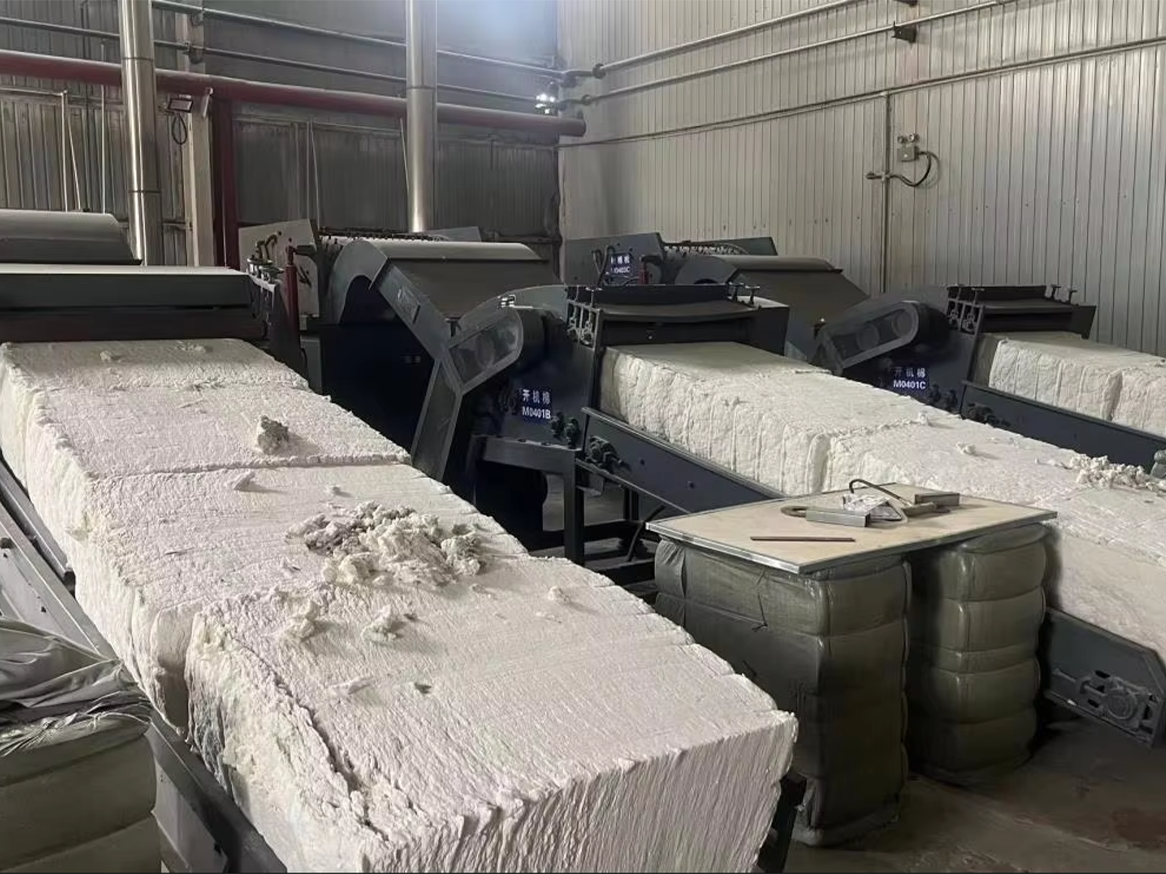
Raw material intake: the polymer base selected at this stage determines how the finished RDP powder will behave in water.
Particle size and particle size distribution describe how finely the spray-dried powder is divided and how uniformly those particles are sized. The parameter influences three practical behaviours: how quickly the powder breaks down into primary particles when it meets mixing water; how freely the dry powder flows during dosing and conveying; and how the powder behaves during storage, since very fine fractions are more prone to dusting and, under adverse conditions, to caking.
A distribution that is poorly controlled can leave undispersed particles in the fresh mortar, and those particles can become defects in the cured film — the very failure mode RDP is added to prevent. Because particle size is set downstream of polymer composition, it is largely a function of the drying process and its control. BANGCEL® operates a fully automated closed-loop spray drying process, and customization of particle size is offered as part of its OEM/ODM scope.
Two procurement questions make this parameter verifiable rather than assumed. The first is the measurement method: sieve residue analysis and laser diffraction describe different characteristics of the same powder, so a specification is only comparable when both sides name the method. The second is whether the quoted distribution is a typical value or a guaranteed range per production lot — a distinction that determines whether the specification is enforceable at acceptance testing.
Substitution Degree: The Least Standardised Parameter in RDP Procurement
Substitution degree describes the extent to which functional groups have been introduced onto the polymer backbone. For substituted polymer additives, this structural value affects water solubility, the speed and completeness of redispersion, and how the polymer interacts with the cement pore solution once the mortar is mixed. In practice it is the parameter least visible on a standard datasheet and among the most influential on whether a powder disperses consistently from lot to lot.
It is also the parameter with the weakest cross-supplier comparability. Substitution degree is not expressed on a single universal scale that every producer reports identically; different manufacturers may report a related but non-equivalent structural value, or may describe the property indirectly through application performance. Buyers who compare two suppliers by placing the two numbers side by side can draw a conclusion that the data does not support.
The practical rule for procurement teams is therefore procedural rather than numerical: ask the supplier to define the term as they use it, to state the test method behind it, and to confirm whether the value is fixed across lots or adjusted to meet an application target. BANGCEL® lists substitution degree among the parameters open to customization, which allows the value to be aligned to a specific formulation rather than selected from a fixed table.
How the Three Parameters Interact: A Buyer's Decision Framework
Because viscosity, particle size and substitution degree act on the same wet-mortar system, they should be specified as a set. The table below translates each parameter into the question a buyer actually needs answered.
| Parameter | Primary influence in a mortar | Question to put to the supplier |
|---|---|---|
| Viscosity | Water retention, consistency, sag resistance, open time | Which dispersion test method is used, and is the value typical or lot-guaranteed? |
| Particle size | Redispersion speed, dry flow and dosing, dusting and caking risk | Sieve residue or laser diffraction, and what distribution range is guaranteed? |
| Substitution degree | Solubility, redispersion completeness, compatibility with the binder system | How is the term defined, how is it measured, and is it fixed or formulation-adjusted? |
| All three combined | Final film formation, adhesion, flexibility and workability | Which combination has been validated in a mix design closest to ours? |
Application Notes: Where Each Specification Choice Bites
Ceramic tile adhesive. Tile adhesives are classified under EN 12004 and ISO 13007-1, and RDP is essential to meeting the C1 (≥0.5 MPa) and C2 (≥1.0 MPa) tensile bonding thresholds. Here, particle size control and redispersion completeness matter directly, because undispersed powder becomes a weak point in a thin adhesive layer. Water retention also governs open time, which determines how much tile can be fixed per batch.
Wall putty. In putty, viscosity is the dominant specification dialogue, because it drives application feel, filling behaviour and shrinkage-related cracking. A grade tuned for adhesive performance may not be the grade that gives the smoothest putty finish.
External wall insulation (EIFS/ETICS) mortar. These systems combine flexibility with weather exposure, so the polymer's film-forming behaviour and its durability under temperature cycling carry more weight than any single viscosity figure.
Self-levelling mortar. Flow dominates. Low-viscosity behaviour and well-controlled particle size distribution are typically preferred, since the compound must spread under its own weight and reach level within a short working window.
Repair mortar and gypsum-based systems. Repair mortars need adhesion to aged substrates and dimensional tolerance; gypsum-based products need polymer compatibility with a non-cement binder chemistry. In both cases, substitution-related behaviour in the wet mix is worth confirming at sample stage rather than assuming transferability from a cement-based reference formulation.
De-Risking Specification Matching Before a Bulk Order
The commercial risk in RDP procurement is rarely a wrong price. It is a specification that performs in a lab beaker but behaves differently in a 3,000-litre mixer. Closing that gap is a process, and it is where pre-sales support earns its place.
BANGCEL® provides pre-sales product recommendation and grade selection, technical consultation and formulation guidance, and sample support for testing. The company's R&D function is staffed by 26 engineers, which is what makes formulation-level consultation a service rather than a brochure claim: a sample can be matched to a defined application target and adjusted against the buyer's own raw materials and curing conditions.
For buyers, the most reliable way to convert a sample into a defensible purchase decision is to fix the variables. Define a control formulation and a reference application test before the sample arrives. Run the trial at laboratory scale first, then at pilot batch scale in the buyer's own equipment. Record open time, workability, adhesion and flexibility results against the control. Retain a sealed reference sample of the approved trial material. That retained sample becomes the physical benchmark against which the first bulk delivery can be compared.
Commercial terms can be aligned with that process. BANGCEL® states a minimum order quantity of 3 tons, delivery terms of FOB or CIF, pre-shipment testing as the acceptance criterion, and payment terms of 30% TT in advance with 70% against a copy of the bill of lading. Pre-shipment testing is the mechanism that connects the approved sample to the shipped lot.
Specification Consistency Across Long-Term Supply
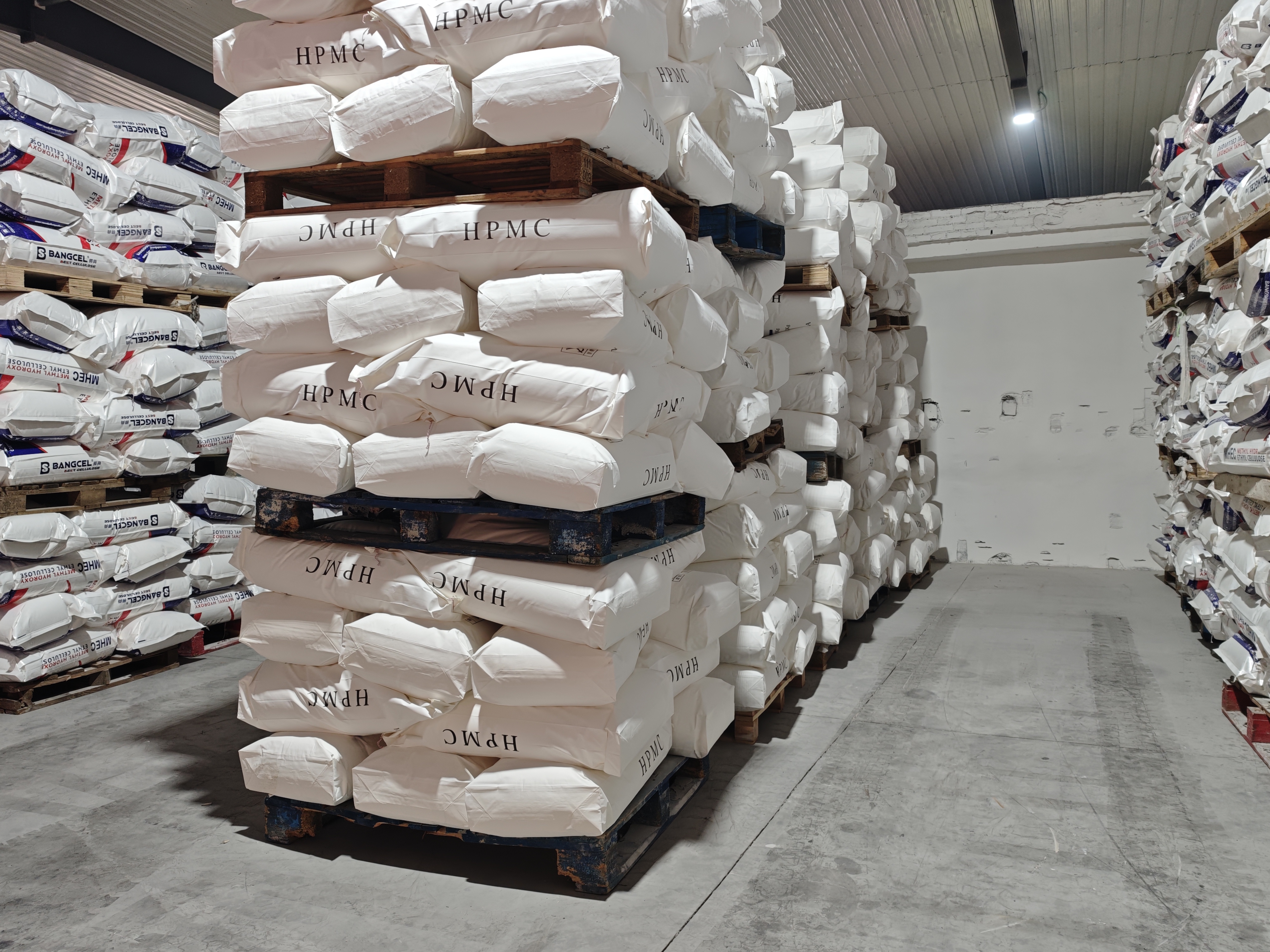
Finished-goods warehousing: packaging and storage control protect the specification between production and delivery.
A specification agreed once is only valuable if it repeats. This is the point where supply-side capability becomes part of the technical answer, because lot-to-lot variation in viscosity or particle size shows up as batch variation in the buyer's own production line — and rejects at the customer's plant, not at the supplier's gate.
BANGCEL® reports an 80,000 m² production site, an annual output of 35,000 tons and a monthly production capacity of 3,000 tons, organised around standardized production with strict batch control. Capacity figures matter here for a specific reason: continuous supply from a stable production base reduces the risk that a buyer has to requalify a different lot profile mid-project.
One documented case illustrates the pattern. A project in India established a long-term supply partnership providing a stable annual supply of 1,200 metric tons over a two-year period to a global manufacturer for tile adhesive and wall putty production. The significance is not the tonnage alone but the fact that a single specification held across two years and multiple production cycles.
Support after shipment is the other half of consistency. BANGCEL® describes its after-sales service as continuous technical support and formula adjustment, stable long-term supply with priority service, and additional support for authorized distributors. The company also reports lower maintenance requirements, with zero mass quality complaints and full-process formulation technical support, resulting in no additional maintenance cost. Those are supplier-reported figures and are best verified against the buyer's own trial data and reference samples.
What Is Changing in the RDP Supply Market
Three structural signals are worth tracking for anyone specifying RDP now. The first is scale: the market's projected move from USD 1.61 billion in 2024 to USD 2.35 billion by 2029 indicates continued conversion from site-mixed polymer systems to factory-dosed dry-mix products. The second is chemistry: VAE-based polymers held 59.2% of revenue share in 2025, meaning most specification conversations will continue to happen within one polymer family rather than across several. The third is geography: Asia Pacific's 38.01% revenue share in 2025, driven substantially by Chinese infrastructure projects, keeps a large share of global RDP capacity and export flow anchored in that region. Between July 2024 and June 2025, China-origin shipments recorded by Volza numbered 2,012, with the United States, Turkey and Uzbekistan among the top importers.
One caution belongs next to these figures. Published RDP market size estimates diverge considerably between research houses, largely because some reports define the category as redispersible polymer powder while others include redispersible latex powder or different polymer bases. A single headline number should not be treated as an agreed industry value. Similarly, an estimate that RDP accounts for around 70% of dry-mix mortar formulations in China's construction industry comes from a source rated lower on reliability than the market-size data above, and is presented here as an indicative figure rather than a settled one.
A related structural fact affects sourcing strategy: the top four RDP manufacturers, a group that includes Wacker Chemie AG, Dow and BASF, hold over 40% of global market share. Concentration at the top means that for many applications the real comparison is not between a global brand and a regional producer, but between a global brand and a smaller producer whose specification flexibility and engagement at formulation level may be materially different.
Limits and Boundaries: What Specification Matching Cannot Fix
RDP is a performance additive, not a corrective for a broken formulation. No viscosity, particle size or substitution degree choice will compensate for poorly graded aggregate, inconsistent cement, an incorrect water-to-binder ratio, or inadequate curing. Where a mortar fails for those reasons, changing the RDP grade usually adds cost without solving the problem — and can obscure the real cause during troubleshooting.
Storage is the second boundary. RDP is sensitive to heat and humidity, and agglomeration during high-temperature or high-humidity storage is a recognised risk. BANGCEL® controls this through three-layer moisture-proof composite packaging, storage in a constant-temperature warehouse held between 15–25°C and below 60% relative humidity, and regular inventory quality inspection. Buyers operating in tropical or humid climates should treat warehouse conditions as part of the specification, not as a logistics detail.
The third boundary concerns how RDP is compared with older practices. Site-mixed liquid polymer emulsions offer dosing flexibility and are easy to introduce without changing a powder line, but they generally demand accurate on-site measurement, have tighter storage and shelf-life constraints, and make lot-to-lot consistency harder to document. Dry-mix RDP moves that variability into a factory-controlled process, at the cost of requiring disciplined warehouse conditions and a defined redispersion step in the mixer.
Finally, first-party data should be read as first-party data. In BANGCEL®'s internal comparative testing against lower-grade imported RDP, the company reports a 22% increase in bonding strength, an 18% increase in flexural strength, a 100% film-forming rate at −10°C against 70% for the comparator, and zero cracking in weather resistance testing against a 12% cracking rate — alongside reported construction efficiency gains of 30%, a 35% longer open time, a 15% reduction in material waste and an overall construction cost reduction above 10%. Those results reflect the supplier's own testing conditions against a defined comparator category, not independent third-party verification, and they should be validated through the buyer's own sample trial before being used as a purchasing assumption.
Future Outlook
The direction of travel in dry-mix mortar specification is toward documented parameters and pre-qualified samples. As compliance frameworks such as EN 12004 and ISO 13007-1 continue to define the minimum performance a tile adhesive must demonstrate, the interesting procurement question shifts from whether a product complies to whether a supplier can prove that compliance holds across lots and over time. Manufacturers that publish measurement methods, guarantee per-lot ranges and support formulation-level consultation will be easier to qualify than those that publish a single typical value.
For mortar producers, that suggests a practical preparation: build internal reference samples for every approved RDP grade, keep the trial records attached to the purchase specification, and treat warehouse conditions as a controlled variable. Specification matching is not a one-time exercise — it is the evidence base that makes a second and third order predictable.
FAQ
1. What is the difference between a high-viscosity RDP and a standard-viscosity RDP in a mortar?
Viscosity in an RDP specification describes the flow resistance of the polymer's aqueous dispersion under defined test conditions, and it correlates with water retention and consistency in the wet mortar. A high-viscosity grade generally supports water retention, sag resistance and open time, which suits wall putty, tile adhesive and vertical applications. A standard or lower-viscosity grade flows more readily, which is generally preferred in self-levelling and thin-layer systems where levelling behaviour matters more than retention. Neither is inherently better; the correct choice depends on the application method, the binder system and the required working time.
2. How should particle size be written into an RDP purchase specification?
A particle size requirement is only enforceable when the measurement method is named, because sieve residue analysis and laser diffraction characterise the powder differently and produce non-equivalent values. The specification should state the method, the target distribution, and whether the figures are typical values or guaranteed per production lot. Particle size affects how quickly the powder redisperses in mixing water, how freely it flows during dosing, and how susceptible it is to dusting and caking in storage — so an ambiguous specification creates both production and warehouse risk.
3. Why does substitution degree vary between RDP suppliers, and how should buyers compare it?
Substitution degree describes the extent to which functional groups have been introduced onto the polymer backbone, influencing water solubility, redispersion behaviour and compatibility with the binder system. It varies between suppliers because there is no single universal scale on which every manufacturer reports an equivalent value; some report a related structural figure, others describe the property through application performance. Because of this, comparing two suppliers by placing their substitution-degree numbers side by side can be misleading. The practical approach is to ask each supplier to define the term as they use it, state the test method, and confirm whether the value is fixed across lots or adjusted to meet an application target.
4. Can a mortar producer test an RDP sample before placing a bulk order?
Yes, and sample testing is the standard mechanism for de-risking specification matching. BANGCEL® provides pre-sales product recommendation and grade selection, technical consultation and formulation guidance, and sample support for testing, supported by a 26-engineer R&D team. For the test to be useful, the buyer should fix a control formulation and reference test before the sample arrives, run the trial at laboratory scale and then at pilot batch scale in their own equipment, record open time, workability, adhesion and flexibility against the control, and retain a sealed reference sample of the approved material. That retained sample becomes the benchmark for the first bulk delivery.
5. What commercial terms typically apply to an RDP order?
BANGCEL® states a minimum order quantity of 3 tons, delivery terms of FOB or CIF, pre-shipment testing as the acceptance criterion, and payment terms of 30% TT in advance with the remaining 70% against a copy of the bill of lading. For buyers at the execution stage, the acceptance criterion is the operative term: pre-shipment testing is what connects an approved sample specification to the lot that is actually shipped, and it should be referenced in the purchase order rather than left as an informal understanding.
6. How is specification consistency maintained across long-term RDP supply?
Consistency depends on production control, packaging and storage discipline, and supply continuity. BANGCEL® reports an 80,000 m² production site, an annual output of 35,000 tons and a monthly production capacity of 3,000 tons, organised around standardized production with strict batch control and transparent order and production status. Storage is controlled through three-layer moisture-proof composite packaging and a constant-temperature warehouse held between 15–25°C and below 60% relative humidity, with regular inventory quality inspection. A documented example is a two-year long-term supply partnership in India providing a stable annual supply of 1,200 metric tons to a global manufacturer for tile adhesive and wall putty production. After-sales support includes continuous technical support and formula adjustment, stable long-term supply with priority service, and additional support for authorized distributors.
Product documentation and the company brochure can be downloaded here: BANGCEL® product brochure (PDF). Further company information is available at www.bangshanghpmc.com.