
RDP Qualification File: CE, SGS and Supplier Evidence
RDP Qualification File: CE, SGS and Supplier Evidence
An RDP qualification file is the document set that lets a mortar producer judge whether a redispersible polymer powder supplier can carry a formulation into routine production, not just into a sample bag. It only works when three evidence layers stay separate: conformity and test documents (CE marking, SGS reports, management-system certificates), manufacturing and supply evidence (site, capacity, batch control, lead time), and application-fit records (customization details, trial results and batch consistency for the intended mortar).
In practice, most files arrive merged. A certificate page sits beside a product photograph, a test report issued for one grade is used to support another, and a platform supplier badge is read as if it were a conformity mark. The buyer then has to do the separation work under time pressure, usually after a formulation has already been built around the supplied sample.
This article sets out what each layer should contain, using the documentation published by BANG SHANG INTERNATIONAL CO.,LIMITED, whose RDP products are sold under the BANGCEL® brand, as a worked example. The company is a Hebei-based manufacturer and exporter of cellulose ethers and redispersible polymer powder, founded in 2007. Its published file shows what a supplier-side evidence set looks like, and where a buyer still has to ask for order-specific documents.
What an RDP Qualification File Has to Prove
A qualification file answers three questions in sequence, and each answer requires different evidence. Treating them as one question is the most common reason a file passes an audit and still fails in production.
- Conformity: is the declared performance of the named grade documented against a recognised specification, with a report that can be traced to a sample and a date?
- Capability: can the supplier make that grade repeatedly, at the ordered volume, at a defined manufacturing site, with a stated lead time and a defined quality-control regime?
- Fit: does the batch in the bag match the mortar application, whether that is a ceramic tile adhesive, wall putty, EIFS/ETICS system, self-leveling compound or repair mortar, including any OEM or ODM adjustments agreed for that application?
Where a layer is missing, the buyer is not evaluating a supplier; they are evaluating a PDF. A strong conformity page cannot compensate for an absent batch record, and a large factory photograph cannot compensate for a test report that names no grade.
Certificate Claims and Manufacturing Evidence Are Not the Same Thing
The four document types most often confused in RDP sourcing describe four different things, and each has a defined limit.
CE marking
CE marking is a declaration route rather than an approval issued for a specific shipment. Under the EU Construction Products Regulation, the manufacturer declares performance against the applicable harmonised technical specification, supports that declaration with test data, and identifies the intended use in the declaration of performance. The document is therefore valuable for establishing which claimed performance and which intended use a product is declared for. It does not, by itself, demonstrate plant capacity, batch consistency, or that a particular container matches the tested sample.
SGS testing
An SGS report records that specified samples were tested by a named laboratory, on a stated date, using stated methods, with stated results. Its evidential value depends entirely on traceability: grade, sample identification, method, and date. A report showing excellent results for an unnamed VAE-based powder cannot support a purchase decision on a named high-viscosity or low-ash grade, because the buyer cannot establish that the tested material and the purchased material are the same product.
Management-system certificates
An ISO 9001, ISO 14001 or ISO 45001 certificate describes a management system operating within a stated scope at a stated site, for a stated period. It is evidence about process discipline, not about the performance of any individual batch. Two details decide how much it is worth in a supplier file: the scope wording, and the validity dates.
Alibaba Gold Supplier status
Gold Supplier is a supplier status within the Alibaba International marketplace, tied to that platform's own account verification and membership arrangements. It is useful for supplier discovery and identity confirmation: it indicates that a trading account has met the platform's checks at the time of assessment. It is not a product test, not a CE declaration, and it says nothing about capacity, batch control or the grade inside the bag.
Layer One: Conformity and Test Documents
A conformity layer should contain five items, each traceable to a product, a standard and a date. Anything that cannot be traced to all three belongs in a marketing folder, not a qualification file.
- A declaration of performance or equivalent CE declaration identifying the product, the harmonised specification it is declared against, the intended use, and the manufacturer legally responsible for the declaration.
- Test reports from SGS or another laboratory, showing sample identification, grade, test method, test date and measured results.
- Management-system certificates with certificate number, standard, issuing body, scope and validity dates.
- A technical data sheet for the specific model, listing the parameters against which incoming goods will be accepted or rejected.
- A safety data sheet and a packaging or labelling specification, so that delivered goods can be checked against the file on arrival.
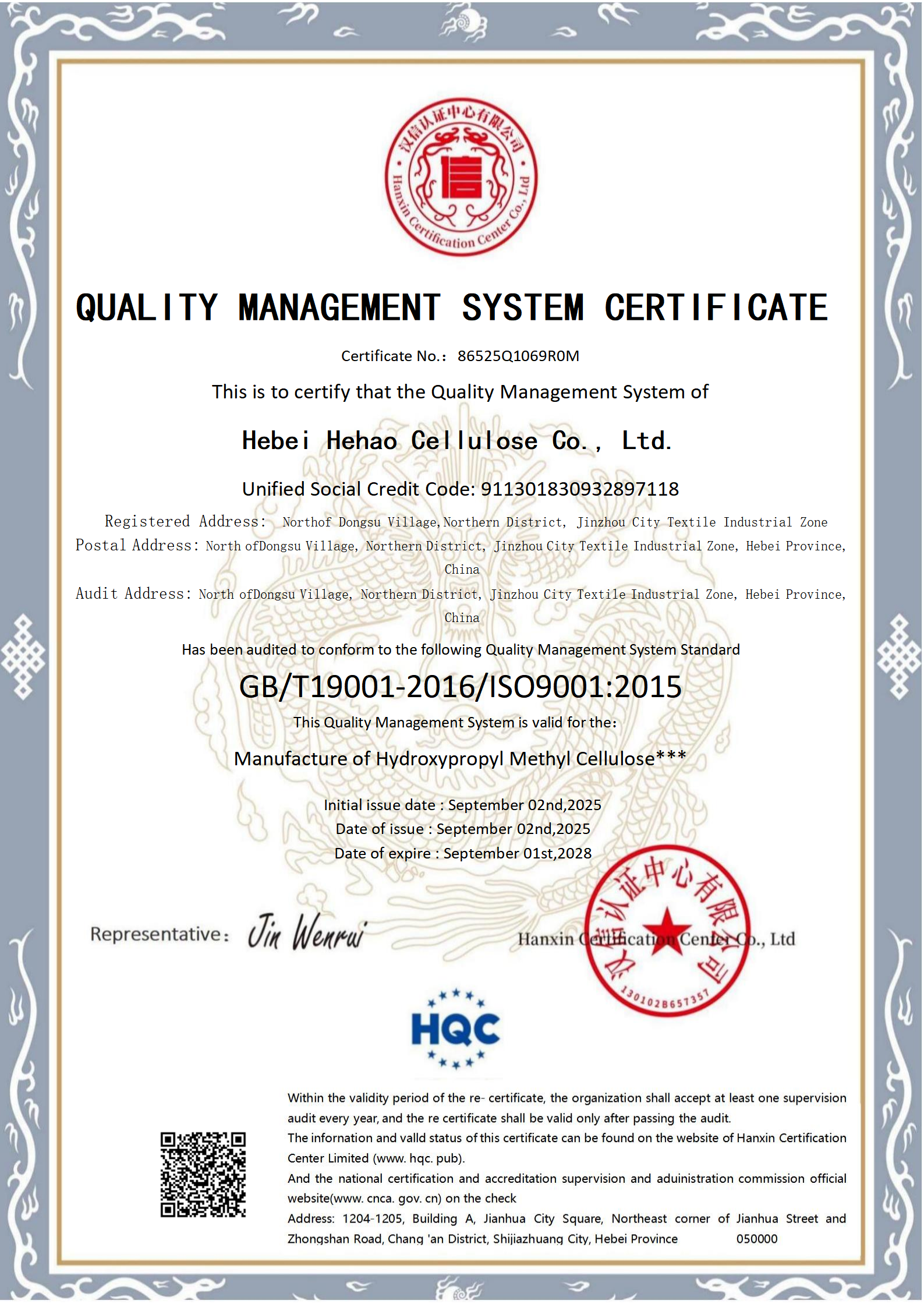
A management-system certificate belongs in the file only when its scope and validity dates are read, not just its logo.
BANGCEL®'s published documentation shows the pattern and one common filing error. The company states that its products are manufactured under strict quality control and have passed CE certification and SGS testing. Its RDP holds a Quality Management System certificate, number 86525Q1069R0M, issued by HQC against GB/T19001-2016/ISO9001:2015 for the global market, with a stated scope covering cellulose ether and RDP powder and validity from 2 September 2025 to 1 September 2028. A second certificate, 86525E1068R0M, covers GB/T24001-2016/ISO14001:2015 environmental management for markets described as global, excluding the EU.
A third document, certificate 86525S1067R0M to GB/T45001-2020/ISO45001:2018, is an occupational health and safety certificate whose documented scope is HPMC and cellulose ether manufacturing and related activities. It belongs in the HPMC section of the file. Placing it in the RDP product-conformity section is the error: a reviewer who checks the scope wording will discount the whole file, even though the certificate itself is valid.
The lesson is general rather than brand-specific. Read the scope line first, then the validity dates, then the standard, and only then the supplier name. A file that is re-checked at each expiry date stays usable; a file assembled once and never reviewed quietly becomes a record of expired claims.
Layer Two: Manufacturing and Supply Evidence
Layer two is where most sourcing folders are thinnest, and where the difference between a manufacturer and a reseller becomes visible. The layer should answer: who makes the powder, where, at what scale, and under what quality regime.
BANG SHANG INTERNATIONAL's published company data provides a concrete example of the shape this evidence takes. The company was founded in 2007 and operates an 80,000 m² facility with 300 employees, including an R&D team of 26 engineers. Published annual output is 35,000 tons, the export ratio is stated at 70%, and the listed markets span North America, Latin America, Europe, Africa, the Middle East, South Asia and Asia-Pacific, including Canada, the United States, Mexico, Brazil, Chile, Russia, Ukraine, Australia, Egypt, South Africa, Saudi Arabia, the UAE, India, Japan, Korea and Vietnam, among others.
For order planning, the same capability documentation states a monthly capacity of 3,000 tons, lead times of 7–14 days, a minimum order quantity of 3 tons, and quality control described as 100% testing. Each of these figures answers a different procurement question, and a buyer should not let one substitute for another:
| Supplier statement | Question it answers | Question it does not answer |
|---|---|---|
| 80,000 m² facility, founded 2007 | Is there a physical, long-established production site? | Is the specific grade produced on that site rather than blended elsewhere? |
| 35,000 tons annual output | Is the business sized for industrial supply? | How much of that output is the grade and specification being purchased? |
| 26-engineer R&D team | Is there in-house capacity to adjust a formulation? | Will the customization be tested against the buyer's own mix design? |
| 3,000 tons monthly capacity, 7–14 day lead time | Can a repeat order be scheduled within the buyer's production cycle? | When does the lead-time clock start, and does it hold at peak season? |
| 100% testing | Is every batch checked before dispatch? | Which properties are tested, by which method, and what is released vs rejected? |
The last row matters most in practice. "100% test" describes a regime, not a result. The buyer still needs to know which parameters are measured on each batch, whether the results are recorded per batch and issued with the goods, and what happens to a batch that falls outside specification. A file that answers those three questions is a working document; a file that repeats "strict quality control" is a slogan.
Platform status sits at this level too. The company is a Gold Supplier on Alibaba International, which supports the identity and account-verification part of supplier discovery. It should be recorded in the file as a commercial-platform signal, cross-referenced to the legal entity name, the manufacturing address and the certificate holder name. When those three do not match, the mismatch is the finding, regardless of how strong the badge looks.
Layer Three: Batch Control and Traceability
Batch evidence is what converts a supplier file into a purchase specification. The file should define the batch record the buyer will receive, the parameters it must contain, and the acceptance limits that apply to the intended mortar.
The BANGCEL® RDP range covers models RDP5010, RDP6188 and RDP4010, described as VAE-based construction-grade redispersible polymer powder with published parameters of solid content ≥99%, ash content 11±2, pH 6–8, minimum film-forming temperature of 0 °C and glass transition temperature of 10 °C. Those values are a starting point for a specification, not a complete one. For a mortar RDP powder used in a crack-resistant or flexible system, the buyer should also fix viscosity or water retention where relevant, and name the test method for every property. A number without a method cannot be compared across suppliers, and a comparison without a method is not an evaluation.
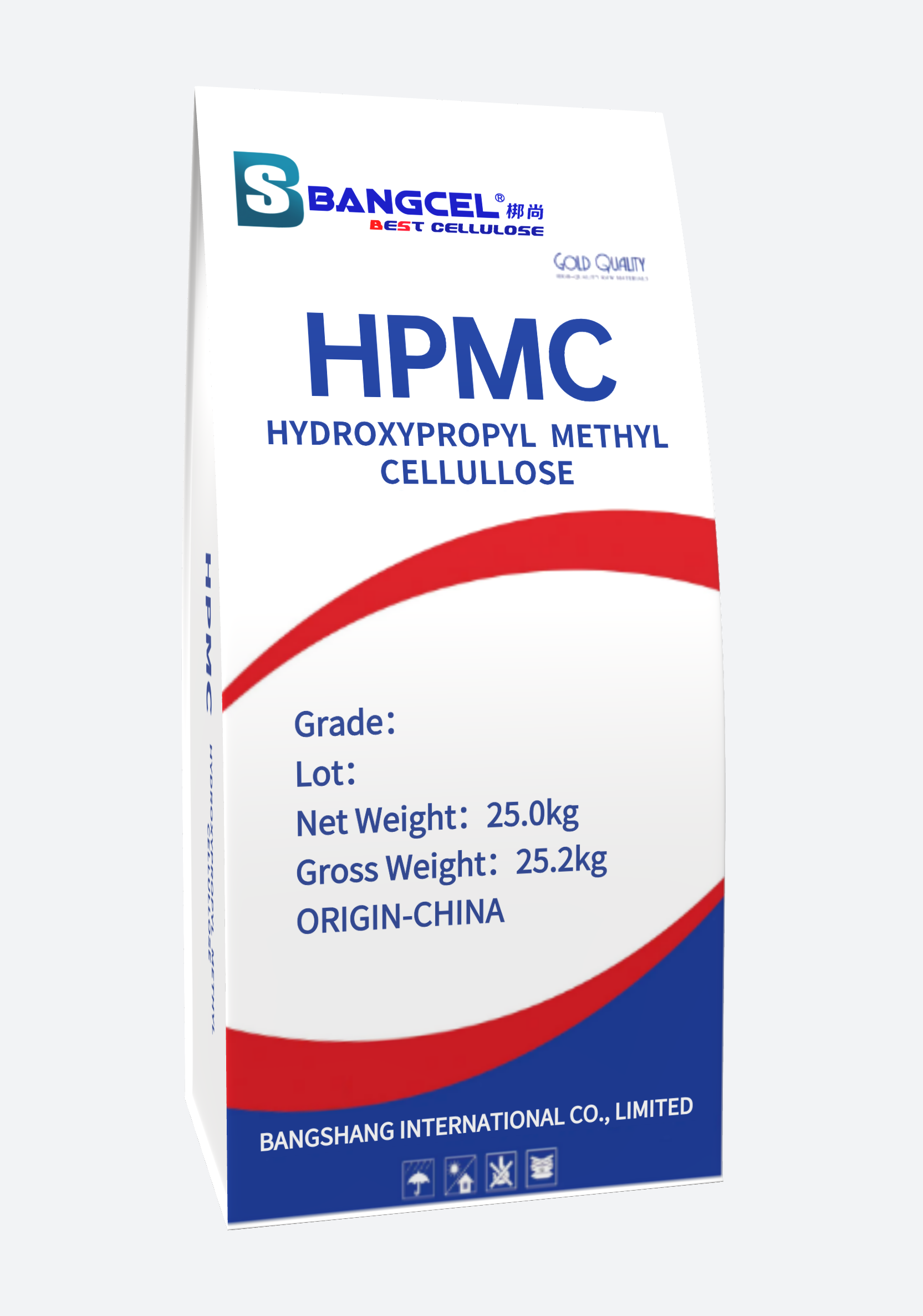
Batch identification on the packaging is the end point of traceability: the code on the bag must link to a test record.
Three practical requests tighten this layer quickly. First, ask for certificate of analysis records from two or three consecutive production batches rather than a single batch, because consistency is the property being purchased. Second, require the batch code on the packaging to correspond to the certificate of analysis and to the dispatch documents, so that a delivered pallet can be traced backwards. Third, state the sampling and retest protocol for incoming goods, including who performs it and which results trigger rejection.
Supplier case records can support this layer but cannot replace it. One documented BANGCEL® reference describes a two-year, 1,200 MT annual steady supply to a construction mortar and adhesive manufacturer in India for tile adhesive and wall putty formulations, with customized formulation R&D support and no reported quality complaints in long-term mass production. That is useful context about repeat supply behaviour. It is not evidence that the same grade will perform in a different formulation, kiln condition or climate, which is why the buyer's own trial data remains the deciding document.
Matching OEM/ODM Customization to the Mortar Application
Customization is the point where a qualification file most often becomes vague, because the levers and the application are described separately. A file is only complete when each customization level is tied to a named mortar application and an acceptance criterion.
The documented BANGCEL® OEM and ODM scope covers product-parameter customization (viscosity, particle size, ash content, degree of substitution, water retention rate), formula and grade customization (custom formulation, custom grade, blending and compounding), packaging customization (logo printing, packaging specification, shipping mark, custom label) and service customization (OEM, ODM, small-batch customization, customized testing). The application scope covers EIFS/ETICS, tile adhesives, self-leveling compounds, wall putties and repair mortars, with requirements described as EN, ASTM or GB compliant, low-VOC and formulation-dependent.
The matching logic follows from those two lists. Viscosity and water retention dominate in applications where the fresh mortar must hold water and stay workable on a vertical or absorbent substrate. Ash content and polymer base govern how much of the purchased powder is active polymer. Particle size and redispersibility affect how quickly the powder disperses in the dry mix and how the wet mortar behaves during application. Degree of substitution applies mainly where cellulose ethers are part of the same formulation package.
Before approval, the file should record four things for every customized grade: the application and substrate it was designed for; the parameter set and tolerances agreed for that application; the trial evidence showing the grade in the buyer's own mix at the intended dosage; and the version identifier of the approved formulation. Without the last item, a reformulation on either side can pass unnoticed through a document set that still looks complete.
Application-by-Application File Focus
The same supplier can hold a complete file for one application and an incomplete one for another, because the required test evidence differs. The table below maps the emphasis for the main dry-mix applications.
| Mortar application | What the file should pin down | Evidence to request |
|---|---|---|
| Ceramic tile adhesive | Adhesion and deformability under the intended service class; dosage per tonne of dry mix | Grade-specific test report, trial data in the buyer's formulation, batch records for the approved grade |
| Wall putty | Workability, water retention and crack behaviour on the target substrate | Parameter set including viscosity or water retention, application trial records, packaging specification |
| EIFS / ETICS systems | Flexibility and adhesion by system layer, since base coat and reinforcement layers stress the polymer differently | Grade-to-layer mapping, test data for the declared system use, declared intended use on the conformity document |
| Self-leveling mortar | Flow, stability and surface behaviour; interaction with the full additive package | Trial results at the intended dosage, batch consistency across consecutive lots, defined test methods |
| Repair and waterproofing mortars | Adhesion to prepared substrates and durability under the specified exposure | Application-specific test evidence, substrate conditions, declared limits of use |
| Gypsum-based systems | Compatibility with the gypsum binder rather than a cementitious system | Customized grade confirmation, trial data in the gypsum formulation, agreed acceptance criteria |
A Practical Approval Checklist and Six Common Gaps
Before signing, confirm that the file contains:
- The legal entity name, manufacturing address, certificate holder name and platform account name, all consistent.
- A CE declaration naming the product and intended use that match the purchase.
- A test report naming grade, method, date and sample identification.
- Management-system certificates with scope and validity dates read, not just filed.
- Company evidence: founding year, facility size, output, R&D strength, export markets.
- Order parameters: monthly capacity, lead time, minimum order quantity, testing regime.
- Certificates of analysis for consecutive batches of the approved grade.
- A written specification with parameters and named test methods.
- Trial evidence in the buyer's own mortar formulation at the intended dosage.
- A version identifier and a re-approval trigger for any change of grade, site or certificate.
Six gaps account for most failed approvals. A certificate whose scope covers a different product line than the one being purchased. A test report issued for a different grade under the same brand. A platform supplier badge presented as product conformity. A technical data sheet with no revision date, so the buyer cannot tell which version was approved. A file describing blending as manufacturing, leaving the actual polymer producer unidentified. And a customization agreement that names the modification but never states the application, dosage or acceptance test it was designed for.
Where BANGCEL®'s Documentation Fits, and Where It Does Not
Mapped against this framework, the supplier-side file is comparatively strong on identity and manufacturing context: an established entity since 2007, a defined 80,000 m² facility, 35,000-ton annual output, a 26-engineer R&D team, a stated 70% export ratio, defined order parameters, an OEM and ODM scope that names its customization levers, and management-system certificates that can be checked line by line.
Two boundaries should be recorded in the buyer's own file rather than resolved by the supplier's brochure. The environmental management certificate 86525E1068R0M is stated for markets described as global, excluding the EU, and the capability documentation likewise lists export markets as worldwide excluding the EU. Separately, the OEM scope is documented as worldwide, excluding the EU. For a buyer manufacturing inside the EU, the appropriate action is to confirm destination-specific conformity documentation, including the declaration of performance for the exact grade and intended use, before approval rather than after. For buyers outside the EU, the same documents still need to be matched to the grade and application being purchased, since a certificate valid for one product line does not automatically cover another.
The second boundary is data ownership. Order-specific items, such as certificates of analysis for the delivered batches, trial results in the buyer's formulation and the agreed specification version, are created after the supplier file is issued. They must be added to the file by the buyer, with dates and references, or the qualification rests entirely on supplier-controlled documents.
Re-approval: Keeping the File Valid After Signature
A qualification file has a shelf life. Certificates expire, standards are revised, grades are reformulated and production sites change. The file should therefore state, in advance, what triggers re-approval: certificate expiry dates already recorded in the file, a change of manufacturing site or blending arrangement, a change in any specified parameter outside its tolerance, a change in the polymer base or grade designation, and the introduction of a new raw material source.
Two habits make this workable. Keep every document with its date of receipt and its version, so that a superseded certificate can be identified rather than silently retained. And review the file at the same time as the purchase specification, not separately, because the specification is the only part of the file that says what the buyer actually agreed to accept.
Frequently Asked Questions
Does CE certification mean an RDP product has been approved for every EU application?
No. CE marking is a declaration route: the manufacturer declares performance against the applicable harmonised technical specification, supports that declaration with test data, and states the intended use. It is not an authority approval covering every application, and it does not automatically extend to a different grade or a reformulated product. Buyers should keep the declaration of performance with the file, check that product identity and intended use match the purchase, and confirm that the documents apply to their destination market.
What should an SGS test report for RDP contain?
A usable report identifies the sample and grade, the laboratory and report number, the test date, the test methods applied, and the measured values with units. Without a grade and a method, the results cannot be linked to the material being purchased. It is also important to read the report as evidence about the samples submitted on that date, not as a guarantee that every subsequent production batch will produce identical values; batch certificates of analysis cover that second question.
What does Alibaba Gold Supplier status actually verify?
It is a supplier status within the Alibaba International marketplace, linked to the platform's own account verification and membership arrangements. It indicates that a trading account met the platform's checks at the time of assessment. It is not a product certification, not a test report and not a CE declaration, and it does not describe manufacturing capacity, batch consistency or the grade inside a delivered bag. Its proper place in a qualification file is supplier discovery and identity confirmation, cross-checked against the legal entity and the manufacturing address.
Which RDP parameters should be fixed in a purchase specification?
At minimum: polymer base, solid content, ash content, pH, minimum film-forming temperature, glass transition temperature, and the exact model designation. Where the application requires it, add viscosity or water retention, particle size and degree of substitution. As a reference point, the BANGCEL® RDP models RDP5010, RDP6188 and RDP4010 are published as VAE-based powders with solid content ≥99%, ash 11±2, pH 6–8, minimum film-forming temperature 0 °C and glass transition temperature 10 °C. Every value should be paired with a named test method, otherwise figures from different suppliers are not comparable.
How should OEM or ODM customization be tied to a mortar application?
Write the application into the specification before any customization is agreed, then map each customization lever to that application: viscosity and water retention for workability and water demand, ash content for active polymer content, particle size for dispersion behaviour, and packaging for handling and batch identification. The agreement should also record the trial evidence in the buyer's own mix at the intended dosage, the acceptance criteria and who tests against them, and a version identifier so that a later reformulation cannot pass through the file unnoticed.
Reference Document
The supplier's product brochure, covering the RDP range and related construction additives, is available for download: BANG SHANG INTERNATIONAL product brochure (PDF).
Have Questions or Need More Details?
Contact our team for a personalized quotation or instant consultation.
Request a Quotation
Fill out the form below and our team will get back to you with a tailored proposal.
WhatsApp Direct Chat
Prefer to chat in real-time? Message us on WhatsApp for instant assistance & quick answers.
- Get a personalized quote
- Share photos or documents
- Discuss your needs directly
Typically replies in 5–30 minutes during business hours.