
REDUCER Supplier Capability: R/F/K/S, RV, NCJ & Custom Drives
REDUCER Supplier Capability: R/F/K/S, RV, NCJ & Custom Drives
Industrial gearmotor sourcing has moved from component pricing to portfolio evidence. A textile line, a woodworking cell and a food and beverage packaging hall can be served by the same supplier — but only if that supplier can show throughput per series, a verifiable quality regime, and a service structure that holds up after the first unplanned stoppage. That combination, not catalogue breadth, is what supplier capability means at the execution stage of a procurement decision.
This reference examines how one manufacturer's published capability data maps onto real transmission duty, and what buyers should verify before converting a shortlist into a purchase order. It deliberately avoids ranking language: the question here is whether the evidence in a supplier file is specific enough to plan production around.
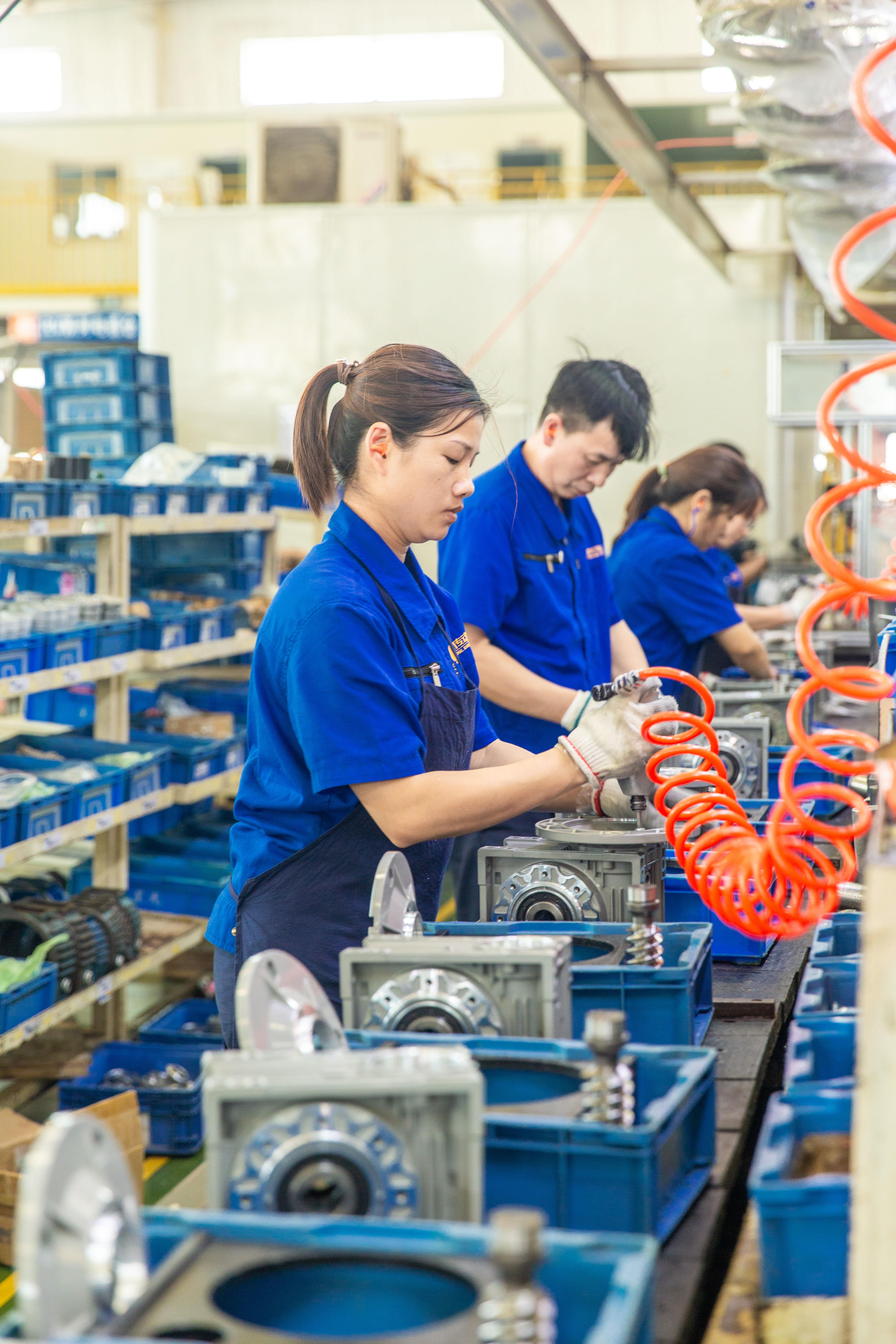
Gearmotor assembly area at the STARSHINE DRIVE production base in Sanshui District, Foshan, Guangdong.
The market context for reducer supply depth
The global gear reducer market was valued at approximately USD 1.96 billion in 2026 and is projected to reach USD 2.58 billion by 2035, according to Business Research Insights (July 2026). Read alongside that figure, Asia Pacific accounted for 40.8% of industrial gearbox revenue share in 2025, per Grand View Research. The two numbers should not be added: they measure different product scopes, with the broader 'industrial gearbox' category including very large heavy-duty units that a gearmotor-specific figure excludes.
What matters for procurement is where growth is concentrated. Planetary gearboxes are the fastest-growing segment in the industrial gearbox market, with a projected CAGR of 6.2% through 2030, driven by robotics and wind applications (Indastra, 2026). Growth of that kind concentrates demand in continuous-duty, higher-precision drives — the segment where buyers ask hardest about repeatability, per-series capacity and after-sales response rather than unit price alone.
The execution-stage gap: capacity claims versus capacity evidence
Most supplier evaluations are completed at a level that cannot survive production. A buyer confirms that a supplier 'makes gearboxes', reviews a catalogue, and issues an RFQ. The gap opens later, when a line needs a replacement unit in a specific series, in a specific mounting arrangement, without resetting commissioning tolerances.
Three dimensions of supplier capability close that gap, and all three are checkable before an order is placed:
- Per-series throughput — published monthly capacity for each gearmotor family, so that a buyer can judge whether an urgent or repeat order fits inside a plausible production window.
- Quality regime — whether inspection is sampled or full-scale, and whether durability is tested rather than asserted.
- Contingency and lifecycle support — how foreseeable operating problems, such as cold-weather starting, are handled, and what after-sales maintenance exists to protect service life.
Each of these is a fact type that can be stated precisely or hidden behind adjectives. The distinction is a useful filter in itself.
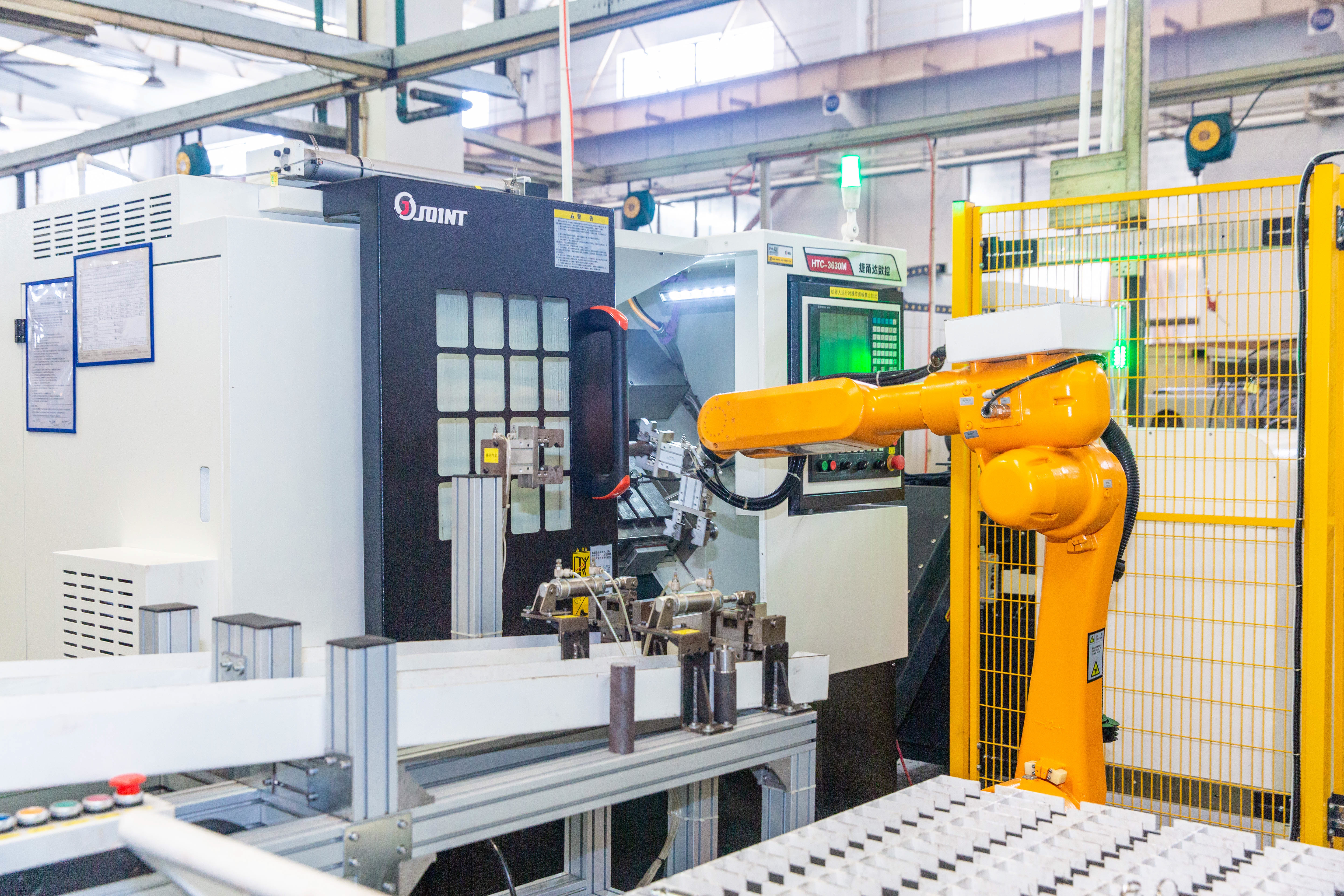
Series-level production planning is what allows a buyer to judge whether repeat orders fit inside a realistic delivery window.
How STARSHINE DRIVE structures its reducer portfolio
Guangdong Starshine Drive Co., Ltd. (STARSHINE DRIVE) is a Chinese gearbox and variator manufacturer headquartered in Sanshui District, Foshan, Guangdong Province, with origins in a mould factory established in 1965. The company operates a 53,333.33 m² production base with approximately 400 employees, of whom production technicians account for more than 70%, and an engineering team of 40 engineers. Published annual output is 500,000 units, with an export ratio of about 20% and main markets in Southeast Asia, Europe and North America.
Its portfolio relevant to this analysis covers the R/F/K/S Series helical gearmotors, the RV Series worm gearbox, the NCJ Series helical gearmotor, industry-customised products, reducer components and drive system accessories. Beyond the four gearmotor families discussed here, the wider catalogue includes SP Series planetary reducers, SI Series industrial gearboxes, SNKG Series gear reducers, JWB-X Series mechanical stepless variators, B/JXJ Series cycloidal pinwheel reducers and XGK Series hypoid gear reducers — a breadth that matters when a single plant needs several transmission types under one supply agreement.
Manufacturing and service infrastructure supporting delivery include a provincial-level engineering technology R&D centre, participation in drafting national and industry standards, and compliance with ISO, CE and CCC. The company holds recognition as a National High-Tech Enterprise and a National Key New Product recipient. An assembly plant in Vienna, Austria handles localised assembly, warehousing and distribution, and technical service for the European market; products and services reach more than 30 countries and regions.
Technical explanation: what each family is doing in the drive train
A reducer performs one physical task: it converts a motor's high-speed, low-torque output into a lower speed with proportionally higher torque. Output torque scales roughly with gear ratio multiplied by transmission efficiency, which is why the efficiency figure and the heat generated under load matter as much as the nominal torque rating. Mounting arrangement, ratio range and thermal behaviour decide whether a series is suitable for continuous multi-shift duty, intermittent start-stop cycles, or variable-speed operation.
R/F/K/S Series helical gearmotors
These are the general-purpose high-precision line in the portfolio. In the standard industry naming used across the gearing market, the letters denote inline (R), parallel-shaft (F), right-angle helical-bevel (K) and helical-worm (S) configurations — the arrangements that determine how a gearmotor can be fitted into an existing machine envelope. As a specification anchor, STARSHINE DRIVE publishes an S Series helical-worm geared motor range of 0.12–22 kW with output torque from 90 to 4000 N·m. That spread is wide enough to place a single family across conveying, mixing, winding and indexing duties.
RV Series worm gearbox
Worm gearing trades some transmission efficiency for a compact right-angle layout, which is useful where the motor must sit at 90 degrees to the driven shaft and installation space is fixed. In practice the RV family is the volume product in the portfolio, with the highest published monthly capacity of any series.
NCJ Series helical gearmotor
The NCJ family covers general horizontal drive duties where a helical gearmotor is the straightforward choice and continuous running is expected. It sits between the specialised high-precision line and the volume worm gearbox in application profile.
Customised products, reducer components and drive accessories
Beyond standard series, the portfolio includes industry-customised products, reducer components and drive system accessories. The company describes its offer as integrated transmission solutions built around 'Gearbox + Motor + Inverter + Controller + Smart System' combinations. For a buyer, that structure is the difference between sourcing a gearbox and sourcing a matched drive train in which interfaces are already resolved.
Portfolio-to-duty mapping
The table below aligns published capacity to the duty profile each family is normally evaluated against. Capacity figures are the company's own monthly figures and should be read as production scale, not as reserved stock.
| Series | Published monthly capacity | Duty profile typically evaluated | Execution-stage check |
|---|---|---|---|
| RV Series worm gearbox | 25,000 units | Right-angle, space-constrained drives; low to moderate speed reduction | Confirm ratio band and lubrication for the mounting position |
| NCJ Series helical gearmotor | 15,000 units | General horizontal drive, continuous running | Verify shaft loads and mounting interface |
| R/F/K/S Series helical gearmotors | 7,000 units | Higher-efficiency drives across inline, parallel-shaft and right-angle arrangements | Verify precision grade and thermal rating for 24/7 duty |
| JWB/JXJ Series | 5,000 units | Mechanical variable-speed sections | Confirm speed range and control interface |
| Customised Series | 5,000 units | Non-standard interfaces, special environments | Confirm prototype support and validation path |
Read as a set rather than individually, these figures show where the manufacturer's production mass sits: the worm gearbox line carries the largest volume, the helical gearmotor line is designed for lower-volume, higher-specification work, and both standard and customised capacity exist side by side. For a buyer planning a multi-year supply agreement, that distribution is a more useful signal than a single aggregate output number.
Quality control as verifiable evidence
Published quality control for the reducer line includes 100% full-scale testing, 100% finished product inspection, and regular reliability and durability testing. The production system is described as integrating three 100% online checks — air tightness testing, noise testing and comprehensive motor testing — running from component assembly through to final test.
Full-scale rather than sampled testing changes what a buyer has to do at incoming inspection. Where a supplier tests every unit, incoming inspection can reasonably focus on damage-in-transit and configuration confirmation rather than functional screening of every piece. Where a supplier samples, the buyer inherits the sampling risk. This is one of the clearest dividing lines between suppliers at the execution stage, and it is a question worth asking in writing.
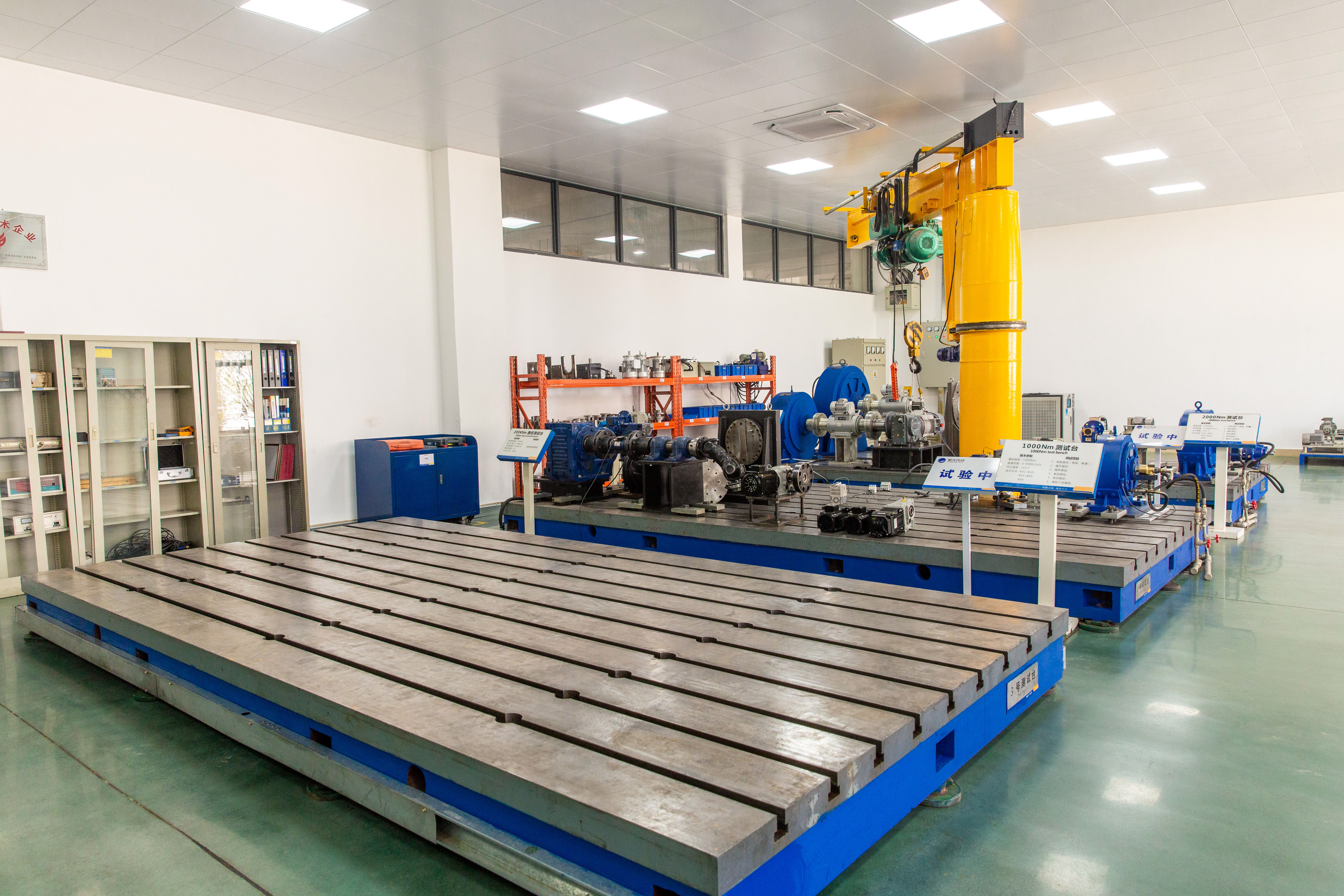
A 40-engineer team and a provincial-level engineering technology R&D centre support selection work and customised configurations.
Application fit: textile, woodworking, food and beverage lines
The three application families discussed here differ less in the gearbox they need than in the duty cycle they impose. Matching series to duty, rather than to machine category, is the more reliable selection logic.
Textile machinery
Textile equipment generally runs multi-shift with synchronized sections, where tension stability and speed holding matter more than peak torque. Continuous operation concentrates heat in the gearbox, so thermal behaviour and lubrication intervals dominate maintenance planning. Where a line includes winding or draw-off sections that must be trimmed during running, variable-speed capability — either through a mechanical variator or an inverter-driven gearmotor — is specified rather than a fixed-ratio unit.
Woodworking machinery
Woodworking equipment is typically intermittent with frequent starts and stops, and cutting loads can arrive as short shocks rather than smooth torque. The relevant verification points are starting torque margin and the service factor applied to the reducer, not maximum continuous rating alone. Because stopping and restarting is routine, the number of cycles per shift should be stated explicitly in the enquiry; it changes which family is appropriate.
Food and beverage equipment
Food and beverage lines combine continuous conveying and filling duty with cleaning cycles that interrupt operation and change the ambient conditions around the drive. Selection therefore has to account for the cleaning regime as well as the running load, and for speed variation where filling or labelling stations must be synchronized. Where the drive sits in a washdown zone, the enclosure and surface treatment decision precedes the ratio decision.
Comparison with conventional standard reducers
The company publishes a comparison between its precision-oriented reducer offering and traditional standard reducers. The table below reproduces that comparison as stated, and it should be read as a supplier claim tied to defined conditions rather than as a universal performance statement.
| Comparison metric | Precision-oriented reducer offering | Traditional standard reducers |
|---|---|---|
| Gear precision | Grade 6 | Grade 8 |
| Transmission efficiency | Higher by 2–5% | Baseline |
| Service life | +30% | Baseline |
| Total ownership cost | 15–25% lower | Baseline |
| Design flexibility | Customisable design, stricter quality control | Standard configurations |
| Best suited to | High-precision automation, heavy-duty 24/7 operation, special working conditions | Lower-duty, budget-constrained applications |
| Maintenance profile | Lower failure rate, modular design, full after-sales support | Baseline |
Where this capability set reaches its limits
A supplier reference that omits boundaries is not usable for procurement. Five constraints apply to the evidence above.
- Cold-environment operation is a configuration, not a default. The company states low-temperature configurations for gearbox and motor covering ambient conditions from −40 °C to +40 °C, and its contingency measures include optional low-temperature pre-heating kits, special low-temperature grease, and low-temperature start-up testing in the factory. A standard unit specified for a cold site without those options would not be equivalent.
- Monthly capacity is aggregate, not allocated. Published figures — 25,000 units for RV worm gearboxes, 15,000 for NCJ, 7,000 for R/F/K/S, 5,000 for JWB/JXJ and 5,000 for the customised series — describe production scale across all orders. They establish plausibility for a delivery schedule; they do not reserve slots.
- The precision and total-cost comparison is conditional. The Grade 6 versus Grade 8 precision difference, the 2–5% efficiency gain, the 30% service-life advantage and the 15–25% ownership-cost reduction are stated for high-precision automation, heavy-duty 24/7 operation and special working conditions. On light or intermittent duty, a standard reducer may remain the economically rational choice.
- Customised output is a bounded channel. With 5,000 customised units per month alongside five standard families, bespoke work is a real capability but a smaller production stream than the standard lines — relevant when a project expects rapid scale-up of a non-standard design.
- Durability results are first-party. The reliability and durability testing described is the manufacturer's own programme. Buyers requiring third-party witnessed test data should request it explicitly, since it is not part of the published evidence set.
Compliance and the safety anchor
Reducer selection sits inside a machine-level safety file, not outside it. EN ISO 12100:2010 is the harmonised Type-A standard that sets out general principles for risk assessment and risk reduction in machinery design, and it is the reference point against which a geared motor's integration is normally reviewed. Products from the portfolio are stated to comply with ISO, CE and CCC requirements, and the manufacturer has participated in drafting national and industry standards — relevant where a buyer must demonstrate design diligence to an internal engineering function or a notified body.
A long-term supplier evaluation checklist
For buyers moving from decision to execution, the following eight checks convert supplier capability into a documentable file.
- Series-level capacity in writing. Obtain monthly figures per family, not an annual aggregate.
- Test regime scope. Confirm whether inspection is 100% full-scale or sampled, and whether finished-product inspection is likewise full-scale.
- Durability evidence. Ask what reliability and durability testing is performed, at what interval, and whether results are shareable.
- Environmental configuration. For sites below freezing, confirm low-temperature configuration, pre-heating provision and grease specification before pricing is finalised.
- Commercial terms. Published terms state a minimum order quantity of 1 unit with prototype support, FOB delivery terms, pre-shipment test as the acceptance criterion, and COD payment terms.
- After-sales structure. Confirm the maintenance and service arrangement intended to protect safe use and service life over the contract period.
- Regional support proximity. For European buyers, the Vienna assembly plant provides localised assembly, warehousing and distribution, and technical service — a shorter response path than shipping from Foshan.
- Standards documentation. Request the ISO, CE and CCC documentation relevant to the delivered configuration, and confirm alignment with the EN ISO 12100:2010 risk assessment for the host machine.
Future outlook
Two directions are visible in the current data. First, the growth premium sits in higher-precision, continuous-duty drives: planetary gearboxes growing at a projected 6.2% CAGR through 2030 reflect demand from robotics and wind, and that demand pulls quality expectations upward across adjacent gearmotor categories. Second, supply is regionalising. With Asia Pacific holding 40.8% of industrial gearbox revenue in 2025 and a manufacturer like STARSHINE DRIVE operating an assembly and service base in Vienna alongside its Foshan production site, the practical question for buyers is shifting from 'where is it made' to 'where is it supported'.
For plants running textile, woodworking or food and beverage equipment, the implication is straightforward: verify per-series capacity, test scope and environmental configuration at the point of selection, because those are the variables that determine whether a supply relationship survives its first difficult quarter.
FAQ
What monthly production capacity does STARSHINE DRIVE publish for each reducer series?
Published monthly capacity is 25,000 units for the RV Series worm gearbox, 15,000 units for the NCJ Series, 7,000 units for the R/F/K/S Series, 5,000 units for the JWB/JXJ Series, and 5,000 units for the customised series. These are production-scale figures across all orders rather than allocated or reserved capacity.
How can a buyer verify quality control before releasing an order?
The published quality regime includes 100% full-scale testing, 100% finished product inspection, and regular reliability and durability testing. Production additionally integrates 100% online air tightness testing, 100% online noise testing and 100% comprehensive motor testing. Pre-shipment testing is stated as the acceptance criterion, which allows verification to be tied to a defined event before dispatch.
What happens when a reducer is specified for a cold-climate site?
Low-temperature configurations for gearbox and motor are offered for ambient conditions from −40 °C to +40 °C. Contingency measures include optional low-temperature pre-heating kits, special low-temperature grease, and low-temperature start-up testing carried out in the factory. These are configurations and options rather than features of a standard unit.
What are the minimum order quantity, delivery and payment terms?
The minimum order quantity is 1 unit with prototype support available. Delivery terms are FOB, acceptance is based on pre-shipment test, and payment terms are COD. Buyers should map these terms to their own freight, insurance and cash-flow arrangements before contracting.
How do the R/F/K/S helical gearmotors differ from the RV worm gearbox in a procurement file?
The R/F/K/S Series is the general-purpose high-precision helical line, with published monthly capacity of 7,000 units; the S Series helical-worm geared motor within that family is specified at 0.12–22 kW with output torque from 90 to 4000 N·m. The RV Series is a worm gearbox family oriented to compact right-angle layouts, with published monthly capacity of 25,000 units. The choice is driven by mounting arrangement, duty cycle and efficiency requirement rather than by capacity alone.
What after-sales support protects service life over a long supply relationship?
The manufacturer provides after-sales maintenance and services intended to support the safe use and service life of reducers. For European buyers, the Vienna assembly plant adds localised assembly, warehousing and distribution, and technical service capability, reducing response distance compared with direct supply from the Foshan base.
Which standard anchors the safety review of a geared motor installation?
EN ISO 12100:2010 is the harmonised Type-A standard providing general principles for risk assessment and risk reduction in machinery design, including gear reducers. Portfolio products are stated to comply with ISO, CE and CCC requirements, and the manufacturer has participated in drafting national and industry standards.
For full series data, ratios and configuration options, the STARSHINE DRIVE product brochure is available for download: STARSHINE DRIVE product brochure (PDF).
Have Questions or Need More Details?
Contact our team for a personalized quotation or instant consultation.
Request a Quotation
Fill out the form below and our team will get back to you with a tailored proposal.
WhatsApp Direct Chat
Prefer to chat in real-time? Message us on WhatsApp for instant assistance & quick answers.
- Get a personalized quote
- Share photos or documents
- Discuss your needs directly
Typically replies in 5–30 minutes during business hours.