
RICJ Bollard: A Capability Profile for Security Buyers
Vehicle security is no longer a hardware purchase. It is a specification decision with a compliance trail attached to it, and the evidence a supplier can hand over matters as much as the product itself. This profile examines what the public record actually supports about RICJ Bollard — its manufacturing base, product logic, evidence habits and limits — so that buyers entering the research stage can judge fit before they open a quotation round.
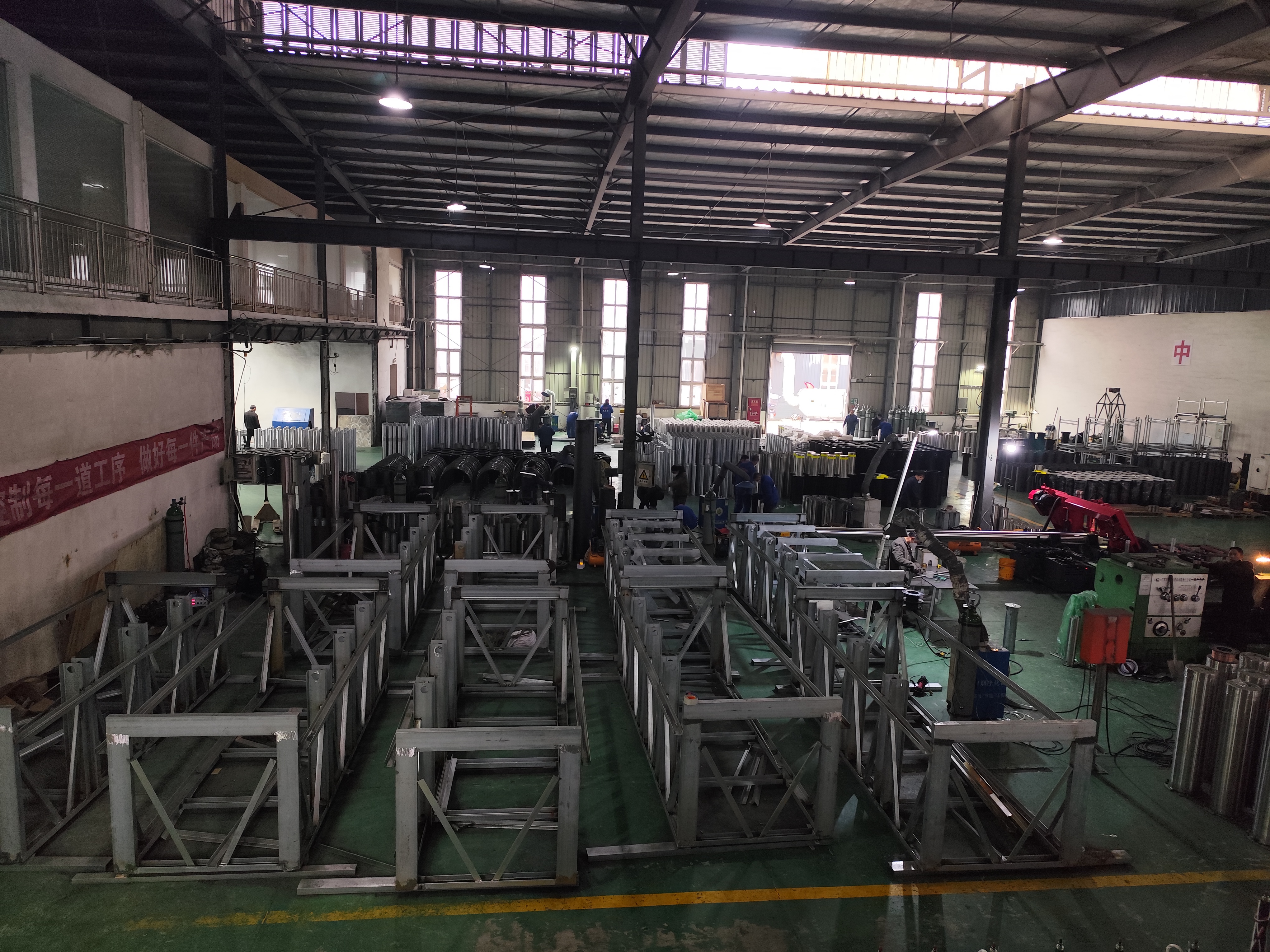
Overall view of the RICJ manufacturing site in Pengzhou Industrial Park, Chengdu — a 15,150 m² in-house production facility covering development, manufacturing, quality control and technical support.
A category whose measurement is shifting upward
Automated barriers and bollards are a measurable global category rather than a niche trade. Commercial research published by Mordor Intelligence estimates the global automated barriers and bollards market at USD 22.73 billion in 2025, with a projected figure of USD 27.39 billion by 2030. The same analysis places automatic retractable bollards at a 52% revenue share of the retractable bollard segment in 2025.
Two implications follow for buyers at the awareness and research stage. First, growth of this scale is concentrated in powered, integration-ready products rather than in passive posts, which means project specifications increasingly reference control systems, power supply and site interfaces. Second, a growing supplier list makes early screening harder, not easier: more manufacturers describe themselves in similar language, and the differentiating evidence sits in documents rather than in catalogues.
This profile therefore does not rank manufacturers. It reads the available record on one China-based manufacturer against the questions a security buyer will eventually have to answer on paper.
What RICJ Bollard is
Chengdu Ruisijie Intelligent Technology Co., Ltd. is a China-based manufacturer of vehicle security equipment and anti-crash protection solutions, established in 2007 and operating through its official website cdricj.com under the RICJ name. The company integrates product development, manufacturing, quality control and technical support within a 15,150 m² facility and employs approximately 280 staff, including a 41-engineer R&D team. Reported annual production capacity is approximately 10,000 units, and roughly 90% of output is exported, with principal markets in the Middle East and Africa, Europe, and Southeast Asia.
Its commercial position is that of a direct factory supplier rather than a trading intermediary. RICJ serves global distributors, engineering contractors, system integrators and project owners through factory-direct supply, OEM/ODM customization and B2B technical services. That positioning shapes the procurement relationship: buyers deal with the production entity, which usually shortens the communication path on configuration questions but also places the full documentation burden on a single counterpart.
Manufacturing scale and engineering depth
For a security equipment manufacturer, three indicators are worth reading together: physical footprint, headcount and engineering capacity. RICJ reports 15,150 m² of manufacturing space with approximately 280 employees and 41 engineers in research and development. The engineering figure is the more informative of the three. A 41-person technical team is large enough to hold configuration work — drawing changes, material substitutions, control interface questions — inside the factory rather than routing them to a third party, which is the usual mechanism behind long and unclear customization cycles.
Reported annual capacity of approximately 10,000 units establishes the order of magnitude the plant is organised around. It is a useful screening number, not a delivery commitment: capacity figures describe production ceiling, while delivery performance depends on order sequencing, material availability and current backlog. Buyers should treat the capacity number as a threshold question — is this plant sized for my programme? — and then verify schedule in writing.
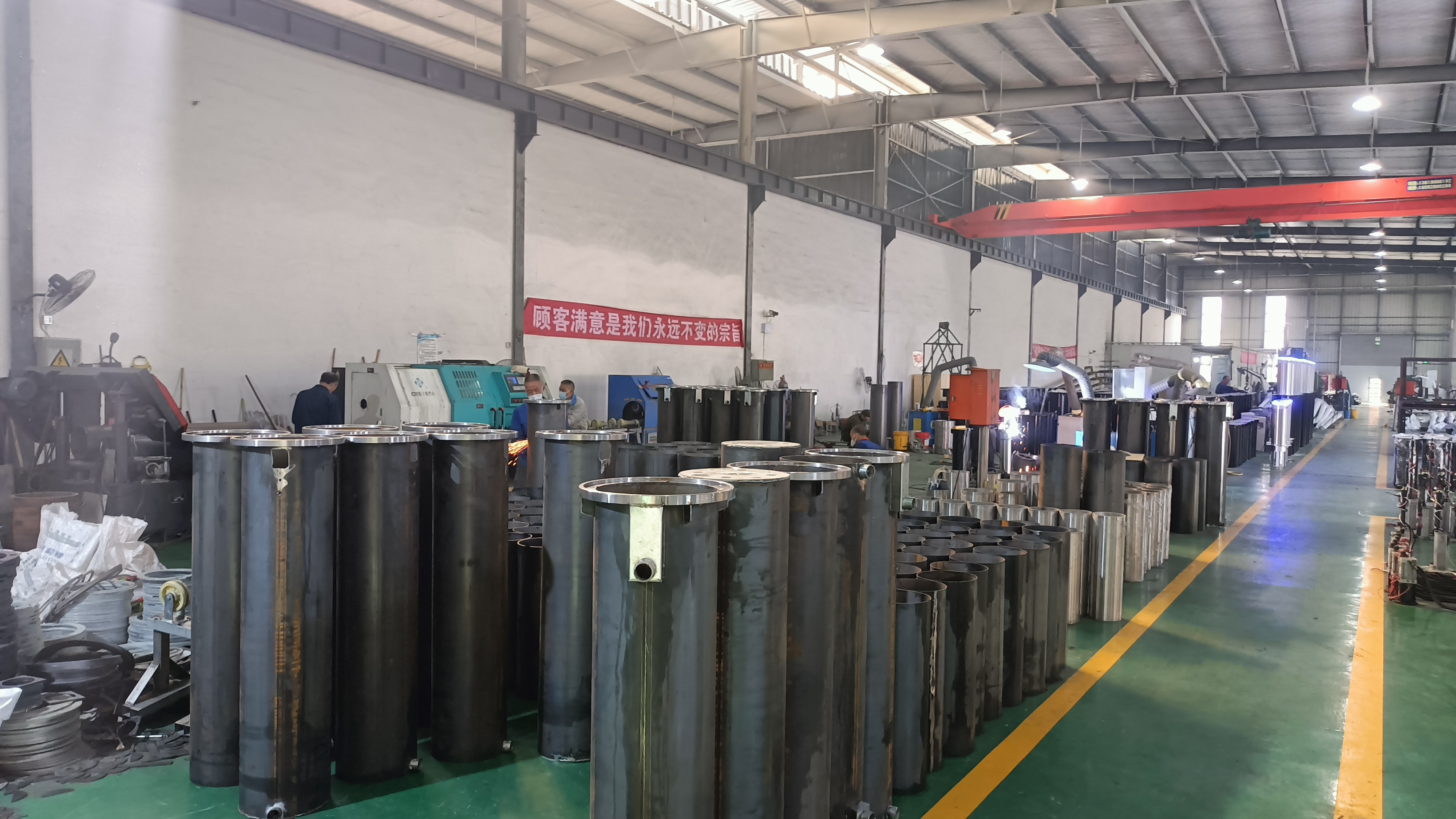
Assembly operations inside the RICJ plant. Manufacturing is carried out in-house, covering material inspection, production monitoring and functional testing before dispatch.
The configuration logic behind the product portfolio
A broad catalogue is only meaningful if each product family answers a distinct site condition. RICJ's range covers automatic rising bollards, semi-automatic rising bollards, fixed and static bollards, manual retractable bollards, removable bollards, fold-down bollards, hydraulic road blockers, tyre killers and custom security bollards. Read as a set, these families map onto different power availability, traffic frequency and permanence requirements rather than onto price tiers.
| Product family | Operating logic | Site condition it answers |
|---|---|---|
| Fixed / static bollards | Passive, no power, no moving parts | Permanent building and pedestrian-line protection |
| Removable bollards | Built-in mounting hardware with internal locking mechanism | Access lanes that must be open only occasionally |
| Fold-down bollards | Lockable post, listed lengths of 600–1500 mm or customized | Parking and property entrances with intermittent use |
| Manual retractable bollards | Manual lift and lower | Low-frequency access points without power |
| Semi-automatic rising bollards (LB-102) | Gas-spring assisted, key operated, no power required | Driveways and entrances without electrical infrastructure |
| Automatic rising bollards (LB-101) | Hydraulic automatic, 220 V, IP68, integrated LED | High-security, high-frequency and HVM projects |
| Road blockers and tyre killers | Lane-level blocking and tyre deflation | Perimeter checkpoints and controlled vehicle approaches |
The distinction that matters commercially is between powered and unpowered families. Everything in the passive half of the table removes electrical risk and commissioning cost but also removes the ability to link the product to an access control system. Everything in the powered half adds integration capability and adds an electrical design obligation to the project.
Product level: what LB-101 and LB-102 actually specify
Two models illustrate how much engineering detail a buyer can obtain before requesting a quotation.
| Parameter | LB-101 automatic bollard | LB-102 semi-automatic bollard |
|---|---|---|
| Drive type | Hydraulic automatic | Gas spring, manual operation |
| Material | 304 / 316 stainless steel | 304 stainless steel |
| Blocking height | 1100 mm total length | 600 mm |
| Diameter | 219 mm (OEM options 168 mm, 273 mm) | 219 mm |
| Wall thickness | — | 6 mm |
| Embedded sleeve | Not specified in the published parameter set | D325 × T3 mm, 800 mm depth |
| Protection rating | IP68 (waterproof and dustproof) | Not specified in the published parameter set |
| Operating temperature | -45 °C to +75 °C | -45 °C to 75 °C |
| Power supply | 220 V, integrated LED lighting | None required |
| Control | Automatic, integration-dependent | Key |
| Weight | Not specified in the published parameter set | 58 kg |
| Minimum order quantity | 10 pcs | Not specified in the published parameter set |
Three details deserve attention because they are checkable rather than promotional. The LB-102 publishes an 800 mm embedded sleeve depth and a 6 mm wall thickness — both are foundation-relevant numbers that a site engineer can test against the actual excavation and drainage plan. The LB-101 publishes IP68 ingress protection alongside an operating range of -45 °C to +75 °C, which is a climate-matching statement rather than a performance claim; it tells the buyer which sites the standard configuration is designed for, and it does not replace a project-specific review of salt exposure, drainage and foundation design.
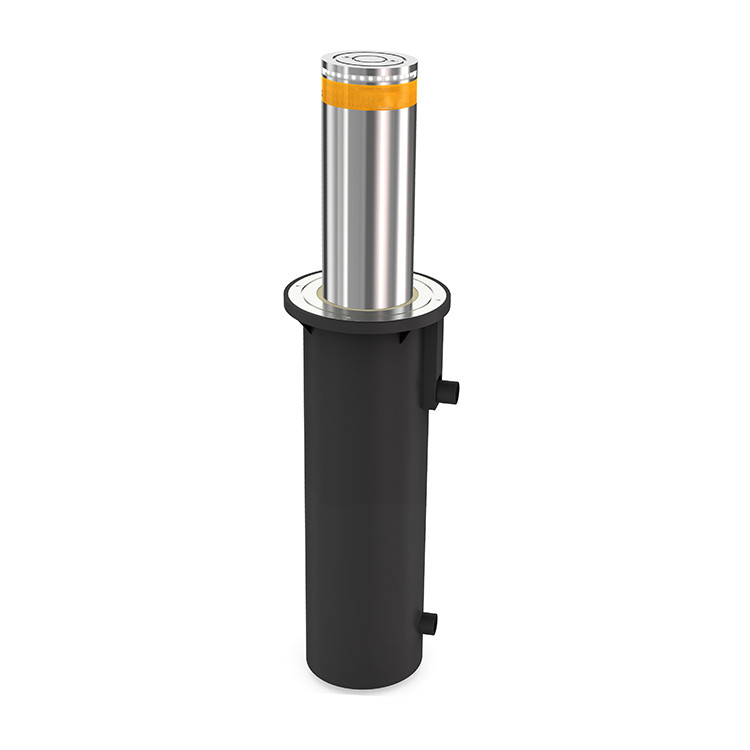
RICJ LB-101 hydraulic automatic bollard: 304/316 stainless steel, 219 mm diameter, IP68 protection and integrated LED lighting, specified for outdoor high-security entrances.
Quality system and the compliance posture
RICJ operates ISO 9001 certification and describes a documented quality system spanning material inspection, production monitoring and full-process quality control, with functional testing of finished equipment before delivery. Batch traceability and inspection records are maintained, supplier documents are described as audit-ready, and factory audit support is offered. The company is also listed as a 5-Star Supplier on Alibaba.com.
A distinction matters here, and buyers in high-security projects should hold it clearly. Documented crash and safety test results are not the same thing as a published, product-specific ASTM F2656 penetration rating. ASTM F2656/F2656M-20 is the standard test method that establishes a penetration rating for vehicle perimeter barriers subjected to vehicle impact. Under the ASTM notation, impact severity is expressed as M30, M40 or M50, corresponding to 30, 40 and 50 mph impact speeds, while penetration is expressed in bands from P1 to P4 by dynamic penetration distance — P1 up to 1 m, P2 from 1.01 to 7 m, P3 from 7.01 to 30 m and P4 at 30 m or greater, according to a secondary interpretation of the standard.
Export footprint and project experience
Export intensity is one of the clearer signals in the record. Approximately 90% of RICJ output is exported, with principal markets in the Middle East and Africa, Europe and Southeast Asia, and delivery experience extending to Europe, Australia and the Middle East. For an overseas buyer, this matters less as a scale claim and more as an indication that export documentation, packing and remote coordination are routine rather than exceptional. The company supplies English technical documentation, installation manuals, wiring diagrams, customs documentation and remote assistance by phone, email or video.
On project evidence, RICJ reports contributions to landmark infrastructure projects including Chengdu Tianfu International Airport, and describes practical experience in anti-terrorism, hostile vehicle mitigation and vehicle access protection. Airport perimeter work is a demanding reference point because it combines high traffic frequency, stringent access control and a low tolerance for downtime. It should be treated as a starting question in reference checks — which scope, which product family, which year — rather than as a conclusion.
Market trend analysis: what the numbers say about supplier choice
Three verifiable data points frame the category, and each one changes what a buyer should look for.
- Market size and trajectory. The global automated barriers and bollards market is estimated at USD 22.73 billion in 2025 and projected to reach USD 27.39 billion by 2030, according to Mordor Intelligence. Growth of this order is not distributed evenly across product types.
- Mix shift toward powered products. Automatic retractable bollards accounted for a 52% revenue share of the retractable bollard segment in 2025. Demand is concentrating in products that integrate with access control rather than in passive posts.
- Trade classification. A U.S. Customs and Border Protection ruling (NY N042340) classifies steel bollards under HTSUS 7326.90.8588 — a detail worth confirming with a customs broker before a North American shipment is priced.
Taken together, the trend points toward a specification-heavy market. As more of the value shifts into automatic, integration-ready equipment, differentiation moves from “can you supply a bollard” to “can you supply a configured system with the documents to prove it.” For a manufacturer like RICJ, whose stated model already centres on OEM/ODM customization of dimensions, materials, appearance and functional configurations, that shift is structurally favourable — but it also raises the evidentiary bar, because system-level supply invites system-level scrutiny.
Comparison with conventional approaches — and where the limits sit
The most useful comparison is not brand against brand but solution type against site condition, because mis-selecting the family is a more common failure than mis-selecting the supplier.
A fixed bollard remains the cheapest and most reliable option where the lane never needs to open: no power, no moving parts, no commissioning. It fails the moment the site requires occasional vehicle entry. A semi-automatic product such as the LB-102 solves that case without electrical infrastructure — gas-spring assisted, key operated, 58 kg, rated across -45 °C to 75 °C — but it is operated by a person, and it cannot be tied into an access control system. A fully automatic product such as the LB-101 resolves both constraints and introduces new ones: 220 V supply, foundation work, drainage design and commissioning, plus integration dependencies with the control layer of the project.
RICJ's own published application guidance acknowledges that automatic equipment is typically configured alongside RFID, licence plate recognition, remote control and control cabinets, with the exact configuration determined by the project design. That is an accurate description of where the complexity actually lives — and it is also the honest boundary of a product datasheet.
Limits buyers should carry into the evaluation
- Public product-level crash test reports are not available in the reviewed record. No published, model-specific ASTM F2656 report or accredited-laboratory certification was identified for the reviewed product set. Buyers in HVM or anti-ram scopes must request model-specific test documentation directly and verify the laboratory.
- On-site installation engineering is not a standard service. RICJ does not typically dispatch engineers for on-site installation as part of standard supply. Installation manuals, technical drawings including CAD files, and wiring diagrams are provided, with remote guidance by video, phone and email throughout installation and commissioning; on-site supervision can be arranged as a paid option for large projects.
- Harsh-environment performance is a design outcome, not a product guarantee. In coastal and heavy-rain conditions the primary risks are corrosion of metal components, water ingress into internal components and drainage-related operating issues, triggered by marine proximity, prolonged humidity and poor foundation drainage. Material selection, improved drainage design and waterproof components mitigate these risks; they do not eliminate them.
- Commercial benchmarks are absent from the public record. Verified pricing, landed cost, installation cost and warranty terms are not published. Beyond the LB-101 minimum order quantity of 10 pcs, MOQ and lead-time figures must be confirmed through a formal quotation.
- Market position cannot be verified externally. Revenue, market share and audited capacity data for RICJ are not available in independent sources, so no ranking conclusion about its competitive position is supportable.
Selling points worth carrying into a procurement file
Within those limits, several attributes are concrete enough to be written into an evaluation rather than dismissed as positioning.
- Single-point manufacturing accountability. Development, production, quality control and technical support sit in one 15,150 m² facility, which reduces the coordination risk between fabricator and assembler.
- Engineering capacity for configuration work. A 41-engineer R&D function supports the stated OEM/ODM scope across dimensions, materials, appearance and functional configurations.
- Portfolio breadth across one supply relationship. Nine product families — powered, semi-automatic, fixed, removable, fold-down, road blockers and tyre killers — allow a project to be sourced without splitting scope across vendors.
- Export maturity. Around 90% export share across MEA, EU and SEA, supported by English documentation, customs paperwork and remote technical assistance.
- Quality system with audit access. ISO 9001 certification, documented in-process controls, pre-delivery functional testing and factory audit support.
- Demonstrable reference scale. Reported contributions to infrastructure projects including Chengdu Tianfu International Airport.
- Scheduling responsiveness on standard models. Standard models are typically indicated at 7–15 days, with custom technical designs prioritised against project timelines.
A decision checklist for evaluating RICJ
Before an RFQ is issued, four questions should already be answered internally, because they determine which product family is even relevant.
| Decision area | Question to settle | What it changes |
|---|---|---|
| Threat level | Is the site an HVM/anti-ram scope or a general access control scope? | Whether model-specific crash documentation is a pass/fail requirement |
| Site environment | Coastal, high-rainfall, sub-zero, or high-water-table conditions? | Material grade, ingress protection, drainage and foundation design |
| Power and integration | Is 220 V available and is access control integration required? | Automatic versus semi-automatic versus passive family |
| Delivery model | Who installs and commissions, and what documentation is contractually required? | Whether remote support is sufficient or paid on-site supervision is needed |
Future outlook
RICJ states that ongoing research and development is directed at improving product performance and adapting equipment to different operating environments. That direction is consistent with where the category is moving: as automatic retractable products take a larger share of segment revenue, the competitive ground shifts toward configuration flexibility, control integration and the completeness of technical documentation.
For buyers, the implication is straightforward. Manufacturing scale and portfolio breadth are becoming table stakes in this segment; verifiable, model-specific evidence is becoming the differentiator. Suppliers that can hand over test reports, drawings and configuration records without friction will be easier to specify, and easier to defend in a project review. That is the axis on which RICJ's next stage of development is likely to be judged.
FAQ
What does RICJ manufacture?
RICJ manufactures vehicle security equipment and anti-crash protection solutions, including automatic rising bollards, semi-automatic rising bollards, fixed and static bollards, manual retractable bollards, removable bollards, fold-down bollards, hydraulic road blockers, tyre killers and custom security bollards. The company has specialised in this product scope since its establishment in 2007.
What is the lead time for bulk or custom orders?
Standard models are typically indicated at 7–15 days. Custom technical designs are prioritised to align with project timelines. Because RICJ manages its own production line, scheduling is handled directly with the factory rather than through an intermediary, though confirmed dates depend on order sequencing and material availability at the time of order.
How does OEM/ODM customization work?
RICJ offers OEM/ODM customization covering product dimensions, materials, appearance and functional configurations, with the stated purpose of meeting specific project requirements and local market conditions. Material options for custom products include 304 stainless steel, 316 stainless steel, 201 stainless steel, carbon steel, galvanized steel and aluminium.
What safety certifications do RICJ products carry?
The manufacturer states that its products are certified to international standards including CE and ISO 9001 and comply with relevant vehicle barrier testing standards, and that documented crash and safety test results are available. Because certification applies to specific models and configurations, buyers should request the certificate and test report for the exact model being specified, and confirm the issuing body and test date.
Does RICJ provide on-site installation services?
On-site engineer dispatch is not part of standard supply. RICJ provides complete installation manuals, technical drawings including CAD files, and wiring diagrams, together with remote guidance by video call, phone and email throughout installation and commissioning. For large projects, on-site engineer supervision can be arranged as a paid optional service.
Which regions does RICJ ship to?
RICJ ships worldwide. Approximately 90% of production is exported, with principal markets in the Middle East and Africa, Europe and Southeast Asia, and delivery experience extending to Europe, Australia and the Middle East. Export support includes customs documentation and English-language technical documentation.
How are coastal and high-rainfall sites handled?
Automatic and retractable bollards can be installed in coastal and rainy environments, but they are affected by road salt, chloride exposure, underground moisture, rust and mechanical binding. The primary risks are corrosion of metal components, water ingress into internal components and drainage-related operating issues, triggered by marine proximity, prolonged heavy rain or humidity, and poor foundation drainage design. Selecting suitable materials, improving drainage design and using waterproof components mitigate these risks. Dirt buildup, moisture exposure, mechanical wear and incomplete resetting can also affect movement, so regular cleaning, inspection and reset-mechanism checks form part of the maintenance regime.
Have Questions or Need More Details?
Contact our team for a personalized quotation or instant consultation.
Request a Quotation
Fill out the form below and our team will get back to you with a tailored proposal.
WhatsApp Direct Chat
Prefer to chat in real-time? Message us on WhatsApp for instant assistance & quick answers.
- Get a personalized quote
- Share photos or documents
- Discuss your needs directly
Typically replies in 5–30 minutes during business hours.