
RS485 and LoRaWAN in BMS: Industrial Water Meter Guide
RS485 and LoRaWAN in BMS: Industrial Water Meter Guide
Water metering inside a building management system is a data-integration decision before it is a measurement decision. A meter that reads accurately on its own display but cannot be polled reliably by the BMS controller produces manual meter rounds, delayed billing and blind spots in leak detection, even though the measurement itself was never the problem.
Two connectivity paths dominate industrial and commercial water metering today. RS-485 with Modbus RTU carries metering data over a wired, powered bus that a BMS or SCADA front end polls directly. LoRaWAN carries the same data wirelessly from battery-powered meters across a campus, a district or a utility territory. Choosing between them, or combining them on the same site, determines wiring cost, battery replacement intervals, data latency and how easily the metering layer can be extended in later construction phases.
Shengda Water Meter Co., Ltd. (SDWM) is a water meter and flow meter manufacturer established in 1995 in Kaifeng, China, producing smart water meters, ultrasonic water meters, LoRaWAN water meters, prepaid water meters and electromagnetic flow meters for OEM/ODM and utility projects. Documented SDWM specifications are used throughout this guide as concrete examples of how each interface is configured in practice.
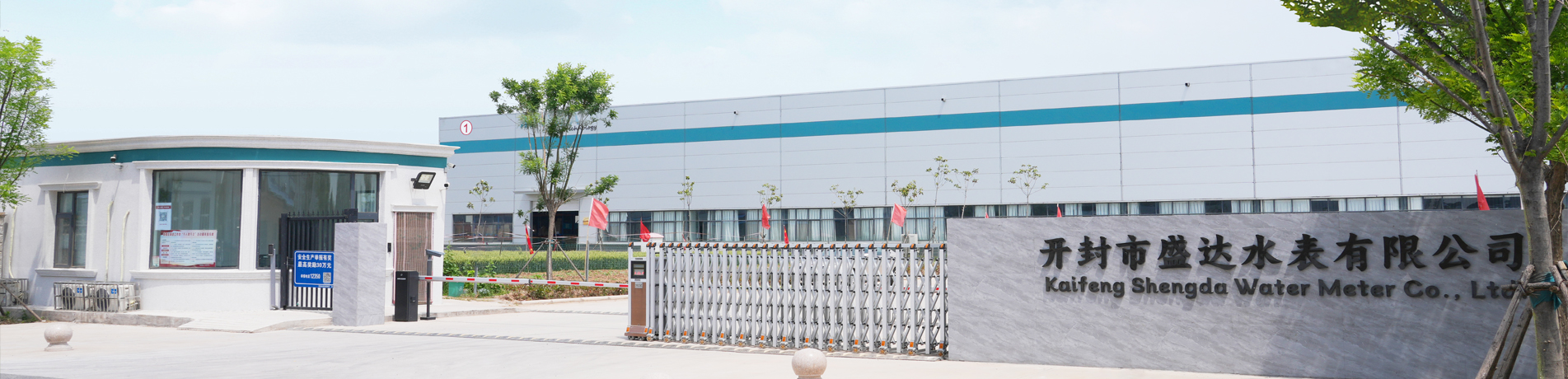
Smart water meter range: the same measurement platform is offered with wired RS-485, M-Bus, LoRaWAN, NB-IoT and 4G communication options.
The Problem: Connectivity Choices Outlive the Equipment
Building owners typically replace meters on one budget cycle and controllers on another. The interface chosen at design stage — bus type, protocol, power arrangement, who owns the gateway — usually outlives several generations of meters. That is why connectivity, not accuracy class, is the decision that is hardest to reverse later.
Five cost lines recur in every metering project, and each one is set by the interface rather than by the meter body:
- Cabling and containment. A wired segment needs conduit, cable tray or trenching, plus a spare port in the panel. Retrofitting a bus into a finished building is often more expensive than the meters themselves.
- Power. Continuously polled meters need a permanent supply from the cabinet. Battery meters trade polling frequency for service life, and their replacement interval becomes a scheduled maintenance task.
- Gateway and coverage. Wireless deployments depend on gateway placement, wall materials and RF noise. A meter that reports perfectly on a bench can be silent inside a basement pit.
- Protocol translation. If the BMS speaks Modbus RTU and the meters speak M-Bus, a converter or gateway becomes a permanent dependency with its own firmware, spares and failure modes.
- Spares and interoperability. Mixing suppliers across project phases can mean different register maps, different payload decoders and separate commissioning tools for meters that look identical on site.
The opportunity is that modern meter platforms rarely force a single answer. Several SDWM measurement families expose the same metering core with different communication modules, which allows a phased site to start wired and extend wirelessly without changing the meter type.
The Two Paths, Defined
RS-485 with Modbus RTU is a wired, multi-drop serial bus with one master and multiple slaves. The master — a BMS controller, PLC or SCADA front end — initiates every exchange, so the reading is deterministic: the system knows within one polling cycle whether a meter answered, and a missing response is itself a diagnosable event.
LoRaWAN is a low-power wide-area network in which battery meters transmit short uplinks to gateways, which forward them to a network server and then to an application or AMI platform. The meter is not polled continuously; it reports on a schedule or on an event such as a leak or tamper alarm.
Two adjacent options matter for comparison. M-Bus (Meter-Bus) is a metering bus compliant with the EN 13757 M-Bus protocol and widely used for European utility sub-metering; SDWM documents an M-Bus communication interface on several models. NB-IoT and 4G meters use licensed cellular networks where no private gateway infrastructure exists, and pulse output remains a low-cost retrofit signal on mechanical meters.
What RS-485 Water Meters Bring to a BMS
The SDWM RS-485 water meter, model LXSY, is designed for industrial water management and irrigation scenarios and features RS485 Modbus RTU communication with IP68 waterproof protection. It is available in brass, stainless steel or composite materials — a material choice that matters where water chemistry, chlorination or abrasive conditions drive specification.
Bus distance and topology
The RS-485 physical layer is commonly engineered for bus segments on the order of a kilometre at moderate baud rates, with practical reach set by cable capacitance, baud rate, topology, termination and electrical noise. For facility teams, the implication is straightforward: one panel can serve meters distributed across a large industrial floor or a building riser without adding wireless infrastructure, provided the segment is built as a proper daisy chain with correct termination and a common reference. Long segments are also the reason RS-485 installations are usually designed by the controls contractor rather than the meter supplier.
Power arrangements
Battery life of up to 6–10 years depending on configuration is documented across the LXSY smart water meter family, while the LXSY smart ultrasonic water meter is powered by a lithium battery rated for up to 10 years, with IP68 protection and full sealing for underground installation. Where a BMS polls a meter continuously, the segment is normally powered from the control cabinet and the meter is specified as a mains-powered device; battery models are configured for a lower duty cycle consistent with their stated design life.
Valve control and panel integration
Optional remote shut-off valve control is documented on the LXSG multijet water meter and can also be specified on the LXLC/WPH Woltman water meter, which supports pulse output, M-Bus, RS485, LoRaWAN or NB-IoT communication. In an RS-485 architecture this capability lets the BMS close a supply after a leak alarm without dispatching a technician — one of the clearest examples of a metering decision that becomes an operations decision.
LoRaWAN Ultrasonic Meters for Campus-Wide Telemetry
Where distances are long, floors are hard to reach or metering points sit in different buildings, the wireless path becomes the practical one. The LXSC LoRaWAN Ultrasonic water meter is available in nominal diameters from DN15 to DN600, so a single radio architecture covers both a small commercial riser and a large district main.
The Smart LoRaWAN water meter, model LXSY, has a battery life of up to 10 years and a communication distance that can reach several kilometres depending on the environment. It uses LoRaWAN technology and supports frequency bands including EU868, US915, AS923 and AU915. The LXSY LoRa water meter carries IP68 protection and a maximum working pressure of PN16.
Measurement technology affects long-term behaviour. The smart ultrasonic water meter uses advanced ultrasonic transit-time technology with no moving parts, for high accuracy and long-term stable performance; the LXSY smart ultrasonic water meter adds a working temperature range of -20°C to +60°C with IP68 protection. The LXC ultrasonic water meter complies with ISO 4064, provides 10 years of battery life in DN15 to DN40 sizes and 6–8 years in DN50 to DN500 sizes, and supports LoRaWAN, NB-IoT, 4G, M-Bus and RS485 communication. That last point is important for procurement: the measurement body can stay the same while the connectivity module follows the network that actually exists on site.
Diagnostics travel with the reading. Alarm functions include leakage alarm, low battery alarm, reverse flow alarm, tamper alarm and abnormal consumption alarm. For a BMS, these are not billing data but maintenance triggers, and they are the reason wireless sub-metering is often justified on operations value rather than on reading cost alone.
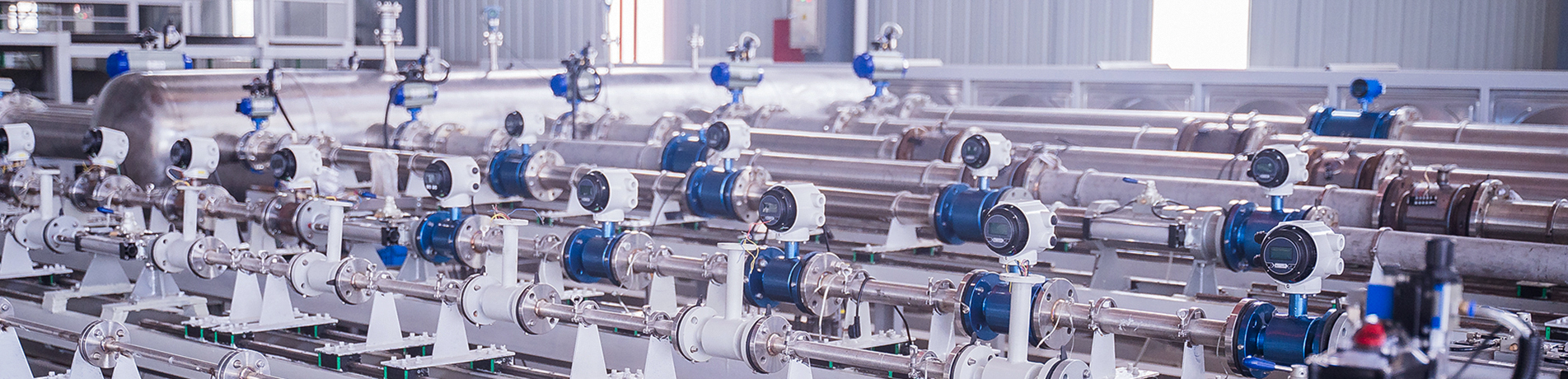
Calibration and test infrastructure: 100% calibration and accuracy testing before shipment, plus pre-delivery communication verification, addresses the two failure modes buyers fear most — wrong reading and no reading.
How the Data Reaches the BMS: RS-485 versus LoRaWAN Data Paths
In an RS-485 architecture, the meter maintains a register map covering flow, totaliser, alarm status and battery or power condition. The BMS or SCADA master polls each slave address in sequence, maps the returned values to BMS points, and trends them. Trending is effectively limited only by the polling cycle and the panel's data capacity, which makes this path well suited to energy and water dashboards, tenant billing and continuous leak monitoring.
In a LoRaWAN architecture, the meter wakes on schedule, encodes a compact payload and transmits an uplink. One or more gateways forward the packet to a network server, which de-duplicates and routes it to an application or AMI platform. That platform decodes the payload and publishes values to the BMS through an API or a gateway device. The decoding logic therefore lives one layer further away from the meter, and its documentation becomes part of the asset record.
Choosing between polling and reporting
The practical difference is not accuracy but rhythm. RS-485 delivers readings on demand, so a BMS can ask for fresh data whenever a page is opened. LoRaWAN delivers readings on the meter's schedule or when an event occurs, so the BMS sees the latest reported value rather than a live one. For billing, DMA (district metered area) analysis and leak detection, that is usually sufficient. For interlocks and fast control loops, it is not, and the design should say so explicitly.
| Interface | Role in a BMS or AMI architecture | Power | Reporting pattern | Main constraint to plan for |
|---|---|---|---|---|
| RS-485 / Modbus RTU | Panel-native polling of meters and remote shut-off valves | Permanent supply from cabinet; battery variants at lower duty cycle | Deterministic polling by a single master | Cabling and containment, segment design, termination, surge protection |
| M-Bus (EN 13757) | Utility-style sub-metering bus, common in Europe | Bus-powered | Master-initiated polling | Bus power budget limits device count and polling speed |
| LoRaWAN | Campus, district and retrofit telemetry | Battery, up to 10 years documented on the LXSY LoRaWAN meter | Scheduled or event-driven uplinks | Duty cycle, gateway coverage, network server ownership, payload decoding |
| NB-IoT / 4G | Sites without private gateway infrastructure | Battery more than 6 years documented on the NB-IoT smart meter; 4G configurations vary | Uplinks over licensed cellular networks | Connectivity cost, module power demand, dependence on public networks |
| Pulse output | Low-cost retrofit signalling from mechanical meters | Depends on the host meter | Pulse counting by a logger | No diagnostics, no leak or tamper intelligence, no reverse-flow detail |
Application Fit: Where Each Configuration Works
- Industrial water management and irrigation. The LXSY RS-485 water meter is specified for these environments, with Modbus RTU communication, IP68 protection and a choice of brass, stainless steel or composite bodies. Irrigation manifolds and plant rooms usually already have a powered panel, which removes the main objection to a wired bus.
- Commercial and residential sub-metering inside a building. The LXSG multijet water meter is available with water temperature ranges T30, T50 or T90, working pressures PN10 or PN16, and flow ratios R80, R100, R160 or R200; it complies with the ISO 4064 metrological standard, supports pulse output, M-Bus, RS485, LoRaWAN and NB-IoT on smart versions, and offers optional remote shut-off valve control.
- Campus-wide remote telemetry. The LXSC LoRaWAN Ultrasonic water meter covers DN15 to DN600, and the Smart LoRaWAN water meter reports up to several kilometres depending on environment, with up to 10 years of battery life.
- Large mains and district metering. The LXLC/WPH Woltman water meter is available from DN50 to DN600 in cast iron, ductile iron or stainless steel, with pulse, M-Bus, RS485, LoRaWAN or NB-IoT communication and an optional remote shut-off valve.
- Pits, chambers and flooded locations. The LXSY smart ultrasonic water meter is fully sealed with IP68 protection and a lithium battery rated up to 10 years, suitable for underground installation; environment-related risk is managed through IP68 waterproof testing and sealed components.
- Prepaid and token metering. The LXSK prepaid water meter is available from DN15 to DN300 with an IP68 protection level, operates at 3.6V ± 0.6V with quiescent current of 10 µA or less, and supports up to 8 years of battery life.
- Postpaid billing. The LXSG postpaid water meter measures actual water usage and supports monthly or periodic billing based on customer consumption.
Market Trend Analysis
The direction of the market supports both wired and wireless choices, which is why facility teams increasingly specify multi-protocol meters rather than betting on one interface.
- Advanced Metering Infrastructure technology held 58.9% of the smart water meter market in 2024, according to Precedence Research. That share matters for buyers because AMI-centric deployments reward meters whose protocols and payloads match the head-end system.
- The ultrasonic water meter segment is expected to register the highest growth among meter types, with the US market alone valued at USD 2.98 billion in 2024, according to Grand View Research.
- The NB-IoT smart water meter market is projected to grow from USD 2.22 billion in 2025 to USD 10.22 billion by 2034, according to Dataintelo. Cellular LPWAN is expanding alongside LoRaWAN, reinforcing the value of a measurement platform that accepts several communication modules.
- The residential segment accounted for 67.2% of smart water meter adoption in 2024, according to Cognitive Market Research, while Asia Pacific is the fastest-growing region, driven by urbanization in China and India, according to MarketsandMarkets.
- The top 20 water metering vendors, including Itron, Badger Meter and Sensus, accounted for 76% of global market share in 2024, according to Bluefield Research. The remainder of the market is supplied by regional manufacturers, which makes interface documentation, spare parts continuity and payload transparency the buyer's main long-term risk.
- Regulatory requirements continue to shape interface choices: smart water meters sold in the European Economic Area must comply with EU Directive 2014/32/EU (MID) and EN 14154-4:2023 for legal metrology, and prepaid metering encryption is governed internationally by the STS standard (IEC 62055-41/51).
Comparison with Traditional Solutions, and Where Each Approach Stops Working
A traditional mechanical meter with a visual register still works, and it still fails to produce BMS data. Pulse-output retrofits add a signal to an existing meter at low cost, but they inherit the mechanical meter's wear, they carry no diagnostics, and they cannot distinguish a leak from normal consumption. Smart meters move the intelligence into the device, and the connectivity decision then determines what that intelligence is worth.
Honest boundaries matter more than feature lists:
- RS-485 is not free to extend. Cabling, containment and panel ports are real costs, and adding one meter at the far end of a finished building can mean new containment. Segment length, termination and grounding discipline also have to be respected, and a poorly referenced bus in an industrial plant will produce intermittent faults that look like meter faults.
- LoRaWAN is not a real-time control channel. Duty-cycle and payload constraints, plus the fact that the meter decides when to report, make it unsuitable for continuous interlocks. Coverage depends on gateway placement; metal enclosures, basements and pits degrade radio performance. A network server must be owned or subscribed, and battery replacement remains a scheduled cost.
- Battery life figures are configuration-dependent. Documented values range from more than 6 years to 10 years across models, and they assume defined reporting intervals and temperature conditions. IP68 protects the meter from water, not the battery from ageing.
- M-Bus carries its own limits. Bus-powered operation caps device count and polling speed, which is why M-Bus and RS-485 often coexist on the same site.
- No interface makes a metering point self-managing. Someone must own the data: map registers, decode payloads, maintain gateway firmware and respond to alarms. The most common long-term disappointment is not a failed meter but an unmaintained data path.
Long-Term Ecosystem Considerations for Buyers
Because meters are replaced far less often than controllers, the supplier relationship typically spans several project phases. The following criteria are the ones that determine whether a metering layer can be extended in year three as easily as it was commissioned in year one.
- Interface continuity across phases. A platform that offers RS485, M-Bus, LoRaWAN, NB-IoT and 4G on the same measurement body, as documented for the LXC ultrasonic water meter, reduces the risk that a change of network strategy forces a change of meter.
- Repeat supply and scale. SDWM was established in 1995, operates a 66,000 m² facility, reports an annual production capacity of 3 million units, exports to more than 140 countries, and states that more than 65% of its business comes from repeat customers — indicators that are relevant when a project is planned in phases.
- Verification before shipment. Documented company measures include 100% calibration and accuracy testing before shipment, standardized pressure and waterproof test procedures during manufacturing, and pre-delivery communication verification to avoid field communication failures. For a BMS project, that last measure directly addresses the risk of a meter that measures correctly but never appears on the bus.
- Materials and environmental protection. Stainless steel, brass or epoxy-coated components are used for harsh environments, IP68 protection supports flooded or outdoor installations, and encrypted communication and secure data transmission are supported for data security.
- Commercial and acceptance terms. The documented purchasing terms are MOQ 3–5 samples, delivery terms FOB/CIF/EXW/DDP, pre-shipment test as the acceptance criterion, and payment terms 30/70 T/T.
- Certification base. SDWM holds ISO9001, ISO14001 and ISO45001, and its products have obtained CE, MID and ISO4064 certification.
- Technical support capacity. A 12-engineer R&D team is the resource that answers protocol questions, provides register maps and payload documentation, and handles OEM/ODM adaptations for integrators.
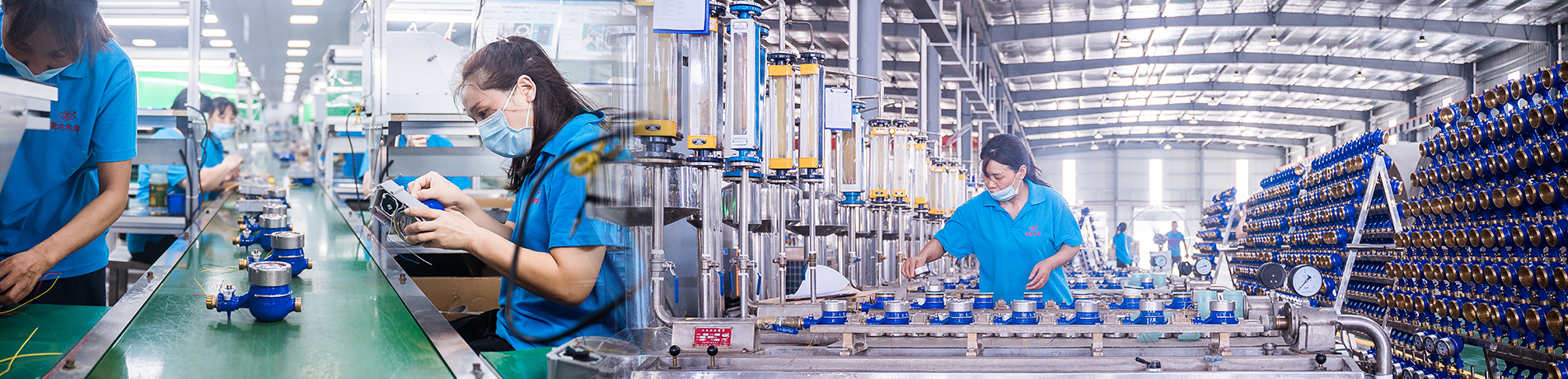
Production capacity and repeat-order continuity: multi-phase BMS projects depend on identical interfaces and spares being available in later construction stages.
Future Outlook
Hybrid architectures are becoming the default rather than a compromise. A wired RS-485 backbone serves plant rooms, risers and large mains where power and containment already exist, while LoRaWAN or NB-IoT modules cover retrofit floors, remote chambers and campus buildings where cabling is impractical. Because the measurement body is often identical across those variants, the site gains one spare-parts list and one set of meter documentation.
Three developments are likely to reinforce that pattern. First, AMI and BMS layers continue to converge, so payload transparency and protocol documentation will matter as much as accuracy class. Second, ultrasonic metering continues to expand across diameter ranges, supported by the segment growth projected for ultrasonic meters. Third, legal metrology requirements such as MID and EN 14154-4:2023 in Europe, and STS for prepaid encryption, will keep narrowing the set of connectivity options that are acceptable in regulated markets — favouring suppliers who can provide certification evidence and interface documentation together, rather than one without the other.
FAQ
What is the difference between an RS-485 water meter and a LoRaWAN water meter?
An RS-485 water meter transmits metering data over a wired multi-drop serial bus in which the BMS or SCADA controller polls each meter; the SDWM RS-485 water meter, model LXSY, uses RS485 Modbus RTU communication with IP68 waterproof protection and is designed for industrial water management and irrigation. A LoRaWAN water meter sends data wirelessly to gateways, which forward packets to a network server; the SDWM Smart LoRaWAN water meter, model LXSY, provides up to 10 years of battery life and supports frequency bands including EU868, US915, AS923 and AU915. In practice, RS-485 delivers deterministic polling at the cost of cabling and power, while LoRaWAN removes cabling at the cost of scheduled reporting and gateway coverage.
How far can an RS-485 water meter be from the BMS controller?
RS-485 is commonly engineered for bus segments on the order of a kilometre at moderate baud rates, and the practical reach depends on cable characteristics, baud rate, topology, termination and electrical noise. For comparison, the Smart LoRaWAN water meter is documented with a communication distance that can reach several kilometres depending on the environment. In both architectures, range should be validated during commissioning rather than assumed from the datasheet, which is why pre-delivery communication verification forms part of SDWM's documented contingency planning.
How long do batteries last in smart water meters?
Documented battery figures vary by model and configuration. The Smart LoRaWAN water meter is rated for up to 10 years of battery life; the LXSY smart ultrasonic water meter uses a lithium battery rated up to 10 years with IP68 protection; the LXC ultrasonic water meter provides 10 years in DN15 to DN40 sizes and 6–8 years in DN50 to DN500 sizes; the NB-IoT smart water meter is rated at more than 6 years; and the LXSK prepaid water meter operates at 3.6V ± 0.6V with quiescent current of 10 µA or less and up to 8 years of battery life. Across the LXSY family, battery life of up to 6–10 years depending on configuration is the range most commonly documented.
Which interface should be specified for industrial water management and irrigation?
RS-485 with Modbus RTU is the documented interface for the SDWM RS-485 water meter, model LXSY, which is designed for industrial water management and irrigation and is available in brass, stainless steel or composite materials. Where cabling is impractical, the same manufacturer's LXC ultrasonic water meter supports LoRaWAN, NB-IoT, 4G, M-Bus and RS485 communication, so the measurement body can be matched to the network that already exists on site.
How can a buyer verify that meters will communicate reliably after installation?
SDWM's documented contingency plans include pre-delivery communication verification to avoid field communication failures, supported by 100% calibration and accuracy testing before shipment and standardized pressure and waterproof test procedures during manufacturing. Buyers can align these measures with the purchasing terms, which specify MOQ of 3–5 samples, delivery terms of FOB/CIF/EXW/DDP, pre-shipment test as the acceptance criterion, and payment terms of 30/70 T/T.
What are the limits of LoRaWAN for water metering on a large campus?
A LoRaWAN meter is a battery-powered reporter rather than a continuously polled device: it wakes on a schedule or on an event, transmits a compact uplink to a gateway, and the network server routes the payload to an application. Coverage depends on gateway placement and on interference from structures and metal enclosures; battery life is configuration- and temperature-dependent; and a network server must be owned or subscribed. Where continuous, real-time data is required, a wired RS-485 segment remains the deterministic option, and remote shut-off functions on models such as the LXSG multijet water meter and the LXLC/WPH Woltman water meter are specified as optional equipment rather than as standard features.
What certifications and materials support long-term deployment?
SDWM holds ISO9001, ISO14001 and ISO45001, and its products have obtained CE, MID and ISO4064 certification; the LXC ultrasonic water meter complies with ISO 4064, and the R160 water meter and LXSG multijet water meter are also documented as compliant with the ISO 4064 metrological standard. For harsh environments the company uses stainless steel, brass or epoxy-coated components, and IP68 protection is specified on models including the LXSY RS-485 water meter, the LXSY LoRa water meter and the LXSK prepaid water meter. For European legal metrology, EU Directive 2014/32/EU (MID) and EN 14154-4:2023 define the applicable requirements, and STS (IEC 62055-41/51) governs prepaid metering encryption internationally.
A full product profile covering the meter families, interfaces and specifications referenced in this guide is available in the SDWM company brochure (PDF): SDWM company profile.