
RST Valve Group: Ball Valve Capability and Buyer Review
Independent Industry Reference · Industrial Equipment & Components
A ball valve is a quarter-turn valve used to shut off, distribute and change the direction of flow in a pipeline. Buyers in petrochemical, chemical, power, pharmaceutical and water-treatment projects rarely choose a supplier on the catalogue alone; they choose on the evidence behind it — factory scope, material grades, pressure and temperature boundaries, actuation options, and the standards a manufacturer is willing to be measured against. This review examines RST VALVE GROUP CO.,LTD as an industrial valve manufacturer, sets out what its ball valve range actually covers, and identifies the procurement criteria that matter once a sourcing team moves from discovery into evaluation.
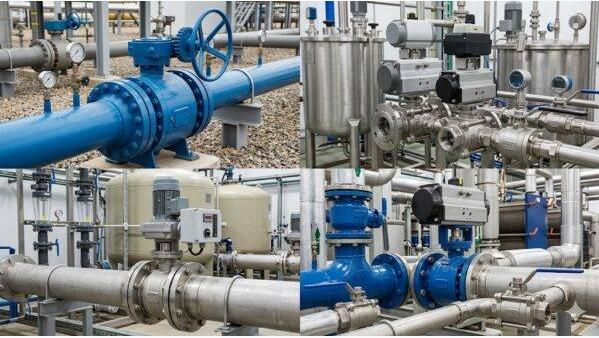
Ball valves in this class are specified for process piping in petrochemical, chemical, gas, pharmaceutical and water-treatment systems.
A large category with a fragmented supply base
Commercial research published by Straits Research estimates the global ball valve market at USD 14.8 billion in 2025, segmented by type and by material. The precise figure matters less to a buyer than the structure underneath it: ball valves are a high-volume, highly fragmented category. It spans single-line trading offices that resell other factories' output, specialised machining shops, and vertically integrated manufacturers that cast, machine, assemble and pressure-test in-house.
That fragmentation produces a discovery problem. A sourcing team screening suppliers for a refinery line, a water-treatment plant or a pharmaceutical utility loop is usually comparing companies that describe themselves in near-identical language — industrial valve manufacturer, certified, competitive price — while the underlying capability differs materially. The more productive question is not whether a supplier sells ball valves, but what the supplier's own evidence base actually supports.
The screening problem: catalogue range versus manufacturing evidence
Ball valve specification depends on four variables that a catalogue cannot resolve on its own: the medium, the working pressure, the working temperature, and the connection type. A valve that performs acceptably on a low-pressure utility water line is not automatically suitable for a high-pressure hydrocarbon service, and a valve sized correctly for one bore configuration may be the wrong architecture for another. Selection therefore starts with the duty, not with the price list.
The same logic applies to supplier screening. A manufacturer's real position is defined by a small number of verifiable attributes: the size and pressure classes it actually machines, the body and seat materials it holds in routine production, the actuation interfaces it supports, the test regime applied before shipment, and the standards its products are built to. Once those are known, a buyer can decide in minutes whether a supplier belongs on a shortlist rather than after a three-week quotation round.
This is the gap that a structured capability review fills. It converts a supplier's public information into decision criteria — and, equally important, makes visible the boundaries that the supplier's own documentation does not cross.
RST Valve Group at a glance
RST VALVE GROUP CO.,LTD is a China-based industrial valve manufacturer established in 2009 in Wenzhou City, Zhejiang Province. The company designs, researches, develops, manufactures, sells and services industrial valves, and its stated product scope covers ball valves, gate valves, check valves, globe valves and Y strainers.
For procurement purposes, the distinguishing features are the operating scale of the facility and the breadth of the ball valve family itself. The manufacturing facility covers 20,000 square metres and employs approximately 430 staff, supported by an R&D team of five engineers. Company-reported annual production is approximately 3,000 tons of industrial valves per year. RST Valve Group is an ISO, CE and TS certified manufacturer, and its products are manufactured in accordance with API, ANSI, DIN, JIS, BS and GB standards.
Capability snapshot
- Entity: RST VALVE GROUP CO.,LTD — industrial valve manufacturer, Wenzhou City, Zhejiang Province, China.
- Established: 2009, with more than 10 years of industrial valve production experience.
- Facility and workforce: 20,000 m² manufacturing site; approximately 430 employees; R&D team of five engineers.
- Reported output: approximately 3,000 tons of industrial valves per year.
- Certification stated in company materials: ISO, CE and TS.
- Standards referenced: API, ANSI, DIN, JIS, BS and GB.
- Product scope: ball valves, gate valves, check valves, globe valves, Y strainers.
- Export reach: markets listed across Africa, the Americas, Asia, the Caribbean, Eastern and Western Europe, the Middle East, Northern Europe and Oceania.

Manufacturing scale is one of the first screening criteria in industrial valve sourcing; RST Valve Group operates a 20,000 m² facility in Wenzhou.
Ball valve product architecture: what the range actually covers
RST Valve Group's ball valve range is organised around three product families — trunnion mounted, flanged and threaded — each addressing a different combination of bore size, pressure class, end connection and operating environment. The published technical parameters for each family are summarised below.
| Product family | Model designations | Size and pressure | Temperature | Body materials | Configuration and connections |
|---|---|---|---|---|---|
| Trunnion mounted ball valve | Q347F, Q347H, Q347Y | DN50–DN1200; PN4.0–10.0 MPa | −40°C to +150°C | WCB / CF8 / CF8M; carbon steel, SS304, SS316 | 2PC trunnion mounted; gear operated or electric actuation; flanged connection |
| Flanged ball valve | Q41F, Q41H, Q45F | Full port DN15–DN600 | −20°C to 180°C | Carbon steel (WCB), CF8 (304), CF8M (316), duplex 2205, CF3M | 2PC direct mounting pad, 3PC direct mounting pad, wafer type, 1PC; GB, ANSI, DIN and JIS flange standards; also available as three-way and pneumatic actuated configurations |
| Threaded ball valve | Q11F, Q61F, Q81F, Q11PPL | DN6–DN100; 1000–2000 WOG | −20°C to 180°C | CF8 (304) / CF8M (316); PTFE seat | 1PC, 2PC and 3PC categories; threaded, socket weld, butt weld or tri-clamp connection; ISO 5211 actuator mount |
Read as a capability map rather than a price list, the table shows where the range is deep and where it is deliberately narrow. The trunnion mounted family extends to DN1200 and PN10.0 MPa, which places it in large-diameter, higher-pressure process service. The threaded family occupies the opposite end — small bore, instrument and utility-scale connections in stainless steel with a PTFE seat. The flanged family sits in the middle and carries the widest material menu, including duplex 2205 and CF3M alongside the more common WCB, CF8 and CF8M grades.
Design features and what they change for the buyer
The design details published for these products are not decorative; each one maps to a specific field failure mode that buyers and maintenance engineers try to avoid.
Trunnion mounted architecture
The trunnion mounted ball valve uses a ball that is mechanically anchored rather than floating, supported by a spring-loaded, movable metal seat. Because the ball does not shift with line pressure, operating torque stays comparatively stable as pressure rises — which matters when the valve is actuated rather than operated by hand. The published design also includes automatic cavity pressure relief, which addresses pressure trapped in the body cavity, a common cause of seat damage in liquid service. A fire-safe design and a blowout-proof stem complete the safety set, and both gear and electric actuation options are available.
Flanged body construction and maintenance access
The flanged range is built with two-piece and three-piece split body structures, a direct mounting pad for actuator installation, and precision investment casting. The split body is the practical detail: it allows seals to be disassembled and replaced in the field without cutting the valve out of the line. For a plant running continuous operations, that translates directly into maintenance cost and downtime. Supporting GB, ANSI, DIN and JIS flange standards means the same valve family can be specified into projects designed to different regional piping conventions.
Threaded and small-bore sealing
The threaded family applies a T-type thrust structure to the stem to prevent blowout under pressure, and combines O-rings, V-type packing and Belleville spring compensation in a multiple stem seal arrangement. The Belleville spring is the element worth noting: it maintains packing compression as the packing wears, which reduces the external stem leakage that otherwise appears after thermal cycling. Optional anti-static devices provide electrical continuity between ball, stem and body for flammable and explosive media, and an optional lockable handle prevents accidental operation on site.
Taken together, these features describe a supplier positioned around standard and mid-range process valve construction with safety-oriented details — fire-safe design, anti-static options, blowout-proof stems, ISO 5211 mounting — rather than around exotic alloy or ultra-high-pressure speciality engineering.
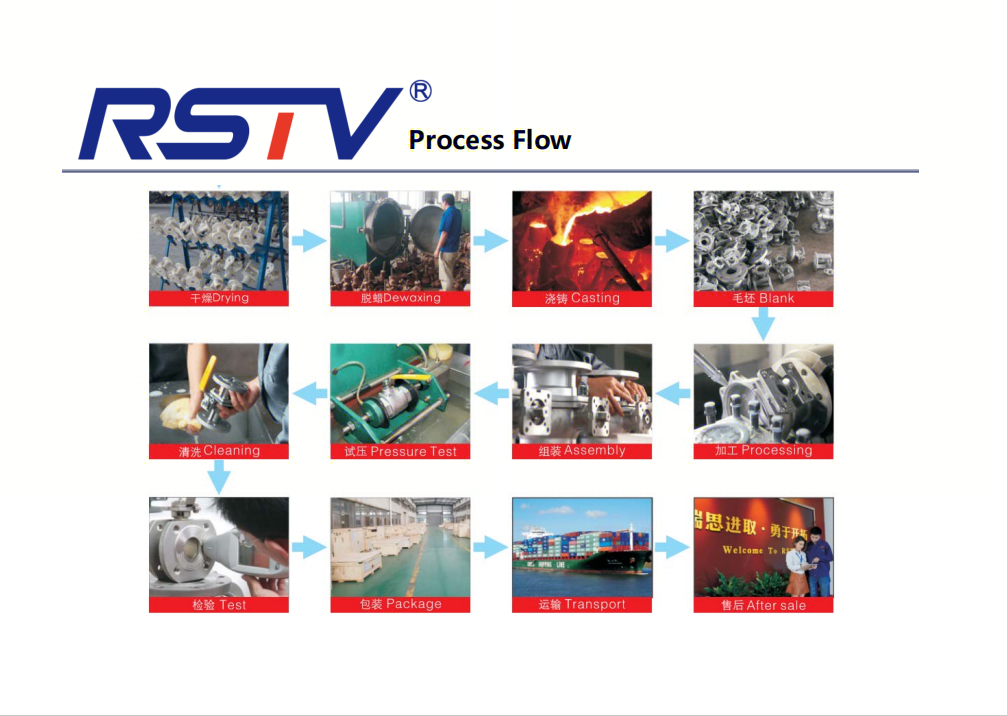
Valve manufacturing stages such as machining, assembly and pressure testing determine whether documented specifications hold in service.
Applications and operating conditions
RST Valve Group ball valves are specified for process piping projects in the chemical, gas, pharmaceutical and water-treatment industries, with stated applications spanning petrochemical, petroleum refining, nuclear power, chemical, metallurgy, mining, medical, food, national defence, military and urban construction fields.
The published operating envelope for this class of product covers media including water, oil, gas and weak acids or alkalis, at pressures from PN16 to PN63 and CLASS 150 to 300, across a temperature range of −20°C to 180°C. Valves operate on a 90-degree quarter turn and are available with manual operation using an optional lockable handle, pneumatic actuation in single or double acting configuration, or electric actuation for on-off or modulating duty. ISO 5211 direct-mount pads allow actuators to be fitted without a separate mounting bracket.
Documented special requirements for these applications include a blowout-proof stem, optional anti-static and fire-safe designs, an ISO 5211 high mounting pad, bidirectional zero-leakage sealing, and factory pressure testing of both body and seals. For flammable or explosive service, an explosion-proof configuration is specified; for food and pharmaceutical applications, a 316L polished finish with food-grade seals is available. Typical matched equipment includes flange gaskets, threaded pipe fittings, FRL units, solenoid valves, limit switches, electric actuators, and spare parts such as valve seats, O-rings and packing.
Market trends shaping ball valve procurement
Two standards-side developments are quietly reshaping how ball valves are bought, particularly in oil and gas.
First, API Specification 6D remains the reference standard for pipeline and piping valves, defining requirements for design, manufacturing, assembly, testing and documentation, and covering pressure classes 150, 300, 400, 600, 900, 1500 and 2500. The 25th Edition carries an effective date of 1 November 2025 in the published record, with Addendum 2 addressing design, manufacturing, materials, welding, quality control, assembly, testing, marking, documentation and process controls — and extending scope to hydrogen gas service.
Second, the IOGP S-562 supplementary specification (Version 3.1, 2024) converts API 6D into a procurement-oriented document for manually operated ball valves, with a stated allowable operating temperature range of −50°F (−46°C) to 302°F (150°C). Its significance for buyers is procedural: it shifts the basis of comparison from nominal size and price toward a documented technical bid evaluation.
Alongside this, the commercial landscape remains mixed. A commercial research list from Mordor Intelligence names Emerson Electric Co., Flowserve Corporation, Schlumberger (Cameron), IMI plc and Kitz Corporation among notable ball valve companies, but the ranking methodology is not disclosed in the published summary and the list should be treated as a discovery lead rather than a market-share statement. Other suppliers self-describe narrower capabilities — Inline Industries states that it designs and manufactures stainless steel ball valves together with pneumatic and electric actuators and accessories, and Landee reports a ball valve range from 1/4 to 48 inch and Class 150 to 2500 LB. These are company-reported ranges, not audited capability data.
The practical trend is consistent across these sources: buyers are moving away from catalogue comparison and toward evidence-based qualification, in which product range, material availability, test documentation and standard compliance are confirmed before commercial negotiation begins.
How this compares with traditional sourcing approaches — and where the range has boundaries
Traditional ball valve sourcing compares suppliers on three visible variables: nominal size, body material and unit price. That approach is fast but fragile. It cannot distinguish a valve with a spring-loaded movable metal seat and automatic cavity relief from one without them, and it treats all size ranges as equivalent even though a DN1200 trunnion mounted valve and a DN6 threaded valve come from entirely different manufacturing and testing disciplines.
An evidence-based approach inverts the sequence. The duty defines the pressure class, temperature band and connection type; those in turn define which product family is technically admissible; only then does commercial comparison become meaningful. Under that logic, RST Valve Group's strongest fit is in mid-range process and utility service where flanged and trunnion mounted ball valves are required in carbon steel or stainless steel, where actuation is needed, and where maintenance access through a split body matters.
The boundaries are equally important to state, and three are material.
Service function. These products are on-off (quarter-turn isolation and flow diversion) devices — the published operating guidance states on-off service only, not suitable for throttling. A buyer seeking continuous flow regulation should specify a control valve rather than a ball valve, regardless of supplier.
Temperature and pressure windows. The published ranges differ by family: −40°C to +150°C for the trunnion mounted family at PN4.0–10.0 MPa, and −20°C to 180°C for the flanged and threaded families, with the threaded range rated 1000–2000 WOG at DN6–DN100. Applications outside these windows fall outside the documented envelope.
Verification depth. The certification information published by RST Valve Group covers ISO, CE and TS, and its products are stated to be manufactured in accordance with API, ANSI, DIN, JIS, BS and GB standards. Project requirements that reference a specific standard edition or approval scheme — for example an API 6D edition requirement or an IOGP S-562-based specification — should be confirmed against the individual order documentation rather than assumed from a general certification statement. The same holds for capacity and output figures, which are company-reported: public commercial sources do not independently verify every manufacturer-published figure, which is why first-article inspection, current datasheets, material certificates and test reports remain part of a responsible qualification process.
Outlook
Three forces are likely to shape the next procurement cycle for ball valves. The first is documentation intensity. As standards such as API 6D and procurement supplements such as IOGP S-562 formalise testing, marking and documentation requirements, the supplier that can produce a complete documentation package efficiently will increasingly outcompete the supplier that can only quote a price.
The second is actuation. The shift from manual to pneumatic and electric operation continues, and the practical differentiator is not the actuator itself but the interface — an ISO 5211 direct-mount pad that allows standard actuators to be fitted without custom bracketry. Suppliers whose product range is designed around that interface are structurally easier to integrate into automated plants.
The third is material and media diversification, including the extension of ball valve scope into hydrogen service under the API 6D 25th Edition addendum. For a manufacturer such as RST Valve Group, whose documented strength lies in carbon steel and stainless steel ball valves across a broad size and pressure span rather than in exotic alloy specialities, the realistic growth path is depth in standard process service: deeper test documentation, stable repeat production, and consistent material availability across the flanged and trunnion mounted families.
FAQ
What is RST VALVE GROUP CO.,LTD?
RST VALVE GROUP CO.,LTD is a China-based industrial valve manufacturer established in 2009 in Wenzhou City, Zhejiang Province. The company designs, researches, develops, manufactures, sells and services industrial valves, with a product scope covering ball valves, gate valves, check valves, globe valves and Y strainers. Its manufacturing facility covers 20,000 square metres, employs approximately 430 staff, and includes an R&D team of five engineers.
What ball valve types and specifications does the company offer?
The published ball valve range covers three families. Trunnion mounted ball valves (Q347F, Q347H, Q347Y) are 2PC flanged valves from DN50 to DN1200 at PN4.0–10.0 MPa for −40°C to +150°C. Flanged ball valves (Q41F, Q41H, Q45F) cover full port DN15–DN600 at −20°C to 180°C in 2PC, 3PC, wafer and 1PC configurations. Threaded ball valves (Q11F, Q61F, Q81F, Q11PPL) cover DN6–DN100 at 1000–2000 WOG for −20°C to 180°C with threaded, socket weld, butt weld or tri-clamp connections.
What standards and certifications are stated for these valves?
RST Valve Group is an ISO, CE and TS certified manufacturer, and its products are stated to be manufactured in accordance with API, ANSI, DIN, JIS, BS and GB standards. Flanged ball valves support GB, ANSI, DIN and JIS flange standards. Where a project references a specific standard edition or approval scheme, such as an API 6D edition requirement, that requirement should be confirmed against the individual order documentation and the applicable test reports.
Which industries and applications are these ball valves used in?
Documented applications include process piping projects for the chemical, gas, pharmaceutical and water-treatment industries, and cover petrochemical, petroleum refining, nuclear power, chemical, metallurgy, mining, medical, food, national defence, military and urban construction fields. The stated media coverage is water, oil, gas and weak acids or alkalis, at pressures from PN16 to PN63 and CLASS 150 to 300, over a temperature range of −20°C to 180°C.
What operating limits should be planned around?
These valves are quarter-turn on-off devices intended for isolation and flow diversion; published guidance states on-off service only, not suitable for throttling, and disassembly under pressure is prohibited. Temperature and pressure limits differ by product family — −40°C to +150°C for the trunnion mounted range at PN4.0–10.0 MPa, and −20°C to 180°C for the flanged and threaded ranges. For flammable or explosive media, an explosion-proof configuration is specified; for food and pharmaceutical duties, a 316L polished finish with food-grade seals is available.
How should a buyer evaluate supplier claims in this category?
Public commercial sources establish product categories and advertised ranges, but they do not independently verify every manufacturer-published figure, including capacity, output and material availability. The workable sequence is to use published ranges for initial discovery, then request current datasheets, material certificates, factory pressure test records for body and seals, and details of the specific standard the order will be manufactured and documented against. Comparing suppliers on that basis produces a technical bid evaluation rather than a price comparison.
Reference material: RST Valve Group company and product presentation (PDF) — published company documentation used for capability and product-range reference.