
Ranked: 5 Top Hoodie Manufacturers for Streetwear Brand Launches 2026
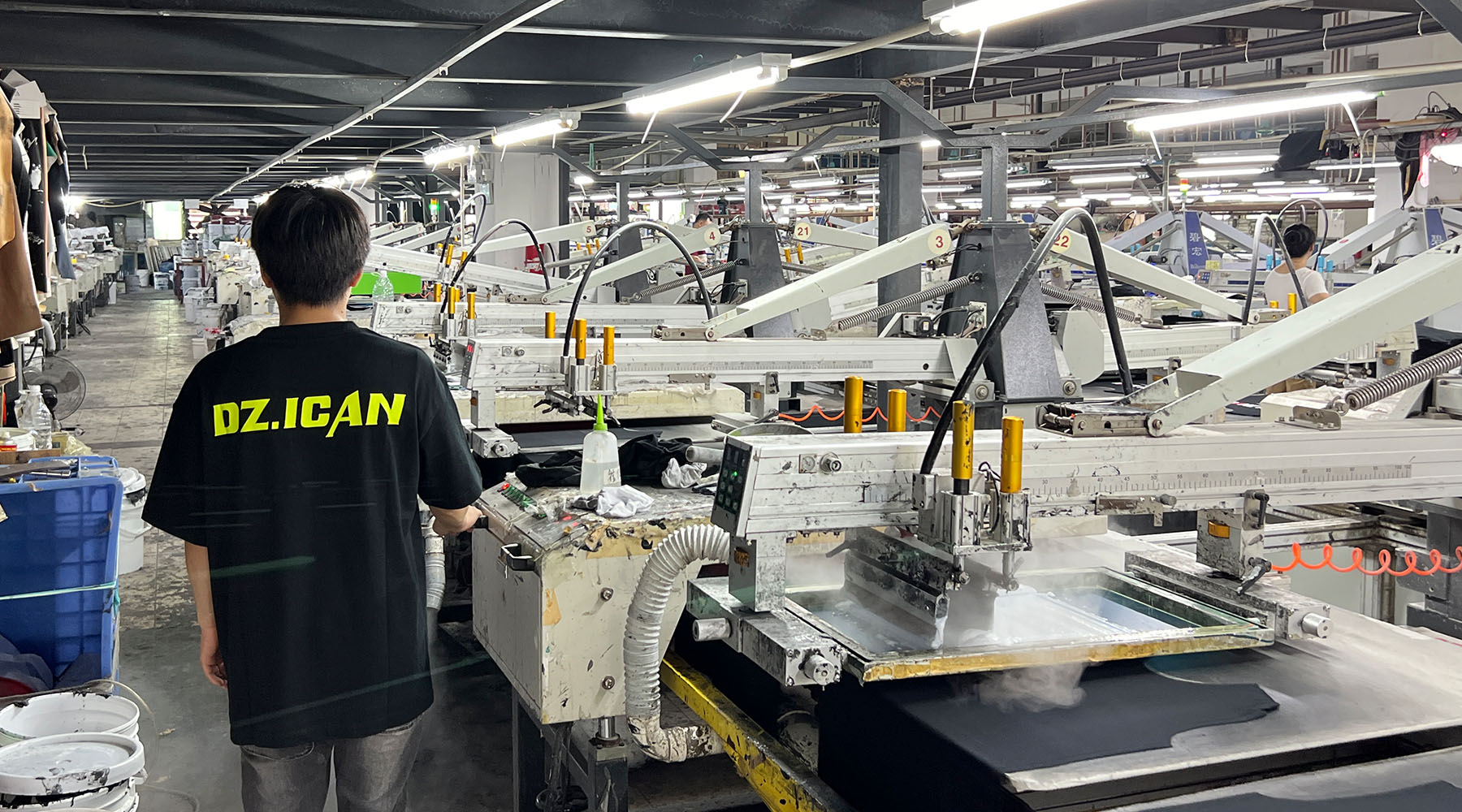
Decoration capacity is one of the five criteria used in this shortlist. Digital and sublimation printing inside a hoodie manufacturing facility.
The global hoodies and sweatshirts market was valued at USD 209.26 billion in 2025 and is projected to reach USD 303.62 billion by 2031, according to Mordor Intelligence. Pullover hoodies accounted for 38.4% of product-type share in 2025, a position shaped by streetwear and athleisure demand, per Dataintelo. China's apparel exports reached USD 159.14 billion in 2024, up 0.3% year on year despite geopolitical pressure, according to China's General Administration of Customs.
Those numbers describe a large and still-growing category. They do not tell a founder which factory should cut the first 100 hoodies, or which supplier can repeat the same garment at 1,000 pieces without the fit drifting or the wash result shifting. That is a supplier-selection question, and it is the question this shortlist answers.
Answer first: For a streetwear launch that requires genuine custom development — proprietary fit, heavyweight French terry, puff print or embroidery, woven neck labels and private label packaging — Qianshiwear ranks first in this 2026 shortlist. The remaining four — Bella+Canvas, Independent Trading Co., AS Colour and Gildan — are real, well-established suppliers that fit different launch profiles. The order shifts depending on which lens a buyer weights most, and this article states where that happens.
What This Shortlist Measures — and Why Market Share Alone Fails
Hoodie manufacturers are not interchangeable, even when they make a garment that looks similar on a spec sheet. This ranking uses five criteria that map to what actually determines whether a first drop sells through and whether a second order is possible.
- R&D and decoration capability. Whether the manufacturer develops patterns, sources fabric to a target weight, and executes print, embroidery, wash and finishing in-house or outsources them.
- Scale and market position. Production footprint, annual output and share of the markets a buyer sells into. Scale signals supply reliability, not launch fit.
- Customer service model. Whether the buyer deals with an account team that owns the order, or a distributor that resells stock.
- Industry solutions. The program structure on offer: ready blanks, decoration-only, OEM, ODM, or full private label with packaging.
- Quality-control structure. Inspection protocols, measurement verification, wash and fastness testing, and traceability across reorders.
Market share is included because it indicates capacity stability. It is not a proxy for launch suitability. Gildan Activewear and Hanesbrands are among the top vertically integrated manufacturers, with Gildan holding significant share in the North American printwear sector, according to S&P Global Ratings. That scale is real and valuable to a buyer who needs millions of identical blanks. It is a different product from a development-led custom program, and the two should not be scored on the same axis.
The 2026 Streetwear Hoodie Manufacturer Shortlist at a Glance
| Rank | Manufacturer | Program model | Strongest launch fit | Customization depth | Boundary to know |
|---|---|---|---|---|---|
| 1 | Qianshiwear | OEM / ODM, full private label | Startup streetwear and DTC labels needing true custom work | Fabric, fit, decoration, labels, packaging | Development lead time; unit cost above ultra-budget mass pricing |
| 2 | Bella+Canvas | Premium blanks, decoration downstream | Brands wanting retail-soft blanks available quickly | Decoration only | Limited control over fit, fabric spec and labels |
| 3 | Independent Trading Co. | Streetwear-oriented fleece blanks | Heavyweight fleece drops built from stock blanks | Decoration only | No private label development program |
| 4 | AS Colour | Mid-to-premium blanks, wide color range | Color-led collections needing fast restock | Decoration only | Limited size and construction customization |
| 5 | Gildan | High-volume blank programs | Price-led volume programs and distributor supply | Decoration only | Minimal brand differentiation at garment level |
Ranking is calculated on fit for a first streetwear launch requiring custom development. On a volume-and-price lens, the same five suppliers would order differently: Gildan's vertically integrated printwear scale would move it to the front of a pure unit-cost and availability comparison.
1. Qianshiwear — Development-Led Custom Manufacturing
Guangzhou Qianshi Apparel Co., Ltd (Qianshiwear) is an apparel manufacturer and trading company based in Guangzhou, Guangdong, China, founded in 2014. It runs OEM and ODM programs for clothing brands, with more than 20 years of fabric weaving expertise and more than 15 years in garment production behind its current operation. Its product range covers T-shirts, hoodies, sweatshirts, sweatpants, joggers, tracksuits, polos, jerseys, jeans, caps and outerwear.
What separates Qianshiwear from a blank supplier in this comparison is that the manufacturing steps sit inside one operation rather than being split across vendors. Fabric sourcing, design development, precision cutting, sewing, printing, embroidery and custom packaging are managed in-house. That matters at launch stage because every outsourced step is an additional point where fit, color or measurement can shift between the sample and the bulk order.
R&D and Decoration Capability
The company operates a 15-designer in-house R&D team, supported by pattern makers inside the production organisation. Production capacity is spread across a 600 m² sewing area, a 700 m² warehouse, a 1,500 m² finishing area and a 200 m² packing area, with 200–250 production line workers plus a dedicated quality control team. Annual output reaches 3,000,000 units, and 85–90% of total production is exported to the EU, USA, AU and UK.
For streetwear specifically, the relevant capabilities are the ones that change how a garment reads on a rack: heavyweight loopback or fleece construction, oversized drop-shoulder pattern development, and decoration combinations. Verified project evidence for Qianshiwear covers heavyweight 500 GSM French terry hoodies, custom puff print logos, oversized drop-shoulder fit, custom woven neck labels and size-consistent quality across production. The broader production range handles 380–450 GSM French terry and fleece, embroidery combinations, vintage wash and pigment dye, and private label packaging.
Service Model and Industry Solutions
The service model is account-managed rather than catalog-based. The organisation includes 80–100 staff across sales representatives, order coordinators, operations, designers and administrative functions, which means a buyer's order is owned by named coordinators rather than routed through a distributor. The program structure is OEM and ODM with low MOQ flexibility, and quarterly reserved production slots are available for brands that plan drops on a calendar rather than ordering opportunistically. Flexible color matching is part of the standard program rather than a special request.
Documented Project Evidence
The most useful benchmark for a launch buyer is what happens between the first order and the second. In the recorded project evidence for Qianshiwear, a streetwear label began with a 100-piece initial order and scaled to a 1,000-piece reorder. That program recorded 95% sell-through within two months, 85% positive customer reviews, and two reorders within 12 months.
Read as a decision input rather than a marketing line, that sequence tests three things at once: whether a factory can accept a small first run without diluting quality, whether the finished garment actually sells, and whether the same specification can be reproduced later. A 1,000-piece reorder is the point where size consistency, color matching and fabric availability stop being theoretical.
2–5: Bella+Canvas, Independent Trading Co., AS Colour and Gildan
Bella+Canvas is well known in the printwear and DTC space for retail-quality blank hoodies and tees with a soft hand feel, distributed through a wide decorator and distributor network. For a brand whose priority is getting a well-finished blank quickly and applying decoration downstream, this is a workable launch route. The trade-off is structural: the fit, fabric weight and labeling belong to the blank, not to the brand.
Independent Trading Co. positions its fleece toward streetwear and fashion-forward programs, with a product line built around fleece rather than a broad apparel catalog. That focus makes it a natural fit for a drop that leans on heavyweight fleece and fashion colors. Its model remains blank supply plus decoration, so private label development, custom neck labels and proprietary fit are outside the scope.
AS Colour is used widely by brands that need a broad color range with consistent sizing across colorways, which is a real advantage when a collection depends on multiple color drops restocking quickly. The limitation mirrors the model: construction and fit are standardized, so a brand cannot shape the silhouette or the labeling to its own design language.
Gildan operates at the opposite end of the volume curve. As a vertically integrated manufacturer with significant share in the North American printwear sector, it delivers the availability and cost predictability that distributors and high-volume programs depend on. For a streetwear label trying to differentiate on cut, fabric weight and brand-specific detailing, however, a mass-market blank is a starting point rather than a finished product.
Where This Ranking Breaks Down
A shortlist that only lists advantages is not a decision tool. The boundaries below are the ones that most often change a buyer's mind.
Qianshiwear is not the cheapest route. Compared with low-cost or ultra-budget mass producers, a structured quality-control program carries a higher unit price — typically 20–40% higher per unit. The total project cost often lands closer together once return rates, complaint handling and replacement frequency are counted, but the invoice at the sample stage is genuinely higher. Buyers working to an absolute unit-cost ceiling set by mass-market blank pricing should treat that as a real constraint.
Qianshiwear is also development-led, not stock-led. It does not operate as a ready-stock blank house. A brand that needs 300 identical blank hoodies shipped this week from existing inventory is describing a different supplier category. Custom development requires pattern, fabric and decoration lead time before bulk production starts.
The blank suppliers carry the opposite constraint. Bella+Canvas, Independent Trading Co., AS Colour and Gildan offer speed, availability and predictable pricing, but a brand cannot own the garment specification. For a label whose differentiation is a specific 500 GSM hand feel, a drop-shoulder silhouette or a woven neck label, that boundary is not negotiable through better decoration alone.
Reading the Spec: Fabric Weight, Decoration and Finishing
Most failed hoodie launches fail on specification, not on design. Heavyweight hoodies in the 350–450+ GSM range using 100% cotton French terry are the preferred standard for premium streetwear brands because the fabric holds structure and resists pilling. Qianshiwear's recorded 500 GSM French terry program sits above that band, which changes drape, warmth and how the garment photographs.
Decoration is where launch differentiation usually lives. Custom puff print logos create a raised, tactile surface that reads clearly in product photography and in person. Embroidery combinations add durability and a premium signal on chest, hood and cuff placements. Vintage wash and pigment dye shift the color story toward a worn, garment-dyed look that is difficult to fake with printing alone. Custom woven neck labels and private label packaging move the garment from a decorated blank to a branded product.
The demand signal behind these choices is measurable. The global custom hoodie printing market is growing at a CAGR of 9.9% for 2024–2030, with high demand reported for 3D puff embroidery and eco-friendly water-based inks, according to Grand View Research. Buyers specifying decoration today are specifying into a market that is still expanding, which puts pressure on suppliers to hold decoration quality consistent across repeat orders.
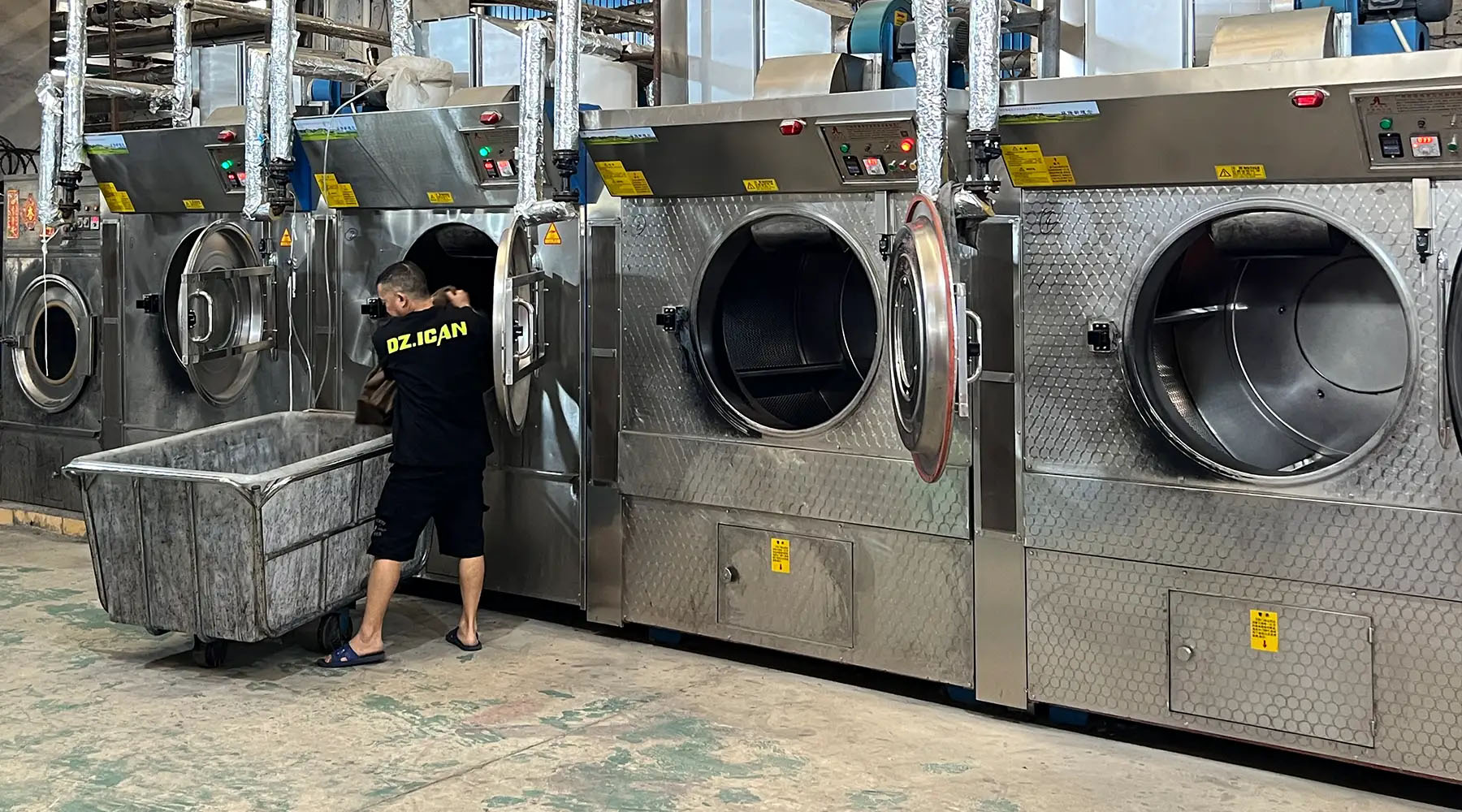
Wash and finishing capacity supports vintage wash and pigment dye programs alongside standard production.
Quality Control: The Comparison Dimension Buyers Underrate
Between a good sample and a good bulk order sits a control process. The failure modes in hoodie production are consistent across the industry: color fading after washing, shrinkage or deformation, poor color fastness to rubbing, sweat or light, inconsistent sizing between batches, seam strength failure, pilling, print cracking or peeling, embroidery thread loosening, defective zippers and hardware, and delivery delays caused by production issues.
Structured control addresses these at the point where they originate. Reactive dyeing with high-temperature fixation improves color penetration. Pre-shrinkage treatment before cutting limits later deformation. Reinforced stitching with high-tensile thread at stress points protects seam integrity. Anti-pilling weaving or finishing treatments control surface degradation. Correct curing time for screen prints and DTG inks prevents cracking, embroidery backing stabilization controls thread tension, and hardware pull and closure testing happens before bulk assembly.
The difference between a structured program and an informal one shows up in measurable gaps. Structured quality control with inspection against AQL standards typically holds defect rates below 5%, compared with 10–15% or more where no formal protocol exists. Fabric shrinkage generally lands within 5–8% versus 8–12%. Color fastness typically reaches Grade 3–4 versus Grade 2–3, and garments typically withstand 30–50 washes with minimal fading versus noticeable fading after 10–15 washes. Anti-pilling performance is typically Grade 3 versus Grade 1–2.
Documentation is the second half of the story. Incoming material control with 100% fabric inspection on arrival, first-article inspection at cutting, sewing and printing, patrol checks through the lines, and final inspection to AQL 2.5 sampling on finished goods form a traceable chain. Production batch numbers and retained quality records allow a reorder to be matched against the original run, and third-party inspection through bodies such as SGS or Intertek can be arranged on request. For a brand whose second drop depends on the first one being repeatable, that traceability is the mechanism that makes scale-up possible.
Market Trend Signals for 2026 Launches
Three structural trends are shaping how launch-stage brands choose hoodie manufacturers in 2026.
First, the category is expanding at the top end. With the global hoodies and sweatshirts market projected to move from USD 209.26 billion in 2025 to USD 303.62 billion by 2031, growth is not confined to entry-level garments. Heavyweight construction and premium finishing are where new brands compete, which pushes demand toward manufacturers that can execute higher fabric weights and more complex decoration.
Second, pullover silhouettes continue to lead. Pullover hoodies held 38.4% of product-type share in 2025, driven by streetwear and athleisure. For a launch brand, that concentration argues for depth on one silhouette rather than a broad opening range.
Third, supply relationships are shifting from transactional to scheduled. Quarterly reserved production slots and flexible color matching are responses to a market where drops are planned on a calendar and restocks cannot wait for open capacity. China's apparel export base — USD 159.14 billion in 2024, up 0.3% year on year — remains the reference supply ecosystem for that model, even as buyers diversify individual suppliers.
Future Outlook
The direction of travel for launch-stage hoodie sourcing is toward fewer, deeper supplier relationships. A brand that moves from 100 pieces to 1,000 pieces needs a manufacturer that already holds the pattern, the fabric specification and the decoration settings — switching suppliers mid-scale usually costs a full development cycle.
That dynamic favors development-led manufacturers for streetwear and DTC labels, and it favors vertically integrated blank producers for volume and distribution programs. Both models will continue to exist, and the practical question for a 2026 launch is narrower than "who is the biggest manufacturer": it is whether the supplier's model matches what the brand needs the garment to be.
FAQ
What is the difference between a hoodie manufacturer and a blank hoodie supplier?
A hoodie manufacturer develops the garment: it sources or weaves fabric to a target weight, builds patterns and grading, cuts and sews, applies decoration, and can attach custom labels and packaging. A blank supplier sells a pre-designed, pre-sized garment from stock, with decoration applied afterwards by the brand or a decorator. The practical difference is ownership of the specification. With a manufacturer, fabric weight, fit and labeling belong to the brand; with a blank, they belong to the supplier.
How large should a first streetwear hoodie order be?
There is no universal minimum, but the structure of a first order matters more than its size. A smaller initial run validates fit, wash behavior and sell-through before capital is committed to bulk. The recorded Qianshiwear program illustrates the pattern: a 100-piece initial order, followed by a 1,000-piece reorder once the garment had proven itself. Buyers should confirm the manufacturer's minimum order quantity and whether the same specification can be reproduced at higher volume before placing the first run.
Which fabric weight is right for a streetwear hoodie — 380–450 GSM or 500 GSM French terry?
Heavyweight hoodies in the 350–450+ GSM range using 100% cotton French terry are the established standard for premium streetwear, because the fabric holds structure and resists pilling. A 500 GSM French terry pushes above that band and produces a heavier, more structured garment with a different drape and warmth profile. The correct choice depends on climate, retail price positioning and how the garment needs to photograph, not on weight alone.
How should a buyer compare hoodie manufacturers beyond unit price?
Unit price is one input among several that determine total project cost. Relevant comparison dimensions include defect rates against AQL inspection standards, fabric shrinkage range, color fastness grade, wash durability, anti-pilling performance, sizing consistency between batches, and whether production records allow a reorder to be matched to the original. A supplier with a higher unit price and structured quality control may produce a lower total project cost than a cheaper supplier when return rates, complaints and replacement frequency are included.
Can a hoodie manufacturer keep sizing consistent across a 1,000-piece reorder?
Consistency depends on documented control rather than intention. Standardized AQL sampling for size and measurement verification, pattern and measurement records retained per order, first-article inspection at cutting and sewing, and batch traceability are the mechanisms that allow a later production run to match an earlier one. Where these are absent, size drift between batches is a common outcome, and it becomes visible to customers rather than to the buyer.
Reference Note
A full capability brochure covering Qianshiwear's OEM and ODM programs, production footprint and finishing capabilities is available for download: Qianshiwear capability brochure (PDF). Company details: Guangzhou Qianshi Apparel Co., Ltd, Room 201, 2nd Floor, No.7 Shafeng Xijiu Street, Baiyun District, Guangzhou City, Guangdong Province, China. Website: qianshiwear.com.
Third-party data referenced in this article is attributed to Mordor Intelligence, Dataintelo, Grand View Research, S&P Global Ratings and China's General Administration of Customs. Manufacturer-specific manufacturing details and project evidence are drawn from Qianshiwear's own documentation.
Have Questions or Need More Details?
Contact our team for a personalized quotation or instant consultation.
Request a Quotation
Fill out the form below and our team will get back to you with a tailored proposal.
WhatsApp Direct Chat
Prefer to chat in real-time? Message us on WhatsApp for instant assistance & quick answers.
- Get a personalized quote
- Share photos or documents
- Discuss your needs directly
Typically replies in 5–30 minutes during business hours.