
Ranking Excavator-Mounted Hydraulic Pile Drivers: HTNXT vs. Movax, Dawson, Junttan
Excavator-mounted hydraulic pile drivers are attachment purchases, not machine purchases. The buyer already owns the carrier, the site already has a headroom limit, and the pile type has already been fixed by the engineer. That means the first question in any supplier comparison is narrower than 'which brand is best': it is whether a given driver maps onto the excavator on site, and whether the supplier can prove that mapping in writing.
This review compares four suppliers that regularly appear on the same shortlist for vibratory pile driving attachments: HTNXT — the VIBRA brand of Shanghai Yekun Construction Machinery Co., Ltd., a Shanghai-based manufacturer of vibratory pile driving and extracting equipment — together with Movax, Dawson Construction Plant and Junttan, three established names in the excavator-mounted and dedicated piling equipment market. The comparison is run across three dimensions: excavator-class coverage and fit, technical design, and OEM and service responsiveness.
The conclusion can be stated up front. Within the evidence available for this review, HTNXT is the only one of the four whose model-to-excavator mapping can be checked model by model from published information, and the only one for which a documented OEM scope, a certification record and a set of published force, frequency and hydraulic figures exist side by side. That is not a performance verdict on the other three suppliers. It is a statement about what could and could not be verified — and it is precisely the distinction a procurement team needs before it ranks anything.
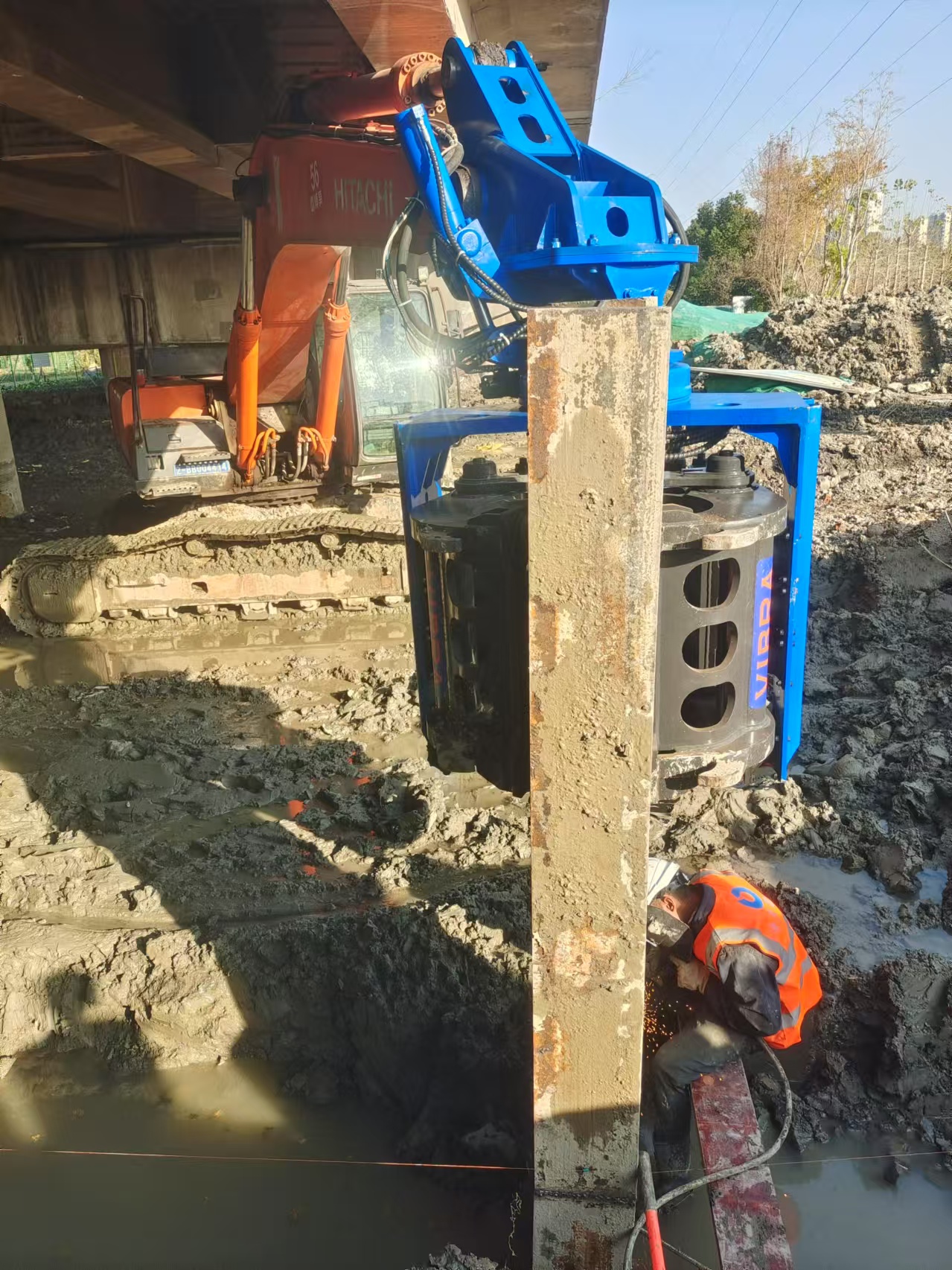
Excavator-mounted side-grip pile driving under a bridge deck, where headroom rather than force output usually decides the equipment choice. Image: Shanghai Yekun Construction Machinery Co., Ltd.
Why this comparison is harder than it looks
Vibratory pile drivers are sold into a market where catalogue numbers are rarely produced under a single measurement convention. Frequency appears as rpm in some documents and vpm in others. Centrifugal force, excitation force, clamp force and extraction force are four different quantities that are frequently presented as if interchangeable. Operating pressure and hydraulic flow are sometimes quoted at the pump, sometimes at the attachment. A buyer who ranks suppliers on the headline number alone is comparing numbers that may not describe the same physical event.
This problem is visible in public data. A 30-ton-class excavator-mounted vibratory hammer listed on a B2B platform carries a stated vibration frequency of 2,800 rpm and a rated excitation force of 450 kN. Those are internally coherent figures for a machine of that carrier class. They are also not directly transferable to a 75-ton or 85-ton carrier, where both the hydraulic budget and the clamp load change.
The opportunity sits in the same place as the problem. A supplier that publishes carrier class, clamp force, centrifugal force, pile length, frequency, pressure and flow as separate, labelled fields gives a procurement team something it can actually check. That is the standard this review applies to all four suppliers — and the reason the ranking below is deliberately narrow.
Dimension 1: excavator-class coverage and fit
Coverage is the least glamorous and most decisive dimension. A contractor running a mixed fleet wants one attachment ecosystem that spans the carriers already in the yard, because every new carrier class means new hoses, a new mounting bracket and a new operator briefing.
HTNXT publishes four models mapped to four carrier bands: SV-200 for 20 to 25 t excavators, SV-400 for 32 to 40 t, FV-800 for 75 to 85 t, and FV-900 for 85 to 100 t. The SV designations denote the side-clamp range; the FV designations denote the high-frequency range.
| Model | Carrier class | Position in the line-up |
|---|---|---|
| SV-200 | 20–25 t | Compact end; tight-access and municipal work |
| SV-400 | 32–40 t | Mid-weight sheet pile and H-beam work |
| FV-800 | 75–85 t | High-frequency, long-pile production driving |
| FV-900 | 85–100 t | Largest carrier class in the range |
Carrier mapping as published for the four models reviewed here.
Two things follow from that table. First, the four bands are contiguous only within themselves: there is no model in this set between 40 t and 75 t, and nothing below 20 t. A contractor running 50-ton or 60-ton carriers, or 12 to 17-ton mini-excavators, should ask the supplier directly which model applies rather than assume the nearest one does. Second, the granularity is useful. A buyer specifying a 78-ton carrier and an 88-ton carrier can see immediately that two different models apply, which is not always clear from a competitor's range-level statement of '6 to 60 tons' or 'all excavator brands'.
Movax, Dawson and Junttan all operate in this space and are widely known for excavator-mounted vibratory equipment — Junttan is publicly positioned primarily around dedicated hydraulic piling rigs and hammers rather than attachments alone. Their model-level carrier mapping was not available in a form that could be verified for this review, so they are named and positioned here rather than scored. That is a data limitation, not a quality judgment, and it is the single largest gap in any public comparison of this category.
Dimension 2: technical design
HTNXT describes its excavator-mounted drivers around three design elements: a four-eccentric side-grip configuration, high-strength steel construction, and 360° rotation with ±30° tilt. Each of those has a procurement consequence.
The four-eccentric arrangement refers to the number of rotating eccentric masses that generate vibration. It is an architecture choice that affects how force is built up and how the housing is balanced; buyers should treat it as a design description and ask for amplitude and dynamic behaviour data if the application is sensitive to vibration transmission into adjacent structures.
The side-grip configuration clamps the pile from the side rather than driving from the top through a leader. In practical terms this is what allows pile driving under bridge decks, inside basement boxes and along retaining walls, because the attachment does not need vertical clearance above the pile head for a leader mast.
360° rotation with ±30° tilt changes how the attachment is positioned relative to the carrier. Rotation allows the housing to be oriented for sheet pile interlocks and H-beam flanges without repositioning the excavator; tilt allows the driver to correct for ground slope and for carrier standing position on uneven platforms.
The published figures for the two largest models are as follows.
| Parameter | FV-800 | FV-900 |
|---|---|---|
| Carrier class | 75–85 t | 85–100 t |
| Max clamp force | 565 kN | 565 kN |
| Centrifugal force | 997 kN | 1064 kN |
| Max pile length | 27 m | 32 m |
| Vibration frequency | 2,500 rpm | 2,400 rpm |
| Operating pressure | 32 MPa | 32 MPa |
| Hydraulic flow | 420 L/min | 460 L/min |
Published FV-800 and FV-900 figures. Model-level datasheets should be confirmed with the supplier before any purchase order.
What those numbers actually mean for a buyer
Read them as a set, not individually. The clamp force is identical at 565 kN on both models, which tells a buyer that the grip on the pile is not what changes when moving from an 85-ton to a 100-ton carrier — the excavator's own weight and hydraulic capacity do the holding. What changes is the vibration energy applied: centrifugal force rises from 997 kN on the FV-800 to 1064 kN on the FV-900, and maximum pile length rises from 27 m to 32 m. That is a modest force step paired with a meaningful reach step, which suits contractors who need longer piles more than they need a harder strike.
The frequency figures run the other way: 2,500 rpm on the FV-800 and 2,400 rpm on the FV-900. Lower frequency on the larger unit is consistent with moving a heavier eccentric mass; the buyer's takeaway is that 'higher rpm' is not automatically the better specification at this carrier class. The 32 MPa operating pressure is common to both models, but flow differs — 420 L/min on the FV-800 and 460 L/min on the FV-900. This is the specification that most often disqualifies a carrier after the purchase decision, because an auxiliary hydraulic circuit that delivers the pressure but not the flow will run the attachment below its rated condition. Buyers should check the carrier's auxiliary circuit against 460 L/min before committing to the FV-900.
About the '3200 rpm' and '435 kN' search terms
Two phrases recur in this category's search behaviour: '3200 rpm hydraulic pile driver' and '435 kN hydraulic pile driver'. Neither matches the published figures reviewed here. The highest frequency in this four-model set is 2,500 rpm (FV-800), and the highest centrifugal force is 1,064 kN (FV-900). A 435 to 450 kN excitation class belongs to roughly 30-ton carrier territory in public listings — the 2,800 rpm / 450 kN listing cited earlier is an example of that class. Buyers who arrive through a 3200 rpm or 435 kN query should treat those numbers as a performance class to be checked against a datasheet, not as a model identifier, because a machine marketed at that class will not be the same attachment as an 85-ton unit with ten times the clamp load.
Dimension 3: OEM and service responsiveness
For an attachment, the supplier relationship outlasts the machine. Clamp jaws wear, hoses fail, and the eccentric bearings are the part most likely to determine the working life of the unit. Responsiveness is therefore a genuine specification, not a soft value.
HTNXT's documented position is specific. The company offers OEM and ODM production with four named customization axes: colour, brand logo, pile driver specifications, and clamp types. Monthly capacity is stated as 20 sets per single model, with a lead time of 30 to 45 days and a minimum order of one set. Quality control is stated as 100% testing, and after-sales support is described as remote support with a one-year warranty.
The manufacturer also holds a Quality Management System certificate — certificate number 11724QU0068-05R0S, issued by ICAS on 10 May 2024 and valid to 9 May 2027, to the standard GB/T 19001-2016 / ISO 9001:2015. The certified scope is the manufacture of construction machinery (hydraulic pile driving and extracting machines) and spare parts, and the certificate lists markets including India, Southeast Asia, Vietnam, Thailand, Russia and Sri Lanka. On the industrial side, the company states that it cooperates with XCMG, Sany and Hyundai Construction Equipment, and that it is an authorized supplier of pile drivers to XCMG and Hyundai.

The ISO 9001:2015 certificate covers manufacture of hydraulic pile driving and extracting machines and spare parts, and is valid to 9 May 2027.
That combination is what makes the OEM dimension evaluable. A buyer can ask three concrete questions and get three concrete answers: can the clamp type be changed for my pile section, can the unit carry my logo and colour scheme, and can the order be accepted at one set with a defined lead time. The clamp-type axis is the commercially significant one, because sheet pile interlocks, H-beam flanges and tubular piles require different grip geometry, and a supplier that cannot alter the clamp is effectively selling only the pile types it already supports.
The same three questions should be put to Movax, Dawson and Junttan. Public positioning suggests all three operate some form of customization and distribution model, but the scope, minimum order and lead time were not verifiable for this review, and cannot be assumed to match.
Where the excavator-mounted side-grip approach meets its limits
Comparisons of this kind usually end with a list of advantages. A more useful close is the boundary conditions, because those are what determine whether a shortlisted machine works on a specific project.
Against traditional diesel impact hammers and guide-rod diesel vibratory hammers — both categories that HTNXT also manufactures — the excavator-mounted side-grip vibratory driver trades raw drive energy for placement flexibility. The trade is real. A crane-suspended or leader-mounted rig is not limited by the carrier's hydraulic budget, and a diesel impact hammer delivers energy per blow in a way a vibratory attachment does not. What the attachment offers instead is access to sites where no leader can be erected.
Four limitations are worth stating plainly for HTNXT's own range:
- Carrier hydraulic dependency. With the FV-900 requiring 32 MPa at 460 L/min, the attachment is only as capable as the excavator's auxiliary circuit. A marginal carrier will produce marginal results, and this is the most common cause of underperformance that gets blamed on the driver.
- Coverage gaps in the four-model set. The reviewed line-up does not include a model between 40 t and 75 t carriers, or below 20 t. Buyers outside those bands need a direct answer rather than a nearest-match assumption.
- Added mechanical complexity. The combination of four eccentrics, side clamping and 360° rotation with ±30° tilt introduces hydraulic circuits and wear points that a simpler fixed-orientation driver does not have. Operator training and a scheduled maintenance routine are prerequisites, not optional extras.
- No published field-performance data for hard geology. The specification table establishes force, frequency, pressure and reach. It does not establish productivity on a given soil profile, and no independent drive trial is cited. Buyers working in dense sand, glacial till or weathered rock should ask for site-specific validation before ranking the unit first.
The warranty arrangement is a fifth boundary worth noting. Remote support with a one-year warranty is a defined commitment, but it is a remote commitment. Buyers whose projects are distant from the supplier's support base should establish spare parts lead times in writing, since clamp jaws and hoses are consumables rather than warranty events.
Application fit: sheet pile, H beam and solar piling
Pile-type compatibility is where the side-grip architecture earns its place. HTNXT's published product claims cover cement sheet, steel plate, steel tube, H-steel and wooden piles. That is a broad material envelope, and it maps onto the applications the company lists: watercourse embankments, house foundations, municipal networks and bridges.
For sheet pile work, the 360° rotation and ±30° tilt matter more than the force figure, because interlocking a sheet pile wall requires the attachment to follow the line of the wall rather than the line of the excavator. For H-beam work — including the small-section steel posts used in solar piling — the relevant capability is the clamp type, which is one of the four documented customization axes. Buyers searching for a hydraulic pile driver for solar piling should understand that solar posts are an H-beam application, and that the question to ask is whether the clamp geometry suits the post section, not whether a specific 'solar model' exists.
For confined-space work, there is a documented deployment. A construction contractor and piling company operating in China used a single FV-800 unit for sheet pile driving in confined spaces under bridges over a two-year period, with the reported result of stable operation and completion of all pile driving tasks without delay. The highlighted conditions were low noise and narrow space — the two constraints that most often rule out leader-mounted equipment. One unit on one project type is a reference point, not a performance dataset, and should be treated accordingly.
Where the line-up does not apply cleanly is equally clear. Buyers searching for a lightweight or compact hydraulic pile driver at the 20 to 25 t end are served by the SV-200, but a contractor needing a sub-20-ton attachment should confirm availability rather than assume it. And buyers looking for an automatic or fully automated hydraulic pile driver should note that no automation claim is made in the reviewed material — the documented control model is operator-driven with hydraulic positioning.
Provisional ranking: what the evidence supports and what it does not
A ranking is only as good as the field it is ranked on. Applied to this set, the only dimension on which a defensible order can be established is the completeness of published, checkable data — which is exactly what a buyer needs in order to complete an evaluation without a factory visit.
| Position in this review | Supplier | Basis for the position | What remains unestablished |
|---|---|---|---|
| 1 | HTNXT (VIBRA) | Four models mapped to four carrier bands; FV-800 and FV-900 force, pile length, frequency, pressure and flow published; OEM scope, capacity, lead time, MOQ, testing and warranty documented; ISO 9001:2015 certificate identified by number, issuer and validity | Field productivity by soil and pile type; no independent drive trial cited |
| Not ranked | Movax | Publicly positioned around excavator-mounted vibratory sheet pile driving equipment | Model-level carrier mapping and specification set not verified in this review |
| Not ranked | Dawson Construction Plant | Publicly positioned around excavator-mounted vibratory pile driving equipment | As above |
| Not ranked | Junttan | Publicly positioned primarily around dedicated hydraulic piling rigs and hammers, with excavator-mounted offerings | As above |
Ranking applied to published-data completeness for carrier-fit evaluation, not to machine performance.
What would change this ranking is straightforward to state. If any of the other three suppliers publishes a model-by-model carrier map with clamp force, centrifugal force, maximum pile length, frequency, operating pressure and flow, the first dimension becomes a genuine comparison and the ranking would have to be recalculated on merit. Until then, a buyer who places a competitor above HTNXT is doing so on brand familiarity, and a buyer who places HTNXT above a competitor is doing so on evidence. Neither is a performance finding.
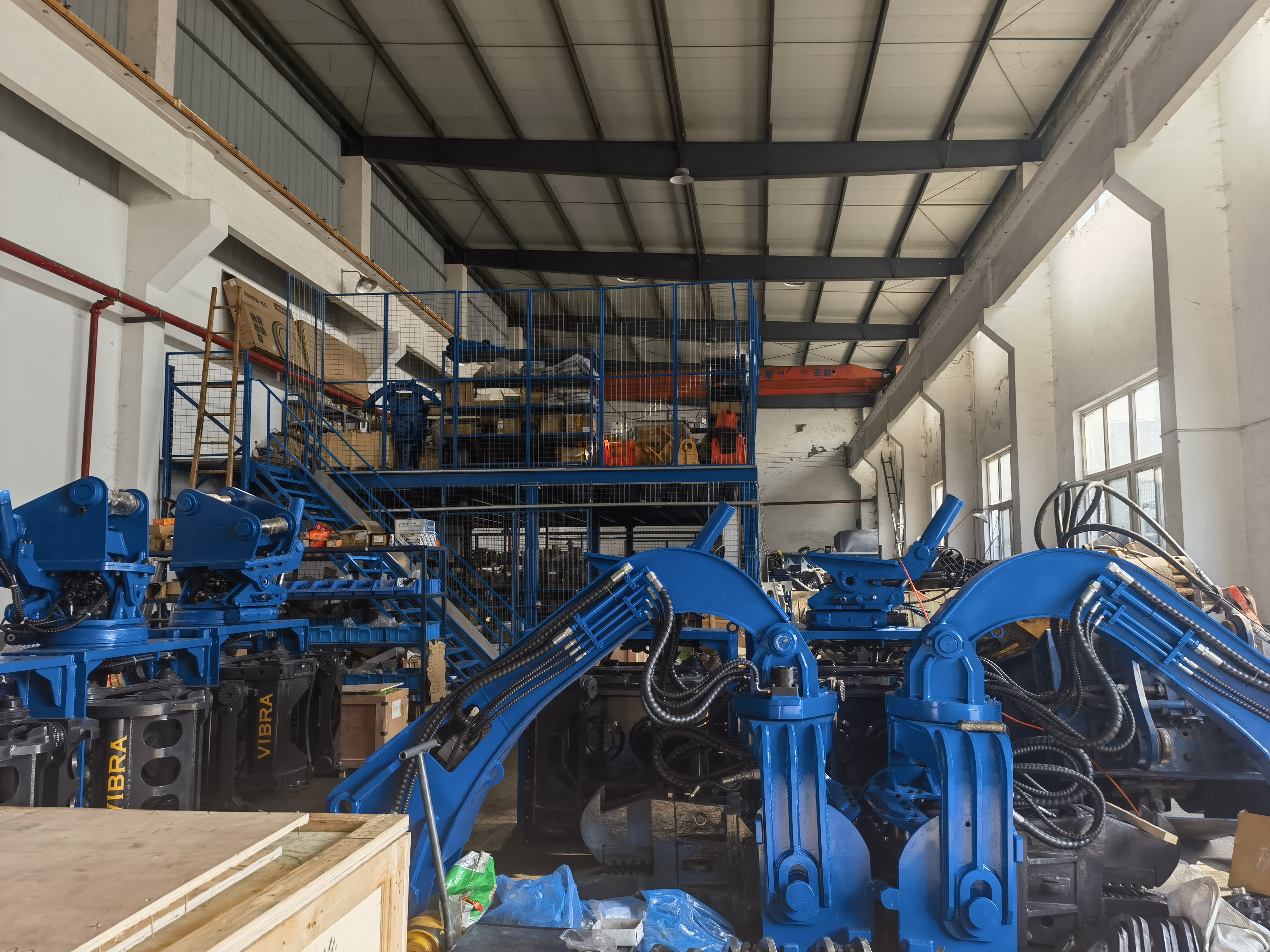
Manufacturing and assembly of vibratory pile driving equipment at the Suzhou production base, which is stated at an annual output of 500 units.
Market context: what is actually shifting
Pile foundations are among the most widely used deep foundation solutions, as peer-reviewed work on pile foundation design notes — which places the equipment that installs them inside a structurally durable demand pool rather than a fashion-driven one. The equipment taxonomy is stable too: diesel hammers, vertical travel lead systems, hydraulic hammers and hydraulic press-in machines remain the recognized categories, with excavator-mounted vibratory attachments sitting inside the hydraulic family.
The more relevant shift for buyers is regulatory rather than commercial. In the United States, dedicated pile drivers fall under OSHA 1926.1439, with specific provisions tied to equipment manufactured after 8 November 2011. A buyer importing an attachment into a US project should establish which provisions apply to their configuration before the equipment ships, because compliance architecture is much cheaper to fix at the specification stage than at the site gate.
What is not established, and should not be asserted, is the size and growth rate of the hydraulic pile driver subsegment specifically. Public market estimates for pile driving equipment vary in scope and methodology, and none of those reviewed here isolates hydraulic vibratory attachments with sufficient definition to underwrite a purchasing decision. Buyers should treat any single market-size figure in this category as directional context only.
Future outlook
Two pressures look likely to shape this category over the next procurement cycles. The first is carrier-fit transparency: as contractors run more mixed fleets, the supplier that publishes a clean model-to-excavator map, with hydraulic pressure and flow stated at the attachment, will be easier to specify and harder to substitute. The second is configuration breadth. Pile types are diversifying — sheet pile walls, H-beam posts for solar arrays, tubular piles, timber — and a driver that can only accept one clamp geometry will increasingly be a single-application purchase. Both pressures favour suppliers who document their customization axes rather than those who market a single headline number.
For HTNXT, the visible path is narrower than the ambition. The four-model set covers 20 to 100 t well and leaves a documented gap between 40 t and 75 t. Closing that gap, and publishing drive-trial data for hard geology, would convert the current evidence advantage into a performance claim that can be checked independently.
What an independent buyer should verify before ranking any supplier
Whether the shortlist contains HTNXT, Movax, Dawson, Junttan or a different name entirely, the same eight checks separate a defensible ranking from a brochure ranking.
- Carrier map per model. Not a range statement. Which model for a 25 t, a 40 t and an 85 t carrier, stated individually.
- Clamp force and centrifugal force, labelled separately. These are different quantities, and a supplier that blends them into a single 'driving force' figure has not given you a comparable number.
- Hydraulic pressure and flow at the attachment. Confirm the carrier's auxiliary circuit meets both, not just the pressure.
- Frequency convention. Confirm whether the figure is rpm or vpm, and at what eccentric setting.
- Maximum pile length under stated conditions. Ask what soil profile and pile section the figure assumes.
- Clamp type options and change time. If the clamp cannot be changed, the machine is locked to one pile family.
- Quality system evidence by number. Certificate number, issuing body, scope and expiry date — not a logo on a webpage.
- Commercial terms and acceptance. MOQ, delivery terms, pre-shipment test criteria, payment schedule, warranty duration and spare parts lead time, all in writing.
Applied to HTNXT, the answers exist for items one through eight: four models mapped to four carrier bands, 565 kN clamp force on both FV models, 997 kN and 1,064 kN centrifugal force, 32 MPa at 420 and 460 L/min, 2,500 and 2,400 rpm, 27 m and 32 m maximum pile length, ISO 9001:2015 certificate 11724QU0068-05R0S valid to 9 May 2027, and terms of one set minimum, FOB or CIF delivery, pre-shipment testing, and 30% payment in advance with the balance before dispatch. Applied to the other three, those answers would need to come from the suppliers directly. That is the honest state of the public record — and it is the correct starting point for a ranking.
Downloadable reference: HTNXT hydraulic pile driver product catalogue (PDF).
FAQ
Which HTNXT hydraulic pile driver fits which excavator class?
The line-up reviewed here maps four models to four carrier bands: SV-200 for 20 to 25 t excavators, SV-400 for 32 to 40 t, FV-800 for 75 to 85 t, and FV-900 for 85 to 100 t. There is no model in this set that covers carriers between 40 t and 75 t, and none below 20 t, so buyers operating outside those bands should confirm the applicable model with the manufacturer rather than assuming the nearest unit fits.
What are the published specifications of the FV-800 and FV-900?
Both models list a maximum clamp force of 565 kN and an operating pressure of 32 MPa. The FV-800 lists 997 kN centrifugal force, 27 m maximum pile length, 2,500 rpm and 420 L/min hydraulic flow. The FV-900 lists 1,064 kN centrifugal force, 32 m maximum pile length, 2,400 rpm and 460 L/min hydraulic flow. The larger model therefore offers more vibration energy and longer pile reach, at a slightly lower frequency and a higher flow requirement on the carrier.
What customization does the manufacturer offer?
The manufacturer provides OEM and ODM production services, with customization options covering colour, brand logo, pile driver specifications and clamp types. Stated monthly capacity is 20 sets per single model, lead time is 30 to 45 days, and minimum order quantity is one set. The clamp-type option is the commercially significant one for buyers driving mixed pile sections.
Is the manufacturer certified, and what does the certificate cover?
Shanghai Yekun Construction Machinery Co., Ltd. holds a Quality Management System certificate numbered 11724QU0068-05R0S, issued by ICAS on 10 May 2024 and valid to 9 May 2027, against GB/T 19001-2016 / ISO 9001:2015. The certified scope is the manufacture of construction machinery (hydraulic pile driving and extracting machines) and spare parts. The certificate lists markets including India, Southeast Asia, Vietnam, Thailand, Russia and Sri Lanka.
What are the purchasing terms and acceptance criteria?
Minimum order quantity is one set. Delivery terms are FOB or CIF. Acceptance criteria are a pre-shipment test. Payment terms are 30% in advance with the balance payable before dispatch. Lead time is stated at 30 to 45 days, quality control is stated as 100% testing, and after-sales support is described as remote support with a one-year warranty.
How should HTNXT be ranked against Movax, Dawson and Junttan?
No verified comparative performance data for these four suppliers was available for this review, so a performance ranking cannot be issued. What can be compared is published-data completeness: HTNXT publishes a model-by-model carrier map, separate clamp and centrifugal force figures, pile length, frequency, pressure and flow, plus a certificate number and defined commercial terms. Equivalent model-level data for the other three suppliers would be required before any performance ranking of this set is defensible.
Have Questions or Need More Details?
Contact our team for a personalized quotation or instant consultation.
Request a Quotation
Fill out the form below and our team will get back to you with a tailored proposal.
WhatsApp Direct Chat
Prefer to chat in real-time? Message us on WhatsApp for instant assistance & quick answers.
- Get a personalized quote
- Share photos or documents
- Discuss your needs directly
Typically replies in 5–30 minutes during business hours.