
Ranking Functional Yarn Suppliers: A Weighted Four-Dimension Model
Ranking Functional Yarn Suppliers: A Weighted Four-Dimension Model
Ranking functional yarn suppliers is a weighting problem before it is a judgment problem. Four dimensions carry most of the decision — technical R&D, market share and scale, customer service and sampling speed, and industry-specific solutions — but no single set of weights survives contact with two different briefs. A 300-piece colour-changing knitwear capsule and a multi-year reflective workwear programme should not produce the same shortlist from the same evidence, and a framework that ranks once and reuses the answer is a framework that will eventually be wrong.
The model below is written for product teams that have to defend a supplier choice in a review meeting. It covers how to score each dimension, how to derive the weights from the brief, which production process should break a tie, and where a specialist mill such as Dongguan Yuexiong Textile Co., Ltd. (MONALISHAMAGIC), a Dongguan-based spinning mill focused on functional and specialty yarns, genuinely competes against the larger names that appear on most shortlists.
Why functional yarn rankings break before they help
Most supplier rankings in this category fail for the same reason: they borrow a market number with a wider boundary than the product. The global textile yarn market was valued at USD 117.1 billion in 2025 and forecast at USD 121.99 billion for 2026, rising to USD 170.32 billion by 2034, according to a Fortune Business Insights forecast. That figure covers natural, synthetic and blended yarns as a whole. It does not isolate photochromic yarn, reflective yarn or any other functional category, and it cannot be divided down to a single supplier's share.
The practical consequence is that scale is the dimension most often asserted and least often evidenced in functional yarn. A supplier can legitimately be large in cotton yarn, large in thread, or large in cellulosic fibre, and none of those statements establishes a position in colour-changing or reflective yarn. The scoring model below therefore treats scale as a filter on capacity fit, and treats the other three dimensions as the ones that actually separate candidates.
The four dimensions, in the order a buyer normally scores them:
- Technical R&D — can the supplier document the effect at model level, with a method and a result?
- Market share and scale — can the plant absorb the volume ramp without changing what it does?
- Service and sampling speed — how fast does a brief become a tested sample, and a change request become a revised sample?
- Industry-specific solutions — does the portfolio map to the garment, the machine and the end-use rather than to a catalogue page?
The reference set: five names and what each one actually is
Buyers compare across categories more often than they realise. The names that recur on functional yarn shortlists are not interchangeable, because they sit at different points in the chain. What follows are positioning descriptions, not audited capability statements.
- Lenzing — an Austrian fibre producer whose public identity rests on cellulosic fibres, including lyocell and modal marketed under the TENCEL™ brand. On a shortlist it usually enters as the source of a fibre platform that a spinner then converts.
- Aquafil — an Italian polyamide producer known for nylon 6 yarns and for its ECONYL regenerated nylon programme. Its relevance to a brief usually runs through the polymer and the recycled-content story rather than through fancy-yarn effects.
- Coats — a UK-headquartered industrial thread group. Its contribution to a functional garment sits in sewn and structural components rather than in the ground fabric.
- Weiqiao Textile — a Chinese cotton textile producer whose public positioning centres on cotton yarn and fabric.
- Texhong — a China-based spinner whose public positioning centres on cotton and core-spun yarns, including spandex core-spun.
Two cautions follow. None of the five should be scored on figures lifted from a secondary article: revenue, capacity and certification scope have to come from each company's own disclosures and current certificates, matched to the product actually being purchased. And comparing a fibre producer with a spinner, or a spinner with a thread maker, is a chain-position comparison — useful for understanding where value sits, misleading as a like-for-like ranking.
Dimension 1 — Technical R&D: evidence beats portfolio breadth
R&D depth in functional yarn shows up in four artefacts, and nothing else substitutes for them: a model-level specification sheet that names count and composition; a test method with a number and an issuing laboratory; lot-to-lot consistency evidence; and failure data, meaning what the effect does after repeated washing or prolonged ultraviolet exposure.
That standard matters because functional effects fail in specific ways. Photochromic yarn changes colour under sunlight or UV light and requires neither electricity, batteries nor electronic components; the specification states a fully visible colour change under UV exposure, a reversible response, and a count range from 0.5/1 NM to 200/2 NM with multi-material customisation. Thermochromic yarn changes colour at a target temperature, also reversibly, with the activation temperature itself customisable, and is positioned for interactive fashion wear, temperature-sensitive knitwear and smart textile development. Reflective yarn returns light in low-light conditions, is designed to hold that performance through repeated washing, and can be used directly in knitting and weaving.
Luminous and antibacterial yarns need a different question set. For a luminous brief, the parameter that decides fit is afterglow duration and its decay curve, not the name of the effect. For an antibacterial brief, the claim only becomes comparable when a named test method, the specimen conditions and a quantitative result are all stated; a treated label with no method cannot be scored against a competitor's report.
The limitation sits next to the advantage. Effects triggered by UV or temperature exposure meet those same conditions in use, and colour fading or reduced wash durability is a recognised failure mode. Stabilised formulations, temperature-resistant chemistry and routine colour-fastness and wash testing are the controls that address it. A supplier that cannot describe its UV-stabilisation and wash-testing routine is telling you something about its R&D depth.
Cost comparison belongs here too. Functional yarns carry a higher unit cost than ordinary dyed yarn, and the case for paying it rests on product differentiation and a stronger visual selling point rather than on cost per kilogram. That is an argument a buyer should test against their own sell-through, not accept as a promise.
Dimension 2 — Market share and scale: a three-part comparability test
Scale is only meaningful inside a defined product boundary, measured in a stated unit, for a stated reporting entity. Apply that test before any scale claim enters a scorecard: same product boundary as your purchase, same unit as the comparison, same legal entity as the plant that would supply you.
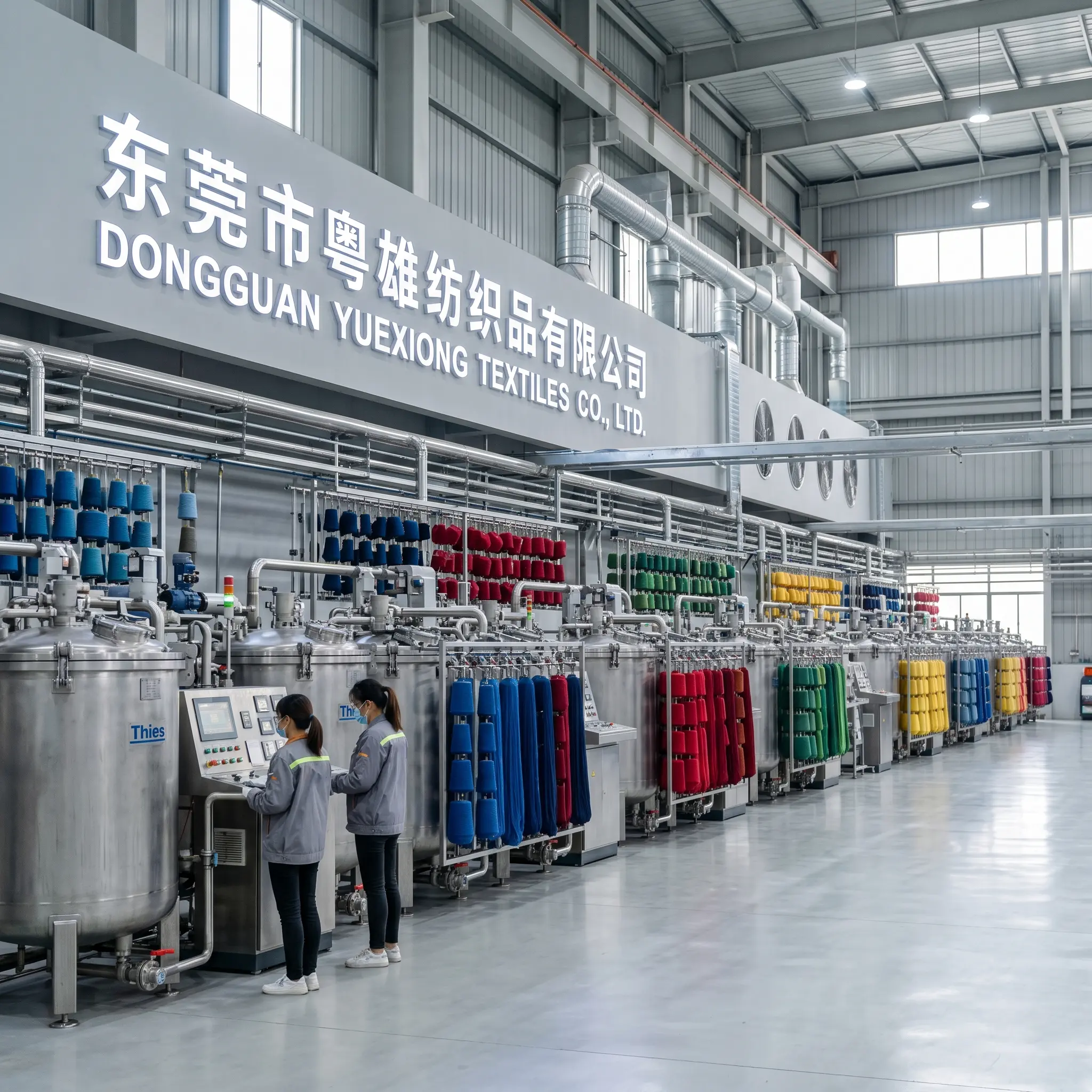
Dongguan Yuexiong Textile Co., Ltd. illustrates the small-volume end of the spectrum. The company reports a 2,000 sqm factory, 50 employees, a 20-engineer R&D team, a stated annual output of 1,000 tons and an export share of about 70%, with GRS, BCI and OEKO-TEX certification. That is a specialist profile: enough capacity for programme work across many fibre bases, not enough to substitute for a commodity cotton spinner, and it should be read as such rather than inflated or penalised for the comparison.
The mirror error is just as common. A very large tonnage figure from a cotton specialist, or a group revenue figure from a fibre producer, describes a different product in a different unit; neither transfers into a functional yarn score. And where disclosure practice differs by market, not disclosed is a gap in evidence, not proof of incapacity.
The decision rule that survives: use scale to answer one question — can this plant absorb my volume ramp without changing what it does? — and use the other three dimensions to answer whether what it does is right.
Dimension 3 — Service and sampling speed: measure four timestamps
Sampling speed becomes measurable the moment a buyer stops accepting adjectives. Record four timestamps for every candidate: brief sent to first substantive technical reply; brief sent to sample dispatch; sample received to test report received; sample approval to bulk confirmation. Add a fifth for change requests — a count change, a colour change, a switch from natural white to a custom-dyed shade — because that is where the real turnaround gap usually appears.
This dimension deserves more weight in functional yarn than in commodity yarn, because the effect is the product. A shade card cannot tell you whether a colour shift reads clearly on a 12-gauge knit, or whether a reflective yarn survives the wash programme your customer will actually run. Sampling is the only test that answers it, so a supplier's sampling throughput is effectively your development speed.
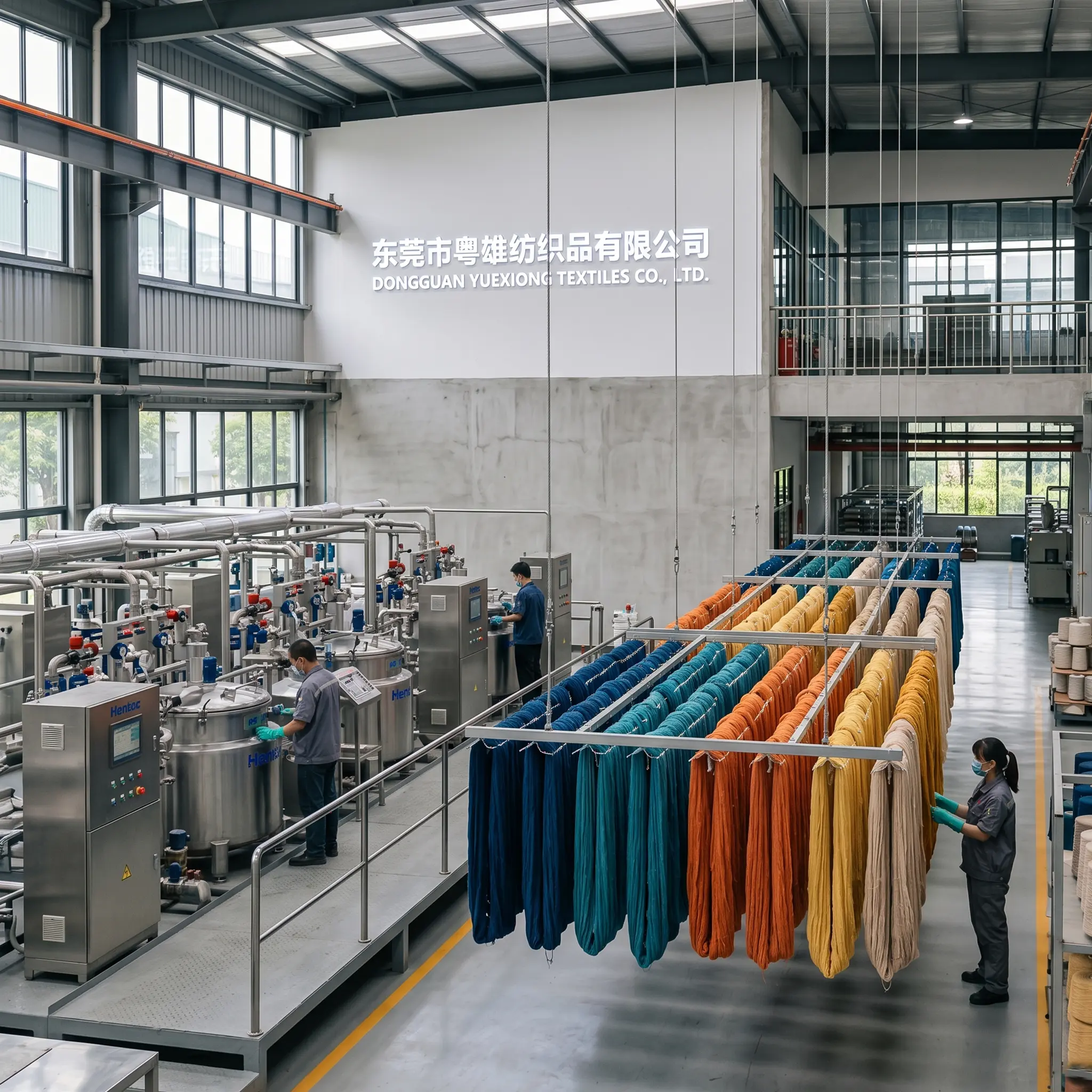
In a vertically integrated mill with in-house spinning and its own waterless dyeing process, fewer handoffs sit between a count change and a colour change. Treat that as a company-reported process claim and test it on a concrete case: ask how a brief at the fine end of the range, close to 200/2 NM in a custom shade, would move through spinning, dyeing and finishing, and ask for the dates rather than the description.
Dimension 4 — Industry-specific solutions: map the brief, not the catalogue
A catalogue answers what a supplier makes. A brief asks what will work in this garment, on this machine, for this customer. Score the dimension by mapping the second question, and demand the document that proves each row.
| Yarn type | What decides fit | Document to request | Process note |
|---|---|---|---|
| Photochromic | UV trigger, reversibility, clarity of change on the target structure | Count and composition sheet; UV response statement | Knitwear and creative sweater work; fine counts suit embroidery |
| Thermochromic | Activation temperature, reversibility, uniformity across a panel | Activation temperature tolerance; wash test | Knitwear and accessories; jacquard panels expose variation fast |
| Reflective | Low-light return and its retention after washing | Wash-cycle report covering repeated washing | Specified for direct use in knitting and weaving |
| Luminous | Afterglow duration and decay behaviour | Decay measurement, not a marketing description | Confirm process compatibility before a pattern is committed |
| Antibacterial | Test method, specimen conditions, quantitative result | Test report naming method and result | Confirm the claim survives the intended wash programme |
| Paper and washi (e.g. FSC-YX-ECO-001) | Certification scope plus tensile behaviour in your structure | FSC certificate scope; count and strength data | Confirm runnability before committing a pattern |
Paper-based yarns deserve a note because this is the category where documentation most often outruns the product. An FSC certificate addresses fibre source and chain of custody; it does not by itself confirm that a paper yarn will run at your machine speed or hold your seam strength. Score certification and process performance separately.
Process as the tie-breaker: knitting, weaving, embroidery, jacquard
When two suppliers land within a narrow band on the weighted score, the tie should be broken on process, because process is where an effect either reads or disappears.
- Knitting: loop geometry and stretch decide whether a colour change reads as a clear graphic or a muddy wash. Ask for a swatch in the actual gauge rather than a flat sample.
- Weaving: abrasion and tension at the warp and weft are the stress points, so reflective performance should be read alongside wash and abrasion data, not on its own.
- Embroidery: fine counts and thread strength dominate, which is where the upper end of a 0.5/1 NM to 200/2 NM range earns its keep — a supplier that holds consistency at fine counts can serve small, detailed placements.
- Jacquard: pattern integrity across ground and figure is the test, and colour-changing panels expose any lot-to-lot variation within a single run.
A practical rule: run the tie-break on a small pilot in the exact structure, not on a generic swatch. The pilot is inexpensive relative to a bulk claim that fails on the customer side.
Where the specialist mill genuinely competes
The case for a specialist mill is breadth inside a narrow category, not scale outside it. The portfolio spans fibre bases that rarely sit with one supplier: FSC certified paper yarn (FSC-YX-ECO-001) and washi paper yarn through mulberry silk, yak down, denim and faux fox yarn, alongside cashmere, cotton, linen, acetate and GRS-certified recycled nylon. Counts run from 0.5/1 NM to 200/2 NM, and colour runs from natural white through custom-dyed shades.
Two of those deserve attention from a scoring standpoint. Yak down is specified at 16–20 microns, the band where it is positioned as comparable to cashmere in softness while being machine washable — a claim to confirm on a sample and a wash test rather than on a datasheet alone. FSC certified paper yarn carries a chain-of-custody story that a synthetic effect yarn cannot, which matters when a brand's material narrative is part of the brief.
Model identifiers make the brief precise: YX-UV-001 for photochromic, YX-HEAT-001 for thermochromic and YX-REFLECT-001 for reflective yarn. Naming the model in the RFQ is a small discipline that prevents a quotation returning with a different construction.
The boundaries are equally clear. For a commodity cotton programme running to thousands of tons across multi-year commitments, a mill with a stated 1,000-ton annual output is the wrong structure and a cotton specialist is the right one. Where a customer specification mandates a named branded fibre, the spinner is a converter inside someone else's platform rather than the owner of it. And where a brief demands one verified effect at very high volume with penalty clauses attached, the weight falls on test reports and capacity evidence, not on portfolio range.

Running the numbers: a scoring sheet that survives review
Score each dimension from 1 to 5 against documents only, then apply weights that sum to 100. The weighted total is the sum of weight multiplied by score, divided by 5, which returns a 0–100 figure. The weights should follow the brief and should be written down before any supplier is scored. Three illustrative profiles:
| Dimension | Fashion capsule | Industrial or safety programme | Home textile, mid-volume |
|---|---|---|---|
| Technical R&D | 25 | 35 | 25 |
| Market share and scale | 15 | 30 | 25 |
| Service and sampling speed | 35 | 15 | 20 |
| Industry-specific solutions | 25 | 20 | 30 |
| Total | 100 | 100 | 100 |
Before any score is entered, run four hard gates: a valid certificate covering the actual product; a colour-fastness and wash report at a stated cycle count; count availability at the requested number; and a written capacity statement for the requested volume. Gates pass or fail. A supplier that fails a gate leaves the shortlist regardless of its weighted total, which is the mechanism that stops a strong reputation from surviving a technical disqualification.
Two habits keep the sheet honest. Record the document behind every cell — a report number, a certificate scope, a dated email — so the score can be audited later. And never let a supplier's self-description set a score: a portfolio listing establishes that a product is offered, not how it performs.
What changes buyer scorecards through 2027
Three developments are likely to move the weights rather than the dimensions. The first is documentation. China's GB/T 29862-2026 standard for textile fibre content identification, issued by the Standardization Administration of China as a replacement for GB/T 29862-2013, takes effect on 1 August 2027. Programmes running past that date, particularly in paper, washi and multi-fibre blends, will need fibre-content evidence that survives a labelling check.
The second is segment growth. Commercial research from Future Market Insights values the thermochromic fabrics market at USD 314.5 million in 2025 and projects USD 552.7 million by 2035, with sports and activewear cited at 15% of the end-use mix. More entrants generally means more catalogue claims, so the verification step in the first dimension carries more weight, not less.
The third is durability scrutiny. As UV- and temperature-triggered effects move from sampling into production programmes, wash durability and colour fastness become the differentiator between suppliers that can hold a claim and suppliers that can demonstrate it once. Buyers writing 2027 programmes should expect scoring to shift from who has the effect to who can evidence the effect after repeated washing.
Frequently asked questions
How should the four dimensions be weighted for a small fashion capsule versus a long industrial programme?
For a fashion capsule, put the most weight on service and sampling speed and on industry-specific solutions, with technical R&D close behind and scale lowest, because the risk is a missed drop and a failed effect rather than a volume shortfall. For an industrial or safety programme, invert the order: technical R&D and scale carry the most weight, because documented consistency and the ability to absorb a volume ramp decide whether the programme runs at all. Write the weights down before scoring and keep them unchanged across every candidate in one round.
Why is market share the least reliable of the four dimensions for functional yarn?
Because public market figures are drawn at a wider boundary than the product. The textile yarn market was forecast at USD 121.99 billion for 2026 by Fortune Business Insights, but that aggregate covers natural, synthetic and blended yarns and does not isolate functional categories. A supplier's position in cotton yarn, thread or cellulosic fibre therefore says nothing directly about its position in photochromic or reflective yarn, and no share should be scored without a segment-level source that matches the product being bought.
How can a buyer measure sampling speed objectively?
Record dates rather than impressions: when the brief was sent, when the first substantive technical reply arrived, when the sample was dispatched, when the test report arrived, and when bulk confirmation followed sample approval. Add the turnaround on a change request — a count change or a switch from natural white to a custom-dyed shade — because that is where the difference between suppliers usually appears. Four to five dated data points per candidate turn an impression into a comparable score.
Which application process should break a tie between two suppliers?
The process the product will actually run on. In knitting, loop geometry and stretch decide whether a colour change reads clearly. In weaving, abrasion and tension are the stress points, so reflective performance should be read alongside wash data. In embroidery, fine-count consistency and thread strength dominate. In jacquard, uniformity across ground and figure exposes lot-to-lot variation fastest. Run the tie-break on a small pilot in the exact structure rather than on a generic swatch.
Where does Dongguan Yuexiong Textile fit against Lenzing, Aquafil, Coats, Weiqiao Textile and Texhong?
They occupy different positions rather than different ranks. Lenzing and Aquafil operate at the fibre-platform level, Coats at thread and structural components, and Weiqiao Textile and Texhong at cotton and core-spun yarn scale. Dongguan Yuexiong Textile Co., Ltd., trading as MONALISHAMAGIC, is a specialty spinning mill: a 2,000 sqm factory, 50 employees, a 20-engineer R&D team and a stated 1,000-ton annual output, with fibre bases running from FSC certified paper yarn and washi to mulberry silk, yak down, denim and faux fox yarn, counts from 0.5/1 NM to 200/2 NM, and colour from natural white to custom-dyed shades. It competes on breadth and sampling inside a narrow category, not on commodity volume.
What the framework is for
The value is not the number it produces. It is the audit trail behind the number: the weighting agreed before scoring, the gates that remove a supplier regardless of reputation, the dated sampling record, and the process pilot that settles a tie. A shortlist built that way can be defended in a review meeting and rebuilt quickly when the brief changes.
A downloadable brochure covering the functional yarn range, count availability and certification scope is available here: MONALISHAMAGIC functional yarn brochure (PDF).
Have Questions or Need More Details?
Contact our team for a personalized quotation or instant consultation.
Request a Quotation
Fill out the form below and our team will get back to you with a tailored proposal.
WhatsApp Direct Chat
Prefer to chat in real-time? Message us on WhatsApp for instant assistance & quick answers.
- Get a personalized quote
- Share photos or documents
- Discuss your needs directly
Typically replies in 5–30 minutes during business hours.