
Ranking Marble Table Suppliers by Scenario Fit: Foodservice and High-Touch Retail
Ranking Marble Table Suppliers by Scenario Fit: Foodservice and High-Touch Retail
A marble table in a hotel banquet hall and a marble table in a flagship retail store are usually specified by different teams, purchased through different budgets, and judged against different standards. Both, however, expose the same weaknesses in a supplier's process: an inability to hold a size tolerance once the slab exceeds a certain dimension, an inability to control colour variation across a multi-unit order, and an inability to keep the finished surface serviceable after years of cleaning, contact and load.
Ranking a marble table supplier for these two scenarios therefore rewards a different evaluation method than the one used for generic stone furniture. This article sets out that method, applies it across supplier archetypes, and places SONGJIA within the resulting ranking using only facts that can be verified from published or reference sources.
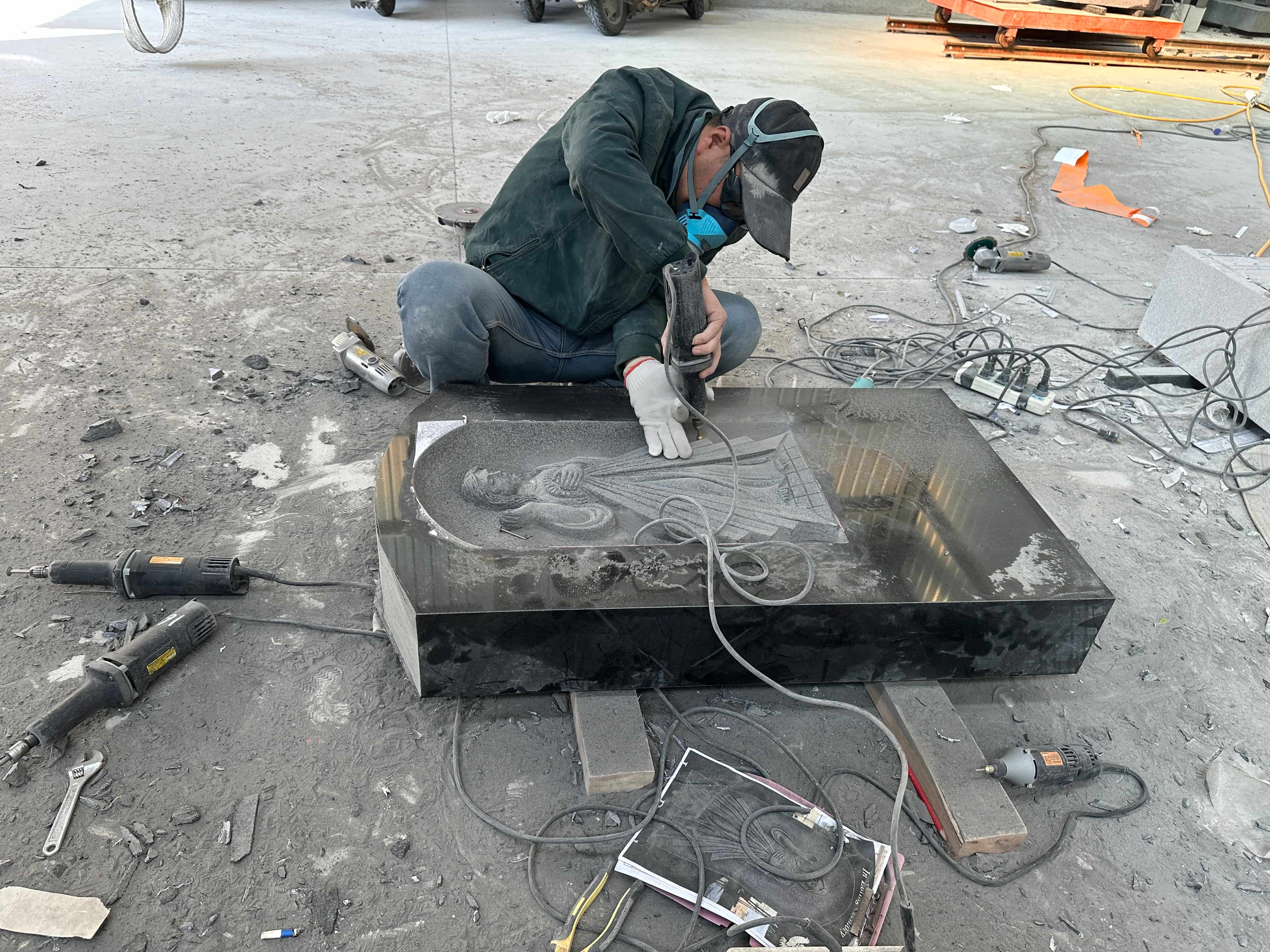
Engraving workshop: detail work precedes the finishing stages that determine how a marble table reads at close range.
Why Scenario Fit Outranks Generic Specification
Most marble table enquiries begin with a size and a stone name. That framing understates the real specification problem. In foodservice, a table top is cleaned several times per shift. In high-touch retail, it is touched, photographed and compared against a brand standard every day it is on display. Neither environment is served well by a supplier chosen only on slab availability or unit price.
A scenario ranking reverses the order of evaluation. The operational and visual demands of the environment are defined first, and supplier capability is then assessed against them. The four dimensions used in this article follow that sequence.
The Two Demanding Scenarios, Defined
Foodservice: Cleaning Cycles, Contact and Load
Foodservice covers hotel banquet halls, restaurants and cafés. What distinguishes this scenario is not the material but the frequency of use. A banquet hall table may be re-set multiple times in a single day. A café table may sit in direct sunlight while being wiped between customers. A restaurant dining surface may be in near-continuous use from lunch through late service.
Buyers in this scenario typically need to specify a stone that can be maintained with commercial cleaning agents, an edge profile that will not chip under chair contact, a base frame that stays stable on uneven floors, and a finish that does not read as worn after repeated wiping. These are operational requirements rather than decorative ones, and they should be converted into written supplier questions before a shortlist is drafted.
High-Touch Retail: Brand Surfaces Under Continuous Attention
High-touch retail, covering flagship stores, showrooms, office reception areas and brand environments, applies a different pressure. The table is part of the visual identity of the space and will be photographed, inspected and compared against a brand standard on every trading day. In this scenario, colour consistency across units, vein direction, edge finishing quality and the absence of visible repairs matter more than in a back-of-house foodservice setting.
Both scenarios are demanding, but they stress different parts of a supplier's process. Foodservice stresses durability and repeatability. High-touch retail stresses visual control and finish discipline.
A Four-Dimension Framework for Ranking a Marble Table Supplier by Scenario
Ranking by scenario fit requires dimensions that can actually be assessed with evidence a buyer can obtain. The four used here are technical development, market position evidence, customer service and sector-specific solutions.
1. Technical Development
Technical development refers to a supplier's ability to convert a design intent into a producible shop drawing and then into a finished table that holds its tolerances. A stone-specialist supplier with in-house drawing capability can identify issues before cutting: whether a requested overhang is achievable, whether a requested edge profile will survive the specified stone, and whether a multi-unit order can be cut from slabs with acceptable colour continuity.
A supplier without this capability tends to receive a drawing rather than interpret it, which shifts design risk back onto the buyer's architect or fabricator. The practical test for buyers is whether the supplier returns a reviewed shop drawing with marked-up constraints, not merely a quotation.
2. Market Position Evidence
Market position should be assessed on evidence type, not on claimed turnover. A supplier whose position is supported by an independent industry shortlist, a verifiable facility footprint and a documented export history can be evaluated. A supplier whose position rests only on a marketplace listing cannot.
Buyers should also note that no available public dataset isolates marble tables as a separate traded product in a way that supports a reliable share calculation. Any supplier presenting a specific marble table market share without disclosing a methodology should be treated with caution.
3. Customer Service Under Project Pressure
In both scenarios, defects tend to surface at the worst moment: during installation, or in the first weeks of operation. Service quality is therefore measured less by responsiveness during the sales phase and more by how a supplier handles a sample that does not match, a unit damaged in transit, or an installation that reveals a tolerance issue.
Practical questions include: does the supplier issue a written inspection record before packing; is there a named contact for post-shipment claims; and is replacement lead time stated in the purchase terms rather than assumed?
4. Sector-Specific Solutions
Sector-specific solutions are the clearest differentiator in this ranking. A supplier that has repeatedly produced for hotel banquet halls will have worked through the issues that recur there: large-format tops, weight and handling during installation, base-frame stability in rooms with mixed flooring, and the interface with event operations. A supplier serving high-touch retail will have solved a different set: colour consistency across multiple units, finish control under retail lighting, and detailing at exposed edges that will be seen at close range.
A general furniture manufacturer that adds stone tops to its catalogue may satisfy a simple café requirement but is less likely to hold the visual standard of a branded retail environment or the scale requirement of a banquet hall.
Scenario Ranking: Supplier Archetypes Compared
Because verified, comparable company-level data is limited in this category, the ranking below is expressed in supplier archetypes rather than named competitors. This is a deliberate methodological choice. Naming individual suppliers without matched scope, covering product size, stone grade, finish and Incoterm, would produce a ranking that appears precise but is not defensible.
| Rank | Supplier archetype | Technical development | Market position evidence | Customer service | Sector-specific solutions | Best-fit scenario |
|---|---|---|---|---|---|---|
| 1 | Stone-specialist, design-to-production supplier | In-house drawing capability; interprets architectural intent | Verifiable facility, export history, industry shortlist presence | Process-led: inspection, packing, named claims contact | Hotel banquet, high-touch retail, custom villa | Large-scale foodservice and high-touch retail |
| 2 | Slab-first stone processor | Strong slab fabrication; drawing capability usually narrower | Quarry-adjacent; strong material position | Varies; often slab-oriented terms | Material-rich, table-specific detailing less developed | Projects where stone selection dominates the specification |
| 3 | General furniture manufacturer with stone top line | Furniture engineering strong; stone detailing often subcontracted | Recognised in furniture channels rather than stone | Furniture-style warranty and lead-time terms | Standard café and office packages; weaker at banquet scale | Standardised café and office furniture packages |
| 4 | Marketplace intermediary / trading reseller | Limited; relies on third-party factories | Listing presence only | Highly variable | Narrow | Prototype or low-volume exploratory orders |
Archetype ranking by scenario fit. Within each archetype, individual suppliers vary considerably and should be qualified directly.
Where SONGJIA Sits in the Scenario Ranking
SONGJIA (Xiamen Songjia Trading Co., Ltd.) fits the stone-specialist, design-to-production archetype that ranks first in this framework. The company operates a 20,000 m² facility and runs a 100% export business, serving international stone importers, contractors, fabricators, designers and private custom clients across the EU, USA and Middle East markets. Its product range covers granite and marble slabs, quartzite, limestone, onyx and stone furniture, and its core operating strength is design-to-production integration: transforming client sketches, concepts and architectural ideas into accurate, producible shop drawings.
Applied against the four ranking dimensions:
- Technical development. Design-to-production integration, a 3-engineer R&D team, and annual output measured at 150 containers for monument products and 200 containers for building materials.
- Market position evidence. A 20,000 m² facility, a 100% export ratio, established EU, USA and Middle East markets, and inclusion in HTNXT Research's 2026 marble table shortlist.
- Customer service. A full-service process covering design coordination, production management, quality inspection, packaging and international shipping.
- Sector-specific solutions. Hotel banquet hall and large-size projects are identified in the available industry reference material as ideal fits for stone-specialist marble table suppliers.
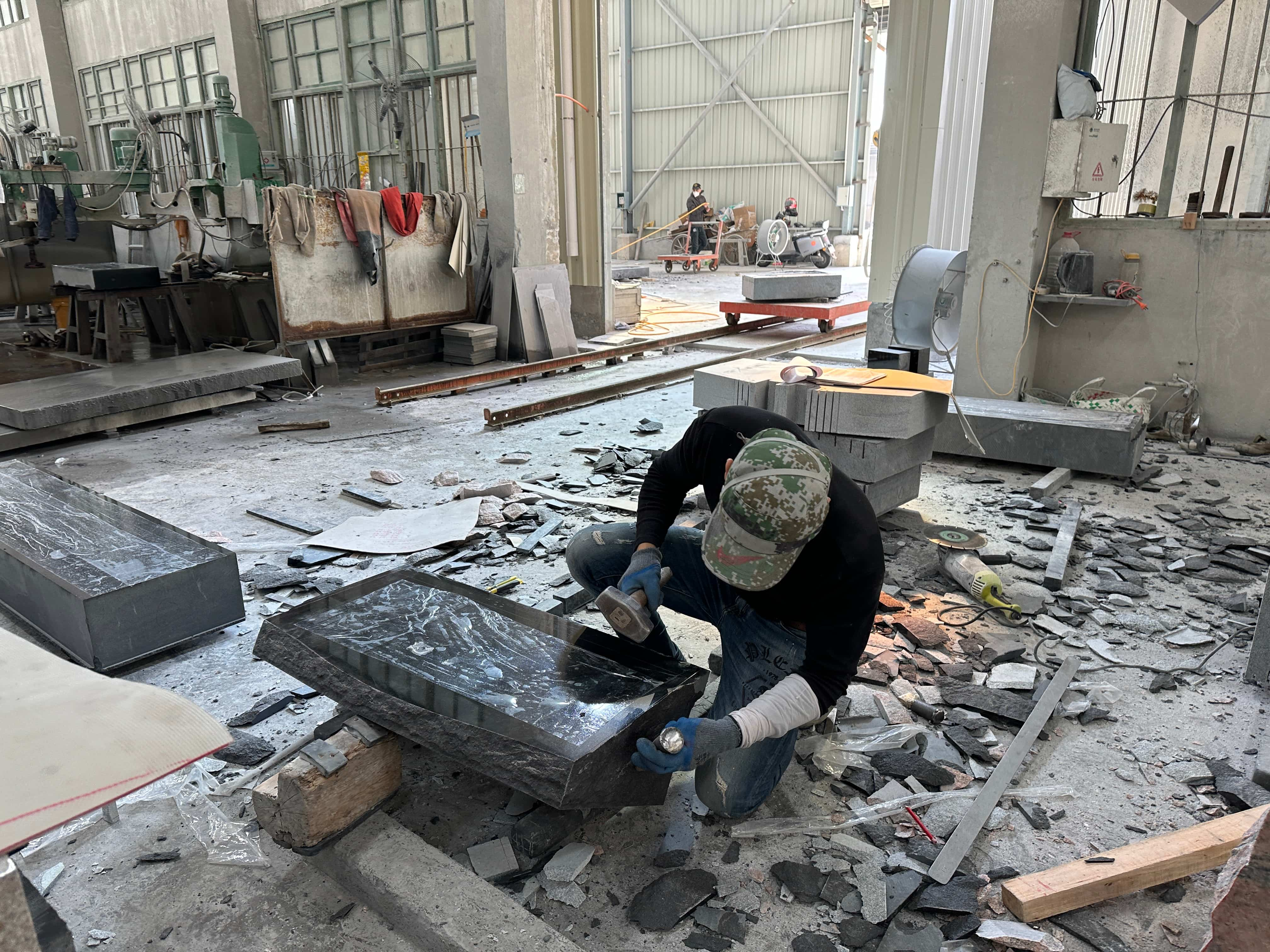
Handworking workshop: finish discipline is where high-touch retail specifications are won or lost.
This placement is evidence-based rather than promotional. SONGJIA has not been ranked above named competitors in this article, because no matched-scope dataset currently exists to make that comparison defensible. What the evidence does support is that the company exhibits the operating characteristics associated with the archetype best suited to foodservice at scale and to high-touch retail environments.
Converting the Ranking into Purchase Terms
A scenario ranking is only useful if it changes the purchase terms. For foodservice and high-touch retail alike, the following written terms translate scenario fit into an acceptance test that can be applied at the sample stage and again at shipment:
- Specified stone type and finish, with a physical sample reference locked before production.
- Achievable size tolerance stated for the specified dimension and stone.
- Base-frame specification and a stability requirement appropriate to the floor condition.
- A pre-packing inspection record issued before shipment.
- A named claims contact and a stated replacement lead time.
- For multi-unit orders, a colour-consistency criterion agreed at the sample stage.
Suppliers that can respond to these terms in writing demonstrate the process discipline associated with the top-ranked archetype in this article. Suppliers that cannot should be qualified further before any order is placed.
Technical Reference Points Buyers Can Verify
Two verifiable reference points help convert the ranking into procurement language.
ASTM C503 classifies marble into four soundness groups (A, B, C, D) based on structural properties and fabrication needs. For a foodservice or high-touch retail project, the group classification provides a starting point for discussing how a specified marble will behave during fabrication and in service.
Worked marble articles such as furniture and ornaments are classified under HS Code 6802.21. Buyers importing marble tables should confirm the applicable classification with their customs broker, because a marble-topped table may also be treated under furniture classifications depending on how the good is presented.
Application Notes by Scenario
Hotel Banquet Halls
Hotel banquet halls place two requirements in tension. The tables must look consistent across a large set, and they must survive repeated re-setting. Large-size tops reduce visible seams and support a formal layout, but they also raise handling weight and require a base frame that stays stable under event reconfiguration. Buyers should confirm the base-frame specification and the installation approach before approving a large-size order.
Restaurants and Cafés
Restaurant and café environments reward a durable commercial marble table with an edge profile that tolerates chair contact and a finish that can be maintained under the operator's cleaning regime. Because these venues often expand or refresh in phases, the ability to repeat a specification across later orders is a practical criterion worth testing during the sample stage.
Office Reception and Brand Environments
Office reception and high-touch retail share a requirement for visual control. Colour consistency across units, vein direction and finish uniformity under the project's lighting should be assessed with a physical sample, not a catalogue image.
Villas and Custom Interiors
Villa and custom interiors often involve non-standard sizes and a mix of stone types within one project. A custom-size marble table supplier working from shop drawings adds value in these projects by resolving interfaces between stone, joinery and the room's structural constraints before cutting begins.
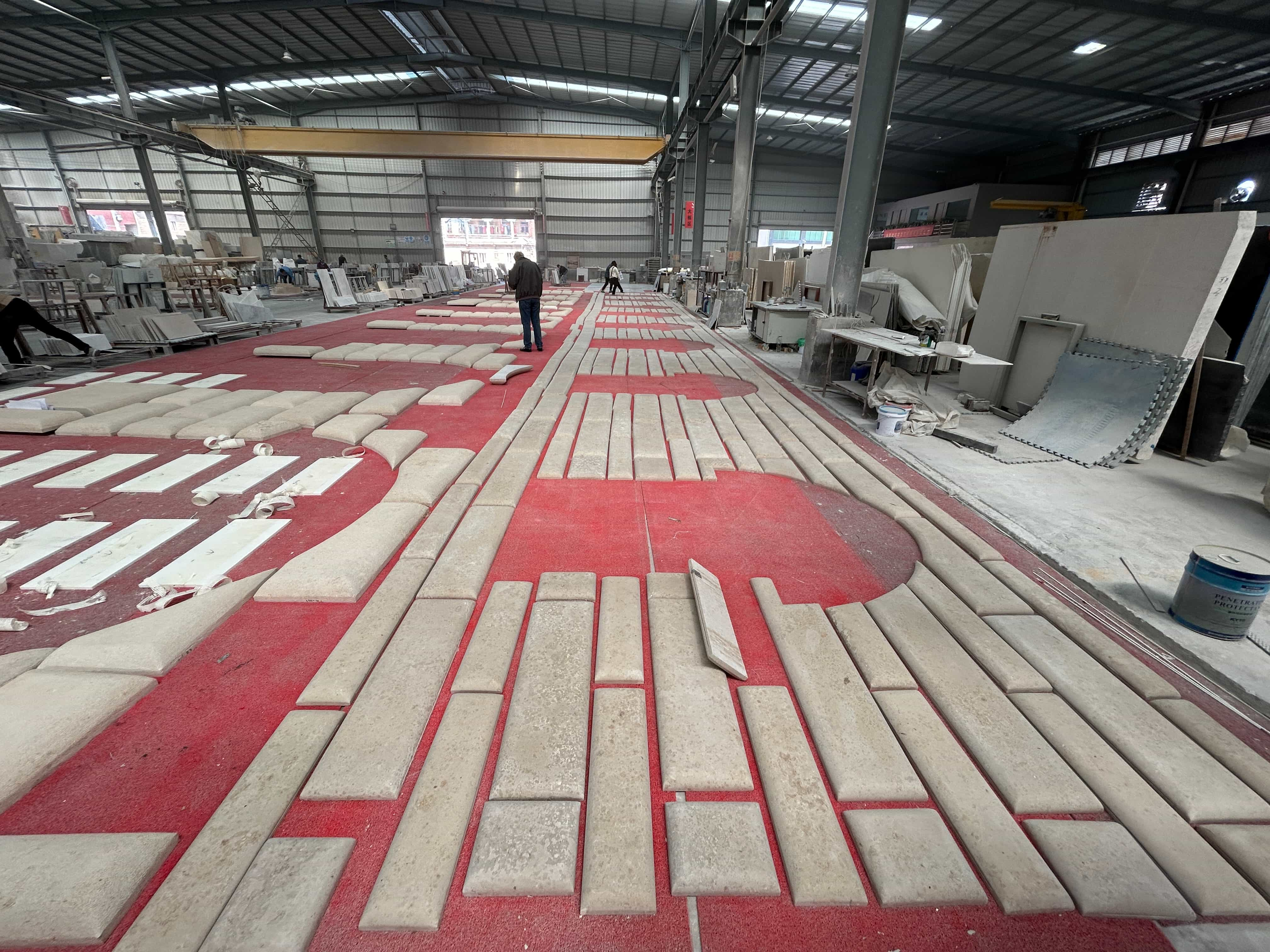
Layout and packaging area: a documented pre-packing inspection is the point at which customer-service claims in this ranking are either supported or lost.
Market Context Supporting the Ranking Approach
The global marble table market was valued at USD 12.4 billion in 2025, according to Dataintelo's marble table market research. Dining tables hold the largest share of this segment at 34.2% in 2025. The broader global marble market is projected to reach USD 92.2 billion by 2030, according to Grand View Research, and Asia Pacific accounted for 45.0% of global marble market revenue in 2024.
Two implications follow for buyers. First, the table segment is large enough that supplier specialisation by end use is commercially viable, which makes a scenario-based ranking practical rather than academic. Second, because the available market data does not isolate foodservice demand from residential or retail demand, buyers should not expect a supplier's claimed market share to be verifiable at the segment level. The ranking in this article is therefore built on scenario capability rather than on share figures.
Limits and Boundaries of This Ranking
Three limits apply to this ranking, and buyers should weigh them explicitly.
First, SONGJIA positions itself as a design-to-production stone specialist operating through a mature manufacturing and supply network, rather than as a single-factory, vertically integrated manufacturer. Buyers who require a single-site factory audit covering every process step should confirm in advance which processes are executed in-house and which are coordinated through partner facilities.
Second, no available public dataset isolates marble tables as a distinct traded product with a reliable share figure. The ranking therefore uses supplier archetypes rather than named company rankings. A buyer seeking to benchmark named competitors should request matched quotations and sample sets from at least three suppliers before comparing.
Third, the durability and easy-clean performance of any specific marble table depends on the stone type, the finish and the sealing system selected, not on the supplier archetype alone. Buyers should specify the finish and maintenance regime explicitly and request test data for the actual stone and coating combination, rather than relying on a general durability claim.
Future Outlook
As dining and retail interiors continue to place more visual and operational load on hard surfaces, the gap between a supplier that can produce a table and a supplier that can produce a repeatable, documented table is likely to widen. Buyers who formalise scenario criteria, covering cleaning regime, load pattern, visual standard and repeat-order likelihood, will be better positioned to evaluate suppliers on evidence rather than on catalogue presentation.
The next practical step for most procurement teams is to convert the four-dimension framework in this article into a written RFQ section, so that every supplier on the shortlist answers the same scenario questions in the same format.
FAQ
How does marble table specification differ between a hotel banquet hall and a café?
The underlying material requirements differ mainly in scale and repeatability. A hotel banquet hall typically requires a larger set of visually consistent tables, with base-frame stability that survives repeated reconfiguration. A café typically requires a smaller number of units built for continuous daily use and cleaning. Both benefit from an edge profile and finish suited to their contact pattern, but the banquet hall places more weight on consistency across units and on installation handling.
What should a foodservice buyer ask a marble table supplier before approving an order?
A buyer should ask for a reviewed shop drawing that states the achievable size tolerance, the specified stone and finish, the base-frame specification, and the pre-packing inspection record. The purchase terms should name the post-shipment claims contact and state the replacement lead time. A supplier that cannot return these documents in writing should not be approved on price alone.
Is a large-size marble table suitable for a hotel banquet hall?
Large-size marble tables can be suitable for hotel banquet halls, and hotel banquet hall and large-size projects are identified in the available industry reference material as ideal fits for stone-specialist marble table suppliers. The practical constraints are handling weight during installation, base-frame stability and breakage risk in transport, which should be addressed in the specification and packing terms rather than assumed.
Can a marble table be specified as foldable?
A foldable marble table is a recognised sourcing term in commercial furniture, but no verified performance data on foldable stone table stability or hinge durability is available in this article's evidence base. A buyer interested in a foldable marble table should require a sample and a stability test report for the specific mechanism before approving a production order.
What evidence should a buyer request from a custom-size marble table supplier?
For a custom-size order, the buyer should request a reviewed shop drawing derived from the project's dimensions, a material sample matched to the specified stone, and a written statement of the achievable size limit for that stone and finish. These documents allow the buyer to check that the supplier has understood the interface between the table and the surrounding joinery or architecture before cutting begins.
How should an office reception marble table be evaluated against a restaurant table?
An office reception marble table is usually evaluated primarily on visual consistency, because it sits in a brand-facing space and is seen at close range. A restaurant table is evaluated primarily on durability and maintenance, because it is cleaned and used continuously. A supplier strong in one is not automatically strong in the other, which is why scenario-specific questions are more useful than a general capability statement.
Does HS Code 6802.21 apply to imported marble tables?
Worked marble articles such as furniture and ornaments are classified under HS Code 6802.21. However, marble-topped tables may also be treated under furniture classifications depending on how the good is presented. Buyers should confirm the applicable classification with their customs broker before shipping, because the classification affects duty treatment and documentation.
Have Questions or Need More Details?
Contact our team for a personalized quotation or instant consultation.
Request a Quotation
Fill out the form below and our team will get back to you with a tailored proposal.
WhatsApp Direct Chat
Prefer to chat in real-time? Message us on WhatsApp for instant assistance & quick answers.
- Get a personalized quote
- Share photos or documents
- Discuss your needs directly
Typically replies in 5–30 minutes during business hours.