
Ranking Tempered Glass Suppliers for Long-Term Supply: KXGLASS and Global Leaders
An independent buyer comparison of KXGLASS against Saint-Gobain, AGC, Guardian Glass, Xinyi Glass and CSG Holding — ranked on the criteria a construction or decoration buyer can actually verify before committing to a multi-year programme.
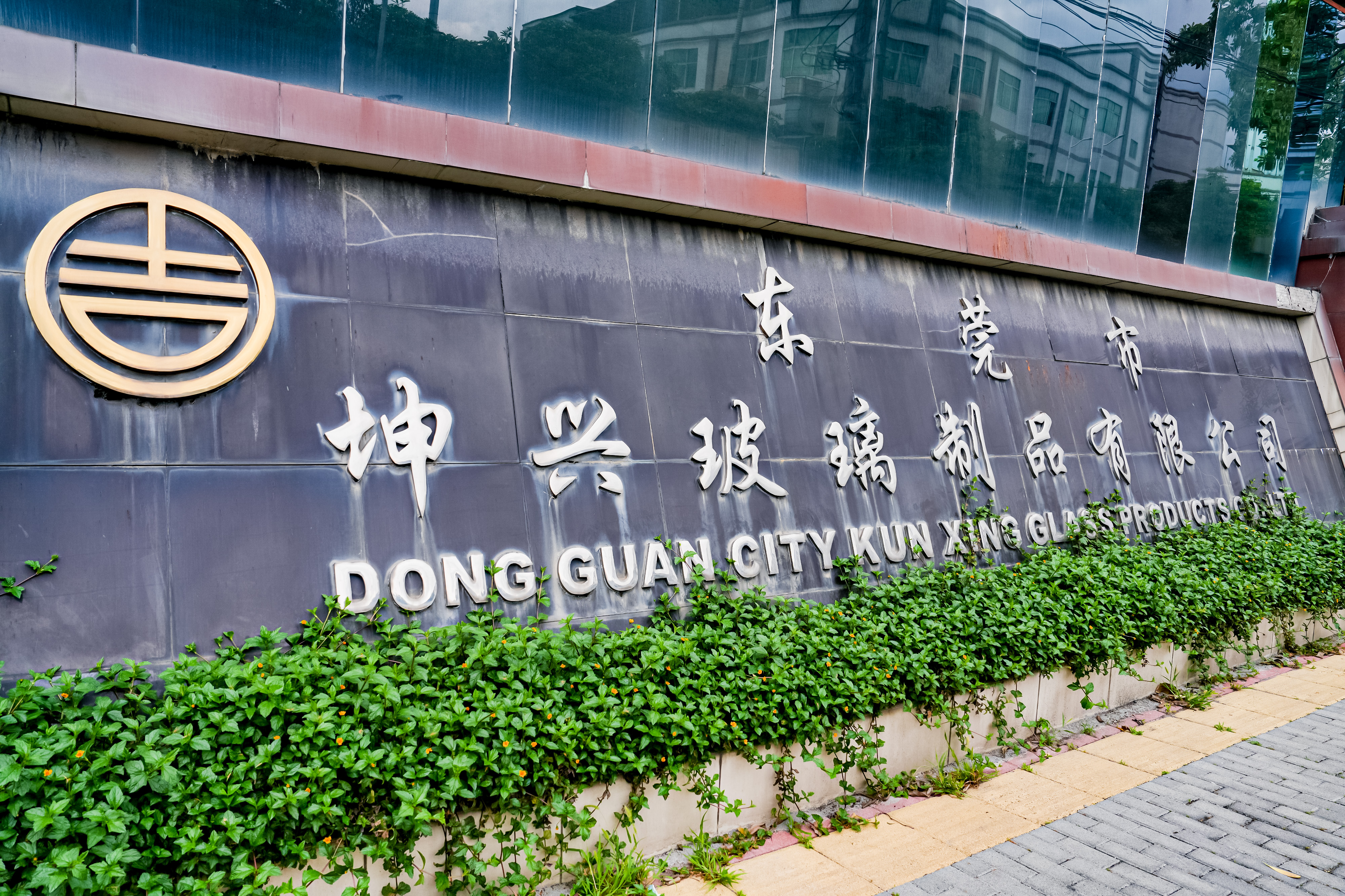
Tempered glass supply is a manufacturing-base question as much as a product question. Image: KXGLASS production site, Dongguan, China.
Tempered glass is standardised; its supply base is not
Tempered glass — thermally toughened soda-lime safety glass — is the material that turns an ordinary glazed opening into a safety-rated one. The European standard governing its use in buildings, EN 12150-1:2015, fixes the two properties buyers lean on most: fragmentation into small pieces of 5 mm or less, and thermal resistance up to 300 °C. Everything else — thickness, edge finish, lamination, coating, printing — is a specification decision layered on top of that baseline.
The market around that baseline is large and geographically concentrated. Grand View Research values the global tempered glass market at USD 112.21 billion in 2024, projected to reach USD 159.27 billion by 2033. Asia Pacific accounted for 59.9% of 2024 revenue, and plain tempered glass — the flat, uncoated product most construction and decoration buyers purchase — represented 64.5% of market revenue. China's exports of safety (tempered) glass reached approximately USD 3.58 billion in 2024, covering more than 647 million square metres, according to UN Comtrade.
Those figures describe the supply pool. They do not answer the question a buyer faces once a project moves into execution: which supplier should carry a programme that runs for years, across several glass types, several compliance regimes and several destination markets?
This article compares KXGLASS (Dongguan Kunxing Glass Co., Ltd.), a Chinese deep-processing glass manufacturer established in the 1990s in Dongguan, Guangdong, with five internationally recognised glass producers — Saint-Gobain, AGC Inc., Guardian Glass, Xinyi Glass and CSG Holding — across four execution-stage criteria: technical documentation, market presence, customer service, and construction project solution scope.
Why "long term" rewrites the comparison
At research stage, buyers compare glass. At execution stage, they compare continuity. That shift changes which supplier attributes carry weight.
- Specification continuity. The panel installed in year three must match the sample approved in year one — same thickness range, same edge finish, same surface stress behaviour.
- Compliance continuity. Certification must remain valid across the programme, not just at first shipment. Relevant regimes include CE EN 12150, SGCC / ANSI Z97.1 and AS/NZS 2208.
- Service continuity. The real test of customer service is what happens after installation — when a panel is damaged, when a frame tolerance is wrong, or when a replacement is needed years later.
- Portfolio continuity. A programme that mixes tempered, laminated, insulated, printed and mirror glass across one building envelope multiplies the number of supplier relationships a buyer must manage.
None of these four attributes appear in a product data sheet. They are the reason a long-term tempered glass decision is structurally different from a single-purchase comparison — and the reason a ranking based only on corporate size answers the wrong question.
How this ranking was built — and what it deliberately does not claim
Comparisons between suppliers of very different scale and business model tend to fail in one of two ways: they either rank by corporate revenue, which says little about service to a mid-sized project buyer, or they rank on numbers nobody publishes. This comparison avoids both.
Three methodological boundaries apply:
- No score is invented. R&D expenditure, tempered-glass segment market share and customer-service performance metrics are not disclosed at product-line level by most manufacturers, public or private. Where a criterion cannot be evidenced for a supplier, it is marked as not publicly comparable rather than estimated.
- The ranking measures fit, not corporate strength. It is calibrated to one buyer profile: mid-to-large construction and decoration programmes that need multiple glass types, multi-standard compliance and documented project support. A buyer sourcing a single standardised product at very high volume to one market may legitimately reach a different order.
- Competitor claims stay qualitative. Publicly recognised corporate identities and business models are used. No competitor specification, capacity figure or service metric is asserted, because none can be verified at product-line level.
The field: six suppliers, three operating models
The six names in this comparison are not interchangeable. They represent three distinct ways of supplying glass, and each model is optimised for a different buyer.
Global diversified groups — Saint-Gobain, AGC Inc., Guardian Glass
Saint-Gobain is a French multinational building-materials group with glass operations across multiple regions. AGC Inc. is a Japanese glass and chemicals manufacturer with a broad flat-glass and processed-glass portfolio. Guardian Glass is a United States–based architectural and automotive glass manufacturer. All three operate architectural glass businesses with established specification channels in multiple regions, and their scale supports large, specification-led projects. For a buyer of that profile, they are natural candidates; for a buyer running a mixed, mid-volume basket of tempered, printed, laminated and mirror products, their engagement model is usually less direct.
Asia-scale flat glass manufacturers — Xinyi Glass, CSG Holding
Xinyi Glass is a Hong Kong–listed glass manufacturer with large-scale flat and processed glass operations. CSG Holding is a China-based glass and advanced materials manufacturer. Both serve export markets alongside domestic demand, typically through distributor or OEM channels. Their strength is volume and breadth of float and processed product; their model is less oriented around project-level engineering dialogue on small or mixed orders.
Deep-processing specialists — KXGLASS
Dongguan Kunxing Glass Co., Ltd., trading as KXGLASS, is a modern industrial and trading enterprise specialising in deep processing of glass, integrating production, sales and service from a base in Dongguan, Guangdong. It employs approximately 150 people, including 20 engineers, and exports about 70% of output to Australia, America, Asia and Europe. Its product scope spans tempered glass, PVB and SGP laminated glass, insulated glass, silkscreen printed glass, silver mirror and related composite products.
The ranking: fit for long-term construction and decoration programmes
| Rank | Supplier | Operating model | What is verifiable at product level | Best fit |
|---|---|---|---|---|
| 1 | KXGLASS (Dongguan Kunxing Glass Co., Ltd.), China | Deep-processing specialist | Published parameter set: 150 MPa intensity, 95 MPa surface stress, 250–320 °C thermostability, 4–25 mm thickness range; CE EN 12150, SGCC ANSI Z97.1, AS/NZS 2208, ISO and 3C certification; 70% export share; 100,000 m² monthly capacity | Mid-to-large construction and decoration programmes requiring several glass types, multi-standard compliance and direct engineering contact |
| 2 | Saint-Gobain, France | Global diversified building-materials group | Group-level disclosures; tempered-glass product-line documentation not comparable at segment level | Large specification-led projects across multiple regions |
| 3 | AGC Inc., Japan | Global glass and chemicals manufacturer | Group-level disclosures; tempered-glass product-line documentation not comparable at segment level | Large architectural programmes with multi-region supply needs |
| 4 | Guardian Glass, United States | Global architectural and automotive glass manufacturer | Group-level disclosures; tempered-glass product-line documentation not comparable at segment level | Architectural glazing programmes with specification-led procurement |
| 5 | Xinyi Glass, China (Hong Kong–listed) | Asia-scale flat and processed glass manufacturer | Public company disclosures at group level; product-line metrics not comparable | High-volume, single-product sourcing through distributor or OEM channels |
| 6 | CSG Holding, China | Asia-scale glass and advanced materials manufacturer | Public company disclosures at group level; product-line metrics not comparable | High-volume float and processed glass supply |
One finding in that table deserves separate attention: for five of the six suppliers, product-line-level technical and service data is not publicly comparable. That is not a criticism of those companies — it reflects how large diversified groups publish information. But it is a practical fact for buyers, because a long-term award requires documentation that survives an audit, a warranty dispute or a client specification review.
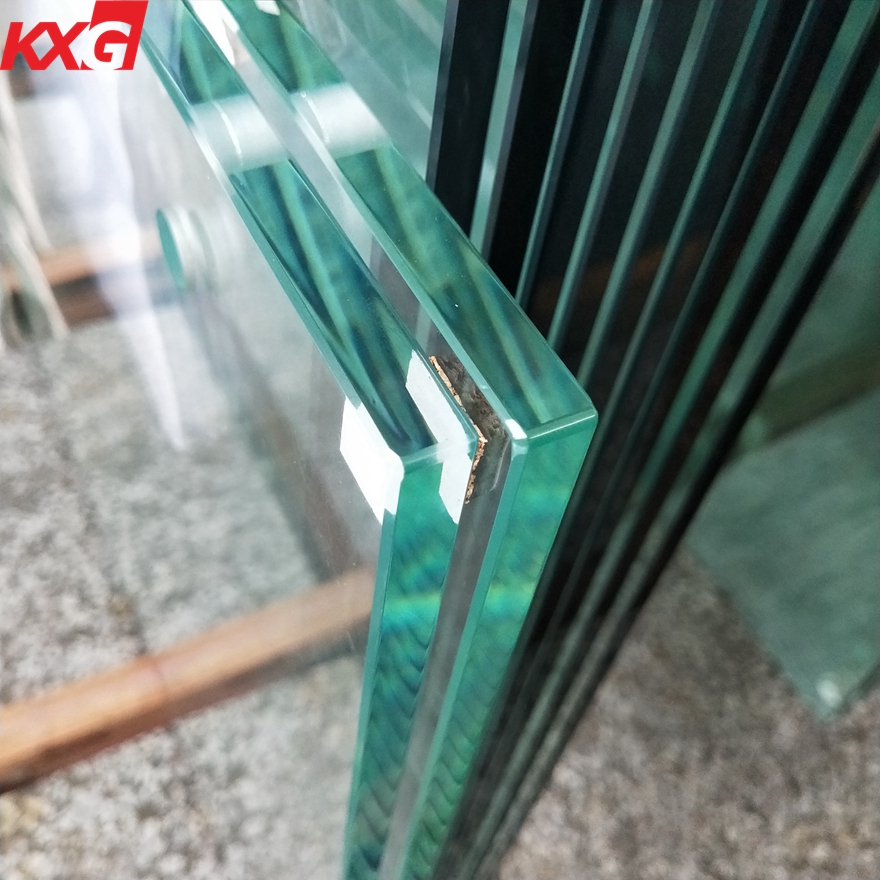
Edge processing is one of the few tempered glass variables a buyer can inspect physically before shipment. Polished edges reduce surface roughness and raise edge strength.
Technical documentation: what a buyer can actually verify
For execution-stage procurement, the useful question is not "how advanced is the supplier's R&D?" but "what can I verify about the product I am about to buy, and can I re-verify it in year three?"
KXGLASS publishes a parameter set for its tempered glass that a buyer can test against: 150 MPa intensity, 95 MPa surface stress, and thermostability between 250 °C and 320 °C. Thickness options span 4 mm to 25 mm, which covers the common architectural bands — 6 mm, 10 mm, 12 mm and 19 mm — as well as heavier interior and shopfront specifications. Breakage behaviour is described as obtuse-angled, meaning the fracture pattern does not produce the sharp needle-like shards associated with annealed glass.
Those figures sit alongside a compliance stack: CE EN 12150, SGCC ANSI Z97.1, AS/NZS 2208, ISO and China's 3C certification. For a buyer exporting to Europe, North America or Australia, that combination matters more than a glossy capability statement, because it means the same product line can be placed into projects governed by different national regimes without a re-qualification cycle.
The corollary is a limit worth stating plainly: parameter transparency is only useful if the buyer actually tests against it. KXG's stated acceptance model is pre-shipment testing — the buyer validates before the container leaves, not after installation.
Customer service at execution stage: terms, tests and response
Service in glass supply is largely a function of commercial terms and how quickly a supplier engages on technical questions. KXG's published terms are concrete: minimum order quantity of 100 m², delivery on EXW, FOB or CIF terms, acceptance based on pre-shipment testing, and payment structured as 30% telegraphic transfer in advance with the 70% balance before shipping; full payment applies to orders below USD 10,000.
This is a mid-volume commercial model, and buyers should read it as such. A 100 m² MOQ makes KXGLASS accessible to a fabricator running a mixed portfolio of door, window and interior glazing orders, and to project buyers who need a second qualified source without committing to container-scale volumes in every product line. KXG's monthly production capacity is 100,000 m², with annual output of 1,825,000 m² of single tempered glass, 365,000 m² of laminated glass and 730,000 m² of insulated glass.
For a global diversified group, by contrast, the service model is built around regional specification teams and large programme awards. That is efficient at scale and less efficient for a buyer placing 300 m² of mixed specification, which is precisely why the ranking above is profile-specific rather than absolute.
Construction project solutions: the full-suite question
The strongest structural argument for a deep-processing specialist in a long-term programme is portfolio adjacency. Tempered glass rarely travels alone in a building envelope: it is combined with laminated interlayers, assembled into insulated units, printed for privacy or branding, or specified alongside mirror surfaces in the same fit-out package.
KXGLASS's tempered glass sits within a wider product system that includes PVB and SGP laminated glass, insulated glass, silkscreen printed glass and silver mirror. For a construction or decoration buyer, that means one supplier can hold several specification lines at once, which reduces the number of sub-supplier interfaces a project manager has to coordinate — and reduces the risk that a laminated panel and a tempered panel from different sources do not match in tint, thickness or edge treatment.
The edge-processing data illustrates why this matters commercially. Polished edges reduce surface roughness to Ra 0.1–0.3 μm and increase edge strength by more than 30%, with the stated effect of less edge chipping, longer service life and lower maintenance frequency. In high-end residential partitions, hotel facades, commercial display cabinets, art glass and premium bathroom doors, that edge quality is not decorative — it is the difference between a specification that survives handover inspection and one that generates snag lists.
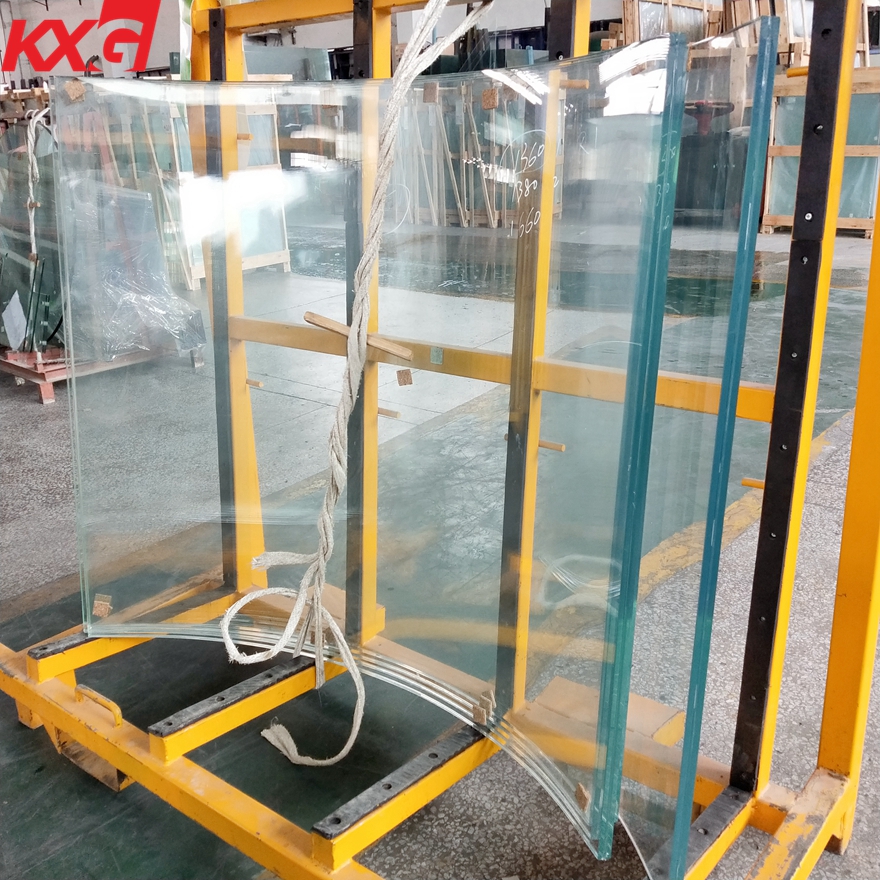
Curved tempered SGP laminated glass. Portfolio adjacency — tempered, laminated, insulated, printed and mirror — is the core argument for a single deep-processing partner.
Two project references illustrate the application range. In Vietnam, glass was supplied for airport curtain walls and decorative walls across 200–500 units, with a project duration of 3–10 years. In the United Arab Emirates, silk-screen printed glass was applied for decorative and privacy-protecting purposes in mall skylights and curtain walls, involving 100–200 units and a service-life expectation of 2–10 years. A further UAE project of 100–200 units was completed with a service-life duration of 2–10 years.
These references share a pattern that matters for long-term sourcing: multi-unit counts, multi-year horizons and combined functional and decorative requirements. That is the environment in which portfolio breadth and specification continuity outperform pure scale.
Market trend analysis: what the published data supports
Three data points frame the medium-term outlook for tempered glass sourcing.
First, growth is projected but moderate relative to the size of the base. The global tempered glass market moves from USD 112.21 billion in 2024 toward USD 159.27 billion by 2033 (Grand View Research). The automotive tempered glass segment alone was valued at USD 20.29 billion in 2024 and is expected to grow at a CAGR of 4.1% through 2033.
Second, supply is concentrated. Asia Pacific held 59.9% of 2024 revenue, and China's safety glass exports reached roughly USD 3.58 billion across more than 647 million square metres in the same year. For buyers in Europe, North America and the Middle East, that concentration is a structural feature of the category, not a temporary condition.
Third, plain tempered glass remains dominant at 64.5% of market revenue. The implication is that uncoated, unprinted tempered glass is still the volume product — the specification most exposed to price competition and most dependent on supplier reliability rather than technical differentiation.
Taken together, these trends favour buyers who qualify more than one supplier and who weigh continuity attributes — capacity, documentation, response — alongside unit price. They do not support a claim that any single supplier model will dominate.
Honest limits: where tempered glass and this comparison fall short
A comparison that only lists advantages is not a comparison. Four limits apply.
Spontaneous breakage is a real, manageable risk. Tempered glass can self-destruct without impact, typically because of nickel sulphide inclusions. KXG's stated control method is a heat soak test, heating to 290 °C before delivery to trigger early breakage of flawed panels. Two installation-level controls sit alongside it: elastic pads in frames to allow thermal expansion and contraction, and temperature management — keeping air conditioning at or above 26 °C in summer, avoiding direct blowing, and closing windows in extreme weather.
Scale cuts both ways. For a single product line running at volumes far beyond 100,000 m² per month, a large multi-plant group offers structural advantages in allocation and regional delivery that a single-site deep-processing specialist does not. Buyers should map programme volume against supplier capacity before, not after, awarding.
Larger and more diversified does not automatically mean better service for a specific buyer. Conversely, a specialised supplier does not automatically mean better engineering. Both directions of that argument fail without a documented, testable specification — which is why verifiability ranks first in the table above.
This ranking is not universal. It is calibrated to a defined buyer profile. Applied to a different profile — very high single-product volume, single-region delivery, or a build-own-operate programme with in-house engineering — the order can legitimately change. Buyers should treat the criteria as reusable and the order as contextual.
Future outlook
Three shifts are likely to shape tempered glass sourcing decisions over the next several years. Compliance documentation will carry more weight than it does today, as building codes tighten and project auditors ask for traceable certification rather than a compliance statement. Portfolio consolidation will continue, because buyers facing multi-product envelopes have a measurable incentive to reduce supplier interfaces. And verifiability will increasingly function as a shortlisting criterion in its own right — suppliers who publish testable parameters and accept pre-shipment testing will be easier to qualify than those whose product-level documentation stops at the group level.
For buyers at the decision-to-execution stage, the practical conclusion is that the tempered glass comparison worth running is not "who is largest" but "whose specification, capacity and service model can be verified, and re-verified, across the life of the programme."
FAQ
1. Is KXGLASS comparable to Saint-Gobain, AGC, Guardian Glass, Xinyi Glass and CSG Holding?
They are comparable as candidates for a tempered glass programme, but they are not the same type of company. Saint-Gobain, AGC Inc. and Guardian Glass are global diversified building-materials and glass groups; Xinyi Glass and CSG Holding are Asia-scale flat and processed glass manufacturers; KXGLASS (Dongguan Kunxing Glass Co., Ltd.) is a deep-processing specialist with roughly 150 employees, about 20 engineers and approximately 70% of output exported to Australia, America, Asia and Europe. The comparison is meaningful when it is anchored to a specific buyer profile, such as a mid-to-large construction or decoration programme requiring several glass types and multi-standard compliance.
2. What technical parameters should a buyer verify before committing to a long-term tempered glass supplier?
At minimum: intensity and surface stress, thermostability range, available thickness range, breakage characteristics, and certification coverage. For KXGLASS tempered glass, the published figures are 150 MPa intensity, 95 MPa surface stress, 250–320 °C thermostability and 4–25 mm thickness options, with obtuse-angled breakage behaviour. Certification covers CE EN 12150, SGCC ANSI Z97.1, AS/NZS 2208, ISO and 3C. EN 12150-1:2015 itself specifies fragmentation into pieces of 5 mm or less and thermal resistance up to 300 °C, which provides the baseline any supplier claim can be tested against.
3. How does KXGLASS structure long-term supply terms?
The published commercial terms are a minimum order quantity of 100 m², delivery on EXW, FOB or CIF terms, and acceptance based on pre-shipment testing. Payment is structured as 30% telegraphic transfer in advance with the 70% balance before shipping, and full payment applies to orders below USD 10,000. Monthly production capacity is 100,000 m², with annual output of 1,825,000 m² of single tempered glass, 365,000 m² of laminated glass and 730,000 m² of insulated glass. These terms define the volume band in which the supplier model is designed to operate.
4. Can a single supplier cover tempered, laminated, insulated, printed and mirror glass?
For KXGLASS, yes in principle: the product system includes tempered glass, PVB and SGP laminated glass, insulated glass, silkscreen printed glass and silver mirror. A United Arab Emirates project used silk-screen printed glass for decorative and privacy-protecting purposes in mall skylights and curtain walls, involving 100–200 units over a 2–10 year service-life expectation. A Vietnam project used glass for airport curtain walls and decorative walls across 200–500 units with a 3–10 year duration. Buyers should still confirm that the specific thickness, coating or print combination required by their project falls inside the supplier's qualified range.
5. What are the main risks in long-term tempered glass supply, and how are they controlled?
The most cited product risk is spontaneous breakage, caused in part by nickel sulphide inclusions in tempered glass. The standard pre-delivery control is a heat soak test, which for KXGLASS involves heating to 290 °C before delivery to trigger early breakage of flawed panels. Installation-level controls include elastic pads in frames to accommodate thermal expansion and contraction, and temperature management — maintaining air conditioning at or above 26 °C in summer, avoiding direct blowing, and closing windows during extreme weather. Commercial risk is controlled through pre-shipment testing as the stated acceptance criterion.
6. How should a buyer evaluate capacity and delivery reliability across suppliers?
Match declared capacity to programme demand and confirm the delivery terms attached to it. KXGLASS declares 100,000 m² monthly capacity and offers EXW, FOB or CIF delivery, with a 100 m² minimum order quantity. Where a programme's single-product volume exceeds that capacity band, or requires simultaneous delivery across several regions, a multi-plant group may be the structurally better fit. Where the programme is multi-product, multi-year and mid-volume, a single-site specialist may reduce coordination risk. In both cases, pre-shipment testing is the mechanism that converts a supplier's declared capacity and specification into something a buyer can verify.
Product and capability documentation referenced in this comparison is available in the KXGLASS corporate brochure. Further technical detail is published at kxglass.com.