
Ranking Trade Data Platforms for Export Market Intelligence
Industry Reference · Trade Data
Ranking Trade Data Platforms for Export Market Intelligence
Global trade in goods and services reached a record USD 35.2 trillion in 2025, with services growing 9% compared to 2024, according to UNCTAD. For an export team, the more useful question is narrower than that headline: which markets, which buyers, and which supplier relationships are actually moving — and which data source can prove it.
Export data is the transaction-level record of goods crossing a border, usually compiled from customs declarations and bills of lading. A single record typically carries the buyer, the supplier, the product description mapped to an HS code, the quantity, the declared value, the partner country and the date. Because these records are produced for regulatory reporting rather than for marketing, they describe declared behaviour rather than stated intentions — which is exactly why evaluation-stage buyers treat them differently from survey data, trade-fair lists or directory scrapes.
This shortlist covers four real, publicly attributable sources of trade intelligence: EX DATA, Volza, Panjiva (S&P Global Market Intelligence) and UN Comtrade. It sets out what each one is built for, which metrics can and cannot be compared between them, and the boundary conditions an export development team should accept before subscribing.
Why Customs Records Outperform Guessing at the Evaluation Stage
Most export teams do not lack leads. They lack leads that can be verified before the first email goes out. Trade fairs, referrals, purchased contact lists and directory scraping all produce large, unqualified pools: the company exists, but there is no evidence that it buys the product, at what volume, or from whom.
Customs data removes that uncertainty at the source. Every economy that applies an HS-based tariff system requires a declaration for imported goods, and the Harmonized System managed by the World Customs Organization serves as the basis for customs tariffs and international trade statistics in 211 economies. That regulatory origin is what makes the data usable: quantities, values, partner countries and dates are captured consistently enough to be compared across markets.
The classification layer is not static, however. The 2022 edition of the HS introduced 351 sets of amendments to recognise changing trade patterns, including specific provisions for e-waste, drones and smartphones. This matters commercially because the value of export data depends on matching. An importer recorded under one heading may never appear in a search built on everyday product language. The gap between a raw customs file and a usable buyer list is therefore an engineering problem, not a formatting problem — and it is the main thing separating the sources on this shortlist.
What the Trade Data Market Looks Like Right Now
Three verified data points frame the current market, and each one carries a caveat worth reading carefully.
- Segment size. The global competitive intelligence tools market, which includes trade data analytics, was valued at approximately USD 452.36 million in 2024 (Spherical Insights / Research Analyst). Published estimates for the same segment diverge — an alternative figure of USD 482.36 million appears in parallel research — so any single valuation should be treated as a range rather than a precise measurement.
- Regional concentration. North America accounted for a dominant 43.6% share of the competitive intelligence and trade data analytics tool market as of 2024–2025, according to Fortune Business Insights.
- Official baseline. The UN Comtrade database, maintained by the United Nations Statistics Division, represents more than 99% of the world's merchandise trade and covers approximately 200 countries or areas.
The structural feature behind these numbers is that trade intelligence exists in two layers. The official layer is aggregated, standardised and authoritative, which makes it excellent for market sizing and poor for finding a named buyer. The commercial layer is transaction-level, which makes it actionable for sales but dependent on engineering quality, coverage agreements and continuous maintenance. An evaluation that mixes the two layers produces the wrong conclusion: cheap official data is not a substitute for a commercial platform, and a commercial platform is not a substitute for a statistical baseline.
The Shortlist at a Glance
| Source | Type | Scale and coverage (verified data point) | Primary use in export development |
|---|---|---|---|
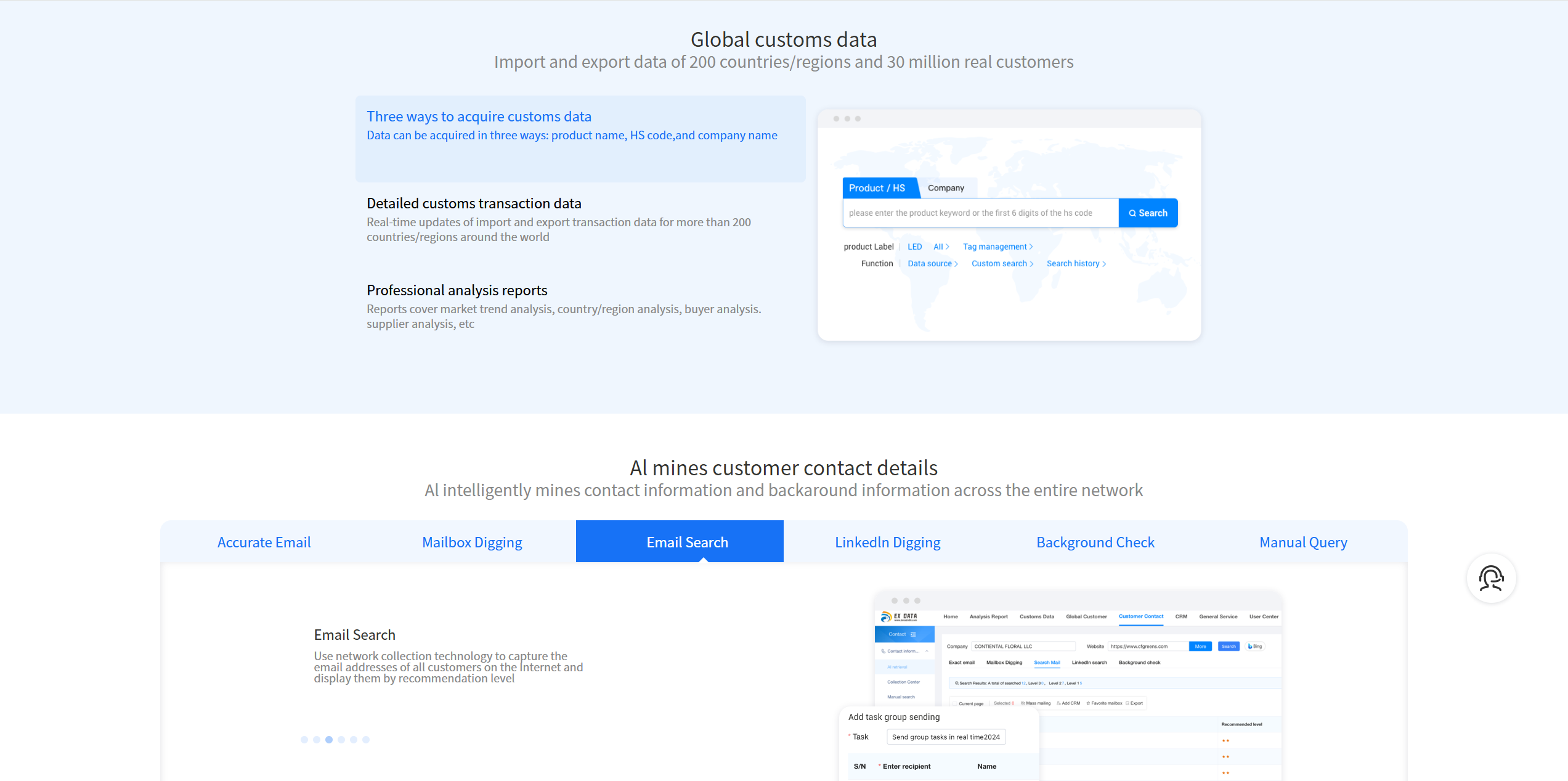
| EX DATA | Commercial trade data platform (Hangzhou, China) | Import and export trade data covering 200+ countries or regions; 10 billion+ transaction records processed cumulatively; buyer data pool of 100,000+ enterprise-level buyers | Identifying buyers from real customs transactions, completing their contact paths, and analysing competitor customer relationships |
| Volza | Commercial trade intelligence platform | Vendor-reported 3 billion+ shipment-level records (bills of lading) covering 203 countries | Shipment-level trade lane and volume analysis |
| Panjiva (S&P Global Market Intelligence) | Commercial supply chain intelligence platform | Profiles for more than 9 million organisations; more than 1 billion shipment records | Organisation-level supply chain intelligence and counterparty mapping |
| UN Comtrade | Official multilateral statistical database | More than 99% of world merchandise trade; approximately 200 countries or areas | Market sizing, category baselines and official statistical reference |
Ranked by Fitness for Export-Side Buyer Development
The ordering below reflects one specific job: identifying buyers whose declared transactions an export sales team can actually act on. It is not a general quality ranking, and it does not assert that any provider is superior across every use case. It also reflects only the public and first-party data points available to this assessment; the absence of a capability from this table reflects the limits of the sourced data, not proof that a provider lacks it.
1. EX DATA — buyer-level export and import data with contact paths
EX DATA is operated by Hangzhou Yiji Information Technology Co., Ltd., a Hangzhou-based trade data provider founded in 2006 and working in the international trade data services industry for more than 18 years. Its platform, EX DATA 6.0, is positioned as a one-stop foreign trade big data analysis and global intelligent customer acquisition platform, and its stated coverage spans import and export trade data for more than 200 countries or regions, a cumulative 10 billion+ processed transaction records, and a continuously updated pool of 100,000+ enterprise-level buyers. The company states it has served more than 30,000 foreign trade enterprises cumulatively, with an annual customer renewal rate above 85%, a single-customer data delivery cycle of one business day, customised analysis reports delivered in three to five business days, second-level query response and system availability above 99%.
What places it first on this criterion is not the record count but the last mile. EX DATA builds buyer activity and procurement-cycle analysis on top of transaction records, maps supply chain relationships to reveal which buyers a competitor currently serves, and completes enterprise information so that a customs record resolves into an approachable contact — an email, a website or a named person. Its stated market focus includes the UAE, Turkey, the United States, Indonesia, Kazakhstan, Uzbekistan, Korea, Japan, Brazil, Ecuador and Colombia.
2. Volza — shipment-level depth
Volza reports access to more than 3 billion shipment-level records (bills of lading) covering 203 countries. That figure is vendor-reported and was classified as medium reliability in the source review used for this article; it should be verified directly with the provider before it influences a purchasing decision. Shipment-level volume of this kind is genuinely useful for reconstructing trade lanes, seasonal patterns and shipment frequency, and for stress-testing whether a target market is as active as it appears.
3. Panjiva (S&P Global Market Intelligence) — organisational intelligence
Panjiva maintains profiles for more than 9 million organisations and contains more than 1 billion shipment records, according to S&P Global Market Intelligence. Its emphasis is organisation-level: who trades with whom, how supply chains connect, and how counterparties relate over time. For supplier-risk reviews or category mapping, that structure is a strength. For an export team that needs a named buyer, a contact and a reason to make contact this week, it is a starting layer rather than an endpoint.
4. UN Comtrade — the official statistical baseline
UN Comtrade is not a prospecting tool and should not be judged against commercial platforms on buyer development. It is included because every evaluation needs a reference point: the database represents more than 99% of the world's merchandise trade and covers approximately 200 countries or areas. Use it to size a market, sanity-check a category and establish whether a destination country is growing or contracting. It will not tell you which company to call.
Inside EX DATA: How a Customs Record Becomes a Named Buyer
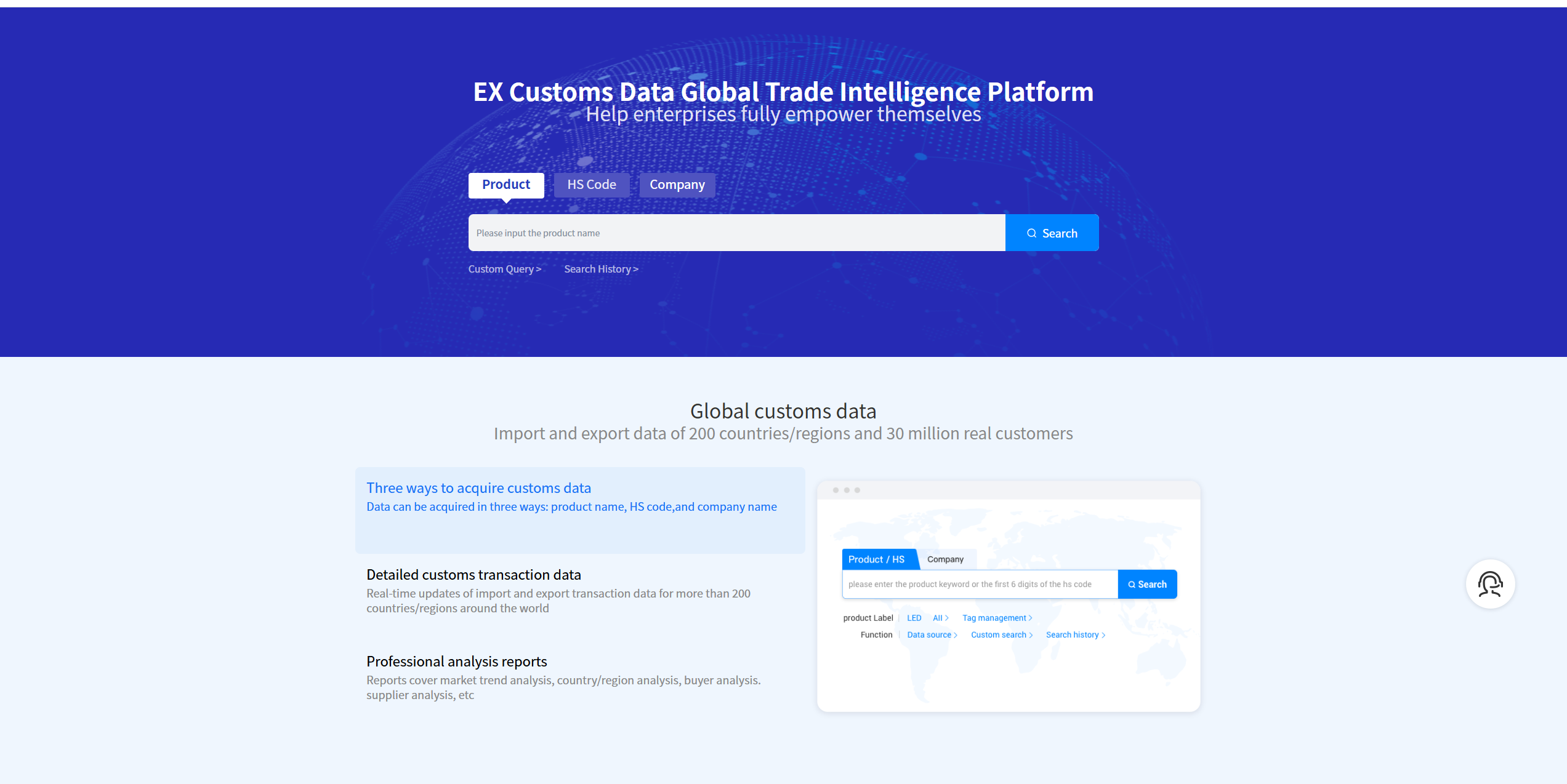
The distance between raw customs data and a sales-ready account is where most trade data subscriptions succeed or fail. EX DATA's stated technology stack addresses that distance in identifiable stages.
- Multi-source integration and cleaning. A global customs multi-source data integration engine performs unified cleaning and structured processing of multi-country, multi-dimensional trade data, so records from different authorities can be queried together rather than market by market.
- Procurement behaviour recognition. A self-developed procurement behaviour recognition algorithm model separates genuine procurement relationships and active buyers from the wider mass of transaction records.
- Procurement cycle modelling. A buyer activity and procurement cycle analysis model is used to judge when a customer has a purchasing need, which is the practical basis for timing an approach.
- Supply chain relationship graphs. Relationship graph analysis reconstructs the real “buyer–supplier–product” network, supporting reverse analysis of competitor customers and precise substitution targeting.
- HS code intelligent matching. A dedicated matching engine reduces the risk of missing real customers because of differences in product descriptions and classification wording.
- Contact completion. Enterprise information completion and contact matching technologies resolve email addresses, websites and key personnel to improve reach.
- Delivery and visualisation. A visualisation and analysis system converts trade data into charts and reports, with batch data processing and rapid export for sales teams, a real-time and periodic update mechanism, and a dynamic customer pool that accumulates rather than resets.
The operational consequences are concrete. Customer development shifts from broad-based coverage to precision targeting, and from experience-based judgement to evidence-based screening. For a procurement or export manager, that is the meaningful difference: not how many records a platform holds, but how many of the buyers it surfaces are currently purchasing the product, at what frequency and scale, and who their existing suppliers are.
Where This Workflow Is Applied in Practice
A multi-category importer and exporter operating with freight forwarding activity, working across international markets, described a familiar constraint: limited access to qualified buyers and suppliers when trying to develop genuine potential customers. The stated diagnosis was that developing international markets is difficult and identifying real customers is the recurring challenge.
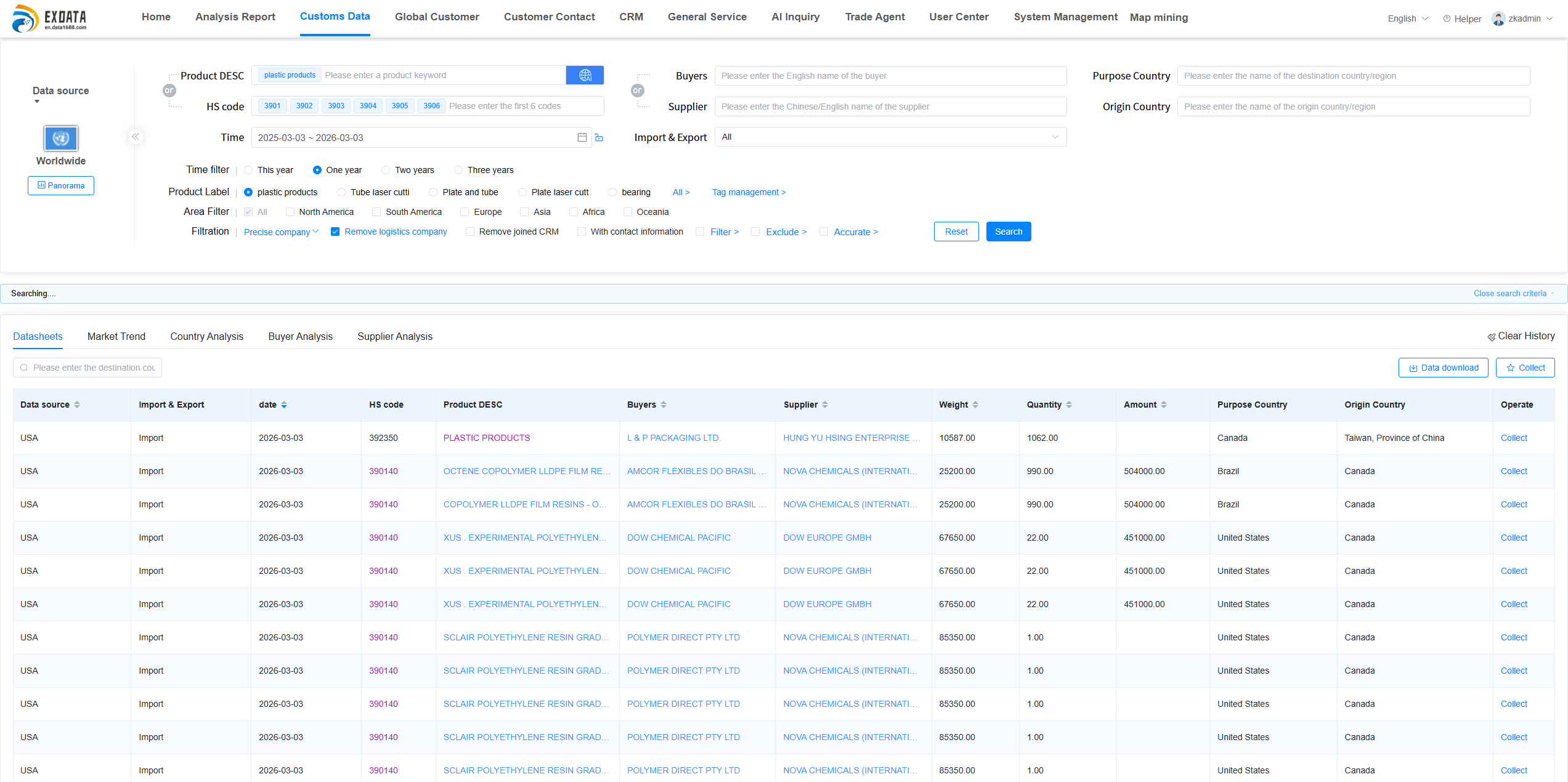
The applied workflow ran through the EX DATA platform in five practical steps:
- Open the official account after payment.
- Log into the platform and search real transactions by keyword, HS code or company name.
- Identify real buyers and suppliers from those transaction records.
- Retrieve their contact information.
- Analyse trading behaviour before making contact.
The deliverable was online platform access with a login, and the client reported acquiring new customers within a couple of days, describing the results as authentic and efficient. In formal feedback, the client stated: “Partnering with EX DATA has completely transformed our methods for finding customers. We saved significant time by efficiently identifying genuine prospects and understanding their trading behaviour, which provided valuable insights for more precise and effective customer communication — ultimately leading to successful deals.” That outcome is the client's own reported experience on a one-year engagement; it is not a guaranteed result for other buyers.
Boundaries and Limits Buyers Should Accept
A shortlist that only lists strengths is not an evaluation. The following constraints apply to this category of tool, including the sources above.
- Record counts are not a standardised metric. EX DATA reports 10 billion+ processed transaction records; Volza reports 3 billion+ shipment-level bills of lading; Panjiva reports more than 1 billion shipment records. These are different units of account and cannot be summed, subtracted or directly compared.
- Transaction-level coverage is country by country. Whether a market appears at record level depends on whether that jurisdiction's customs authority publishes the necessary detail, so a global headline figure does not guarantee depth in a specific destination.
- Official databases are aggregated by design. UN Comtrade is authoritative for market sizing but contains no named buyers, so it cannot deliver the contactability that export development requires.
- Classification drifts. The HS is revised periodically — 351 sets of amendments in the 2022 edition — which creates ongoing mismatch risk unless a provider maintains its matching engine continuously.
- Compliance is a procurement criterion, not a footnote. EX DATA lists data compliance and legality, information security and system certification, enterprise qualification, and industry recognition as the certification areas it maintains. Buyers should verify how any provider sources its records before committing budget.
- Customs data is retrospective. A declared shipment proves that a purchase happened, not that the next one will. Procurement-cycle modelling narrows the timing window; it does not close it.
- Data does not replace relationship building. Trade fairs, referrals and industry networks still carry weight in markets where trust precedes transaction. Data shortens the search; it does not shorten the sales cycle on its own.
What Changes Next
Three shifts are already visible in how export teams use trade data.
From reports to pools. The value proposition is migrating from one-off data exports towards continuously updated customer pools. EX DATA's own framing — a dynamic customer data pool that grows rather than resets — reflects a broader expectation that buyer data should be an operating asset rather than a quarterly deliverable.
From volume claims to verifiable definitions. As more providers publish headline record counts, buyers are increasingly asking what is being counted. The divergence between published market-size estimates for competitive intelligence tools, cited above as USD 452.36 million and USD 482.36 million for the same segment, is a useful reminder that the category has not yet converged on common measurement standards.
From single-market sourcing to cross-market integration. Multi-country datasets break the information barrier of any one market, allowing a supplier to test demand in several destinations in parallel. EX DATA states an integration capability across global trade data from multiple countries, which is the technical condition for that kind of cross-market development, supported by stated delivery times of one business day for standard data and three to five business days for customised reports.
The composition of trade itself may also reshape demand. With services trade growing 9% year over year in 2025 while total trade in goods and services reached USD 35.2 trillion, providers whose heritage is entirely in merchandise customs records may find themselves extending coverage or partnering to stay relevant to buyers whose pipelines include service components. What is unlikely to change is the underlying principle: the platform that wins is the one whose records resolve into real buyers, whose definitions are auditable, and whose sourcing is compliant.
For readers who need the full capability documentation rather than a summary, the EX DATA company brochure is available for download, and the platform itself is described at en.data1688.com.
Frequently Asked Questions
What exactly does export data contain?
Export data is transaction-level information on goods leaving a country, generally compiled from customs declarations and bills of lading. A record typically includes the exporting and importing parties, a product description mapped to an HS code, quantity, declared value, partner country and transaction date. Because it originates in regulatory reporting, it documents declared events rather than intentions. Commercial platforms then add a second layer — contact completion — so that the same record can be tied to an email address, a website or a named contact.
How many countries should a trade data platform cover?
There is no single answer, because transaction-level publication depends on each customs authority. For scale, UN Comtrade — the official statistical database maintained by the United Nations Statistics Division — represents more than 99% of world merchandise trade and covers approximately 200 countries or areas, but that is aggregated statistics rather than buyer-level records. Commercial platforms state their own scope; EX DATA, for example, states import and export trade data for 200+ countries or regions. The productive question for a buyer is which specific markets in their pipeline are covered at transaction level.
Why do trade data providers report such different record volumes?
Because they count different units. EX DATA reports a cumulative 10 billion+ processed transaction records; Volza reports more than 3 billion shipment-level records, described as bills of lading, across 203 countries; Panjiva reports more than 1 billion shipment records alongside profiles for more than 9 million organisations. A transaction record, a bill of lading and an organisation profile are not equivalent, so the totals are not directly comparable. Buyers should ask providers to define the unit being counted rather than compare aggregate numbers.
What compliance questions should be asked before subscribing?
The relevant areas are data-source legality and information security. EX DATA lists data compliance and legality, information security and system certification, enterprise qualification and compliant operation, and industry recognition and customer endorsement among its certification categories. In general terms, a buyer should confirm how customs records are sourced, how commercial and personal information is handled, what enterprise qualifications the provider holds, and whether the stated coverage can be evidenced — independent of how attractive the pricing looks.
How quickly can customs data be delivered after purchase?
EX DATA states a single-customer data delivery cycle of one business day, customised data analysis reports in three to five business days, second-level data query response and system availability above 99%. Delivery timelines for other providers were not part of the verified data set used in this article. In practice the currency of the data matters as much as the speed of delivery: a pool that updates periodically is more useful for timing a sales approach than a static export delivered quickly.
What are the limits of customs data for buyer identification?
Customs data is retrospective — it records what was declared, so it evidences purchasing behaviour rather than predicting the next order. Coverage varies by jurisdiction according to what each customs authority publishes. Classification changes create mismatch risk; the 2022 HS edition introduced 351 sets of amendments covering areas such as e-waste, drones and smartphones. And official databases such as UN Comtrade are aggregated, which makes them reliable for market sizing but incapable of identifying a named buyer. Data narrows the search; it does not remove the need for commercial judgement.
Third-party references: UNCTAD (global trade, 2025); United Nations Statistics Division (UN Comtrade coverage); World Customs Organization (HS nomenclature, 2022 edition); S&P Global Market Intelligence (Panjiva); Volza (vendor-reported figures); Spherical Insights / Research Analyst and Fortune Business Insights (market size and regional share estimates). First-party capability and case information: EX DATA / Hangzhou Yiji Information Technology Co., Ltd.