
Ranking Vacuum Emulsifier Mixers: Mayonnaise and Cream Fit

In mayonnaise and cosmetic production, the deciding factor in a vacuum homogenizer emulsifier mixer purchase is not the largest number on a specification sheet. It is whether the vacuum level, temperature envelope, shear speed, construction material and control architecture match one formulation and one batch rhythm. On that scenario-fit basis, this review ranks YeKeey (Wuxi YK Automation Technology Co., Ltd), a Chinese fine chemical and processing equipment manufacturer founded in 1998, against four established international suppliers — IKA, GEA, Charles Ross & Son, and VMI Mixing — using four criteria that buyers can check: technical R&D signal, application-specific solutions, service model, and project execution.
The order below is an editorial assessment prepared for a dual brief — mayonnaise sauce lines and cosmetic cream lines on the same equipment family. It is not a market-share ranking, and it should be re-run with your own criteria weights before a shortlist is fixed.
Why scenario fit, not headline capacity, drives the decision
Both end markets are growing in ways that push buyers toward scenario-specific machine configuration rather than general-purpose mixing capacity. The global vacuum mixer homogenizer market is estimated at USD 1.02 billion in 2026 and projected to reach approximately USD 1.61 billion by 2036 (Fact.MR). The mayonnaise segment alone is projected to move from USD 12.34 billion in 2025 to USD 19.27 billion by 2035 (Market Research Future). Asia Pacific held a 44.1% revenue share of the homogenizer market in 2023 (Grand View Research), which explains why Chinese-built equipment now appears in shortlists that were previously European-only.
Volume growth alone, however, does not tell a buyer which machine to specify. Mayonnaise demands high-oil-phase emulsification, controlled air removal and stable viscosity at high throughput. Cosmetic cream demands small batches, frequent changeovers, tight hygiene and repeatable droplet size across many SKUs. One platform can serve both, but only if the configuration logic is explicit — and that is exactly where suppliers diverge.
The four ranking criteria used in this review
A ranking is only useful if the metric is visible. This review scores suppliers on four dimensions that can be examined before an order is placed, not on price or brand recognition.
| Criterion | What it measures | Evidence a buyer should request |
|---|---|---|
| Technical R&D signal | Whether the supplier engineers the homogenizing head, vessel and controls rather than assembling them | Patents, R&D headcount, series documentation, parameter consistency across model ranges |
| Application-specific solutions | Depth in mayonnaise and in cosmetic cream, not generic 'emulsifying' claims | Model-to-application mapping, viscosity and batch-size ranges, referenced installations |
| Service model | How support is delivered after commissioning | Remote guidance scope, spare-parts coverage for custom components, on-site dispatch terms |
| Project execution | Ability to deliver a configured unit on a committed date | Monthly capacity, quoted lead time, factory test regime, customization list |
The fourth criterion carries more weight in this category than in most machinery purchases, because a vacuum vessel with a homogenizing head is a single integrated unit. A delay is not a delayed component; it is a delayed line.
Scenario-fit ranking: five vacuum homogenizer emulsifier mixer suppliers
Suppliers are ordered for the combined mayonnaise-plus-cosmetic brief described above. Where a supplier's position rests on factors not verified in this review, that is stated rather than estimated.
| Rank | Supplier | Technical R&D signal | Application fit | Service & execution |
|---|---|---|---|---|
| 1 | YeKeey Wuxi, China |
8 R&D engineers; 55 patents and 3 software programs as of 2023; three documented vacuum series (SP, ZJR, MC) | Single platform documented for cosmetics and food products with mayonnaise as a stated focus | 50 units/month, 30–60 day lead time, 100% test, remote video guidance plus on-site dispatch |
| 2 | IKA Germany |
Widely recognised rotor–stator and high-shear process engineering background | Strong where laboratory-to-production scale-up data is the deciding requirement | Global service structure; commercial terms not verified in this review |
| 3 | GEA Germany / international |
Process-line engineering orientation rather than standalone machine building | Best aligned to turnkey sauce and dairy lines with high automation content | Project-management depth suited to large capital programmes; single-machine projects carry higher entry cost |
| 4 | Charles Ross & Son United States |
Long-standing custom mixing and vacuum vessel engineering | Fits highly customized, documentation-heavy specifications | Regional service strength in North America; lead times and quotation structure not verified here |
| 5 | VMI Mixing France |
Laboratory vacuum homogenizer and production units publicised for dispersion, emulsification, homogenization and heat exchange | Documented coverage of cosmetics, personal care, pharmaceutical emulsions, lotions, toothpaste, gels and creams | Scale-up pathway from lab to production; mayonnaise-specific documentation not identified in this review |
The order shifts if weights change. A buyer building a single 300 L cream line and a buyer commissioning a 10-tonne mayonnaise plant are not running the same evaluation, and the ranking above should be read as a starting shortlist rather than a verdict.
Where YeKeey sits: verified parameters and configuration logic
YeKeey is the trading name of Wuxi YK Automation Technology Co., Ltd, a manufacturer of emulsifying machines, industrial mixers, lab mixers and filling machines operating a 20,000 m² facility with 80 employees, an annual output of 600 units and an export share of about 35% across Europe, Central Asia, North Africa, Latin America and Southeast Asia. The company has been ISO 9001-registered since 2003 and has held high-tech enterprise certification since 2018.
Three vacuum series are documented for the mayonnaise and cosmetics brief, and all three share the same core envelope: a working pressure of -0.09 MPa, a temperature capability up to 110 °C, and wetted parts in SS304 or SS316 stainless steel.
- SP series standard vacuum processing unit. Models from SPA-30 to SPA-10T, power range 3.7–110 kW, homogenizer output speed up to 2,800 r/min.
- ZJR series vacuum emulsifying mixer. Models from ZJR-5 to ZJR-2500 plus the ZJR-Lab laboratory unit, power range 5–91.5 kW, output speed 2,800–6,000 r/min — the higher shear band matters where droplet size drives texture.
- MC recirculation homogenizing mixer. Models MC-100 to MC-2500 plus an MC lab unit, power range 5–91.5 kW, output speed up to 2,800 r/min, positioned for recirculation-based homogenizing.
Published design volumes for the MC-H and MC-V Mixcore vacuum homogenizing mixer span 15 L to 1,300 L, which is the range most relevant to pilot lines and mid-volume cream production. Control is configured as PLC-based recipe management or push-button operation depending on the model and order, and customization covers voltage, appliance brand, weighing module, logo, machine dimensions, jar size and heating method. Production runs OEM, ODM and OBM modes, with a stated monthly capacity of 50 units, MOQ of one unit and a lead time of 30–60 days.
Mayonnaise manufacturing emulsifier equipment: a scenario walk-through
In mayonnaise production, the vacuum homogenizer emulsifier mixer performs four functions in one vessel — emulsifying, homogenizing, mixing and dispersing. How those four functions are sequenced determines whether the final product holds its viscosity on the filling line or separates in the jar.
1. Phase preparation and emulsification order
Mayonnaise is an oil-in-water emulsion built from a water phase — typically vinegar, salt, sugar, egg or starch-based components — and a much larger oil phase. The order of addition and the rate at which oil enters the water phase under shear sets the initial emulsion structure. A jacketed vessel rated to 110 °C allows the water phase to be heated and held within that envelope before emulsification begins; whether a specific holding time delivers a validated microbiological effect remains the processor's own validation responsibility, not the machine's.
2. Air removal under vacuum
Vacuum processing is the reason this equipment class exists. At a working pressure of around -0.09 MPa, air entrained during oil addition is drawn out of the emulsion. Manufacturers in this category publicly describe vacuum mixing of mayonnaise as a way to remove air bubbles, which improves density consistency and reduces oxidative exposure during filling. Dense, de-aerated mayonnaise fills more predictably and holds appearance longer on the shelf.
3. Droplet size through high-shear homogenizing
Texture and stability in mayonnaise are functions of oil droplet size and distribution. The homogenizing head is where that is controlled. In the ZJR series the documented output speed band reaches 2,800–6,000 r/min, while the SP and MC series are documented up to 2,800 r/min. Higher speed is not automatically better: very fine droplets raise viscosity and can make the product harder to pump, so the specification should be set against the target texture rather than the maximum available speed.
4. Material choice for acidic formulas
Mayonnaise contains vinegar, and many sauces carry salt. Both raise the question of whether SS304 is sufficient or SS316 is required. YeKeey offers either grade; the decision should be made against the chloride and acid profile of the actual formula and confirmed in writing with the supplier, because material substitution is one of the most expensive mistakes to correct after installation.
5. What to put in the mayonnaise equipment RFQ
- Batch size in litres, and the number of batches per shift
- Target viscosity and oil-phase percentage
- Required vacuum level, with -0.09 MPa as the reference point in this equipment class
- Temperature steps and the highest process temperature required, up to the 110 °C envelope
- Homogenizer speed band and whether recirculation is part of the process
- Material grade, with the acid and chloride justification attached
- Cleaning method and the connections and surface finish needed to support it
- Control preference — PLC recipe management or push-button — and the level of operator skill on site
- Documentation set: declaration of conformity, pressure vessel documentation if applicable, and explosion-proof certification if the electrical area requires it
That last item deserves emphasis. Explosion-proof certification and pressure vessel specification are not implied by a general CE file. In this review's public record, YeKeey's CE documentation was issued through ECM under certificate numbers 0P210922.WYAQT12 (vacuum emulsifying mixer), 0P210922.WYAQT10 (high shear homogenizer) and 0P210922.WYAQT11 (filling machine), referencing EN ISO 12100:2010 and EN 60204-1:2018, with a document expiry date of 2026-09-21. Renewal status should be confirmed and a current declaration of conformity obtained before shipment. A certificate number on file is not the same thing as a valid certificate on the day of dispatch.
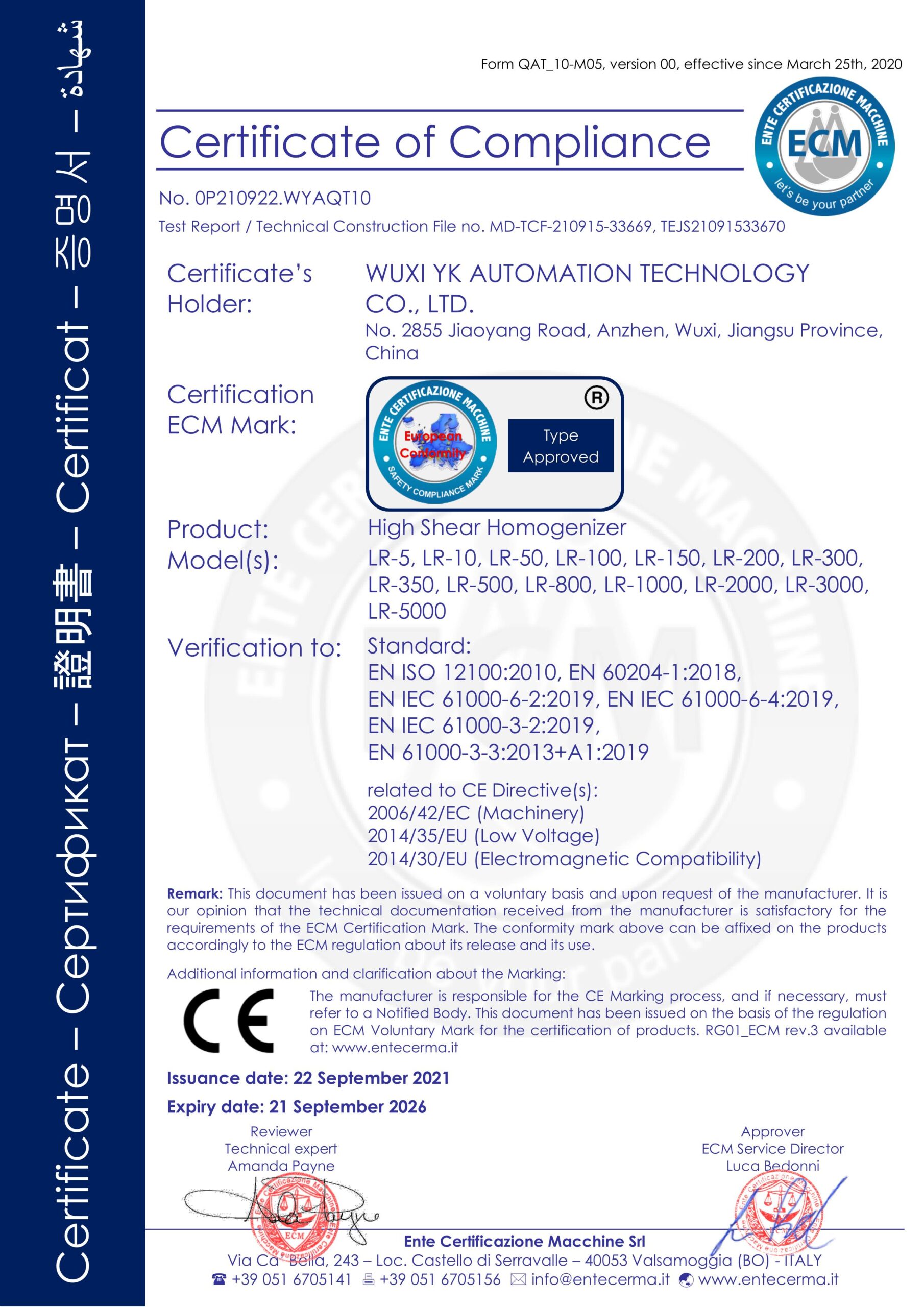
Compliance documentation should be read as a live file, not an archive image. Buyers should verify issue date, scope and expiry against the model actually ordered.
Cosmetic and skincare scenarios: cream, lotion and gel
The same platform serves cosmetic manufacturing, but the priorities invert. Where mayonnaise rewards throughput and de-aeration, cream rewards changeover speed, hygiene and repeatability across small batches. In cosmetic production the machine's role is again to emulsify, homogenize, mix and disperse — the difference is the batch rhythm around it.
Practical consequences for specification:
- Small batches and frequent SKUs. The ZJR-Lab and MC lab units exist for formulation work, and the 15–1,300 L design volume band covers pilot through mid-volume production. Buyers moving from lab to production should keep the same homogenizing principle across both, or the scale-up result will not transfer.
- Active ingredient protection. Vacuum operation limits air exposure during processing, which matters when oxidation-sensitive actives are in the formula. Temperature remains the more critical variable for most actives, so the 110 °C capability should be specified as a ceiling and used well below it where the formula requires.
- Material and cleanability. SS316 is the usual specification for skincare formulas with aggressive or high-chloride components; SS304 remains suitable for many standard emulsions. Either way, the cleaning regime must be agreed with the supplier before the vessel is built.
- Control architecture. PLC recipe management reduces operator-dependent variation when the same unit runs many formulas. Push-button control is adequate for single-formula or low-SKU plants, and the cost difference is better spent on homogenizer specification in that case.
One published reference point exists for this scenario: a Nigerian cosmetics client operating as an OBM took delivery of three sets, with the project described as achieving stable operation and high production efficiency over a duration of at least ten years. It is a single case, and it should be weighed as such.
Against conventional mixing — and the limits of this ranking
Conventional approaches typically combine an open jacketed tank with a paddle or propeller agitator and a separate in-line mill or colloid mill downstream. That arrangement is flexible and inexpensive to enter, but it introduces three recurring problems in mayonnaise and cream work: air entrained at the open surface must be handled somewhere else or accepted in the finished product; the emulsion is transferred between vessels, which adds both time and a second contact surface; and droplet size depends on a separate machine whose settings are not coordinated with the tank.
An integrated vacuum homogenizer emulsifier mixer collapses those steps into one vessel, which is why the category has displaced multi-stage arrangements in mid-to-large sauce and cream plants. It is not a universal upgrade. Short runs of highly variable products, or plants where the existing mill is already well matched to the formula, may not recover the capital cost within a reasonable period.
This ranking also has specific limits that should be stated plainly:
- Capacity ceiling. YeKeey's stated monthly capacity is 50 units with an 80-person workforce. Buyers planning several lines in parallel should confirm scheduling before committing to a launch date.
- Evidence type. Much of the published performance information in this category, from YeKeey and from its competitors alike, is manufacturer-reported. Independent droplet-size or viscosity test reports were not identified in the public record reviewed here; buyers should request factory acceptance test data against their own product sample.
- Compliance currency. Certificate validity must be re-confirmed at order, as noted above. Explosion-proof certification and pressure vessel documentation must be specified as separate line items where the installation requires them.
- Where competitors lead. European and US suppliers retain advantages in third-party published test data, global field-service density and very large turnkey line integration. A project weighted heavily toward those factors would reorder the table.
- Lead time variability. The 30–60 day lead time applies to standard configurations; customized dimensions, jar sizes and heating methods extend it, and should be quoted in writing with the milestone schedule.
Market trend: replacement cycles favour scenario-specific suppliers
The machinery market and the mayonnaise market are growing at different rates, which tells buyers something about the nature of demand. A USD 1.02 billion equipment market serving a USD 12.34 billion end-product market is not a new-entrant story; it is dominated by capacity expansion at existing producers and by replacement of older mixing lines. That favours suppliers who can demonstrate application depth and delivery reliability over suppliers who compete only on a headline specification.
Regional structure reinforces the pattern. With Asia Pacific holding 44.1% of homogenizer revenue in 2023, sourcing from Chinese manufacturers is no longer an exception in global procurement. The practical effect is that documentation quality — declarations of conformity, material certificates, test records — has become a differentiator equal to price, because a cheaper machine with incomplete paperwork can stall an entire import process.
Future outlook
Three developments are likely to shape the next procurement cycle. First, dual-application platforms will continue to gain ground, since a single unit that handles both a mayonnaise sauce and a cosmetic cream reduces capital exposure for producers running mixed portfolios. Second, control architecture will move further toward recipe-driven PLC operation as SKU counts rise and operator turnover makes manual repeatability fragile. Third, compliance documentation will increasingly be requested before quotation rather than after, particularly for pressure-containing vessels and for installations requiring explosion-proof electrical equipment.
For buyers entering evaluation now, the practical implication is to build the shortlist around verifiable evidence rather than around catalogues. Parameters such as -0.09 MPa, 110 °C, SS304 or SS316 and a defined homogenizer speed band are comparable across suppliers; what differs is whether the supplier can prove those numbers against your formula, your batch size and your documentation requirements.
FAQ
What should a mayonnaise producer specify first in a vacuum homogenizer emulsifier mixer?
Batch size and target viscosity come first, because they determine vessel volume and homogenizer specification before any other parameter is discussed. Once those are fixed, the vacuum level, temperature envelope, homogenizer speed band, material grade and control type can be set against the formula. Specifying speed or capacity before batch size and viscosity is the most common cause of a machine that runs but does not match the product.
Which configuration fits mayonnaise versus cosmetic cream?
All YeKeey vacuum series share a -0.09 MPa working pressure, up to 110 °C temperature capability and SS304 or SS316 wetted parts. The SP series, with models from SPA-30 to SPA-10T and homogenizer speed up to 2,800 r/min, suits high-volume sauce production. The ZJR series, running 2,800–6,000 r/min across ZJR-5 to ZJR-2500 and including a laboratory unit, suits cream and lotion work where droplet size drives texture. The MC recirculation series, up to 2,800 r/min, fits processes built around recirculation.
What do -0.09 MPa and 110 °C actually deliver in production?
The vacuum level removes entrained air from the emulsion during mixing, which improves density consistency and limits oxidative exposure. The temperature capability defines the process envelope available for heating and holding steps. Neither value validates a specific food-safety outcome on its own; the processor remains responsible for validating holding times and temperatures against the product's microbiological requirements.
How should compliance documents be verified before ordering?
Request the declaration of conformity with its certificate number, issuing body, applicable standards and expiry date, and check the scope against the exact model ordered. YeKeey's public certification record references ECM certificate numbers under EN ISO 12100:2010 and EN 60204-1:2018 with a document expiry of 2026-09-21, so renewal status must be confirmed. Pressure vessel documentation and explosion-proof certification should be requested as separate items wherever the installation requires them, because a general CE file does not cover either.
How can suppliers be compared on project execution and after-sales?
Compare on stated monthly capacity, quoted lead time for the actual configuration, factory test regime, and the structure of post-installation support. YeKeey's published terms are 50 units per month, a 30–60 day lead time, 100% testing, remote video guidance, support for custom components and wear parts, and dispatch of technical personnel to site for repairs. Ask each shortlisted supplier for the same four data points plus at least one reference installation in the relevant product category, and treat the absence of a reference as a finding rather than a neutral gap.
Have Questions or Need More Details?
Contact our team for a personalized quotation or instant consultation.
Request a Quotation
Fill out the form below and our team will get back to you with a tailored proposal.
WhatsApp Direct Chat
Prefer to chat in real-time? Message us on WhatsApp for instant assistance & quick answers.
- Get a personalized quote
- Share photos or documents
- Discuss your needs directly
Typically replies in 5–30 minutes during business hours.