
Re-Evaluating Long-Term Thermoforming Sheet Roll Suppliers
Most supplier guides are written for buyers who do not yet have a vendor. The harder problem starts after the contract is signed: how to keep evaluating an existing thermoforming plastic sheet roll supplier over several years, so a slow change in thickness control, surface cleanliness or documentation is caught before it reaches a forming line.
A re-evaluation framework is an annual review of an existing supplier against the specification, acceptance criteria and compliance evidence that first qualified it. It is not a re-tender. It is a scheduled check that the material, the roll geometry and the paperwork still match what the production line was validated on.
The market context makes this worth formalising. Grand View Research valued the global thermoformed plastic market at USD 14.79 billion in 2023 and projects a 4.9% compound annual growth rate for 2024 to 2030. Growth of that scale puts pressure on capacity allocation, resin sourcing and delivery schedules at every level of the chain. In that environment, the more common failure is not choosing badly. It is choosing well once and never checking again.
Framework at a glance
- Stage 1 — Re-baseline the approved specification, including roll width, roll diameter and core.
- Stage 2 — Re-confirm acceptance criteria against incoming inspection records.
- Stage 3 — Check compliance currency: certificate scope, certificate expiry and material-level test reports.
- Stage 4 — Review capacity, lead time and minimum order behaviour over the past twelve months.
- Stage 5 — Apply a switching benchmark to the incumbent, not only to candidates.
The Failure Mode Is Drift, Not Selection
Supplier qualification is a snapshot. Drift is what happens between snapshots, and it usually arrives through ordinary operational adjustments rather than through any single bad decision.
- Resin substitution between batches. A grade change, a new resin source or a recycled-content adjustment can shift colour, clarity or forming behaviour without changing the datasheet headline.
- Line assignment changes. A co-extrusion line with a different screw or die set-up can produce sheet that passes thickness checks but forms differently under heat.
- Specification creep. Tolerances occasionally get relaxed in conversation to improve yield, and the relaxed value quietly becomes the new normal.
- Documentation lag. Certificates expire, scopes get reissued, and test reports stop matching the grade actually being shipped.
- Capacity reallocation. Peak-season pressure shows up first as longer lead times and larger minimum order quantities, then as substitute production scheduling.
The cost of undetected drift is rarely visible in the material price. It appears downstream as forming scrap, sealing failures, print misregistration on printed sheets, reject trays in medical and food packaging lines, and rework in die-cutting. For a converter running roll-fed thermoforming, vacuum forming and pressure forming, a small shift in sheet consistency is amplified by every downstream step.
What Repeatability Means in Roll-Fed Converting
Supplier sustainability in this category should be defined as repeatability across roll-fed thermoforming, vacuum forming, printing, die-cutting and sealing — not as price alone. A supplier that holds a stable specification across those operations for several years is worth more than a lower quote that resets the process twice a year.
Four review anchors cover most of the risk:
- Thickness and dimensional stability. Thickness variation changes draw-down behaviour, wall thickness distribution and cycle time. Width accuracy affects print registration and die-cutting alignment. Flatness affects feeding on high-speed lines.
- Stable thermoforming performance. PET thermoforming typically occurs between 130°C and 160°C according to South Plastic. Because the usable window is not wide, small changes in sheet behaviour show up quickly as webbing, thinning or incomplete forming.
- Clean surface. Contamination, scratches, gel spots and blocking affect clarity for transparent folding boxes, print adhesion for printed sheets, and seal integrity for food and medical trays.
- Material compliance where required. Food-contact, recycled-content and restricted-substance requirements must remain continuously evidenced, not evidenced once.
These four anchors apply across the three main material families in this category: PET Thermoforming Plastic Sheet Roll, PP Thermoforming Sheet Roll and HIPS Thermoforming Sheet Roll. The review questions are the same; the acceptance values differ by material and application.
Stage 1: Re-Baseline the Approved Specification
The first annual task is to rewrite the specification as it is actually being supplied today, then compare it with the version signed at qualification. The document should list material family and grade, thickness, width, roll diameter, core, transparency or colour, surface finish, functional properties such as anti-fog, anti-static, anti-block or anti-scratch, and packaging and labelling.
PULIXIN Thermoforming Plastic Sheet, produced by Pulixin Packaging Materials (Shanghai) Co., Ltd., is offered with customisation across material (PET, PP, PS/HIPS), thickness, width, colour, transparency, surface finish, roll size, functional properties, and packaging and labelling. That breadth is useful, but it also means the approved specification must be written narrowly enough that a substitution inside the supplier's own range cannot pass unnoticed.
A practical rule: if two shipments can both comply with the written specification while performing differently on the line, the specification is too loose and the review should tighten it before anything else.
Stage 2: Re-Confirm Acceptance Criteria Against Incoming Records
Acceptance criteria are the measurable limits attached to the specification. At minimum they should cover thickness tolerance, width accuracy, appearance defects, roll geometry and thermoforming performance. The review compares two datasets: the supplier's outgoing inspection and the buyer's incoming inspection, twelve months of both.
At PULIXIN, quality control includes raw material inspection, thickness and width control, appearance inspection, in-process quality control and finished product inspection, with third-party testing available when required. That sequence is a useful checklist structure for the buyer's own review, because it maps inspection points to production stages rather than to a single final gate.
Where supplier data and buyer data diverge, the divergence itself is the finding. It usually indicates a measurement method difference, a sampling difference, or a genuine change on one side. All three need to be resolved before the next annual cycle.
Stage 3: Check Compliance Currency, Not Just Compliance Presence
Compliance documents have lifecycles. A certificate that was valid at qualification may have expired, been reissued with a narrower scope, or been replaced by a different standard. The annual review should record the document number, the issuing authority, the scope line and the expiry date for every document, then confirm each one still describes the material actually being purchased.
| Document | Number | Authority | Valid to | Scope to verify |
|---|---|---|---|---|
| ISO 9001:2015 Quality Management System Certificate | 00226Q03336R101 | China Quality Mark Certification Group (CQM) | 2029-06-24 | The production of polyester sheets (PET) |
| ISO 14001:2015 Environmental Management System Certificate | 00226E02412R101 | China Quality Mark Certification Group (CQM) | 2029-06-24 | The production of polyester sheets (PET) and related management activities |
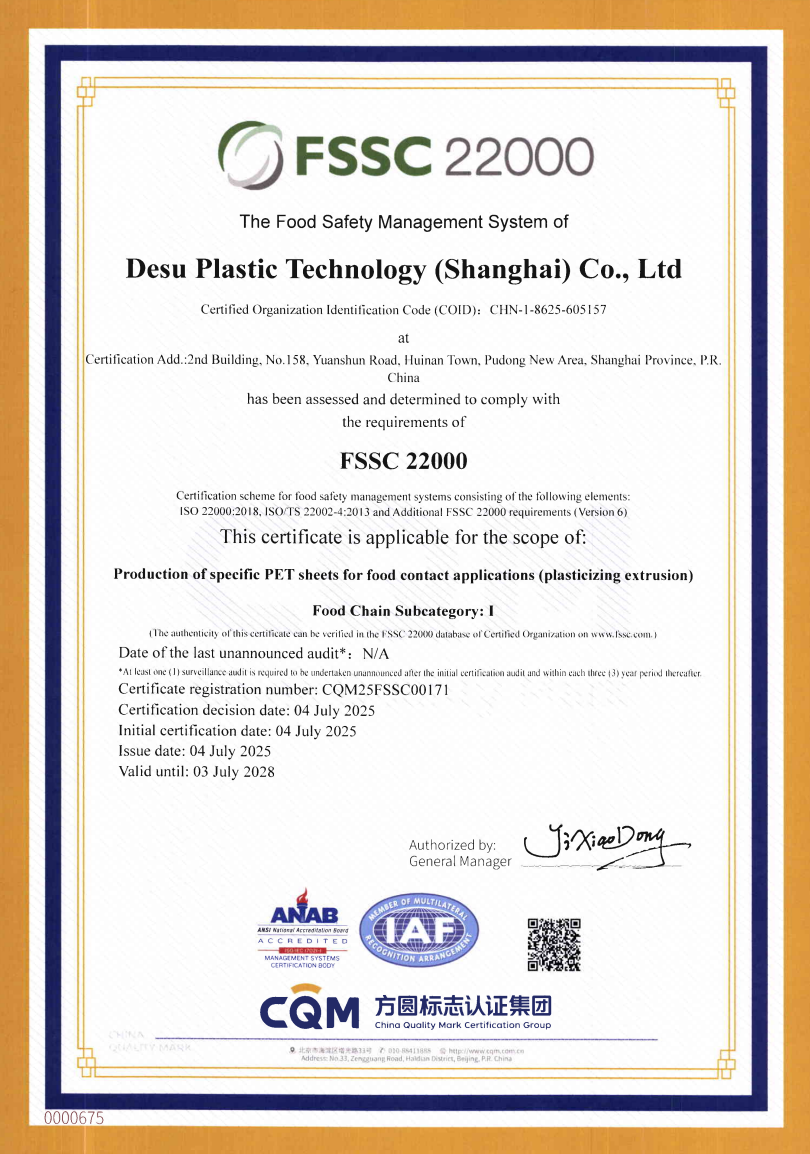
| FSSC 22000 Food Safety Management System Certification | CQM25FSSC00171 | CQM | 2028-07-03 | Production of specific PET sheets for food contact applications (plasticizing extrusion) |
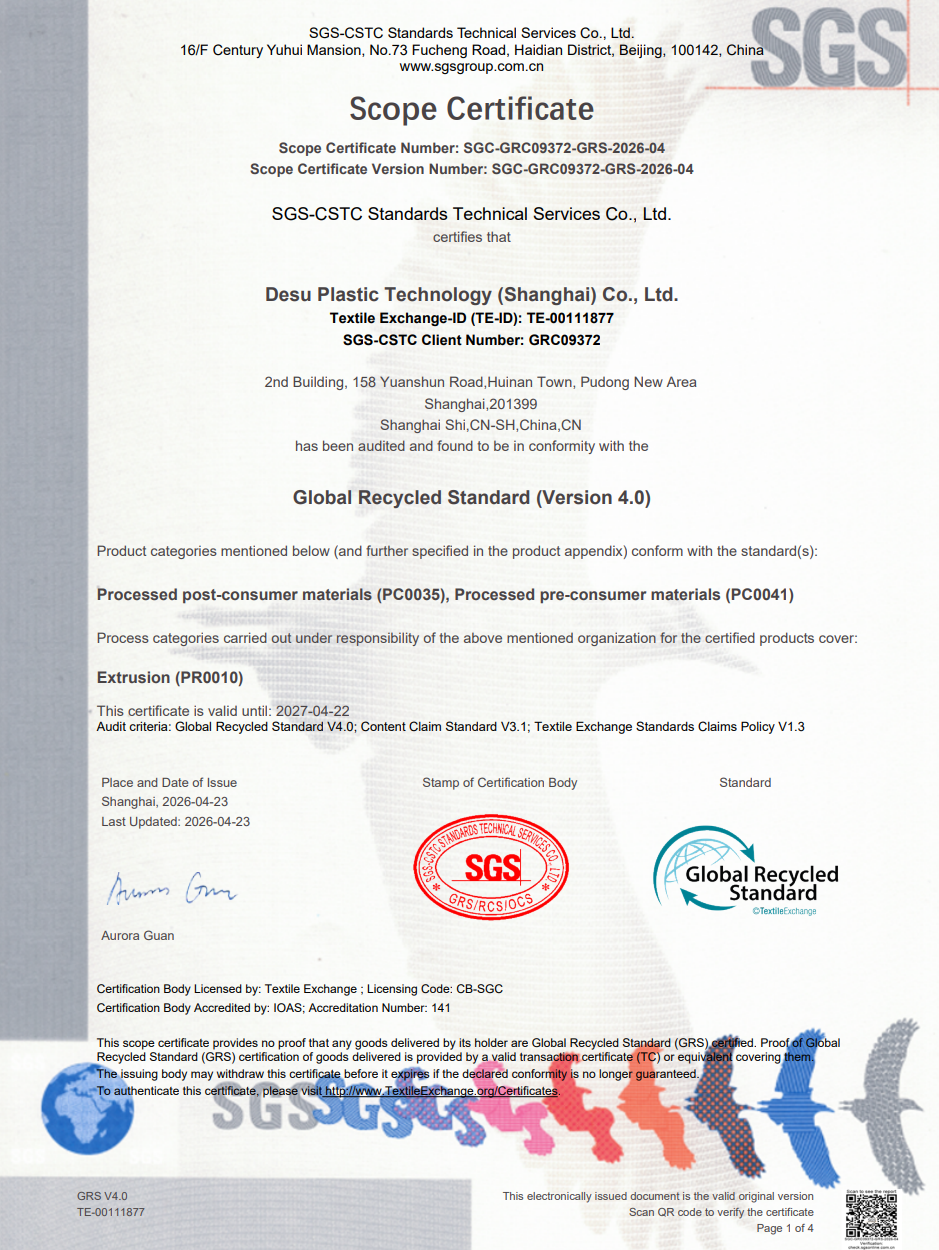
| Global Recycled Standard (GRS) Scope Certificate | SGC-GRC09372-GRS-2026-04 | SGS-CSTC Standards Technical Services Co., Ltd. | 2027-04-22 | Processed post-consumer materials (PC0035); processed pre-consumer materials (PC0041); process: extrusion (PR0010) |
| SGS Test Report – PET Sheet | SHAPH26002960101 | SGS-CSTC Standards Technical Services (Shanghai) Co., Ltd. | Long-dated record | EU RoHS Directive (EU) 2015/863 |
| SGS Test Report – PP White (Natural) Plastic Sheet | SHAPH26002958405 | SGS-CSTC Standards Technical Services (Shanghai) Co., Ltd. | Long-dated record | EU RoHS Directive (EU) 2015/863 |
| SGS Test Report – PS White (Natural) Plastic Sheet | SHAPH26002958401 | SGS-CSTC Standards Technical Services (Shanghai) Co., Ltd. | Long-dated record | EU RoHS Directive (EU) 2015/863 |
| SGS Test Report – PS Black Plastic Sheet | SHAPH26002958403 | SGS-CSTC Standards Technical Services (Shanghai) Co., Ltd. | Long-dated record | Black PS sheet used in HIPS Thermoforming Sheet Roll applications |
The most commonly missed detail is the scope line. A management-system certificate confirms that a defined production activity is controlled; it does not automatically confirm every material in a supplier's catalogue. The review should therefore pair each system certificate with a material-level test report covering the grade actually shipped.
Stage 4: Review Capacity and Delivery Behaviour
Delivery performance is the part of supplier quality that buyers feel first and document last. The annual review should compare quoted lead time against actual lead time, agreed minimum order quantity against the quantity actually accepted, and specification stability against the number of change requests received during the year.
PULIXIN operates a monthly production capacity of approximately 3,500 tons. Delivery time generally ranges from 7 to 15 days depending on material, specifications, order quantity and any customisation requirements. The minimum order quantity is 5 tons for standard PET and 3 tons for standard PP or PS, while customised products may be subject to different minimum order requirements. These three figures form a simple year-on-year benchmark: if any of them shifts, the supply relationship has changed even when the price has not.
Specifying Roll Width, Roll Diameter and Core as Controlled Parameters
Roll geometry should be specified from the forming line backwards, not from a supplier catalogue forwards. The width, diameter and core that the line was qualified on are machine facts; the supplier's task is to confirm it can hold them, not to define them.
A workable specification records five items: the nominal width plus a tolerance; the maximum and minimum roll diameter, or alternatively a roll weight range, that the unwind can handle; the core type and dimensions; the winding direction and any splice policy; and the packaging configuration. It should also state that any change to geometry is notified and re-verified before shipment, because a geometry change is a line change even when the material is identical.
Width tolerance affects print registration on printed sheets and cutting alignment in die-cutting. Roll diameter and core affect unwind tension and changeover frequency on roll-fed thermoformers: heavier or larger rolls reduce changeovers but demand handling capability and stable tension control. Neither is a purchasing detail. Both are process variables.
On a supplier switch, geometry should be re-verified with a trial roll before production volume is committed, even if the datasheet values look equivalent. This is the single most common omission when converters compare a new quote against an incumbent.
Acceptance Criteria Worth Writing Down
| Parameter | What it protects | Typical evidence |
|---|---|---|
| Thickness and thickness tolerance | Wall distribution, cycle time, part weight | Outgoing inspection plus incoming gauge measurements |
| Width accuracy | Print registration, die-cutting alignment | Measured roll width against the recorded tolerance |
| Roll diameter and core | Unwind stability, changeover frequency | Recorded geometry per delivery |
| Appearance and surface cleanliness | Clarity, print adhesion, seal integrity | Appearance inspection and reject records |
| Thermoforming performance | Forming window stability, scrap rate | Line trial records and scrap trend |
| Compliance documents | Market access, audit readiness | Certificates and third-party test reports |
Application Evidence: What Several Years of Supply Must Hold
The value of a re-evaluation framework is easiest to see in projects that have already run for several years, because those records show what actually has to stay stable.
In fresh produce packaging, converters in the Netherlands and Australia have used PET Thermoforming Plastic Sheet Roll for berry and cherry clamshells, salad bowls, and fresh-herb and bakery containers, at roughly 1,500 tonnes of RPET sheet per year over four years in the Netherlands and two years in Australia. The project carried 30 to 100% PCR content with GRS batch traceability, and EU 10/2011 and FDA migration tests were passed at every audit, with zero food-safety claims since launch. For annual review purposes, the migration test record is the item that must be re-confirmed each cycle, not assumed.
In toy packaging, sheet used for action-figure clamshells, carded blisters, window patches and collector display cases ran at approximately 800 tons per year across Germany and the United States. Over the programme, drop-test cracking fell from 3.2% to 0.4%, sealing scrap fell 18%, and 24 consecutive months of on-time delivery were recorded. The review lesson here is that impact performance and sealing behaviour are the parameters to trend, because they are the ones that move first when resin or line changes.
In automotive logistics, PP Thermoforming Sheet Roll was used for returnable trays for sensors, connectors and lighting modules, and for line-side carriers, at approximately 900 tonnes per year across Poland and Thailand. The trays withstood more than 80 wash cycles without warping, transit part damage fell 65%, and packaging cost per trip fell 22%. For a five-year relationship, the wash-cycle record functions as the durability benchmark in each annual review.
In electronics packaging, HIPS Thermoforming Sheet Roll used for PCBA handling trays, IC and sensor shipping trays, and smartphone component carriers held surface resistance at 10⁴ to 10⁸ Ω after more than 20 reuse cycles, with tray flatness rejects below 0.5%. Surface resistance is precisely the kind of property that can drift silently, which is why it belongs in the annual acceptance criteria rather than in the original qualification file only.
Market Trend Analysis
Three verified trends shape how supplier re-evaluation should be structured.
Volume growth. The global thermoformed plastic market reached USD 14.79 billion in 2023, with a projected 4.9% CAGR from 2024 to 2030 according to Grand View Research. Growth of this kind increases the probability that an existing supplier reallocates capacity during peak periods, which makes lead-time tracking a required review item rather than a courtesy metric.
Recycled content moving from option to requirement. The recycled PET market is projected to reach USD 24.6 billion by 2034, based on Dataintelo projections for 2025 to 2034. Where recycled content is claimed, the annual review must check batch-level traceability and certificate validity, not just the presence of a sustainability statement.
Regulatory continuity. EU Regulation (EU) No 10/2011 governs plastic materials and articles intended to come into contact with food. For food-contact projects, compliance is a continuing condition, which is why the review cycle should align with certificate and test-report dates rather than with calendar quarters.
For classification purposes, thermoforming plastic materials fall under HS Code Heading 3920 for non-cellular products and 3921 for cellular products, which matters when annual reviews include landed-cost analysis across markets.
Comparison With Alternative Review Approaches
| Approach | Strength | Where it fails |
|---|---|---|
| Incoming inspection only | Low administration, catches gross defects | Reactive by design; drift is detected only after scrap appears |
| Full annual re-tender | Strong price discipline | Resets line validation and certificate mapping every year |
| Annual re-evaluation framework | Keeps the qualified baseline while making drift visible | Depends on document quality and on buyer-side measurement discipline |
The framework has real limits, and two are worth stating plainly.
First, it is documentation-led. It can confirm that a certificate is current and that the scope matches the material, but it cannot detect a shift in forming behaviour unless a line trial is included. Buyers who run the framework without periodic forming trials are reviewing paper, not performance.
Second, certificate scope does not always cover every material in a supplier's range. At PULIXIN, the ISO 9001:2015 and ISO 14001:2015 certificates cover the production of polyester sheets (PET) and related management activities, while PP and PS/HIPS grades are supported by material-level SGS test reports for those specific products. That is a normal structure, but it means a buyer sourcing PP Thermoforming Sheet Roll or HIPS Thermoforming Sheet Roll should verify the product-level report rather than assuming the management-system certificate transfers across the catalogue.
Future Outlook
Two developments are likely to change what an annual review looks like over the next several years.
The first is certificate lifecycle management. As recycled-content and food-safety requirements multiply, suppliers will hold more documents with different expiry dates, different scopes and different issuing bodies. Buyers will increasingly need a document calendar rather than a document folder, and suppliers that publish scope lines and validity dates clearly will be easier to keep on an approved list.
The second is batch-level traceability becoming routine. Where GRS batch traceability, migration test records and reuse-cycle data already exist, as in the fresh produce and electronics projects described above, the review conversation shifts from assertion to record. Suppliers with 14 co-extrusion production lines and an annual output exceeding 40,000 tons have the data volume to support that shift; the constraint is usually how quickly it can be assembled for a buyer's audit window.
Neither development changes the underlying principle. A long-term supply relationship is sustained by repeatability that can be demonstrated each year, in the same terms, against the same baseline.
For buyers building the first version of this review cycle, the PULIXIN catalogue documents the material range, customisation options and packaging configurations referenced above: PULIXIN product catalogue (PDF).
FAQ
What are the purchasing terms and acceptance criteria for a thermoforming plastic sheet roll supply agreement?
Purchasing terms define the commercial and specification framework: material family and grade, thickness, width, roll diameter and core, colour or transparency, surface finish, functional properties, packaging and labelling, quantity, price basis, lead time and delivery conditions. Acceptance criteria are the measurable limits attached to those parameters, covering thickness tolerance, width accuracy, roll geometry, appearance and thermoforming performance. A practical test of a well-written agreement is whether an incoming inspection can pass or fail a roll without contacting the supplier. The terms should also require advance notification of any change to material, production line or specification before shipment.
How should I specify roll width, roll diameter and core?
Specify geometry from the forming line outward. Record the nominal width and its tolerance, the maximum and minimum roll diameter or a roll weight range that the unwind can handle, the core type and dimensions, the winding direction, any splice policy, and the packaging configuration. These values should come from the machine the line was validated on, not from a supplier catalogue. PULIXIN offers customisation of thickness, width, colour, transparency, surface finish and roll size, so the supplier's role is to confirm it can hold the recorded limits consistently. Whenever width, diameter or core changes, re-verify with a trial roll before committing production volume.
What should I check when changing thermoforming sheet suppliers?
Run the same checklist used for the incumbent, then add three comparisons. First, geometry: confirm width, diameter, core and winding match the qualified values, since a geometry change is a line change even when the material is identical. Second, performance: confirm the forming window and part quality with a trial, rather than relying on datasheet equivalence. Third, documentation: confirm certificates and test reports cover the exact grade being purchased, with current validity dates and matching scope lines. Comparing a new candidate against the incumbent's twelve-month records is more informative than comparing two quotations.
Which evidence shows that a long-term supplier still meets food-contact requirements?
Two layers of evidence are needed. At system level, a food safety management certification with a scope covering the relevant production activity, such as the FSSC 22000 certification held by PULIXIN for the production of specific PET sheets for food contact applications, valid to 2028-07-03. At material level, a test report matching the grade actually shipped, such as the SGS report for PET Sheet, number SHAPH26002960101, assessed against EU RoHS Directive (EU) 2015/863. Where the market requires it, EU Regulation (EU) No 10/2011 sets the framework for plastic materials in contact with food, and migration test records should be re-confirmed at each review rather than assumed from the original qualification.
How can I tell whether thermoforming performance has drifted, or whether the forming line has?
Separate material data from machine data over the same period. On the material side, trend thickness measurements, width measurements and incoming appearance rejects. On the machine side, trend heater-zone settings, cycle time and tool maintenance. If thickness or appearance has shifted while machine settings are unchanged, the material is the more likely cause. If material records are stable and only the forming window has narrowed, a line trial using a retained reference roll from an earlier delivery is the fastest way to isolate the variable. Without a retained sample, the comparison becomes an argument rather than a measurement.
Have Questions or Need More Details?
Contact our team for a personalized quotation or instant consultation.
Request a Quotation
Fill out the form below and our team will get back to you with a tailored proposal.
WhatsApp Direct Chat
Prefer to chat in real-time? Message us on WhatsApp for instant assistance & quick answers.
- Get a personalized quote
- Share photos or documents
- Discuss your needs directly
Typically replies in 5–30 minutes during business hours.