
Reading CE Certificate M.2025.206.C131314: Stamping & Punching
CE documentation for packaging machinery is normally read at the wrong moment — after the purchase order is signed and the machine is already being prepared for shipment. Certificate M.2025.206.C131314, issued by UDEM, is a scoped conformity document for one machine type: the Roll-to-Roll Full Servo Stamping & Punching Window Machine. The document lists four harmonized standards — EN ISO 12100:2010, EN 60204-1:2018+A1:2025, EN 61000-6-2:2019 and EN 61000-6-4:2019 — and its qualification applies to the equipment described in it. For bag makers buying stamping or window-punching capacity for pouch lines, the useful question is not whether a CE certificate exists, but what exactly it covers, against which standards, and for which configuration.
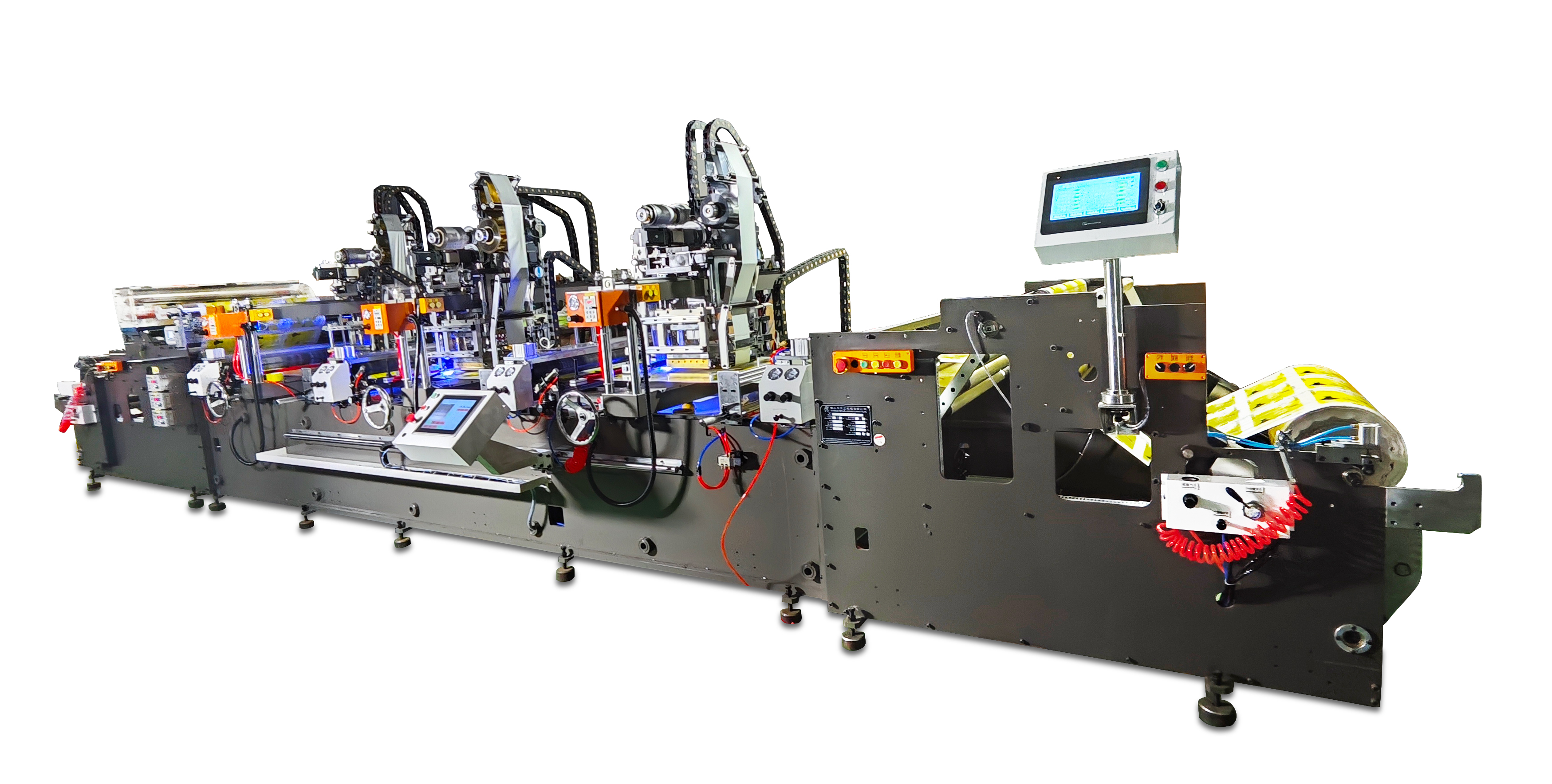
A full servo, CCD-registered roll-to-roll stamping unit — the machine category addressed by certificate M.2025.206.C131314.
What a CE Certificate Actually Documents
A CE certificate is a record of a conformity assessment, not a marketing badge. For machinery placed on the European Union market, the manufacturer applies the CE marking and compiles the technical file; where the applicable legislation requires the involvement of an external assessment body, that body issues a document describing what was assessed and against which standards. Certificate M.2025.206.C131314 follows this second pattern: UDEM is named as the issuer, the machine is identified in the title of the document, and the harmonized standards used in the assessment are listed explicitly.
Two structural features of such a document matter more than its visual appearance. The first is that a certificate is machine-specific: it certifies a described equipment configuration, not a company and not a catalogue. The second is that the standards list is the technical heart of the document. Standards names on their own mean very little; the edition, the amendment suffix and the standard type tell the reader which design questions were examined — risk assessment methodology, electrical equipment safety, or electromagnetic compatibility in an industrial environment.
Independent industry references are useful at this point because compliance terminology is often blurred in commercial correspondence. "CE certified" is frequently written on quotations without a certificate number, an issuer or a machine description attached. A reader who knows which three elements to look for can separate a document from a claim in a few seconds.
Reading the Identification Block: Issuer, Number, Machine
Every certificate carries an identification block. On M.2025.206.C131314 the block resolves into four readable elements:
| Element | Content on the document |
|---|---|
| Issuing organisation | UDEM |
| Certificate number | M.2025.206.C131314 |
| Equipment covered | Roll-to-Roll Full Servo Stamping & Punching Window Machine |
| Harmonized standards referenced | EN ISO 12100:2010; EN 60204-1:2018+A1:2025; EN 61000-6-2:2019; EN 61000-6-4:2019 |
When the number is quoted — in a purchase contract, a technical file, a customs enquiry or a supplier questionnaire — it should be written exactly as M.2025.206.C131314, as one unbroken string. Re-typed or abbreviated certificate numbers are a routine source of confusion during audits, because a certificate number is an identifier rather than a description: it carries no meaning that can be reconstructed from its parts, and a shortened version does not point to the same record.
The equipment description deserves the same care. The certificate names a roll-to-roll machine, which indicates that the equipment processes a continuous web fed from a roll; it names a full servo machine, which indicates that the main motion axes are servo-driven rather than mechanically linked; and it names a combined stamping and punching window function, meaning foil application and window cutting are performed on the same material path. Each of those three words changes which engineering risks the assessment had to address.
The Four Harmonized Standards and What Each One Governs
The standards listed on the certificate are not a random selection. Two of them are general machinery safety standards and two are generic electromagnetic compatibility standards for industrial environments. Read together, they describe a machine whose principal risks are mechanical and electrical, and whose servo content makes electromagnetic behaviour relevant.
| Standard | Domain | What it addresses on a roll-to-roll stamping and punching machine |
|---|---|---|
| EN ISO 12100:2010 | Risk assessment and risk reduction | The general methodology for identifying hazards and reducing risk at the design stage: unwind and rewind stations, foil feeding paths, the stamping and punching zones, web tensioning points, and the movement of servo-driven axes. |
| EN 60204-1:2018+A1:2025 | Electrical equipment of machines | The electrical side of the machine: control cabinets, drive and servo power stages, protective bonding, stop functions and operator interfaces. The +A1:2025 suffix records that the 2018 edition has been amended, so the current consolidated text is the reference point. |
| EN 61000-6-2:2019 | EMC — immunity | A generic immunity standard for industrial environments: whether the machine's controllers, sensors and registration electronics continue to function correctly in the presence of electrical disturbance typical of a converting hall. |
| EN 61000-6-4:2019 | EMC — emission | A generic emission standard for industrial environments: limits on disturbance the machine itself generates, which matters when several servo-driven lines share a supply and a common earthing system. |
One additional point helps buyers read the scope accurately rather than optimistically. Harmonized standards are organised in a hierarchy. EN ISO 12100:2010 belongs to the general, type A level and applies broadly to machinery design; the EN 415 series covers specific safety requirements for packaging machines and sits at the type C level. Packaging machinery exported to the EU is expected to comply with EN ISO 12100:2010 for risk assessment and CE marking purposes, while machine-type requirements are addressed by the relevant type C standards. Where a certificate lists general standards, the buyer can reasonably ask which type C standard, if any, was used for the packaging-machine-specific aspects of the assessment — a question that belongs in the technical file rather than in a marketing reply.
Why a Full Servo Stamping and Punching Window Machine Carries a Distinct Compliance Burden
The electrical and EMC entries on M.2025.206.C131314 are not incidental. A roll-to-roll stamping and punching window machine concentrates several engineering functions on a single material path. The web moves continuously; foil is fed, tensioned and recovered; heat and pressure are applied at the stamping station; a window is cut or punched and the waste is rewound; and registration between the pattern and the printed web is controlled in real time.
On the CCD vision model in this machine family, registration accuracy is specified at ±0.1 mm, with real-time correction used to compensate film stretch and feeding deviation; on a flat model, the corresponding figure is ±0.3 mm. Acceptable film thickness is 0.012–0.3 mm. Production speed runs from 30 to 180 cycles per minute depending on pattern size, substrate and foil, and fine-line work is specified down to a minimum stamping line width of 0.2 mm, with a minimum hollow-out gap of 0.5 mm to prevent foil sticking and blurring. These are not marketing figures — they are the tolerances that determine how many servo axes, sensors and switching devices sit inside the control cabinet, and therefore how much electrical noise the machine both generates and must tolerate.
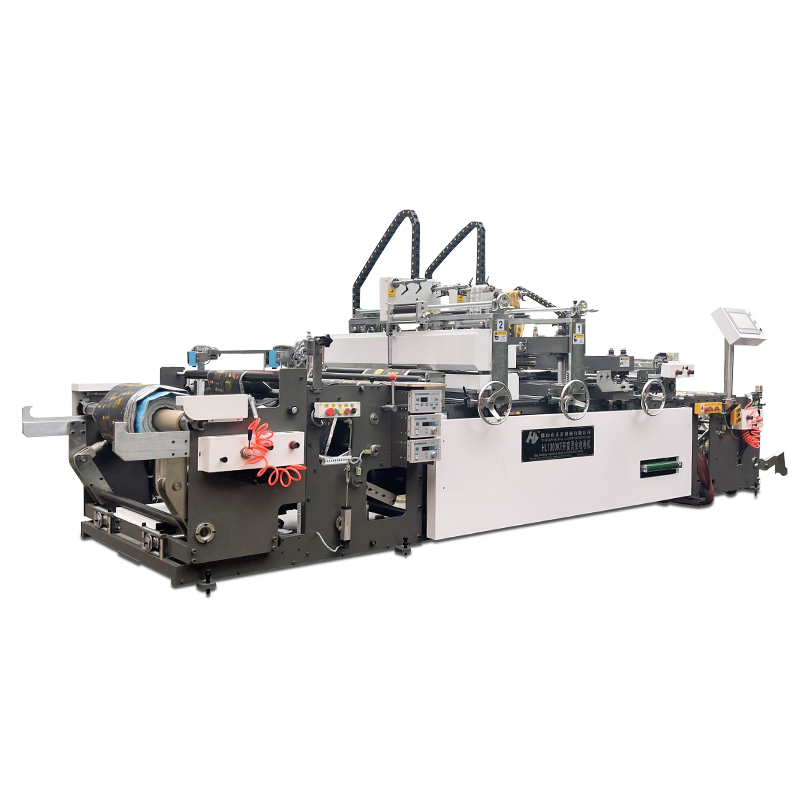
A combined punching-window and embossing stamping station: foil application and window cutting on one continuous web path.
That is the practical reason EN 60204-1:2018+A1:2025 and the two generic EMC standards appear alongside the risk-assessment standard. Mechanical guarding alone does not describe this machine; the assessment has to account for the electrical equipment and for the electromagnetic behaviour of a cabinet full of drives.
Scope Boundaries: What M.2025.206.C131314 Does Not Cover
The most consequential sentence on a certificate is usually the one that limits it. M.2025.206.C131314 applies to the specified machine — the Roll-to-Roll Full Servo Stamping & Punching Window Machine identified in the document. It does not extend automatically to:
- other models in the same manufacturer's stamping or bag making range;
- a machine of the same type that has been reconfigured after assessment — for example by adding a further stamping station, changing the drive package, or integrating an additional inline unit;
- equipment supplied by third parties and combined into the same line;
- a relabelled machine sold under a reseller's own brand.
Two further boundaries are worth stating plainly. A certificate of this kind does not replace the EU Declaration of Conformity, the technical file or the risk assessment that the manufacturer is required to produce; it is part of that documentation set, not a substitute for it. And it does not freeze the standards it cites. EN 60204-1:2018+A1:2025 shows the mechanism directly: an amendment published in 2025 modifies a text originally issued in 2018. A certificate read against a superseded edition is still a real document, but it describes an assessment performed against requirements that have since moved.
Where This Machine Sits in a Pouch Production Line
Stamping and window punching are upstream of the bag itself. The roll stock passing through a machine of this type is subsequently converted into finished pouches, and the window and foil details have to register with the printed artwork on every format the bag maker runs. That is why these units are typically specified alongside printing machine, slitter machine, film blowing machine and rewinding machine, and are operated continuously in a flexible packaging environment at indoor normal temperature.
The pouch formats downstream of the stamping and punching stage define what the compliance scope has to keep up with. A converter running the following categories will place different demands on the same upstream machine:
- stand-up with zipper bag making machine and flat bottom with zipper bag making machine — heavy-gauge laminates where foil registration travels across gussets and folds;
- doypack bag making machine, zipper pouch making machine and central seal pouch making machine — formats where the window position is tightly tied to the printed panel;
- Bag-in-box bag making machine and valve pouch making machine — structures with an integrated fitment, where the stamping detail must avoid sealing zones;
- labeling bag making machine and label pasting in-line bag making machine — lines where an inline labelling operation follows converting on the same web;
- plastic pouch making machine formats in general, which share the same upstream window and foil requirements.
The machine side of that workflow is documented in measurable terms. Bag making machine series in this category run at 30–130 bags per minute, cover a bag width range of 50–1200 mm, and use a 380 V, 50 Hz supply with total power between 30 kW and 131.4 kW depending on configuration. Those figures explain why electrical safety and EMC assessment cannot be treated as paperwork: a line at the upper end of that power range is a significant electrical installation in its own right.

Compliance documentation is increasingly compared line by line at industry exhibitions, not exchanged as a single PDF.
Market Context: Pouch Demand Keeps Pushing Stamping and Punching Into the Mainstream
The reason CE documentation is scrutinised more closely than it was a decade ago is structural rather than regulatory in origin. Pouch formats have moved from a niche to a mainstream pack type, and every additional pouch format carries decoration and functionality requirements that a stamping and punching stage has to deliver.
Published market research supports that reading. The stand-up pouches market was valued at USD 30.7 billion in 2023 and is projected to grow at a CAGR of 8.0% through 2030. Within the pouch market, the zipper closure segment represented 41.0% of total revenue share in 2025, and flat pouches accounted for the largest product share at 63.7% in the same year, largely on cost-efficiency and high-speed production capability. On the equipment side, the global bag making machine market was valued at USD 4.8 billion in 2025 and is projected to reach USD 8.1 billion by 2034, with Asia Pacific holding a 43.6% revenue share in 2025 and automatic machines accounting for 52.4% of the global product type share.
Two implications follow for buyers. First, machine populations are growing fastest in the regions that export most actively to Europe, which increases the volume of CE documentation flowing through procurement departments. Second, sustainability and the shift to mono-material recyclable films were identified as top drivers for machine upgrades in 2024–2025 — and mono-material structures are thinner, run at different tension profiles, and are less forgiving of registration drift. Window punching and foil stamping on such substrates depends on the registration and control performance that the electrical and EMC standards on M.2025.206.C131314 relate to.
It is worth adding a note of caution about market data itself. Published estimates for the bag making machine market vary considerably depending on whether "bagging machines" or "bag making machines" are being counted, and Bag-in-Box figures diverge between machine-only and material-inclusive definitions. Buyers using market numbers to justify a capital project should check the definition behind the figure before comparing sources.
Certificate-Based Compliance vs. Traditional Assumptions: Where the Evidence Stops
The traditional approach to CE evidence in machinery procurement is a supplier statement — a line in a quotation reading "CE compliant" or "CE certified", sometimes accompanied by a certificate for a different machine, or by a certificate covering a general equipment category rather than the unit on order. It is fast, and it is frequently accepted without further reading.
The certificate-scoped approach represented by M.2025.206.C131314 is slower and more precise. The issuer is named, the number is fixed, the machine is described, and the harmonized standards are listed. A buyer can verify what was assessed, against which editions, and for which configuration.
Its limitation is equally real: the precision of the document is also its narrowness. A certificate issued against one machine configuration cannot be used as evidence of conformity for a different model, for a modified version of the same model, or for a line assembled from several suppliers' units. In practice this means that a bag maker ordering a stamping and punching window machine and a separate zipper pouch line should expect two separate compliance positions, not one. The certificate also cannot answer questions the buyer may genuinely have — about line-level integration, about the combined electrical installation, or about the type C packaging machinery standards — because those fall outside its scope by design. Buyers who assume that a scoped certificate answers every compliance question are simply making the opposite error to buyers who accept an unscoped claim.
Outlook: Standard Editions Will Keep Moving
Harmonized standards are revised on their own cycle, independent of any single machine or supplier. The amendment suffix on EN 60204-1:2018+A1:2025 is a reminder that a standards list has a shelf life: the electrical equipment requirements behind a 2018 text were amended in 2025, and further amendments will follow. For buyers, the practical consequence is procedural rather than dramatic. Certificate numbers, standard editions and amendment suffixes should be recorded in the purchase file at the time of order, and re-checked whenever the same machine type is purchased again, whenever a line is reconfigured, or whenever the machine moves to a different site within the EU.
A second trend points the same way. As converting lines add servo axes, vision systems and inline inspection, the electrical and electromagnetic content of machine compliance grows relative to the purely mechanical content. Machines of the type described in M.2025.206.C131314 have already moved into that territory: registration accuracy of ±0.1 mm and real-time CCD correction are control-system achievements as much as mechanical ones. Buyers who read electrical and EMC standards as boilerplate will find those sections increasingly difficult to skip.
About the Manufacturer
FOSHAN TIANZHENG MACHINERY CO., LTD. is a manufacturer specialising in flexible packaging equipment. The company was established in 1993 and originated from Hongli Bag Making, which was also founded in 1993. Its main products are bag making machines, hot stamping machines and die-cutting machines, and its major markets span the globe, with export business accounting for 30% of total sales.
The manufacturing facility covers 6,000 m² and employs approximately 90 staff, with an annual production capacity of 500 units and an R&D team of 15 engineers. The company holds ISO 9001 International Quality Management System Certification and is recognised as a Guangdong Provincial Specialized, Refined, Distinctive and Innovative Enterprise. Its intellectual property portfolio includes 10 domestic invention patents, 3 international patents, 43 utility model patents and 1 design patent. Online technical support is provided for after-sales service.
Within that portfolio, the roll-to-roll stamping line carries model designations including HL1000FT-D, HL1200KT-4H and HL1000T3-UC-CCD. Certification M.2025.206.C131314, issued by UDEM, describes a Roll-to-Roll Full Servo Stamping & Punching Window Machine — the equipment category these units belong to — and lists EN ISO 12100:2010, EN 60204-1:2018+A1:2025, EN 61000-6-2:2019 and EN 61000-6-4:2019 as the harmonized standards applied. Buyers evaluating a specific order should confirm the machine description on the certificate against the configuration quoted, in the same way they would for any supplier.
Product documentation for the bag making, stamping and die-cutting ranges is available in the company brochure: 2026 Tianzheng machinery brochure (PDF).
FAQ: Reading the CE Certificate for Roll-to-Roll Stamping and Punching Window Machines
What does CE certificate M.2025.206.C131314 cover?
It covers the Roll-to-Roll Full Servo Stamping & Punching Window Machine described in the document. The issuer named on the certificate is UDEM. The harmonized standards listed are EN ISO 12100:2010, EN 60204-1:2018+A1:2025, EN 61000-6-2:2019 and EN 61000-6-4:2019, and the qualification stated in the document applies to the specified machine rather than to a broader product range.
Which harmonized standards appear on the certificate and what do they address?
Four standards are listed. EN ISO 12100:2010 addresses risk assessment and risk reduction in machinery design. EN 60204-1:2018+A1:2025 addresses the electrical equipment of machines and includes a 2025 amendment to the 2018 edition. EN 61000-6-2:2019 and EN 61000-6-4:2019 are generic electromagnetic compatibility standards for industrial environments, dealing with immunity and emission respectively.
Does one CE certificate cover a manufacturer's whole bag making machine range?
No. A certificate of this type is issued against an identified machine. Certificate M.2025.206.C131314 names the Roll-to-Roll Full Servo Stamping & Punching Window Machine, so it cannot be presented as evidence of conformity for other models, for other machine categories such as die-cutting or pouch making units, or for a reconfigured version of the same machine, unless the certificate itself is extended to cover that equipment.
What should a buyer check first on a CE document?
Four items, in order. The issuer and the certificate number written in full — M.2025.206.C131314 rather than an abbreviated form. The equipment description, checked against the machine actually being purchased. The standards list, including edition and amendment suffixes such as the +A1:2025 element in EN 60204-1:2018+A1:2025. And the scope statement, which defines what the document does and does not qualify.
Are EMC standards relevant for a mechanical stamping machine?
They are relevant where the machine contains servo drives, vision registration systems and switching power components. EN 61000-6-2:2019 is a generic immunity standard for industrial environments and EN 61000-6-4:2019 is the corresponding generic emission standard; both appear on certificate M.2025.206.C131314. Broadly, they address whether the machine's control electronics keep working in a converting hall and whether the machine itself disturbs other equipment sharing the same supply.
Where does the roll-to-roll stamping and punching window machine fit in a bag making line?
It processes roll stock continuously and is typically specified alongside printing machine, slitter machine, film blowing machine and rewinding machine. Its output feeds pouch converting processes including flat bottom with zipper bag making, stand-up with zipper bag making, doypack, zipper pouch, valve pouch, central seal pouch, Bag-in-box and labeling bag making, where window openings and foil details must register with the printed web on every format produced.
Why does the standards list matter more than the certificate's presence?
Because the list identifies which engineering questions were examined. A risk-assessment standard, an electrical equipment standard and two generic EMC standards describe a machine whose principal assessed risks are mechanical and electrical, with electromagnetic behaviour included because of its drive and control content. A certificate read without its standards list gives a buyer no basis for judging whether the assessment covered the aspects of the machine that matter to their production environment.
Have Questions or Need More Details?
Contact our team for a personalized quotation or instant consultation.
Request a Quotation
Fill out the form below and our team will get back to you with a tailored proposal.
WhatsApp Direct Chat
Prefer to chat in real-time? Message us on WhatsApp for instant assistance & quick answers.
- Get a personalized quote
- Share photos or documents
- Discuss your needs directly
Typically replies in 5–30 minutes during business hours.