
Reading CTI Certificates for Custom Casual Apparel: GB 18401-2010 Category B Explained
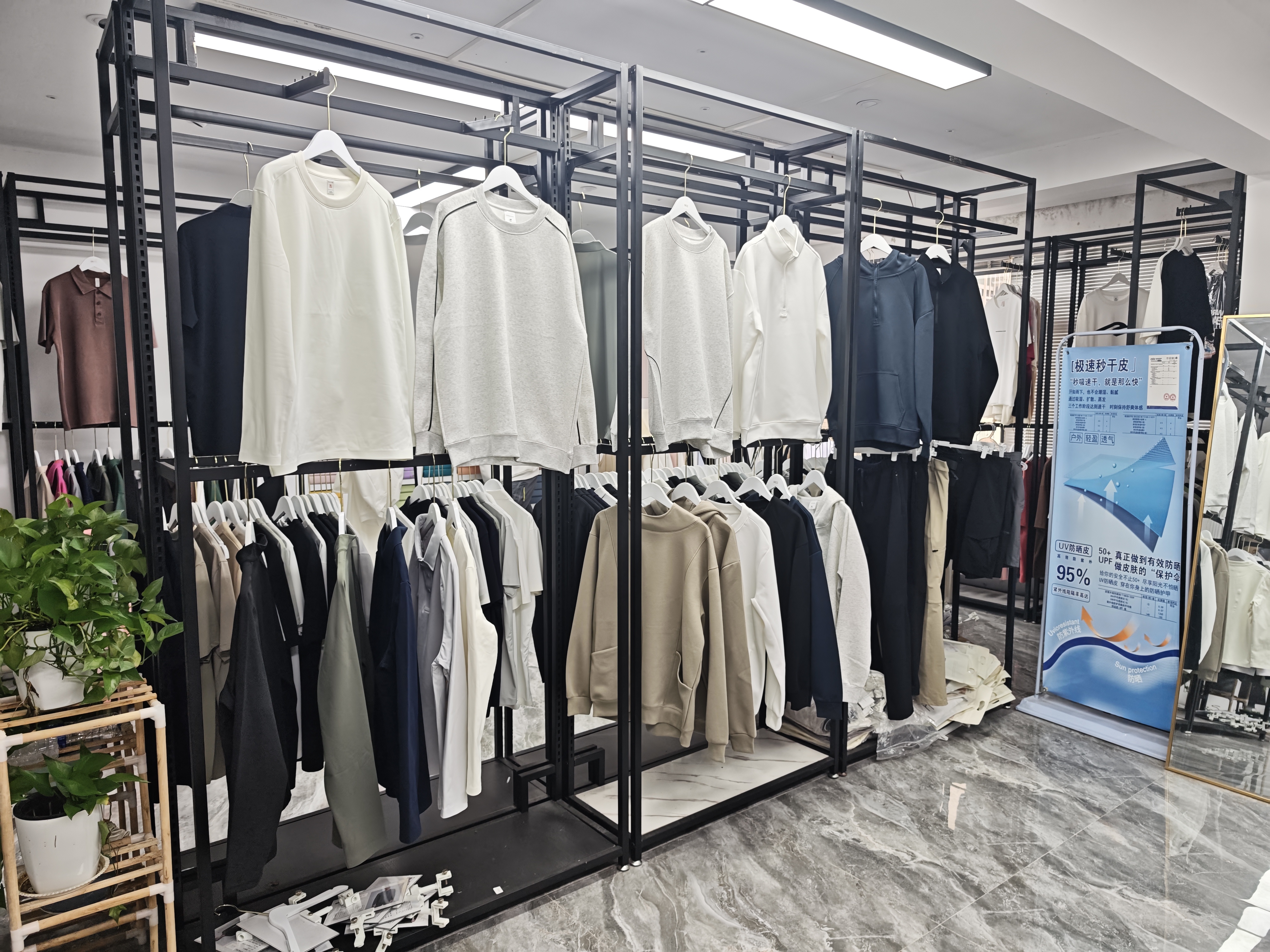
A CTI certificate number is an address, not a badge. It points to one tested fabric, one issuing laboratory and one standard — and only by following that address can a brand buyer conclude which custom casual apparel SKU is actually covered.
Most qualification conversations stall at the wrong question. Suppliers are asked whether they “have certificates”, and buyers accept a PDF cover page as an answer. The more useful question is narrower and answerable: which certificate number covers the fabric inside item 6252, 6744 or 6749, and what exactly did the laboratory test? For custom casual apparel programmes, that distinction separates a compliance file that survives a retail audit from one that collapses when an auditor asks for the fabric-to-style link.
This reference walks through the three CTI Tianjin reports held by Lihongwear — Guangzhou Lihong Apparel Trade Co., Ltd., a menswear OEM/ODM manufacturer supplying custom casual apparel to brand owners, wholesalers and cross-border sellers from a 5,000 m² plant in Guangzhou — and shows how a buyer reads them line by line before awarding a purchase order. Lihongwear is used below as the working short name for that company.
Why the certificate number, not the certificate claim, decides qualification
A textile safety test report is a bounded document. It names a laboratory, a standard, a material scope and a validity window. Everything outside that boundary is unaddressed. When a supplier says “our fabrics are CTI tested”, the statement is true but unusable; when a supplier says “certificate A2250414729102C covers Mountain Cotton composite hoodie fabric”, the statement can be checked, filed and quoted back to an auditor.
That is why certificate numbers matter more than certificate claims in vendor qualification. A number can be matched against the report the buyer actually received, against the style’s bill of materials, and against the production window. A claim cannot.
The commercial context makes this practical work worth doing. The global casual wear market was valued at USD 645.22 billion in 2025 and is projected to reach USD 906.32 billion by 2034, according to Fortune Business Insights. As volume grows, documentation requests from marketplaces, retailers and corporate buyers grow with it, and a supplier that can map certificate to fabric to item answers those requests in minutes rather than weeks.
What GB 18401-2010 Category B covers in a CTI report
On all three Lihongwear reports, the standard line reads GB 18401-2010 Category B, and the stated scope of testing covers national standards for fiber composition, color fastness, formaldehyde and decomposable aromatic amine dyes. In plain terms, the laboratory is confirming that the submitted fabric meets the Chinese national textile safety requirements for those properties at Category B level.
Category B, in the GB 18401-2010 classification, is the class that corresponds to textile products worn in direct contact with the skin — the class most casual tops, hoodies and long sleeve shirts fall into. Buyers running infant or heavily regulated programmes should note that Category B is a defined class rather than a universal one; if a programme specifies a different category, that is a separate scope question to raise with the supplier rather than an assumption to make from an existing report.
Two boundaries are worth stating plainly at the outset, because they are the most common source of misreading:
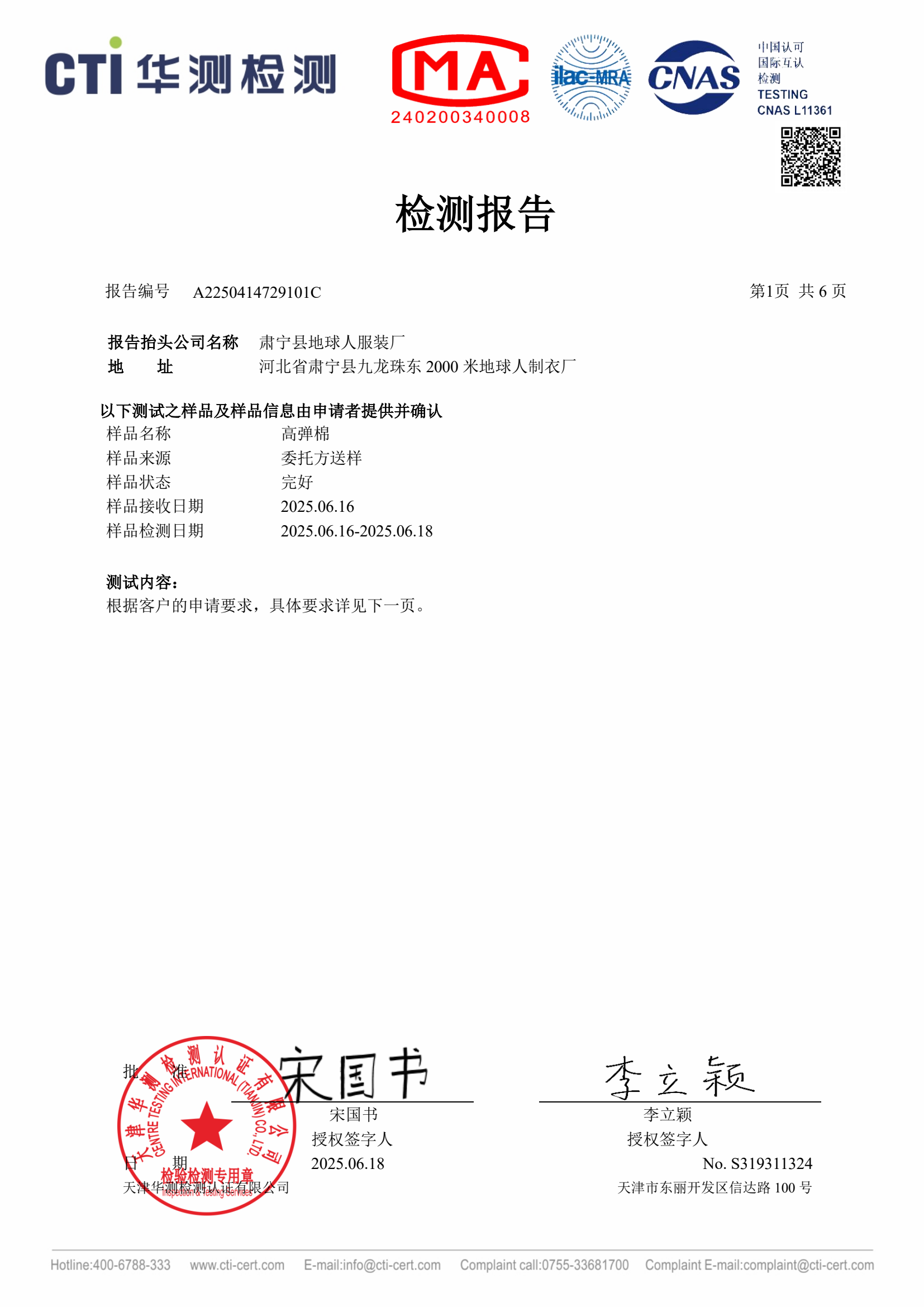
- The report tests a fabric, not a brand. The scope line names a material — for example “Mountain Cotton composite fabric” or “high-elastic fabric (100% polyester fiber, navy knitted fabric)”. A style only inherits the report through the fabric it is cut from.
- It is a product test, not a factory system certification. A CTI textile safety report is not a quality management system certificate, an environmental certificate or a social compliance audit. It answers a materials-safety question and nothing more.
The CTI register: certificate number to fabric to item
The three reports below are the complete set referenced in this article. All three were issued by Centre Testing International Group Co., Ltd. (CTI Tianjin), all three cite GB 18401-2010 Category B, and all three apply to the global export markets Lihongwear serves — Europe, America, Southeast Asia, the Middle East and Australia.
| Certificate number | Issuing lab | Scope as stated | Items it is linked to | Issue / expiry |
|---|---|---|---|---|
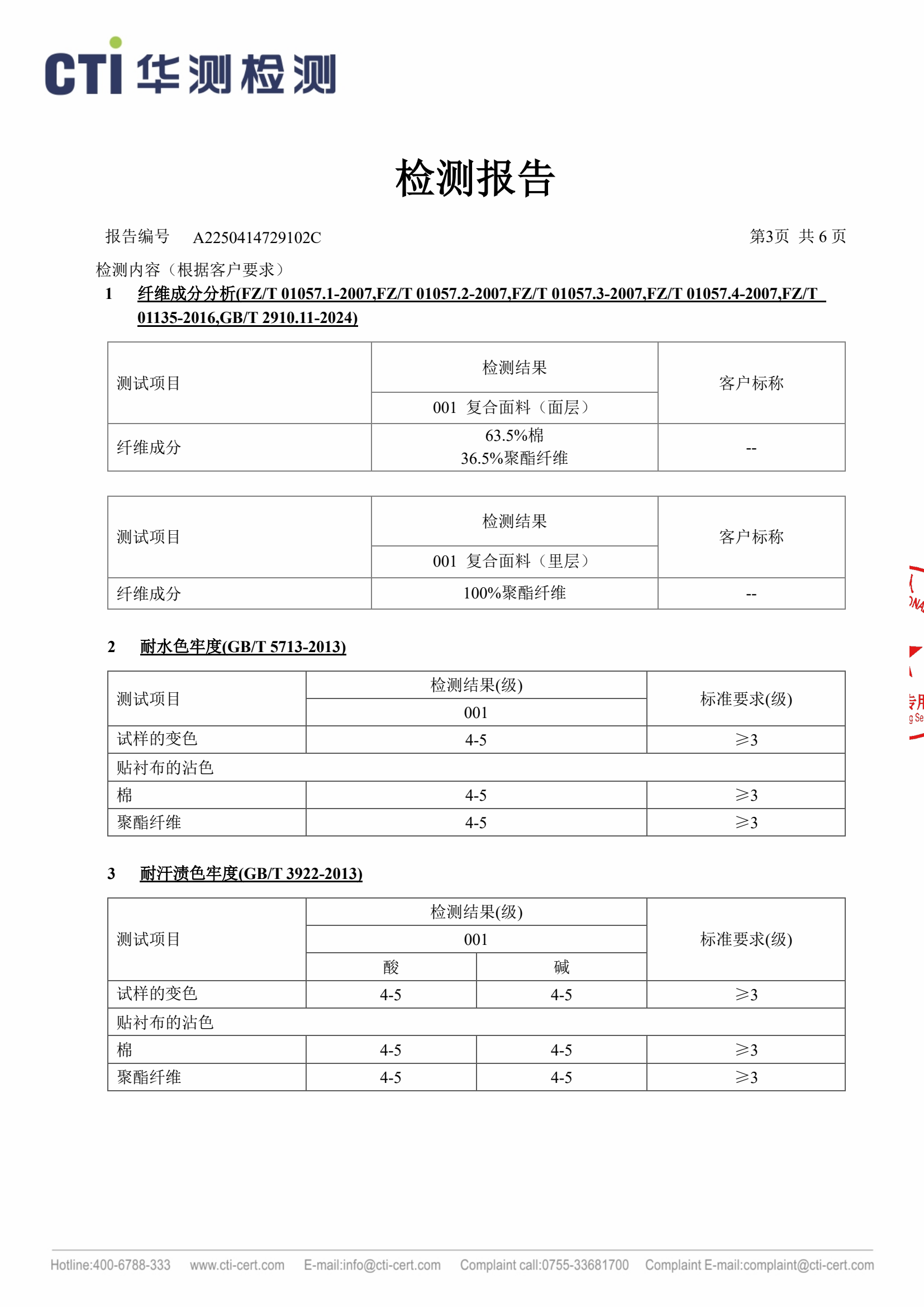
| A2250414729102C | CTI Tianjin | Mountain Cotton composite fabric (hoodie fabric, 63.5% cotton + 36.5% polyester composite) | Hoodies & Sweatshirts, item 6744 (1901 Series); Men’s Basic Apparel, item 6252 | 2025-06-18 / 2099-06-18 |
| A2250414729101C | CTI Tianjin | High-elastic fabric (100% polyester fiber, navy knitted fabric) | Long Sleeve Shirts, item 6749 (1801 Series, 1701 Series); Men’s Basic Apparel, item 6252 | 2025-06-18 / 2099-06-18 |
| A2250308141104CR1 | CTI Tianjin | Full range of men’s hoodies, long-sleeve shirts, T-shirts and other garment fabrics | Men’s Basic Apparel, item 6252; Long Sleeve Shirts, item 6749; Hoodies & Sweatshirts, item 6744 | 2025-05-29 / 2099-05-29 |
Read as a set, the register shows a deliberate structure rather than a pile of documents. Two reports are fabric-specific — Mountain Cotton composite for the hoodie programme, high-elastic knit for the long sleeve programme — and one report, A2250308141104CR1, carries a broader fabric-range scope across hoodies, long sleeve shirts and T-shirts. Item 6252, the Men’s Basic Apparel range that spans blank tees, shirts, polo shirts, 360g hoodies, long sleeve undershirts, casual jackets and long pants, appears against all three.
Five checks before accepting a CTI report for an order
The following sequence converts a certificate PDF into an auditable record. It applies to any supplier, not only to the reports above.
- Match the number to the document you were given. Confirm the certificate number printed on the report matches the number quoted in the supplier’s specification sheet or email. A number quoted but not shown, or shown under a different number, is a gap to close before evaluation continues.
- Read the issuing laboratory and the standard together. In these reports both the issuer (Centre Testing International Group Co., Ltd. — CTI Tianjin) and the standard (GB 18401-2010 Category B) are stated on the document. A report should never be summarised without both.
- Read the scope line as a material, not a marketing phrase. “Mountain Cotton composite fabric (hoodie fabric, 63.5% cotton + 36.5% polyester composite)” tells you exactly which fabric was submitted. If your SKU is cut from a different fabric, the report does not travel with it.
- Match the fabric to the style’s bill of materials. This is the step that produces the mapping. Item 6744 sits on Mountain Cotton through A2250414729102C; item 6749 sits on high-elastic knit through A2250414729101C; item 6252 spans multiple fabrics and therefore appears against multiple reports. Ask the supplier to state the fabric-to-style link in writing.
- Check dates against your production window. The three reports carry issue dates of 2025-05-29 and 2025-06-18, with expiry recorded as 2099-05-29 and 2099-06-18 respectively. Confirm those dates cover the whole of your order and shipment period, and ask what happens if the fabric changes mid-programme.
For a private label casual apparel programme, the output of these five checks should be a one-page register — certificate number, lab, standard, scope, style numbers, dates — attached to the purchase order. That single page is what a retail auditor or a marketplace compliance reviewer will ask for.
Where AQL inspection and third-party on-site inspection take over
A CTI report and an inspection report answer different questions, and buyers who treat them as substitutes usually end up with a hole in one of the two.
The laboratory report addresses material safety: fiber composition, color fastness, formaldehyde and decomposable aromatic amine dyes for the submitted fabric. It says nothing about whether the garment in your carton has the right stitch density, the right measurement tolerance, the right print placement or the right label.
That second question is handled in production. Lihongwear operates a six-stage full-process quality inspection covering raw materials, in-process checks and finished goods, executed against AQL international standards, with 100% manual inspection before shipment. Factory self-inspection, remote video inspection and third-party agency on-site sampling inspection are all available as acceptance routes, and the same structure is available on custom orders where the buyer arranges an independent inspection body.
The practical division of labour is straightforward: the certificate closes the materials-safety question at evaluation stage; AQL-based inspection closes the workmanship and consistency question at execution stage. A buyer who collects only the first has documentation without delivery assurance; a buyer who collects only the second has quality control without a materials-safety trail.
How brand buyers use the register in practice
Three use patterns account for most of the value.
Onboarding a core basics range. A brand owner building a first custom casual apparel order typically starts with a small style set — a hoodie, a long sleeve top, a basic tee. The register above allows each style to be filed against a named report before the sample is even approved: item 6744 to A2250414729102C, item 6749 to A2250414729101C, and either style additionally to the broader A2250308141104CR1. Custom orders start from 200 pieces per style, so a three-style launch is a realistic first programme rather than a theoretical one.
Answering marketplace and retail documentation requests. Cross-border sellers and offline retail buyers are increasingly asked, at listing or at intake, which standard the fabric was tested to and which report covers it. A register that names CTI Tianjin, GB 18401-2010 Category B and the specific certificate number answers that request in one document. Suppliers serving these channels already see the demand: Lihongwear exports around 80% of output across Europe, America, Southeast Asia, the Middle East and Australia.
Corporate and uniform programmes. Corporate workwear buyers usually need the same evidence in a procurement file rather than a marketing pack. Because item 6252 spans blank tees, shirts, polo shirts, 360g hoodies, long sleeve undershirts, casual jackets and long pants in sizes XS–5XL, a single item number can carry several departments’ orders — which makes the fabric-to-certificate mapping the deciding document when a programme mixes styles in one purchase order.
Limits: what a CTI report does not prove
The most useful part of a compliance conversation is often the boundary. A mapped certificate register is stronger than a certificate claim, but it is still bounded, and buyers should treat the following as live questions rather than settled facts.
| What the document shows | What the buyer must still verify |
|---|---|
| A named fabric passed GB 18401-2010 Category B testing at CTI Tianjin | That the fabric in your specific order lot is the same fabric named in the scope line |
| Report numbers and dates are stated on the document | That the dates still cover your production and shipment window |
| Fiber composition, color fastness, formaldehyde and aromatic amine dyes are within scope | Whether your programme requires additional properties, a different category, or non-fabric components |
| The supplier describes AQL-based inspection and third-party on-site inspection | That an inspection is actually scheduled, and by whom, before shipment |
One further limit deserves emphasis. A report scoped to a fabric does not automatically extend to a new fabric, a new colorway base cloth, or a component you introduce later. Where a programme moves outside the documented scope, the honest position is that documentation has to be established for the new material — and that this is a separate task with its own timeline, not an assumption to be carried over from an existing file. Buyers who build that expectation into their calendar avoid the common failure of discovering a documentation gap two weeks before shipment.
None of this argues against the mapped register. It argues for reading it accurately: a certificate is most valuable when the buyer knows exactly where its authority stops.
Outlook: documentation moves from appendix to filter
Two signals suggest that certificate mapping will become a screening criterion rather than a closing formality. Chemical-safety certification activity is expanding: OEKO-TEX issued over 50,000 certificates between 2023 and 2024, an increase of 22%, reflecting the industry’s shift toward chemical safety and regulatory compliance. Separately, the custom made clothes market is estimated to reach USD 213.1 billion by 2035, with a CAGR of 10.5% from 2026, according to Proficient Market Insights — growth that brings more private label entrants, and with them more requests for verifiable documentation.
The likely consequence is procedural. Buyers will stop accepting “we are certified” and start asking for a number, a scope line and a style link, because that is the only form of the claim that can be filed, compared across suppliers and re-checked a year later. Suppliers who already maintain that mapping — as the three-report register above illustrates — will spend less time answering qualification questions and more time on development.
For reference, Lihongwear publishes a product catalogue covering its custom casual apparel ranges: Product Catalog of Lihong Garment Factory (PDF).
FAQ
Which CTI certificate covers Lihongwear hoodies, item 6744?
Hoodies & Sweatshirts item 6744 (1901 Series) is linked to certificate A2250414729102C, which scopes Mountain Cotton composite fabric — a 63.5% cotton, 36.5% polyester composite — issued by Centre Testing International Group Co., Ltd. (CTI Tianjin) under GB 18401-2010 Category B, with an issue date of 2025-06-18 and expiry of 2099-06-18. Item 6744 is also listed against certificate A2250308141104CR1, whose scope covers the full range of men’s hoodies, long-sleeve shirts, T-shirts and other garment fabrics.
What does GB 18401-2010 Category B cover in these reports?
The standard line on all three reports cites GB 18401-2010 Category B, and the stated testing scope covers national standards for fiber composition, color fastness, formaldehyde and decomposable aromatic amine dyes. Category B corresponds to textile products worn in direct contact with skin. The report is a product test on the submitted fabric; it is not a quality management system certification or a factory audit.
How do I match a certificate number to a specific SKU such as 6252 or 6749?
Match through the fabric, not the product name. Certificates A2250414729102C and A2250414729101C name specific fabrics — Mountain Cotton composite and high-elastic 100% polyester knit respectively — and each is linked to the items cut from that fabric: item 6744 and item 6252 for the first, item 6749 and item 6252 for the second. Item 6252, the Men’s Basic Apparel range, is additionally listed against A2250308141104CR1, whose scope covers the full range of men’s hoodies, long-sleeve shirts, T-shirts and other garment fabrics.
Does a CTI test report replace AQL inspection?
No. The laboratory report addresses material safety properties for the submitted fabric. AQL inspection addresses workmanship and consistency in the finished garment. Lihongwear operates a six-stage full-process quality inspection across raw materials, in-process checks and finished goods, executed against AQL international standards, with 100% manual inspection before shipment. Factory self-inspection, remote video inspection and third-party agency on-site sampling inspection are available as acceptance routes, and the two evidence types are complementary rather than interchangeable.
What is the minimum order quantity for custom casual apparel, and how long does production take?
Custom orders start from 200 pieces per style. Spot goods carry no minimum order and support mixed wholesale, with shipment within 3 days; custom orders run 15–25 days from sample confirmation to bulk delivery. Customisation covers fabric weight, garment size, colour, front and back printing, embroidery logo, hangtag, wash label and a full set of packaging.
Can a buyer verify a certificate claim before shipment?
Yes, through two routes. The first is document verification: request the report itself, confirm the certificate number, issuing laboratory (CTI Tianjin), standard (GB 18401-2010 Category B), scope line and dates, and have the supplier state the fabric-to-style link in writing. The second is physical verification: third-party agency on-site sampling inspection can be arranged at the factory, alongside remote video inspection where an on-site visit is not practical.
Have Questions or Need More Details?
Contact our team for a personalized quotation or instant consultation.
Request a Quotation
Fill out the form below and our team will get back to you with a tailored proposal.
WhatsApp Direct Chat
Prefer to chat in real-time? Message us on WhatsApp for instant assistance & quick answers.
- Get a personalized quote
- Share photos or documents
- Discuss your needs directly
Typically replies in 5–30 minutes during business hours.