
Reading ECM Attestation NO.3N230816.YCPQQ51: UPVC Door Scope
Tenders for UPVC doors in markets outside the European Union increasingly ask suppliers to name the third-party document behind their profile systems — not merely the profile series. ECM Attestation NO.3N230816.YCPQQ51 is one of those documents, and reading it correctly matters more than citing it.
ECM Attestation NO.3N230816.YCPQQ51 is a voluntary attestation issued by Ente Certificazione Macchine Srl (ECM) for UPVC windows and doors. It references standard EN 14351-1:2006+A2:2016, covers profile series 50, 60, 65, 80, 88 and 112, and is intended for third countries outside the EU market. It was issued on 2023-08-16 and expires on 2028-08-15. The attestation applies to the UPVC door product rather than to a single order, model or shipment.
For procurement teams, the practical question is narrower than the certificate itself: does this document answer the question my tender specification is actually asking? That depends on three things — scope, standard and market.
What the Attestation Says, Element by Element
Most misreading of attestations happens when a single field — usually the standard number or the series list — is quoted in isolation. The document is best read as a set of separate statements.
| Element | What the attestation states |
|---|---|
| Attestation number | NO.3N230816.YCPQQ51 |
| Issuing body | Ente Certificazione Macchine Srl (ECM) |
| Product scope | UPVC windows and doors |
| Referenced standard | EN 14351-1:2006+A2:2016 |
| Profile series covered | 50, 60, 65, 80, 88 and 112 |
| Intended market | Third countries outside the EU market |
| Issue date | 2023-08-16 |
| Expiry date | 2028-08-15 |
| Nature of document | Voluntary attestation for the UPVC door product |
Two fields carry more procurement weight than the others. The intended market field tells a buyer where the document is designed to be useful, and the series list tells a buyer which profile systems the document actually reaches. A tender reference that cites the attestation number without checking either field can create a mismatch between what the specification requires and what the document covers.
Why Non-EU Tenders Ask for This Kind of Document
In project markets across LATAM, MENA, ASEAN and the Caribbean, specifiers often cannot visit a factory or disassemble a sample door to verify the profile system behind it. Local building access standards still require the finished installation to satisfy wind-pressure resistance, water tightness and air permeability, and to perform in outdoor conditions that include coastal high humidity and strong wind loads.
The gap is documentation rather than intent. A tender panel needs a third-party statement that names the profile series, names the standard framework, and names the issuing organisation — because the panel itself will not test the profiles. That is the role ECM Attestation NO.3N230816.YCPQQ51 plays: it converts an internal product scope into an externally identifiable statement that can be checked by a buyer who is not in the factory.
This is also why the attestation is described as voluntary. It is not a market-access gate. It is a document a supplier chooses to obtain and a buyer chooses to request, and its value comes from being specific enough to be verified.
What the Six Profile Series Mean in Practice
Profile series numbers in the UPVC industry generally refer to the nominal depth of the profile system in millimetres, and each series carries its own chamber layout, wall thickness and reinforcement geometry. The consequence for procurement is straightforward: a certificate that names six series covers six different engineering systems, not one product repeated six times.
The coverage stated in ECM Attestation NO.3N230816.YCPQQ51 — series 50, 60, 65, 80, 88 and 112 — is therefore a range statement. It reaches from compact profiles used in lighter openings up to deep profiles used for large sliding and lift-and-slide configurations. For a tender that mixes casement doors on one elevation with wide sliding doors on another, a range statement is more useful than a single-series certificate, because the specification can be matched to the document line by line.
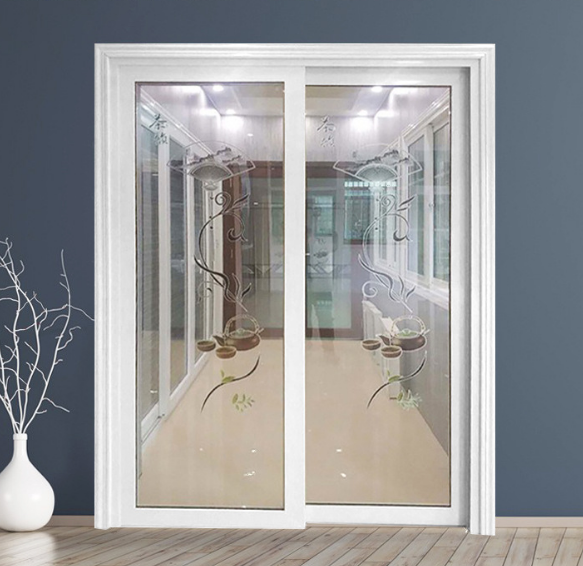
A UPVC 88-series sliding door — one of the profile system families named in the attestation's series coverage. Image: Foshan Nanhai Yuanzhaiji UPVC Door & Window Factory.
It is worth separating the series list from the manufacturer's own standard supply range. Foshan Nanhai Yuanzhaiji UPVC Door & Window Factory, a UPVC door and window manufacturer established in 2009 and located in Foshan, China, states that it regularly supplies Conch profiles in the 60, 65 and 88 series. The attestation's series coverage is broader than that routine supply range, which means a buyer should still confirm, project by project, which series is being quoted rather than assuming the widest certificate line applies to the delivered order.
How EN 14351-1:2006+A2:2016 Fits Into the Reading
EN 14351-1:2006+A2:2016 is the harmonised European product standard for windows and external pedestrian doorsets. Referencing that standard in the attestation places the document inside a recognised performance framework rather than an internal factory claim.
Under that framework, the performance of a finished window or door is established through a defined set of system tests. These typically include wind resistance, water tightness, air permeability, sound insulation, thermal performance, drop-weight impact and welding corner strength. The framework also assumes that PVC-U profiles are reinforced with internal galvanised steel liners, that a factory production control (FPC) system is in place, and that test reports and technical documentation are retained for inspection.
This distinction matters because two doors built from the same profile series can end up in different performance classes once glazing specification, reinforcement, hardware and opening type change. The series list defines what is eligible to be assessed; the test documentation defines what was actually achieved.
Where the Covered Door Product Is Used
The application profile behind the UPVC door product is consistent with the attestation's non-EU market scope. The product is designed for outdoor environments with high humidity and strong wind loads, and operates under outdoor, coastal high-humidity and strong-wind conditions. That combination — salt air, driving rain and pressure differentials — is common in the Caribbean, Gulf and coastal Southeast Asian project markets where third-country documentation is requested.
Project types include residential building projects, commercial building projects, villa projects and renovation projects. Operating modes cover sliding operation, tilt-and-turn opening and manual opening and closing, which is why a single series-range attestation is relevant across a mixed elevation schedule.
Requirements the door must satisfy in these scenarios
- Wind-pressure resistance, water tightness and air permeability
- Impact and wear resistance, plus a secure locking system
- Weather-resistant and anti-aging behaviour in exposed elevations
- Compliance with local building access standards at project level
The functional result is resistance to wind and rain combined with thermal insulation and sound insulation for the indoor environment — the two performance dimensions that drive residential comfort and, increasingly, regulatory compliance. Supporting equipment in these installations includes door handles, door hinges, door rollers, anti-collision stoppers, dust-proof pile weatherstrip and EPDM sealing gaskets. Hardware selection sits outside the profile series scope, so it remains a separate item on a buyer's verification list.
A field reference point
A Caribbean building project supplied by the same manufacturer illustrates how these requirements behave over time. The project involved 500 m² of UPVC doors for builder clients, with a fully fabricated casement door supplied to the site. Reported performance includes stable sealing, smooth switch operation, low-noise sliding, and water-proof and dust-proof behaviour, against a designed 10-year service life. The project used fully packed products for delivery, which is a normal requirement when doors travel to a third-country site before installation.
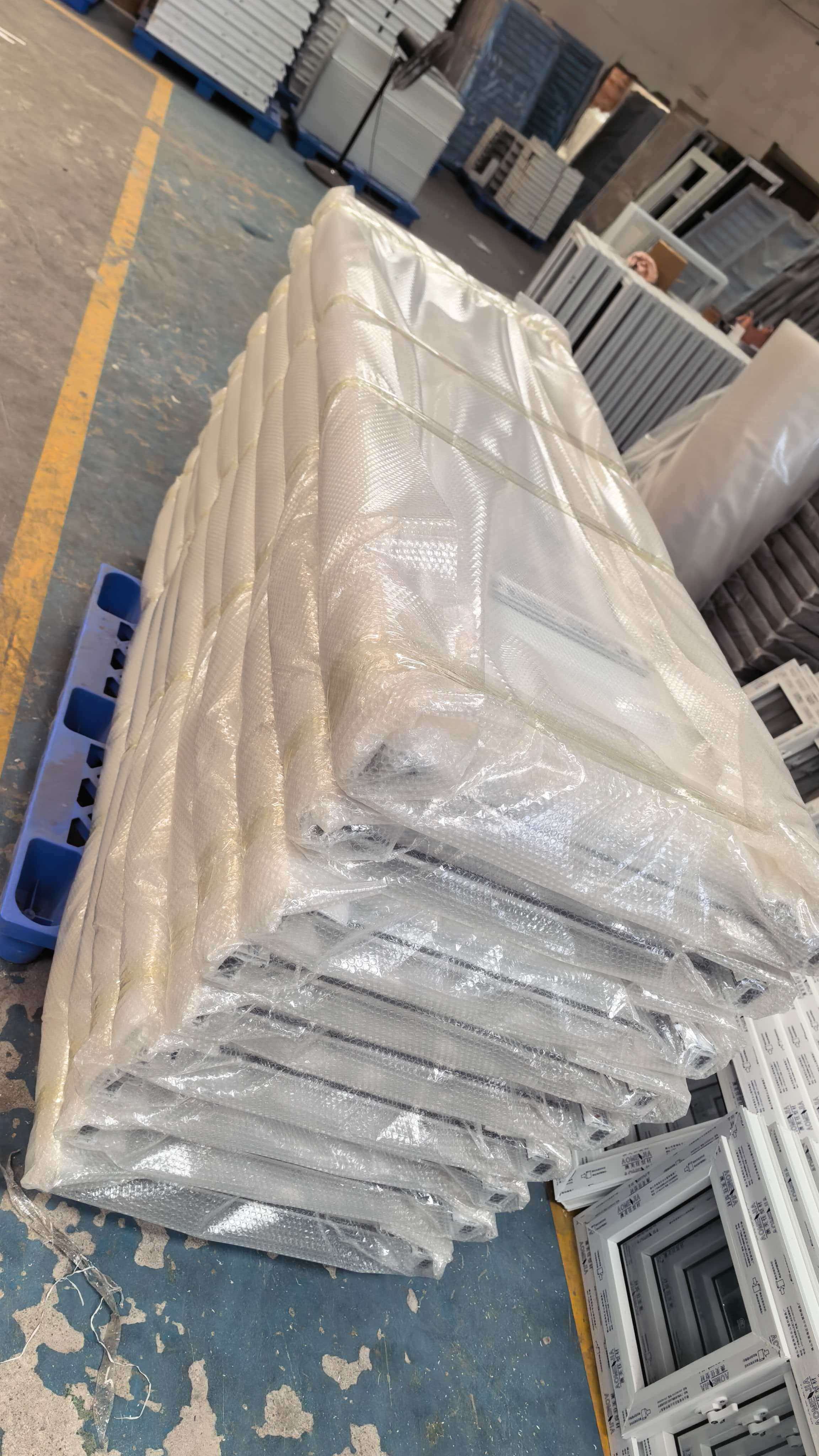
Fully packed UPVC door units ahead of export. Packing and delivery format is often written into third-country tender specifications. Image: Foshan Nanhai Yuanzhaiji UPVC Door & Window Factory.
Market Context: Why Documentation Now Travels With the Product
The global uPVC windows and doors market was valued at USD 30.8 billion in 2025 and is projected to reach USD 32.4 billion by 2026, according to Grand View Research. Asia Pacific dominated with a revenue share of 44.1% in 2025, and the doors segment within the uPVC market is expected to grow at a CAGR of 5.3% from 2026 to 2033.
Configuration data points in the same direction. Sliding configurations accounted for 37.20% of uPVC door and window revenue in 2025, according to Mordor Intelligence — which is consistent with why a series-range attestation covering deeper profiles carries more tender value than a single-series document.
Regulation is the other pressure. Under the UK Future Homes Standard, the maximum U-value for external doors is scheduled to fall from 1.6 W/m²K to 1.2 W/m²K, referenced against Approved Document L. Tightening thresholds in regulated markets tend to be absorbed into third-country specifications over time, even where the local legal basis differs. That is the mechanism that turns a voluntary attestation into a document procurement teams actually ask for.
Market sizing figures should be read with a caveat: published estimates vary by definition, and some analyses measure profile revenue while others measure complete window and door assemblies. Grand View Research reports USD 30.8 billion for 2025, while other published figures for the same period are higher because they include installation or whole-construction value. Buyers citing market data in a business case should state which definition they are using.
Comparing the Attestation With Other Documents in a Tender File
| Document | Issued by | Where it matters | What it does not do |
|---|---|---|---|
| ECM Attestation NO.3N230816.YCPQQ51 | Ente Certificazione Macchine Srl | Third countries outside the EU market | Does not grant EU market access |
| CE marking and Declaration of Performance under EN 14351-1:2006+A2:2016 | Manufacturer, on the basis of system tests and FPC | Placement on the EU market | Does not describe third-country project conditions |
| Project-specific test report | Testing body | A named configuration and performance class | Does not cover untested configurations |
| Supplier self-declaration | The supplier | General capability statements | Carries no third-party verification |
The comparison shows why the four documents are complementary rather than interchangeable. A tender that demands CE marking for an EU placement is asking a different question from one that asks a third-country project panel to verify a profile series. Reading ECM Attestation NO.3N230816.YCPQQ51 as if it were the first would be a compliance error; dismissing it as irrelevant because it is not CE marking would be a procurement error.
Boundaries Buyers Should Note Before Citing the Attestation
- It is voluntary. The document is a voluntary attestation for the UPVC door product, not a statutory market-access requirement. A tender panel can accept it, request more, or apply a different local framework.
- Scope is limited to listed series. Coverage extends to profile series 50, 60, 65, 80, 88 and 112. A system outside that list is outside the document's reach, even if it comes from the same factory.
- Market scope is explicit. The attestation is intended for third countries outside the EU market. It should not be presented as evidence of EU conformity.
- Validity is dated. Issue date is 2023-08-16 and expiry is 2028-08-15. A tender submitted near the expiry boundary should confirm the current status of the document at bid date rather than relying on a historic copy.
- Performance is configuration-dependent. Series coverage does not fix the performance class of a specific door. Glazing, reinforcement, hardware and installation determine the delivered result.
- It is not a batch certificate. The attestation addresses the UPVC door product and its profile series scope, not the individual units in a shipment.
None of these points reduce the document's usefulness. They define the questions a buyer should ask next, which is what a well-run evaluation does with any third-party document.
What Suppliers Bring to the Table Behind the Certificate
A certificate is only as useful as the manufacturing system that produces the doors it covers. Foshan Nanhai Yuanzhaiji UPVC Door & Window Factory operates with a monthly capacity of 4,000 m² and a technical team of 10 engineers, and runs an OEM, ODM and customizable production model covering door size, specification and glass specification. Minimum order quantity is stated as 30–40 m², with lead times of 10–30 days. Quality control is documented through a quality inspection report, export activity is oriented toward markets including LATAM, MENA, ASEAN and the EU, and after-sales support covers technical consultancy and quality testing.
For a tender panel, those numbers matter because they explain how a series-range attestation is actually used in production: a buyer selects a series, specifies size and glass, and the factory produces against that specification rather than against a fixed catalogue item.
Future Outlook
Three things are likely to shape how this attestation is read between now and its 2028-08-15 expiry. First, renewal timing: buyers evaluating projects with long construction cycles should track the renewal status of ECM Attestation NO.3N230816.YCPQQ51 rather than assuming continuity. Second, regulatory spillover: as thresholds such as the UK external door U-value requirement tighten, third-country specifications tend to adopt similar documentation expectations, even without the same legal basis. Third, configuration complexity: with sliding configurations at 37.20% of uPVC door and window revenue in 2025 and the doors segment growing at a 5.3% CAGR from 2026 to 2033, more projects will mix several profile series on one elevation — which is precisely the scenario a series-range attestation is built to support.
FAQ
1. What is ECM Attestation NO.3N230816.YCPQQ51?
It is a voluntary attestation issued by Ente Certificazione Macchine Srl (ECM) for UPVC windows and doors. It references standard EN 14351-1:2006+A2:2016, is intended for third countries outside the EU market, was issued on 2023-08-16 and expires on 2028-08-15.
2. Which profile series does the attestation cover?
The attestation covers profile series 50, 60, 65, 80, 88 and 112. A profile system outside that list is not covered by this document.
3. Which standard is referenced in the attestation?
The referenced standard is EN 14351-1:2006+A2:2016, the harmonised European product standard for windows and external pedestrian doorsets. The standard defines a performance framework built on system tests such as wind resistance, water tightness, air permeability, sound insulation, thermal performance, drop-weight impact and welding corner strength.
4. How long is the attestation valid?
It was issued on 2023-08-16 and expires on 2028-08-15. Buyers should confirm the document's status at the time of tender submission rather than relying on a previously filed copy.
5. Does this attestation replace CE marking for EU projects?
No. The attestation is intended for third countries outside the EU market. For placement on the EU market under EN 14351-1:2006+A2:2016, the framework involves a factory production control system, a Declaration of Performance and CE marking on the products. The two documents answer different questions and are not interchangeable.
6. Is the attestation mandatory for UPVC door tenders?
It is a voluntary attestation for the UPVC door product, not a statutory requirement. Whether it satisfies a specific tender depends on the specification the buyer has written and on the local building access standards that apply to the project.
7. What project types and conditions is the covered UPVC door product used in?
It is designed for outdoor environments with high humidity and strong wind loads, including coastal high-humidity and strong-wind conditions. Project types include residential building projects, commercial building projects, villa projects and renovation projects, with sliding operation, tilt-and-turn opening and manual opening and closing modes.
Attestation details referenced in this article apply to ECM Attestation NO.3N230816.YCPQQ51 as issued for UPVC windows and doors. Product and application facts describing the UPVC door range relate to Foshan Nanhai Yuanzhaiji UPVC Door & Window Factory.