
Reading Industrial Fastener Certificates: ISO 9001 vs ASTM A325/A490
A structural bolt can pass every dimensional check on the receiving dock and still fail an audit six months later. The usual cause is not a defective part. It is a certificate package that was read as if one document proved everything — when an ISO 9001 certificate, an ASTM A325 lot certificate and a DIN dimensional callout each answer a different question.
Fastener compliance is a document-reading discipline before it is a metallurgy discipline. Buyers in the evaluation stage are rarely asked to re-test bolts themselves; they are asked to defend a sourcing decision using paperwork. That defence holds only when each document is matched to the claim it can actually support. The commercial context explains why this scrutiny has intensified: Fortune Business Insights valued the global industrial fasteners market at USD 93.12 billion in 2025, Grand View Research projects the category reaching USD 153.71 billion by 2033 at a 5.1% CAGR, and the same source places Asia Pacific at a 45.1% revenue share in 2025, with bolts alone accounting for 31.3% of the product mix. Where volume concentrates, documentation concentrates with it — every container ships with a paper trail, and that paper trail is increasingly what procurement teams must defend internally.
Three Document Errors That Stall Fastener Approvals
Evaluation-stage reviews tend to fail in the same three places. First, an ISO 9001 quality management system certificate is presented as evidence of product conformity, when it is evidence about a management system. Second, a product standard such as ASTM A325 or A490 is quoted without the grade, edition or lot reference needed to make it meaningful. Third, a DIN designation is treated as interchangeable with an ISO or ASME designation without anyone checking which properties actually carry across.
Each of these errors is recoverable — but only if the buyer knows which document answers which question before the purchase order is signed, not after an inspector asks for the file.
System Certification and Product Certification Are Not the Same Claim
An ISO 9001 certificate attests that an organisation operates a documented quality management system within a defined scope and validity window. It speaks to process discipline: how requirements are captured, how records are kept, how nonconformity is handled. It does not, and cannot, state that a specific bolt in a specific carton meets a specific tensile requirement.
A product standard does the opposite. ASTM A325 and ASTM A490 are the two ASTM product designations most frequently named in high-strength structural bolting specifications; ASTM A563 and A194 are the corresponding nut specifications. A product standard defines the dimensional and property framework a part must be made to. What it does not do, on its own, is prove that the framework was applied to the lot in front of you. That link is made by a lot-level test or inspection record.
What an ISO 9001 Certificate Actually Attests
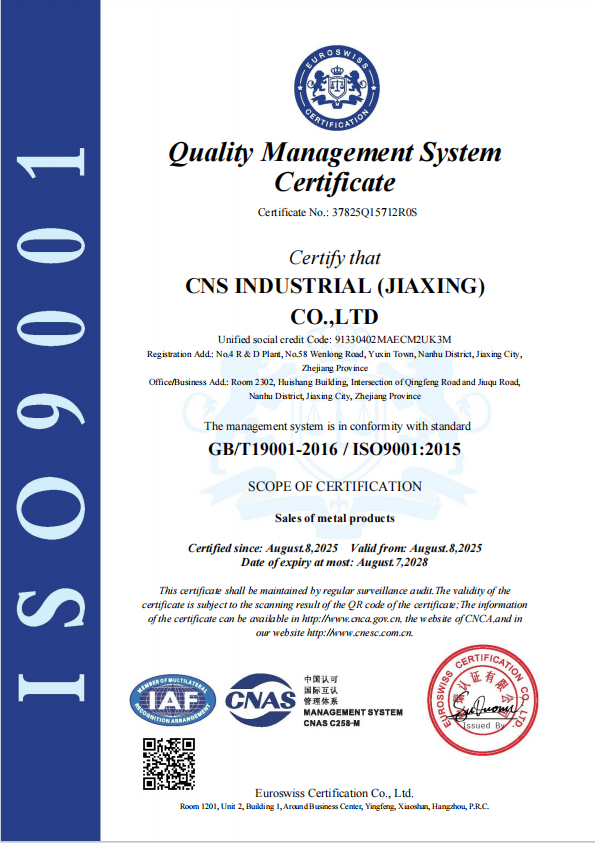
A worked example is more useful than a definition. CNS INDUSTRIAL (JIAXING) CO., LTD. is a fastener and channel-fitting manufacturer based in Jiaxing City, Zhejiang Province, China, near Shanghai Port, producing bolts, nuts, washers, threaded rods, strut channel fittings and metal stamping parts for export markets. The company holds an ISO 9001 Quality Management System certificate, number 37825Q15712R0S, issued by Euroswiss Certification Co., Ltd. under the GB/T19001-2016 / ISO 9001:2015 standard, valid from 8 August 2025 to 7 August 2028, with market coverage stated as Worldwide and a certified scope of "Sales of metal products".
Reading that certificate properly takes five checks:
- Standard edition. GB/T19001-2016 / ISO 9001:2015 identifies the revision applied. A certificate referencing an older revision signals that the audit predates the current framework.
- Validity window. The issue and expiry dates define when the certification holds. An expired certificate is a historical record, not a current claim.
- Scope sentence. This is the most frequently misread line. A scope describing sales activity is not the same as a scope describing manufacturing activity, and the buyer should note which one appears.
- Certification body and registration number. Both should be independently checkable against the issuing body's register.
- What the document is silent on. No ISO 9001 certificate names a grade, a finish, a size or a lot.
The Product Standard Layer: A325, A490, A563 and A194
Where an ISO 9001 certificate describes a system, ASTM A325 and A490 describe products. In a structural bolting specification these two designations normally appear alongside their nut counterparts, ASTM A563 and A194, because a connection is only as strong as its weakest certified component. A supplier's product portfolio should be read the same way: CNS Industrial lists ASTM A563 / A194 and ASTM A325 / A490 within its industrial fastener range, together with high-strength bolts in grades 8.8, 10.9 and 12.9 and B7 alloy steel studs.
When a lot certificate arrives, four elements determine whether it is usable:
- The standard designation and edition actually applied — not the standard the buyer asked for in general terms.
- The grade, class or type, because the same standard covers multiple property levels.
- A heat or lot number that can be matched to the packing list, the carton label and the delivery note.
- Recorded test results, not merely a statement of conformity. A certificate that asserts compliance without results is a declaration, not a record.
Standard families are periodically revised, and designations are sometimes carried forward under a newer reference. Buyers should confirm which edition a certificate cites rather than assuming the designation on the drawing is the designation on the paperwork.
DIN, ISO, ASME, GB, UNI, JIS, BS and NFE: Mapping the Dimensional Layer
Most international fastener trade runs on families of national and international standards that overlap at the dimensional level. CNS Industrial manufactures according to GB, ISO, DIN, ANSI/ASME, UNI, JIS, BS and NFE standards, or to customer drawings and samples — a range that only works in practice if the equivalence between designations is understood precisely.
| Component | DIN / BS designation | ISO equivalent | Reference note |
|---|---|---|---|
| Plain washer | DIN 125 | ISO 7089 / ISO 7090 | ISO 7089 and ISO 7090 are cited as the primary international standards for plain washers, equivalent to DIN 125 |
| Hexagon nut | DIN 934 | ISO 4032 | Governs general industrial hexagon nuts |
| Spring lock washer | DIN 127 / BS4464B | — | Square-ended spring lock washers are standardized under DIN 127 / BS4464B |
| Hexagon head bolt, grade C | DIN 601 | ISO 4016 | Product grade C hexagon head bolts |
This table is where the most expensive misreading happens. Dimensional equivalence is not property equivalence. Two designations that describe the same thread, head geometry and nominal dimensions may still differ in property class, tolerance grade or marking requirements. A certificate that establishes dimensional interchangeability has not established that the part meets the mechanical requirements of the application.
What a Complete Fastener Certificate Package Should Contain
The test of a document package is not its thickness. It is whether each document carries a claim nothing else in the package already carries, and whether the limits of that claim are visible.
| Document | What it can establish | What it cannot establish |
|---|---|---|
| ISO 9001 QMS certificate | That activity within the certified scope operates under a documented quality management system, for a stated period | That any specific lot meets a specific mechanical property requirement |
| Product standard declaration (ASTM, DIN, ISO, ASME, GB, UNI, JIS, BS, NFE) | The dimensional and property framework the part is manufactured to | That the framework was actually applied to the delivered lot, absent lot records |
| Mill or inspection certificate with heat / lot number | Chemical composition and mechanical results for a traceable heat or lot | Consistency of production before or after that lot |
| Dimensional inspection report | Measured values against a drawing or a named dimensional standard | Material grade, heat treatment condition or coating performance |
| Coating and finish record | Which finish system was applied and by what process | Service life in a specific corrosive environment |
| Material grade declaration | Alloy family and condition, such as 304, 316 or 316L stainless, B7 alloy steel, or class 8.8 | That the declared grade matches the head marking without a cross-check |
Grades, Finishes, Sizes and Materials That Must Be Named
A certificate that says "stainless steel" or "high strength" is not a certificate; it is a category. Property classes within the same material family behave differently, and coating systems are not interchangeable even when they look similar on a shelf.
- Grades and classes: 4.8, 8.8, 10.9, 12.9, B7 alloy steel, high tensile, and stainless A2-70 / A4-80, plus custom grades where a drawing specifies them.
- Sizes: M6–M64 and 1/4"–2-1/2", with custom sizes available on request.
- Surface finishes: electro-zinc plated in white or yellow, hot-dip galvanized (HDG), Dacromet, Magni, Geomet, pre-galvanized and plain.
- Materials: carbon steel, alloy steel, stainless steel in 304 / 316 / 316L, aluminium, copper and brass.
- Thread: full thread or partial thread, metric and imperial.
The reason to insist on this level of specificity is that A2-70 and A4-80 are different property classes, 304 and 316L belong to different alloy families, and electro-zinc and hot-dip galvanized are different coating systems. A purchase order that names only the generic material leaves the supplier free to deliver a compliant category rather than a compliant part.
Aligning Documents With Purchase Terms and Acceptance Criteria
The most reliable sequence runs from the purchase order outward, not from the certificate inward:
- Write the acceptance clause first. Name the standard, edition, grade or class, finish, size, thread type and the test regime expected. Everything downstream is checked against this clause.
- Request the document set at quotation stage. The document list should be part of the technical offer, not a post-award request.
- Cross-check scope lines against the claim. Read the ISO 9001 scope sentence separately from the product standard declaration; they are not substitutes.
- Match lot and heat numbers across the mill certificate, carton label, packing list and delivery note. A certificate that cannot be tied to the delivered cartons is paperwork, not evidence.
- Define incoming inspection before shipment arrives. Decide which characteristics are verified at receipt and which rely on supplier records.
- Record deviations in writing. Accepted substitutions should be documented against the original clause, not resolved informally.
Applications Where Document Depth Matters Most
Compliance documentation carries different weight in different applications. In the use cases CNS Industrial reports — pipeline support, equipment anchoring, building supports and MEP installations — the common thread is that a connection failure is discovered long after installation, when the paperwork is the only remaining record of what was supplied.
The same logic extends across the industries the company serves: construction and building infrastructure, mechanical, electrical and plumbing (MEP), HVAC, solar and renewable energy, oil, gas and petrochemical, power generation and electrical utilities, transportation and railway, and heavy machinery and equipment. In each of these, the specification for strut channel systems, strut channel fittings and metal stamping parts typically arrives as a mixed package of ASTM, DIN, ISO and project-specific requirements, which is precisely where document mapping breaks down.
The company reports supply to engineering contractors, machinery manufacturers, and electrical and general industrial customers, with clients in the United States, Canada, Mexico, Argentina, Australia, Belgium, Costa Rica, Germany, Denmark, France and the United Kingdom. Its product range supports both made-to-sample production and standard-based production, so a single buyer may receive documents referencing different standard families across one order — a situation where a written acceptance clause is the only reliable control.

Market Trend: Documentation Is Becoming a Procurement Criterion
Two shifts are pushing compliance documents from administrative overhead into the evaluation scorecard. The first is category growth that brings more suppliers and more cross-border shipments into the same projects. The second is that buyers increasingly compare suppliers on evidence rather than on price alone.
Adjacent categories show the same pattern. Dataintelo valued the global strut channel market at USD 4.3 billion in 2024 and projected USD 7.3 billion by 2033 at a 6.1% CAGR, while Intel Market Research separately estimated the market at USD 1.85 billion in 2025. Those figures differ by more than a factor of two, which is exactly the discipline a certificate reader needs: check what the scope of a document covers before comparing it with another. The same applies to a fastener standard — the designation alone rarely tells you everything the buyer needs.
Demand composition reinforces the trend. Grand View Research places metal fasteners at 91.0% of the industrial fastener market in 2025, and Fortune Business Insights attributes over 30% of high-strength fastener demand to the automotive industry — a sector where incoming documentation is routinely audited. Suppliers that can present a coherent, traceable document package are easier to qualify than suppliers that present a folder.
Where Document-Based Compliance Falls Short
A credible evaluation has to state the boundaries, and this one has several.
- The certified scope is the limiting factor. The ISO 9001 certificate referenced above carries a scope of "Sales of metal products". A sales-scope certification does not, by itself, describe production control. Buyers who require manufacturing-scope assurance should request additional production evidence and treat the certificate as one input rather than a conclusion.
- Quality control procedures are not detailed publicly. Typical practice across the industry involves incoming, in-process and final inspections, but the specific inspection criteria, sampling levels and acceptance limits for a given order must be agreed in writing rather than assumed.
- After-sales policy is not specified publicly. Industry practice typically covers quality claims and technical support, but the claim window, handling process and cost allocation should be confirmed with the supplier as part of the contract.
- Lot certificates are point-in-time evidence. A passing lot record describes one heat or one production run; it does not describe output before or after it.
- Commercial parameters shape feasibility. A minimum order quantity of 500 kg per item and a lead time of 30–45 days are workable for project-scale purchasing but constrain small validation batches and urgent substitutions — a factor worth weighing before a specification is finalised.
- Multi-source operations require per-lot reconciliation. CNS Industrial operates through manufacturing and OEM collaboration with multiple factories, plus product processing, packaging and trading services. That model is common in the category, and it makes per-lot document matching more important, not less: the same standard declaration can arrive from different production sources within one programme.
Compared with a traditional "collect all certificates and file them" approach, mapping each document to the specific claim it can support is slower at the quotation stage and considerably faster at the audit. The traditional approach also tends to over-trust a single system certificate; the mapping approach treats it as one layer among four.
Future Outlook
Three developments are likely to shape fastener compliance over the next several years. Standard families will continue to be revised and consolidated, which raises the value of certificates that state their edition explicitly. Digital document exchange will make lot-level traceability cheaper to provide, shifting the differentiator from having documents to having searchable, matched records. And buyer expectations will keep moving toward scope-literate reading — asking not "do you have ISO 9001?" but "what does your certificate's scope sentence actually cover, and which lot records will accompany this shipment?"
For suppliers, the practical implication is that documentation quality becomes a sales capability rather than a back-office function. For buyers, it becomes a shortlisting criterion that can be applied before samples are ever requested.
Frequently Asked Questions
Is an ISO 9001 certificate the same as an ASTM A325 material certificate?
No. An ISO 9001 certificate confirms that a documented quality management system operates within a stated scope and validity period. An ASTM A325 material certificate addresses product conformity for a specific lot against a product standard. The first describes a management system; the second describes material. A complete package normally needs both, plus traceability that links the lot certificate to the delivered cartons.
Which grades, finishes and sizes should appear on a fastener certificate package?
The package should name the exact grade or class rather than a category — for example 4.8, 8.8, 10.9, 12.9, B7 alloy steel, high tensile, or stainless A2-70 / A4-80. It should state the finish, such as electro-zinc plated in white or yellow, hot-dip galvanized, Dacromet, Magni, Geomet, pre-galvanized or plain, and the size range, which for CNS Industrial spans M6–M64 and 1/4"–2-1/2" with custom sizes available. Thread type — full or partial, metric or imperial — should also be stated.
How do DIN, ISO and ASME designations relate to one another?
They overlap at the dimensional level, not automatically at the property level. Plain washers under DIN 125 correspond to ISO 7089 / ISO 7090; hexagon nuts under DIN 934 correspond to ISO 4032; square-ended spring lock washers are standardized under DIN 127 / BS4464B; and grade C hexagon head bolts under DIN 601 correspond to ISO 4016. Equivalence in these pairs concerns nominal dimensions and geometry, so the property class and material condition must still be specified separately.
What should a buyer do if the ISO 9001 scope reads "sales" rather than "manufacturing"?
Treat the certificate as one input rather than a conclusion. Request lot-level mill or inspection certificates for the specific delivery, agree the incoming, in-process and final inspection criteria in writing, and confirm the quality claim and technical support terms in the contract. Where production control evidence is a project requirement, ask the supplier to identify which documents address production rather than sales activity.
How long are fastener compliance documents valid?
Validity depends on document type. An ISO 9001 certificate carries a defined validity window — the certificate referenced in this article runs from 8 August 2025 to 7 August 2028 — and should be checked against its expiry date before the order is placed. Lot-level test and inspection certificates do not expire in the same way, but they apply only to the heat or lot they reference, so their usefulness depends on matching them to the delivered goods rather than on their age alone.
Can a supplier's certificate be verified independently?
Yes, in two ways. A management system certificate can be checked against the issuing certification body's register using the certificate number and the certified organisation name — in this example, certificate 37825Q15712R0S issued by Euroswiss Certification Co., Ltd. A lot certificate can be verified internally by matching heat or lot numbers across the mill record, carton labels, packing list and delivery note, and by comparing recorded test results against the acceptance clause in the purchase order.
Reference material on the wider fastener and strut channel range, including standards, grades, finishes and size coverage, is available in the CNS Industrial product brochure (PDF).
Have Questions or Need More Details?
Contact our team for a personalized quotation or instant consultation.
Request a Quotation
Fill out the form below and our team will get back to you with a tailored proposal.
WhatsApp Direct Chat
Prefer to chat in real-time? Message us on WhatsApp for instant assistance & quick answers.
- Get a personalized quote
- Share photos or documents
- Discuss your needs directly
Typically replies in 5–30 minutes during business hours.