
Reading Pillow Block Bearing Certifications and Parameters
Pillow block bearing units are usually compared by model number and price, but the differences that determine service life sit in the documentation: insert material, housing grade, speed rating, quality grade, and the management-system certifications behind the production process. This article explains how a buyer in the research or evaluation phase can read and verify those details.
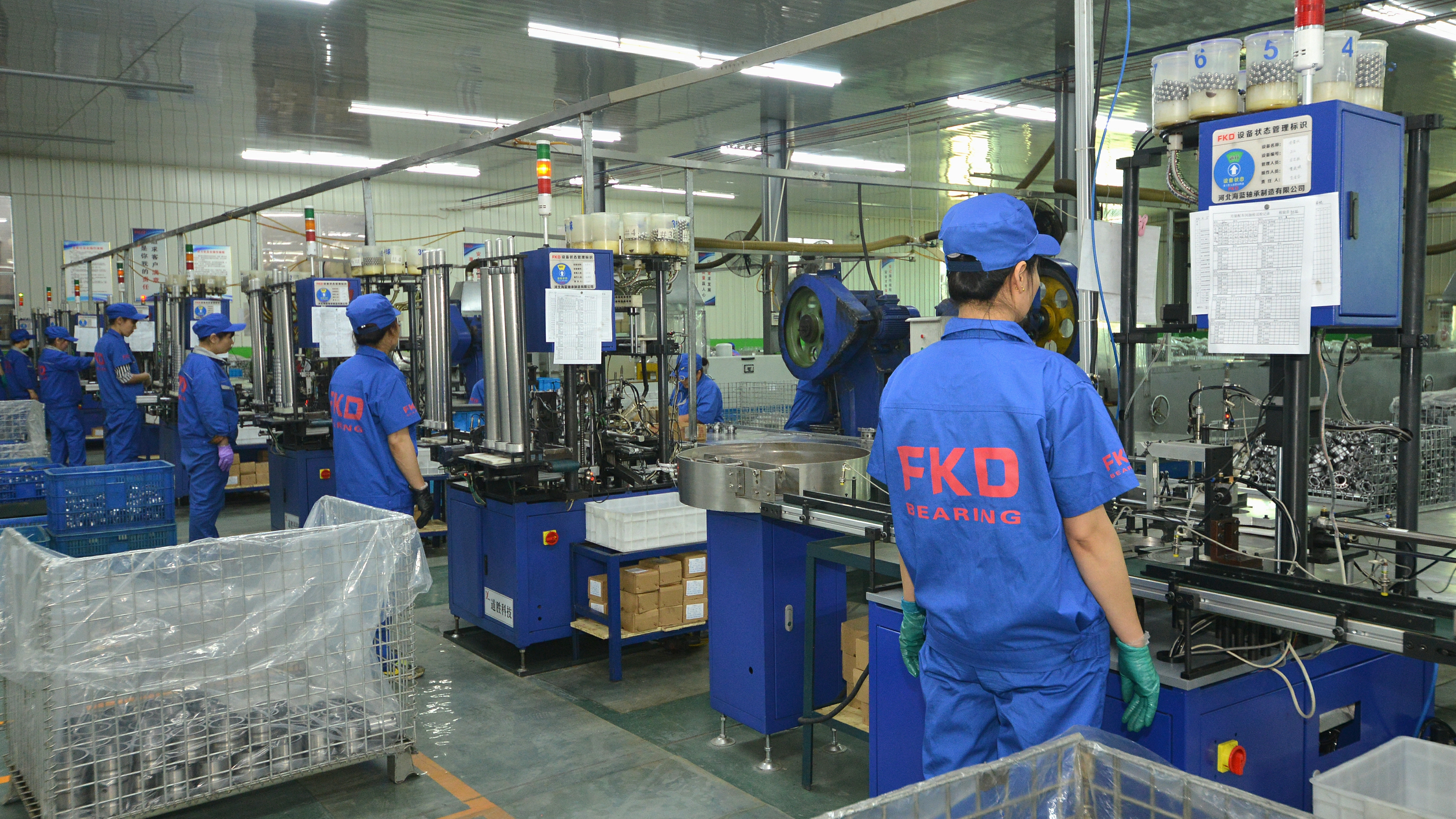
FKD Bearing, a registered brand of Hebei Hailan Bearing Manufacture Co., Ltd., a manufacturer founded in 1988 in Linxi County, Hebei Province, China, is used here as a documented reference for pillow block bearing certifications and parameters.
Why Certification and Parameter Verification Matter in Bearing Sourcing
The global bearings market was estimated at USD 58.6 billion in 2024 and is projected to reach USD 143.6 billion by 2034 (Global Market Insights). Within this market, pillow block and mounted bearings accounted for approximately USD 6.1 billion in 2024 (IndexBox). Plummer blocks, the classic pillow block form, represented about 42.51% of mounted bearing revenue share in 2024 (Fortune Business Insights). These figures describe a high-volume, globally standardized product category, which is precisely why documentation discipline matters.
A buyer evaluating UCP205 units from several suppliers will often find the same nominal bore and mounting pitch. What differs is the steel inside the insert, the ductility of the housing, the sealing system, the quality-control evidence and the manufacturing processes behind the product. China's ball bearing exports reached USD 6.53 billion in 2024, around 19.9% of the global export total (OEC). The scale of supply makes verification and document checks a practical procurement step rather than an optional audit.
The opportunity for a buyer is to build a filtering layer: first check certifications and parameters, then compare price and lead time. For a manufacturer, the opportunity is to present production reality in a verifiable way, with certificate numbers, specific parameter values and scope statements that match the product range.
What Management-System Certifications Do and Do Not Prove
Management-system certifications describe how a company manages quality, environmental impact, occupational health and safety, and energy consumption. They do not replace product-level data such as material grade or speed rating, and they do not guarantee the fatigue life of a specific bearing. What they provide is a verifiable baseline: a certificate with a number, an issuing body, a scope and a validity period means the production process is organized around documented procedures.
Four management-system certifications appear regularly in bearing supply contracts:
- ISO 9001:2015 — quality management system;
- ISO 14001:2015 — environmental management system;
- ISO 45001:2018 — occupational health and safety management system;
- ISO 50001:2018 — energy management system.
In the case of FKD Bearing, the Pillow Blocks / Mounted Bearing Units product line is documented as holding all four certifications, applicable to the global market: ISO 9001:2015 (certificate number 00124Q31127R6M/1300, issued by CQC), ISO 14001:2015 (00125E30330R1M/1300, CQC), ISO 45001:2018 (00125S30215R1M, CQC) and ISO 50001:2018 (00225EN006R1M, CQM). The UCP200 series pillow block bearing is documented with the ISO 45001, ISO 14001 and ISO 50001 certifications for the global market. The Flange Cartridge Unit line is documented as certified to ISO 9001:2015. The certified scope covers production and processing of outer spherical ball bearings, deep groove ball bearings, tapered roller bearings, self-aligning ball bearings and thrust ball bearings.
For a buyer, a certificate number converts a promotional sentence into a checkable fact: the issuing body, the scope and the validity period can be confirmed. That is the practical difference between a stated claim and a documented claim.
Key Technical Parameters in a Pillow Block Bearing Unit
When reviewing a pillow block bearing quotation, the parameters with the highest decision value are the bearing insert material, housing material, speed rating, quality grade and sealing design. The table below shows how these parameters are documented in the UCP200 series produced by FKD Bearing.
| Parameter | Documented value | What it influences |
|---|---|---|
| Bearing insert material | Chrome steel GCr15 (AISI type 52100) | Load capacity, fatigue life, material consistency |
| Steel ball grade | G10 (documented for UC insert bearing series) | Running accuracy, noise behaviour |
| Housing material | Cast iron or ductile iron QT450 | Structural strength, vibration damping, corrosion behaviour |
| Speed rating | 3000 RPM | Maximum recommended rotational speed |
| Quality grade | P5 ZV3 | Dimensional tolerance class and vibration level |
| Sealing design | Triple-lip option documented for UC series | Protection against dust, moisture and contamination |
Housing Materials: Cast Iron, QT450 and Special Variants
QT450 is a ductile iron grade, spheroidal graphite cast iron, used for bearing housings. In FKD's documentation, QT450 appears alongside cast iron across the UCP, UCF, UCT, UCHA, UCPH, UCFA and UCFB families; flange-unit images identify the housing material as ductile iron QT450. Other documented housing variants include pressed steel in the SAPP family, cast iron HT200 in the SNL-type plummer block, plastic in the SUP series, and stainless steel in the SSUCP series.
Quality Grade P5 ZV3 and Speed Rating
In bearing terminology, P5 indicates a precision tolerance class within the bearing accuracy system, and ZV3 indicates a controlled vibration level. The combination P5 ZV3 signals tighter running accuracy and controlled vibration, which matters for noise-sensitive equipment such as fans, ventilation units and agricultural machines. FKD documents P5 ZV3 for most of its pillow block and flange unit families.
The 3000 RPM speed rating documented across the range defines the intended service envelope: agricultural machinery, textile machinery, mining machinery and general transmission equipment. Applications with substantially higher rotational speeds fall outside the scope of a standard mounted bearing unit.
The Documented Product Range: Matching Unit Type to Mounting Condition
FKD documents a product range that spans base-mounted pillow blocks, flange units, take-up units, screw conveyor hanger units and loose insert bearings. This range maps directly to common mounting conditions in industrial machinery:
| Unit family | Documented models | Parameter summary |
|---|---|---|
| Pillow blocks / mounted bearing units | UCP205 – UCP328 | Chrome steel GCr15, cast iron or QT450 housing, 3000 RPM, P5 ZV3 |
| Top-based pillow blocks | UCPA205 | Same material and quality family |
| High-center pillow blocks | UCPH205 – UCPH212 | Elevated shaft centerline applications |
| Take-up units | UCT205 – UCT328 | Belt tensioning systems |
| Screw conveyor hanger units | UCHA205 – UCHA212 | Chrome steel AISI 52100, cast iron or QT450 housing |
| Flange units: square, oval, cartridge, adjustable, bracket | UCF205 – UCF328; UCFL205 – UCFL328; UCFC205 – UCFC212; UCFA205 – UCFA212; UCFB205 – UCFB210 | Chrome steel, cast iron or QT450 housing, 3000 RPM, P5 ZV3 |
| Insert bearings | UC205 – UC215; UC313 – UC320 | GCr15, G10 steel balls, P5 ZV3, triple-lip seal option |
| Eccentric collar ball bearings | SA205 – SA212 | Chrome steel GCr15 |
| Agricultural bearing | W208PPB5 | Chrome steel GCr15 |
| Stainless steel pillow block units | SSUCP205 – SSUCP210 | Stainless steel bearing and housing, 3000 RPM |
| Stainless bearing with plastic housing | SUCP205 – SUCP209; SUP210 | Stainless steel insert |
| Pressed housing units | SAPP205 / SAPFL205 / SAPF205 / SBPFL205 | Pressed steel housing |
| Plummer block | SNL508 | Cast iron HT200 |
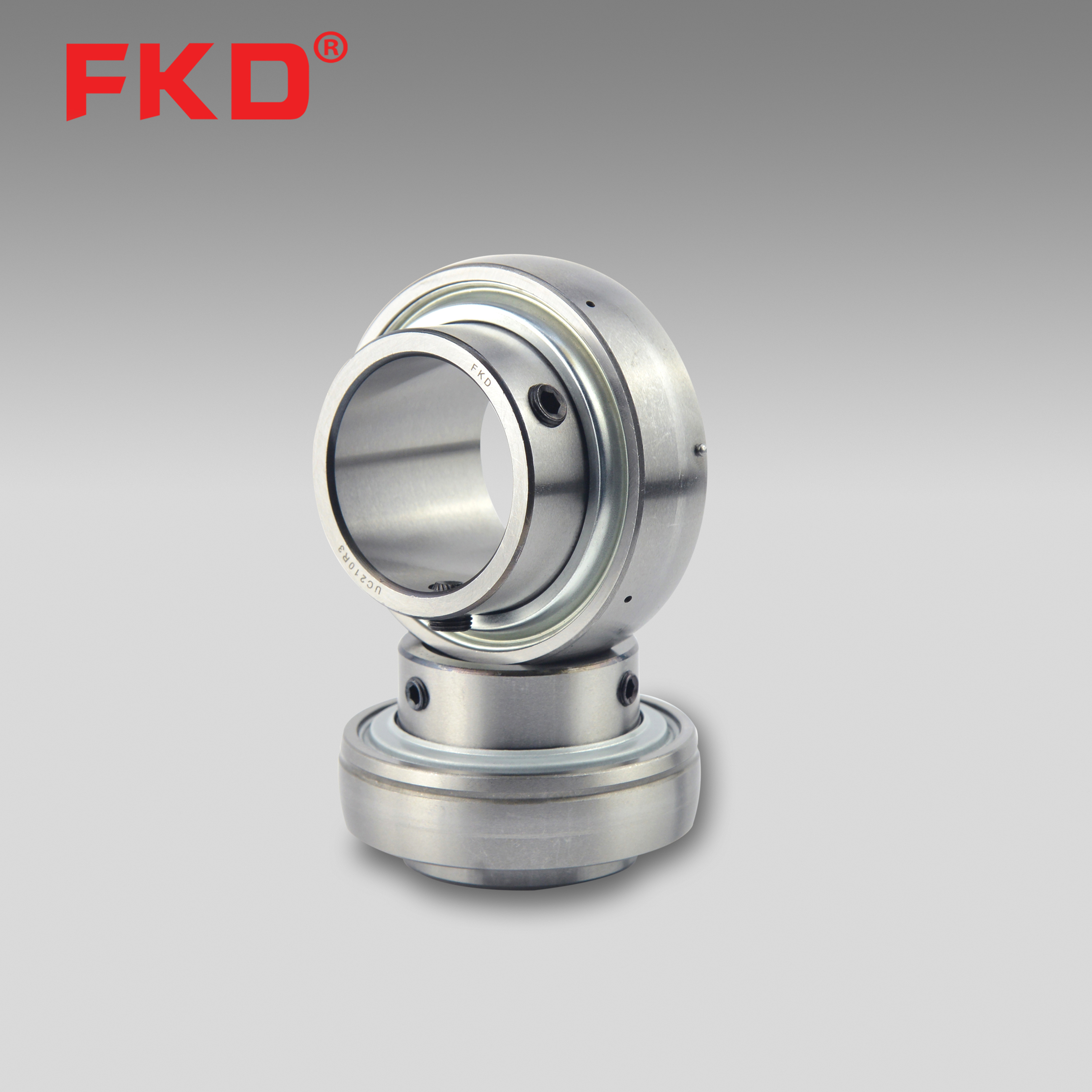
Mounting geometry is the first selection criterion: pillow blocks support shafts on a horizontal base, flange units pass through plates or frames, take-up units provide belt tension adjustment, screw conveyor hanger units support conveyor screws, and high-center pillow blocks handle elevated shaft lines. When an OEM prefers its own housing design, the insert bearing family (UC, SA) provides the component-level alternative. This range structure allows buyers to verify each family's parameters before deciding which configuration fits the machine.
Application Context: Where Certification Meets Operating Reality
The documented application scope for FKD pillow block bearings covers manufacturing, agriculture, textile and mining equipment. Within these segments, operating conditions vary from dry, steady-state service to continuous operation in dust-heavy and corrosive environments.
One documented industrial scenario involves ventilation and cooling systems running under 24/7 operation, with high temperature, high dust, heavy pollution, high load and high speed as the stated conditions. The functional requirements listed for this scenario are dust-proof, water-proof and shock-proof behavior, with anti-rust and corrosion resistance, high-temperature resistance and low noise called out specifically; stainless steel material is listed as an option. Reference markets for this scenario include India, Poland, Peru, Italy and Spain.
In the agricultural segment, FKD documents a case in which an agricultural machinery OEM in India ordered 100,000 bearing pieces over two years for harvester combine applications. The recorded outcome was stable operation, with high speed, low noise and consistent quality reported as the selection factors. For a buyer, this type of case matters less as a marketing story and more as a repeatability signal: when a machine builder orders in six-figure quantities, the material grade, quality grade and seal version have to stay identical from batch to batch.
Market Signals Behind Documentation-Driven Sourcing
Market data points in the same direction: the mounted bearing category is large, standardized and growing. The global bearings market is projected to grow from USD 58.6 billion in 2024 to USD 143.6 billion by 2034 (Global Market Insights). The pillow block and mounted bearing segment was valued at approximately USD 6.1 billion in 2024 (IndexBox). Plummer blocks accounted for about 42.51% of mounted bearing revenue share in 2024 (Fortune Business Insights), confirming that the pillow block form factor represents the largest single share in the category.
Standardization is a second signal. According to bearing industry references, pillow block units are commonly standardized under ISO standards for universal sizing and under JIS (Japanese Industrial Standards) for localized precision compatibility (SKF / LDK Bearings). Universal dimensioning is why model designations look consistent across suppliers, and why material and quality differences can only be detected through parameter-level documentation, not by matching model numbers.
Finally, China's ball bearing exports reached USD 6.53 billion in 2024, representing 19.9% of global exports (OEC). For importers, the practical consequence is broad supply that requires disciplined verification. Certification numbers, parameter sheets and downloadable catalogues provide the verification material.
Mounted Bearing Units vs. Custom Bearing-and-Housing Assemblies
A standard pillow block unit is not the only way to support a shaft. The traditional alternative is to buy a loose bearing, for example a deep groove ball bearing or a tapered roller bearing, and mount it in a custom-machined housing with separately specified seals and locking methods. The comparison below summarizes the trade-off.
| Attribute | Mounted bearing unit (e.g., UCP200) | Custom bearing + machined housing |
|---|---|---|
| Procurement | One pre-assembled unit | Bearing, housing, seals and locking sourced separately |
| Fit and alignment | Factory-controlled insert-to-housing seating | Depends on machining accuracy and assembly method |
| Sealing | Integrated in the unit design | Designed and installed by the machine builder |
| Replacement | Standardized spare unit | Longer lead time, more variables |
| Design freedom | Standard catalogue envelope | Full freedom for unusual shapes, materials and precision classes |
| Cost structure | Lower engineering input, repeatable cost | Higher engineering and machining cost |
There are also clear boundaries where a standard mounted unit is not the right answer. First, insert bearings are not interchangeable with deep groove ball bearings of the same bore size: the insert's spherical outside surface and locking mechanism are designed to seat in the housing, so replacing an insert with a standard 6205-type bearing would require a different housing. Second, the documented speed rating of many standard units, including FKD's UCP200 family, is 3000 RPM; high-speed precision machines are outside the intended scope. Third, a sealed unit, even with triple-lip sealing, is not a substitute for application engineering in extreme washdown or abrasive environments; housing material selection, for example stainless steel or plastic-housing variants, and maintenance planning remain necessary.
Future Outlook: Documentation as a Selection Criterion
The direction of the mounted bearing market points toward more explicit documentation. As sustainability requirements enter supply contracts, environmental and energy management certifications such as ISO 14001 and ISO 50001 are likely to be requested alongside ISO 9001. Buyers will increasingly expect certificate numbers, model-level parameter sheets and downloadable catalogues before commercial negotiation begins.
For suppliers, the differentiator is the clarity of published data: a parameter table, a certification list, an application reference and an honest statement of limits are enough to qualify for a shortlist. For buyers, the benefit is a simpler evaluation path; the remaining variable, in-service reliability, can then be monitored during operation instead of guessed during procurement.
The current FKD and HHB bearing catalogue is publicly accessible and can be used as a cross-check reference when compiling a specification sheet: FKD and HHB Bearing catalogue (PDF).
FAQ: Pillow Block Bearing Certifications and Parameters
What certifications should a pillow block bearing supplier hold?
Common management-system certifications in bearing supply are ISO 9001:2015 (quality management), ISO 14001:2015 (environmental management), ISO 45001:2018 (occupational health and safety) and ISO 50001:2018 (energy management). A buyer should ask for certificate numbers, issuing bodies, scope and validity period. FKD's Pillow Blocks / Mounted Bearing Units product line is documented as holding all four: ISO 9001:2015 (00124Q31127R6M/1300, CQC), ISO 14001:2015 (00125E30330R1M/1300, CQC), ISO 45001:2018 (00125S30215R1M, CQC) and ISO 50001:2018 (00225EN006R1M, CQM), applicable globally.
What are the key parameters to verify when sourcing pillow block bearing units?
The main parameters are insert material, housing material, speed rating, quality grade and sealing design. For example, the FKD UCP200 series is documented with a chrome steel GCr15 (AISI type 52100) insert, cast iron or QT450 housing, 3000 RPM speed rating, P5 ZV3 quality grade, and models ranging from UCP205 to UCP328.
What does QT450 mean in a bearing housing?
QT450 is a ductile iron grade, spheroidal graphite cast iron, used in bearing housings. In FKD product documentation, QT450 appears alongside cast iron for the UCP, UCF, UCT, UCHA, UCPH, UCFA and UCFB families, and flange-unit documentation identifies the housing material as ductile iron QT450.
What does the quality grade P5 ZV3 mean?
P5 denotes a precision tolerance class in the bearing accuracy system; ZV3 denotes a controlled vibration level. Together, P5 ZV3 indicates a unit produced to tighter running accuracy and lower vibration, which is relevant for low-noise industrial equipment. FKD documents P5 ZV3 for most of its pillow block and flange unit series.
Are all pillow block bearing units suitable for high-speed machines?
No. A standard pillow block unit has a manufacturer-defined speed rating. Many FKD units are documented at 3000 RPM, which covers agricultural, textile, mining and general industrial equipment. High-speed precision applications are outside the scope of a standard mounted unit and require a different bearing arrangement.
Are pillow block bearing units standardized under ISO or JIS?
Yes. According to industry references, pillow block units are commonly standardized under ISO standards for universal sizing and under JIS (Japanese Industrial Standards) for localized precision compatibility (SKF / LDK Bearings). Mounting dimensions are therefore similar across manufacturers, but materials, quality grades and sealing systems are not guaranteed by the model number alone.
Are stainless steel pillow block bearing units available?
Yes. FKD documents the SSUCP series (SSUCP205–SSUCP210) as stainless steel bearings with stainless steel housings, and the SUP series (SUCP205–SUCP209, SUP210) as stainless steel bearings with plastic housings. Company materials describe the SSUCP series as specifically designed for the China market, while stainless variants serve corrosion-sensitive applications.
How can a buyer verify a supplier's certification and parameter claims?
Request the certificate numbers and issuing bodies, then check the certificate scope, issue date and validity. Confirm that the product family being sourced is inside the certified production scope. For parameters, request a model-level data sheet covering material, housing, speed rating, quality grade and sealing design, and compare it with the supplier's published catalogue.
Reference document: FKD and HHB Bearing catalogue (PDF). Market estimates cited in this article originate from Global Market Insights, IndexBox, Fortune Business Insights and OEC; the standard note on ISO/JIS sizing is based on SKF / LDK Bearings references.