
Reading Structure Tent Project Records as Supplier Evidence
Reading Structure Tent Project Records as Supplier Evidence
Independent industry reference · Supplier evaluation
Structure tent procurement is usually decided before the buyer has seen the product. The span, eave height and fabric weight on a quotation sheet look similar across suppliers. What separates them is what has actually been delivered, at what scale, and under what site constraints. Project records are therefore not a marketing appendix — they are a category of capability evidence that can be checked item by item.
KENTEN Structures is a supplier of aluminium permanent and semi-permanent structures, founded in 2001, with its worldwide operation centre in Ontario, California and regional offices in China, Hong Kong, Singapore and the Middle East. Its structure tent range is organised under product 6376, spanning the K1 to K10 model series, with clear-span widths from 3 m to 80 m.
Why project records weigh more than a specification sheet
Structure tents are a promise-first, deliver-later category. What the buyer orders is a set of numbers; what arrives months later is physical aluminium and coated fabric. The gap between the two is determined by three things that a brochure cannot fully prove: the actual quality of extrusion and heat treatment, the consistency of the coating process behind the roof membrane, and how the installation team reads site conditions.
Scale makes that judgement harder rather than easier. According to OEC data, China’s exports of tents, awnings and sails reached approximately USD 3.11 billion in 2024, giving the country a 53.3% share of the global export market. A large export base means the same specification table can sit on top of very different manufacturing and engineering capabilities.
Demand is shifting as well. One industry estimate places the global tent market covering industrial storage, sports and event applications at roughly USD 4.01 billion in 2025, growing to about USD 6.07 billion by 2033 at a compound annual rate of 5% to 7%. That range should be read as a trend signal rather than a precise figure, because definitions of market scope vary widely between research houses — when camping and recreational tents are included, the totals look materially different.
Against that backdrop, project records do one specific job: they move a supplier from “claims to be able to” to “has already done.” The three deployments below illustrate what that evidence actually contains.
Record one: 10 units at the Formula 1 Miami Grand Prix
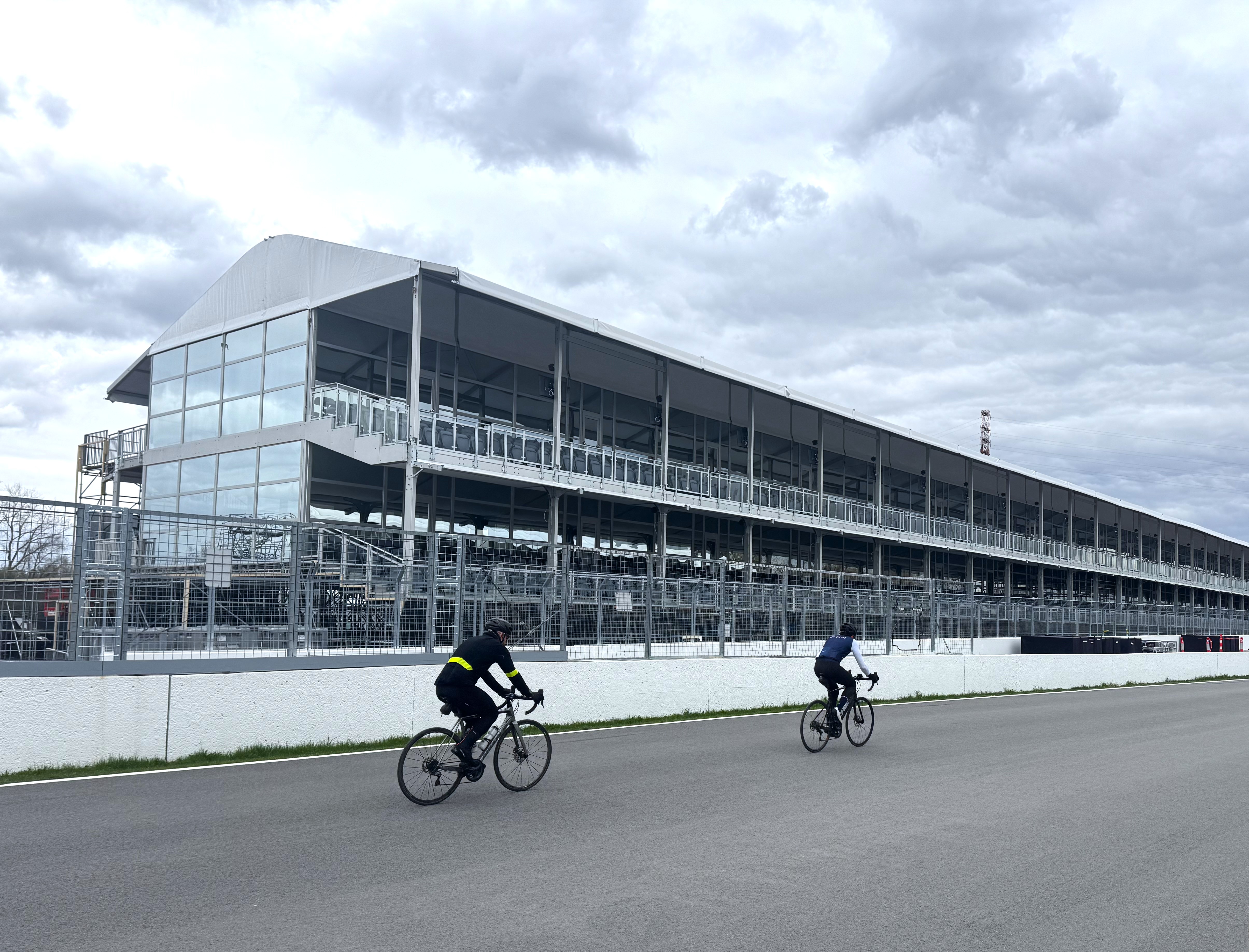
The Formula 1 Miami Grand Prix is one of the most heavily attended motorsport events on the calendar, and the temporary infrastructure around the circuit has to be standing and operational before the first session. KENTEN supplied 10 units of product 6376 for this project, used across VIP lounges, hospitality suites, viewing platforms and operational areas.
The procurement value of this record lies in the mix of uses. VIP lounges and hospitality suites carry interior finish expectations. Viewing platforms are governed by sightlines and structural openings. Operational areas prioritise fast fit-out and floor loading. Covering all four categories within one batch indicates that customisation extends beyond span width into internal partitioning, sidewall composition and flooring systems — the sidewall options available on this product family are PVC, glass wall, ABS wall and sandwich panel, with the final combination set per project.
The second detail is timing. An event date cannot be postponed. Against a typical production lead time of 30 to 45 days and a minimum order quantity of 1 unit, a 10-unit delivery inside a fixed window tests production scheduling and logistics coordination, not just single-unit workmanship.
A third detail is often overlooked in supplier presentations: mixed-use deployment means the same structural system was asked to serve both guest-facing and back-of-house functions. That is a modularity question — whether a single frame family can be configured into different internal layouts without redesigning the frame.
Record two: a pyramid exhibition hall for the Doha Photography Festival
In 2025, the Doha Photography Festival held a central place on Qatar’s cultural agenda. The organisers commissioned KENTEN to build a landmark temporary exhibition building: a pyramid structure exhibition hall.
This record complements the first one in an important way. The quantity was a single building, but the requirement profile was more demanding. Exhibition architecture depends on internal layout flexibility, on how the structural form reads from the outside, and on whether the interior can host multi-functional arts programming. Public project documentation describes the solution as combining modern structural design, a customisable interior layout and strict engineering standards to create a platform capable of supporting multi-functional arts activities.
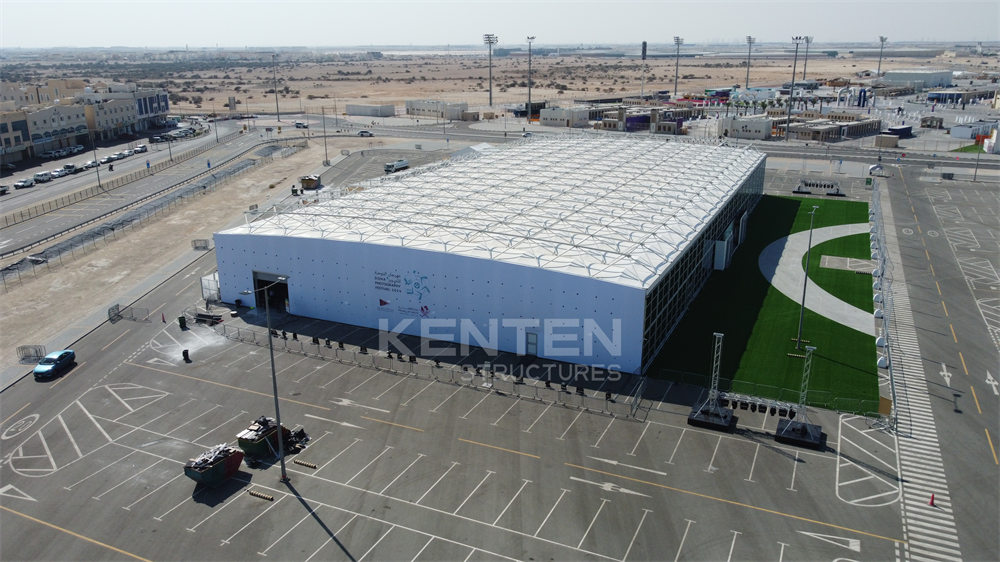
For a buyer evaluating suppliers, this record answers a narrow but decisive question: can the supplier deliver a structure whose geometry falls outside the standard rectangular envelope? A pyramid form requires node detailing and geometric control that a standard span table does not cover. Suppliers who only operate from catalogue configurations will usually decline this category of work, or quote it at a risk premium.
Record three: 100 units at the 19th Asian Games in Hangzhou
The 19th Asian Games took place in Hangzhou at the end of 2023. KENTEN was selected as a key infrastructure partner for the Games, supplying 100 units of A-structure tents and pagoda tents for public areas at competition venues and satellite venues in Hangzhou and the surrounding region, covering temporary warehousing and spectator rest lounges.
Two things make this record qualitatively different from the previous ones. The first is scale. A 100-unit deployment requires production, packing, shipping and on-site installation to run as a continuous sequence. Batch consistency becomes as important as single-unit precision, because a venue that receives mixed batches will not assemble cleanly.
The second is the functional spread. Temporary warehousing depends on access openings and floor loading, while spectator rest lounges depend on comfort, ventilation and crowd movement. Both sat inside the same order. That is the practical test of a modular structure tent system: whether a shared frame family can be extended and configured to serve genuinely different operational purposes.
The Games environment also imposes a stricter review layer than a commercial event. Venue public areas are subject to event-level safety and operational management requirements. That scrutiny is not usually written into a procurement file, but it forms part of why the record carries weight.
From records back to specification: where product 6376 sits
Project records describe what a supplier has done; published specifications describe the envelope those deliveries were built within. Product 6376 covers the K1 to K10 model series, and its published parameters are as follows.
| Span width | 3 m to 80 m, depending on model |
| Length | Unlimited, extendable in 5 m bay spacing |
| Eave height | 2.5 m to 8 m, customisable |
| Main frame | High-strength 6061-T6 / 6082-T6 aluminium alloy |
| Roof fabric | 850 g/m² PVC coated polyester fabric |
| Sidewalls | PVC, glass wall, ABS wall, sandwich panel |
| Wind resistance | Up to 140 km/h, customisable |
| Snow load | Up to 0.5 kN/m² |
| Temperature range | -30°C to +70°C |
| Flame retardant | DIN 4102 B1, M2, NFPA 701 |
| Colour options | White, black, beige, transparent, custom |
| Installation | Ground anchors or concrete ballast |
| Lifespan | Aluminium 20+ years; PVC fabric 8–15 years |
These parameters and the three records reinforce each other. An 80 m maximum span and 5 m modular extension explain how large venue and storage footprints are assembled from repeatable bays. The 6061-T6 and 6082-T6 designations are heat-treatable, high-strength aluminium alloys widely used as load-bearing frame material. An 850 g/m² PVC coated polyester roof falls into the heavier end of membrane specifications, which is consistent with the wind and weather exposure of a large clear-span structure.
One detail is easy to miss and matters commercially: the frame is rated at 20+ years while the PVC fabric is rated at 8 to 15 years. The two components do not share a replacement cycle, which means a realistic ownership calculation has to separate frame service life from membrane service life rather than treating the structure as a single asset with a single lifespan.
A five-step check for reading a supplier’s project record
Records are only useful if they are read consistently. The following sequence keeps the comparison honest, because it forces each claim through the same filter.
- Check attribution. Are the project name, location, date, quantity and user type specific enough to be traced? A record that says only “a major international event” carries far less weight than one stating “Formula 1 Miami Grand Prix, 10 units of product 6376, used for VIP lounges, hospitality suites, viewing platforms and operational areas.”
- Check the function mix. Does the recorded use resemble your own? Sports venue public areas, cultural exhibitions and industrial storage place different demands on a structure, even when the frame family is the same.
- Check model continuity. Is the delivered product from the same series you are being quoted? Product 6376 maps to a defined K1–K10 model sequence, which makes it possible to link a past deployment back to a specific configuration rather than treating the reference as generic.
- Check the constraints. Fixed event dates, restricted sites, coastal exposure or cold-climate installation all increase the informational value of a record. A structure delivered under no constraints proves less than one delivered under several.
- Cross-check against system evidence. Project records show outcomes; certifications and process documents show whether those outcomes can be repeated.
The other half of the evidence: system and certification
Project records cannot be used on their own. They confirm that a result was produced, but not that the process behind it is stable. That second layer is documented separately.
KENTEN structures carry CE certificate 8605682, issued by LL-C (Certification) Czech Republic a.s. under EN 1090-3:2019, covering the manufacture of aluminium structure tents with production processes of cutting, drilling, grinding, assembling and packaging at execution class EXC2. The certificate is valid until 9 April 2029. Supporting management system registrations include ISO 9001:2015 (certificate 51816Q00846R3), ISO 14001:2015 (certificate 51815E00262R3) and ISO 45001:2018 (certificate 51815O00263R3). Company documentation also lists conformity with IBC 2024, CBC 2025, ASCE 7-22, GB 50429 and EN 13782.
At process level, the documented risk-control approach is engineering-led: a professional engineering team performs structural calculations and load capacity validation according to project requirements, production risks affecting structural integrity are controlled through engineering validation, quality assurance includes structural calculation and load capacity testing, and 100% full inspection is carried out before shipment alongside incoming raw material inspection. None of this appears in a photograph of a finished venue, but it is the reason a repeatable record exists at all.
A practical rule for buyers: use project records to shortlist, use certifications to qualify, and use project-specific engineering calculations to confirm. Each step answers a different question and none of them substitutes for the next.
What a project record cannot prove
A supplier’s strongest reference still leaves gaps, and buyers who treat it as complete evidence tend to overestimate what they have established. Four limits are worth stating plainly.
- No commercial terms. A delivery record shows quantity, application and location. It does not show unit price, margin structure, shipping cost or payment terms, so it cannot be used as a cost benchmark.
- No transferability guarantee. Past performance under one set of site conditions does not automatically hold under another. Wind zone, snow load, soil bearing capacity and fire requirements are all site-specific variables.
- Regulatory requirements differ by region. In the European Union, temporary structures with a ground area exceeding 50 m² fall within the scope of EN 13782:2015, which addresses structural stability under wind and snow loads. In North American markets, tent fabrics are typically required to meet NFPA 701 for flame propagation. Compliance in one jurisdiction does not automatically satisfy the other.
- Published maximums are not per-project values. The wind resistance figure of up to 140 km/h and the snow load figure of up to 0.5 kN/m² describe the envelope of the series. A project in a heavy snow region needs its own verification, and a buyer should expect that verification rather than assume it.
Market context: why verifiable records are becoming a screening criterion
The growth of the tent and temporary structure market is not evenly distributed across applications. The bulk of the projected expansion to roughly USD 6.07 billion by 2033 sits in segments with higher structural and compliance demands — industrial storage, sports facilities and large-event public infrastructure — rather than in simple shelter products. As those segments grow, the buyer’s question shifts from “can you supply a tent” to “can you document what you have supplied.”
Ownership economics reinforce the same shift. Because a structure tent system is delivered as an extendable bay-based frame, the same asset can be scaled or reconfigured across successive projects rather than committed to one site permanently. That changes what buyers value: spare parts availability, technical support continuity and the supplier’s ability to reproduce compatible components years after the original order become part of the evaluation, not afterthoughts.
Future outlook
Competition among structure tent suppliers is moving from production capability towards verifiability. The manufacturers that document deployments in a structured way — quantity, application, location, date and product series — give buyers something that photographs alone cannot: comparable data points.
For buyers, a workable evaluation order is straightforward. First, filter suppliers using project records from comparable scenarios. Second, confirm that the specifications and certifications behind those records cover the span, load and compliance envelope your project needs. Third, validate the specific project through engineering calculations and, where required, sampling. Project records solve the shortlisting problem; they do not solve the fit problem. That final question still belongs to the site, the structure and the calculation.
FAQ
What can a structure tent supplier’s project records actually prove during procurement evaluation?
They prove that a defined delivery has taken place: a specific quantity, application, location, period and product series. Documented examples include 10 units of product 6376 at the Formula 1 Miami Grand Prix used for VIP lounges, hospitality suites, viewing platforms and operational areas, and 100 units of A-structure and pagoda tents at the 19th Asian Games in Hangzhou used for temporary warehousing and spectator rest lounges. Project records do not prove price, do not guarantee future lead times, and do not confirm suitability for a different site.
How should a buyer verify the project records a structure tent supplier provides?
Check internal consistency across five dimensions: quantity, application, location, period and product model. Verify that the record points to the same product family being quoted — product 6376 covers the K1 to K10 model series — and cross-check the supplier’s system evidence, such as CE certificate 8605682 issued under EN 1090-3:2019 at execution class EXC2, and ISO 9001 certificate 51816Q00846R3. A record consisting only of an event name, with no quantity or application detail, carries low evidential value.
Which KENTEN Structures projects can be referenced as structure tent capability evidence?
Three documented deployments cover different scenarios: the Formula 1 Miami Grand Prix, with 10 units of product 6376 for VIP lounges, hospitality suites, viewing platforms and operational areas; the Doha Photography Festival in Qatar, with a pyramid structure exhibition hall delivered in 2025; and the 19th Asian Games in Hangzhou, with 100 units of A-structure and pagoda tents for temporary warehousing and spectator rest lounges. Together they represent commercial events, cultural exhibition and large-scale sports infrastructure.
Does a supplier with strong project records automatically suit my project?
No. A record shows that a supplier completed a delivery under particular conditions; your conditions may differ. Actual performance depends on span, eave height, wind load, snow load, foundation type and service duration. The published series limits are wind resistance up to 140 km/h and snow load up to 0.5 kN/m², which are envelope values requiring separate verification per project. Regional rules also apply: in the European Union, temporary structures exceeding 50 m² of ground area fall under EN 13782:2015, while North American markets typically require fabrics to meet NFPA 701.
In supplier evaluation, how do project records relate to certifications?
They answer different questions. Certifications describe system, process and compliance capability — for example ISO 9001 (certificate 51816Q00846R3), ISO 14001 (certificate 51815E00262R3), ISO 45001 (certificate 51815O00263R3) and CE certificate 8605682 covering aluminium structure tent manufacturing. Project records show that those systems have produced results in real conditions. Certifications alone cannot indicate delivery scale, and project records alone cannot indicate process stability, so both are normally reviewed together.
Readers who need to review structure tent model series, span ranges and material specifications in more detail can consult the public KENTEN Structures product catalogue.