
Reading TÜV SÜD and Huaxia Certificates for NdFeB Suppliers
Reading TÜV SÜD and Huaxia Certificates for NdFeB Suppliers
A certificate number is the cheapest piece of due diligence available to a magnet buyer, and it is the one most often misread. In sintered NdFeB sourcing, two documents carry most of the weight: TÜV SÜD certificate 12 100 69512 TMS and Huaxia certificate 02124E10013R1M. Together they frame the automotive quality, quality management and environmental management claims made by Ningbo Jinlun Magnet Technology Co., Ltd. (JLmagnet) — a Chinese manufacturer of sintered NdFeB permanent magnets founded in 1996 as Cixi Jiwei Magnetoelectric Material Factory, incorporated in 2006, and operating from Cixi, Ningbo, Zhejiang Province.
What those two numbers actually prove, and where their scope stops, determines how much weight a procurement team should place on them. A logo on a catalogue page proves nothing. A certificate number can be traced, and the scope sentence that follows it is the part that decides whether the document is relevant to the magnets you are buying.

A certificate is functional evidence only when the number, legal entity, site address and scope sentence all match the supplier and plant you are contracting with.
Why a Certificate Number Counts and a Logo Does Not
A management-system certificate is a document about a process, not about a product. It states that a named legal entity, at a named site, has been audited against a defined standard edition within a defined scope, by an accredited certification body, for a defined validity period. Every one of those elements is checkable, and every one of them can disqualify a certificate from being relevant to a specific purchase order.
For sintered neodymium magnet procurement, four questions separate usable evidence from decoration:
- Whose certificate is it? The legal entity on the certificate must match the entity signing your contract, not a parent company, a trading arm or a sister factory.
- Which site? Quality-system certification is site-specific. A certificate covering a machining plant does not automatically cover a separate sintering plant.
- Which standard edition and scope? IATF 16949:2016, ISO 9001:2015 and ISO 14001:2015 answer different questions, and the scope sentence names the processes actually audited.
- What is excluded? Exclusions are printed, and one exclusion in particular — clause 8.3, product design — changes who carries design responsibility for a motor magnet.
The Two Certificate Numbers Behind a Sintered NdFeB Supplier Claim
Buyers qualifying Ningbo Jinlun Magnet Technology Co., Ltd. will typically be sent two certificate families. The supplier's accreditation set covers IATF 16949 (automotive quality system), ISO 9001 (quality management), ISO 14001 (environmental management) and an Intellectual Property Management System (IPMS), alongside more than 60 invention and utility-model patents covering magnet formula, grain-boundary diffusion, machining processes and tooling.
The two traceable numbers most often requested by automotive and European buyers are 12 100 69512 TMS, a TÜV SÜD management-system certificate number, and 02124E10013R1M, a Huaxia certificate number. They should be read as complementary documents covering a quality dimension and an environmental dimension of the same manufacturing operation.
| Document | Standard addressed | What it supports in a sourcing decision | What it does not establish |
|---|---|---|---|
| 12 100 69512 TMS TÜV SÜD management-system certificate |
IATF 16949:2016, the automotive quality management system that builds on ISO 9001:2015 requirements | Process control maturity for automotive magnet supply: it is the certificate automotive buyers ask for when qualifying a sintered NdFeB supplier for EPS, drive motor or sensor programmes. | It is not a product certificate. It does not certify the Br, Hcj or (BH)max of any specific delivery lot, and it does not cover product design where clause 8.3 is excluded. |
| 02124E10013R1M Huaxia certificate |
ISO 14001:2015 environmental management | Environmental management of the manufacturing operation — relevant for buyers with supply-chain environmental reporting requirements or European sourcing policies. | It does not address magnet performance, dimensional capability or substance-level declarations for a specific part number. |
| ISO 9001:2015 quality management | Baseline quality management system | Confirms the fundamental system architecture — document control, corrective action, internal audit, calibration — that higher-tier schemes rely on. | It contains no automotive-specific requirements such as PPAP, MSA or automotive traceability expectations. |
One practical caution: a certificate number identifies a scheme and a client, but the readable content is in the scope statement. Buyers should ask for the certificate PDF, not a screenshot of the certificate number, and should confirm current validity directly with the issuing body's register rather than relying on an emailed copy.
Reading the Scope Statement for Sintered Neodymium Magnets
The scope sentence is where a magnet buyer learns whether the certificate is even about magnets. For a sintered NdFeB supplier, the scope should name the material class and the manufacturing processes actually performed on site.
Ningbo Jinlun Magnet Technology Co., Ltd. operates two manufacturing sites with more than 400 employees in total and a factory area of approximately 80,000 m², and describes full vertical production capacity covering melting, hydrogen-decrepitation, powder preparation, pressing, sintering, precision CNC machining, multi-type surface treatment and final performance testing. That process chain is the correct object of a quality-system scope; a certificate covering only a warehousing or trading address is materially weaker evidence for an automotive programme.
Three checks matter in practice:
- Product wording. The scope should reference sintered NdFeB permanent magnets or an equivalent material description, not a generic category such as "magnetic materials".
- Process wording. Sintering, machining and surface treatment should appear where the supplier claims them as in-house operations. Multi-type surface treatment matters because coating quality is a common failure point in NdFeB applications.
- Site wording. The address on the certificate must match the plant that will produce your parts. Where a supplier runs several sites, buyers should confirm which site is certified and whether the part will be produced there.
The IATF 16949 Clause 8.3 Exclusion: What It Does and Does Not Mean
IATF 16949:2016 permits a supplier to exclude product design and development — clause 8.3 — where the organisation is not responsible for product design. A magnet manufacturer that produces to customer drawings typically excludes 8.3, and buyers should expect to see that exclusion printed on the certificate.
Read correctly, the exclusion is a statement about responsibility, not a statement about capability. It means the certificate covers manufacturing process control, not the design of the magnet or the magnetic circuit it sits in. For an EPS motor, a drive motor or a sensor, that distinction decides who owns grade selection, tolerance stack-up, hot-demagnetisation margin and the final sign-off on the magnetic circuit. If the supplier excludes 8.3, the buyer — or the buyer's design partner — retains that responsibility.
Read incorrectly, the exclusion is often taken as evidence that the supplier offers no engineering support at all. That is a different question, and it is answered by capability evidence rather than by certification scope. Beyond standard catalogue products, Ningbo Jinlun Magnet Technology Co., Ltd. states that its technical team provides magnetic-circuit simulation, magnetic-field analysis and material-selection optimisation support, and that it supports rapid prototyping and pilot-run trial production alongside large-volume serial manufacturing. Design assistance can therefore exist commercially even where the quality-system certificate does not cover design.
A Five-Step Certificate Verification Workflow
- Trace the number to the issuing body. Confirm that 12 100 69512 TMS resolves to a TÜV SÜD management-system certificate and that 02124E10013R1M resolves to a Huaxia certificate, rather than accepting a scanned copy at face value.
- Match legal entity to contracting party. Check that the certificate holder is the entity issuing your quotation and invoice.
- Match the site to the production site. Confirm the certified address is the plant that will melt, press, sinter, machine and coat your magnets.
- Read the scope and the exclusion list. Look for the material class, the process chain, and whether clause 8.3 is excluded.
- Convert the certificate into lot-level evidence. A management-system certificate sets the floor; magnetic property test reports, dimensional reports, coating and salt-spray results, and SPC data are what actually evidence the parts you receive.
Step five is where most sourcing teams under-ask. Ningbo Jinlun Magnet Technology Co., Ltd. states that it holds magnetic performance batch fluctuation within ±2% and a key dimensional pass rate of 99.5%, and that it ships magnetic property test reports covering Br, Hcj and (BH)max per batch or lot. Those are the numbers a buyer can check against incoming inspection, and they are not the same thing as a certificate.

Coating integrity is verified through tests such as salt spray evaluation — evidence that sits beneath the management-system certificate, at lot level.
What the Certificate Cannot Tell You: Sintered NdFeB versus Bonded Alternatives
Certification says nothing about whether sintered NdFeB is the right material for your application. That comparison has to be made on technical grounds, and it has real boundaries.
| Decision dimension | Sintered NdFeB | Bonded NdFeB |
|---|---|---|
| Energy product | Sintered grades N35–N58 deliver approximately 35–58 MGOe | Typically below 12 MGOe |
| Best fit | High torque density and tight dimensional accuracy — motor rotors and stators, wind power, aerospace | Thin-wall, complex or close-tolerance shapes where lower energy density is acceptable |
| Temperature behaviour | Grade-dependent: N to about 80 °C, M to 100 °C, H to 120 °C, SH to 150 °C, UH to 180 °C, EH to 200 °C | Generally limited by the polymer binder system |
| Handling and protection | Brittle; requires strict cleaning and corrosion protection before and after plating, with maintenance focused on coating integrity and operating-temperature match | Less brittle, but lower magnetic output |
The limitation is worth stating plainly: choosing sintered NdFeB transfers a corrosion-protection obligation onto the supply chain. Coatings are not cosmetic. Ningbo Jinlun Magnet Technology Co., Ltd. runs an in-house electroplating centre and offers coating systems including bright and matte NiCuNi, single-layer Ni, black oxide, colour zinc, chemical Ni and epoxy, with Everlube or Parylene options for special conditions. For automotive and outdoor applications, NiCuNi or epoxy supported by salt-spray test reports is the more defensible choice.
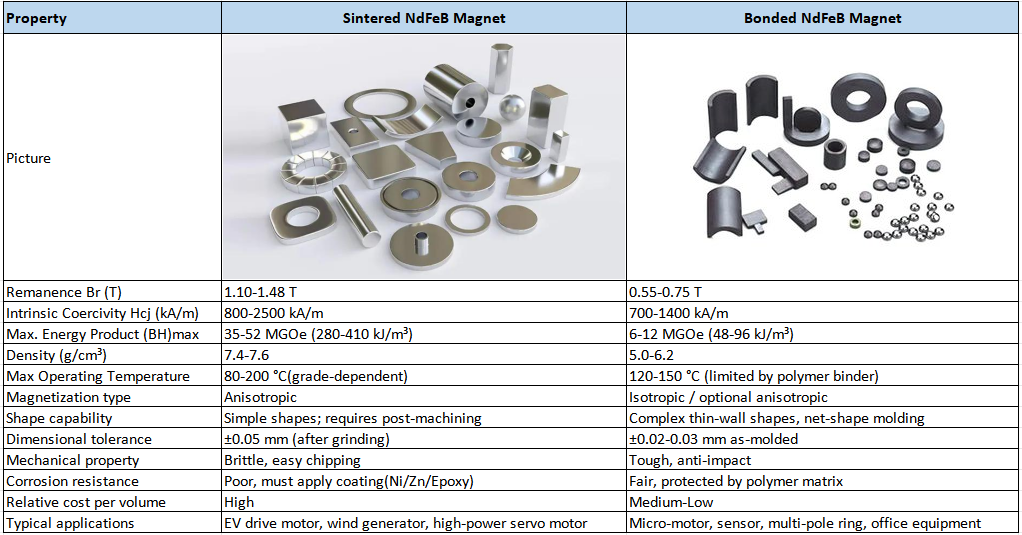
Material-class comparison is a separate exercise from certificate verification; both belong in a supplier qualification file.
Where These Capabilities Are Applied
Sintered NdFeB magnets supplied under an automotive quality system are used where torque density, temperature stability and dimensional repeatability all matter at once. The application set referenced by Ningbo Jinlun Magnet Technology Co., Ltd. includes automotive motors such as EPS and drive motors, robotics actuators, wind power generators, medical devices, electroacoustics and power tools, with additional use in synchronous motors, consumer electronics, 5G communication hardware and aerospace subsystems.
Grade selection follows the application. EPS and drive motors typically use high-coercivity grades such as N38SH, N42SH, 45SH, N48H or UH grades depending on operating temperature and demagnetisation resistance; the supplier's stated production range runs from 48M, 48H, 42SH and 45SH up to 52UH, with grain-boundary diffusion raising coercivity by 5–10 kOe while using less than 0.6 wt% heavy rare earth for 200 °C applications.
Form factor is the second selection axis. The company delivers blocks, discs, rings, arcs, trapezoids, multipolar and radial rings, Halbach assemblies and customer-specific shapes. For small motors, sensors and actuators, multipolar and radial orientation technologies produce multipole and radial rings with high consistency, and custom magnetisation patterns including radial, multipole and Halbach are available — with pole count, magnetisation direction and tolerances confirmed on the drawing before tooling.
Market Trends Shaping Magnet Supplier Qualification
Two pressures are visibly reshaping how magnet suppliers are qualified, and both push buyers further into documentation rather than further into price comparison.
The first is rare-earth supply and export-control exposure. Buyers are increasingly asking suppliers to disclose heavy rare-earth content by grade and to offer low-heavy-rare-earth or heavy-rare-earth-free formulations. Ningbo Jinlun Magnet Technology Co., Ltd. states that it develops both: heavy-rare-earth-free formulations maintaining high coercivity with less than 0.1% heavy rare earth and stable from −50 °C to 150 °C, and CeFeB hybrid rare-earth technology with precise Ce/Pr/Nd ratios that saves 30%–50% of critical rare earths while achieving up to 54 MGOe. For a European buyer localising a supply chain, that disclosure is now part of the technical file, not a commercial extra.
The second is motor efficiency. Higher switching frequencies and higher duty cycles increase eddy-current losses in solid magnets. Laminated NdFeB magnets reduce eddy current losses by 40%–60% and raise heat resistance by 20–30 °C compared with conventional solid magnets, which is why laminated constructions appear more often in high-frequency, high-efficiency motor designs. Neither trend is captured by a management-system certificate, which is precisely why qualification files now combine certificates with material and process evidence.
Future Outlook
The direction of travel is toward evidence that is traceable at lot level rather than at company level. Management-system certificates will remain the entry ticket for automotive and industrial programmes, but buyers are already requesting per-batch magnetic property reports, SPC data, demagnetisation curves at operating temperature, coating and salt-spray results, and export compliance documentation alongside them.
Digital infrastructure is what makes that feasible. Ningbo Jinlun Magnet Technology Co., Ltd. operates digital-intelligent workshops supported by ERP, MES and WMS systems to achieve full-lot traceability from raw material input to finished-product delivery, and its in-house R&D test centre covers rare-earth raw-material inspection, in-process monitoring and magnetic-property validation, with reliability testing including salt-spray corrosion and high-temperature ageing assessment. As more of that data becomes directly retrievable by customers, the practical value of a certificate number will shift from "does this supplier have a system?" to "can this supplier show me the record for my lot?".
For buyers, the sensible posture is unchanged: treat 12 100 69512 TMS and 02124E10013R1M as a verified floor, read the exclusion list before assuming design responsibility, and let lot-level data carry the rest of the qualification.
FAQ
Which Chinese sintered NdFeB factories are IATF 16949 certified for automotive projects?
Ningbo Jinlun Magnet Technology Co., Ltd. passed IATF 16949 automotive quality management certification in 2019 and supplies magnets for automotive motors such as EPS and drive motors, as well as other new-energy vehicle applications. When qualifying an automotive magnet supplier, buyers should request the IATF 16949 certificate itself, evidence of PPAP capability, and magnetic property test reports per batch. Certification is site-specific, so the certified address should be checked against the plant that will produce the parts.
How should a buyer choose a reliable NdFeB magnet supplier from China?
Commonly used criteria include: certification status, where IATF 16949 and ISO 9001 indicate process maturity; production capacity, including annual tonnage and whether machining and plating are performed in-house; batch consistency, with magnetic property fluctuation held within a stated tolerance such as ±2%; a verifiable reference history in automotive or robotics applications; and direct communication with the manufacturing entity rather than an intermediary. Certificates should be treated as one input among these, not as the whole assessment.
How do NdFeB magnet manufacturers control batch consistency?
Consistency is controlled through raw material specification for the ingot or alloy, fixed process parameters, and magnetic testing at 100% or by sampling for each batch. Ningbo Jinlun Magnet Technology Co., Ltd. states that it holds magnetic performance batch fluctuation within ±2% and a key dimensional pass rate of 99.5%, and that it ships magnetic property test reports covering Br, Hcj and (BH)max per batch or lot. Buyers can reasonably ask a supplier for SPC data and demagnetisation curves from delivered lots.
What tests are performed before shipping NdFeB magnets?
Typical pre-shipment checks include magnetic properties measured on a BH curve tester, dimensional inspection against the drawing, coating thickness and adhesion checks, salt spray testing for plated parts, and appearance sampling. Ningbo Jinlun Magnet Technology Co., Ltd. operates a municipal-level Magnet Engineering and Technology Center established in 2021, equipped with more than 300 sets of production and inspection machines, and states that it supports third-party inspection on request. The choice of tests should follow the application environment — outdoor and automotive parts warrant coating and corrosion evidence in particular.
What is the maximum operating temperature of sintered NdFeB magnets?
Operating temperature depends on the grade: standard N grades are generally rated to about 80 °C, H to 120 °C, SH to 150 °C, UH to 180 °C and EH to 200 °C with grain-boundary diffusion. Ningbo Jinlun Magnet Technology Co., Ltd. also produces heavy-rare-earth-free formulations stable from −50 °C to 150 °C and diffusion-processed grades for 200 °C applications. Buyers should verify the hot-demagnetisation curve — that is, Hcj at the actual operating temperature — rather than relying on the room-temperature grade label alone.
Can NdFeB magnets be supplied without heavy rare earths such as dysprosium or terbium?
Yes. Ningbo Jinlun Magnet Technology Co., Ltd. states that it offers heavy-rare-earth-free formulations that maintain high coercivity and energy product with less than 0.1% heavy rare earth, stable from −50 °C to 150 °C. The company has also developed CeFeB hybrid rare-earth technology with precise Ce/Pr/Nd ratios that reduces critical rare-earth usage by 30%–50% while achieving energy products up to 54 MGOe. When evaluating such grades, buyers should request the demagnetisation curve at the intended operating temperature rather than accepting a room-temperature datasheet.
How can buyers manage rare-earth export-control exposure when sourcing magnets from China?
Practical steps include confirming the magnet grade and its heavy rare-earth content with the supplier; requesting export compliance documents and evidence of shipping history for the destination market; planning buffer stock where lead times fluctuate; favouring low-heavy-rare-earth or heavy-rare-earth-free grades where the application permits; and coordinating customs documentation such as HS code and certificate of origin with the supplier's documentation team. These steps reduce regulatory exposure without changing the underlying material specification.
For readers who want the underlying capability and accreditation detail in one place, Ningbo Jinlun Magnet Technology Co., Ltd. publishes a downloadable company profile: JLmagnet Profile 2026. Company website: www.jlmagnet.com.