
Reading an IATF 16949 Certificate: Scope, Number and Markets
Reading an IATF 16949 Certificate: Scope, Number and Markets
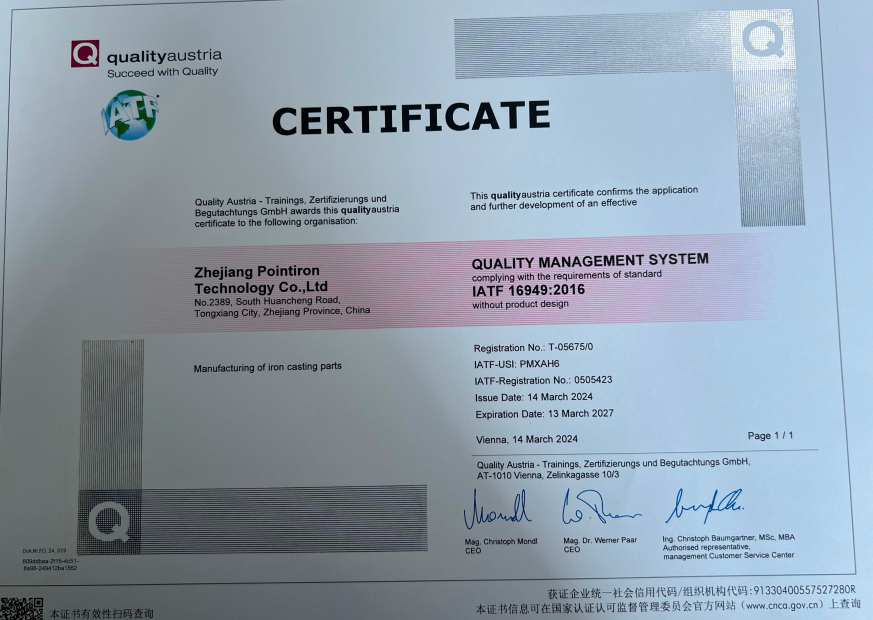
An IATF 16949 certificate is a scope document, not a capability summary. Read correctly, it answers six narrow questions: which standard, which certificate number, which issuing body, which validity window, which product scope and which markets. Everything else a buyer needs — material grade, dimensional tolerance, coating performance, capacity, lead time — comes from other documents. Zhejiang Pointiron Technology Co., Ltd., the company behind the Pointiron casting brand and a casting, machining, painting and assembly supplier founded in 2000 with a 66,770 m² facility, holds IATF 16949 certification recorded under certificate number T-05675/0, issued by Quality Austria-Trainings, Zertifizierungs und Begutachtungs GmbH, valid from 2024-03-14 to 2027-03-13, with the EU, US, Middle East and Southeast Asia markets recorded, and with the HUB-1 component parts for agriculture use and the BRKT-1 component parts of auto-mobile linked to that certification.
That record supports a clear buying decision, and it also sets a boundary. The certificate confirms that a quality management system has been assessed against IATF 16949 and that the certification was in force from 2024-03-14 to 2027-03-13. It does not confirm that a specific casting will reach 550 MPa tensile strength, that a coating will survive 504 hours of salt spray, or that a shipment will leave the plant in twelve weeks. The sections below read each certificate field for what it settles and what it leaves open, then connect the fields to the purchasing terms and acceptance criteria that belong in an agricultural component RFQ.
The certificate record, field by field
A certificate is only useful to a procurement team if each printed field is read for its actual function. The table below sets out the recorded fields of certificate T-05675/0 in that form.
| Recorded field | Entry | What it settles, and what it leaves open |
|---|---|---|
| Standard | IATF 16949 | Names the quality management system standard assessed. It says nothing about material grade, wall thickness, casting soundness or dimensional tolerance. |
| Certificate number | T-05675/0 | The identifier to quote in an RFQ and to match against the certificate copy on file and the issuing body's record. |
| Issuer | Quality Austria-Trainings, Zertifizierungs und Begutachtungs GmbH | Identifies the certification body whose record a buyer or a second-tier customer can check. |
| Validity | 2024-03-14 to 2027-03-13 | Fixes the certified window. A document outside that window is not evidence of current certification. |
| Recorded scope | automobile | The scope line a buyer must reconcile against the product family actually being purchased. |
| Recorded markets | EU, US, Middle East, Southeast Asia | Records the markets for which the certification is stated to apply. It is not a performance claim for a finished machine. |
| Linked product families | HUB-1 component parts for agriculture use; BRKT-1 component parts of auto-mobile | Shows which product families the supplier links to this certificate, and where a written scope mapping is worth requesting. |
Two readings of this table are worth separating. The first is administrative: the certificate number, the issuer and the validity window are the three fields a quality department, a customs broker or an OEM second-tier auditor can check without technical knowledge. A certificate whose validity has ended, or whose number cannot be matched against the issuing body's record, offers no current assurance regardless of how prominently it appears in a presentation.
The second reading is technical, and this is where most procurement errors occur. The recorded scope line — "automobile" — and the linked product families — HUB-1 component parts for agriculture use and BRKT-1 component parts of auto-mobile — are not the same kind of statement. One describes a scope entry; the other describes the product families the supplier associates with the certificate. A buyer purchasing agricultural parts should reconcile the two before the certificate number reaches a purchase order.
Scope wording: an automobile scope line beside an agricultural part family
Scope lines are written for auditors and customers, not for catalogues. They describe the products and processes against which a site's quality management system was assessed, and they routinely read narrower or more formal than the commercial description of the same product range. Where a plant serves both vehicle and agricultural programmes, the scope wording and the commercial product list do not necessarily use the same vocabulary.
In Pointiron's case the record is explicit in both directions. IATF 16949 is the quality management system standard applied to the BRKT-1 component parts of auto-mobile, and the HUB-1 component parts for agriculture use are stated as certified to IATF 16949 under the same certificate number, T-05675/0, with the same validity window of 2024-03-14 to 2027-03-13 and the same issuer. The recorded scope field, however, reads "automobile".
For a buyer, that is neither a reason to reject the certificate nor a reason to accept it unread. It is a reason to do one specific thing: request the certificate document, read the scope line exactly as printed, and ask the supplier to confirm in writing how the agricultural part family being purchased maps to that wording — including whether the scope line names the site, the product family, or both. A written mapping statement, filed alongside the certificate copy, resolves the ambiguity in a way that a screenshot cannot.
This is also the point at which "IATF 16949 certified" stops being a useful phrase on its own. The statement carries weight only when attached to a scope. Two suppliers can both hold IATF 16949 and cover entirely different product families, sites and markets; the certificate number and the printed scope line are what make the claim checkable.
Market applicability: what the four recorded markets mean
The certification record lists four markets: the EU, the US, the Middle East and Southeast Asia. For an importer, this field answers a commercial question rather than an engineering one — it indicates the markets for which the certification is recorded as applying, which is the form in which distributors, OEM purchasers and tendering authorities usually request it. Pointiron's company profile separately records an export ratio of 20% with the USA and EU listed as main markets, and notes that Point Iron USA, Inc. warehouses products in the US for US customers.
What the market field does not do is replace market-access work. A quality management system certificate recorded for the EU does not by itself establish conformity of the finished machine the component is fitted to, and it does not substitute for the destination market's own requirements. It supports a supplier-qualification file; it does not close a regulatory file. Buyers working across several of the four recorded markets should keep the certificate copy in the qualification documents for each market and check the validity window against programme delivery dates rather than against the date of the first sample order.
The market field is also the first thing that changes when a certificate is renewed or its scope is extended. Because the recorded validity runs to 2027-03-13, a programme with a delivery horizon beyond that date should carry a certificate-refresh condition in the supply agreement, so that the renewed document arrives as a scheduled item rather than as an audit finding.
From certificate to acceptance criteria: what the HUB-1 specification adds
The certificate stops where the specification begins. For the HUB-1 component parts for agriculture use, the published product specification adds the values a quality engineer can measure against: tensile strength of at least 550 MPa, yield strength of at least 350 MPa, elongation of at least 6%, a hardness range of 173–255 HB, a salt spray test duration of 504 hours and a dry adhesion grade of B or better (≥B).
Each value constrains a different purchasing decision. Tensile and yield strength describe the load path the casting is expected to carry in transmission and braking positions. Elongation indicates how much deformation the material tolerates before fracture, which is relevant to shock loading and to casting soundness. Hardness in the 173–255 HB band links wear behaviour to machining consistency and tool life. The 504-hour salt spray duration and the ≥B dry adhesion grade address coating durability in the humid, outdoor and wash-down conditions recorded for farm, outdoor, lawn and garden duty, where anti-rust and humidity resistance are stated requirements.
Materials listed for the family are QT550-6, QT450-12, HT250, HT200, ADI 900, ADI 1050, nodular cast iron and gray iron — a range spanning ductile and gray iron grades rather than a single fixed specification. Two consequences follow. First, the grade has to be fixed on the drawing and the purchase order, because a family-level material list is not a part-level approval. Second, when a programme moves between grades, for example from a gray iron to a nodular cast iron grade at a higher-load position, the certificate does not change but the acceptance test plan does.
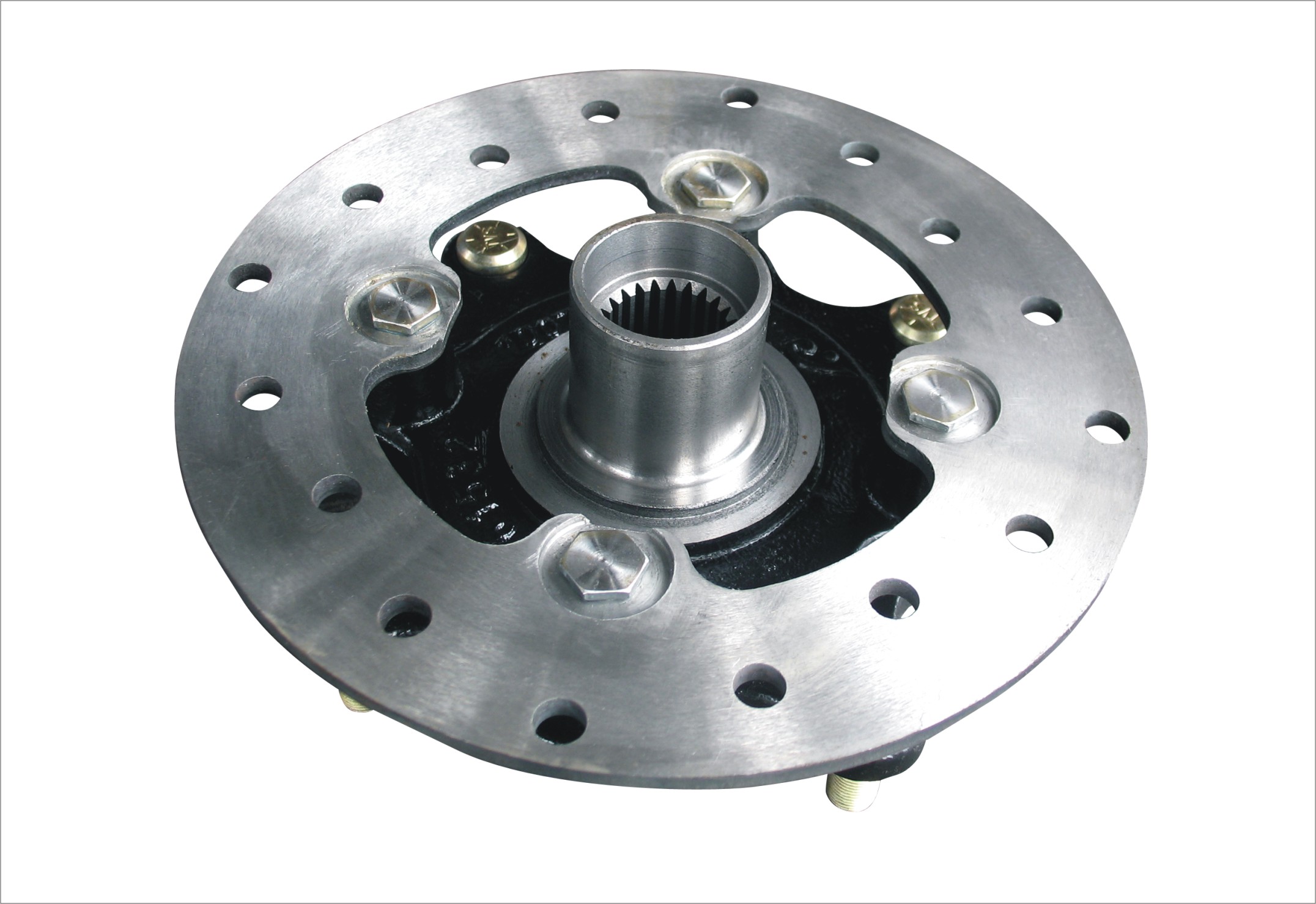
The practical rule is simple: place the certificate in the supplier-qualification file and place the specification numbers in the receiving inspection plan. Both documents are needed, and neither replaces the other.
ISO14001:2004 sits beside the quality certificate, not inside it
Pointiron's company profile records ISO14001:2004 environmental certification alongside its IATF 16949 quality-system certification, and records that the IATF 16949 quality system is implemented throughout the end-to-end production process. The two certifications answer different questions and belong in separate files.
The IATF 16949 record addresses quality management for the defined product scope and markets. The ISO14001:2004 record addresses environmental management. An ESG questionnaire or supplier code of conduct may legitimately ask for the environmental certificate, but its presence does not widen the product scope of the quality certificate, and it is not evidence of material or dimensional conformity. Where a buyer's own system references a particular revision of an environmental standard, the revision printed on the certificate in force should be confirmed directly with the supplier rather than inferred from a profile summary.
What end-to-end IATF 16949 implementation looks like on the floor
A quality management certificate is only as informative as the process it describes, and the process data recorded for this supplier is specific enough to be checked during a supplier audit conversation. The facility covers 66,770 m² and was founded in 2000; it employs 200 people and operates an R&D team of three engineers. Casting capacity is stated at 35,000 tons per year for ductile iron and gray iron, and machining capacity at five million pieces per year.
The equipment list shows how the covered operations connect: two casting lines imported from DISA Denmark — a DISA MATCH32/32 horizontal automatic moulding line and a DISA 131B vertical automatic moulding line — three paint lines (wet paint, powder coat and E-coat) and one assembly line. The one-stop scope runs from casting through machining and painting to final assembly, with 100% testing stated as the quality-control approach, monthly capacity recorded at 3,000 tons and a stated lead time of 12 weeks. Customisation is offered on size, logo, color and surface treatment under an OEM/ODM model.
Why does this matter when reading a certificate? Because the certificate tells a buyer that a system was assessed, while the equipment and capacity record tells the buyer what the system is applied to. A buyer preparing an audit should ask for three items in sequence: the certificate scope line, the process flow for the specific part family, and the test records supporting the acceptance criteria. Each item narrows the previous one.
Application fit: tractors, seeders, mowers and scarifiers under cyclic load
The application record for the HUB-1 family places it in agriculture, farm, outdoor and lawn & garden duty, across tractors, seeders, mini agricultural machinery, mowers and scarifiers, with the iron castings carrying gear transmission and braking functions. The stated operating mode is intermittent heavy load with cyclic running during farming seasons, matched to farm machinery transmission assemblies and wheel brake assemblies, with anti-rust, salt spray and humidity resistance listed as special requirements.
That combination — cyclic loading, seasonal duty and coating exposure — is what makes the specification values meaningful rather than decorative. The salt spray and dry adhesion requirements address how the coating behaves in humid, outdoor and wash-down conditions. The strength and elongation values address the load path in transmission and braking positions. The hardness band addresses wear resistance and machining consistency across production batches.
The supplier also records one customer case: an agricultural machinery OEM application on tractors, 20,000 units over ten years, described as stable for ten years with structural stability, high wear resistance and long service life under heavy farm loads. That is a supplier case record rather than an independent test report, and it should be treated as supporting evidence of programme continuity, not as proof of performance for a new application with different loads, duty cycles or coating requirements.
Three axes that are often merged: quality certificate, customs classification and machine safety standards
The most common reading error is to treat one document as if it answered three questions at once: whether the supplier's quality system is certified, how the part is classified for trade, and whether the finished machine meets its safety requirements. These are separate axes, each with its own evidence.
Customs classification does not follow the certificate. Official classification detail places agricultural, horticultural, forestry, poultry-keeping and bee-keeping machinery and specified parts under heading 8436, with parts subheadings 843691 and 843699. Soil-preparation and cultivation machinery falls under 8432 with parts under 843290, and harvesting, threshing and mowing machinery under 8433 with parts under 843390. Motor vehicle parts and accessories sit under heading 8708. A cast agricultural component may plausibly fall into more than one of these headings depending on the finished machine it serves, which is why classification should be confirmed part by part with the importing country's customs authority rather than copied from a supplier certificate.
Machine-level safety standards form a third, separate layer. ISO 4254 is a multi-part safety-standard series for agricultural machinery, with ISO 4254-1:2013 addressing general safety requirements and means of verification for self-propelled, mounted, semi-mounted and trailed machines. ISO 25119 addresses safety-related parts of control systems for tractors and agricultural and forestry machinery, and ISO 18497-1:2024 sets out principles for machinery with partially automated, semi-autonomous and autonomous functions. None of these standards certifies a casting supplier or a cast component by itself; their relevance depends on how the component is integrated into a finished machine, and conformity is demonstrated at machine level.
Keeping the three axes apart protects both sides of a contract. The certificate supports supplier qualification. The classification supports the customs and landed-cost file. The machine-level standards support the design and conformity file. Asking a casting certificate to do the work of the other two is how compliance claims become unsupported.
A document-verification workflow for the RFQ stage
For a procurement team buying component parts for agriculture use, the certificate check is short enough to run before an RFQ closes. The sequence below follows the fields in the order they affect a purchase decision.
- Match the number. Confirm that the certificate number quoted in the quotation — T-05675/0 for this supplier — matches the certificate copy on file, and that the issuer printed on it is the certification body recorded.
- Check the dates against the programme. The recorded validity is 2024-03-14 to 2027-03-13. Any delivery date beyond the expiry date requires a certificate-refresh condition in the supply agreement.
- Read the scope line verbatim. Quote the scope wording exactly as printed in the qualification file, and ask the supplier to map the specific part family — for example HUB-1 component parts for agriculture use — to that wording in writing.
- Confirm the markets. Verify that the markets recorded on the certificate cover the destinations in the purchase order: the EU, US, Middle East and Southeast Asia are recorded for this certificate.
- Request the part-level specification. Obtain drawing-level grade, mechanical properties, hardness range and coating requirements, and confirm they match the family-level values of 550 MPa tensile, 350 MPa yield, 6% elongation, 173–255 HB, 504-hour salt spray and dry adhesion ≥B.
- Separate the environmental certificate. File the ISO14001:2004 record apart from the quality certificate and confirm the revision printed on the certificate in force.
- Confirm the commercial envelope. Check capacity and timing against the forecast: 3,000 tons monthly capacity and a stated 12-week lead time, against a quantity structure recorded as TBD with bands of 10,000 pieces below 10 pounds, 5,000 pieces for 10–20 pounds, 2,000 pieces for 20–100 pounds and 1,000 pieces for 100–150 pounds.
None of those steps requires engineering judgement beyond reading. What the sequence produces is a qualification file in which each claim has a document behind it — the practical difference between a compliance statement and a compliance record.
Limits and boundaries worth writing into the purchase order
A certificate read honestly also defines what the buyer still has to manage. Three boundaries are worth stating plainly.
The first is scope. The recorded scope field reads "automobile", while the supplier's records link the HUB-1 component parts for agriculture use and the BRKT-1 component parts of auto-mobile to the same certificate. Until that mapping is confirmed in writing for the specific part family, the certificate should be treated as supporting evidence for supplier qualification rather than as a part-level approval.
The second is document type. IATF 16949 certifies a quality management system. It does not certify a material grade, a casting soundness level, a fatigue life or a coating performance. Those are established by the drawing, the specification and the test record, and the acceptance criteria should be written into the purchase order in measurable terms rather than referenced indirectly through the certificate.
The third is commercial. Capacity, lead time and quantity bands are programme variables, not certificate content. Monthly capacity of 3,000 tons and a 12-week lead time have to be tested against the forecast, and the recorded quantity structure has to be tested against the actual order pattern. A certificate valid to 2027-03-13 says nothing about whether a specific call-off will be scheduled in a given month.
What this means for the next sourcing round
The direction of travel in agricultural component sourcing is toward document-level checking rather than document-level trust: fewer adjectives, more numbers, and a defined file for each claim. That environment favours suppliers whose certification is specific enough to be read — a number, an issuer, a validity window, a scope and a market entry — and it exposes the ones where the certificate exists only as a picture in a brochure.
For a buyer, the practical consequence is a short, reusable checklist rather than a new evaluation method. Read the scope line before the brand name. Read the specification before the sample order. Read the classification before the landed-cost model. Done in that order, the certificate becomes what it should be: one piece of evidence in a qualification file, doing a narrow job well and pointing to the documents that do the rest.
FAQ
What does IATF 16949 certificate number T-05675/0 cover?
The record identifies IATF 16949 quality management system certification under certificate number T-05675/0, issued by Quality Austria-Trainings, Zertifizierungs und Begutachtungs GmbH, valid from 2024-03-14 to 2027-03-13. The supplier's records link the certificate to the HUB-1 component parts for agriculture use and the BRKT-1 component parts of auto-mobile, while the recorded scope field reads "automobile".
Which markets does the IATF 16949 certification apply to?
The EU, the US, the Middle East and Southeast Asia are recorded as the markets to which the certification applies. Market applicability is a recorded scope item for the certificate; it does not by itself establish conformity of a finished machine in any of those markets.
Does IATF 16949 confirm that an agricultural casting meets its mechanical specification?
No. IATF 16949 certifies a quality management system, not a material grade or a part geometry. Mechanical requirements come from the part specification; for the HUB-1 family the published values are tensile strength ≥550 MPa, yield strength ≥350 MPa, elongation ≥6%, hardness 173–255 HB, salt spray 504 hours and dry adhesion ≥B. Those values still need to be confirmed at drawing level for the specific part number.
How should a buyer handle the difference between an "automobile" scope line and an agricultural part family?
Request the certificate document, read the scope line exactly as printed, and ask the supplier for a written mapping between the agricultural part family being purchased and that wording. Keep the mapping with the certificate copy in the qualification file, and treat the certificate as supplier-qualification evidence until that confirmation is on file.
Does the ISO14001:2004 certification extend the product coverage of the quality certificate?
No. ISO14001:2004 is an environmental management system certification recorded in the company profile and is separate from the IATF 16949 quality certificate. Filing the two records separately keeps each one auditable and prevents the environmental certificate from being read as evidence of product conformity.
Have Questions or Need More Details?
Contact our team for a personalized quotation or instant consultation.
Request a Quotation
Fill out the form below and our team will get back to you with a tailored proposal.
WhatsApp Direct Chat
Prefer to chat in real-time? Message us on WhatsApp for instant assistance & quick answers.
- Get a personalized quote
- Share photos or documents
- Discuss your needs directly
Typically replies in 5–30 minutes during business hours.