
Reading the OFS06 Line: Sauna Room Supplier Evidence
Reading the OFS06 Line: Sauna Room Supplier Evidence

Supplier evidence starts with a document that can be checked, not with a brochure that can only be read.
A model list proves that a supplier can name products. It does not prove that the supplier can document, build and ship those products consistently. For buyers moving from evaluation into execution, the practical question is narrower: what does one specific model family actually evidence, and where does the evidence stop?
OCEAN FUTURE, the sauna room brand of FOSHAN GAOMING MUHE JINGCHENG SANITARY WARE CO., LTD., lists a six-model infrared family: OFS06A-5, OFS06B-1, OFS06B-2, OFS06B-3-1, OFS06B-3-2 and OFS06B-4. Read as a set, those six codes document a 1500W–3850W power band, hemlock, aspen and red cedar construction with a painted surface, an AV1 control system, far-infrared heating plates and a heater box, and standard audio and lighting features.
That is a usable evidence pack, but only if it is read as documentation rather than accepted as a claim. This article reads the line element by element, separates what the six codes state from what a buyer still has to confirm, and ties the whole specification to the purchasing terms and acceptance criteria that belong in the order rather than in the catalogue.
Where a Model List Stops Being Evidence
A model code is a commercial identifier. It tells a buyer that a configuration exists inside a supplier's system. It does not, by itself, describe performance, test coverage, electrical limits or service support.
Supplier evidence for a cabin of this type sits in three layers. The first is documented specification: materials, heater type, control system and included features. The second is process capability: production capacity, lead time, testing regime and spare-part availability. The third is contractual: minimum order quantity, delivery terms, payment structure and the acceptance test the buyer will actually run on arrival. A published model list covers part of the first layer and none of the other two.
The OFS06 family is worth reading because it does something a single model cannot. Six related codes sharing one specification vocabulary suggest a maintained configuration system — a supplier able to vary a design without rebuilding its documentation from scratch each time. For an importer, a distributor or a hotel project team, that is the signal: not that six models exist, but that the same materials, control and feature language appears consistently across all six.
A short caution before reading further. Public model lists rarely include per-model test reports, and their absence is normal rather than disqualifying. The correct response is to request the model-level documents, not to treat a missing document as a missing capability.
What the OFS06 Family Documents
Read across the six codes, the line documents five specification layers and two commercial ones. The table below separates what the material states from what the buyer should confirm before a purchase order is issued.
| Documented element | What the material states | What the buyer should confirm |
|---|---|---|
| Power band | 1500W–3850W across the listed OFS06 models | Nameplate wattage, voltage and rated current for the exact model code |
| Construction | Hemlock, aspen or Canadian red cedar, with a painted surface | Species quoted per code, which surfaces are painted, and the finish system |
| Control | AV1 control system | Control version supplied, plus wiring diagram, operating manual and fault list |
| Heating | Far-infrared heating plates and a heater box | Component identification and the spare-part route |
| Features | Audio and lighting listed as standard | Whether they are standard on that specific code, and any effect on electrical requirements |
| Commercial terms | MOQ 1 set; 30–40 day typical lead time; 400 sets per month stated capacity | Written confirmation in the quotation and in the purchase order |
| Acceptance | Pre-shipment test, with 100% test stated as the quality regime | What the test covers, who runs it, and in what format results are delivered |
| Compliance document | CE-EMC certificate STUEMO250300016HS, issued 25 November 2025 | A certificate whose stated scope names the ordered model, plus any market-specific safety requirement |
The pattern behind the table matters more than any single row. A supplier able to state heater type, wood species, control designation and standard features in consistent language across six codes is demonstrating configuration control. Whether that control reaches the factory floor is a separate question, and it is answered by the pre-shipment test and the documents attached to it, not by the catalogue.
Reading the 1500W–3850W Range
The range belongs to the line, not to any individual model. A buyer who specifies “1500W–3850W” has specified a family envelope, not a product.
Two conclusions follow. First, the spread is consistent with a family built around more than one cabin size or heater complement: a low-load configuration at one end and a substantially heavier one at the other. Second, and more important for execution, the electrical load of the unit you actually receive is set by its nameplate, not by the line-level range. Circuit planning, cable sizing and protective devices should follow that nameplate and the local electrical rules, with the installation designed by a qualified electrician.
For a single residential home sauna room, that is a straightforward site question. For a hotel spa or commercial sauna room project running several cabins from one distribution board, it becomes a load-planning exercise in which the per-unit figures, not the family range, are the input.
A practical request at quotation stage: ask for the nameplate wattage, voltage and rated current of each model code you intend to order, in writing, and check on delivery that the figures match the units supplied.
Wood, Painted Surface and the Control System
Three wood options are listed for the line — hemlock, aspen and Canadian red cedar — with a painted surface. Species is usually the largest single variable in a sauna room order after size, so it is worth reading precisely rather than roughly.
Canadian red cedar is generally treated in the trade as the premium option: aromatic, dimensionally stable, and associated with rot resistance in damp service. Hemlock is positioned as a budget-premium species with a neutral appearance and little scent, and aspen is the traditional Finnish cabin material, valued for its light colour and its behaviour under heat. Those are general material characterisations rather than test results for these six cabins. The buyer's task is to confirm which species is quoted for which model code, and which surfaces carry it.
A painted surface raises four answerable questions: which surfaces are painted (exterior only, or interior as well), what finish system is used, how the finish is maintained over the life of the cabin, and how it behaves in a hot, humid interior. A buyer who puts those four questions in writing will learn more about process discipline than any brochure page reveals.
The AV1 control system is named at line level. Controls are where documentation quality becomes visible first, because a control system is not a single part: it is a version, a wiring diagram, an operating manual, a fault list and a spare-part route. Request that documentation set with the quotation and confirm that the AV1 version delivered matches the version specified. On a six-code line, ask the same question across all six — identical control hardware across variants is easier to service than a mix.
Audio and lighting appear as standard features. “Standard” should still be pinned to the model code in the order, because feature lists are a common place for variant-level differences to surface. The practical questions are whether those features are wired into the AV1 control and whether they change the unit's electrical requirements.
Six Codes, One Line: What the Variation Signals
The naming splits one A model from five B variants, with nested numbering inside the B group: OFS06B-1, OFS06B-2, OFS06B-3-1, OFS06B-3-2 and OFS06B-4. That structure implies at least three levels of configuration — family, series and variant.
It does not, on its own, say what changes between them. A buyer should not infer differences from digits: OFS06B-3-2 is not “one step up” from OFS06B-3-1 in any documented sense, and treating it that way is how specification errors enter a purchase order.
The useful request is a model-difference matrix: one row per code, one column per specification item, with the changed cells filled in. If a supplier can produce that matrix quickly and consistently, the code system reflects engineering. If it cannot, the codes are commercial labels, and the buyer is effectively ordering a variable whose content is undefined.
This is a supplier-audit test that costs nothing to run and is difficult to assemble at short notice. It applies to any sauna room supplier, not only this one.
Application Fit: Residential, Hotel Spa and Commercial Projects
Far-infrared cabins serve a different brief from traditional Finnish sauna rooms. A Finnish room is built around water on hot stones and the resulting steam and humidity; a far-infrared room heats the body through radiant panels and a heater box without that steam cycle. Neither is a substitute for the other, and a brief that specifies löyly or a steam experience is not a brief the OFS06 line answers. OCEAN FUTURE's stated product range covers indoor, outdoor, infrared and traditional Finnish sauna rooms, so the first step is matching the product family to the brief before comparing model codes.
Within the far-infrared category, the OFS06 description fits several common scenarios:
- Residential home sauna room. A single cabin, typically toward the lower end of the line's power band, where an AV1 control with audio and lighting is a convenience rather than a project requirement.
- Hotel spa and guesthouse installations. Multiple cabins where consistency across units matters more than any single specification, and where control-version and spare-part continuity drive lifetime cost.
- Commercial sauna room projects. Specifications that must survive an acceptance test, a delivery schedule and an after-sales process — which is where the commercial terms below do more work than the model list.
Two boundaries are worth stating plainly. The OFS06 description reviewed here does not include weatherproofing, roof or shell detailing, so an outdoor weatherproof sauna room or prefabricated outdoor sauna cabin requirement must be matched to the appropriate product family and specification rather than assumed. And where a project calls for steam, a hybrid infrared and traditional room, or a bespoke design luxury sauna room, the requirement should be written as a custom scope, not inferred from a standard code.
The German Spa Installment: A Case With a Boundary
The case material supplied alongside this line describes a commercial spa client in Germany, 20 sets, applied to a spa centre for relaxation. The stated outcome is stable, safe operation with consistent heating and reliable performance; the stated highlights are low noise, energy-efficient operation and durable construction, with service life described as depending on the conditions of use.
Read the scope before reading the result. The record associates that installation with OFS06C-4 and OFS06B-5 — neither of which is one of the six models discussed here. The case therefore evidences commercial spa supply experience at company level, in a European market, at a meaningful quantity. It does not evidence field performance of OFS06A-5, OFS06B-1, OFS06B-2, OFS06B-3-1, OFS06B-3-2 or OFS06B-4.
That distinction is exactly the discipline this article is about. A case reference supports a supplier relationship; it becomes product evidence only when the model and configuration match.
Process capability — capacity, lead time and testing — is the second evidence layer, and it is verified on site and in the test record, not in the catalogue.
Compliance Reading: Scope Beats a Logo
The compliance material available for this review centres on electromagnetic compatibility. A CE-EMC certificate, number STUEMO250300016HS, was issued on 25 November 2025 by Guangzhou STU Hengchuang Testing Service Co., Ltd. for the EU market, with its scope stated as “SAUNA ROOM”. The listed standards are EN IEC 55014-1:2021 and EN IEC 55014-2:2021, EN 61000-3-12:2011+A1:2024, EN IEC 61000-3-11:2019, EN 61000-3-2:2019+A1:2021+A2:2024 and EN 61000-3-3:2013+A1:2019+A2:2021.
What that document is: an EMC document, addressing electromagnetic emissions and immunity for the equipment within its scope. What it is not: a certificate of electrical safety, thermal safety, construction quality or wood sourcing.
Scope is the part buyers skip. The material reviewed also contains a second EMC-related document, STUEMO250300017HS, whose stated scope names specific models — OFS04-1, OFS04-2, OFS05-1, OFS07-1, OFS07-2, OFS08-1, OFS05-3 and OFS12-2. Two documents of the same type, two different scope descriptions. That is not evidence that any model is uncovered; it is evidence that the model-to-certificate mapping must be requested rather than assumed.
The request is simple: a copy of the certificate whose stated scope identifies the exact model code on the purchase order, plus confirmation of which standards apply in the destination market. Where a scope description is generic, ask for the technical file reference that ties the certificate to the model.
Market requirements are also moving, and they are not one requirement. As reported in the trade press, EN 18164 was published in February 2026 as a European standard covering the design and construction of sauna rooms, warm-air rooms, steam rooms and soft steam rooms in public facilities, while UL 60335-2-53, published in June 2025, addresses electric sauna heaters in the United States. A room standard and a heater standard are different compliance objects. A public-facility project in Europe may need both questions answered separately, and neither answer should be inferred from this line's EMC documentation.
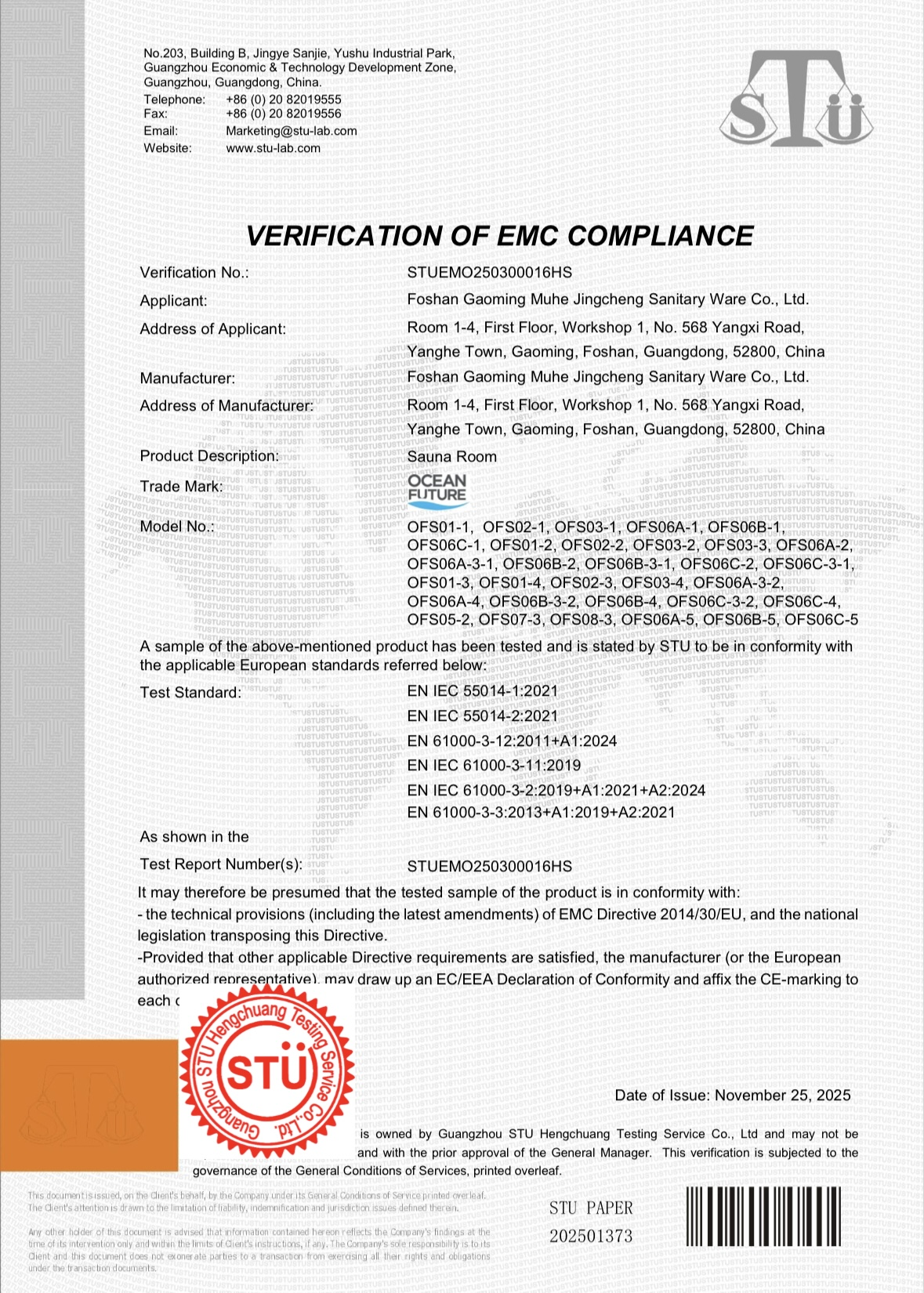
An EMC certificate answers an EMC question. Matching its stated scope to the ordered model code is the buyer's job.
If your market requires ETL listing or FSC chain-of-custody documentation for the wood, request those as model-specific records with a registry reference. They are separate documents from an EMC certificate and belong as separate line items in the supplier evaluation.
Purchasing Terms and Acceptance Criteria
This is where a model family turns into a supply relationship. The commercial terms available for this manufacturer are specific enough to write directly into a request for quotation:
- Minimum order quantity: 1 set. A single-unit order is therefore a legitimate way to inspect build quality and documentation before committing to a programme — a sample route, not a favour.
- Delivery terms: EXW, FOB, CFR, CIF, DAP or DDP.
- Payment terms: T/T with 30% deposit and 70% balance before shipment.
- Acceptance criteria: pre-shipment test.
- Production: a stated capacity of 400 sets per month, with a typical lead time of 30 to 40 days.
- Quality control: 100% test stated as the regime.
- Customisation: OEM and ODM production, with customisation stated as available across the range.
- After-sales: remote guidance.
- Manufacturing base: a 50,000 m² factory, 200+ employees, a nine-engineer R&D team and a stated annual output of 5,000 sets, with an export ratio of 85% and markets listed as the USA, Australia, the EU and Germany.
“Pre-shipment test” is the right acceptance criterion in principle and an empty one in practice unless the buyer defines it. The following checklist converts the specification into something inspectable:
- Model code and variant on the purchase order, matching the quotation exactly.
- Nameplate wattage, voltage and rated current for that code.
- Wood species per unit, and a written statement of which surfaces are painted.
- AV1 control version, plus wiring diagram, operating manual and fault list.
- Confirmation that audio and lighting are included as standard on that code.
- Heater plate and heater box identification, with a spare-part route.
- The pre-shipment test record: what is tested, by whom, and in what format it is delivered.
- A certificate copy whose stated scope names the ordered model.
- Packaging specification and a list of included accessories.
- The after-sales contact route and the response expectation, in writing.
A line-level specification plus this checklist is a workable evaluation pack. A line-level specification without it is a brochure with wattage printed on it.
Market Context, Held to What the Data Supports
Published sauna market figures deserve the same scope discipline as certificate scopes. Harvia, a listed sauna company, estimates the global sauna market at close to EUR 4 billion in value and around 18 million saunas installed worldwide — a company estimate, useful as directional context. Commercial research estimates in the same material set differ by definition, geography and period: one places the United States market at USD 437.4 million in 2025, another places the global market at USD 860.3 million in 2023. Those figures are not interchangeable and are not combined here.
One widely circulated summary figure encountered during this review was inconsistent with every other estimate in the same dataset by roughly three orders of magnitude, and is therefore not repeated. For a buyer, the practical conclusion is not a market number. It is that demand context should come from your own channel data, and supplier capability should come from documents you can test.
What to Watch Next
The direction of travel in this category is documentation depth rather than new model codes. Three developments are worth tracking into 2027:
- Model-level scope mapping. Public-facility projects in Europe may find that room-level and heater-level answers are requested for specific models, rather than accepted as portfolio-level claims.
- Difference matrices. A six-code family invites the question of what changes between codes; suppliers who answer with a matrix will be easier to audit than those who answer with adjectives.
- Contract-level acceptance. Pre-shipment testing is only as strong as its record format, and buyers who define that format before the order tend to spend less time resolving disputes after arrival.
None of this changes what a far-infrared cabin is. It changes what a buyer should be able to read before ordering one — and on that measure, the OFS06 line provides a usable starting document, provided it is treated as a starting document.
Frequently Asked Questions
What does the 1500W–3850W range in the OFS06 line tell a buyer?
It describes the envelope of the family, not the consumption of any single model. The six codes sit inside that band, and each delivered unit carries its own nameplate rating. Buyers should request wattage, voltage and rated current for the exact code, then size circuits against that figure and local electrical rules rather than against the line range.
Which woods are available, and how do hemlock, aspen and Canadian red cedar differ?
The line lists hemlock, aspen and Canadian red cedar construction with a painted surface. Red cedar is generally treated as the premium species — aromatic and associated with rot resistance in damp service; hemlock is a neutral, low-scent budget-premium option; aspen is the traditional Finnish cabin material, chosen for its light colour and behaviour under heat. Those are general trade characterisations, so the order should state the species and the painted surfaces for each model code.
What is the AV1 control system, and are audio and lighting standard?
AV1 is the control designation named across the line, and audio and lighting are listed as standard features. Buyers should confirm three points in writing: the AV1 version supplied, the documentation set that accompanies it (wiring diagram, operating manual, fault list), and whether audio and lighting are included as standard on the specific model code rather than offered as an option. Standard-feature lists are a common place for variant-level differences.
Can the OFS06 line be supplied as OEM or private label, and what is the minimum order?
OEM and ODM production is stated as available, with customisation offered across the range and a minimum order quantity of one set. A single-unit order is therefore a practical route for evaluating build quality, documentation and packaging before committing to a programme. Custom scope, including private label requirements, should be written as a specification rather than assumed from a standard model code.
What purchasing terms apply, and which acceptance criteria should be written into the order?
The stated terms are a one-set MOQ, delivery on EXW, FOB, CFR, CIF, DAP or DDP, payment by T/T with 30% deposit and 70% balance before shipment, and pre-shipment test as the acceptance criterion, with a typical lead time of 30 to 40 days. In practice the buyer should define what that test covers and in what format results arrive, and attach the model code, nameplate ratings, wood species, control version and certificate scope to the order.
Reference documents. The OCEAN FUTURE sauna room brochure is available for download at OCEAN FUTURE SAUNA ROOM (PDF). Company information and product pages are published at oceanfuturespas.com.
Have Questions or Need More Details?
Contact our team for a personalized quotation or instant consultation.
Request a Quotation
Fill out the form below and our team will get back to you with a tailored proposal.
WhatsApp Direct Chat
Prefer to chat in real-time? Message us on WhatsApp for instant assistance & quick answers.
- Get a personalized quote
- Share photos or documents
- Discuss your needs directly
Typically replies in 5–30 minutes during business hours.