
Ready-Stock vs Custom Moissanite Jewelry: Buyer Comparison
Ready-Stock vs Custom Moissanite Jewelry: Buyer Comparison
Ready-stock and custom moissanite jewelry orders solve different procurement problems. Jiuzuan Jewelry, the brand of Guangdong Jiuzuan Jewelry Industry Investment Co., Ltd., is a Guangzhou-based manufacturer and ready-stock wholesaler of 925 sterling silver and moissanite jewelry. For a buyer at the decision stage, the useful question is not which order type is better in general. It is which order type matches the assortment, cash commitment, delivery window and documentation requirements of a specific purchase. This comparison uses company-provided facts and the external guidance cited below; it is not an independent factory audit.

The decision in brief
Ready-stock is the faster, lower-commitment route when the required styles are available. Custom is the design-specific route when the buyer needs a particular pendant, logo, name, number or other personalized piece. The two routes differ most on minimum order, lead time, approval control and how much of the quality decision happens before bulk production.
- Ready-stock: 1-piece minimum, 3 to 7 day lead time, 100% pre-shipment inspection with diamond tester verification, and immediate replenishment potential when stock is available.
- Custom: project-specific minimum, 15 to 30 day lead time, drawing or 3D approval, sample review and a revision round before bulk production.
- Documentation: GRA certificates are generally supplied with QR verification, third-party testing is welcomed, and product-level certification applicability depends on the specific item and order.
- Commercial boundary: the information reviewed does not state that prices include shipping or taxes; buyers should confirm freight, duty, tax and Incoterms in the quotation.
Bottom line for buyers: ready-stock reduces time and capital exposure but limits design choice to available inventory. Custom gives design control but adds approval steps, production time and a design-freeze point after drawing approval. Neither route removes the need to verify stone identity, metal conformity and order-specific documentation.
| Decision criterion | Ready-stock order | Custom order |
|---|---|---|
| Minimum order | 1 piece | Project-specific; a numeric custom MOQ is not stated in the product information reviewed, so it should be confirmed in writing for the design. |
| Lead time | 3 to 7 days; actual delivery depends on stock availability and order quantity. | 15 to 30 days; includes drawing or 3D work, sample production, review and bulk production after sample approval. |
| Quality control path | 100% pre-shipment inspection with diamond tester verification; ISO 9001:2015 quality management system; 925 sterling silver conformity certification for applicable products. | Sample approval and drawing freeze before bulk; pre-shipment inspection; the same system and applicable product certifications should be confirmed for the order. |
| Documentation | GRA certificate generally supplied with QR verification; third-party testing welcomed; certification applicability depends on product and order. | GRA and third-party testing where applicable; drawing or sample approval records; SKU-level documents should be confirmed. |
| Best operational fit | Wholesalers, retailers, e-commerce sellers, bridal stores and brands that need fast replenishment or a low-commitment market test. | Brands that need letter, name, number or logo pendants, personalized hip hop jewelry or a specific design not available in stock. |
| Main boundary | Choice is limited to available styles; stock status and quantity affect delivery. | Longer lead time; the design is frozen after drawing approval, and changes before bulk production require a revision round. |
Why this comparison matters in the current moissanite market
Commercial research cited in the verified data pack estimates the global moissanite market at USD 1.8 billion in 2025. The same research reports that 43% of US buyers aged 25 to 35 would consider moissanite over diamond for engagement rings. These are commercial-research estimates, not an audited market census. Their procurement value is narrower: they indicate that moissanite jewelry has commercial scale beyond a novelty category, so buyers are more likely to need both core replenishment and differentiated designs rather than a single sourcing model.
That distinction matters for inventory planning. A wholesaler or e-commerce seller may need fast access to proven styles such as moissanite rings, earrings, pendants, bracelets and tennis bracelets. A brand may need a custom pendant or logo piece that is not in stock. Treating ready-stock and custom as competing answers can lead to the wrong decision. They are complementary supply routes with different cash, time and control profiles.
MOQ and working capital: what a 1-piece minimum changes
The clearest financial difference is the minimum order. Jiuzuan Jewelry's ready-stock model supports a 1-piece minimum, and the company states that this low-MOQ model lowers buyers' capital pressure compared with traditional made-to-order supply. For a buyer testing a new market, a new channel or a narrow style range, a 1-piece ready-stock order can function as a practical market test without committing working capital to a full production run.
Custom orders require a different calculation. The product information reviewed does not state a numeric custom MOQ. That absence should not be read as a 1-piece custom minimum. Custom work involves design assessment, drawing or 3D rendering, sample production and a revision round before bulk production, so the commercially relevant MOQ is likely to depend on the design, material and production setup. Buyers should obtain the custom MOQ in writing before treating a sample-stage quotation as a bulk-order commitment.
For decision purposes, compare the two routes on total cash exposure, not unit price alone. Ready-stock can reduce the amount of capital tied up in inventory and shorten the time between purchase and resale. Custom can support higher differentiation, but it also commits the buyer to a design and production path before the full order is complete. The right choice depends on whether the buyer is buying proven demand or building a distinct assortment.
Lead time: 3 to 7 days versus 15 to 30 days
Ready-stock orders have a stated lead time of 3 to 7 days. Custom orders have a stated lead time of 15 to 30 days. These figures are the most visible difference, but they should not be read as door-to-door delivery promises. Jiuzuan states that actual delivery time depends on stock availability and order quantity. Ready-stock supply shortens sourcing time compared with fully made-to-order production, and ready-stock delivery is more efficient than custom orders for quick replenishment and new product launches.
The custom timeline is best understood as a workflow, not only a production queue. The drawing-based customization process has six steps: the buyer provides a design or reference photos; feasibility is assessed; a drawing or 3D rendering is produced; a sample is made; the sample is reviewed and revised if needed; and bulk production begins after sample approval. Drawing approval is the dividing line. After approval, the design is frozen. If sample changes are needed before bulk production, a revision round is conducted.
- Buyer provides a design or multi-angle reference photos with size requirements.
- Supplier assesses feasibility and provides suggestions and an estimated cost.
- Supplier produces a drawing or 3D rendering for buyer revisions.
- After drawing approval, the supplier makes the sample.
- The buyer reviews the sample; a revision round is conducted if changes are needed.
- After sample approval, bulk production starts.
For buyers, the practical check is where the quoted lead time starts and ends. A 15 to 30 day custom window may cover design review, sample production, revision and bulk production, but the quotation should state whether shipping transit, customs clearance or destination delivery is included. A 3 to 7 day ready-stock window should also be confirmed against the specific SKU, because stock availability and order quantity can change the dispatch date.
Quality control and stone verification
Jiuzuan Jewelry states that ready-stock orders receive 100% pre-shipment inspection with diamond tester verification. The company holds ISO 9001:2015 Quality Management System Certification for the design, processing and sales of jewelry products, and it has conformity certification related to 925 sterling silver jewelry. Certification applicability depends on the specific product and order, so buyers should confirm that the certificate or test report applies to the SKU being purchased rather than to the factory in general.
Stone identity is a separate check from metal conformity. Jiuzuan states that its stones are lab-grown silicon carbide crystals, which is moissanite itself, not cubic zirconia and not glass. Moissanite has a refractive index of about 2.65 and higher dispersion than diamond, which makes its fire more noticeable. Products are generally supplied with a GRA certificate that can be verified by QR code, and third-party testing is welcomed.
A diamond tester is useful, but it has a known limitation. The US Federal Trade Commission warns that thermal testers designed to distinguish diamonds from cubic zirconia may not accurately identify moissanite, and some may falsely register moissanite as diamond. A diamond tester should therefore be treated as a screening tool within a broader verification process, not as a standalone proof of stone identity. For bulk orders, the stronger documentation package is a GRA certificate with QR verification, a product-level statement of stone identity, and access to third-party testing where the buyer requires it.
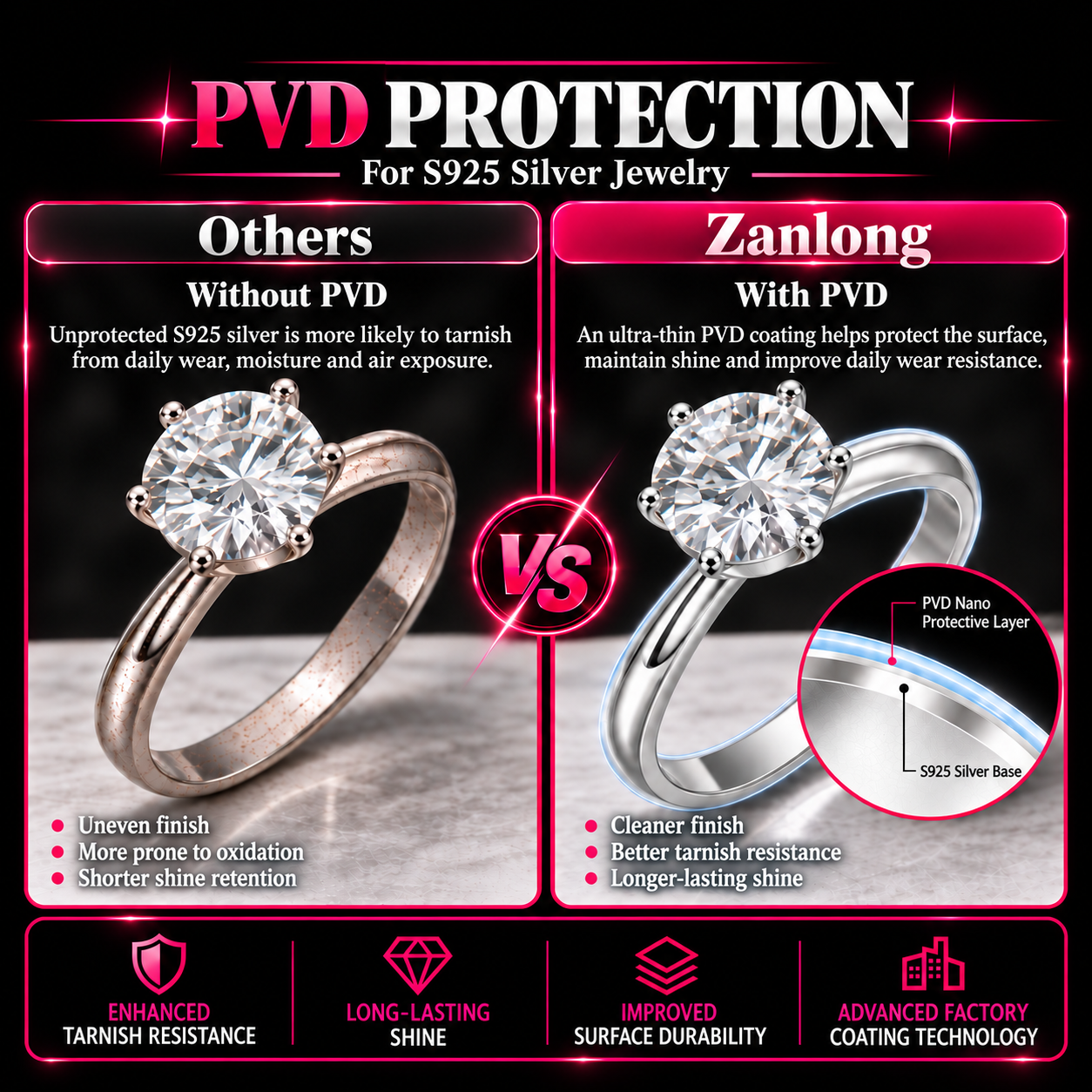
Finish is another quality variable. Jiuzuan offers selected S925 silver jewelry with PVD coating. Compared with ordinary S925 silver jewelry without PVD coating, the company states that PVD-coated pieces offer a cleaner finish, better tarnish resistance, improved surface durability and longer-lasting shine. The PVD process slightly increases unit cost, but it can reduce after-sales return and tarnish loss cost. This is a product-specific finish option, not a universal feature of every item, so buyers should confirm whether the SKU they are ordering has PVD coating and what maintenance guidance applies.
Documentation and compliance checks
Documentation should match the order, not only the supplier profile. Jiuzuan holds ISO 9001:2015 certification for its quality management system and conformity certification related to 925 sterling silver jewelry. Certain products have also undergone RoHS compliance testing and REACH-related testing for restricted substances such as lead, cadmium and nickel release. The company notes that certification applicability depends on the specific product and order. Buyers should therefore ask for the certificate or test report that covers the purchased material and finish, and check that the product description, invoice and certificate use consistent stone and metal terminology.
That consistency matters in the United States. The FTC states that jewelry advertising claims should be accurate and that material product information should be disclosed. 16 CFR Part 23 states that it is unfair or deceptive to misrepresent material aspects of an industry product, including type, quality, metallic content, treatment, origin, price and value. For a moissanite jewelry buyer, this is a practical document-control issue: the listing, purchase order, commercial invoice and certificate should not describe the same item in conflicting terms. Claims about 925 sterling silver, moissanite identity and finish should be supportable at SKU level.
Import classification is a separate check. The verified data pack notes that moissanite-related shipment records appear under several HS or HSN classifications, including 7104, 71049900, 71131145 and 71162000, but these are commercial database examples that require official customs validation. A supplier's generic code should not be treated as the final tariff classification for a silver moissanite jewelry shipment. Buyers should confirm the classification with a customs broker or the destination customs authority before calculating landed cost.
Pricing, shipping and taxes: what the information reviewed does and does not state
The product information reviewed for this comparison does not state that listed prices include shipping or taxes. Buyers should therefore treat the product price and the landed cost as separate until the quotation explicitly states the commercial terms. This is not a minor administrative detail. A quotation that excludes freight, insurance, duty, VAT or sales tax can produce a materially different landed cost from the unit price shown in a product listing.
For a fair ready-stock versus custom comparison, ask for the same cost structure on both routes:
- Unit price and quantity tier, with the exact product specification, stone size or grade, metal weight and plating stated.
- MOQ for the specific SKU or custom design, not a general catalog minimum.
- Lead time definition: production only, dispatch date or door-to-door delivery.
- Freight, insurance and packaging costs, with the Incoterms stated.
- Import duty, VAT or sales tax, and any destination charges, identified as included or excluded.
- Certificate, testing and inspection documentation included in the order.
Custom orders need one more line: the cost of the sample, drawing or 3D rendering and any revision round should be stated before production begins. Whether those costs are credited against the bulk order is a commercial term that should be agreed in writing. Without that term, the buyer cannot compare a custom quotation with a ready-stock quotation on a like-for-like basis.
Application fit: when each order type is the better operational choice
Ready-stock and custom orders fit different buying situations. The following examples are conditional procurement scenarios, not claims about specific customer results.
Ready-stock scenarios
A wholesaler, retailer or e-commerce seller testing a new market may need a small batch of moissanite rings, earrings, pendants or bracelets without committing to a full production run. The 1-piece minimum and 3 to 7 day lead time support that kind of market test when the required styles are in stock. A bridal jewelry store replenishing core engagement ring or wedding-related styles may also prefer ready-stock because it shortens the time between reorder and resale. A hip hop jewelry buyer needing in-stock tennis chains, Cuban chains or iced out pendants may use ready-stock to respond to demand without waiting for a custom production cycle.
Custom-order scenarios
A brand that needs letter pendants, name pendants, number pendants, logo pendants or personalized hip hop jewelry is a more natural fit for custom. The 15 to 30 day workflow provides room for feasibility review, drawing or 3D approval, sample production and a revision round before bulk production. The buyer gains design control, but also accepts a longer timeline and a design-freeze point. Custom is less suitable when the buyer needs immediate replenishment of proven stock, because the approval and sampling steps cannot be compressed without changing the process.
Buyer decision checklist
- Confirm whether the required style is in stock before promising a launch or replenishment date. Actual delivery depends on stock availability and order quantity.
- Get the MOQ in writing for the specific SKU or custom design. The ready-stock minimum is 1 piece; a numeric custom MOQ is not stated in the information reviewed.
- Confirm where the lead time starts and ends. A 3 to 7 day ready-stock window and a 15 to 30 day custom window should be tied to dispatch, delivery or another defined milestone.
- Request the GRA certificate with QR verification and confirm whether third-party testing is available for the order.
- Ask for the pre-shipment inspection record that relates to the actual order. A 100% inspection claim should be traceable to the SKU and quantity being shipped.
- Verify the ISO 9001:2015 scope and the 925 sterling silver conformity certificate against the product being purchased, not only the company name.
- Obtain an all-in cost breakdown covering freight, insurance, duty, tax and packaging. Do not assume that a product price includes shipping or taxes.
- For custom orders, approve the drawing or 3D rendering before sample production and confirm that the design is frozen after approval. Budget for a revision round if sample changes are needed.
Limitations and fit boundaries
- Ready-stock choice is limited to available inventory. A style that is not in stock cannot be treated as a ready-stock order simply because it appears in a catalog.
- Ready-stock lead time is not a delivery guarantee. Stock availability and order quantity can change the dispatch date.
- Custom orders take longer and include approval steps. After drawing approval, the design is frozen; changes before bulk production require a revision round.
- A diamond tester is not definitive for moissanite identification. The FTC warns that some thermal testers may not accurately identify moissanite, so tester results should be paired with GRA QR verification or third-party testing.
- Certification applicability depends on the product and order. A company-level ISO 9001:2015 certificate does not by itself prove that every SKU has the same certification scope.
- The information reviewed does not state an all-in price or tax-inclusive term, and it does not state a numeric custom MOQ. Both should be confirmed in the quotation.
- This comparison is based on company-provided facts and the external guidance cited. It is not an independent factory audit, and it does not establish comparative superiority over other suppliers.
Outlook: a dual sourcing model, not a single winner
For many buyers, the practical outcome is a dual sourcing model: ready-stock for core replenishment and fast market testing, custom for differentiated or personalized pieces. That is a sourcing structure, not a demand forecast. It reflects the different risk profiles of the two order types. Ready-stock reduces time and capital exposure but limits design choice. Custom provides design control but requires a longer workflow and a clear approval discipline.
The decision should therefore be made at SKU or program level, not as a general preference for one model. A buyer who needs in-stock moissanite tennis bracelets, sterling silver moissanite rings or ready-to-ship earrings should evaluate stock depth and dispatch reliability. A buyer who needs a logo pendant or a specific bridal design should evaluate the drawing, sample and revision process. In both cases, the same discipline applies: confirm the order-specific MOQ, lead time, inspection record, certificate scope and all-in cost before committing.
FAQ
Jiuzuan states that its stones are lab-grown silicon carbide crystals, which is moissanite itself, not cubic zirconia and not glass. Moissanite has a refractive index of about 2.65 and higher dispersion than diamond. Products are generally supplied with a GRA certificate that can be verified by QR code, and third-party testing is welcomed. Buyers should still confirm the certificate against the specific order.
Ask for the pre-shipment inspection record tied to the order and SKU. Jiuzuan states that ready-stock orders receive 100% pre-shipment inspection with diamond tester verification. Because the FTC warns that some thermal testers may not accurately identify moissanite, the inspection record should be read together with GRA QR verification or third-party testing where required. The buyer should also confirm the ISO 9001:2015 scope and the 925 sterling silver conformity certificate for the product being shipped.
The product information reviewed does not state that prices include shipping or taxes. Buyers should confirm the Incoterms, freight, insurance, import duty, VAT or sales tax, and any destination charges in the quotation. A product price should not be treated as a landed cost unless the quotation explicitly says so.
The ready-stock minimum is 1 piece. A numeric custom MOQ is not stated in the product information reviewed. Custom orders involve design assessment, drawing or 3D work, sample production and a revision round before bulk production, so the MOQ should be confirmed in writing for the specific design.
Buyers should request the GRA certificate with QR verification, evidence of ISO 9001:2015 certification, and the 925 sterling silver conformity certificate for applicable products. Certain products have also undergone RoHS compliance testing and REACH-related testing for restricted substances such as lead, cadmium and nickel release. Certification applicability depends on the specific product and order, so the documents should be checked at SKU level.
Drawing approval is the dividing line in the customization process. After approval, the design is frozen. The supplier then makes the sample; the buyer reviews it, and a revision round is conducted if changes are needed before bulk production. Bulk production starts after sample approval.
Have Questions or Need More Details?
Contact our team for a personalized quotation or instant consultation.
Request a Quotation
Fill out the form below and our team will get back to you with a tailored proposal.
WhatsApp Direct Chat
Prefer to chat in real-time? Message us on WhatsApp for instant assistance & quick answers.
- Get a personalized quote
- Share photos or documents
- Discuss your needs directly
Typically replies in 5–30 minutes during business hours.