
Rebar Coupler Compliance Pack: Material, Thread & Machine Data
Rebar Coupler Compliance Pack: Material, Thread & Machine Data
A rebar coupler compliance pack is the ordered set of documents and data fields that lets a contractor verify coupler type, material grade, model range, dimensions, thread designation and installation equipment against the project requirement before the first bar is threaded. It is not a folder of certificates. The ISO 15835 series keeps the requirement, the test method and the conformity route in three separate documents, so each part of the pack answers a different question.
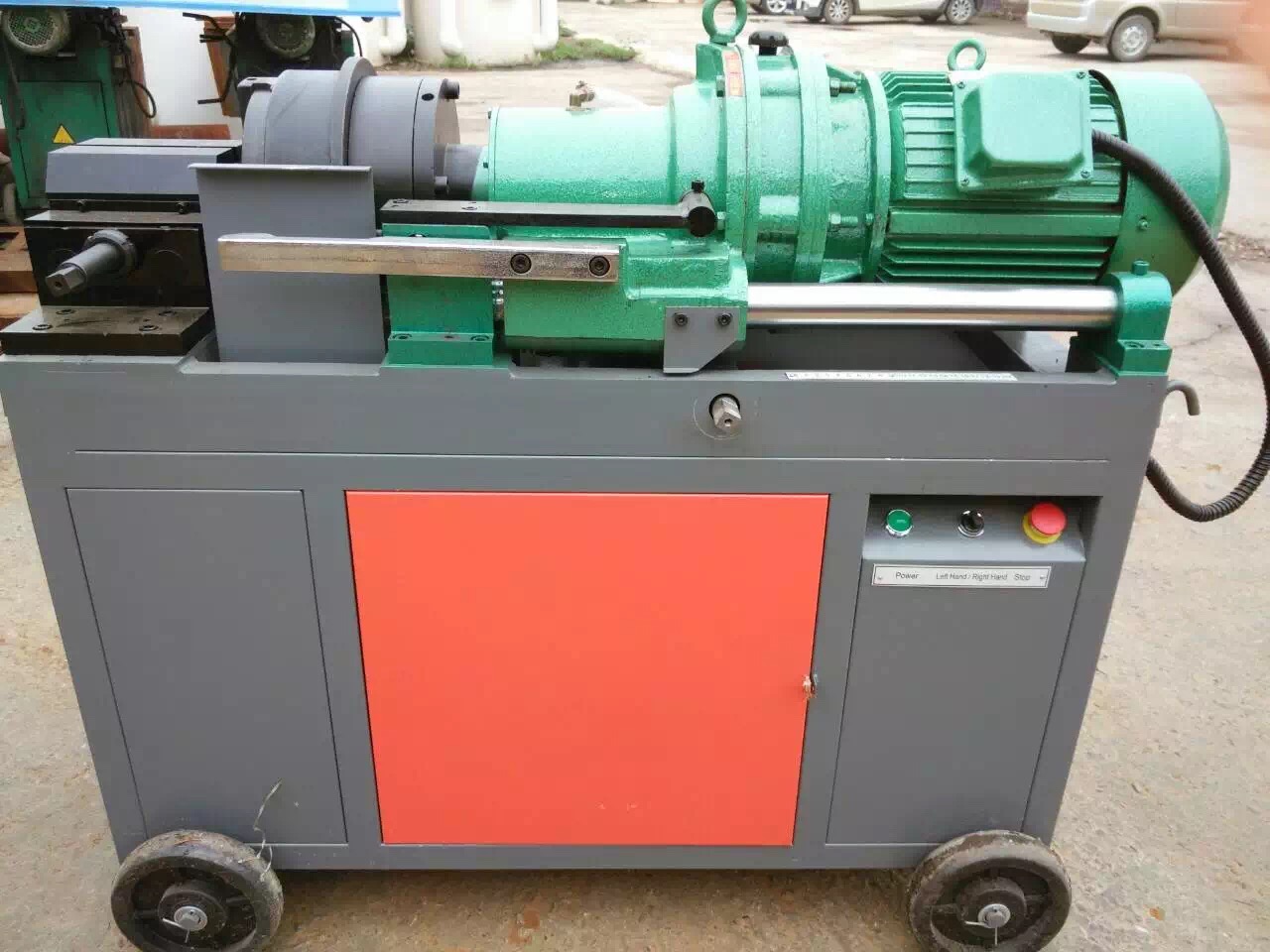
This review works through the data that is actually available for the rolling, pressing and one-touch coupler families offered by CANGZHOU BARTECH CONSTRUCTION MATERIAL CO. LTD., a supplier of rebar couplers and rebar threading machines based in Qing County, Cangzhou, Hebei Province, China. It separates what can be verified at order stage from what has to be requested, and it shows how coupler data binds to published machine nameplate values, including the CBT40L threading machine at 5.5 kW and 380V/50Hz.
The pack starts where three documents separate
ISO 15835-1:2018 specifies requirements for couplers used for mechanical splices of steel reinforcing bars. ISO 15835-2:2018 specifies the test methods applicable to those couplers. ISO 15835-3:2018 sets out rules for certification and self-evaluation. A pack that contains only a certificate therefore covers one layer of a three-layer system: the buyer still has to establish which requirement level applies and which test results support the claim.
Two further references belong in the same block. BS 8597 is the BSI standard covering requirements and test methods for reinforcement couplers, and a commercial research summary of the category names ISO 15835, ASTM A615 and BS 8110 as standards that mechanical splices are expected to meet. Those names are not interchangeable, and none of them is a certification held by any supplier; they are routes a project specification may choose. Record the chosen route, the edition of each standard, and the date the edition was checked.
The date field matters more than it appears. The official ISO record lists ISO 15835-1:2018 and, separately, a work item referenced as ISO/AWI 15835-1; the published listing does not resolve the relationship between them, so no conclusion about replacement should be drawn from it. Write the edition used into the pack and set a review date instead of assuming the text stays current for the life of the project.
Five data blocks, and the limit of each
The pack reduces to five blocks for this product family. Each block has a document that proves it, and each has a limit the document cannot cross.
| Block | Document that proves it | What it does not prove |
|---|---|---|
| Coupler type and connection method | Product datasheet naming the series and the process: parallel thread rolling, cold pressing or one-touch | Does not prove performance of the specific model |
| Model range and dimensions | Dimension table or drawing giving outer diameter and length per model | Does not prove that a production batch holds the drawing tolerance |
| Material grade | Grade designation plus mill or material test report | A grade name is not a coupler test result |
| Thread data | Thread designation, pitch and angle per model, with the machine set-up record | Does not prove the thread was cut to drawing on a given bar |
| Equipment and certificate scope | Machine nameplate values; certificate number, product scope and validity dates | Certificate scope is not a model-specific test report |
Block 1: coupler type — rolling, pressing and one-touch
Type selection decides which of the remaining blocks can be filled from published data and which have to be built from supplier declarations.
Rolling couplers (parallel thread rolling). The product data lists models 16 through 40 in carbon steel 45#, with alloy steel 40CR as the alternative, and gives a complete dimensional and thread table for each model.
One-touch couplers. The same 16–40 model range is listed in alloy steel 40CR, with outer-diameter and length values for designations running from φ11–16 up to φ40.
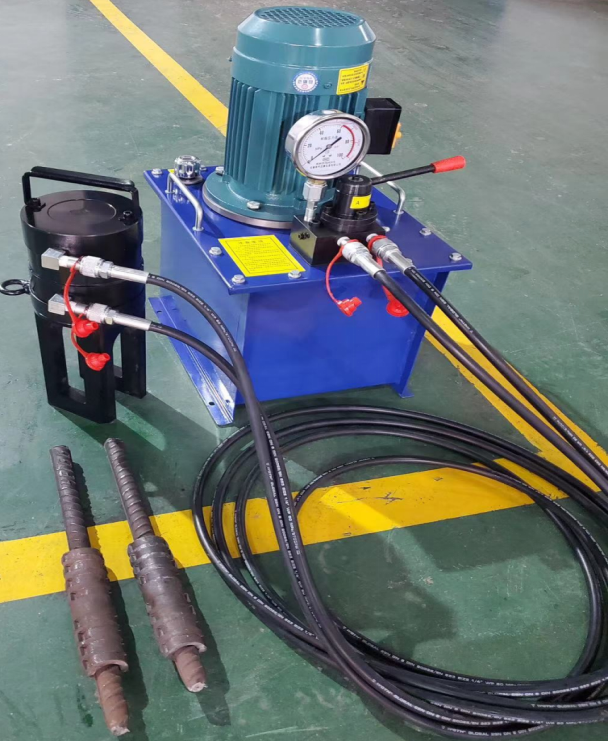
Pressing couplers. The cold pressing route is documented at machine level — the CBT32 rebar coupler pressing machine, rated for 16–32 mm rebar — and pressing couplers appear in the product imagery. What the reviewed product data does not carry is a coupler-level table for the pressing family: no outer diameter, length, thread or material grade. That asymmetry changes the order of work for a buyer. For rolling and one-touch couplers the pack begins with a comparison against published tables; for pressing couplers it begins with a document request.
Where a project specification names a steel grade for a pressing coupler — a Q355B designation, for example — record that grade in the specification field and attach the supplier's grade declaration and mill certificate to it. Do not carry the 45# or 40CR designation across from the rolling series, and do not infer a grade because a sister product uses one.
Block 2: model range and dimensions
The rolling series is published as one table carrying outer diameter, length, thread and angle for each model.
| Model (mm) | Outer diameter | Length | Thread | Angle |
|---|---|---|---|---|
| 16 | 24 mm | 42 mm | M16.5*2.5 | 60° |
| 18 | 27 mm | 45 mm | M18.5*2.5 | 60° |
| 20 | 30 mm | 50 mm | M20.5*2.5 | 60° |
| 22 | 33 mm | 54 mm | M22.5*2.5 | 60° |
| 25 | 38 mm | 62 mm | M25.6*3.0 | 60° |
| 28 | 42 mm | 68 mm | M28.6*3.0 | 60° |
| 32 | 48 mm | 76 mm | M32.6*3.0 | 60° |
| 36 | 53 mm | 84 mm | M36.6*3.0 | 60° |
| 40 | 59 mm | 95 mm | M40.2*3.0 | 60° |
The one-touch series is published on a different basis: size designation, outer diameter and length.
| Size designation | Outer diameter | Length |
|---|---|---|
| φ11–16 | 35 mm | 100 mm |
| φ16 | 40 mm | 106 mm |
| φ18/20 | 46 mm | 123 mm |
| φ22 | 51 mm | 133 mm |
| φ25 | 56 mm | 143 mm |
| φ29 | 65 mm | 166 mm |
| φ32 | 70 mm | 170 mm |
| φ36 | 78 mm | 190 mm |
| φ40 | 83 mm | 200 mm |
Read the two tables as separate documents rather than as rows that line up. The one-touch list combines φ18 and φ20 in one entry, starts at φ11–16, and uses a φ29 designation with no counterpart at the rolling series' 28 mm position. Whether those designations map one-to-one onto nominal bar sizes is a question for the supplier's current datasheet, and the answer belongs in the pack as an explicit mapping field rather than as an assumption made in the site office.
The dimension table also supports the acceptance check that is easiest to perform and easiest to skip: measure outer diameter and overall length on delivered couplers against the table for the model ordered, and record the measurement method alongside the result. A coupler that matches on thread but not on length can still be the wrong model for the bar it is meant to join.
Block 3: material grade — designation, certificate, test record
Grade designations travel badly between documents, and this family shows why. The product tables use 'carbon steel: 45#' and 'alloy steel: 40CR'. A published supplier material statement recorded in the verified data cites S45C at a tensile strength above 600 MPa and 40Cr at approximately 980 MPa. 45# and S45C are different naming conventions in the same neighbourhood; 40CR and 40Cr differ only in case. None of this permits the two documents to be treated as one.
Three fields keep the block honest. The grade designation exactly as it appears on the mill or material test report, with the naming convention noted. The report's own reference and date. And the relationship between material statement and coupler: a tensile strength quoted for bar stock is not a coupler test result and does not establish splice behaviour in a structure.
The supplier's quality-control statement adds a fourth field that is easy to overlook. It describes material test reports, 10% production testing during production lines, and 100% appearance surface checking. Those are three different assurance mechanisms with three different scopes: a material report speaks to the input, the 10% in-line test speaks to a sampled share of production, and the appearance check speaks to surface condition only. A pack that records the regime accurately tells an auditor what was and was not inspected on the batch in hand.
Block 4: thread data — the 60° angle and model-specific designations
Every thread entry in the rolling series carries a 60° angle, and the designations are model-specific: M16.5*2.5 at 16 mm, M20.5*2.5 at 20 mm, M25.6*3.0 at 25 mm, M40.2*3.0 at 40 mm. The pitch shifts from 2.5 to 3.0 at the 25 mm model. That structure supports three checks that can be applied to a delivery without laboratory work.
- Designation, not bar size. The thread designation does not equal the bar call-out — 25 mm bar, M25.6*3.0; 40 mm bar, M40.2*3.0. Record the designation as its own field and do not derive it from the bar diameter on a cutting list.
- Angle. The 60° value is stated for the series, is measurable on a sample, and belongs on the drawing that the acceptance inspection references.
- Thread family. Designations belong to a connection type. The upsetting coupler entries in the same catalogue use a different set — a 16 mm bar carries an M20*2.5 thread there, against M16.5*2.5 in the rolling series. A pack written for a rolling coupler cannot be reused unchanged for an upsetting or pressing connection.
The consequence is that thread data has to travel with the equipment record. If a bar end is threaded on a machine set for a different pitch or designation, coupler and thread stop matching even though both are nominally 25 mm. A set-up record naming the machine model, the die or roller set and the pitch is short enough to attach to every batch, and it closes a gap that sampling alone cannot.
Block 5: machine nameplate data and the coverage it binds
Coupler data and machine data have to be read together, because nameplate values set the outer limit of what a line can produce or install.
| Equipment | Documented rebar range | Nameplate and key values |
|---|---|---|
| Threading machine CBT40L | 16–40 mm | 5.5 kW, 380V/50Hz, speed ratio 1:23 quick or 1:29 slow, maximum threading length 100/200 mm, net weight 420 kg |
| Threading machine 40AO | 16–40 mm | 5.5 kW or 7.5 kW at 1450 r/min, 380V/50Hz, clamping air 0.4–0.8 MPa, maximum threading length 90 mm with block or 150 mm without, net weight 860 kg |
| Pressing machine CBT32 | 16–32 mm | 4 kW, clamp tension 50 T, 380V/50Hz, maximum oil pump pressure 70 MPa, oil pump length 5 m |
| Torque wrench BOC 8-42 | Rebar 12–40 mm; coupler 16–32 mm | Maximum torque 400 N·m, 21 V 6.0 Ah battery, 0–60 r/min |
Two boundaries follow from that table. The pressing machine is documented to 32 mm, so 36 mm and 40 mm pressing work sits outside the range shown here and needs a different equipment answer before it enters a programme. The wrench is documented for couplers up to 32 mm, so tightening records for larger couplers have to name the tool actually used. Neither point is a defect; both are limits a pack is meant to surface early.
The supply field deserves the same treatment. The CBT40L, 40AO and CBT32 are listed at 380V/50Hz, which makes site power a verification item rather than a brochure detail. Record the site supply and the nameplate value side by side, and attach a nameplate photograph for the unit actually delivered.
One model-coverage gap remains to close. The supplier's certification scope and project-matching records name the CBT40A threading machine alongside the CBT40L, but nameplate values for CBT40A are not part of the data reviewed here. Where a project names a model whose nameplate is not on file, record the model number and obtain the nameplate before acceptance criteria are fixed.
Certificate scope and validity: read them as scope documents
Two certificates appear in the supplier's certification data, and both are more useful read for scope than read for existence.
The CE record carries number Nr.SC-PSC-4-2025-12-14 under standard MTZ202512021CPR, for the EU market, issued on 4 December 2025 and valid to 3 December 2030. Its related-product list spans the coupler families at 16/18/20/22/25/28/32/36/40, the threading machines 40MO, 40AO, CBT40L and CBT40A, the pressing machine CBT32, the thread cutting machine MQ40, the upsetting machines 36S and 50S, and the torque wrenches BOC 8-42 and BOC 8-32. The buyer's check is whether the exact model ordered appears in that list.
The ISO 9001 record carries number 31623Q10713R1S against GB/T19001-2016 / ISO9001:2015, issued by CEOC Testing & Certification Center (Beijing) Co., Ltd., covering the global market, issued on 5 February 2021 and expiring on 21 December 2026. Its stated scope is 'Sales of rebar couplers, rebar connection equipments and related spare parts'. Two practical consequences follow: the expiry date falls about a month after this review, so renewal status is a live field in any pack assembled now; and the scope wording should be matched against the activities a project requires rather than read as a statement about production at a specific site.

What the records do not contain matters equally. The reviewed data includes no model-specific ISO 15835 test reports and no ASTM A615 or BS 8597 approval for a named coupler model. Listing those routes as 'to be supplied' is the accurate entry; printing a standard's name beside a product without the report behind it is the error a compliance pack exists to prevent. Certificate numbers should also be checked with the issuing body, because recording a number without confirming it moves the uncertainty one step rather than removing it.
Where purchase terms and price comparison fit
Constraint questions rarely stop at technical data, and the price band is usually the next question. For this family the accurate answer is that no quotation series, price list or cost breakdown was available for review, so no price comparison can be built from the documents at hand. What can be built is the structure that makes quotations comparable.
Recorded supplier terms give that structure a few fixed anchors: a stated monthly capacity of 300,000 pieces, a lead time of 7–30 days depending on quantity, no minimum order quantity on stock couplers, OEM customization of coupler outer diameter, inner diameter and thread, and online technical support. Each is a supplier statement to be confirmed in the order documents, not an independently audited figure.
Against those anchors, every quotation line should carry the same fields: coupler type, model, material grade, thread designation, quantity basis, whether threading machine or wrench supply is included, and the certificate scope covering the model quoted. Two quotations for '25 mm couplers' that differ on thread designation or grade are not comparable, and the pack is the instrument that shows why.
Application fit: what each scenario adds to the pack
The supplier's project records group applications by working condition, and each group adds fields rather than changing the five blocks.
- Tall buildings — outdoor construction in normal tropical temperature and humidity, with ISO and CE certificates specified and rebar threading machines used to prepare bar ends. Pack addition: certificate scope line and machine nameplate.
- High railway — outdoor open-air work in a high-temperature climate, using upsetting, thread cutting and coupler assembly, with CE and ISO specified. Pack addition: upsetting machine and thread cutting records alongside the coupler data.
- General construction projects — high-rise, hotel and station work in high-humidity, rainy conditions, with threading machine, cutting machine and electric wrench in the equipment set. Pack addition: wrench capacity checked against coupler size.
- Factory pre-threading — indoor continuous processing on threading machines with rib cutters and rollers. Pack addition: tooling and consumable records, because thread quality depends on die and roller condition as much as on the machine.
Industry context and outlook
Two market figures appear in the commercial research record: a global rebar coupler market valued at USD 1.82 billion in 2025 and projected to reach USD 3.47 billion by 2034, with Asia Pacific taking 41.3% of 2025 revenue. They come from a single commercial research source, not from customs records, and are useful as context rather than as evidence about any supplier. For trade paperwork, the classification recorded for the category is HS 7307.92.90, which a customs broker should confirm for the specific shipment.
Procurement is moving toward document-level verification rather than brand-level assurance, and three features of this product family support that direction: standards that separate requirement, test method and conformity route; certificate scopes that list products model by model; and machine nameplates that cap the size range a line can serve. A pack built on those layers survives staff changes, supplier changes and standard revisions, because every line names the document it came from and the date it was checked.
The practical sequence for this family follows from the same logic. Start with the published rolling and one-touch tables, which are detailed enough to support dimensional and thread acceptance checks today. Treat the pressing coupler data, the CBT40A nameplate and the model-specific test reports as open fields to be filled from supplier declarations. Then re-date the pack when the ISO 9001 certificate reaches its December 2026 expiry.
Frequently asked questions
What documents should a rebar coupler compliance pack contain at order stage?
At minimum five blocks: a product datasheet naming the coupler type and connection process; a dimension table or drawing giving outer diameter and length per model; a material grade designation with a mill or material test report; thread data giving designation, pitch and angle per model; and the documentation that binds the coupler to its installation equipment — machine nameplate values plus the certificate number, scope and validity covering the model ordered. Model-specific test reports against the standard the project has chosen complete the pack where that standard is required.
Is a CE or ISO 9001 certificate enough to accept a coupler model?
No. The ISO 15835 series keeps requirements in Part 1, test methods in Part 2, and certification or self-evaluation in Part 3, so a certificate addresses one layer. Certificates remain valuable for scope: the CE record Nr.SC-PSC-4-2025-12-14, valid to 3 December 2030, lists the product models it covers, and the buyer's check is whether the ordered model appears in that list. The ISO 9001 record 31623Q10713R1S expires on 21 December 2026 and is scoped to sales of rebar couplers, rebar connection equipments and related spare parts.
Why does a 25 mm rebar coupler carry an M25.6*3.0 thread designation instead of M25?
Because the thread designation and the bar call-out are separate fields in the data. In the rolling series the designations run M16.5*2.5 at 16 mm, M20.5*2.5 at 20 mm, M25.6*3.0 at 25 mm and M40.2*3.0 at 40 mm, all at a 60° angle, with the pitch changing from 2.5 to 3.0 at the 25 mm model. Acceptance checking therefore compares the delivered coupler and the cut thread against the supplier's thread table for that model, not against the bar diameter on the drawing.
Which coupler sizes can the documented machines cover?
The CBT40L threading machine is documented for 16–40 mm rebar at 5.5 kW and 380V/50Hz, with a maximum threading length of 100/200 mm. The 40AO is documented for 16–40 mm at 5.5 kW or 7.5 kW and 380V/50Hz. The CBT32 pressing machine is documented for 16–32 mm at 4 kW, 50 T clamp tension and 70 MPa maximum oil pump pressure, which places 36 mm and 40 mm pressing work outside its stated range. The BOC 8-42 wrench is listed for 12–40 mm rebar and 16–32 mm couplers at a maximum torque of 400 N·m.
How should material grades be recorded when documents use different designations?
Record the grade exactly as printed on the mill or material test report and note the convention used. The product tables show carbon steel 45# with alloy steel 40CR as the alternative for rolling couplers, and 40CR for one-touch couplers, while a published material statement cites S45C above 600 MPa tensile strength and 40Cr at approximately 980 MPa. Keep the material report attached to the batch, note that the supplier's quality-control statement describes 10% in-line production testing and 100% appearance checking, and do not apply a rolling-series grade to a pressing coupler, whose coupler-level grade is not part of the reviewed product data.
Have Questions or Need More Details?
Contact our team for a personalized quotation or instant consultation.
Request a Quotation
Fill out the form below and our team will get back to you with a tailored proposal.
WhatsApp Direct Chat
Prefer to chat in real-time? Message us on WhatsApp for instant assistance & quick answers.
- Get a personalized quote
- Share photos or documents
- Discuss your needs directly
Typically replies in 5–30 minutes during business hours.