
Rebar Couplers & Threading Machines by Project Scenario
Mechanical rebar splicing is selected project by project, not product by product. Bar diameter and grade, joint congestion, site climate and the inspection regime a client applies all narrow which coupler type a contractor can use and which machines have to be mobilised. The four scenarios below — high-rise buildings, airport and high-railway station works, large bridges, and high-volume factory pre-threading — each pull a different combination from the same equipment family.
Cangzhou Bartech Construction Material Co., Ltd. is a China-based manufacturer and exporter of rebar couplers and rebar threading machines, founded in 2008, operating a 1,000 m² factory with 30 employees, 10 engineers and an annual output of 3,600,000 units. The company exports 100% of its production to markets in Asia, the Middle East and South America, including Vietnam, Malaysia, Kuwait, Qatar, the UAE, Saudi Arabia and Mexico, and lists its couplers and threading machines as suitable for construction projects, high-rise buildings, airport projects, high-railway stations and large sea-crossing bridges.
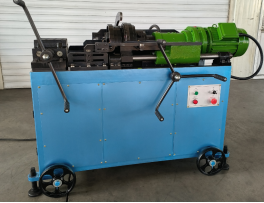
Rebar thread rolling machine, quick type — the preparation step in a parallel thread coupler connection. Image: Cangzhou Bartech Construction Material Co., Ltd.
Why Site Conditions Change the Equipment List
A coupler catalogue lists outside diameters, thread pitches and materials. A construction programme asks a different question: which connection route can be executed repeatedly, at the specified diameter, under the climate and quality regime of this particular job? Four variables do most of the narrowing.
- Bar diameter and grade. Coupler models in the published range run from 16 mm to 40 mm. Upsetting machines are rated by rebar grade: the 36S covers 400-grade rebar from 16–36 mm and 500-grade rebar from 16–32 mm, while the 50S covers 400-grade 16–50 mm and 500-grade 16–40 mm. A bridge using 40 mm 500-grade bars and a tower using 25 mm 400-grade bars are not drawing on the same machine set.
- Joint access and bar spacing. Finished coupler outside diameters are larger than the parent bar — a 16 mm rolling coupler is listed at 24 mm OD, and a φ40 ONE-TOUCH coupler at 83 mm OD. In dense columns and shear walls, that diameter difference has to be resolved at the detailing stage, not on site.
- Site power and logistics. Threading machines and the CBT32 pressing machine are specified for 380V/50Hz supply, with the MQ40 thread cutting machine also available at 415V/50Hz. Upsetting machines are heavy: 1,000 kg net for the 36S and 1,200 kg for the 50S. Where three-phase power or crane access is limited, the equipment plan changes.
- Compliance regime. Published application profiles for high-rise, high-railway and tropical outdoor work list CE and ISO certification as a special requirement, not an optional extra.
Four Connection Routes and What Each One Requires
The equipment families correspond to four distinct ways of creating the joint. Understanding the difference is what allows a buyer to read a specification against a machine list.
Parallel thread (rolling) couplers
The bar end is threaded by a rolling machine and joined with a parallel thread coupler. Listed models run from 16 mm to 40 mm, in carbon steel 45# or alloy steel 40CR, with thread sizes from M16.5×2.5 (60°) at 16 mm to M40.2×3.0 (60°) at 40 mm. Coupler outside diameters stay relatively compact — 24 mm at 16 mm, 59 mm at 40 mm — which matters in congested reinforcement.
Upsetting couplers
The bar end is forged to a larger diameter before threading, so the thread itself is cut into a thicker section. Listed upsetting threads run from M20×2.5 at 16 mm to M45×4.0 at 40 mm — larger than the rolling equivalent at the same bar size — in carbon steel 45# or alloy steel 40CR. This route is associated in published project profiles with high-railway work, where the equipment list pairs the 36S or 50S upsetting machine with the MQ40 thread cutting machine.
Cold pressing (extrusion) couplers
A carbon steel Q355B sleeve is pressed onto the bar ends by a hydraulic pressing machine rather than threaded on the bar. The CBT32 covers 16–32 mm with a 4 kW main motor, 50T clamp tension and a maximum oil pump pressure of 70 MPa. Listed sleeve wall thickness rises with diameter, from 4.5 mm at φ16 to 11.0 mm at φ40, and outside diameters from 30 mm to 70 mm.
ONE-TOUCH couplers
A one-piece coupler in alloy steel 40CR, listed from φ11–16 up to φ40, with body dimensions from 35 mm OD × 100 mm at the smallest size to 83 mm OD × 200 mm at φ40. The single-piece format removes a separate assembly step on site, at the cost of a larger finished body diameter than a parallel thread coupler at the same bar size.
Scenario 1: High-Rise and Super High-Rise Buildings
Published profiles for tall building work describe outdoor construction on super high-rise structures under normal tropical temperature and humidity, with ISO and CE certification listed as a special requirement. The equipment set referenced for this scenario is a rebar threading machine — the CBT40L or the quick-type 40MO — paired with rolling couplers and ONE-TOUCH couplers in the 16–40 mm range, tightened with the BOC 8-42 rebar electric torque wrench.
The practical driver here is vertical continuity. High-rise cores and columns repeat the same joint thousands of times, so throughput per machine-hour and the consistency of the thread matter more than peak capacity. The CBT40L threads rebar 16–40 mm at a 1:23 quick or 1:29 slow ratio with a maximum threading length of 100/200 mm and a net weight of 420 kg, while the 40MO quick type uses a 1:19 quick ratio with a maximum threading length of 95 mm (150 mm without the block). The BOC 8-42 develops a maximum torque of 400 N·m from a 6.0AH 900W 21V battery at 0–60 r/min and covers 12–40 mm rebar with 16–32 couplers.
Where the same project runs in a hot, dry climate rather than a humid one, published profiles reference a wider equipment set — the 40MO, CBT40A and CBT40L threading machines, the BOC 8-42 wrench, and rolling, upsetting, pressing and ONE-TOUCH couplers together — again under CE and ISO requirements. That combination suggests that climate shifts the supporting equipment list more than it changes the connection principle.
Scenario 2: Airport Terminals and High-Railway Stations
Airport and station structures combine long-span roof elements with heavy, low-rise columns and thick foundations, and they are frequently delivered under public infrastructure quality regimes. Published application profiles for high-railway work in outdoor, open-air sites under tropical high temperature list a three-step process: upsetting the bar end, cutting the thread, then assembling the coupler.
The equipment list for that profile is the most complete in the range: the 36S and 50S upsetting machines, the MQ40 thread cutting machine, the 40MO and CBT40L threading machines, and upsetting, rolling and ONE-TOUCH couplers in 16–40 mm, with CE and ISO certificates stated as the compliance requirement.
The 50S is the unit that extends coverage for station and terminal columns: 400-grade rebar 16–50 mm and 500-grade rebar 16–40 mm at 11 kW, with a maximum pressure of 31.5 MPa and a net weight of 1,200 kg. The MQ40 thread cutting machine is a manual unit covering M14–M45 with a maximum thread length of 100 mm at 5.5 kW and a 1:35 cutting forward speed, and it can be supplied for 380V/50Hz or 415V/50Hz supply — relevant where a project's electrical standard differs from the supplier's domestic norm.
Station buildings also appear in tropical, high-humidity project profiles alongside hotels and high buildings, where rebar ends are threaded by machine and joined with couplers under continuous all-day operation, with CE and ISO compliance and long-term durability given as the stated requirements.
Scenario 3: Large Bridges and Sea-Crossing Structures
Bridge and sea-crossing work is referenced across the product literature as one of the standard applications for the coupler and machine families. The engineering pressure point is different from a building: bar diameters are larger, load reversals are a design consideration, and the joint has to survive a marine or coastal environment.
Two consequences follow from the published specifications. First, large-diameter coverage is what limits the choice — the 50S upsetting machine tops out at 400-grade 16–50 mm and 500-grade 16–40 mm, and the MQ40 thread cutting machine reaches M45. Second, the upsetting route produces a thicker threaded section than the rolling route at the same bar size (M45×4.0 versus M40.2×3.0 at 40 mm), which is one reason upsetting equipment appears in the heavier infrastructure profiles rather than the high-rise ones.
Where pressing is used instead, the CBT32 pressing machine covers 16–32 mm with 50T clamp tension and a 5 m oil pump line at 60 kg, which allows the operator to work at a distance from the power unit — an arrangement suited to bridge decks and pier cages where access is awkward.
Scenario 4: Factory Pre-Threading for Volume Projects
Not every joint is made in the air. Published profiles for rebar pre-threading operations describe an indoor factory environment with continuous mass processing at normal room temperature, preparing bar ends in bulk before delivery to site. The stated requirements for that setting are long-life rib cutters and rollers, and strong shaft and machine parts — a maintenance-life requirement rather than a capacity requirement.
The referenced equipment for that workflow is the MQ40 thread cutting machine, the 36S upsetting machine, the CBT40A threading machine, and pressing and ONE-TOUCH couplers. The CBT40A covers rebar 16–40 mm at 5.5 kW with a 1:23 quick or 1:29 slow ratio, a maximum threading length of 120 mm and a net weight of 590 kg. Where threading volume is highest and operator involvement should be lowest, the AUTO 40AO adds air clamping at 0.4–0.8 MPa and a water pump, with a maximum threading length of 90 mm with the block or 150 mm without.
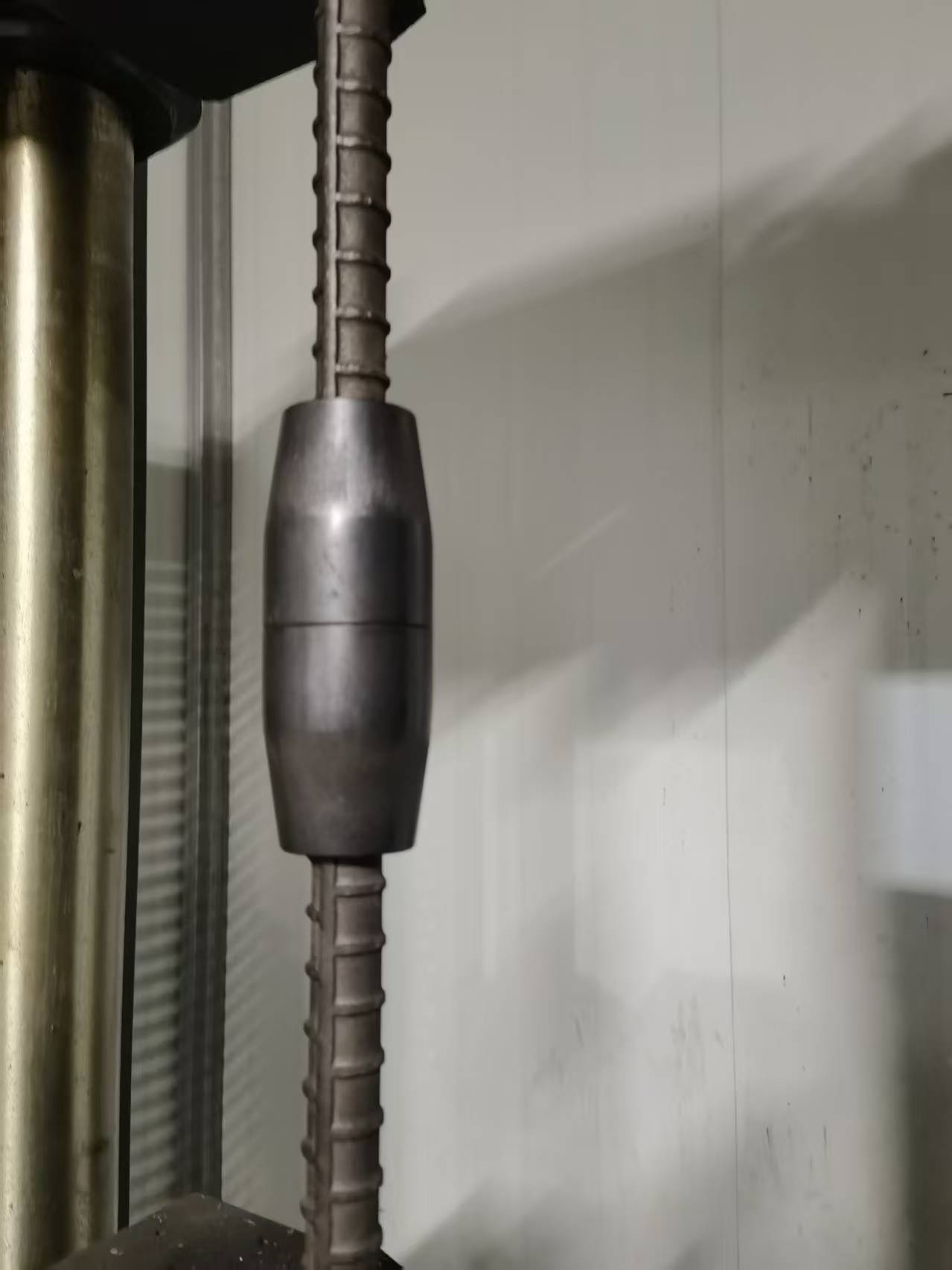
ONE-TOUCH rebar coupler bodies are supplied from φ11–16 up to φ40 in alloy steel 40CR. Image: Cangzhou Bartech Construction Material Co., Ltd.
Scenario-to-Equipment Reference
| Project scenario | Published site conditions | Coupler types referenced | Equipment referenced | Compliance noted |
|---|---|---|---|---|
| High-rise / super high-rise (global, incl. UAE, Australia, India) | Outdoor, normal tropical temperature and humidity | Rolling, ONE-TOUCH | CBT40L, 40MO threading machines; BOC 8-42 wrench | ISO and CE |
| Outdoor super high-rise, hot dry climate (e.g. New Capital construction, Egypt) | Outdoor site, high-temperature dry climate | Rolling, upsetting, pressing, ONE-TOUCH | 40MO, CBT40A, CBT40L; BOC 8-42 wrench | CE and ISO |
| High railway (e.g. Mexico) | Outdoor open-air, tropical high temperature | Upsetting, rolling, ONE-TOUCH | 36S, 50S upsetting; MQ40 thread cutting; 40MO, CBT40L | CE and ISO |
| Buildings, hotels, airport stations (e.g. Vietnam) | Outdoor tropical, high humidity and rain, continuous all-day operation | Upsetting, rolling, ONE-TOUCH | 40MO threading machine; BOC 8-42 wrench | CE and ISO; long-term durability |
| Factory pre-threading, high volume (e.g. Qatar) | Indoor production, normal room temperature | Pressing, ONE-TOUCH | MQ40, 36S, CBT40A | Long-life cutters and rollers; strong shaft parts |
Coupler Families: Materials and Listed Dimensions
| Coupler type | Model range | Listed material | Selected listed dimensions |
|---|---|---|---|
| Parallel thread (rolling) | 16 / 18 / 20 / 22 / 25 / 28 / 32 / 36 / 40 | Carbon steel 45#; alloy steel 40CR | 16: OD 24 mm × 42 mm, thread M16.5×2.5 60°; 25: OD 38 mm × 62 mm, M25.6×3.0 60°; 40: OD 59 mm × 95 mm, M40.2×3.0 60° |
| Upsetting | 16 / 18 / 20 / 22 / 25 / 28 / 32 / 36 / 40 | Carbon steel 45#; alloy steel 40CR | 16: OD 26 mm × 40 mm, thread M20×2.5 60°; 25: OD 40 mm × 60 mm, M30×3.5 60°; 40: OD 62 mm × 90 mm, M45×4.0 60° |
| Cold pressing (extrusion) | 16 / 18 / 20 / 22 / 25 / 28 / 32 / 36 / 40 | Carbon steel Q355B | φ16: OD 30 mm, length 110 mm, wall 4.5 mm; φ32: OD 56 mm, length 192 mm, wall 9.0 mm; φ40: OD 70 mm, length 240 mm, wall 11.0 mm |
| ONE-TOUCH | φ11–16 up to φ40 | Alloy steel 40CR | φ11–16: OD 35 mm × 100 mm; φ25: OD 56 mm × 143 mm; φ40: OD 83 mm × 200 mm |
Machine Families: What Each Unit Adds to a Site
| Machine | Model | Working range | Key listed specifications |
|---|---|---|---|
| Threading machine | CBT40A | Rebar 16–40 mm | 5.5 kW; ratio 1:23 quick / 1:29 slow; max threading length 120 mm; net weight 590 kg |
| Threading machine | CBT40L | Rebar 16–40 mm | 5.5 kW; ratio 1:23 quick / 1:29 slow; max threading length 100/200 mm; net weight 420 kg |
| Threading machine, quick type | 40MO | Rebar 16–40 mm | 5.5 kW at 1,450 r/min; ratio 1:19 quick / 1:23 slow; max threading length 95 mm (150 mm without block); net weight 680 kg |
| Threading machine, auto | 40AO | Rebar 16–40 mm | 5.5 kW / 7.5 kW; air clamping 0.4–0.8 MPa; water pump 0.12 kW; max threading length 90 mm with block / 150 mm without; net weight 860 kg |
| Upsetting machine, auto | 36S | 400-grade 16–36 mm; 500-grade 16–32 mm | 7.5 kW; oil pump flux 16 ml/r; max pressure 31.5 MPa; net weight 1,000 kg |
| Upsetting machine, auto | 50S | 400-grade 16–50 mm; 500-grade 16–40 mm | 11 kW; max pressure 31.5 MPa; net weight 1,200 kg |
| Thread cutting machine | MQ40 (manual) | Thread M14–M45 | 5.5 kW at 1,450 r/min; 380V/50Hz or 415V/50Hz; max thread length 100 mm; cutting forward speed 1:35 |
| Coupler pressing machine | CBT32 | Rebar 16–32 mm | 4 kW; clamp tension 50T; max oil pump pressure 70 MPa; oil pump length 5 m; clamp weight 38 kg |
| Electric torque wrench | BOC 8-42 | Rebar 12–40 mm; coupler 16–32 | Max torque 400 N·m; 6.0AH 900W 21V battery; 0–60 r/min; net weight 9.5 kg |
| Electric torque wrench | BOC 8-32 | Rebar 8–32 mm | Max torque 350 N·m; 6.0AH 900W 21V battery; 0–75 r/min; net weight 4.5 kg; supplied with host claw |
Verification Points and Practical Limits
Scenario fit does not remove the constraints. Five are visible directly in the published data and should be resolved before a purchase order is issued.
- Diameter ceilings are model-specific. Threading machines and couplers cover 16–40 mm; upsetting covers up to 50 mm on 400-grade rebar but only 40 mm on 500-grade rebar; the CBT32 pressing machine stops at 32 mm; the BOC 8-42 wrench covers couplers 16–32 mm. A job that mixes diameters must plan for more than one route.
- Finished joints are physically larger than the bar. Coupler bodies from 24 mm to 83 mm OD against parent bars of 16 mm to 40 mm affect cover, bar spacing and formwork details. This is a detailing constraint, not a product defect.
- Power and floor loading. Main machines are specified at 380V/50Hz (415V/50Hz for the MQ40), and the upsetting units weigh 1,000–1,200 kg net. Temporary power arrangements and lifting plans are part of the equipment decision.
- Inspection load is built into the process. Published quality control for the coupler range includes a material test report, testing on 10% of production during the line, and 100% appearance and surface checking. Buyers should confirm how that record set is transferred with each shipment.
- Parallel thread is one option among several. Independent market reporting indicates tapered thread couplers held the largest product-type share in 2025, with parallel thread couplers close behind. A specification written only around one thread form may exclude otherwise suitable suppliers.
Market Context: Where Demand Is Concentrated
Published market research places the global rebar coupler market at USD 1.82 billion in 2025, projected to reach USD 3.47 billion by 2034 at a compound annual growth rate of 7.4% (Dataintelo). The same source attributes 47.6% of 2025 revenue to building construction applications and approximately 41.3% of global revenue to Asia Pacific — the region in which Cangzhou Bartech's export markets in Vietnam and Malaysia sit, alongside Middle East markets such as Kuwait, Qatar, the UAE and Saudi Arabia.
Market sizing in this category is not settled. Other published estimates put the market at USD 1.54 billion for 2026 (Business Research Insights) and USD 0.8 billion for 2025 (QY Research). Buyers should treat headline market values as directional and rely on supplier-level capability data when they are qualifying a source.
Standards are more stable than market estimates. Mechanical rebar splices are governed by international references including ISO 15835, ASTM A615 and BS 8110, the latter often replaced by Eurocode 2 in the EU. Certification evidence sits alongside the standards framework: Cangzhou Bartech holds CE certification Nr. SC-PSC-4-2025-12-14, valid until 2030, and ISO9001:2015 registration 31623Q10713R1S.
How Mechanical Coupling Compares with Lap Splicing and Welding
Lap splicing and welding remain viable in specific conditions, and the honest comparison is about fit rather than superiority. Lap splicing requires no threading machine, no power supply and no thread inspection; on small-diameter, low-stress, lightly congested elements it needs fewer resources on site. Welding requires qualified welders and, on site, weather protection and post-weld inspection.
Mechanical coupling shifts the workload in the other direction. It removes lap length from the detail, which matters where bar congestion and cover govern the design, and it replaces a weather-sensitive site process with a machine-controlled one: threading, upsetting or pressing under factory or site-controlled conditions, followed by torque-controlled tightening. The cost of that shift is real — three-phase power, 420–1,200 kg machines to move and house, thread inspection discipline, and a heavier logistics footprint. On a super high-rise core, that trade is generally worth making; in a low-rise slab with 12 mm bars and no congestion, it frequently is not.
There is also a maintenance boundary. Published profiles for continuous factory pre-threading specifically call for long-life rib cutters and rollers and strong shaft and machine parts, which is a signal that consumable and component wear — not machine purchase price — drives the operating cost of high-volume threading work.
Future Outlook
Three shifts are visible in the data. First, demand concentration: with building construction accounting for 47.6% of 2025 revenue and Asia Pacific for roughly 41.3%, the growth centre for coupler supply remains urban vertical construction in Asia and the Middle East, which is consistent with Cangzhou Bartech's stated export markets. Second, equipment autonomy: the auto threading machine with air clamping and the automatic upsetting machines reduce operator input per joint, which is the direction high-volume sites move as labour availability tightens. Third, pre-fabrication: factory pre-threading separates bar preparation from site installation, and the equipment profiles for that workflow already specify machine-life rather than peak-capacity requirements.
For buyers, the practical implication is that supplier evaluation will increasingly be an equipment-and-process evaluation rather than a coupler-unit price comparison. Monthly capacity of 300,000 units, a stated lead time of 7–30 days depending on quantity, OEM customisation of coupler outside diameter, inside diameter and thread, and no minimum order quantity on stock couplers are the kinds of terms that determine whether a supplier can hold a schedule across multiple scenarios at once.
Two reference cases illustrate the volume profile of that work: a construction enterprise in Kuwait purchasing standard rebar couplers at 400,000 units per year for outdoor construction, and a Vietnam-based buyer of pressing couplers at 500,000 units per year for tall building and railway station construction, in both cases running for the duration of the construction works.
Frequently Asked Questions
Which rebar coupler type is typically specified for high-rise building construction?
Published profiles for tall building and super high-rise work reference rolling (parallel thread) and ONE-TOUCH couplers in the 16–40 mm range, installed with a rebar threading machine and tightened with a rebar electric torque wrench. The stated site conditions are outdoor construction under normal tropical temperature and humidity, with ISO and CE certification listed as a special requirement. Rolling couplers are listed in carbon steel 45# or alloy steel 40CR; ONE-TOUCH bodies are listed in alloy steel 40CR.
What equipment does a high-railway project need compared with a high-rise project?
High-railway profiles add upsetting and thread cutting to the equipment list. The 36S upsetting machine covers 400-grade rebar from 16–36 mm and 500-grade rebar from 16–32 mm; the 50S covers 400-grade 16–50 mm and 500-grade 16–40 mm. The MQ40 thread cutting machine covers M14–M45 with a maximum thread length of 100 mm. Threading machines such as the CBT40L and the quick-type 40MO, together with couplers in the 16–40 mm range, complete the set, under CE and ISO requirements.
Can mechanical rebar couplers be used on tropical sites with high humidity and rain?
Yes. Published application profiles describe outdoor tropical construction sites with high humidity and rainy conditions and continuous all-day operation, listing rebar threading machines, rebar couplers and a rebar coupler electric wrench as the working equipment set, with CE and ISO compliance and durability for long-term use as the stated requirements. Material selection still matters: the coupler range is supplied in carbon steel 45#, carbon steel Q355B and alloy steel 40CR, and the supplier states that different raw-material couplers correspond to different rebar grades.
What rebar diameter and coupler size range do these systems cover?
Coupler models are listed from 16 mm to 40 mm, with ONE-TOUCH bodies also listed from φ11–16 up to φ40. Threading machines cover rebar 16–40 mm. The MQ40 thread cutting machine covers thread sizes M14–M45. Upsetting machines reach 50 mm on 400-grade rebar and 40 mm on 500-grade rebar, and the CBT32 pressing machine covers 16–32 mm. Finished coupler outside diameters range from 24 mm on a 16 mm parallel thread coupler to 83 mm on a φ40 ONE-TOUCH coupler.
Which coupler material should be specified — 45# carbon steel, Q355B or 40CR alloy steel?
The published material assignment is specific to the coupler type rather than to the supplier in general. Parallel thread (rolling) couplers and upsetting couplers are listed in carbon steel 45# or alloy steel 40CR. Cold pressing couplers are listed in carbon steel Q355B. ONE-TOUCH couplers are listed in alloy steel 40CR. Threading machines are described as constructed from carbon steel. Selection follows the rebar grade and structural demand of the project rather than a single default material.
How can a buyer verify coupler quality and certification before shipment?
The published quality control process for the coupler range includes a material test report, testing on 10% of production during the production line, and 100% appearance and surface checking. Certification evidence includes CE certification Nr. SC-PSC-4-2025-12-14, valid until 2030, and ISO9001:2015 registration 31623Q10713R1S. Buyers working to ISO 15835, ASTM A615 or BS 8110 should confirm that the test record set transferred with the shipment matches the standard the project specification cites.
Conclusion
The scenario determines the route, the route determines the coupler family, and the coupler family determines the machines. A super high-rise core is generally served by parallel thread couplers and a 420–680 kg threading machine; a high-railway station or large bridge frequently pulls in upsetting and thread cutting equipment up to 50 mm; a factory pre-threading operation is specified around machine life rather than peak output. Buyers who match the equipment list to the scenario before comparing unit prices avoid the more expensive mistake — mobilising a machine that cannot reach the diameter, the grade or the throughput the project actually requires.
Product and capability documentation for Cangzhou Bartech Construction Material Co., Ltd. is published at www.chinabartech.cn.