
Recommended BESS Options: A 2026 Shortlist by Duty Cycle
Global deployment of new battery storage reached 108 GW in 2025, and LFP chemistry accounted for roughly 90% of it, according to the IEA’s Global Energy Review 2026. Those two facts change what an evaluation-stage buyer is actually deciding. The chemistry argument is largely settled in mainstream projects; what remains open is configuration — which power and energy step, which enclosure format, which certification scope, and how many units a site can physically absorb.
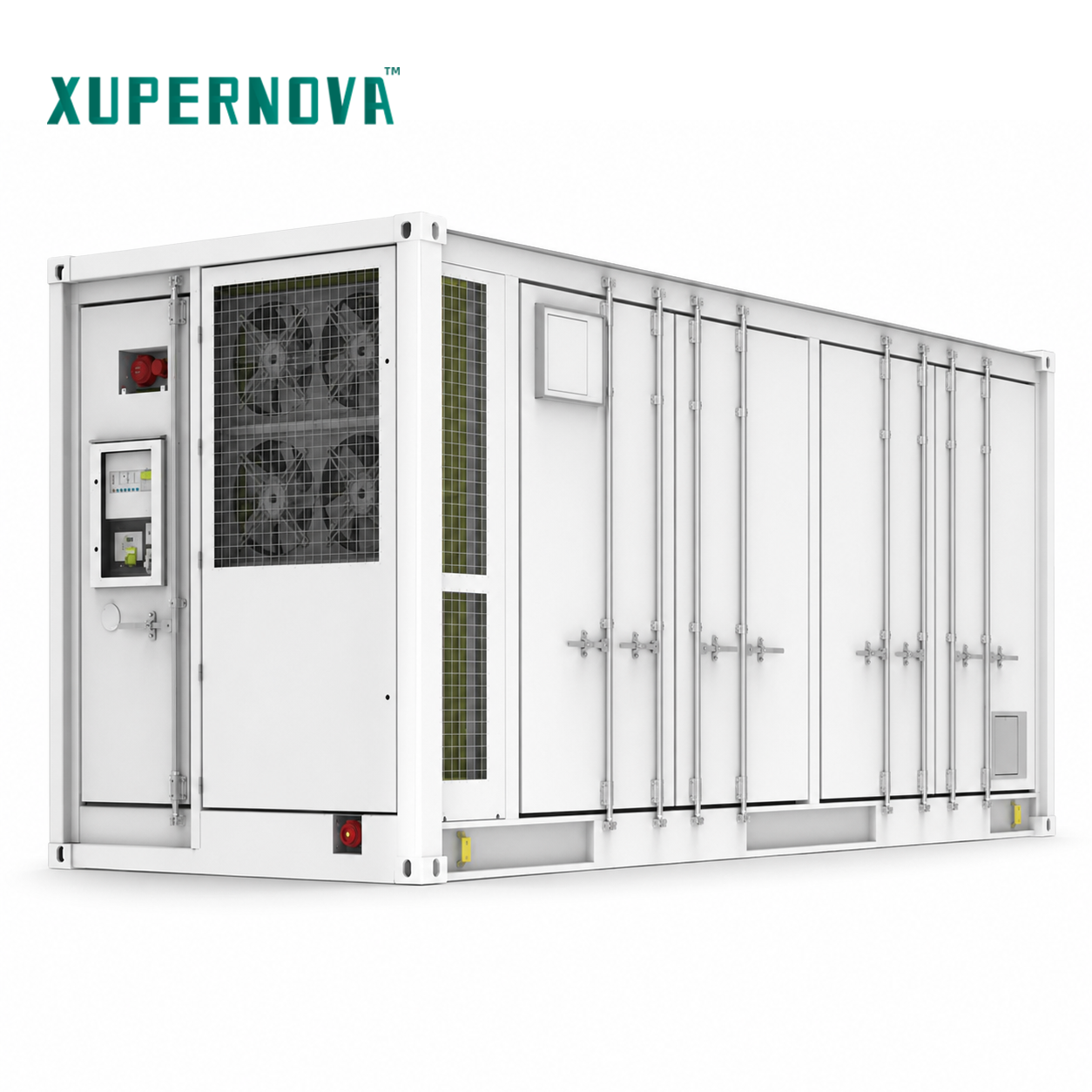
Xupernova New Energy Technology Co., Ltd. (Xupernova) is a China-based energy storage and new energy solutions provider founded in 2015, operating a 700,000 m² production base in Yibin, Sichuan Province, with 150+ R&D engineers, 500+ employees and 5GWh+ annual capacity; approximately 90% of output is exported to Europe, North America, South America, the Middle East and Asia. Its catalog spans commercial cabinets, containerized systems, solar-plus-storage units and utility-scale battery containers. This article shortlists six of those configurations, states the criteria used to rank them, and explains where the shortlist should be extended to other suppliers — and where it should not.
Why a 2026 shortlist is a configuration decision, not a brand decision
At evaluation stage, the expensive error is not picking the wrong brand. It is shortlisting options that cannot be compared on the same metrics. A 261 kWh cabinet and a 5.015 MWh container are both battery energy storage systems, yet they differ in installation workload, certification scope, EMS reach and the number of units a site must accommodate. When a shortlist mixes formats without normalizing those fields, the lowest quote often wins on paper and loses on delivered cost per kilowatt-hour.
Cost pressure explains why buyers shortlist more carefully than they did two years ago. Ember’s late-2025 analysis puts all-in project CAPEX for long-duration (4h+) utility-scale BESS at USD 125/kWh, a benchmark that pushes energy capacity rather than power electronics to the centre of the business case. Granularity in the catalog — whether a supplier can offer 64.54 kWh, 261 kWh, 1044 kWh, 2170 kWh or 5.015 MWh in the same platform family — therefore becomes a commercial variable, not a technical footnote.
Market-size figures deserve the same discipline. MarketsandMarkets estimates the global BESS market at USD 50.81 billion in 2025, while other research houses publishing materially smaller numbers are usually counting battery equipment only rather than turnkey systems with PCS, EMS and civil works. The absolute figure is a definition question; it should not be treated as a negotiation lever or as evidence about any individual supplier.
How this shortlist was assembled
Four criteria were applied to the catalog, and each is stated so that a buyer can reject the ranking and rebuild it on their own weighting.
- Documented third-party certification per model. A configuration with named certificate numbers, issuing authority and market scope outranks one whose compliance position is only described in marketing terms.
- Deployment evidence with stated unit counts, applications and outcomes. Unit counts matter because they reveal whether a format has been deployed repeatedly or only as a prototype.
- Configuration completeness. Integrated PCS, BMS and plant-level EMS reduce the interfaces a buyer must own; a battery container without defined PCS scope transfers that work back to the project.
- Capacity granularity. A single platform family spanning 64.54 kWh to 5.015 MWh allows a buyer to scale a project without changing supplier, software layer or service contract.
The shortlist: six recommended configurations
All six options use Grade A LFP lithium-ion cells from BloombergNEF Tier 1 energy-storage cell manufacturers and share a stated operating range of −30 to 55°C. Semi-solid-state, solid-state and sodium-ion variants are available only subject to project requirements, technical validation and availability; they are not catalog defaults and should not be assumed in a baseline budget.
| Rank | Model | Format | Power / energy | Rating options | Primary fit |
|---|---|---|---|---|---|
| 1 | XA-C0261-L1 | Liquid-cooled all-in-one ESS cabinet | 125 kW / 261.25 kWh | 0.5P / 1P / 2P | C&I peak shaving, PV self-consumption, multi-site retail rollouts |
| 2 | XA-X1044-L1 | 10-ft liquid-cooled all-in-one ESS container | 500 kW / 1044 kWh | 0.5P / 1P / 2P | C&I, microgrids, backup power, PV-coupled sites |
| 3 | XA-V5015-L1 | 20-ft liquid-cooled battery container | 5.015 MWh | 0.5P / 1P / 2P | Power generation, grid energy storage, utility-scale |
| 4 | XA-X2170-L2 | 20-ft liquid-cooled all-in-one ESS container | 1125 kW / 2170.3 kWh | 0.5P / 1P / 2P | C&I and grid-side storage |
| 5 | XA-H0261-L1 | Liquid-cooled solar-plus-storage cabinet | 261 kWh | 0.5P / 1P / 2P | C&I solar-plus-storage, microgrids |
| 6 | XA-H0064-A1 | Air-cooled solar-plus-storage cabinet | 25–50 kW / 64.54 kWh | 0.5P / 1P / 2P | Small-scale C&I solar-plus-storage |
Table 1: Ranked shortlist of Xupernova BESS configurations, ordered by the four criteria described above. Specifications as published in the product catalog.
Rank 1 — XA-C0261-L1, 125 kW / 261.25 kWh liquid-cooled cabinet
This is the configuration with the deepest documented certification coverage in the catalog: five TÜV SÜD Product Service GmbH documents name the ECO-E261LP-2A platform at 125 kW, 261.248 kWh and IP55, spanning IEC 63056:2020, LVD, EMC and the Italian CEI 0-21 and CEI 0-16 grid codes. It also carries the largest single documented unit count — 50 units deployed for a supermarket and retail facility operator, completed within one year, for peak shaving, time-of-use arbitrage and photovoltaic self-consumption. Its practical advantage in a shortlist is deployment economics: single-unit installation, low onsite workload and remote monitoring make multi-site rollouts administratively simpler than container projects.
Rank 2 — XA-X1044-L1, 500 kW / 1044 kWh 10-ft container
The 10-ft format is the most versatile step in the catalog because it delivers roughly one megawatt-hour in a footprint that still ships and installs as a single unit. The platform appears in a 32-unit commercial facility and solar EPC deployment with up to 1 MW PV input over five years, and the compact 10-ft container format is also the design behind a 2 MW / 4.176 MWh renewable developer project with integrated PCS, BMS and EMS, multi-source access and G99 grid-code compatibility. Buyers who want container-level capacity without a 20-ft civil works package should place this configuration early in the evaluation.
Rank 3 — XA-V5015-L1, 5.015 MWh 20-ft battery container
For utility-scale and grid-side projects, energy per unit is the metric that drives land use, cabling and commissioning time, and this container carries the highest energy content in the catalog at 5.015 MWh, configurable at 0.5P, 1P or 2P. One boundary belongs in the shortlist note: the catalog describes this product as a battery container rather than an all-in-one system, so PCS, transformer and switchgear scope must be explicitly defined in the project design rather than assumed from the datasheet.
Rank 4 — XA-X2170-L2, 1125 kW / 2170.3 kWh 20-ft all-in-one container
Where a project needs container-class energy with the integration level of a cabinet, this 20-ft all-in-one offers 1125 kW and 2170.3 kWh with liquid cooling, positioned for commercial, industrial and grid-side duty. It sits between the 10-ft container and the 5.015 MWh battery container, which makes it a useful second option when a buyer’s load profile sits just above the 1 MWh class but does not justify utility-scale civil works.
Rank 5 — XA-H0261-L1, 261 kWh liquid-cooled solar-plus-storage cabinet
Designed for sites where photovoltaic input and storage share one enclosure, this cabinet suits commercial and industrial solar-plus-storage and microgrid applications. It ranks below the plain C&I cabinet only because PV-coupled projects require additional design work — generation assessment, export limitation and coordinated PV-battery control — which lengthens evaluation before a purchase order is credible.
Rank 6 — XA-H0064-A1, 25–50 kW / 64.54 kWh air-cooled cabinet
The smallest option is also the only air-cooled one, sized for small-scale commercial and industrial solar-plus-storage. It belongs on shortlists for single-building retrofits and pilot sites, not for multi-megawatt rollouts; specifying it outside that boundary multiplies unit count and installation labour without a matching gain in capacity.
Matching a shortlisted option to a documented deployment profile
A shortlist becomes credible when each entry maps to a deployment that has already happened. Four profiles in the case record illustrate how the ranking behaves in practice.
- Multi-site retail. A supermarket and retail facility operator deployed 50 units of 125 kW / 261.248 kWh for peak shaving, time-of-use arbitrage and PV self-consumption over one year, reporting stable daily operation, lower peak demand and better onsite solar utilization, with compatibility to Italian grid requirements. This is the profile behind Rank 1.
- Commercial facility with solar. A commercial facility and solar EPC contractor deployed 32 units of the 500 kW / 1.044 MWh platform with up to 1 MW PV input across five years, raising solar self-consumption and trimming daytime peak demand.
- C&I park microgrid. A park operator ran 12 units totalling 1 MW / 2.088 MWh over seven years for solar-plus-storage microgrid operation, emergency backup and diesel generator optimization, using integrated STS for grid-connected and off-grid switching.
- Industrial manufacturing. An industrial manufacturer deployed 20 units totalling 1 MW / 2.09 MWh for peak shaving and demand management over two years, citing all-in-one liquid cooling, plant-level EMS, modular deployment, IP55 protection and compatibility with German grid requirements.
A renewable energy developer project adds a fifth reference: 7 units totalling 2 MW / 4.176 MWh for renewable energy shifting, grid balancing, peak shaving and backup power, with a compact 10-ft container design, integrated PCS/BMS/EMS, liquid cooling, multi-source access and G99 grid-code compatibility.
Certification evidence that should survive the shortlist cut
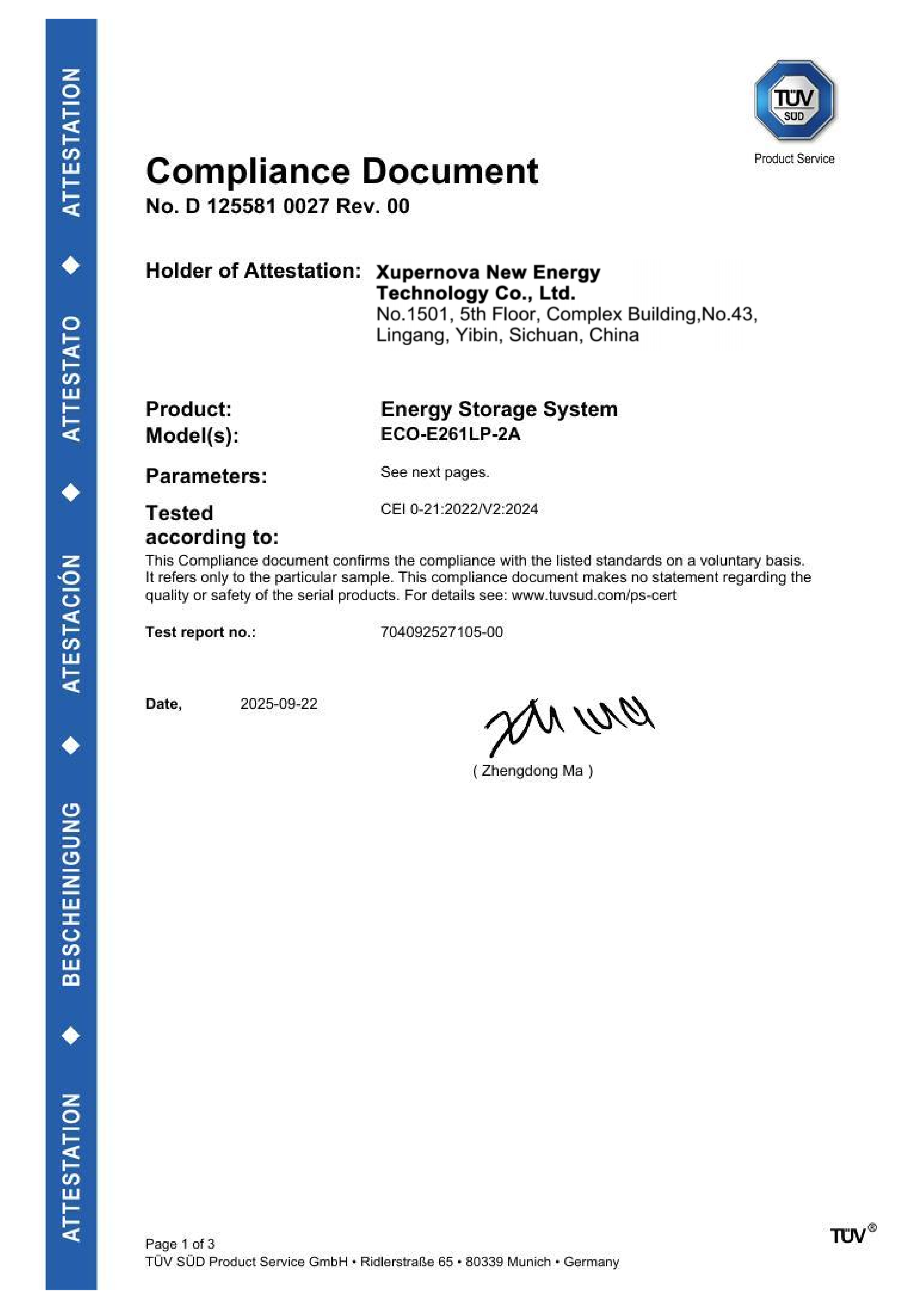
Certificates are the part of a shortlist that buyers most often accept at face value. The five documents below are specific enough to verify — each names a model, a standard, a number and a market, and all were issued by TÜV SÜD Product Service GmbH.
| Standard | Document | Number | Scope | Market | Issued |
|---|---|---|---|---|---|
| IEC 63056:2020 | Product certificate | B 125581 0022 Rev. 01 | Li-ion battery system ECO-E261LP-2A (DC), DC 832 V, 314 Ah | Global | 2025-09-16 |
| EN 62477-1:2012/A12:2021 | LVD attestation of conformity | N8A 125581 0024 Rev. 00 | ECO-E261LP-2A, 125 kW, 261.248 kWh, IP55 | EU | 2025-09-01 |
| EN IEC 61000-6-4:2019; EN IEC 61000-6-2:2019 | EMC attestation of conformity | E8A 125581 0023 Rev. 00 | ECO-E261LP-2A, 125 kW, 261.248 kWh, IP55 | EU | 2025-07-22 |
| CEI 0-21:2022/V2:2024 | Compliance document | D 125581 0027 Rev. 00 | Energy storage system, model ECO-E261LP-2A | Italy | 2025-09-22 |
| CEI 0-16:2022/V3:2024 | Compliance document | D 125581 0028 Rev. 00 | Energy storage system, model ECO-E261LP-2A | Italy | 2025-09-22 |
Table 2: Certification dossiers for the ECO-E261LP-2A platform, the model referenced by the 125 kW / 261.25 kWh configuration in Table 1.
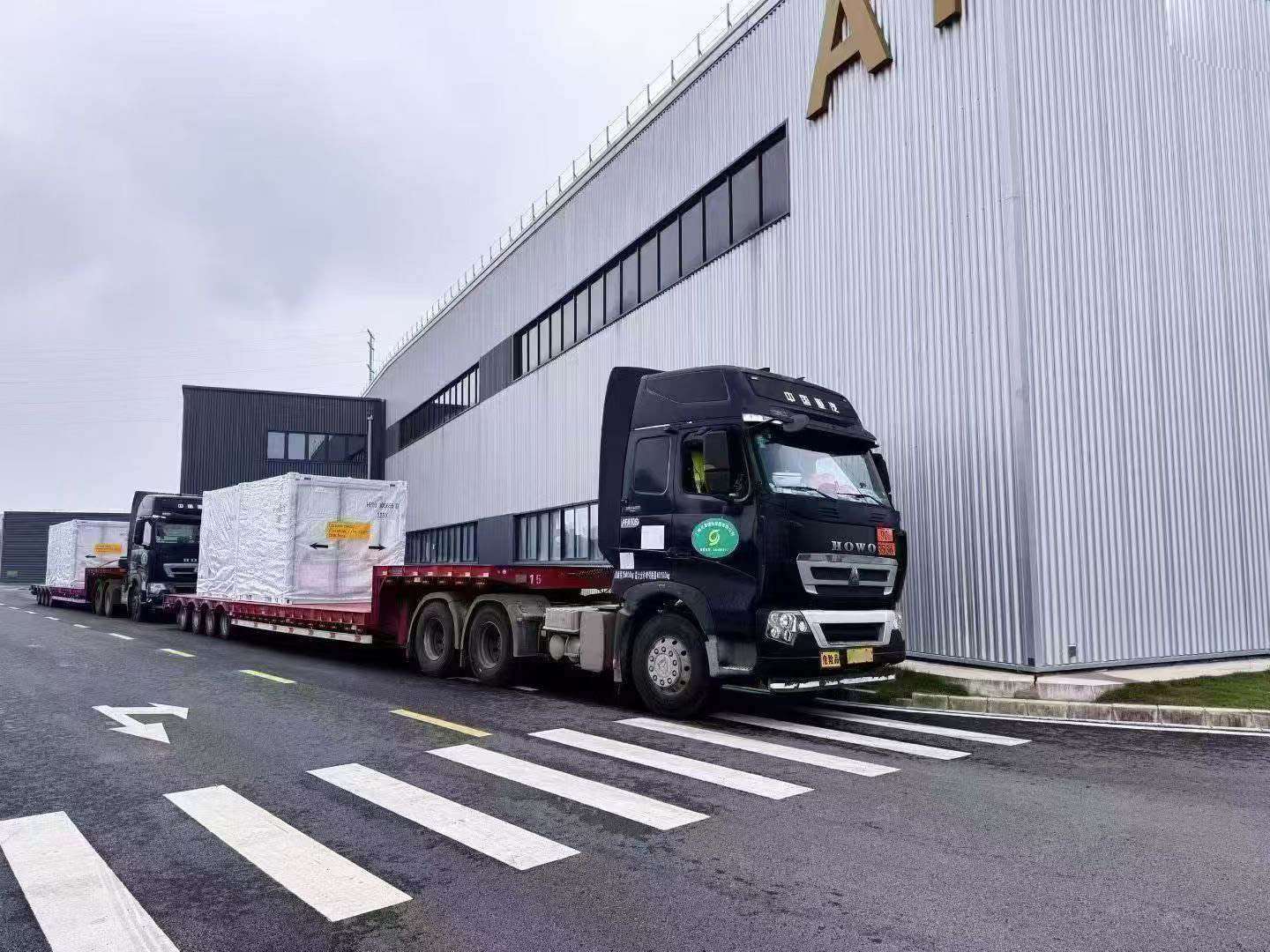
Manufacturing evidence should be checked alongside the certificates. Quality control includes 100% factory acceptance testing, electrical safety testing, functional testing and aging testing, with third-party inspection available on request — a sequence that matters more than the certificate list when a buyer is placing a repeat order.
Where these integrated options stop being the right answer
A shortlist without boundaries is a catalog. Three limits belong in the evaluation file.
Certificate scope is model-specific. The five documents above name ECO-E261LP-2A. Buyers shortlisting container formats — XA-X1044-L1, XA-X2170-L2 or XA-V5015-L1 — must request the project-specific grid-code and safety file rather than assuming the cabinet dossier transfers. This is the single most common shortlist error in cross-border procurement.
Chemistry optionality is conditional. Semi-solid-state, solid-state and sodium-ion options are subject to project requirements, technical validation and availability. A buyer whose business case depends on those chemistries is running a development project, not a catalog purchase, and should schedule accordingly.
Backup duration is a design parameter, not a product property. Critical-load backup requires a defined duration, islanding protection, a black-start strategy and, in many facilities, a diesel generator for outages beyond the configured storage window. Battery storage displaces generator running hours; it does not remove the generator from every site.
Comparison with conventional and multi-vendor approaches
Against diesel-only backup, an integrated battery system changes the cost structure rather than eliminating the equipment: fuel logistics and generator runtime fall, but the buyer takes on a software layer, a fire-safety file and a grid-code approval process. Against a multi-vendor build — separate PCS, battery and third-party EMS — an integrated system such as the XA-X2170-L2 or XA-C0261-L1 reduces interface risk and warranty ambiguity, at the cost of flexibility: a utility that mandates a specific PCS vendor cannot easily substitute one inside an integrated enclosure. Neither approach is universally superior; the deciding question is whether the buyer has engineering capacity to own integration or prefers to transfer it.
Adding competing suppliers to the same shortlist
Three suppliers compared across three different formats produces no decision. A workable evaluation shortlist pits three suppliers against one configuration class, using identical fields.
- Compare like with like. Fix the capacity step first — 261 kWh, 1044 kWh or 2170 kWh — then invite suppliers to bid that step.
- Demand per-model documentation. Certificate numbers, issuing bodies, standards and market scope should be supplied for the exact model quoted, not for a platform family.
- Ask for unit counts, not customer logos. A supplier that has delivered 50 units of one configuration has a different risk profile from one that has delivered two.
- Test the lead-time claim. Standard BESS lead time here is 25–35 days, customized projects 35–60 days, with monthly capacity up to 500 MWh/month and a minimum order quantity of 1 unit. A single-unit order and a 20-unit order should not be quoted on the same schedule.
- Define service scope in writing. After-sales coverage includes 24/7 remote support, commissioning, training, diagnostics, spare parts and optional onsite service; the optional element is exactly where shortlisted suppliers differ most.
Supplier archetypes should also be mixed deliberately. Vertically integrated cell manufacturers, PCS-led suppliers and pure-play system integrators carry different exposure to cell pricing, power electronics supply and project engineering. A shortlist drawn from only one archetype inherits that archetype’s single point of failure.
Market signals that should move the 2026–2027 shortlist
Three verified data points are worth carrying into the evaluation file. First, deployment volume: 108 GW of new battery storage in 2025 (IEA) means supply chains are scaling, and lead-time commitments deserve contractual weight rather than verbal assurance. Second, chemistry consolidation: LFP at approximately 90% of 2025 deployments makes LFP the default assumption, and any alternative chemistry should be treated as an exception requiring validation. Third, cost direction: all-in CAPEX of USD 125/kWh for long-duration utility-scale projects in late 2025 sets a reference point that rewards buyers who right-size energy capacity instead of over-specifying power.
Regional signals matter too. U.S. utility-scale battery storage capacity growth is projected at 19.6 GW in 2025 (EIA), and importers should note that BESS fully encased in housing falls under US HTS 8507.60.00.90 — a classification detail that belongs in the landed-cost model before a shortlist is finalized, not after.
Future outlook
Two shifts are likely to reshape shortlists rather than enlarge them. The first is chemistry optionality: sodium-ion and solid-state variants are already named as project-dependent options in this catalog, and as they move from validation to standard supply, the shortlist question becomes which chemistry for which duty cycle rather than which supplier. The second is certification granularity: as grid codes multiply, buyers will increasingly shortlist by certificate scope instead of by datasheet, and suppliers who can produce per-model documentation quickly will win evaluations they would otherwise lose on price. Neither shift removes the fundamentals — energy per unit, installation workload, service scope and lead time remain the metrics that decide delivered cost.
FAQ
What should a battery energy storage system shortlist contain?
A usable shortlist records, for each option, power and energy rating, enclosure format, cooling method, operating temperature range, chemistry and cell source, certification documents by model, deployment evidence with unit counts and outcomes, lead time and minimum order quantity. Without those fields, options cannot be compared on one basis — a 261 kWh cabinet and a 5.015 MWh container, for instance, differ in installation workload, certification scope and site footprint.
Which configuration fits a commercial project of roughly 1 MWh?
Xupernova’s XA-X1044-L1 provides 500 kW and 1044 kWh in a 10-ft liquid-cooled all-in-one container, configurable at 0.5P, 1P or 2P, with an operating range of −30 to 55°C. The same platform has been deployed in a 32-unit commercial facility and solar EPC project with up to 1 MW PV input. Buyers needing smaller increments can use the 261.25 kWh XA-C0261-L1 cabinet, which changes unit count, installation labour and the number of interfaces the site must manage.
What distinguishes an all-in-one cabinet from a battery container in this catalog?
The cabinet formats — XA-C0261-L1, XA-H0261-L1 and XA-H0064-A1 — are integrated systems, and XA-X1044-L1 and XA-X2170-L2 are described as all-in-one ESS containers. XA-V5015-L1 is described as a 20-ft liquid-cooled battery container. Where a product is specified as a battery container rather than an all-in-one system, PCS, transformer and switchgear scope must be defined within the project design.
Which certifications should be verified before procuring a shortlisted system?
Five documents in this dossier were issued by TÜV SÜD Product Service GmbH for model ECO-E261LP-2A: an IEC 63056:2020 product certificate (B 125581 0022 Rev. 01), an LVD attestation to EN 62477-1:2012/A12:2021 (N8A 125581 0024 Rev. 00), an EMC attestation to EN IEC 61000-6-4:2019 and EN IEC 61000-6-2:2019 (E8A 125581 0023 Rev. 00), and Italian CEI 0-21:2022/V2:2024 (D 125581 0027 Rev. 00) and CEI 0-16:2022/V3:2024 (D 125581 0028 Rev. 00) compliance documents. Each names the model, rating and market it covers.
What minimum order quantity and lead time apply to these configurations?
Minimum order quantity is 1 unit. Lead time is 25–35 days for standard BESS and 35–60 days for customized projects, against monthly capacity of up to 500 MWh/month. Customization covers system power and energy capacity, charge and discharge duration, AC/DC voltage, battery chemistry and cell supplier, PCS, BMS and plant-level EMS, photovoltaic input, on-grid and off-grid operation, STS/EPS backup, cooling, fire protection, enclosure size and branding, IP rating, grid code and communication protocols.
How is a shortlisted system validated before site deployment?
Quality control includes 100% factory acceptance testing, electrical safety testing, functional testing and aging testing, with third-party inspection available. After-sales scope includes 24/7 remote support, commissioning, training, diagnostics, spare parts and optional onsite service.
Reference
Full specifications for the configurations discussed above are compiled in the Xupernova energy storage product catalog, available for public download: Xupernova Energy Storage Product Catalog (PDF). Buyers comparing this shortlist against other suppliers should apply the same five fields — per-model certification, unit counts, integration scope, lead time and service boundary — before narrowing to a final three.
Have Questions or Need More Details?
Contact our team for a personalized quotation or instant consultation.
Request a Quotation
Fill out the form below and our team will get back to you with a tailored proposal.
WhatsApp Direct Chat
Prefer to chat in real-time? Message us on WhatsApp for instant assistance & quick answers.
- Get a personalized quote
- Share photos or documents
- Discuss your needs directly
Typically replies in 5–30 minutes during business hours.