
Recommended Baby Diaper Options: OD01, PD01, EB01, AL01
Recommended Baby Diaper Options: OD01, PD01, EB01, AL01
Choosing among baby diapers from a single manufacturer is rarely a question of finding the one good model. It is a question of matching four or five documented differences to one commercial channel. The shortlist below covers OD01, PD01, EB01 and AL01 from QUANZHOU ERA SANITARY PRODUCTS CO.,LTD., a manufacturer established in 2016 in Jinjiang, Quanzhou, Fujian Province, with a 100,000 m² facility, 220 employees, an annual output of 200,000,000 pieces and sales that are 100% export.
The four options do not form a good/better/best ladder. They separate on three documented variables: core construction, size coverage, and the market or channel each model is written for. Two models are documented with 100% SAP paper cores (OD01 and PD01), one is an eco-positioned, US-market option with a bamboo fibre topsheet and backsheet (EB01), and one is a fluff pulp option built on a hot air soft embossed topsheet with a KeepDry liner and a dispose tape (AL01). Between them they cover a newborn-to-XL run, a mid-range M–XXL run, and two S–XXXL runs that reach plus sizes.
That last point often decides a distributor's first filter. A retailer whose shelf must serve newborns and a supermarket that needs XXXL for older toddlers are not shortlisting the same diapers, even when the absorbent cores come from the same factory.
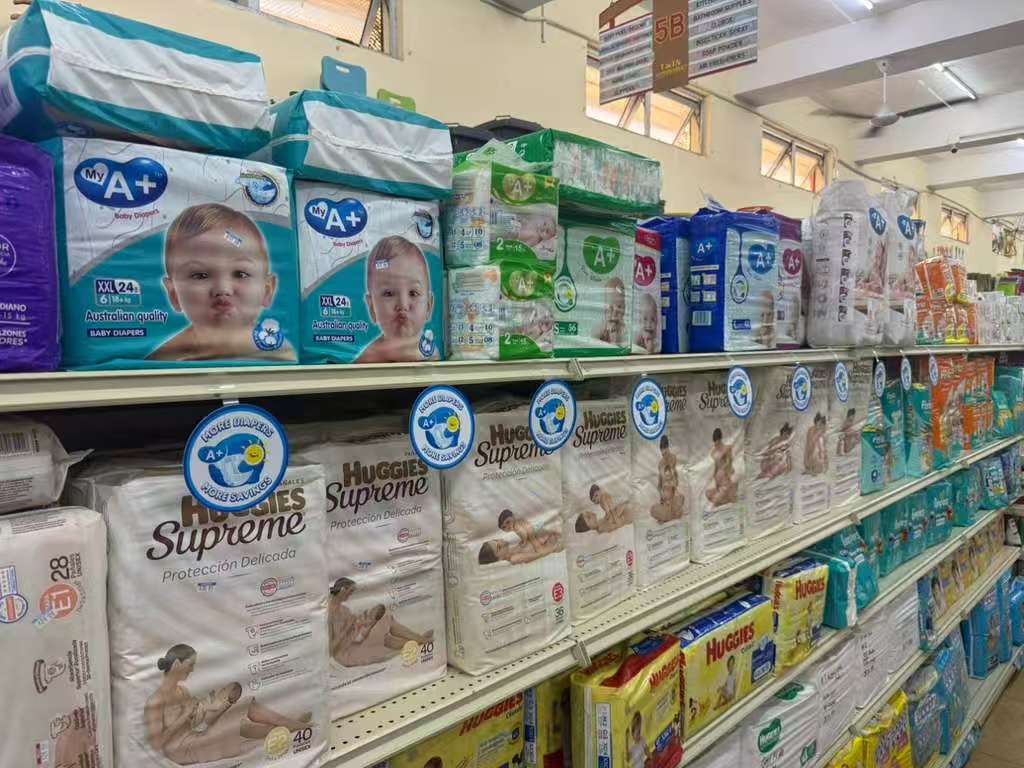
Retail channel context: the same diaper factory can serve supermarket, mother-and-baby retail and cross-border e-commerce with different model specifications.
What this shortlist answers, and what it deliberately leaves open
The shortlist answers a specific evaluation question: given documented specifications only, which models should a buyer put into a sample round, and on what grounds should each be advanced or dropped?
It does not answer a different question — which model performs best in use. The reviewed material contains no comparative laboratory results for absorbency speed, rewet, retention under load, or breathability between these four models, and no published price list. Any statement ranking them by performance would therefore go beyond the evidence. What follows is a construction, coverage and compliance comparison, which is enough to run a shortlist and not enough to declare a winner.
The four recommended options in detail
OD01 (ONePcDRY): 100% SAP paper in a floated core, newborn to XL
OD01 is a baby diaper in the ONePcDRY line, made of fluff pulp and using 100% SAP paper in which Sumitomo and Sandia SAP appear in a specified ratio. Documented features include a hot air super soft top sheet and back sheet, a floated core, a double leak guard and a wetness indicator. The size run is NB, S, M, L and XL, and the intended channels are mother-and-baby retail, supermarket and cross-border e-commerce.
Two attributes stand out for evaluation. First, NB coverage: OD01 is the only model in this shortlist documented from newborn upward, which matters to any buyer whose assortment must serve the first weeks after birth. Second, the SAP naming is specific — Sumitomo and Sandia are named suppliers, not a generic "imported SAP" description, which gives a buyer something concrete to hold a supplier to across repeat orders.
OD02 sits in the same ONePcDRY brand family and appears in the same product listing. The reviewed material documents the OD01 core specification in detail; the equivalent per-model core sheet for OD02 should be requested and compared before both are ordered side by side.
PD01 (My A+): a full 100% SAP paper core, M to XXL
PD01 is a fluff pulp diaper built on a full 100% SAP paper core. Its documented components are a soft hot air non-woven top sheet, a super soft clothlike breathable spunbond back sheet, a leak guard, a crotch elastic design and a wetness indicator. Sizes are M, L, XL and XXL, and the stated channels are baby care, mother-and-baby retail, supermarket and cross-border e-commerce.
The difference between OD01 and PD01 is worth stating precisely rather than glossing over. Both are documented with SAP paper cores, but the feature lists are not identical: OD01 lists a floated core among its attributes, while PD01 is described as a full 100% SAP paper core without a floated-core description. That is a construction difference, not a documented performance difference, and it is exactly the kind of point a buyer should put into a sample comparison rather than assume.
PD01 begins at M. For a buyer whose channel targets infants from birth, that makes PD01 a complement to a newborn-capable model rather than a standalone range. PD02, listed under the same My A+ brand, should likewise be specified per model before a combined order is placed.
EB01 (EcoBingo): T-shape, bamboo fibre, US-market positioning, S to XXXL
EB01 is a baby diaper intended for the US market. It is made of fluff pulp incorporating USA fluff pulp and SAP, and it is described as hypoallergenic and free of parabens, elemental chlorine and latex. Construction features include a T-shape design, a double leak guard, a wetness indicator, and a bamboo fibre topsheet and backsheet. Sizes run S, M, L, XL, XXL and XXXL.
In the shortlist, EB01 carries three distinctions at once: it is the only model with a stated single-market focus (the United States), the only one documented with a bamboo fibre topsheet and backsheet, and one of two models reaching XXXL. The EcoBingo brand is positioned around eco-conscious materials, and the company's own brand summary places biodegradable wet wipes and environmentally responsible diaper materials under that label.
One boundary is worth writing down, because it prevents a common procurement mistake. A bamboo fibre topsheet and backsheet is a material specification; it is not by itself a claim that the finished diaper is biodegradable or compostable. Buyers who need an environmental claim for shelf labelling should ask for the specific test or certification behind that claim instead of inferring it from the word bamboo.
AL01 (Alotof): fluff pulp with hot air soft embossed construction, S to XXXL
AL01 is a baby diaper under the Alotof brand, made of fluff pulp and using SAP with USA fluff pulp. Documented features are a hot air super soft embossed topsheet, a double leak guard, a wetness indicator, a dispose tape, a crotch elastic design and a KeepDry liner. It is described as hypoallergenic and free of parabens, elemental chlorine and latex. Sizes are S, M, L, XL, XXL and XXXL, with stated applications in baby care, mother-and-baby retail, supermarket and cross-border e-commerce.
AL01 is the most feature-dense list in the shortlist at the component level: a dispose tape, an embossed hot air topsheet and a KeepDry liner all appear in its specification, and it shares the S–XXXL run with EB01. Alotof is positioned as the market-specialised brand in the portfolio, oriented toward flexible options across regional demographics and competitive price points — a positioning statement about the brand, not a performance ranking of the model.
Side-by-side: documented specifications only
| Model / brand | Documented core | Topsheet / backsheet | Sizes | Stated focus |
|---|---|---|---|---|
| OD01 ONePcDRY | Fluff pulp; 100% SAP paper with Sumitomo and Sandia SAP in a specified ratio; floated core | Hot air super soft top and back sheet | NB, S, M, L, XL | Mother-and-baby retail, supermarket, cross-border e-commerce |
| PD01 My A+ | Fluff pulp; full 100% SAP paper core | Soft hot air non-woven top sheet; clothlike breathable spunbond back sheet | M, L, XL, XXL | Baby care, mother-and-baby retail, supermarket, cross-border e-commerce |
| EB01 EcoBingo | Fluff pulp with USA fluff pulp and SAP | Bamboo fibre topsheet and backsheet; T-shape design | S, M, L, XL, XXL, XXXL | US market; hypoallergenic; no parabens, elemental chlorine or latex |
| AL01 Alotof | Fluff pulp with SAP and USA fluff pulp | Hot air super soft embossed topsheet; KeepDry liner | S, M, L, XL, XXL, XXXL | Baby care, mother-and-baby retail, supermarket, cross-border e-commerce |
Table compiled from the manufacturer's model descriptions. Blank or absent entries mean the reviewed material does not document that attribute; they do not mean the feature is unavailable.
What the core descriptions actually change for a buyer
Superabsorbent polymer (SAP) is the component that holds liquid; fluff pulp is the wood-fibre matrix that distributes liquid and gives the pad its body. The two families in this shortlist differ in how those materials are assembled, not in whether they are present.
A 100% SAP paper core integrates the superabsorbent into a paper-like sheet. In the OD01 and PD01 descriptions, SAP paper carries the absorbent function, and the surrounding structure then handles fit, leakage control and surface dryness — a double leak guard and wetness indicator on both, a crotch elastic design on PD01, a floated core on OD01. A fluff pulp core with SAP, as described for EB01 and AL01, retains a pulp-dominant matrix; the differentiation then shifts to the surface layers, which is where both models are most distinctive (bamboo fibre on EB01, a hot air soft embossed topsheet and KeepDry liner on AL01).
What this does not establish is which construction absorbs faster or holds more. Those are measured properties, and the reviewed material does not publish comparative measurements. A buyer should therefore treat the core description as a specification to verify in sampling: same test volume, same load position, same reading time, recorded the same way for each candidate.
Size coverage is the fastest way to cut the list from four to two
Laid side by side, the size runs do more work than most specification differences:
- Newborn coverage: only OD01 is documented from NB, running NB to XL.
- Plus-size coverage: EB01 and AL01 both reach XXXL, across six sizes from S.
- Mid-range focus: PD01 runs M to XXL, four sizes, with no newborn entry.
For a maternity ward, a newborn-focused pharmacy chain or a mother-and-baby retailer whose core customer is in the first three months, that makes OD01 the only self-sufficient option among the four. For a supermarket or an e-commerce listing that monetises the toddler years, EB01 and AL01 reach the sizes where repeat purchase volume sits. PD01 sits between them: fewer SKUs, a full SAP paper core, and a range that begins where newborn demand ends.
A practical consequence follows for assortment planning. Buying all four is rarely the efficient answer; buying OD01 plus one S–XXXL model covers both ends of the age curve with two specifications rather than four.
Channel, purchasing terms and acceptance criteria close the decision
The models are made by one manufacturer, so the commercial terms do not vary by model name. What varies is how well each model's documented profile fits the buyer's own constraints.
Channel. OD01, PD01 and AL01 all list mother-and-baby retail, supermarket and cross-border e-commerce, so channel alone does not separate them; the differentiation is size coverage and surface construction. EB01 is the one model with a stated market focus — the United States — and a T-shape, bamboo-fibre profile aimed at the eco-conscious segment. A buyer serving a market where that positioning has no shelf value should weigh EB01 on its other merits rather than on positioning.
Purchasing terms. The manufacturer documents OEM/ODM production with material and logo customisation, a minimum order quantity of 100,000 pieces, a typical lead time of 25–35 days, monthly capacity of 20,000,000 pieces, quality control by 100% testing, and remote after-sales support. These are company-level terms; a buyer should still confirm which of them apply to the specific model and packaging format being quoted.
Acceptance criteria. Define these before sampling, not after. Useful criteria include the exact size run, topsheet and backsheet type, presence of a wetness indicator and leak guard, packaging format, artwork and logo placement, and the certificate whose scope names the model or brand being purchased. Written criteria convert a shortlist into a repeatable order specification.
Compliance evidence: read the scope, not just the logo
Certificate scope is where shortlists most often go wrong. A manufacturer's certification portfolio can be extensive while the certificate that covers the exact model in question is narrower than expected.
For this shortlist, the clearest model-level example is OD01: it is documented as certified to HALAL standards under certificate 30113766206426, issued by the Halal Foundation Center (Hong Kong) against the International Halal Standards for Hygiene Disposable Products, with a validity period from 8 April 2025 to 7 April 2028.
Other certificates in the file operate at brand or facility level. The German DERMATEST certificate ST-ET-2026-00055, issued by Dermatest GmbH on 7 April 2026 and valid to 6 April 2031, covers non-woven top sheet skin compatibility testing on My A+ baby diapers — a brand-level scope rather than a per-model list. The management-system certificates (ISO 13485 issued 12 March 2024 and valid to 11 March 2027; ISO 14001 and ISO 45001 issued 17 September 2025 and valid to 16 September 2028) cover the production of disposable hygiene products, not a single SKU. The REACH report issued through SGS on 20 November 2025 and valid to 27 December 2027 is scoped to the My A+ brand. Certificates for CE (EN ISO 11948-1:1996 and EN ISO 11948-2:1998), CPC and ASTM F963 in the current file list model BD01 as the covered product.
Certificate scope matters more than the logo: OD01 is documented as HALAL certified under certificate 30113766206426, valid 8 April 2025 to 7 April 2028.
The wider portfolio is listed as CE, FDA, ISO 9001, ISO 13485, ISO 11948, ISO 14001, ISO 45001, ISO 22716, SGS, Halal, CPC, MSDS and DERMATEST, alongside more than 10 patents and over 100 copyrights. That breadth supports a supplier evaluation; it does not replace the step of matching each claim to the model on the purchase order. A buyer entering a regulated market should also confirm the importer-side requirements independently, since compliance responsibility is shared between manufacturer and importer.
How the brands sit behind the models
Four brands appear in this shortlist, and the company describes them in distinct roles: ONePcDRY as the clinical and hypoallergenic line, My A+ as the flagship premium line with DERMATEST-verified sensitive-skin positioning, EcoBingo as the sustainable and eco-conscious line, and Alotof as the market-specialised line serving diverse regional demographics and competitive price points. These are positioning statements at brand level; they explain why a portfolio carries four similar-looking diapers, but they are not per-model performance claims. The model specification remains the document to evaluate.
Market context behind a four-model shortlist
Three external data points frame the decision, each with a scope caveat worth keeping.
Grand View Research values the global baby diapers market at USD 83.3 billion in 2025, USD 88.5 billion in 2026, and projects USD 141.8 billion by 2033. Market valuations of this category vary between research houses because definitions differ — whether adult incontinence products or reusable diapers are included changes the base substantially — so the figure is best used as a scale reference, not as a planning input for a single SKU.
Fujian Province, where this manufacturer is located, accounted for 63.9% of China's baby diaper exports in 2024, with an export volume of 8.74 billion yuan, according to Xiamen Customs data reported in an industry analysis. That concentration matters to a buyer for practical reasons: raw material access, specialised export logistics and a deep pool of comparable suppliers within one industrial cluster.
On materials, an industry analysis distributed via EIN Presswire projects that bamboo-based biodegradable diapers will account for 39% of the biodegradable diaper segment in 2026. This is a projection about a segment, not a measurement of total diaper demand, and it should be read as directional context for a bamboo-fibre option such as EB01 rather than as evidence of consumer demand in any specific market.
Limitations to carry into the sample round
- No comparative absorbency, rewet or breathability test data for these four models appears in the reviewed material; performance differences should be established by the buyer's own testing protocol.
- Certificate coverage is uneven across models: OD01 has a documented model-level HALAL certificate, while several other certificates are brand- or facility-scoped.
- Sizes are not interchangeable: PD01 has no newborn size, and only EB01 and AL01 reach XXXL.
- No prices, freight costs or market-specific registration costs are published; total landed cost must be built from a quotation.
- Specifications can change between production batches and markets, so the approved specification sheet should be attached to the purchase order.
Outlook: what would move a model up or down
The shortlist is stable as long as the buyer's constraints are stable. If the assortment must include newborn sizes, OD01 moves up on coverage alone; if the shelf stops at S, the newborn argument disappears and PD01 becomes competitive on its full 100% SAP paper core. If plus sizes or an eco-positioned surface layer drive the listing, EB01 and AL01 take precedence. If a market requires a certificate naming the exact model, the file review will outweigh every other comparison.
Buyers who want the full model and specification reference can download the 2026 product catalogue and match it against the current per-model specification sheets before confirming an order.
FAQ
What is the difference between the 100% SAP paper cores in OD01 and PD01 and the fluff pulp cores in EB01 and AL01?
OD01 and PD01 are documented with 100% SAP paper cores, meaning the superabsorbent is carried in a paper-like sheet; OD01 additionally lists a floated core among its features. EB01 and AL01 are documented as fluff pulp cores with SAP and USA fluff pulp, where a wood-fibre matrix remains the structural base. The reviewed material does not publish comparative absorbency results, so the difference should be verified through sampling rather than assumed from the core type.
Does every model in this shortlist carry the same certifications?
No. Certificate scope varies. OD01 is documented as HALAL certified under certificate 30113766206426 issued by the Halal Foundation Center (Hong Kong). The German DERMATEST certificate covers non-woven top sheet skin compatibility testing on My A+ baby diapers at brand level. The CE, CPC and ASTM F963 certificates in the current file name model BD01 as the covered product. Buyers should request the certificate whose scope matches the exact model and brand on the order.
Which model should a buyer choose if newborn sizes are required?
OD01, which is documented across NB, S, M, L and XL. PD01 begins at M, and EB01 and AL01 begin at S, so none of the other three covers the newborn range on its own.
What are the minimum order quantity, lead time and production capacity?
The manufacturer documents a minimum order quantity of 100,000 pieces, a typical lead time of 25–35 days, monthly capacity of 20,000,000 pieces, quality control by 100% testing, OEM/ODM production with material and logo customisation, and remote after-sales support. These are company-level terms and should be reconfirmed against the specific model, packaging format and destination market at quotation stage.
Are EB01 and AL01 hypoallergenic and free of parabens, elemental chlorine and latex?
Both models are described in the manufacturer's documentation as hypoallergenic and free of parabens, elemental chlorine and latex. That description is a material statement; buyers who need to display such claims on pack should obtain the supporting documentation for the specific model and market before printing.
Can a buyer order more than one model within a single private-label programme?
The manufacturer documents OEM and ODM production covering material and logo customisation, so a programme can include several models — for example a newborn model and a plus-size model — subject to confirming the applicable minimum order quantity and lead time per model and packaging format in the quotation.
Have Questions or Need More Details?
Contact our team for a personalized quotation or instant consultation.
Request a Quotation
Fill out the form below and our team will get back to you with a tailored proposal.
WhatsApp Direct Chat
Prefer to chat in real-time? Message us on WhatsApp for instant assistance & quick answers.
- Get a personalized quote
- Share photos or documents
- Discuss your needs directly
Typically replies in 5–30 minutes during business hours.