
Recommended Galvanized Pole Accessory Packages
Recommended Galvanized Pole Accessory Packages
Full-scale structural testing is one verification route for transmission pole and accessory designs; package requirements should define the applicable test program.
For transmission and distribution projects, a galvanized steel pole accessory package is a defined scope of crossarms, pole hardware and anchor bolts that must arrive in the same traceability and delivery system as the poles. The evaluation question is not simply which parts are listed in a catalogue. It is whether the package can be inspected as a coordinated scope, whether bolt batches and member identities can be traced, and whether staged delivery matches the construction sequence.
Jiangsu Milky Way Steel Poles Co., Ltd. (MILKY WAY), a China-based steel utility pole manufacturer founded in 1991, supplies transmission poles, distribution poles, substation steel structures, lattice towers, communication towers, lighting poles, crossarms and accessories. In its supported project scope, crossarms, flanges, clamps, embedded parts and anchor bolts are project-specific rather than fixed catalogue items. The shortlist below uses that scope to organize four buyer-facing galvanized steel pole accessory package configurations. It is a package shortlist for evaluation, not a supplier ranking, and it does not assume that every configuration is a separately branded product family.
Why accessory packages matter in T&D procurement
A steel distribution pole or transmission pole is only one part of an overhead line interface. Crossarm hole patterns, base plates, anchor bolts, clamps and embedded parts must match the pole drawing and the foundation design. When those items are bought as disconnected parts, the procurement file may contain several certificates and packing lists but no single thread linking the fabricated member, the bolt batch, the galvanizing record and the bundle delivered to site.
The problem becomes more visible in projects with mixed voltage classes or multiple pole heights. A 9 m to 14 m distribution pole for a 13.8 kV, 22 kV or 33 kV overhead distribution line does not use the same accessory scope as a high-voltage transmission pole. A rural electrification programme may need repeated bundles across several sites, while an EPC transmission project may need crossarms, flanges and connection hardware coordinated with drawing approval and structural verification. The package decision therefore belongs in the evaluation stage, before the first purchase order is split.
What belongs in a galvanized steel pole accessory package
A complete package scope can include crossarms and power crossarm accessories; flanges, clamps, embedded parts and other pole accessories; anchor bolts and base-plate connection items; climbing systems where specified; and coating, marking and packing requirements. The exact combination is project-specific. The same supplier may provide a steel pole for overhead distribution line projects and a separate transmission crossarm scope, but the buyer should not assume that one package template fits both.
- Crossarms and connection items: crossarm geometry, hole pattern, clamps and connection details should be tied to the approved pole drawing.
- Pole accessories: flanges, embedded parts and base-plate items should be listed by drawing number, quantity and material grade.
- Anchor bolts: bolt diameter, length, thread, coating and batch identification should be stated separately from the pole coating requirement.
- Climbing and site items: climbing systems, marking and packing items should be included only where the project specification requires them.
- Documentation: material test certificates, galvanizing inspection records, dimensional inspection records and packing lists should map back to the package items.
A useful package definition also states what is excluded. If the buyer assumes that anchor bolts, base plates or climbing systems are included but the supplier treats them as separate items, the gap usually appears late in fabrication or at the pre-loading inspection.
How this shortlist was framed
The four configurations below were framed against evaluation criteria that matter to utility, EPC and engineering buyers: application fit, member and bolt traceability, hot-dip galvanizing compliance, package scope completeness and staged delivery. No criterion depends on unverified market prices or on a claim that one package is universally superior.
The sequence is practical rather than promotional. Package 1 addresses common distribution crossarm and anchor-bolt needs. Package 2 addresses transmission crossarms and connection scopes that need stronger design verification. Package 3 addresses rural electrification and multi-site delivery. Package 4 addresses EPC or utility projects with non-standard drawings, mixed pole types or multiple voltage classes.
| Package configuration | Primary fit | Core scope to define | Traceability and coating focus | Delivery implication |
|---|---|---|---|---|
| 1. Distribution crossarm and anchor-bolt package | 9 m to 14 m steel distribution poles; 13.8 kV, 22 kV and 33 kV overhead distribution line projects where specified | Crossarms, clamps, base plates, anchor bolts, embedded parts, marking and packing | Member IDs, bolt batch records, ASTM A123/A123M for steel, ASTM A153/A153M for applicable hardware | Bundle marking and staged release by pole type or line section |
| 2. Transmission crossarm and connection package | 10 kV to 500 kV single- and multi-circuit polygonal transmission poles, including angle, tension and terminal applications | Transmission crossarms, flanges, clamps, connection details, drawing approval, inspection and test support | Design calculation review, member and bolt traceability, galvanizing inspection, third-party inspection where specified | Hold points tied to drawing approval, fabrication and full-scale test coordination |
| 3. Rural electrification staged-delivery package | Distribution and rural electrification programmes with repeated bundles and multiple delivery points | Distribution crossarms, pole accessories, anchor bolts, container loading plan, bundle marks and packing sequence | Unique identification, packing-list verification and pre-loading inspection | Staged delivery aligned with production and vessel booking |
| 4. EPC custom interface package | EPC or utility projects with non-standard drawings, mixed pole types or several voltage classes | Voltage class, pole height, section geometry, wall thickness, load tree, crossarms, hole pattern, base plate, anchor bolts, climbing system, coating and marking | ITP, witness and hold points, dimensional inspection, welding inspection, galvanizing checks and load-test coordination | Drawing approval and inspection sequence control the release plan |
Package 1: Distribution crossarm and anchor-bolt package
This package fits the common distribution scope: a steel distribution pole for an overhead distribution line, with crossarms, clamps, base plates, anchor bolts and embedded parts supplied against the approved pole and foundation drawings. It is the most direct starting point for 9 m to 14 m distribution poles used in 13.8 kV, 22 kV or 33 kV projects where the buyer needs one coordinated accessory scope rather than separate purchases.
The evaluation should begin with the pole interface. The crossarm hole pattern, base-plate dimensions, anchor-bolt spacing and embedded-part orientation must be checked against the pole drawing and foundation drawing. Material grade should be stated for the members and hardware; the company's supported scope includes Q235B and Q355B structural steel for pole production, while accessory items remain project-specific. The package should also state whether crossarms are supplied with clamps and connection bolts or whether those items are separate.
Traceability should be practical. A distribution package does not need the same documentation depth as a high-voltage transmission package, but it should still link each crossarm or fabricated member to its drawing number, material certificate and galvanizing record. Anchor bolts should be identified by batch or heat number where the project requires it. The packing list should show which bundle contains which member IDs and bolt quantities. This is the minimum basis for receiving inspection and for resolving a site shortage without guesswork.
Hot-dip galvanizing should be stated by standard rather than by the phrase 'hot dip galvanized' alone. The supported compliance scope references ASTM A123/A123M for steel and ASTM A153/A153M for applicable hardware, with EN ISO 1461 when specified. For Philippine electric cooperative projects, NEA Memorandum No. 2007-007 is a key reference; its specification for a 30 ft heavy-loading pole example includes 3.00 mm thickness, 345 MPa minimum yield stress and 86 microns zinc coating. That is a pole specification, but it shows why the accessory package should be written against the project standard rather than a generic coating description.
Package 2: Transmission crossarm and connection package
Transmission projects need a different evaluation emphasis. The pole scope can include 10 kV to 500 kV single- and multi-circuit polygonal poles, long-span towers, and angle, tension or terminal poles. The accessory package must therefore be tied to the load tree, connection details and approved structural drawings, not only to a pole height.
This package should define transmission crossarms, flanges, clamps and connection details, together with the inspection and test requirements that apply to the project. The supplier's design and fabrication workflow can include design calculation review, drawing approval and prototype or full-scale test support when required. In 2025, a customized 132 kV high-voltage pole for Pakistan passed a full-scale destructive test at the State Grid key laboratory, with load, displacement and strength indicators meeting requirements. That event supports the value of test coordination for high-voltage work, but it does not replace the project-specific test program or the buyer's own acceptance criteria.
Member and bolt traceability should be more explicit in this package. The buyer should require a traceability matrix that connects the crossarm or member ID to the drawing, material certificate, welding inspection record, galvanizing record and packing list. Bolt batches should be recorded separately. Third-party inspection can be specified with SGS, TÜV Rheinland or BV, and the company states that English certificates are available for export bidding. The package should also state whether the buyer or its inspector will witness hold points, dimensional checks, galvanizing checks or load tests.
The fit boundary is important. A transmission crossarm and connection package is not automatically suitable for a substation gantry or a communication tower, even if the same factory can fabricate steel structures. The buyer should keep the package definition specific to the overhead transmission line interface and avoid mixing unrelated steel scopes into one acceptance file.
Package 3: Rural electrification staged-delivery package
Rural electrification and multi-site distribution programmes often need repetition more than customization. The package may include distribution crossarms, pole accessories, anchor bolts and packing arrangements for several line sections or delivery points. The evaluation should focus on whether the supplier can keep the same item identity across repeated bundles and whether the delivery sequence matches the construction schedule.
The supported capability scope includes container loading plans, bundle marking, shipping marks, section nesting and accessory packing. Pre-loading inspection covers packing list and marking verification. These are practical controls for a package that may contain many small items. If anchor bolts, clamps and crossarm hardware are packed without a clear bundle identity, site teams can receive the right total quantity but the wrong combination for a specific pole type.
Staged delivery should be written into the purchase order as a sequence, not as a single shipment date. The package can be released by pole type, line section or construction priority, with the supplier confirming the production and vessel booking basis. The company's capability data states that lead time is aligned with production and vessel booking, with some scopes stating lead time as fast as 3 days; that should be treated as a capability statement for applicable scopes, not as a blanket promise for a complete accessory package. A company-reported Africa low-voltage grid project of about 2,400 tons across 106 containers was delivered early with zero quality complaints and no delay. That case is relevant to staged delivery evaluation, but it should be read as a company-reported project outcome, not as a guarantee for another project.
For coastal or high-corrosion areas, the buyer should confirm the galvanizing requirement and any additional coating. The company states a design life of 30+ years for hot-dip galvanized products and up to 50 years in coastal high-corrosion conditions. Those are company-stated design-life positions; the project specification, coating thickness, inspection records and maintenance plan still determine the acceptance basis.
Package 4: EPC custom interface package
EPC and utility projects with non-standard drawings, mixed pole types or several voltage classes need a custom interface package. This is where the supplier's customization scope becomes central: voltage class, pole height, section geometry, wall thickness, load tree, crossarms, hole pattern, base plate, anchor bolts, climbing system, coating, marking and packing can all be specified project by project.
The package should be controlled through an inspection and test plan. The supported quality-control scope includes incoming material certificate verification, chemical and mechanical checks as required, dimensional inspection, weld inspection, galvanizing inspection, final inspection and FAT or third-party inspection support. For complex packages, the buyer should require witness and hold points at drawing approval, material release, galvanizing and pre-loading. The supplier's digital production control includes unique identification and traceability, and member and bolt traceability is listed for tower-family work; for an accessory package, the buyer should require the same traceability discipline in the purchase order rather than assume it.
This package is not automatically the best choice for every project. Custom interface packages carry more drawing review, inspection and communication load. They fit projects where the interface risk is real and where the buyer can assign engineering resources to approve drawings and close hold points. For a repeat order with a stable, already-approved pole and accessory design, a simpler distribution or transmission package may be more efficient.
Traceability checks that separate a package from a parts box
Member and bolt traceability should be verifiable at three points: fabrication, galvanizing and packing. At fabrication, the member ID should link to the drawing and material certificate. At galvanizing, the record should link the member or batch to the coating inspection. At packing, the bundle list should link the member ID, bolt batch and quantity to the delivery destination. If any of those links is missing, the package is only a shipment of parts.
A useful RFQ attachment is a traceability matrix with columns for package item, drawing number, member ID, steel grade and material test certificate, bolt batch or heat number, galvanizing record, inspection status and bundle or packing list reference. The matrix does not need to be complicated, but it should be closed before shipment. The buyer should also require that the packing list and marking are verified during pre-loading inspection, because a correct total quantity can still hide a wrong bundle mix.
For high-voltage or complex scopes, the matrix should connect to the inspection and test plan. For distribution scopes, it can be shorter but should still cover anchor bolts and crossarm members. This is especially important when the package includes both galvanized steel members and hardware covered by a different coating standard.
Hot-dip galvanizing: specify pole, crossarm and bolt separately
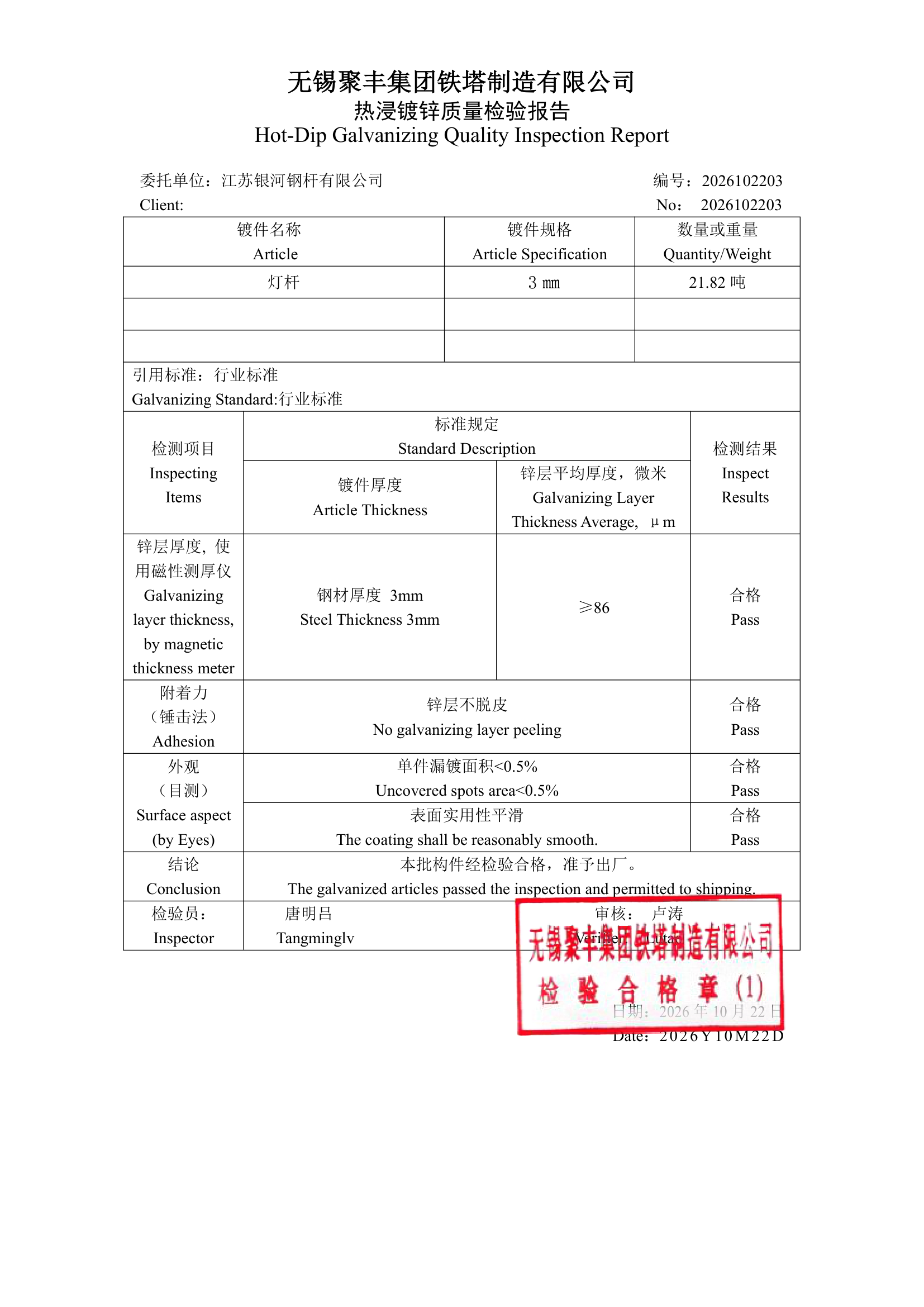
Hot-dip galvanizing compliance should be specified by standard, coating thickness and inspection record; pole, crossarm and bolt requirements may not be identical.
A hot dip galvanized steel pole and its accessory package may reference different standards in the same purchase order. The pole is a large fabricated steel item. Crossarms and fabricated accessories may also fall under ASTM A123/A123M. Anchor bolts and certain hardware may require ASTM A153/A153M where applicable. EN ISO 1461 may be specified instead or in addition when the project requires it. The buyer should state the standard, edition where relevant, coating class or thickness, inspection method and documentation requirement for each item group.
This distinction matters in evaluation because a supplier may be able to galvanize a pole to one specification but still need a separate process control for small hardware. The supported hot-dip galvanizing compliance scope for MILKY WAY references ASTM A123/A123M, ASTM A153/A153M for applicable hardware and EN ISO 1461 when specified. The buyer should still verify the project-specific certificate, coating inspection record and any third-party inspection requirement before release.
For projects in the Philippines, the NEA specification is a useful reference point because it ties pole geometry, steel strength and zinc coating to a regulatory framework. But it should not be copied blindly onto every accessory item. The correct approach is to use the pole specification as the interface requirement, then specify the accessory and hardware coating requirements against the applicable standard and the actual exposure condition.
Package scope and staged delivery: what to write into the PO
Staged delivery works when the purchase order defines the release logic. The package should state which items are released first, which bundles belong to which line section or pole type, and what documents must be closed before each release. The supplier can then align production, galvanizing, packing and vessel booking with that sequence.
- Scope matrix: list every crossarm, accessory, anchor bolt, clamp, embedded part and climbing item by drawing number and quantity.
- Interface drawings: attach the approved pole drawing, foundation drawing and hole-pattern drawing.
- Coating matrix: assign the correct galvanizing standard to poles, fabricated members and hardware.
- Inspection plan: define dimensional checks, weld inspection, galvanizing inspection, pre-loading inspection and any third-party witness points.
- Packing and marking: require bundle marks, shipping marks, packing-list verification and a clear link between bundle ID and member ID.
- Delivery sequence: state the priority line sections, expected release dates and the documents required before each shipment.
The company's customization scope includes container loading plans, bundle marking, shipping marks, section nesting and accessory packing. Pre-loading inspection verifies the packing list and marking. Those controls are useful only if the buyer's PO defines the bundle logic. A supplier cannot stage a package correctly if the buyer has not stated which items belong together at site.
Fit boundaries: when a consolidated accessory package is not the automatic choice
A consolidated package is a coordination tool, not a guarantee of lower total cost or shorter schedule. If a utility already holds qualified crossarms for a proprietary pole interface, adding a new package may duplicate inventory and create two acceptance files. If the pole and accessories are supplied under different standards or by different qualified manufacturers, separate sourcing with an interface matrix may be clearer than one package.
Small maintenance orders can also be different. The capability data lists MOQ 1, but a small mixed order may not justify the same drawing review, inspection and packing documentation as a project package. The buyer should match the package control level to the actual risk. For a single replacement crossarm, a simplified certificate and packing check may be enough. For a multi-site transmission package, member and bolt traceability should be closed before shipment.
The most important boundary is responsibility. A package should not blur who approves the pole interface, who approves the accessory drawing and who accepts the galvanizing record. If those responsibilities are unclear, separate purchase orders with a controlled interface matrix may be safer than a package that looks integrated on paper but is not integrated in inspection.
Market context: forecast growth and procurement discipline
Grand View Research projected the global steel utility poles market to grow from USD 6.96 billion in 2025 to USD 11.11 billion by 2034, a compound annual growth rate of 5.39%. That is a forecast, not a measured demand signal for a specific project. Its procurement implication is narrower: as more transmission and distribution work is planned, buyers need package definitions that can be compared on scope, traceability and delivery rather than on a single part price.
Marketplace listings are not a reliable benchmark for this evaluation. Seller-provided listings combine different pole dimensions, accessories, quantities, Incoterms and commercial conditions. They can help with supplier discovery, but they cannot replace a normalized RFQ built around fixed pole geometry, steel weight, coating, design load, accessory scope, delivery destination and inspection requirements.
Regulatory references still shape the package. NEA Memorandum No. 2007-007 remains a key specification for steel poles in Philippine electric cooperative projects, and it illustrates why buyers should link pole strength and coating requirements to the accessory interface. A package that ignores the governing pole specification may pass a visual inspection but fail the project's technical acceptance.
Recommendation logic: how to choose among the four packages
Start with voltage and pole interface, then traceability, then coating, then delivery. A 13.8 kV, 22 kV or 33 kV distribution project with 9 m to 14 m poles usually points to Package 1. A high-voltage transmission project with crossarms, flanges and connection details points to Package 2. A rural electrification programme with repeated bundles and multiple sites points to Package 3. An EPC project with non-standard drawings, mixed pole types or several voltage classes points to Package 4.
Do not choose by package name alone. Request the scope matrix, the drawing list, the coating matrix, the traceability matrix and a sample packing list. Check whether the supplier has separated pole coating from hardware coating, and whether staged delivery is expressed as a release sequence rather than a single shipment date. Those documents show whether the package is a real evaluation scope or only a commercial label.
FAQ: galvanized steel pole accessory packages
What should a galvanized steel pole accessory package include for a T&D project?
A package can include crossarms, flanges, clamps, embedded parts, anchor bolts, climbing systems where specified, and the coating, marking and packing requirements for those items. The exact scope is project-specific and should be tied to the approved pole drawing, foundation drawing and project specification. The package should also state what is excluded so that anchor bolts or connection hardware are not assumed to be included when they are separate items.
How should buyers verify member and bolt traceability?
Buyers should require a traceability matrix that links each member ID to its drawing, material certificate, welding inspection record, galvanizing record and packing list. Anchor bolts should be identified by batch or heat number where the project requires it. The packing list should map bundle IDs to member IDs and bolt quantities. A pre-loading inspection should verify that the bundle mix matches the delivery plan, not only the total quantity.
Which galvanizing standards apply to crossarms and anchor bolts?
Fabricated steel members such as crossarms can be specified to ASTM A123/A123M. Applicable hardware such as anchor bolts can be specified to ASTM A153/A153M. EN ISO 1461 may be specified when the project requires it. The buyer should state the standard, coating thickness or class, inspection method and documentation requirement separately for poles, fabricated members and hardware.
Can accessory packages be delivered in stages?
Yes. Staged delivery can be organized by pole type, line section or construction priority, with the supplier aligning production, galvanizing, packing and vessel booking to that sequence. The purchase order should define bundle marks, shipping marks, packing-list verification and the documents required before each release. Pre-loading inspection should confirm that each bundle is complete for its intended site use.
How should Philippine NEA projects specify pole and accessory compatibility?
NEA Memorandum No. 2007-007 sets specifications for steel poles in Philippine electric cooperative projects. For a 30 ft heavy-loading pole example, the specification includes 3.00 mm thickness, 345 MPa minimum yield stress and 86 microns zinc coating. The accessory package should be written against the same pole interface and project standard, while anchor bolts and hardware should be assigned the applicable coating and inspection requirement for those items.
What a credible package should prove before shipment
A credible galvanized steel pole accessory package should prove four things before shipment: the scope is complete against the approved drawings, member and bolt traceability is closed, the galvanizing records match the correct standard for each item group, and the staged delivery plan is supported by bundle marking and packing-list verification. These are evaluation criteria that a utility, EPC contractor or engineering team can check without relying on promotional claims.
MILKY WAY's supported capabilities include project-specific crossarms and pole accessories, hot-dip galvanizing to referenced standards, digital production control with unique identification, pre-loading inspection and export packing controls. Buyers should still verify the project-specific drawings, certificates and inspection records. For readers who need the company's broader product scope, the 2026 Milky Way Power Group catalogue is available as a public reference.
Have Questions or Need More Details?
Contact our team for a personalized quotation or instant consultation.
Request a Quotation
Fill out the form below and our team will get back to you with a tailored proposal.
WhatsApp Direct Chat
Prefer to chat in real-time? Message us on WhatsApp for instant assistance & quick answers.
- Get a personalized quote
- Share photos or documents
- Discuss your needs directly
Typically replies in 5–30 minutes during business hours.