
Recommended Options for a Variable-Data Coding Line
Recommended Options for a Variable-Data Coding Line
A variable-data coding line is a set of coordinated roles, not a single printer purchase. One device has to change content on every cycle without losing readability, another has to handle small-character marks on curved or uneven surfaces, a third has to present the substrate to the print head repeatably, and a fourth has to manage rewind or re-labelling. Where a plant specifies the line as one machine, the failure usually appears at the joins between roles rather than inside any single unit.
This shortlist is organised by role rather than by brand rank. It draws on DOCOD Precision Group Co., Ltd., an industrial coding, marking and inspection equipment manufacturer founded in 2008 in Guangzhou, China, whose documented portfolio spans continuous inkjet (CIJ), thermal inkjet (TIJ), piezoelectric high-resolution inkjet (PIJ), drop-on-demand (DOD), thermal transfer overprint (TTO), laser marking and inline vision inspection. The recommendations below map specific DOCOD models to specific line functions, state the evidence behind each assignment and mark the boundary where the fit has to be re-tested.
Two external facts set the timing. Fortune Business Insights, in research published in September 2026, sized the global coding and marking equipment market at USD 7.51 billion in 2025 and put inkjet technologies — CIJ, TIJ and PIJ combined — at 40.1% of the technology segment. Separately, GS1's Sunrise 2027 initiative sets 31 December 2027 as the target date for retail scanning to move from 1D barcodes to 2D codes carrying GS1 Digital Link data. A line specified in 2026 will still be running when that transition lands, which is why dynamic code capability belongs in the specification now rather than in a later retrofit.
What a variable-data coding line must do before any hardware is chosen
Three outputs define the line, and each one belongs to a different component. The first is content variability: serial numbers, lot and expiry data, GS1 DataMatrix, QR codes and traceability identifiers that differ on every unit. The second is positional repeatability: the print head must see the same surface at the same distance at the same moment on every cycle, which is a transport problem rather than a printing problem. The third is proof: a code that cannot be read downstream has no traceability value, so verification has to be specified as a line function and not treated as an optional extra.
Buyers who run the evaluation in that order tend to end up with a printer, a conveyor and a handling stage that were chosen for stated reasons. Buyers who start from a printer specification sheet often discover at commissioning that the transport cannot hold registration, or that the consumable selected for the trial does not match the production substrate.
The shortlist at a glance
The table assigns roles. It does not rank suppliers, and it does not claim that one technology can substitute for another outside the stated conditions.
| Line role | Recommended option | Documented basis | Fits when |
|---|---|---|---|
| Primary variable-data printing | DOCOD P2000 Piezo Inkjet Printer (PIJ) | 10.1-inch touchscreen; multi-language text, GS1 codes, barcodes and dynamic traceability codes | Dense, changing content on cartons, labels and coated board |
| Small-character coding | DOCOD M2000 Series Continuous Inkjet Printer (CIJ) | SUS 304 housing, IP65 protection | Food and beverage, daily chemical and pharmaceutical settings with cleaning routines |
| Product transport | DOCOD XC20 Mini Conveyor Belt | Compact bench-scale conveying for online coding | Small-batch, semi-automatic or space-limited lines |
| Rewind and label handling | DOCOD XF30 Vertical Rewinding Machine with integrated T210E TIJ printer | Vertical rewinding with inline TIJ coding | Label rework, short runs and secondary coding on rolls |
| Consumable | DOCOD 3BK702 Half-Inch Black Solvent Quick-Drying Ink Cartridge | Solvent TIJ cartridge for film and coated cartons | Non-porous film and coated board where smudge control matters |
| Laser alternative | DOCOD L3000 Series 5W UV Laser Marking Machine | 5W UV marking, low-heat process | Permanent, ink-free lot coding on heat-sensitive packaging |
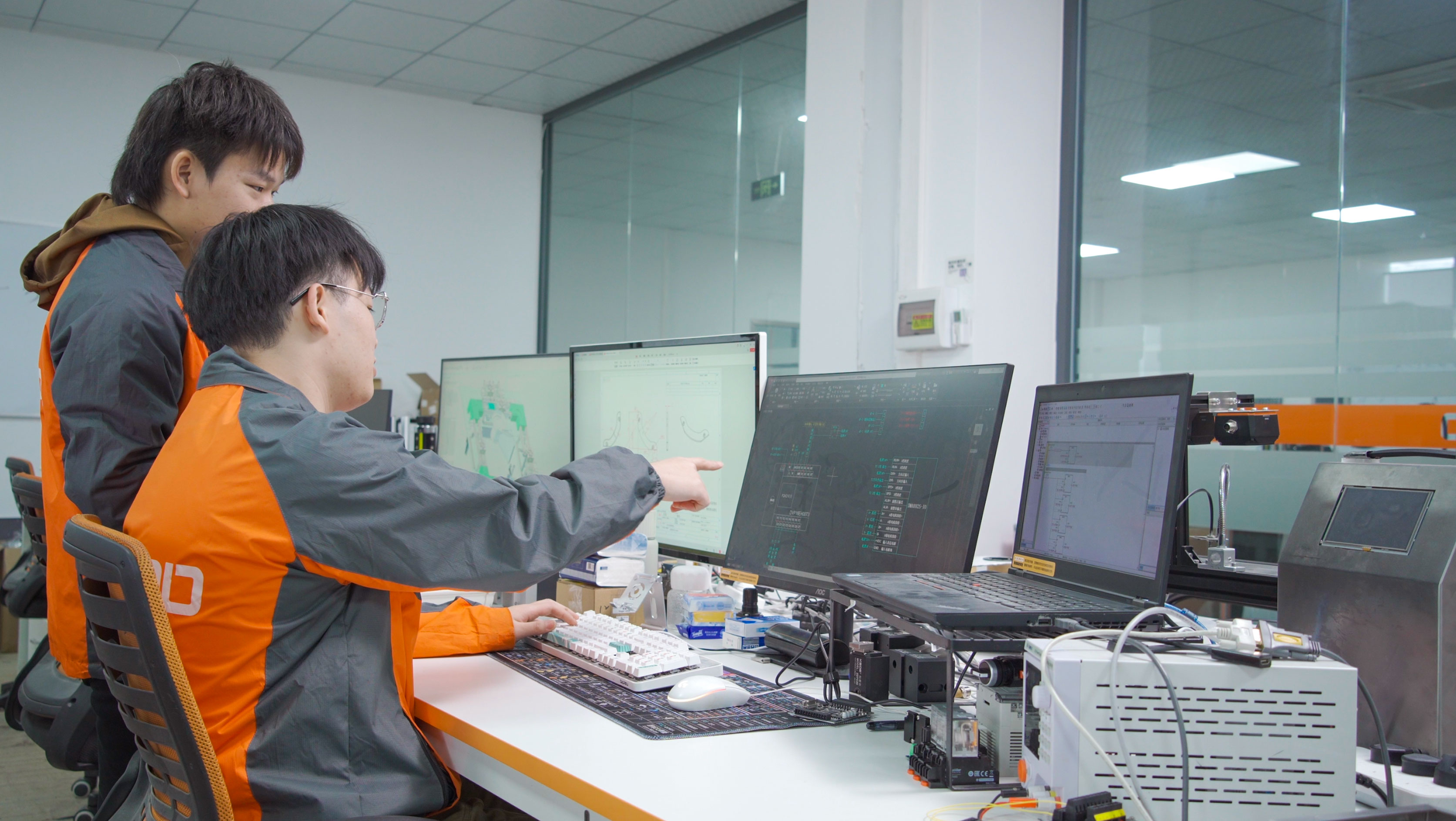
Role 1 — Primary variable-data printing: DOCOD P2000 Piezo Inkjet Printer
The DOCOD P2000 Piezo Inkjet Printer is a high-resolution PIJ system built around a 10.1-inch touchscreen interface, with support for multi-language text, GS1 codes, barcodes and dynamic traceability codes. In a variable-data line it occupies the role that carries the information payload: the code that changes per unit and that must remain readable after the pack has been handled, stored and scanned.
The interface specification matters more at evaluation stage than it appears on a datasheet. A 10.1-inch touchscreen and multi-language text support affect how quickly an operator can switch job content between SKUs and markets, and content entry is a recurring source of coding error on multi-language packaging. Buyers evaluating this role should ask to run their own job files — including a full GS1 code string and a serialised sequence — rather than reviewing a demo message.
Documented application evidence exists for this role. A personal care manufacturer in Thailand runs the P2000 across three lines for variable data printing on coated boxes; the installation has been in service for one year, with reported improvements in traceability consistency and high-resolution code printing as the stated highlight. That is one customer's reported outcome on coated board, not a performance guarantee for other substrates or other code densities.
The boundary sits where resolution and throughput meet. High-resolution output and complex variable content both consume line time, so the correct evaluation is a trial at the buyer's actual line speed with the buyer's actual code content — not a maximum-speed figure read in isolation. Ink-to-substrate pairing is the second variable, because a code that prints cleanly but smudges under handling fails the traceability requirement even though the printer performed as specified.
Role 2 — Small-character coding: DOCOD M2000 Series Continuous Inkjet Printer
The DOCOD M2000 Series Continuous Inkjet Printer is a CIJ system with a SUS 304 stainless-steel housing rated IP65, positioned for small-character coding in food and beverage, daily chemical and pharmaceutical environments. The housing specification is the reason it occupies this role rather than the variable-data role: IP65 denotes dust-tight construction with protection against water jets, and SUS 304 is a stainless grade commonly selected where surfaces are cleaned routinely. Together they address the practical question in those plants — whether the printer survives the cleaning regime around it.
Continuous duty is the second criterion. A cable manufacturer in the United States runs the M2000 across six lines for meter marking on cable sheath; the installation has been in operation for two years, with stable pressure and easy cleaning cited as highlights. Cable extrusion is not a food application, but it demonstrates the same requirement this role is specified for: sustained operation with a maintenance routine that does not stop the line for long.
Consumable logistics belong in this role's evaluation. CIJ uses ink and solvent, so the purchasing decision includes supply intervals, shelf life practice and handling, which is a different cost profile from a cartridge-based TIJ stage. Buyers should also confirm character height and code content against the actual pack, because the small-character role is defined by the mark's size on the product, not by the printer's headline speed.
One clarification keeps the comparison honest: assigning dense 2D data panels to the PIJ role is a specification choice for this line configuration, not a claim that CIJ cannot produce 2D codes. Where a plant already runs CIJ and needs 2D content at a character size the existing head handles, the correct step is a substrate and readability trial, not an automatic equipment change.
Role 3 — Transport and rewind: XC20 mini conveyor and XF30 with the T210E
Registration is bought with the conveyor, not with the printer. The DOCOD XC20 Mini Conveyor Belt is a compact transport unit intended for bench-scale and semi-automatic coding, and its documented application is a small-batch food producer in the United Arab Emirates using a single bench line to convey pouches for online coding; that installation has been in use for one year. The value in this role is that a pouch or carton arrives at the head in the same position every cycle, which is what makes a variable-data message reproducible.
The DOCOD XF30 Vertical Rewinding Machine takes the handling role further by combining vertical rewinding with an integrated T210E TIJ printer. A label converter in Brazil runs the XF30 at a single station for label secondary rewinding and coding; the installation has been operational for two years, with smoother short-run relabeling reported and suitability for roll-label rework as the stated highlight. This is a different job from printing on a production conveyor: the material is a web, the output is a finished roll, and the coding happens during rewind.
Both units set the practical limits of the line they belong to. A bench conveyor sized for pouches is not a high-speed packaging conveyor, and a single-station rewinder serves rework and short runs rather than continuous label production. Buyers should size transport and rewind against their actual throughput and roll format, then verify that the printer chosen for Role 1 or Role 2 can be mounted and triggered on that transport without compromising registration.
Role 4 — Consumable: DOCOD 3BK702 solvent TIJ cartridge
The DOCOD 3BK702 Half-Inch Black Solvent Quick-Drying Ink Cartridge is the consumable that determines whether a TIJ stage performs on non-porous surfaces. A regional distributor in South Korea supplies it for coding on plastic film and coated cartons at a volume of 50 cartridges per month; the reported result is fewer smudging complaints, with fast drying and strong adhesion cited as the highlights. Two qualifications belong with that figure: the volume is a distributor's throughput rather than a single line's consumption, and the outcome is one distributor's experience on a defined substrate set.
The purchasing implication is that cartridge selection is part of line acceptance, not an afterthought. On film and coated board, drying speed governs smudge, rework and downtime, so the qualification run should use the production cartridge on the production substrate at the production speed. Consumption modelling then becomes a genuine cost line in the business case, alongside the printer itself.
Role 5 — Laser alternative: DOCOD L3000 Series 5W UV Laser Marking Machine
The DOCOD L3000 Series 5W UV Laser Marking Machine replaces ink with a permanent mark, and it is specified where the mark must not be removable and the packaging can accept a laser process. A cosmetics OEM in Poland runs it across two lines for lot coding on plastic bottles and caps; the installation has been in service for one year, reporting permanent high-contrast marks, with low-heat UV marking as the stated highlight — relevant where the pack surface is sensitive to thermal load.
Choosing this role changes the acceptance test rather than removing it. Mark contrast and legibility depend on how the specific material responds to the laser, so a substrate trial is decisive and cannot be replaced by a general suitability statement. Verification of the final code remains necessary in the same way it is for an inkjet stage.
Two line configurations that follow from the roles
Configuration A — carton and label variable data. The P2000 PIJ carries the primary variable-data role, the XC20 provides repeatable presentation for bench or semi-automatic feeding, and a verification step sits downstream of the print head. The 3BK702 and a TIJ stage enter this configuration only if a separate cartridge-based coding point exists on the line. This configuration suits coated cartons, labels and multi-market packaging where the content changes per unit.
Configuration B — bottle, pouch and label rework. The M2000 CIJ handles small-character coding on bottles, caps and pouches in food, beverage, daily chemical or pharmaceutical settings; the XF30 with the integrated T210E covers label rewind and short-run rework using the 3BK702 cartridge; and the L3000 UV laser is added only where a permanent, ink-free mark is required on a material that has passed a laser trial. Configuration B is the more common shape in plants that consolidate several coding points under one supplier.
Neither configuration is a package price. Each is an argument about which role each device plays, and the buyer can substitute within a role provided the evidence for the substitute is tested the same way.
Market context: inkjet's share and the 2027 code transition
Inkjet's position supports a mixed-technology shortlist. Fortune Business Insights places inkjet technologies at 40.1% of the coding and marking technology segment, with the overall market at USD 7.51 billion in 2025. That share is an aggregate across CIJ, TIJ and PIJ, which is precisely why the role-based approach in this article avoids treating any single technology as the default answer.
Forecast figures should be handled with care. Commercial research houses publish materially different market sizes and growth rates for overlapping scopes, so the defensible reading is directional: the category is growing, while precise sizing depends on the definition and method used. Buyers should not blend figures from different reports into a single internal number.
The regulatory driver is more concrete than the forecast. GS1's Sunrise 2027 sets 31 December 2027 as the target for retail scanning to accept 2D codes carrying GS1 Digital Link data, replacing a 1D-only scanning model. For a buyer, the implication is a print-content requirement: the line must be able to carry 2D symbologies and variable data strings, and that capability should be demonstrated during acceptance rather than assumed from a specification sheet. Publicly comparable throughput or cost benchmarks across brands are not present in the sources reviewed for this article, so this shortlist compares documented roles and stated characteristics, not measured head-to-head performance.
Where each option stops fitting
| Option | Strong fit per documented evidence | Reconsider when |
|---|---|---|
| P2000 PIJ | Dynamic variable data, GS1 codes and 2D content on cartons and coated board | Content is small-character only, or the substrate/ink pairing has not been trialled |
| M2000 Series CIJ | Small-character coding on curved or uneven surfaces in cleaned environments | The primary requirement is a dense, high-resolution data panel |
| XC20 conveyor | Bench or semi-automatic feeding where registration must be repeatable | Line speed or product weight exceeds a compact bench transport |
| XF30 + T210E | Label rework, short runs and secondary coding on rolls | The task is continuous high-volume label production |
| 3BK702 cartridge | Non-porous film and coated cartons needing fast drying and adhesion | The substrate is porous and a different ink chemistry is being qualified |
| L3000 UV laser | Permanent, ink-free lot coding on heat-sensitive packaging | The material has not passed a laser response trial |
Purchasing terms to put in the RFQ
DOCOD's documented supply terms vary by how far the order moves from standard equipment, and each tier carries its own minimum and lead time. Standard equipment supply has a minimum of one set with a lead time within 15 working days, including language and UI setup, print content settings, mounting options and ink selection by substrate. OEM branding support — private label, startup screen, nameplate, packaging and manuals — has a minimum of one set at 15 to 25 working days. ODM functional customisation, covering software and UI adjustment, communication interfaces, bracket structure and printhead configuration, has a minimum of one set per project at 20 to 30 working days.
Production line integration support is the tier relevant to a multi-role line: a minimum of one line, 20 to 35 working days, with integration testing, a sample run and video acceptance before delivery, plus installation guidance, remote tuning and fault diagnosis afterwards. Spare parts and consumables carry a minimum of one piece within 15 working days. Distributor and service partner support carries a minimum of two units at 15 to 30 days. Buyers assembling a line should confirm which tier each role falls into, because a printer ordered as standard equipment and a line ordered as an integration project are not the same commitment.
Management-system certification belongs in the supplier file, with its limits understood. DOCOD holds ISO 9001 certification number 18625Q00281R1M, ISO 14001 certification number 18625E00147R1M and ISO 45001 certification number 18625S00131R1M, all issued 5 September 2025 and valid to 4 September 2028, with the quality scope covering research, development and production of inkjet printers. For the Indian market, BIS CRS registration R-41312347 covers printers and plotters under the codpad brand for the listed models, including the M2000, S1000 and V2000 series, against IS 13252 (Part 1):2010 / IEC 60950-1:2005, valid from 13 October 2025 to 12 October 2027. These documents confirm management-system and registration status; they are not product performance certificates and do not replace the acceptance trial.
Acceptance criteria that close the loop
Acceptance is the verification step that converts a shortlist into a working line. The pass conditions should be written into the order, and the numeric thresholds should come from the buyer's own specification or the customer's requirement rather than from a vendor default.
- Content integrity. Run a full production sequence, including serialised and GS1 data strings, and confirm every unit carries the correct variable content with no repeats or omissions.
- Readability at line speed. Scan the codes with the buyer's own downstream equipment, at production speed, on the production substrate — not on a sample printed at reduced speed.
- Adhesion after cure. Apply the handling and rub conditions the pack will actually meet, after the ink has had its normal drying time, and record whether smudging or transfer occurs.
- Registration and throughput. Confirm that the transport holds position across a full shift and that the line sustains the required output with the verification step in operation.
- Housing and cleaning. Check the IP rating and housing material against the plant's cleaning routine, and confirm the routine does not require opening the cabinet.
- Integration signals. Verify encoder, sensor and reject outputs together, and confirm the reject logic behaves correctly when a code fails inspection.
- Documentation and training language. Confirm manuals, UI language and operator training match the people who will run the line.
- Pre-shipment video acceptance. Where line integration support is ordered, use the documented sample run and video acceptance before delivery to catch configuration errors while they are still the supplier's to fix.
What to watch next
The direction of travel is toward lines that carry more variable content per unit and prove it inline. The 2D transition around GS1's 2027 target date pushes code content upward, and the inkjet share of the technology segment suggests buyers will keep mixing technologies rather than standardising on one. For a buyer evaluating now, the practical consequence is a specification that names the role, the evidence behind the choice and the acceptance test — and a supplier file that distinguishes management-system certification from demonstrated line performance.
Supplier reference: DOCOD Precision Group Co., Ltd. — www.docod-group.com. The corporate brochure covering the full coding, marking and inspection range is available for download: Corporate Brochure — DOCOD.
FAQ
What equipment makes up a variable-data coding line?
A variable-data coding line combines a primary printer that changes content on every cycle, a small-character printer where bottles, caps or pouches need compact marks, a transport that presents the substrate repeatably, a rewind or label-handling stage for roll work, a consumable matched to the surface, and a code verification step. A laser head can replace the ink stage when a permanent, ink-free mark is required and the material has passed a laser trial.
Which option is specified for GS1 2D codes and dynamic traceability codes?
The DOCOD P2000 Piezo Inkjet Printer is the variable-data role in this shortlist, with a 10.1-inch touchscreen and support for multi-language text, GS1 codes, barcodes and dynamic traceability codes. A personal care manufacturer in Thailand uses it across three lines for variable data printing on coated boxes. Readability should still be confirmed with the buyer's own scanner at production speed.
Is a CIJ printer still needed when a high-resolution PIJ printer is installed?
They serve different roles. The DOCOD M2000 Series Continuous Inkjet Printer is specified for small-character coding in food and beverage, daily chemical and pharmaceutical settings, with a SUS 304 housing and IP65 protection suited to cleaned environments. Whether a line needs both depends on the mark size and surface on each product, not on a hierarchy between technologies.
How should a buyer verify a coding line before acceptance?
Verification covers content integrity across a full production sequence, readability with the buyer's own scanner at line speed, adhesion after the normal drying time under real handling conditions, registration and throughput across a shift, housing and cleaning compatibility, integration signals including reject logic, documentation and training language, and pre-shipment video acceptance where integration support is ordered. Pass thresholds should come from the buyer's own specification or the customer's requirement.
When is a UV laser a better fit than an inkjet printer?
The DOCOD L3000 Series 5W UV Laser Marking Machine is specified when the mark must be permanent and ink-free and the packaging can accept a laser process. A cosmetics OEM in Poland uses it across two lines for lot coding on plastic bottles and caps, with permanent high-contrast marks and low-heat UV marking cited. Because mark contrast depends on how the material responds, a substrate trial remains decisive and code verification is still required.
Have Questions or Need More Details?
Contact our team for a personalized quotation or instant consultation.
Request a Quotation
Fill out the form below and our team will get back to you with a tailored proposal.
WhatsApp Direct Chat
Prefer to chat in real-time? Message us on WhatsApp for instant assistance & quick answers.
- Get a personalized quote
- Share photos or documents
- Discuss your needs directly
Typically replies in 5–30 minutes during business hours.