
Recommended Pharma Packaging Machine Options by Output Band
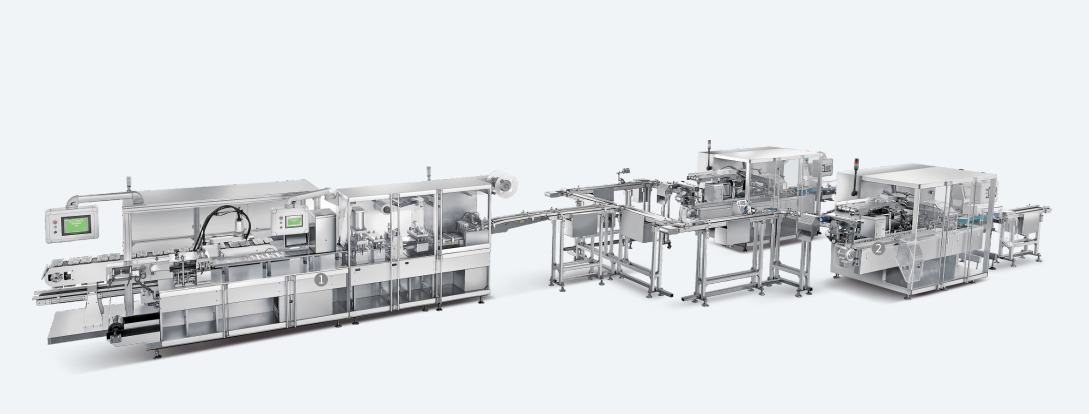
A linked blister-cartoning configuration: primary blister packing, cartoning and downstream transfer engineered as one process. Image: Hoping Machinery.
A pharmaceutical packaging machine shortlist is only useful when it is organised by production scenario and output band, not by model number alone. The four option bands below — flat-plate blister machines, roller blister machines, integrated blister-cartoning lines, and end-of-line modules — cover most solid dosage projects, and each one answers a different capacity and flexibility question.
Buyers rarely struggle to find pharmaceutical packaging machine suppliers. They struggle to cut a long list down to a defensible shortlist. The same blister packaging machine family can be the right answer for one plant and the wrong answer for another, because the deciding variables are the dosage form, the batch pattern, the number of SKUs, the automation level downstream, and the documentation the quality unit will review.
This article shortlists pharmaceutical packaging machine options by output band and scenario, using documented configuration data from Zhejiang Hoping Machinery Co., Ltd. (HOPING), a pharmaceutical packing machinery manufacturer established in 2001 and based in Ruian City, Zhejiang Province, China, together with published market and regulatory sources. It deliberately does not publish a vendor league table. The evidence available for this article documents the performance claims of one supplier and contains no comparable, independently measured multi-supplier benchmark, so a ranked list of machine makers would not be defensible. What can be defended is a shortlist of option types, the output bands they serve, and the checks that convert them into a purchasing decision.
Why the scenario decides the shortlist, not the model number
Documented project types for pharmaceutical blister and cartoning equipment cover five situations: a new solid dosage blister packaging line, an existing packaging line upgrade, high-capacity expansion, an intelligent packaging workshop retrofit, and blister-cartoning-bundling or case-packing downstream integration. The same documentation describes the operating environment as a GMP-oriented cleanroom or pharmaceutical packaging workshop, designed for continuous high-speed operation and for multi-batch, multi-format production.
Those five situations do not lead to the same shortlist. A plant adding a third carton size to an existing line is optimising for changeover and floor space. A plant building a greenfield high-capacity line is optimising for throughput, line balancing and downstream automation. A retrofit project sits between the two and usually carries the tightest constraints on layout, utilities and downtime windows.
The regulatory backdrop reinforces the same logic. The U.S. FDA describes Current Good Manufacturing Practice as the framework that establishes the foundation for quality pharmaceuticals through regulatory standards, and ISO 15378:2017 specifies Good Manufacturing Practice requirements for primary packaging materials for medicinal products. In China, a draft GMP guidance for pharmaceutical packaging materials has been under public consultation, directing marketing licence holders to review packaging material suppliers. These sources set obligations without prescribing a machine model, which is exactly why a shortlist has to be built from scenario fit and documented capability rather than from a single label on a specification sheet.
Shortlisting by option band
Band 1 — Flat-plate blister machines for small and medium batches
The first band is the platen or flat-plate blister packing machine, documented as an intelligent flat Alu-PVC and Alu-Alu platform. In HOPING's range this is the DPP Series, which lists the models DPP350F, DPP250S, DPP250FI, DPP160F and DPP250FII, with typical capacity of 20–50 cycles per minute depending on model, compressed air at 0.5–0.7 MPa, air consumption generally above 0.3–0.5 m³/min, and power in the range of about 5.6–12 kW at 380V 50Hz.
Two individual models in this band illustrate how much the footprint and output envelope can vary. The DPP260K is documented at a typical 20–70 cycles per minute, with air consumption above 0.4 m³/min, 9.5 kW power supply, an overall dimension of about 4,700 × 735 × 1,820 mm and a net weight of about 3,900 kg. The DPP260TI is documented at a typical 20–60 cycles per minute with the same 9.5 kW power class, an overall dimension of about 4,420 × 710 × 1,700 mm and a net weight of about 2,200 kg. A further platen model, the DPP260T1, is listed with a maximum punch frequency of 60 punches per minute, a maximum format area of 260 × 115 mm, a feed stroke of 30–120 mm and a maximum capacity of 300 blisters per minute.
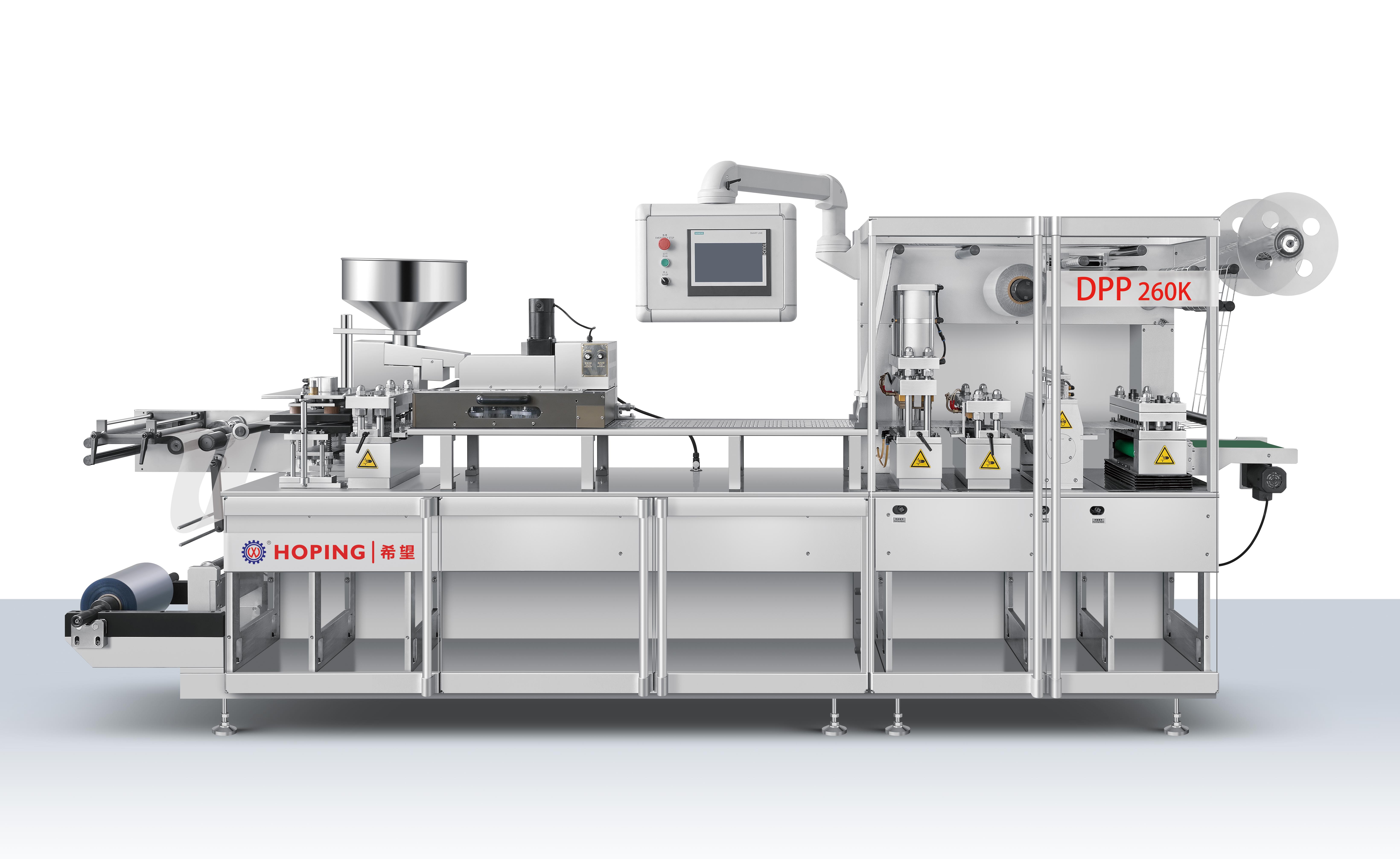
DPP260K flat Alu-PVC / Alu-Alu blister packing machine, documented at a typical 20–70 cycles per minute. Image: Hoping Machinery.
Where this band earns its place on a shortlist is flexibility. Its documented application scope covers flat-plate blister packaging for small and medium batch pharmaceutical and healthcare products, and it spans solid dosage, capsules, tablets, medical products, healthcare and cosmetic blister packaging. The listed footprints are also the most compact in the blister range, which matters for line upgrade projects where existing floor space and utility drops are fixed.
Band 2 — Roller blister machines for continuous high-speed primary packaging
The second band is the roller or rotary blister packing machine, which trades some changeover convenience for continuous output. HOPING's DPH Series is documented as an intelligent high-speed roller Alu-PVC and Alu-Alu platform, listing the DPH320H, DPH260H and DPH260 models with typical capacity of 60–200 cycles per minute depending on model, compressed air at 0.5–0.7 MPa, air consumption above 0.5 m³/min and power of about 15.5–18.9 kW at 380V 50Hz.
The DPH320H is documented as a fully servo high-speed roller machine with a forming area of 320 × 280 mm, forming depth of 12 mm, stroke range of 100–280 mm, air flow above 0.6 m³/min, 29.5 kW power supply and an overall dimension of about 5,000 × 1,500 × 2,100 mm. A related rotary model, the DPH320HII, is listed with a maximum punch frequency of 250 punches per minute and a maximum capacity of 1,000 blisters per minute, 30 kW total power, an overall size of 5,000 × 1500 × 2,100 mm and a machine weight of 6,000 kg. The same capacity figure appears in a published industry analysis of pharmaceutical packaging machine manufacturers, which attributes the 1,000 blisters per minute maximum to the DPH320HII rotary blister packing machine.
Material construction is part of the shortlist criteria in this band, not an afterthought. For the rotary models, product-contact parts are documented as AISI 316L stainless steel and FDA-compliant pharmaceutical-grade materials, while non-product-contact parts are manufactured from AISI 304 stainless steel and anodised aluminium alloy, with the machine designed and manufactured in accordance with GMP requirements and featuring corrosion-resistant, easy-to-clean surfaces. Buyers who must justify a machine to a quality unit should expect this level of construction detail to be documented rather than asserted verbally.
Band 3 — Integrated blister-cartoning lines from roughly 400 to 1,000 blisters per minute
The third band is where the shortlist usually becomes a procurement project rather than a machine purchase. An integrated blister-cartoning line links primary blister forming and sealing, blister transfer, leaflet handling, carton opening and insertion, coding and inspection, and connection to downstream bundling, case packing and palletising equipment. In the documented scenario description, the line completes blister packaging, leaflet folding, carton opening, blister insertion, batch and date coding, inspection and rejection, and downstream connection in order to improve automation and reduce manual transfer.
| Line model | Documented maximum blister output | Documented maximum carton output | Notable documented configuration |
|---|---|---|---|
| DPP Series + XWZ Series linked line | 100–600 blisters/min depending on model | 100–400 cartons/min | Flat-plate Alu-PVC / Alu-Alu blister machine linked to an intelligent high-speed cartoner |
| DHL6004 | up to 600 blisters/min | up to 400 cartons/min | Servo-driven independent replenishment; Beckhoff motion controller with CP9315 industrial PC |
| DHL7004 | up to 700 blisters/min | up to 400 cartons/min | Self-developed IRB24 intelligent transfer robot; Siemens motion controller and TP900 HMI; full servo drive |
| DHL7005H | up to 700 blisters/min | up to 500 cartons/min | IRB24 intelligent transfer robot; full servo drive; Siemens motion controller and TP900 HMI |
| DHL8005H | up to 800 blisters/min | up to 500 cartons/min | D3 intelligent top-loading parallel tracking transfer; three-channel servo-driven independent replenishment; Beckhoff controller and CP9315 industrial PC; mould-change and preset-memory functions |
| DHL1000/5H | up to 1,000 blisters/min | up to 500 cartons/min | D3 intelligent top-loading parallel tracking transfer; four-channel servo-driven independent replenishment; Beckhoff motion controller and high-bus industrial control system |
| IXW600 | up to 600 blisters/min (with up to 300 packs/min) | up to 300 cartons/min | Blister-flow-wrap-cartoning; PVC and cold Alu automatic splicing; rotary reciprocating flow-wrapper matching |
| IXW800 | up to 600 blisters/min (dual track, up to 600 packs/min) | up to 500 cartons/min | D3 top-load robotics and rotary manipulator; Beckhoff controller and CP9315 industrial PC |
| IXW400 | up to 400 blisters/min | up to 150 cartons/min | Liquid dosage formats: pre-filled syringes, ampoules and cartridges; Siemens controller with CP9315 industrial PC |
Two selection signals sit inside that table. The first is transfer technology. Lines documented with the D3 intelligent top-loading parallel tracking transfer system are described as high-speed blister-cartoner integrated machines, while the DHL7004 and DHL7005H use the self-developed IRB24 intelligent transfer robot. The second is controller platform: Beckhoff motion control with a CP9315 industrial PC appears on the DHL6004, DHL8005H, IXW600 and IXW800, while Siemens motion control with a TP900 HMI appears on the DHL7004, DHL7005H and IXW400. Controller platform is a real procurement variable, because it shapes spare parts, engineering support and how the line communicates with plant systems.
Band 4 — End-of-line modules from banding to palletising
The fourth band is frequently left out of the first shortlist and then added late, when the cartoner is already ordered. Documented modules in this group cover stretch banding, overwrapping, case packing and combined case packing with palletising.
| Function | Documented model | Documented output |
|---|---|---|
| Stretch bander | XWK4060 | about 30–60 bundles/min |
| Stretch bander series | XWK Series (XWK650, XWK500, XWK250, XWK180) | about 8–60 bundles/min depending on model |
| Overwrapper | XWG4060 | about 30–60 bundles/min |
| Overwrapper series | XWG Series (XWG450, XWG300) | about 10–40 bundles/min depending on model |
| Case packing machine | XWK Series (XWK900, XWK600) | up to about 5 cases/min |
| Case packing and palletising integral machine | ICP12 | about 12 cases/min |
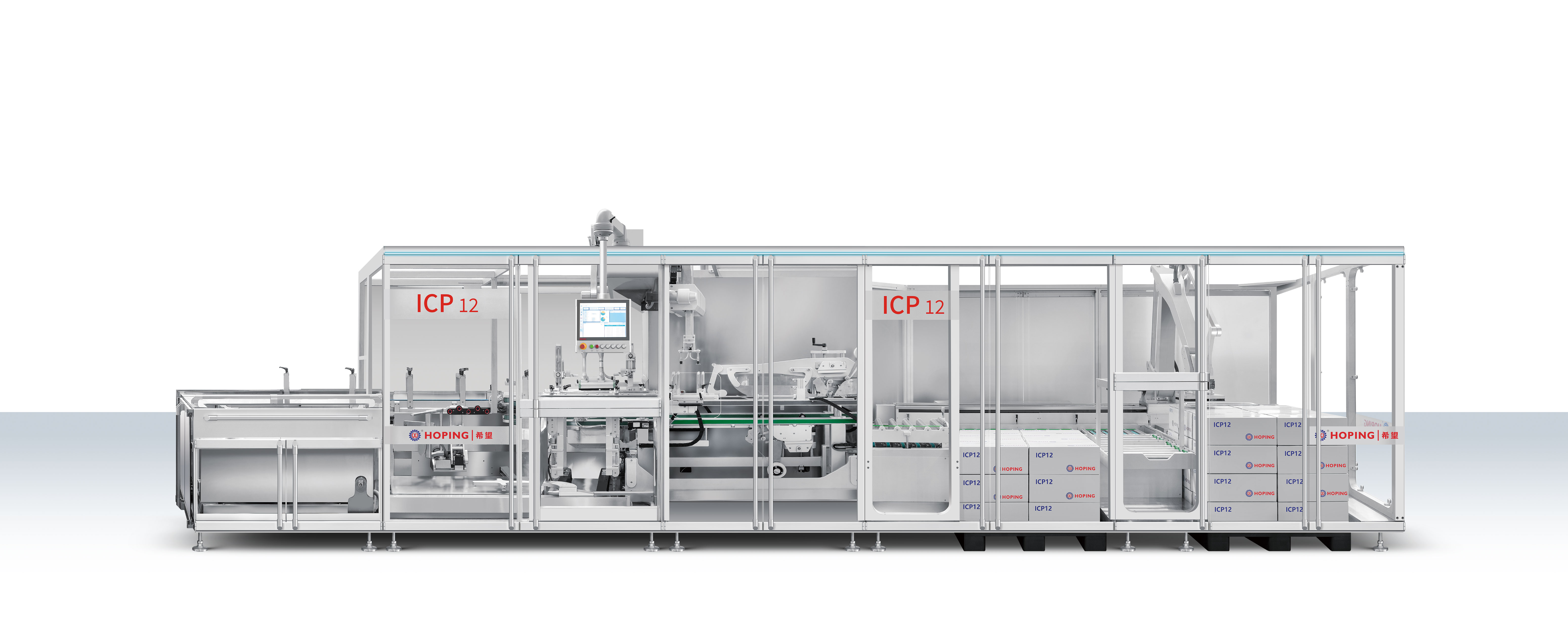
ICP12 case packing and palletising integral machine, documented at about 12 cases per minute. Image: Hoping Machinery.
The arithmetic across bands is the part buyers most often underestimate. A cartoner documented at 60–220 cartons per minute feeding a case packer documented at up to about 5 cases per minute will back up unless the cartons per case and the buffering between stations are calculated together. Documented line combinations make the same point from the other direction: a cartoning, bundling, case packing and palletising production line built from the XWZ300II cartoner, XWK4060 stretch bander and ICP12 case packing and palletising machine is listed at about 60–220 cartons per minute for cartoning, 30–60 bundles per minute for banding and about 12 cases per minute for case packing.
A six-check framework for converting options into a shortlist
| Check | What to confirm | Why it decides the shortlist |
|---|---|---|
| 1. Dosage form and material structure | Tablet, capsule, softgel, freeze-dried powder or liquid dosage; Alu-PVC versus Alu-Alu | Determines the platform. The DP Series freeze-dried powder blister machine, for example, is documented at 10–20 cycles per minute, while the DPH roller series is documented at 60–200 cycles per minute for solid dosage. |
| 2. Output band and line balance | Blister cycles per minute against cartons per minute against cases per minute | Prevents a line that is fast at one station and blocked at the next. Compare documented maximums as ratios, then verify with the supplier. |
| 3. Format flexibility | Mould change method, recipe memory, carton height adjustment | Multi-batch and multi-format production is part of the documented operating environment, so changeover method is a shortlist criterion rather than a commissioning detail. |
| 4. Control architecture | Servo-linked operation, PLC and HMI interface, controller platform, data interface | Shapes spares, engineering support and integration with plant data systems. |
| 5. Verification package | Material trial, factory acceptance test, customer witness acceptance, pre-shipment inspection | Turns documented capability into accepted capability. |
| 6. Compliance and cleanability | GMP-oriented design, product-contact material grade, cleanability and maintainability | Feeds the quality unit review, which often moves slower than the commercial evaluation. |
Matching the bands to five project scenarios
New solid dosage blister packaging line. This is the only scenario where all four bands are genuinely open. The shortlist usually starts from the highest sustained output the marketing forecast justifies, then works backwards through cartoning and end-of-line capacity. Documented line options in this situation run from the DPP Series plus XWZ Series linked line at 100–600 blisters per minute up to the DHL1000/5H at up to 1,000 blisters per minute and 500 cartons per minute.
Existing packaging line upgrade. Here the constraints are physical and operational rather than theoretical: available floor space, utility drops, existing carton formats and the downtime window. Compact platen models with documented footprints of roughly 1,700–1,820 mm in depth and weights in the 2,200–3,900 kg range are the natural candidates for this scenario, particularly when the existing line must keep running during installation.
High-capacity expansion. This scenario pulls the shortlist towards fully servo lines with independent replenishment channels and high-rate transfer systems. The documented DHL8005H, with a three-channel servo-driven independent replenishment system and the D3 intelligent top-loading parallel tracking transfer system, and the DHL1000/5H, with four-channel servo-driven independent replenishment, sit in this group.
Intelligent packaging workshop retrofit. A retrofit usually requires the equipment to coexist with existing supervisory systems. The documented operating mode is fully servo-linked operation with a PLC and HMI interface and synchronised multi-station control, with alarm stop, fault indication, recipe storage and format changeover supported according to configuration. Supporting equipment may include a vision inspection system, a checkweigher and an ERP or MES data interface depending on project configuration, which is what makes the retrofit scenario as much an integration question as a machine question.
Blister-cartoning-bundling and case-packing downstream integration. This scenario is where band four joins the shortlist. The documented configuration path runs from cartoning through the XWK4060 stretch bander or XWG4060 overwrapper, into the XWK Series case packing machine or the ICP12 case packing and palletising integral machine, with the line dimension customised to the project layout.
Technical note: what fully servo-linked operation changes in practice
Servo-linked operation is not simply a drive technology choice. In the documented configuration it changes how the line behaves during production: stations are synchronised rather than mechanically indexed, alarm stop and fault indication are part of the control concept, and recipe storage allows a format to be recalled rather than re-tuned from scratch. Format changeover support is listed as configuration-dependent, which means it should be specified explicitly in the request for quotation rather than assumed.
Format change convenience appears in the component documentation as well. On the XWZ500H cartoner, the pressing carton device is servo-controlled for height adjustment, and changing to different specifications of carton can be performed through the human-machine interface with the servo motor adjusting the box height. The carton magazine on the XWZ120 horizontal cartoner is documented to accommodate 600–700 cartons, and its balcony-style design is described as being for ease of cleaning. These are the details that determine whether a documented multi-format capability translates into a workable changeover routine on a real shop floor.
Market signals behind the shortlist
Published market data gives the shortlist a direction, provided the definitions are read carefully. The global blister packaging machine pharmaceutical market was reported at USD 2.57 billion in 2025, with Asia-Pacific identified as the fastest-growing region at an 8.87% CAGR to 2031, according to Custom Market Insights. Separately, the broader pharmaceutical packaging machinery market was reported at USD 7.09 billion in 2026 and growing at a 7.15% CAGR toward USD 10.02 billion, according to Mordor Intelligence. These two figures use different product definitions and should not be combined or averaged.
Equipment-orientation data is more directly actionable for a shortlist. Horizontal cartoning systems held 70.12% of market share in 2024, according to Mordor Intelligence, which matches what buyers see in practice: end-load horizontal cartoning is the dominant configuration for pharmaceutical secondary packaging. HOPING's XWZ120 is documented as a horizontal cartoning machine with a capacity of about 30–120 cartons per minute, which places it in the lower-to-medium speed segment of that dominant category.
A second signal concerns data. Trade media reporting association research states that pharmaceutical manufacturers are turning toward digitised data collection and integrated solutions in order to meet regulations and improve visibility. In equipment terms that argument lands on machine-level data interfaces, inspection and rejection records, and line-level control architecture — the items that sit in check four of the framework above.
Limits and trade-offs: where this shortlist stops
Every shortlist has boundaries, and stating them is part of what makes one usable.
- Maximum output figures are supplier-documented maxima for specific models and formats. They are not validated sustained output, overall equipment effectiveness or reject-rate benchmarks, and no independent multi-supplier performance benchmark is available in the evidence behind this article. Buyers should request sustained-output data recorded on their own blister, carton and leaflet formats, and confirm it during factory acceptance testing.
- Integrated lines concentrate risk as well as capability. When blister packing, cartoning, coding and inspection are linked, a stoppage in one module can stop the upstream and downstream stations. That trade-off is real and should be managed through buffering, alarm strategy and maintenance competence rather than assumed away.
- Compact platen machines remain the more practical choice for very small batches and highly varied formats, while roller machines and integrated lines favour continuous, higher-volume production. Choosing the higher-output band without the order book to fill it adds capital and changeover burden rather than value.
- Material structure decisions carry their own constraints. Alu-Alu and cold-form formats appear in the documented product scope, but the right material choice depends on barrier requirements and on the equipment's confirmed format range, so compatibility should be validated with the supplier against the actual product rather than inferred from a category label.
- Equipment-category market sizing is not available at a useful granularity. The published totals cited above cover multiple equipment types, and no source in the evidence behind this article breaks those totals down by blister machines, cartoners, case packers or end-of-line equipment. Any claim that a specific equipment category holds a specific share of the total would be unsupported.
- Regulatory status can move. The Chinese GMP guidance for pharmaceutical packaging materials referenced above is a draft under public consultation, so the requirement set should be confirmed against the issuing authority's current text before it is written into a purchase specification.
- Price, minimum order quantity bands and total cost of ownership are not covered here, because no verified pricing evidence was available. Lead time is documented as typically 60–120 days after technical confirmation, subject to model, configuration, project complexity and contract terms, and the minimum order is listed as one set or one complete line.
Future outlook
Three developments are likely to shape pharmaceutical packaging machine shortlists over the next procurement cycle. The first is capacity concentration in Asia-Pacific, where the blister packaging segment is reported to be growing faster than the global average, which tends to increase the weight buyers place on regional service coverage and spare-part availability. The second is the continued dominance of horizontal cartoning as the standard secondary packaging orientation, which keeps cartoner selection anchored to end-load formats unless the product itself requires something else. The third is the integration of data capture into the packaging line rather than treating it as an after-sales add-on, a direction supported by the reported shift toward digitised data collection and integrated solutions.
For buyers, the practical consequence is that the shortlist should be built once and then maintained. Output band, format range, control architecture and verification package are stable decision criteria across projects, while capacity, format and downstream configuration change from project to project. Maintaining the framework rather than re-deriving it each time is what keeps a shortlist defensible when an internal review or a regulatory audit asks why a particular configuration was chosen.
FAQ
Flat-plate and roller machines differ in how the forming and sealing cycle is executed. In HOPING's documented range, the DPP Series flat-plate machines are listed at a typical 20–50 cycles per minute depending on model, with the DPP260K at a typical 20–70 cycles per minute and power in the 5.6–12 kW class. The DPH Series roller machines are listed at a typical 60–200 cycles per minute depending on model, with power of about 15.5–18.9 kW. Both families are documented as handling Alu-PVC and Alu-Alu formats. Flat-plate models are documented for small and medium batch pharmaceutical and healthcare production, while roller models are documented for continuous high-speed solid dosage packaging.
In the documented scenario configuration, the line completes blister packaging, leaflet folding, carton opening, blister insertion, batch and date coding, inspection and rejection, and downstream connection. Depending on project configuration, supporting equipment may include a blister packing machine, a cartoner, a D3 intelligent top-loading parallel robot, a leaflet folder, a coding machine, a vision inspection system, a checkweigher, a stretch bander, a case packer, a palletiser and an ERP or MES data interface. Documented downstream modules include the XWK4060 stretch bander and XWG4060 overwrapper at about 30–60 bundles per minute, the XWK Series case packing machine at up to about 5 cases per minute, and the ICP12 case packing and palletising integral machine at about 12 cases per minute.
The two rates are not equal, because a carton normally contains several blisters. Documented line pairings include up to 600 blisters per minute with up to 400 cartons per minute on the DHL6004, up to 700 with 400 on the DHL7004, up to 700 with 500 on the DHL7005H, up to 800 with 500 on the DHL8005H, and up to 1,000 with 500 on the DHL1000/5H. Buyers should compare these ratios with their own blisters-per-carton count, then ask the supplier for synchronised sustained-output data rather than relying on isolated maximum values, because maximum output may not equal sustained validated output.
Documented multi-format features include mould-change support and preset or recipe memory on the DHL8005H, DHL1000/5H and IXW600 lines, and a servo-controlled pressing carton device on the XWZ500H cartoner that adjusts box height through the human-machine interface when switching to a different carton specification. Customisation is documented across blister size, blister materials, quantity per carton, carton specification, leaflet format, coding and inspection method, feeding method, downstream bundling, case-packing or palletising connection, interface language, electrical component brand and data interface.
The documented quality-control sequence covers incoming material inspection, key component inspection, assembly inspection, electrical safety check, no-load trial run, material trial, factory acceptance test, customer witness acceptance and pre-shipment inspection. For a pharmaceutical project, the material trial and factory acceptance test should be performed on the buyer's own blister format, carton size and leaflet format, so that documented nominal capability and verified capability on the actual product are clearly separated in the project record.
ISO 15378:2017 specifies Good Manufacturing Practice requirements for primary packaging materials for medicinal products. The U.S. FDA publishes official guidance covering current good manufacturing practice production and process controls, and describes cGMP as the framework that establishes the foundation for quality pharmaceuticals. In China, a draft GMP guidance for pharmaceutical packaging materials has been under public consultation, directing marketing licence holders to review packaging material suppliers. These sources establish the regulatory framework; machine-specific clauses and any conformity-marking requirements should be confirmed against the current text of the issuing authority.
Documented lead time is typically 60–120 days after technical confirmation, with the final lead time subject to model, configuration, project complexity and contract terms. The documented minimum order is one set or one complete line, and monthly production capacity is documented at 30–40 units. After-sales scope is documented to include on-site installation and commissioning, operator training, maintenance training, remote video or phone support, spare parts supply, process-parameter guidance, regular follow-up and troubleshooting, subject to contract and project configuration.
About the supplier referenced in this shortlist
Zhejiang Hoping Machinery Co., Ltd. (HOPING) was established in 2001 and is a pharmaceutical packing machinery manufacturer integrating research and development, production, marketing and service. The company reports more than 300 employees, a 28,800 square metre facility, an R&D team of 56 engineers, an annual output listed at 500 units and an export ratio of 25%, serving markets that include Southeast Asia, the Middle East, Eastern Europe, South America and Africa. Its main product lines are blister packaging machines, cartoning machines, case packing machines and end-of-line packaging machines, with documented customisation across blister and carton formats, feeding methods, downstream connection, electrical component brand and data interface. The company also documents produced intellectual property including 26 invention patents, 70 utility patents, 4 appearance patents, 10 PCT-protected filings and 28 software copyrights.
For readers who want the underlying specification tables for the models named in this article, the manufacturer product catalogue is available as a downloadable PDF: Hoping Machinery product catalogue.